
Journal of Algebra Combinatorics Discrete Structures and Applications
New Linear Codes over
GF
(3)
,
GF
(11)
, and
GF
(13)
∗
Research Article
Nuh Aydin, Derek Foret
Abstract: Explicit construction of linear codes with best possible parameters is one of the major and challenging problems in coding theory. Cyclic codes and their various generalizations, such as quasi-twisted (QT) codes, are known to contain many codes with best known parameters. Despite the fact that these classes of codes have been extensively searched, we have been able to refine existing search algorithms to discover many new linear codes over the alphabets F3, F11, andF13 with better parameters. A
total of 38 new linear codes over the three alphabets are presented.
2010 MSC:94B15, 94B60
Keywords: Best known codes, Constacyclic codes, Quasi-cyclic codes, Quasi-twisted codes
1.
Introduction
Let Fq denote the finite field withq elements (which is also denoted by GF(q)). A linear code C
of length n over Fq is a vector subspace of Fnq. Over a given finite field Fq, a linear code has three
fundamental parameters: the length n, the dimension k, and the minimum (Hamming) distance d. A code with these parameters is denoted as an[n, k, d]q-code. One of the main problems of coding theory is
a discrete optimization problem: determine the optimal values of these parameters and construct codes whose parameters attain the optimal values. Over a given finite fieldFq we can fix two of the parameters,
and look for the optimal value of the remaining one. For example,dq[n, k]stands for the largest minimum
distance of a linear code of lengthnand dimensionkoverFq. This optimization problem is very difficult.
In general, it is only solved for the cases where either k or n−k is small. There is a database of best known linear codes [14] over small finite fields which is a major source of reference for coding theory researchers.
While there exist theoretical upper bounds on the value of dfor a givenn and k, in general there do not exist explicit constructions for linear codes attaining these parameters. A code is called “good" if it has best known parameters; it is called “new" or “record-breaking" if its parameters are better than
∗
This research was partially supported by Kenyon Summer Science Scholars program.
the currently best known codes; and called “optimal" if its parameters attain the equality in a theoretical bound. The good codes are also referred to as the best known linear codes (BKLCs). The database [14] of BKLC’s includes the parameters of best known codes together with their constructions over finite fields up to size 9. Computer algebra system Magma also contains a similar database [8]. More recently, tables of best known codes overGF(11)andGF(13)have been published in [10] and [9].
The majority of the BKLCs do not attain the theoretical upper bounds on minimum distance. Therefore, it is still possible to improve the parameters of BKLCs. It should be noted however that it may not always be possible to attain the theoretical upper bound on the minimum distance for a given length and dimension.
Computers are often used in searching for codes with best parameters but there is an inherent difficulty: computing the minimum distance of a linear code is computationally intractable (NP-hard)[17]. Since it is not possible to conduct exhaustive searches for linear codes if the dimension is large, researchers often focus on promising subclasses of linear codes with rich mathematical structures. The class of cyclic codes and its various generalizations, such as constacyclic codes, cyclic (QC) codes, and quasi-twisted (QT) codes, lend themselves well to the problem of finding codes with good parameters. Many record-breaking codes have been obtained in the class of QC codes in the last few decades ([1–3,5–7,11–
13, 15,16]). These are the codes we consider in this paper. The search algorithm introduced in [6] has been highly effective and used in several subsequent works (e.g., [1–3,5,7, 12, 13]).
We begin by reviewing the structure of constacyclic and QT codes and then describe how we imple-mented an improved version of the search algorithm that was used in previous works to search for new linear codes. We conclude with a list of new record breaking codes over the fieldsF3,F11, and F13with
generators and other necessary information to construct them.
2.
Constacyclic search method
A linear code C overFq that is closed under a constacyclic shift is called a constacyclic code, that
is, if (c0, c1, . . . , cn−1)∈C, then(a·cn−1, c0, c1, . . . , cn−2)∈C as well. Here, a∈F∗q is a non-zero field
element, and it is called the shift constant. The important special case of cyclic codes are obtained when we take a= 1.
It is well known that constacyclic codes are ideals inFq[x]/hxn−aiif we represent their elements as
polynomials, and that each constacyclic codeC contains at least one polynomial that generates it as an ideal. While generating polynomials are not unique, the monic generator polynomial of least degree is. This is what we call the generator polynomialg(x)ofC. It is also well known thatg(x)is the generator polynomial for a constacyclic code of lengthnwith shift constantaif and only ifg(x)dividesxn−a, i.e.
xn−a=g(x)h(x)for some h(x)∈
Fq[x]/hxn−ai. Hence, there is a one-to-one correspondence between
the divisors ofxn−aand the constacyclic codes of lengthnwith shift constanta. The polynomialh(x)
is called the check polynomial of C. A constacyclic code is therefore uniquely determined by either its generator polynomial or its check polynomial. From the generator polynomialg(x) =g0+g1x+· · ·+gmxm
of a constacyclic codeC we obtain its generator matrix as a circulant (twistulant) matrix
g0 g1 · · · gm 0 · · · 0
0 g0 g1 · · · gm 0· · · 0
. . .
0 . . . 0 g0 g1 · · · gm
where each row is the cyclic (constacyclic) shift of the row above.
Using the computational algebra system Magma, we are able to factor xn −a and compute the
minimum distancedof all constacyclic codes generated by the divisors ofxn−a. We follow the method
We first consider cyclic codes with length-dimension pairs for which lower bounds are available (found in either [14], [10], or [9]). We are then able to reduce the number of constacyclic codes to be examined by using the following theorems.
Theorem 2.1. [6] Leta∈Fq where a=ωi for some primitive elementω in Fq. Then, ahas an n-th
root in Fq if and only if gcd(n, q−1)|i.
Theorem 2.2. [6] If Fq contains an n-th root of a, then a constacyclic code with length n and shift
constant ais equivalent to a cyclic code of length n.
The above two theorems immediately lead to the following corollary:
Corollary 2.3. Let ω be a primitive element of Fq and let a = ωi for some positive integer i. If
gcd(n, q−1)|ithen a constacyclic code with lengthnand shift constantais equivalent to a cyclic code of lengthn.
Therefore, once we examine all cyclic codes of length n over Fq, we do not need to examine
con-stacyclic codes of length nfor shift constant a=ωi ifgcd(n, q−1)|i, as the resulting constacyclic code
is equivalent to a cyclic code that we have already computed and equivalent codes have the same pa-rameters. Of the remaining constacyclic codes with shift constant a6= 1, some of them turn out to be equivalent to each other. The next theorem specifies which shift constants still need to be examined once all cyclic codes are computed.
Theorem 2.4. [6] Leta, bhave the same order in the multiplicative groupF∗q and letCabe the constacyclic
code [n, k, d]q with shifta. Then there exists a constacyclic code Cb that is equivalent toCa.
Given the theorem above, we classify the elements ofF∗q according to their multiplicative orders and
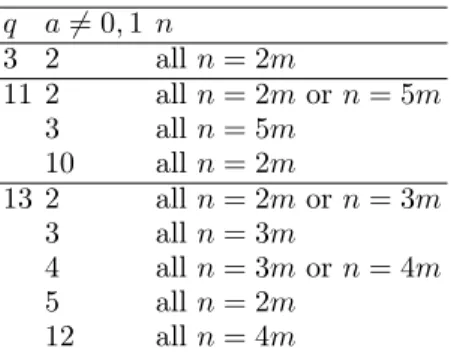
examine only one constant from each class. The following table combines the results of Corollary2.3and Theorem 2.4to show which constacyclic codes of length nand shift constanta still need to be checked after computing all cyclic codes. Any constacyclic code with parameters not found in the table would be equivalent to a cyclic or a constacyclic code.
Table 1. Constacyclic codes searched
q a6= 0,1 n
3 2 alln= 2m
11 2 alln= 2mor n= 5m
3 alln= 5m
10 alln= 2m
13 2 alln= 2mor n= 3m
3 alln= 3m
4 alln= 3mor n= 4m
5 alln= 2m
12 alln= 4m
Two parts of our search method that have the largest impact on the running time are the number factors of xn−aconsidered and the time to compute the minimum distance of each code generated by a divisor ofxn−a. Whenxn−ahas many factors, we only consider a predetermined amount of factors of xn−a for each degree. We also allocate a maximum computation time for each minimum distance
3.
Quasi-twisted search method
Quasi-twisted (QT) codes are a generalization of constacyclic codes.
Definition 3.1. Let πa denote the constacyclic shift operator. A linear code C is said to be `- quasi-twisted (`-QT) if it is invariant under π`
a, where ` is some positive integer which divides the length of
the code. That is, if (c0, c1, . . . , cn−1)∈C, then(acn−`, . . . , acn−1, c0, c1, . . . , cn−`−1)∈C as well.
The class of QT codes contains several other classes as special cases. When a = 1, we obtain the class of quasi-cyclic (QC) codes, when ` = 1 the class of constacyclic codes, and when a = ` = 1, the class of cyclic codes. Algebraically, a QT code of length n = ml is an R-submodule of R` where
R=Fq[x]/hxm−ai. A generator matrix of a QT code can be obtained in the form
G1,1 G1,2 . . . G1,`
G2,1 G2,2 . . . G2,`
..
. ... . .. ...
Gr,1 Gr,2 . . . Gr,`
where eachGi,j is a twistulant matrix. Such a code is called anr-generator QT code. Most of the work
on QT codes is focused on the 1-generator case. We also consider 1-generator QT codes in the paper.
A method of constructing QT codes from constacyclic codes is based on the following theorem [6].
Theorem 3.2. [3,6] Let C be a 1-generator QT code of length n=m` overFq with a generator of the
form
(g(x)f1(x), g(x)f2(x), . . . , g(x)f`(x))
where xm−a=g(x)h(x)and(h(x), fi(x)) = 1for all i= 1, . . . , `. Thendim(C) =m−deg(g(x)), and
d(C)≥`·dwheredis the minimum distance of the constacyclic code generated byg(x).
Search methods based on this theorem have been implemented in a number of articles and many record-breaking codes have been obtained [1–3,5, 7, 12, 13]. We continue this line of work by refining the search method even further. We build up QT codes from the best constacyclic codes obtained in the first stage. To do so, we take the generator polynomial g(x) of one of the [m, k, d]q constacyclic codes
and construct a QT code of index `with generating polynomial of the form
(g(x), f1(x)g(x), f2(x)g(x), . . . , f`(x)g(x))
so thatn=m`, the length of the QT code, does not exceed the maximum lengths of codes found in the databases. Polynomialsfi(x)that are relatively prime to the check polynomialh(x) = (xm−a)/g(x)are
randomly chosen from the elements ofFq[x]/hxm−aiwithdeg(fi(x))<deg(h(x)).
The generator polynomial of the best constacyclic code for every length/dimension pair that our constacyclic search found is used for as many values of ` as possible. Unlike in our constacyclic search, where one program examines numerous factors of xn−a, our QT search programs examine only one
factor of xm−a at a time; that is, the given generator polynomialg(x). As the dimension of an`-QT
4.
New codes
4.1.
New constacyclic codes
The following are the parameters of new record breaking constacyclic codes. For each code we give its shift constant a, the parity check polynomialh, andw, the improvement on the minimum distance. The parity check polynomial is given in place of the generator polynomial g(x)due to considerations of space. The coefficients of the parity check polynomial are listed in ascending order. Thus, the parity check polynomial for the first code in the table ish(x) = 10 +x+ 7x2+ 9x3+ 2x4+ 4x5+ 10x6+x7.
Table 2. Record-breaking GF(11)and GF(13)constacyclic codes
[n, k, d]q a h w
[111,7,93]11 1 [10,1,7,9,2,4,10,1] 4
[133,7,109]11 1 [10,9,4,6,5,7,2,1] 1
[157,6,136]13 1 [1,0,7,12,7,0,1] 3
[170,5,150]13 1 [1,2,5,5,2,1] 1
[183,6,159]13 3 [9,6,5,10,11,2,1] 2
[244,6,213]13 1 [5,7,12,5,12,2,1] 3
4.2.
New quasi-twisted codes
The following are the parameters of new record breaking QT codes together with their generators. The shift constantsaof the original constacyclic codes along with index`are also given. Each`-QT code is generated by a matrix of the form[G1, G2, . . . , G`]whereG1 is the generator matrix of a constacyclic
code with generator polynomialg(x), and each one of the remainingGi is a twistulant matrix defined by
g(x)fi(x) mod (xn−a), wherefi(x)∈Fq[x]/hxn−aiis relatively prime with the check polynomial. To
identify each new code, we have also given g(x) (orh(x) depending on space as above) as well as each
fi(x). All of these codes have been included in the database [8].
We have special comments for 3 of the codes in the list. We found the code with parameters [150,22,67]3 in the summer of 2015. Later we found a [150,22,68]3 code using a more comprehensive
search strategy in the summer of 2018 [4]. For the code with parameters[105,28,37]overF3, an alternative
construction that involves many steps is given in [14] 1. Since our construction is more direct, hence
preferable, we include this code in the list. The same is the case for the[108,19,48]3-code in the list. It is
possible that additional new codes might be obtained from these by applying the standard constructions such as extending, shortening, and puncturing.
1
Table 3. Record-Breaking QT codes overGF(3)and GF(11).
[n, k, d]q α ` polynomials
[22,7,14]11 1 2 g [1,7,6,7,1]
f1 [2,7,4,1,3,10]
[44,5,35]11 1 4 g [1,5,4,2,4,5,1]
f1 [9,1,1,4,8]
f2 [9,3,10,3,9]
f3 [7,6,0,8,3]
[105,7,84]11 1 3 h [7,0,2,7,9,2,10,1]
f1 [10,0,2,1,9,10,4]
f2 [4,9,2,9,1,7,1]
[140,7,114]11 1 4 h [7,0,2,7,9,2,10,1]
f1 [5,10,3,9,7,4,10]
f2 [6,10,6,3,2,6,1]
f3 [8,3,8,9,1,1,10]
[180,7,149]11 1 3 h [6,9,9,9,4,6,2,1]
f1 [4,9,8,5,0,5]
f2 [8,5,1,4,9,6,6]
[222,7,187]11 1 2 h [10,1,7,9,2,4,10,1]
f1 [0,5,9,7,7,0,9]
[54,17,21]3 1 3 g [11]
f1 [02100011120022022]
f2 [1120000001110211]
[72,19,28]3 1 3 g [211211]
f1 [2220112222001220221]
f2 [022010100001221121]
[72,23,25]3 1 3 g [11]
f1 [01122221012112210211222]
f2 [11100101010100221020221]
[96,22,38]3 1 4 g [121]
f1 [2000000000202101001122]
f2 [222012220001011221112]
f3 [121020102210122001022]
[96,23,37]3 1 4 g [11]
f1 [21120000122222112010021]
f2 [21011202100201022220122]
f3 [0012021200000220121121]
[108,23,43]3 1 4 g [12021]
f1 [20011120102211120210221]
f2 [10100220002102121101201]
f3 [21201210011020112222011]
[60,21,21]3 1 2 g [1201221021]
[60,23,19]3 1 2 g [11122111]
f1 [0020111110201210001122]
[99,25,37]3 1 3 g [112020201]
f1 [2211100112220202001001102]
f2 [0222112121210222002101221]
[99,26,36]3 1 3 g [21220011]
f1 [21222102220010010101000122]
f2 [101020102111000111001201]
[70,18,28]3 1 2 g [211210212200020101]
f1 [2211102102202212]
[70,22,25]3 1 2 g [22012112222121]
f1 [0212020110210011112001]
∗[150,22,67]3 1 5 g [200201001]
f1 [201010011201220212022]
f2 [2011010222200200112]
f3 [2100200100212110012201]
f4 [0201221221220110212101]
∗[105,28,37]3 1 3 g [20000001]
f1 [022221201110020200110110102]
f2 [1102100001000202101200221212]
∗[108,19,48]3 1 3 g [220121102102212011]
f1 [0020100200212000022]
f2 [110122020011221022]
[111,19,50]3 1 3 g [1020220100010220201]
f1 [2221211012111220022]
f2 [1001122120001122121]
[156,23,70]3 1 4 g [12112222110200211]
f1 [11002122111110022021221]
f2 [0110010122211021001021]
f3 [01122011220011011020211]
[80,21,31]3 1 2 g [22001100011012102021]
f1 [12021022220212212121]
[200,21,98]3 1 5 g [22001100011012102021]
f1 [0200012220000112202]
f2 [022200002211101112011]
f3 [22002101002112110211]
f4 [201000120020000002]
[132,22,58]3 1 3 g [12200202120210211201011]
f1 [0000112102010210210212]
f2 [0112112020201110011222]
[176,22,84]3 1 4 g [12200202120210211201011]
f1 [2100210110120022211222]
f2 [0001102221222001011022]
f3 [0220001200100220201221]
[104,25,41]3 1 2 g [1110022112022011221200212111]
[104,28,37]3 1 2 g [2020210012121010221210211]
f1 [1001022102211210110102110112]
[112,22,48]3 1 2 g [20202120101202010212102101201200011]
f1 [0212012112010121220002]
[201,22,98]3 1 3 g [2201102112100222011112211222201110021221022011]
f1 [002012112212211210222]
f2 [0110100221011221001122]
[140,26,58]3 1 2 g [122102210220022121110112021222210021022102211]
f1 [021001020200200211002001]
References
[1] R. Ackerman, N. Aydin, New quinary linear codes from quasi–twisted codes and their duals, Appl. Math. Lett. 24(4) (2011) 512–515.
[2] N. Aydin, N. Connolly, J. Murphree, New binary linear codes from quasi–cyclic codes and an aug-mentation algorithm, Appl. Algebra Eng. Commun. Comput. 28(4) (2017) 339–350.
[3] N. Aydin, N. Connolly, M. Grassl, Some results on the structure of constacyclic codes and new linear codes overGF(7)from quasi–twisted codes, Adv. Math. Commun. 11(1) (2017) 245–258.
[4] N. Aydin, J. Lambrinos, O. VandenBerg, On equivalence of cyclic codes, generalization of a quasi– twisted search algorithm, and new linear codes, in submission.
[5] N. Aydin, J. M. Murphree, New linear codes from constacyclic codes, J. Frankl. Inst. 351(3) (2014) 1691–1699.
[6] N. Aydin, I. Siap, D. K. Ray-Chaudhuri, The structure of 1–generator quasi–twisted codes and new linear codes, Des. Codes Cryptogr. 24(3) (2001) 313–326.
[7] N. Aydin, I. Siap, New quasi–cyclic codes overF5, Appl. Math. Lett. 15(7) (2002) 833–836.
[8] W. Bosma, J. J. Cannon, C. Playoust, The Magma algebra system I: The user language, J. Symbol. Comput. 24(3–4) (1997) 235–265.
[9] E. Z. Chen, N. Aydin, A database of linear codes overF13 with minimum distance bounds and new
quasi–twisted codes from a heuristic search algorithm, J. Algebra Comb. Discrete Appl. 2(1) (2015) 1–16.
[10] E. Z. Chen, N. Aydin, New quasi-twisted codes over F11–minimum distance bounds and a new
database, J. Inform. Optim. Sci. 36(1–2) (2015) 129–157.
[11] E. Z. Chen, Six new binary quasi–cyclic codes, IEEE Trans. Inform. Theory 40(5) (1994) 1666–1667. [12] R. Daskalov, P. Hristov, New binary one–generator quasi–cyclic codes, IEEE Trans. Inform. Theory
49(11) (2003) 3001–3005.
[13] R. Daskalov, P. Hristov, E. Metodieva, New minimum distance bounds for linear codes over GF(5), Discrete Math. 275(1-3) (2004) 97–110.
[14] M. Grassl, Code Tables: Bounds on the minimum distance of linear codes and quantum codes, online, http://www.codetables.de/
[15] T. A. Gulliver, V. K. Bhargava, New good rate (m−1)/pm ternary and quaternary quasi–cyclic codes, Des. Codes Cryptogr. 7(3) (196) 223–233.
[16] I. Siap, N. Aydin, D. K. Ray–Chaudhuri, New ternary quasi–cyclic codes with better minimum distances, IEEE Trans. Inform. Theory 46(4) (2000) 1554–1558.
![Table 3. Record-Breaking QT codes over GF (3) and GF (11). [n, k, d] q α ` polynomials [22, 7, 14] 11 1 2 g [1,7,6,7,1] f 1 [2,7,4,1,3,10] [44, 5, 35] 11 1 4 g [1,5,4,2,4,5,1] f 1 [9,1,1,4,8] f 2 [9,3,10,3,9] f 3 [7,6,0,8,3] [105, 7, 84] 11 1 3 h [7,0,2,7,](https://thumb-us.123doks.com/thumbv2/123dok_us/7935684.2109711/6.892.207.678.241.1181/table-record-breaking-qt-codes-gf-gf-polynomials.webp)
