Emerging Business Models: Freestanding Emergency Rooms Alan A. Ayers, MBA, MAcc
Content Advisor, Urgent Care Association of America Vice President, Concentra Urgent Care
Despite reports of the nation’s “physician shortage,” the number of convenient health care options accessible to many consumers continues to grow and includes not just urgent care centers but also retail-host clinics, walk-in family practice offices, hospital emergency fast-tracks, and pediatric after-hours facilities. Rising demand for health care—fueled by aging baby boomers, lifestyle-induced illness, and the promise of greater insurance coverage under health care reform— is leading hospitals, payers, physicians and entrepreneurs to respond to consumer needs with new and innovative delivery models. One such emerging model is the “freestanding emergency room.”
Freestanding Emergency Room Operating Model Defined
Freestanding emergency centers, depicted in Figure 1.0, are walk-in medical facilities—structurally separate and distinct from a hospital—which hold themselves out to provide emergency care to the general public. Like hospital emergency departments, freestanding ERs are fully-equipped to diagnose and stabilize cardiac arrest, stroke symptoms, breathing problems and trauma, however, ambulances do not bring patients to the center and patients requiring hospital admission, surgery or specialist care are transferred by paramedic to a higher-acuity facility.
Figure 1.0: Retail positioning of Emerus 24-Hour Emergency Room, Houston, Texas
Freestanding ERs—which are present in about 16 states—are operated by hospitals, physicians, and non-physician entrepreneurs. Just as there is variance in the capabilities and offerings of urgent care centers, the operating model of freestanding emergency centers also varies depending on the ownership, location and size, competition, and target patient demographics of the facility.
Although they market themselves as “full service emergency rooms,” the biggest differences between freestanding ERs and hospital EDs generally pertain to:
• Capacity and volume
o Average metropolitan hospital ED sees 100-150 patients per day o Freestanding ER can break even at 35-40 patients per day
• Ambulance service
o 16% of all hospital ED patients arrive by ambulance o EMS typically does not serve freestanding ERs • Hospital admission rates
o 15-20% in hospital EDs o 3-5% at freestanding ERs • Length of stay
o 3 hours and longer in hospital EDs o 60-90 minutes at freestanding ERs • Patient acuity
o Higher acuity at hospital EDs due to trauma center certification, surgical and intensive care capabilities, and ambulance diversion and transfer
o Low to moderate acuity due to self-triaged, ambulatory patients at freestanding ERs • Positioning and accessibility relative to Medicaid and indigent poor populations
o Urban legacy hospital campus for hospital ED o Affluent, suburban retail areas for freestanding ERs
Considering these differences, one may speculate that freestanding ERs have more in common with urgent care centers than with hospital EDs. However, what differentiates freestanding ERs from urgent care is what the freestanding ERs do
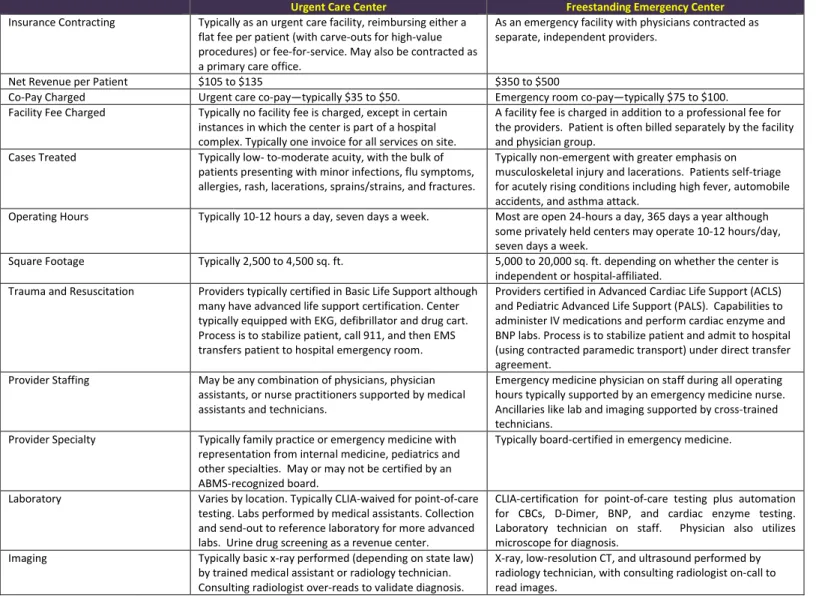
have in common with hospital EDs—24 hour/365 day operations, insurance contracting as an ER including ER co-pay charged, separate facility and professional fees charged, staffing by emergency physicians and nurses, and advanced lifesaving, imaging and laboratory capabilities. Table 1.0 details common differences between freestanding ERs and conventional urgent care centers.
Table 1.0: Generally, freestanding ERs differ from urgent care centers in the following ways:
Urgent Care Center Freestanding Emergency Center
Insurance Contracting Typically as an urgent care facility, reimbursing either a flat fee per patient (with carve-outs for high-value procedures) or fee-for-service. May also be contracted as a primary care office.
As an emergency facility with physicians contracted as separate, independent providers.
Net Revenue per Patient $105 to $135 $350 to $500
Co-Pay Charged Urgent care co-pay—typically $35 to $50. Emergency room co-pay—typically $75 to $100.
Facility Fee Charged Typically no facility fee is charged, except in certain instances in which the center is part of a hospital complex. Typically one invoice for all services on site.
A facility fee is charged in addition to a professional fee for the providers. Patient is often billed separately by the facility and physician group.
Cases Treated Typically low- to-moderate acuity, with the bulk of
patients presenting with minor infections, flu symptoms, allergies, rash, lacerations, sprains/strains, and fractures.
Typically non-emergent with greater emphasis on musculoskeletal injury and lacerations. Patients self-triage for acutely rising conditions including high fever, automobile accidents, and asthma attack.
Operating Hours Typically 10-12 hours a day, seven days a week. Most are open 24-hours a day, 365 days a year although
some privately held centers may operate 10-12 hours/day, seven days a week.
Square Footage Typically 2,500 to 4,500 sq. ft. 5,000 to 20,000 sq. ft. depending on whether the center is
independent or hospital-affiliated. Trauma and Resuscitation Providers typically certified in Basic Life Support although
many have advanced life support certification. Center typically equipped with EKG, defibrillator and drug cart. Process is to stabilize patient, call 911, and then EMS transfers patient to hospital emergency room.
Providers certified in Advanced Cardiac Life Support (ACLS) and Pediatric Advanced Life Support (PALS). Capabilities to administer IV medications and perform cardiac enzyme and BNP labs. Process is to stabilize patient and admit to hospital (using contracted paramedic transport) under direct transfer agreement.
Provider Staffing May be any combination of physicians, physician
assistants, or nurse practitioners supported by medical assistants and technicians.
Emergency medicine physician on staff during all operating hours typically supported by an emergency medicine nurse. Ancillaries like lab and imaging supported by cross-trained technicians.
Provider Specialty Typically family practice or emergency medicine with representation from internal medicine, pediatrics and other specialties. May or may not be certified by an ABMS-recognized board.
Typically board-certified in emergency medicine.
Laboratory Varies by location. Typically CLIA-waived for point-of-care
testing. Labs performed by medical assistants. Collection and send-out to reference laboratory for more advanced labs. Urine drug screening as a revenue center.
CLIA-certification for point-of-care testing plus automation for CBCs, D-Dimer, BNP, and cardiac enzyme testing. Laboratory technician on staff. Physician also utilizes microscope for diagnosis.
Imaging Typically basic x-ray performed (depending on state law)
by trained medical assistant or radiology technician. Consulting radiologist over-reads to validate diagnosis.
X-ray, low-resolution CT, and ultrasound performed by radiology technician, with consulting radiologist on-call to read images.
Freestanding Emergency Room Patient Demographics
Houston, Texas—the nation’s fourth largest metropolitan area with a population of over 6,000,000 people covering 1,200 square miles—is currently a “hotbed” of freestanding emergency center activity. In recent years, Houston-based hospitals, physician groups and entrepreneurs have opened nearly 35 freestanding emergency centers in the region, a quarter of which are hospital-affiliated.
Evaluating the residential demographics around freestanding ERs in Greater Houston demonstrates the centers are not located to serve the Medicaid and indigent populations who depend on the “safety net” of urban hospital emergency rooms. Rather, as detailed by Table 2.0, the typical freestanding ER site is a high-traffic, high-visibility retail strip serving well-established, high-income, high density residential areas.
Table 2.0: Demographic Comparison of Houston-area Freestanding Emergency Rooms to the Community as a Whole
24-Hour ER Center 1 Mile Radius
Houston, Texas Combined Statistical Area
Residential Density
Population per Sq. Mile 4,740 1,395
Households per Sq. Mile 1,771 484
Household Structure
% Married Household w/
Children Present 29% 31%
% Single Female Household w/
Children Present 5% 18%
Ethnicity/Race
% Hispanic 22% 35%
% African American 7% 17%
Household Income
Median Household Income $88,686 $54,146
% Households w/ Income Less than $30k 16% 23% % Households w/ Income Greater than $100k 46% 24% Employment Density
Employment per Sq. Mile 3,121 653
Businesses per Sq. Mile 186 31
True to a more affluent consumer base, Figure 3.0 illustrates that Houston-area emergency centers tend to be “up-market” in their branding and facility décor with luxury furnishings, granite countertops, free wireless Internet access, exam room cable television, gourmet coffee and refreshment bars, children’s play areas and pediatric-themed rooms. The experience is more reminiscent of a “day spa” than a cold, sterile hospital ED.
Given locations and facilities that appeal to upper-income consumers, a conclusion may be reached that time-starved professionals with employer-paid insurance are undeterred by emergency room co-pays if theybelieve a freestanding ER has shorter wait times, more sophisticated capabilities, and better qualified providers than other options, including urgent care centers—regardless of whether such capabilities are needed for their conditions, or whether their
perceptions are even reality.
Factors Driving the Freestanding Emergency Room Phenomenon
In addition to an affluent, educated, professional population, three other factors are driving the freestanding ER
business in Houston—a central concentration of the medical community, geographical dispersion of residents, and rapid population growth.
Houston is home to the Texas Medical Center, the nation’s largest integrated health complex with 49 world-class research institutions, 14 hospitals, and two medical schools—including the Texas Heart Institute, M.D. Anderson Cancer Center, and Baylor College of Medicine. But because so much of Houston’s medical community is concentrated in one
area, hospitals have turned to ambulatory strategies to serve patients and capture referrals from the geographically dispersed suburbs. Freestanding ERs provide a convenient entry point to a hospital’s specialists without the risk of building and staffing a suburban hospital.
Figure 3.0: Left: Elite Care 24-Hour Emergency Center, Houston, Texas; Right: Texas Emergency Care Center, Pearland, Texas
Federal and State Law
The Emergency Medical Treatment and Active Labor Act (EMTALA) requires that hospitals participating in government health programs (Medicare, Medicaid and/or Tricare) provide emergency medical treatment to any presenting patient, regardless of ability to pay. Generally a hospital’s obligation under EMTALA is to provide an evaluation as to whether an emergent condition exists; if an emergent condition does exists, to provide treatment until that condition stabilizes; and last, to transfer patients to an appropriate specialized facility if care is required beyond the hospital’s capabilities. A freestanding emergency center that is affiliated with a hospital and accepts Medicare and/or Medicaid is generally subject to EMTALA while an independently owned facility may forego the federal requirement by opting out of the government insurance schemes.
In addition to federal regulations, many states have laws that altogether prohibit, restrict the activities, or require licensure of freestanding ERs. For example, the State of Texas passed legislation in 2011 requiring licensure of freestanding emergency centers that regulates operating hours, facility attributes, and contains a provision for treatment similar to EMTALA:
A facility shall provide to each facility patient, without regard to the individual's ability to pay, an appropriate medical screening, examination, and stabilization within the facility's capability, including ancillary services routinely available to the facility, to determine whether an emergency medical condition exists and any necessary stabilizing treatment.
This means that in Texas, a freestanding ER that chooses not to bill Medicare or Medicaid must still evaluate all patients for an emergency condition (and stabilize those presenting with an emergency) regardless of ability to pay. This is a different standard than urgent care centers which can generally turn away patients who are unable or unwilling to pay.
Growth of the Freestanding Emergency Room Business Model
In Texas and elsewhere, freestanding ERs are popping up like wildflowers. In July, 2011, St. David’s Health System opened its first 24/7 freestanding ER at the opulent Hill Country Galleria in Bee Cave, Texas—a professional, growing
suburban area 10-15 miles West of Austin that does not yet have sufficient population density to support a new
hospital. To facilitate transfers and referrals, the freestanding ER facility shares the same patient information systems as other St. David’s hospitals throughout the region.
Meanwhile, in December, 2011, Baptist Health in San Antonio opened the first of five planned shopping center emergency facilities that will flank the North freeway loop’s “wealth belt.” Operating under a management services agreement with Emerus—which has its own branded freestanding ERs in Houston and Dallas/Ft. Worth—the objective is to expand Baptist’s footprint, increase referrals, and grow marketshare without the capital investment, threat of excess capacity, and cannibalization risk of building new hospitals.
According to the Healthcare Financial Management Association (HFMA), five factors are driving hospital systems like St. David’s and Baptist to utilize freestanding ERs in their strategies to increase market penetration and improve financial performance:
• Increased demand for hospital emergency services, including a steady increase in patients who commonly utilize hospital EDs for their primary health care needs.
• Dysfunction in legacy hospital EDs including inadequate number of beds and treatment areas, poor space configuration, and inefficient operations leading to ED wait times of up to 12 hours or longer in some cases—which cause hospitals to fall short of benchmark measures on ED length of stay.
• Ability to expand the hospitals’ brand and physical footprint without the capital costs and certificate of need requirements of building a new hospital or outpatient campus.
• Ability to expand incremental use of hospital-based services, capture referrals for the hospital and its affiliated providers, differentiate from competing hospitals, and mitigate competitive threats from urgent care centers, retail clinics and other on-demand providers. • Identical reimbursement for freestanding ER and hospital ED patients.
Although HFMA lists “co-location with complimentary ambulatory services like imaging, laboratory and physician offices” as a critical success factor for freestanding ERs, the example in Figure 4.0 illustrates that most new freestanding ERs are retail operations, completely separate from any other hospital-affiliated outpatient services.
The Urgent Care Operator’s Response
There’s an old saying, “if it walks like a duck, flies like a duck, and quacks like a duck—then it’s an urgent care center.” For all practical purposes, and for the vast majority of patients, freestanding ERs are functioning as walk-in urgent care centers that charge higher rates. The result is a bad financial deal for consumers, payers, and independent providers. Consumers are generally savvy in self-triage—they understand when a medical emergency warrants calling 9-1-1, going to a hospital emergency department, going to an urgent care center, or simply utilizing over-the-counter products. For the small number of emergent cases that present at the freestanding ERs, its true there may be more advanced
capabilities present, but the same process exists as an urgent care center to transfer those patients by paramedic to the nearest hospital.
More significant is the 95 to 97 percent of freestanding ER patients who are discharged to the street—just as some studies indicate that up to 85 percent of all hospital ED patients can be treated in lower acuity settings—many if not all of these low-acuity freestanding ER patients could be treated for lower cost in urgent care centers. Especially since freestanding ER’s—by virtue of their suburban retail locations—do not serve the same chronically ill patient base as their urban hospital counterparts.
To add to consumer confusion, as illustrated by Figure 5.0, some freestanding ERs further market themselves as both “Emergency and Urgent Care.” The key determinant as to whether a facility is a freestanding ER or an urgent care center is how its contracted with insurance—influencing the patient’s co-pay and whether a facility fee is charged. Given that freestanding ERs are opening in the same retail-facing suburban locations as urgent care and generally going after the same insured patient base with low-acuity or acutely rising episodic health conditions—freestanding ERs and urgent care centers are in direct competition. Countering this competitive threat entails educating prospective patients:
• If it’s not a medical emergency, why pay for one?
o Illustrate to consumers the occasions in which they should and should not seek urgent care in marketing messages.
o Promote the lower co-pay and lower total cost of visit of urgent care and the convenience of one consolidated bill.
o Appeal directly to working uninsured, consumers with high-deductible health plans, and other self-pay segments.
o Encourage third-party payers and self-insured employers to reduce medical claims cost by incentivizing
members/employees to utilize urgent care instead of the ER.
• Urgent care offers the clinical capabilities, skill, and experience to treat all your episodic health care needs.
o Make the scope of services offered at the urgent care facility—minor illness, accident/injury, workers’
compensation—clear in the center’s branding.
o Publicize the center’s capabilities and its providers’ expertise—board certifications, hospital privileges, and prior ER
practice.
o Emphasize the urgent care center’s interrelationship with primary care, referral specialists and ancillary providers.
• Urgent care offers a superior patient experience—one focused on your comfort and that values your time.
o Create an “upscale” patient experience—pay attention to details important to patients including waiting room
furnishings, overall cleanliness, television/magazines, children’s play areas, and amenities like refreshments and wireless Internet.
o Set expectations among providers and staff as to what constitutes a “superior” patient experience and develop
processes and metrics to assure such is delivered consistently.
o Publicize wait times in general terms—such as “in and out in about an hour”—and assure processes and measures
are in place to control negative wait time variances.
o Utilize technology like web pre-registration, call-ahead scheduling, and cell phone/pager callbacks to reduce
Figure 5.0: Legacy ER and Urgent Care Center, Frisco, Texas
Conclusion
Freestanding emergency rooms pose a competitive threat to urgent care—not only are they targeting the same retail locations and suburban family demographics as many urgent care centers, the vast majority of freestanding ER cases are well within the treatment capabilities of urgent care. Because freestanding ERs charge the same rates as hospital emergency departments, by definition they offer a “bad deal” for consumers and payers. By understanding the operating model, target demographics, and growth drivers of freestanding ERs, the urgent care operator can devise strategies to educate consumers that urgent care can treat their episodic health needs with the same level of clinical expertise as hospital EDs, offer short wait times, walk-in and after-hours convenience, while also improving access by reducing overall health care costs.