04
THE MARINE RADAR
Basic terms
radar tracking range bearing target reference source echo scanner radar beam indirect echo side-lobe effect radar range scanning displaycathode ray tube (CRT) console
radar repeater radarscope scope
plan position indicator (PPI)
LOP
true motion radar relative motion radar racon CPA TCPA screen presentation bearing cursor range strobe pip readings tuning of radar errors bearing resolution range resolution radar shadow multiple echo false echo
Radar is a word derived from "radio detection and ranging". It is of great practical value to the navigator in the piloting waters. Radars are not only used to locate navigational aids and to perform radar navigation, but they are also used for tracking other vessels in the vicinity so as to avoid risk of collision.
Radar determines distance to an object by measuring the time required for a radio signal to travel from a transmitter to the object and return. Such measurements can be converted into lines of position (LOP’s) comprised of circles with radius equal to the distance to the object. Since marine radars use directional antennae, they can also determine an object’s bearing. However, due to its design, a radar’s bearing measurement is less accurate than its distance measurement. Understanding this concept is crucial to ensuring the optimal employment of the radar for safe navigation.
Insert the missing words
Radar is a word derived from "radio detection and __________". It is of great practical value to the navigator in the __________ waters. Radars are not only used to locate navigational aids and to perform radar navigation, but they are also used for __________ other vessels in the vicinity so as to avoid risk of collision.
Radar determines distance to an object by measuring the time required for a radio signal to travel from a __________ to the object and return. Such measurements can be converted into lines of __________ (LOP’s) comprised of circles with radius equal to the distance to the object. Since marine radars use directional __________, they can also determine an object’s bearing. However, due to its design, a radar’s __________ measurement is less accurate than its distance measurement.
The basic principle of radar is to determine the range to an object or "target" by measuring the time required for an extremely short pulse of very high radio frequency, transmitted as a radio wave, to travel from a reference source (own ship) to a target and return as a reflected echo. The radar antenna (called the scanner) rotates to scan the entire surrounding area. Bearings to the target are determined by the orientation of the antenna at the moment when the reflected echo returns.
Supply the appropiate term
The basic principle of radar is to determine the radius/range/circle to an object or "target" by measuring the time required for an extremely short post/pump/pulse of very high radio frequency, transmitted as a radio wave, to travel from a reference source (own ship) to a charge/target/place and return as a reflected echo. The radar antenna (called the scanner) rotates to see/scan/screen the entire surrounding area. Bearings to the target are determined by the orientation of the antenna at the moment when the reflected signal/echo/sound returns.
Complete the text below
Marine Radar FURUNO 1832 : 4 kW output, 36 nm range
3 NMEA 0183 ports ( 2 inputs and 1 output) User-programmable function keys
Automatic optimization of radar picture Newly enhanced short range performance
Cursor position and radar system data output ( TTM target data with ARP-10)
Head-up, Course-up, North-up and True Motion Economy Mode, Guard Zone Alarm and Watch Mode
Optional Autoplotter ARP-10 ( 10 targets auto/ manual acquisition and auto tracking)
The basic principle of radar is to determine the ... or "target" by measuring the time required for an extremely short pulse of very high radio frequency, transmitted as a radio wave, to travel from a reference source (own ship) to a target and return ... .
The radar antenna (called the __________ ) rotates to scan the entire surrounding area. Bearings to the target are determined by the orientation of the antenna at the moment when ... .
The radar incorporates a display device, i.e. a cathode ray tube located within a console called a radar repeater. The most common of such displays is called the plan position indicator scope, or PPI. Bearing on the PPI scope is indicated around the periphery of the screen. On ships having a gyro compass the display has a gyro input and the presentation is oriented so that the true north lies under the 000 degrees mark. Most radars are now fitted with bearing cursors and range strobes. As the antenna rotates a thin line sweeps around the center of the screen and illuminates or "paints" any objects within the range of the radarscope. The presentation of objects is called a "pip" or "blip".
Insert the missing term
The radar incorporates a __________ , i.e. a cathode ray tube located within a console called a radar __________ .
The most common of such displays is called the plan position indicator scope, or __________.
Bearing on the PPI scope is indicated around the periphery of the __________.
On ships having a gyro compass the display has a gyro input and the presentation is oriented so that the true __________ lies under the 000 degrees mark.
Most radars are now fitted with bearing cursors and range strobes.
As the antenna rotates a thin line sweeps around the center of the screen and illuminates or "paints" any objects within the range of the __________.
The presentation of objects is called a "__________" or "blip".
Factors Affecting Radar Interpretation
• Radar’s value as a navigational aid depends on the navigator’s understanding its characteristics and limitations. Whether measuring the range to a single reflective
object or trying to find a shoreline lost amid severe clutter, knowledge of the characteristics of the individual radar used are crucial.
• Marine radars are usually short range radars that are used by ships to pinpoint locations about other ships and land in the area. The frequencies with which these radars are operated are known as x-band or s-band frequencies. The x stands for secret, as the ship radar was mainly a hidden frequency while used for the purpose of tracking ship during the Second World War. The s stands for small range in the second type.
Complete the text below
• Radar’s value as a navigational aid depends on the navigator’s understanding its ... and ... .
• Whether measuring the range to a single reflective object or trying to ... lost amid severe clutter, knowledge of the characteristics of the individual radar used are crucial.
• Marine radars are usually short range radars that are used by ships to ... about other ships and land in the area.
• The frequencies with which these radars are operated are known as x-band or s-band ___________.
• The x stands for ___________ , as the ship radar was mainly a hidden frequency while used for the purpose of tracking ship during the Second World War.
• The s stands for ... in the second type.
Radar Resolution
There are two important factors in radar resolution: bearing resolution and range resolution.
Bearing Resolution
Bearing resolution is the ability of the radar to display as separate pips the echoes received from two targets which are at the same range and close together. It is proportional to the antenna length and reciprocally proportional to the wavelength.
Supply the missing word Radar Resolution
There are two important factors in radar ___________ : bearing resolution and range resolution.
Bearing Resolution
Bearing resolution is the ability of the radar to display as separate pips the
___________ received from two targets which are at the same ___________ and close together.
It is proportional to the antenna length and reciprocally proportional to the ___________.
Range Resolution
Range resolution is the ability to display as separate pips the echoes received from two targets which are on the same bearing and close to each other. This is determined by pulselength only. Practically, a 0.08
microsecond pulse offers the discrimination better than 25 meters as do so with all Furuno radars.
Test targets for determining the range and bearing resolution are radar reflectors having an echo area of 10 square meters.
Read the text below and separatae the words in each sentence Range Resolution Rangeresolutionistheabilitytodisplayasseparatepipstheechoes receivedfromtwotargetswhichareonthesamebearingandclosetoeach other.Testtargetsfordeterminingtherangeandbearingresolutionareradar reflectorshavinganechoareaof10squaremeters. Bearing Accuracy
One of the most important features of the radar is how accurately the bearing of a target can be measured. The accuracy of bearing measurement basically depends on the narrowness of the radar beam. However, the bearing is usually taken relative to the ship’s heading, and thus, proper adjustment of the heading marker at installation is an important factor in ensuring bearing accuracy. To minimize error when measuring the bearing of a target, put the target echo at the extreme position on the screen by selecting a suitable range.
TRUE or FALSE? Bearing Accuracy
• One of the most important features of the gyro compass is how accurately the
bearing of a target can be measured.
• The accuracy of bearing measurement basically depends on how wide the radar
beam is.
• The bearing is usually taken relative to the ship’s course.
• So, proper adjustment of the heading marker at installation is an important factor
in ensuring range accuracy.
• To minimize error when measuring the bearing of a target, put the target echo at
Discussion:
Work in pairs and discuss the above text using the questions above: 1. What are the main uses of marine radar?
2. Explain the basic principle of the radar function. 3. How does the radar determine distance to an object? 4. What do the directional antennae enable?
5. How are the bearings determined? 6. What is a PPI?
7. How is the presentation oriented in radars with the gyro input? 8. What happens on the radarscope as the antenna rotates?
9. Explain the concepts of difraction, attenuation and refraction.
10. What are the factors affecting the interpretation of the radar picture? 11. What is bearing resolution?
12. What is range resolution?
13. When do the radar shadows occur? 14. What is the cause of the multiple echo? 15. What are the two instances of false echoes?
16. What is the accuracy of the radar bearings and range?
17. Explain the difference between a true and relative motion radar. 18. Explain the difference between an x-band or s-band radar. 19. Why is tracking ships compulsory?
Part II.
Operation of the Marine Radars
The operation of the marine radars can be explained as follows:
• There is an antenna on the top of the radar that continuously rotates and flashes • The flashes actually are frequency beams that are transmitted from the radar to
find out whether there any objects present in the path of the ship
• The frequency and the time taken by the flashes to return (reflections) to the radar receiver of the ship helps to find out whether the route of the boat can be
continued with or not
• On the display screen, the reflections can be seen so that identifying the actual distance of the objects can be even more easy
The operation of the marine radars can be explained as follows:
• There is an antenna on the top of the radar that continuously rotates and flashes • The flashes actually are frequency beams that are transmitted from the radar to
find out whether there any objects present in the path of the ship
• The frequency and the time taken by the flashes to return (reflections) to the radar receiver of the ship helps to find out whether the route of the boat can be
continued with or not
• On the display screen, the reflections can be seen so that identifying the actual distance of the objects can be even more easy
Interpretation of information on a radarscope
Interpretation of information on a radarscope is not always easy and requires much skill of the radar operator to obtain correct readings. These are affected by unfavorable meterological conditions, possible component failures, bad tuning errors.
Among the factors producing errors in interpretation are: bearing resolution, range resolution, radar shadows, multiple echoes and false echoes.
- Bearing resolution is the minimum difference in bearing between two targets at same range which can be seen clearly. If two objects are close together their pips may merge giving the impression of one target only. Such faulty presentations often appear in coastal areas ("false shoreline").
- Range resolution is the minimum difference in range between two objects at the same bearing to be clearly distinguished on the radar display. False interpretation may occur if small boats or rocks are merged with the shoreline.
- Radar shadowsoccur when a large radar target masks another small object positioned behind it or when an objeet is obscured by the curvature of the Earth.
- The multiple echo occurs when a radar beam bounces back and forth between the ship and a relatively close-in target, i.e. another ship.
- A false echois a type of false pip that appears on the display where there is actually no target at all. It occurs when a part of the energy is reflected to the antenna from a part of the ship's structure (indirect echo) or if energy from side lobes (in addition to the main lobe of the radar beam) is reflected back by a target (side-lobe effect).
In piloting most radar bearings are accurate only to within 3 to 5 degrees. A well-tuned radar gives ranges precise to within ±100 yards out to the radar horizon. Therefore radar range LOP's are preferred over radar bearings.
In a true motion radar, one's own ship and other moving targets move on the PPI in accordance with their true courses and speeds. All fixed targets appear as stationary echoes. It needs own ship's speed and course input. In a relative motion radar the position of one's own ship is usually fixed at the centre of the PPI, and all detected targets move relative to one's own ship.
- Bearing resolution is the minimum difference in bearing between two targets at same range which can be seen clearly. If two objects are close together their pips may merge giving the impression of one target only. Such faulty presentations often appear in coastal areas ("false shoreline").
- Range resolution is the minimum difference in range between two objects at the same bearing to be clearly distinguished on the radar display. False interpretation may occur if small boats or rocks are merged with the shoreline.
- Radar shadowsoccur when a large radar target masks another small object positioned behind it or when an objeet is obscured by the curvature of the Earth.
ship and a relatively close-in target, i.e. another ship.
- A false echois a type of false pip that appears on the display where there is actually no target at all. It occurs when a part of the energy is reflected to the antenna from a part of the ship's structure (indirect echo) or if energy from side lobes (in addition to the main lobe of the radar beam) is reflected back by a target (side-lobe effect).
Basic Block Diagram of a Radar
Tug and Tow Merged Because of Lack of Range Resolution
A False Shoreline Caused by Lack of Bearing Resolution
IMO STANDARD MARINE COMMUNICATION PHRASES
III/6.2.2 - NAVIGATIONAL ASSISTANCE SERVICE
6.2.2.1 - Request, identification, begin and end
Is shore based radar assistance available?
- Yes, shore based radar assistance available.
- No, shore based radar assistance not available.
- Shore based radar assistance available from ... UTC to ... UTC.
Do you want navigational assistance to reach ... ?
- Yes, I want navigational assistance to reach ... .
- No, I do not want navigational assistance.
What is your position?
- My position ... degrees from ... distance ... kilometres/nautical miles.
How was your position obtained?
- Position obtained by GPS.
- Position obtained by DECCA.
- Position obtained by RADAR.
- Position obtained by cross-bearing.
- Position obtained by astronomical observation.
- Position obtained by ... .
Repeat your position for identification.
I have located you on my radar screen - your position ... degrees from….
I cannot lacate you on my radar screen. What is your present course and speed?
- My present course ... degrees, speed ... knots.
What is course to reach you?
- Course to reach me ... degrees.
Is your radar working?
- Yes, radar working.
- No, radar not working.
What range scale are you using?
- I am using ... miles range scale.
Advise you change to larger range scale. Advise you change to smaller range scale. You are leaving my radar screen.
Change to radar ... (name) VHF Channel ... . Changing to radar ... (name) VHF Channel... . l have lost radar contact.
A.
Comprehension & vocabulary
A.1 Decide whether the following statements are true or false:
1. The pulses transmitted from the ship's antenna are reflected from the targets and are received and displayed on the screen.
2. Radar is based upon the time interval between the transmitting of the pulse and the return of its echo.
3. Range resolution requires two targets to be separated in bearing. 4. CRT is short for Cathode Ray Tube.
5. CPA is short for Closest Point of Approach. 6. TCPA indicates the time of CPA.
7. In the Head up display the radar display bears to the true north. 8. In the North-upward display the north is 0° on the display.
A.2 Explain the terms:
Ramark Racon CPA TCPA gain CRT PPI VRM sea clutter rain clutter
Consult any handbook on marine radars on the web or in your library!
A.3Complete the text below with the appropriate words: bearings distance crossing bearings radar landmarks
Determining ship's position by radar
There are three ways, generally, of determining the position of a vessel by 1.__________. The first is by determining the distances to known 2.__________ . This method is useful when you are not sure of the 3.__________ of these landmarks either because of gyro error or uncertainty of the magnetic compass.
The second is by obtaining the true bearing and 4.__________ from known landmark. In this case you only need one object clearly visible on radar.
The third would be by 5.__________ such as tangent bearings.
A.4 Choose the right answer:
1. The ability of a radar to distinguish separate targets on the same bearing, but having small difference in range, is called:
a) bearing resolution b) range resolution c) range elongation d) propagation
a) peak power in relation to the pulse repetition rate b) beam width
c) range resolution d) refraction
3. The common wave length in a marine radar is: a) 3 and 10 cm
b) 3 and 10m c) 600 m
d) 500 kilocycles
4. Of the following the most accurate position by radar fix is: a) radar range and visual bearing
b) intersection of radar range circles c) radar range and bearing
d) intersection of two radar bearings
5. You are observing a pip of a small ship by radar. Between you and the ship is a point of land. You are not able to see the pip because of:
a) poor bearing resolution b) super-refraction
c) shadow effect d) side lobes
6. When the range of a ship is decreasing and its bearing remains constant,the ships are on:
a) parallel courses b) opposite courses c) diverging courses d) collision courses
A5 . Supply the right term:
The radar display is often referred to as the ______________ (PPI). On a PPI, the sweep appears as a radial line, centered at the center of the _______ and rotating in synchronization with the antenna. Any returned _______ causes a brightening of the display screen at the bearing and _______ of the object. Because of a luminescent coating on the inside of the tube, the glow continues after the trace rotates past the _______. On a PPI, a target’s actual range is proportional to its _______ from the center of the scope. A moveable _______ helps to measure ranges and bearings. In the “headingupward” _______, which indicates _______ bearings, the top of the scope represents the direction of the ship’s _______. In this unstabilized presentation, the orientation changes as the ship changes _______. In the _______ “north-upward” presentation, gyro _______ is always at the top of the scope.
multiple echo the minimum difference in bearing the azimuth two
targets at same range which can be seen clearly. If two objects are close together their pips may merge giving the impression of one target only. Such faulty presentations often appear in coastal areas ("false shoreline").
false echo the minimum difference in distance between two objects
at the same bearing to be clearly distinguished on the radar display. False interpretation may occur if small boats or rocks are merged with the shoreline.
bearing resolution These occur when a large radar target masks another small object positioned behind it or when an objeet is obscured by the curvature of the Earth.
radar shadows This occurs when a radar beam bounces back and forth
between the ship and a relatively close-in target, i.e. another ship.
range resolution A type of wrong pip that appears on the display where there is actually no target at all. It occurs when a part of the energy is reflected to the antenna from a part of the ship's structure (indirect echo) or if energy from side lobes (in addition to the main lobe of the radar beam) is reflected back by a target (side-lobe effect).
A7 Writing and speaking skills
Write down the operation of the radar using the Basic Block Diagram of a Radar and then present it orally to the student next to you.
B.
Grammar
B.1 Supply the right link word to camplete the sentences below. The meaning of the link word is given in brackets:
Radar provides a means of fixing the ship's position (time) 1.__________ other methods may not be available.
(Reason) 2.__________ both range and bearing could be obtained, only one identifiable object is necessary.
(Condition) 3.__________ a visual bearing is available, it is undoubtedly , more reliable than any radar bearing.
(Reason) 4.__________ radar range is more accurate than a radar bearing, the best fix is obtained by two or more ranges.
Fixes (relative) 5.__________ are obtained by a bearing and range are less accurate
(comparison) 6.__________ those obtained by using intersecting range areas.
B.2 Re-write all instances in the reading text where the word radar occurs as a "noun " and as a "noun modifier ":
NOUN NOUN MODIFIER
true motion radar radar shadow
B.3 Supply the correct form of the verb in brackets:
Various aids to radar navigation (develop) 1.__________ to aid the navigator in (search)
2.__________ for radar targets and in (amplify) 3.__________ the echoes. Corner reflectors (fit) 4.__________ generally on the tops of buoys or on cornered buoys. Radar beacons are transmitters (operate) 5.__________ in the marine radar frequency band. Racon (provide) 6.__________ both bearing and range to the target and Ramark
(provide) 7.__________ bearing information only. However, when the Ramark installation (delect) 8.__________ as an echo on the radarscope, the range (be)
Writing skills
C.1 Summarize the reading text using the answers to the questions below as a guide:
20. What are the main uses of marine radar?
21. Explain the basic principle of the radar function. 22. How are the bearings determined?
23. What is a PPI?
24. How is the presentation oriented in radars with the gyro input? 25. What happens on the radarscope as the antenna rotates?
26. What are the factors affecting the interpretation of the radar picture? 27. What is bearing resolution?
28. What is range resolution? 29. When do radar shadows occur?
30. What is the cause of the multiple echo? 31. What are the two instances of false echoes?
32. What is the accuracy of the radar bearings and range?
33. Explain the difference between a true and relative motion radar.
A PPI Presentation Oriented to True North
A PPI Presentation Oriented Relative to Ship’s Head
FURTHER READING RADAR OBSERVATION
GENERAL Minimum Range
The minimum range, Rmin, is defined by the shortest distance at which, using a scale of 1.5 or 0.75 nm, a target having an echoing area of 10 square meters is still shown separate from the point representing the antenna position. It is mainly dependent on the pulse length, antenna height, and signal
processing such as main bang suppression and digital quantization. It is good practice to use a shorter range scale as far as it gives favorable definition or clarity of picture. The IMO Resolution A. 477 (XII) and IEC 936 require the minimum range to be less than 50m.
Maximum Range
The maximum detecting range of the radar, Rmax, varies considerably depending on several factors such as the height of the antenna above the waterline, the height of the target above the sea, the size, shape and material of the target, and the atmospheric conditions.
Under normal atmospheric conditions, the maximum range is equal to the radar horizon or a little shorter. The radar horizon is longer than the optical one about 6% because of the diffraction property of the radar signal. It should be noted that the detection range is reduced by precipitation (which absorbs the radar signal).
X-BAND and S-BAND
In fair weather, the above equation does not give a significant difference between X and S band radars. However, in heavy precipitation condition, an S band radar would have better detection than X band.
Radar Resolution
There are two important factors in radar resolution: bearing resolution and range resolution.
Bearing Resolution
Bearing resolution is the ability of the radar to display as separate pips the echoes received from two targets which are at the same range and close together. It is proportional to the antenna length and reciprocally
proportional to the wavelength. The length of the antenna radiator should be chosen for a bearing resolution better than 2.5 (IMO Resolution). This condition is normally satisfied with a radiator of 1.2 meters (4 feet) or longer in the X band. The S band radar requires a radiator of about 12 feet (3.6 meters) or longer.
Range resolution is the ability to display as separate pips the echoes received from two targets which are on the same bearing and close to each other. This is determined by pulselength only. Practically, a 0.08
microsecond pulse offers the discrimination better than 25 meters as do so with all Furuno radars.
Test targets for determining the range and bearing resolution are radar reflectors having an echo area of 10 square meters.
Bearing Accuracy
One of the most important features of the radar is how accurately the bearing of a target can be measured. The accuracy of bearing measurement basically depends on the narrowness of the radar beam. However, the bearing is usually taken relative to the ship’s heading, and thus, proper adjustment of the heading marker at installation is an important factor in ensuring bearing accuracy. To minimize error when measuring the bearing of a target, put the target echo at the extreme position on the screen by selecting a suitable range.
Range Measurement
Measurement of the range to a target is also a very important function of the radar. Generally, there are two means of measuring range: the fixed range rings and the variable range marker (VRM). The fixed range rings appear on the screen with a predetermined interval and provide a rough estimate of the range to a target. The variable range marker’s diameter is increased or decreased so that the marker touches the inner edge of the target, allowing the operator to obtain more accurate range measurements.
RADAR OBSERVATION - EXERCISES
GENERAL
1. Supply the missing terms:
Minimum Range
The minimum range is defined by the shortest distance at which, using a
scale of 1.5 or 0.75 nm, a __________ having an echoing area of 10 square meters is still shown separate from the point representing the __________ position. It is mainly dependent on the __________ length, antenna __________, and signal processing such as main bang suppression and digital quantization. It is good practice to use a shorter range __________ as far as it gives favorable definition or clarity of picture. The IMO Resolution A. 477 (XII) and IEC 936 require the minimum __________ to be less than 50m. All FURUNO radars satisfy this requirement.
2. Rearrange the chunks below to make sensible sentences:
Maximum Range
The maximum detecting range of the radar, Rmax, of the target,
waterline, the height of the target above the sea, the size, shape and material varies considerably
the height of the antenna above the depending on several factors such as and the atmospheric conditions. the maximum range is equal to the radar horizon or a little shorter under normal atmospheric conditions, the optical one about 6%
The radar horizon is longer than
because of the diffraction property of the radar signal by precipitation
the detection range is reduced It should be noted that
3. Match the terms with the corresponding definitions:
Range Resolution In fair weather, the above equation does not give a significant difference between X and S band radars. However, in heavy precipitation condition, an S band radar would have better detection than X band.
Bearing Resolution the ability of the radar to display as separate pips the echoes received from two targets which are at the same range and close together. It is proportional to the antenna length and reciprocally proportional to the wavelength.
X-BAND and S-BAND the ability to display as separate pips the echoes received from two targets which are on the same bearing and close to each other.
Range Measurement One of the most important features of the radar is how precisely the
bearing of a target can be measured. This basically depends on the narrowness of the radar beam. However, the bearing is usually taken relative to the ship’s heading, and thus, proper adjustment of the heading marker at installation is an important factor in ensuring preciseness. To minimize error when measuring the bearing of
a target, put the target echo at the extreme position on the screen by selecting a suitable range.
Bearing Accuracy Measurement of the distance to a target is also a very important function of the radar. Generally, there are two means of measuring range: the fixed range rings and the variable range marker (VRM). The fixed range rings appear on
the screen with a predetermined interval and provide a rough estimate of the range to a target.
4. Put the slash marks between the words in the text below and the read the txt aloud. FALSEECHOES Occasionallyechosignalsappearonthescreenatpositionswherethereis Notargetordisappeareveniftherearetargets.Theyare,however,recognizedifyouunderstandth ereasonwhytheyaredisplayed.Typicalfalseechoesareshownbelow.
5. Write down question-word questions (i.e those beginning in Who, Which, Whose, What, Why, How, When, Where, etc.?) to which the following sentences are responses:
Multiple echoes
Multiple echoes occur when a transmitted pulse returns from a solid object like a large ship, bridge, or breakwater. A second, a third or more echoes may be observed on the display at double, triple or other multiples of the actual range of the target. Multiple reflection echoes can be reduced and often removed by decreasing the gain (sensitivity) or properly adjusting the A/C SEA control.
e.g. When do multiple echoes occur?
Multiple echoes occur when a transmitted pulse returns from a solid object like a large ship, bridge, or breakwater.
_______________________________________ ? _______________________________________ ? _______________________________________ ? _______________________________________ ? _______________________________________ ? _______________________________________ ?
6. Match the parts of the sentences on the right with the ones on the left:
Sidelobe echoes
Every time the radar pulse is transmitted, short ranges and from strong targets. If a target exists where it can be
detected by the side lobe as well as the main lobe,
careful reduction of the gain or proper adjustment of the A/C SEA
control. Side lobes show
usually only on
some radiation escapes on each side of the beam, called “sidelobes”. They can be reduced
through
the side echoes may be
represented on both sides of the true echo at the same range.
Virtual image
A relatively large target close to your ship may be represented at two
positions on the screen. One of them is the true echo directly reflected by the target and the other is a false echo which is caused by the mirror effect of a large object on or close to your ship. If your ship comes close to a large metal bridge, for example, such a false echo may temporarily be seen on the screen.
Shadow sectors
Funnels, stacks, masts, or derricks in the path of the antenna block the radar beam. If the angle subtended at the scanner is more than a few degrees, a non-detecting sector may be produced.Within this sector targets cannot be detected.
SEARCH AND RESCUE TRANSPONDER (SART)
A Search and Rescue Transponder (SART) may be triggered by any XBand (3 cm) radar within a range of approximately 8 nautical miles. Each
radar pulse received causes it to transmit a response which is swept
repetitively across the complete radar frequency band. When interrogated, it first sweeps rapidly (0.4 microseconds) through the band before beginning a relatively slow sweep (7.5 microseconds) through the back band to the starting frequency. This process is repeated for a total of twelve complete cycles. At some point in each sweep, the SART frequency will match that of the interrogating radar and be within the pass band of the radar receiver. If the STRT is within range, the frequency match during each of the 12 slow sweeps will produce a response in the radar display, thus a line of 12 dots equally spaced by about 0.64 nautical miles will be shown.
Search and Rescue Transponder (SART)
SART or Search and Rescue Transponder, is an extremely vital equipment on the ship as it performs the job of a signal-man. It is a vital machine during distress for it helps in locating the position of the vessel in case it goes off-track. SARTs are made of water proof components which protects it against damage by water. SARTs are essentially battery-operated, hence can be operative for a long time, as long as 100-hours if need arises in case of emergencies.
SARTs are of use in ships, lifeboats and life rafts. They are the most supportive machines in case of an unprecedented emergency. SARTs are designed to remain afloat on water for a long time in case the vessel finds itself submerged in water. The bright color of SARTs enables their quick detection, whereas the combination of transmitter and receiver enables it to transmit as well as receive radio signals. SART machines have been
instrumental in rescuing several crafts and ships by reacting to the search signal sent from an X-band radar, typically of 9 GHz. These signals are known as homing signals. The response is usually displayed on radar screens as a sequence of dots on a S band-radar, which helps rescuers reach the vessels in time.
The battery of SART is kept safe and can last long because it lies dormant when not needed. The equipment is activated only when it needs to be, like when it comes in contact with water. Standard vessels of 500 tons or less are not supposed to go in the sea without a SART, whereas vessels above 500 tons are not supposed to venture out in the seas without two transponders. This signifies the importance of a SART on a ship. The device remains dormant until an emergency switch is on. This way, it saves on several watts of power, crucial for other equipments. It turns itself on, when it gets signals emitted by the radar of a vessel passing by. The crew on the ship is thus alerted that another vessel in the vicinity of 100 meters requires assistance. Audio and visual signals do the trick in most cases.
SARTs find themselves useful in rescue operations involving airplanes or ships stranded by air and sea accidents. They are designed to survive the toughest conditions and stay active on elevated positions like on a pole so that they could cover a diverse range. Talking of heights, a SART transponder on an airplane could have a range of 30 to 40 miles. This helps to scrutinize a huge range and huge area.
SART emits a sequence of 12 dots, the first dot represents the starting point, and the rest would simply rush to the ends. As the rescuing vessel or individual approaches the
SART, the circumference of the arc would go up. The pattern differentiates it from that of a RADAR, which simply reflects the signals.
Looking at the facts, one can determine that SARTs are a marvel of human engineering, making them significant equipments on the ship venturing out in deep oceans.
Radar Reflectors
Marine radar reflectors are an important device that are fitted in boats especially in today’s times when there is a constant threat of boats, ships, and yachts entering unknown water borders. Boats that are made of fibreglass do not reflect the radar pulses; this could cause unwanted collisions between boats or with ships. For this reason radar reflectors are designed specifically to help boats get located and avert any untowardly accident.
In order to understand how a radar reflector works, it is important to understand how the system of radar works. The Radar (Radio Detection and Ranging) system basically involves sending electromagnetic pulses or waves across in an intended direction. The difference in the time it takes for these pulses to reach back to the point from where they were emitted proves whether there are any objects that are moving or not.
ARPA
The availability of low cost microprocessors and the development of advanced computer technology during the 1970s and 1980s have made it possible to apply computer techniques to improve commercial marine radar systems. Radar manufactures used this technology to create the Automatic Radar Plotting Aids (ARPA). ARPAs are computer assisted radar data processing systems which generate predictive vectors and other ship movement information.
The International Maritime Organization (IMO) has set out certain standards amending the International Convention of Safety of Life at Sea requirements regarding the carrying of suitable automated radar plotting aids (ARPA). The primary function of ARPAs can be summarized in the
statement found under the IMO Performance Standards. It states a requirement of ARPAs....“in order to improve the standard of collision avoidance at sea: Reduce the workload of observers by enabling them to automatically obtain information so that they can perform as well with multiple targets as they can by manually plotting a single target”. As we can see from this statement the principal advantages of ARPA are a reduction in the workload of bridge personnel and fuller and quicker information on selected targets.
computer technology to predict future situations. An ARPA assesses the risk of collision, and enables operator to see proposed maneuvers by own ship. While many different models of ARPAs are available on the market, the following functions are usually provided:
1. True or relative motion radar presentation.
2. Automatic acquisition of targets plus manual acquisition.
3. Digital read-out of acquired targets which provides course, speed, range, bearing, closest point of approach (CPA, and time to CPA (TCPA).
4. The ability to display collision assessment information directly on the PPI, using vectors (true or relative) or a graphical Predicted Area of Danger (PAD) display.
5. The ability to perform trial maneuvers, including course changes, speed changes, and combined course/speed changes.
6. Automatic ground stabilization for navigation purposes.
ARPA processes radar information much more rapidly than conventional radar but is still subject to the same limitations. ARPA data is only as accurate as the data that comes from inputs such as the gyro and speed log. ARPA DISPLAY
From the time radar was first introduced to the present day the radar
picture has been presented on the screen of a cathode ray tube. Although the cathode ray tube has retained its function over the years, the way in which the picture is presented has changed considerably. From about the mid-1980s
the first raster-scan displays appeared. The radial-scan PPI was replaced by a raster-scan PPI generated on a television type of display. The integral ARPA and conventional radar units with a raster-scan display will gradually replace the radial-scan radar sets.
The development of commercial marine radar entered a new phase in the 1980s when raster-scan displays that were compliant with the IMO Performance Standards were introduced.
The radar picture of a raster-scan synthetic display is produced on a
television screen and is made up of a large number of horizontal lines which form a pattern known as a raster. This type of display is much more complex than the radial-scan synthetic display and requires a large amount of
memory. there are a number of advantages for the operator of a raster-scan display and concurrently there are some deficiencies too. The most obvious advantage of a raster-scan display is the brightness of the picture. This allows the observer to view the screen in almost all conditions of ambient light. Out of all the benefits offered by a raster-scan radar it is this ability which has assured its success. Another difference between the radial-scan and raster-scan displays is that the latter has a rectangular screen. The screen size is specified by the length of the diagonal and the width and height of the screen with an approximate ratio of 4:3. The raster-scan television tubes have a much longer life than a traditional radar CRT. Although the tubes are cheaper over their counterpart, the complexity of the signal processing makes it more expensive overall.
Raster-scan PPI
The IMO Performance Standards for radar to provide a plan display with an effective display diameter of 180mm, 250mm, or 340mm depending upon the gross tonage of the vessel. With the diameter parameters already chosen, the manufacturer has then to decide how to arrange the placement of the digital numerical data and control status indicators. The raster-scan display makes it easier for design engineers in the way auxiliary data can be written. Monochrome and Color CRT
A monochrome display is one which displays one color and black. The general monochrome television uses white as the color. This however is not an appropriate color for the conditions under which a commercial marine radar is viewed. Unlike a television screen, marine radar displays tend to be viewed from the shorter distance and the observer has a greater
concentration on the details of the screen and therefore is subject to
eyestrain. For this reason the color most common to monochrome rasterscan applications was green. The green phosphor provides comfortable
viewing by reducing eye strain and stress.
The color tube CRT differs from its monochrome counterpart in that it has three electron guns, which are designated as red, green, and blue.
FEATURES
The FR-2805 and FAR-2805 series of Radar and ARPAs are designed to fully meet the exacting rules of the International Maritime Organization (IMO) for installations on all classes of vessels.
The display unit employs a 28 inch diagonal multicolored CRT. It
provides an effective radar picture of 360 mm diameter leaving sufficient space for on screen alpha-numeric data.
Target detection is enhanced by the sophisticated signal processing technique such as multi-level quantization (MLQ), echo stretch, echo average, and a built-in radar interference rejector. Audible and visual guard zone alarms are provided as standard. Other ship’s movement is assessed by trails of target echoes or by electronic plotting. The FAR-2805 series ARPA further provides target assessment by historical plots, vectors and target data table.
On screen data readouts include CPA, TCPA, range, bearing, speed/course on up to 3 targets at a time. The ARPA functions include automatic
acquisition of up to 20 targets, or manual acquisition of 40 targets. In addition, the ARPA features display of a traffic lane, buoys, dangerous points, and other important reference points.
General Features
• Daylight-bright high-resolution display
• 28 inch diagonal CRT presents radar picture of 360 mm effective diameter
with alphanumeric data area around it
• User friendly operation by combination of tactile backlit touchpads, a
trackball and rotary controls
• Audio-visual alert for targets in guard zone
• Echo trail to assess targets’ speed and course by simulated afterglow • Electronic plotting of up to 10 targets in different symbols (This function
is disabled when ARPA is activated)
• Electronic parallel index lines
• Interswitch (optional) built in radar or ARPA display unit
• Enhanced visual target detection by Echo Average, Echo Stretch,
Interference Rejector, and multi-level quantization
• Stylish display
• Choice of 10, 25 or 50 KW output for X-band; 30 KW output for S-band,
either in the transceiver aloft (gearbox) or RF down (transceiver in bridge)
• Exclusive FURUNO MIC low noise receiver
ARPA Features
• Acquires up to 20 targets automatically
• Movement of tracked targets shown by true or relative vectors (Vector
length 1 to 99 min. selected in 1 min steps)
• Setting of nav lines, buoy marks and other symbols to enhance navigation
safety
• On-screen digital readouts of range, bearing, course, speed, CPA, TCPA,
BCR (Bow Crossing Range) and BCT (Bow Crossing Time) of two targets out of all tracked targets.
• Audible and visual alarms against threatening targets coming into
operator-selected CPA/TCPA limits, lost targets, two guard rings, visual alarm against system failure and target full situation
• Electronic plotting of up to 10 targets in different symbols (This function
is disabled when ARPA is activated)
• Electronic parallel index lines
• Interswitching (optional) built in radar or ARPA display unit • Enhanced visual target detection by Echo Average, Echo Stretch,
Interference Rejector, and multi-level quantization
• Stylish display
• Choice of 10,25 or 50 kW output for X-band; 30kw output for S-band,
either in the transceiver aloft (gearbox) or RF down (transceiver in bridge)
DISPLAY CONTROLS - MODE PANEL
HM OFF
Temporarily erases the heading marker.
ECHO TRAILS
Shows trails of target echoes in the form of simulated afterglow.
MODE
Selects presentation modes: Head-up, Head-up/TB, North-up, Course-up, and True Motion.
GUARD ALARM
Used for setting the guard alarm.
EBL OFFSET
Activates and deactivates off-centering of the sweep origin.
BKGR COLOR
Selects the background color.
INDEX LINES
Alternately shows and erases parallel index lines.
X2 ZOOM
enlarges a user selected portion of picture twice as large as normal. (R-type only)
CU, TM RESET
Resets the heading line to 000 in course-up mode; moves own ship position 50% radius in stern direction in the true motion mode.
INT REJECT
Reduces mutual radar interference
RANGE RINGS
DEGAUSSING THE CRT SCREEN
Each time the radar is turned on, the degaussing circuit automatically demagnetizes the CRT screen to eliminate color contamination caused by earth’s magnetism or magnetized ship structure.
significant course change. While being degaussed, the screen may be disturbed momentarily with vertical lines. If you wish to degauss by manual operation at an arbitrary time, open and press the Degauss switch in the tuning compartment.
INITIALIZING THE GYRO READOUT
Provided that your radar is interfaced with a gyrocompass, ship’s heading
is displayed at the top of the screen. Upon turning on the radar, align the onscreen GYRO readout with the gyrocompass reading by the procedure
shown below. Once you have set the initial heading correctly, resetting is not usually required. However, if the GYRO readout goes wrong for some reason, repeat the procedure to correct it.
1. Open the tuning compartment and press the HOLD button. The Gyro LED lights.
2. Press the UP or DOWN button to duplicate the gyrocompass reading at the on screen GYRO readout. Each press of these buttons changes the readout by 0.1-degree steps. To change the readout quickly, hold the UP or DOWN button for over two seconds.
3. Press the HOLD switch when the on screen GYRO readout has matched the gyrocompass reading. The Gyro LED goes out.
Note: The HOLD button is used to disengage the built-in gyro interface from the gyrocompass input in the event that you have difficulty in fine-adjusting the GYRO readout due to ship’s yawing, for example. When initializing the GYRO readout at a berth (where the gyrocompass reading is usually stable), you may omit steps 1 and 3 above.
PRESENTATION MODES
This radar has the following presentation modes: Relative Motion (RM)
Head-up: Unstabilized
Head-up TB: Head-up with compass-stabilized bearing scale (True Bearing)
Course-up: Compass-stabilized relative to ship’s intended course North-up: Compass-stabilized with reference to north)
True Motion (TM)
North-up: Ground or sea stabilized with compass and speed inputs SELECTING PRESENTATION MODE
Press the MODE key on the mode panel. Each time the MODE key is pressed, the presentation mode and mode indication at the upper-left corner of the screen change cyclically.
Loss of Gyro Signal: When the gyro signal is lost, the presentation mode automatically becomes head-up and the GYRO readout at the screen top shows asterisks(***.*). The message SET HDG appears at the upper of the screen. This warning stays on when the gyro signal is restored, to warn the operator that the readout may be unreadable. Press the MODE key to select another presentation mode (the asterisks are erased at this point). Then, align the GYRO readout with the gyrocompass reading and press the CANCEL key to erase the message SET HDG.
Head-up Mode (Figure 5.7)
A display without azimuth stabilization in which the line connecting the center with the top of the display indicates own ship’s heading.
The target pips are painted at their measured distances and in their directions relative to own ship’s heading.
A short line on the bearing scale is the north marker indicating compass north. A failure of the gyro input will cause the north marker to disappear and the GYRO readout to show asterisks (***.*) and the message SET HDG appears on the screen.
Course-up Mode (Figure 5.8)
the top of the display indicates own ship’s intended course (namely, own ship’s previous heading just before this mode has been selected). Target pips are painted at their measured distances and in their directions relative to the intended course which is maintained at the 0 position while the heading marker moves in accordance with ship’s yawing and course changes. This mode is useful to avoid smearing of picture during course change. After a course change, press the (CU, TM RESET) key to reset the picture orientation if you wish to continue using the course up mode.
Head-up TB (True Bearing) Mode (Figure 5.9)
Radar echoes are shown in the same way as in the head-up mode. The difference from normal head-up presentation lies in the orientation of the bearing scale. The bearing scale is compass stabilized, that is, it rotates in accordance with the compass signal, enabling you to know own ship’s heading at a glance.
This mode is available only when the radar in interfaced with a gyrocompass.
In the north-up mode, target pips are painted at their measured distances and in their true (compass) directions from own ship, north being maintained UP of the screen. The heading marker changes its direction according to the ship’s heading.
If the gyrocompass fails, the presentation mode changes to head-up and the north marker disappears. Also, the GYRO readout shows asterisks (***.*) and the message SET HDG appears on the screen.
Own ship and other moving objects move in accordance with their true courses and speeds. All fixed targets, such as landmasses, appear as stationary echoes.
When own ship reaches a point corresponding to 75% of the radius of the display, the own ship is automatically reset to a point of 50% radius opposite to the extension of the heading marker passing through the display center. Resetting can be made at any moment before the ship reaches the limit by pressing the (CU, TM RESET) key. Automatic resetting is preceded by a beep sound.
If the gyrocompass fails, the presentation mode is changed to the head-up mode and the north marker disappears. The GYRO readout at the top of the screen shows asterisks (***.*) and the message SET HDG appears on the screen.
MEASURING THE RANGE (FIGURE 5.12)
Use the fixed range rings to obtain a rough estimate of the range to the target. They are concentric solid circles about own ship, or the sweep origin. The number of rings is automatically determined by the selected range scale and their interval is displayed at the upper left position of the screen. Press the RINGS key on the mode panel to show the fixed range rings if they are not displayed. Successive presses of the RINGS key gradually increase their brightness in 4 steps and fifth press erases the range rings.
Use the Variable Range Markers (VRM) for more accurate measurement of the range of the target. There are two VRMs, No.1 and No.2, which appear as dashed rings so that you can discriminate them from the fixed range rings. The two VRMs can be distinguished from each other by different lengths of dashes.
Press the VRM ON key to display either of the VRMs. Successive presses of the VRM ON key toggle the active VRM between No.1 and No.2 and the currently active VRM readout is circumscribed by >...<.
Align the active VRM with the inner edge of the target of interest and read its distance at the lower right corner of the screen. Each VRM remains at the same geographical distance when you operate the RANGE+ or RANGEkey. This means that the apparent radius of the VRM ring changes in
proportion to the selected range scale. Press the VRM OFF key to erase each VRM.
MEASURING THE BEARING (FIGURE 5.13)
Use the Electronic Bearing Lines (EBL) to take bearings of a target. There are two EBLs, No.1 and No.2 which are toggled by successive presses of the EBL ON key. Each EBL is a straight dashed line extending out from the own ship position up to the circumference of the radar picture. The fine dashed line is the No.1 EBL and the course dashed one is the No.2 EBL.
Press the ELB ON key to display either of the EBLs. Successive presses of the EBL ON key toggle the active ELB between No.1 and No.2 and the currently active EBL readout is circumscribed by >... <.
Rotate the EBL rotary control clockwise or counterclockwise until the active EBL bisects the target of interest, and read its bearing at the lower left corner of the screen. The EBL readout is affixed by “R” (relative) if it is relative to own ship’s heading, T (true) if it is referenced to the north, as determined by RADAR 2 menu settings.
Each EBL carries a range marker, or a short line crossing the EBL at right angles and its distance from the EBL origin is indicated at the VRM readout whether or not the corresponding VRM is displayed. The range marker changes its position along the EBL with the rotation of the VRM control. Press the EBL OFF key to erase each EBL.
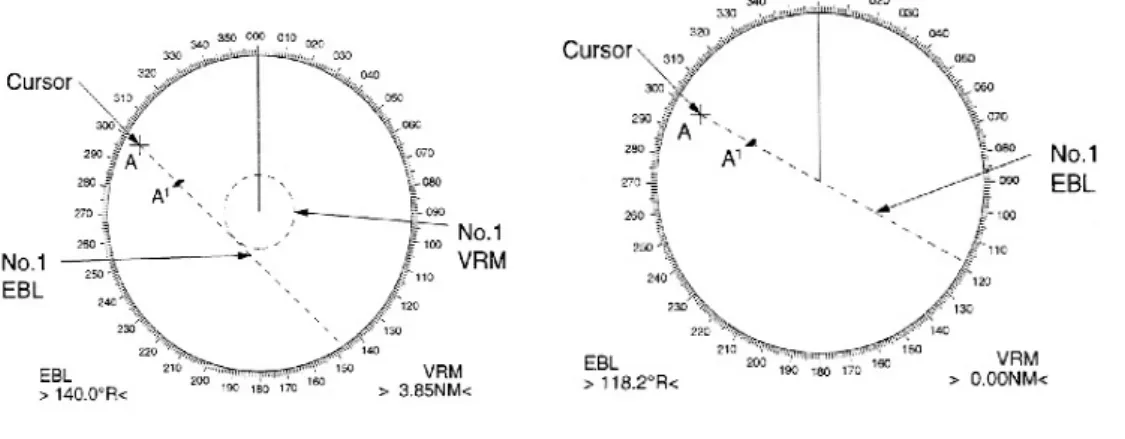
COLLISION ASSESSMENT BY OFFSET EBL
The origin of the EBL can be placed anywhere with the trackball to enable measurement of range and bearing between any targets. This function is also useful for assessment of the potential risk of collision. To assess possibility of collision:
1. Press the EBL ON key to display or activate an EBL (No.1 or 2).
2. Place the cursor (+) on a target of interest (A in the illustrated example) by operating the trackball.
3. Press the EBL OFFSET key on the mode panel, and the origin of the active EBL shifts to the cursor position. Press the EBL OFFSET key again to anchor the EBL origin.
4. After waiting for a few minutes (at least 3 minutes), operate the EBL control until the EBL bisects the target at the new position (A’). The EBL readout shows the target ship’s course, which may be true or relative depending on the settings on the RADAR 2 menu.
If relative motion is selected, it is also possible to read CPA by using a VRM as shown in figure 5.14. If the EBL passes through the sweep origin (own ship) as illustrated in figure 5.15, the target ship is on a collision course.
5. To return the EBL origin to the own ship’s position, press the EBL OFFSET key again.
OPERATION OF ARPA GENERAL
The FAR-2805 series with ARP-25 board provide the full ARPA functions complying with IMO A. 823 and IEC-60872-1 as well as complying with the radar performance MSC.64(67) Annex 4. PRINCIPAL SPECIFICATIONS
Acquisition and tracking
Automatic acquisition of up to 20 targets plus manual acquisition of 20 targets, or fully manual acquisition of 40 targets between 0.1 and 32 nm (0.1 and 24 nm depending on initial setting)
Automatic tracking of all acquired targets between 0.1 and 32 nm (0.1 and 24 nm depending on initial setting)
Vectors
Vector length: 30 sec, 1, 2, 3, 6, 12, 15, 30 min. Orientation: True velocity or relative velocity
Motion trend: Displayed within 20 scans, full accuracy within 60 scans after acquisition.
Past positions: Choice of 5 or 10 past positions at intervals of 30 sec, 1,2,3 or 6 min.
Alarms: Visual and audible alarms against targets violating CPA/ TCPA limits, lost targets, targets crossing guard zone
(guard ring), system failure and target full status.
Trial maneuver: Predicted situation appears in 1 min after selected delay (1-60 minutes).
KEYS USED FOR ARPA
The Auto Plotter uses the keys on the plotting keypad on the right side of the radar screen and two keys on the control panel. Below is a brief description of these keys.
CANCEL: Terminates tracking of a single target specified by the trackball if the key is pressed with a hit-and-release action. If the key is held depressed for about 3 seconds, tracking of all targets is terminated.
ENTER: Registers menu options selected.
VECTOR TRUE/REL: Selects a vector length of 30s 1, 2, 3, 6, 12, 15 or 30min.
TARGET DATA: Displays data on one of tracked targets selected by the trackball.
TARGET BASED SPEED: Own ship’s speed is measured relative to a fixed target.
AUTO PLOT: Activates and deactivates the ARPA functions.
TRIAL: Shows consequences of own ship’s speed and course against all tracked targets.
LOST TARGET: Silences the lost target aural alarm and erases the lost target symbol.
HISTORY: shows and erases pat positions of tracked targets. ACQ: (on control panel): Manually acquires a target. AUDIO OFF: (on control panel): Silences aural alarm.
AUTOMATIC ACQUISITION
The ARPA can acquire up to 40 targets (20 automatically and 20
manually or all 40 manually). If AUTO ACQ is selected after more than 20 targets have been manually acquired, only the remaining capacity of targets can be automatically acquired. For example, when 30 targets have been
acquired manually, then the ARPA is switched to AUTO ACQ. Only 10targets can be acquired automatically. A target just acquired automatically is
marked with a broken square and a vector appears about one minute after acquisition indicating the target’s motion trend. Three minutes after
acquisition, the initial tracking stage is finished and the target becomes ready for stable tracking. At this point, the broken square mark changes to a solid circle. (Targets automatically acquired are distinguished from those acquired manually, displayed by bold symbol).
Enabling and disabling auto acquisition
1. Press the E, AUTO PLOT key if the ARPA is not yet activated. Note that the label ARPA appears in the box at the upper right on the screen.
2. Press the E, AUTO PLOT MENU key to show the ARPA 1 menu. 3. Press the (1) key to select menu item 1 AUTO ACQ.
4. Further press the (1) key to select (or highlight) ON (enable auto acquisition) or OFF (disable auto acquisition) as appropriate.
5. Press the ENTER key to conclude your selection followed by the E, AUTO PLOT MENU key to close the AUTO PLOT 1 menu. Note that the label AUTO+MAN is displayed in the box at the upper right on the screen when auto acquisition is enabled; MAN when auto acquisition is disabled. Note: When the ARPA has acquired 20 targets automatically, the message AUTO TARGET FULL is displayed in the box at the right hand side of the screen.
Setting auto acquisition areas
Instead of limits lines, auto acquisition areas are provided in the system. There are two setting methods:
3, 6 Nautical Miles: Two predefined auto acquisition areas; one between 3.0 and 3.5 nautical miles and the other between 5.5 and 6.0 nautical miles. SET: Two sector shaped or full circle auto acquisition areas set by using the trackball.
To activate two predefined auto acquisition areas (3 & 6 NM): 1. Press the E, AUTO PLOT MENU key to show the ARPA 1 menu. 2. Press the (2) key to select menu item 2 AUTO ACQ AREA.
3. Further press the (2) key to select (or highlight) menu option 3, 6 nautical miles.
4. Press the ENTER key to confirm your selection followed by the E, AUTO PLOT MENU key to close the ARPA 1 menu.
To set auto acquisition areas with trackball:
1. Press the E, AUTO PLOT MENU key to show the ARPA 1 menu. 2. Press the (2) key to select menu item 2 AUTO ACQ AREA. 3. Further press the (2) key to select (or highlight) SET option.
4. Press the ENTER key to conclude your selection. At this point the AUTO ACQ SETTING menu is displayed at the screen bottom.
5. Press the (2) key to select menu item 2 1/2 and press the ENTER key. 6. Place the cursor at the outer counterclockwise corner of the area and press the ENTER key.
7. Place the cursor at the clockwise edge of the area and press the ENTER key.
Note: If you wish to create an auto acquisition area having a 360 degree coverage around own ship, set point B in almost the same direction (approx.
+/-3) as point A and press the ENTER key.
8. Repeat steps 5 and 7 above if you want to set another auto acquisition area with the trackball.
9. Press the (1) key followed by the E, AUTO PLOT MENU key to close the ARPA 1 menu.
An auto acquisition area like the example shown above appears on the display. Note that each auto acquisition area has a fixed radial extension width of 0.5 nautical miles.
Note that the auto acquisition areas are preserved in an internal memory of the ARPA even when auto acquisition is disabled or the ARPA is turned off.
SETTING CPA/TCPA ALARM RANGES
The ARPA continuously monitors the predicted range at the CPA and predicted time to CPA (TCPA) of each tracked target to own ship. When the predicted CPA of any target becomes smaller than a preset CPA alarm range and its predicted TCPA less than a preset TCPA alarm limit, the ARPA releases an aural alarm and displays the warning label COLLISION on the screen. In addition, the ARPA symbol changes to a triangle and flashes together with its vector.
Provided that this feature is used correctly, it will help prevent the risk of collision by alerting you to threatening targets. It is important that GAIN, A/ C SEA, A/C RAIN and other radar controls are properly adjusted.
CPA/TCPA alarm ranges must be set up properly taking into
consideration the size, tonnage, speed, turning performance and other characteristics of own ship.
CAUTION: The CPA/TCPA alarm feature should never be relied upon as the sole means for detecting the risk of collision. The navigator is not relieved of the responsibility to keep visual lookout for avoiding collisions, whether or not the radar or other plotting aid is in use.
To set the CPA/TCPA alarm ranges:
1. Press the E, AUTO PLOT MENU key on the plotting keypad to show the ARPA 1 menu.
2. Press the (6) key to select menu item 6 CPA, TCPA SET. At this point, a highlight cursor appears at the “CPAx.xNM” field.
3. Enter the CPA alarm range in nautical miles (max 9.9 min) without omitting leading zeroes, if any, and press the ENTER key. The highlight cursor now moves to the:TCPAxx.xMIN” field.