Address for correspondence Dr. Guneet Awal
Department of Dermatology, Venereology & Leprosy
Sri Guru Ram Das Institute of Medical Sciences and Research, Amritsar
Ph: 9988834379
Email: [email protected]
Case Report
Squamous cell carcinoma of hand in a patient of
generalized vitiligo treated by surface mould
brachytherapy
Guneet Awal, Seema Goel*, Rajinder Kumar Goel**, Simplepreet Kaur
Department of Dermatology, Venereology & Leprosy, Sri Guru Ram Das Institute Of Medical Sciences and Research, Amritsar.
* Department of Dermatology, Venereology & Leprosy, Government Medical College, Patiala. ** Department of Surgery, Government Medical College, Patiala.
Abstract Nonmelanoma skin cancers (NMSC) are the most common malignant tumors in humans, with squamous cell carcinoma (SCC) constituting about one-fourth of these cases. Considering that patients with vitiligo have no protective pigment (melanin) in sun-exposed depigmented skin, it would be expected that these patients develop a higher risk for photodamage and NMSC. However, there is a paucity of reports of NMSC in sun-exposed, long-standing vitiliginous skin as NMSC are rare occurrences in such patients. Currently, ablative surgery is almost always recommended as the treatment for most SCCs. Nonetheless, high dose rate (HDR) surface mould brachytherapy is a safe and simple alternative to surgery, in selected cases, as it successfully eradicates the tumor and also preserves hand function. We report a case of generalized vitiligo with cutaneous SCC of the hand treated with surface mould brachytherapy.
Key words
Squamous cell carcinoma (SCC), long standing vitiliginous skin, high dose rate (HDR) surface mould brachytherapy.
Introduction
Nonmelanoma skin cancers (NMSC) are the most frequent malignant tumors in humans constituting 95% of total skin cancers, with histology revealing squamous cell carcinoma (SCC) in 25 % of cases. Most relevant risk factors include sunlight overexposure on face and upper extremities, presence of burns scars or chronic inflammatory lesions and chemical and actinic keratoses. Association of vitiligo and SCC has been a subject of controversy. Actinic
damage in long-lasting vitiliginous skin would be expected due to absence of melanin in the involved skin. Clinical experience and review of literature, however, show that skin cancers and solar keratoses are rare findings in sun-exposed vitiligo skin. The highest cure rates for early stage NMSC are achieved using Mohs micrographic surgery, which is considered the gold standard. However, surgical procedure causes significant disfigurement and functional impairment. Therefore, in the era of organ preservation, a noninvasive method of treatment
is often preferred. Radiotherapy using
We report a case of generalized vitiligo with cutaneous SCC of the hand treated with surface mould brachytherapy.
Case Report
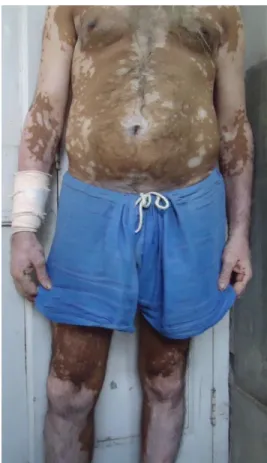
A 61-year-old Indian man presented with generalized vitiligo since 45 years and a non-healing ulcer on the volar aspect of fourth finger of the right hand of 6 months duration. Vitiligo was bilaterally symmetrical involving upper limbs (including hands), lower limbs, large areas
on the trunk and lower lip (Figure 1). The
patient had been a tractor mechanic for past 35 years, which forced him to work outdoors in the sun for long hours and prolonged exposure to mineral oils (diesel). Despite long standing vitiligo, he had taken no specific treatment or photoprotection measures. He was a nonsmoker with no history of exposure to PUVA or X-rays and insignificant past medical or surgical history. No history of allergy to any substance could be elicited.
He had noticed a small asymptomatic
erythematous, scaly papule on the volar aspect of fourth finger of the right hand about a year
ago before clinical presentation, which
subsequently ulcerated 6 months later due to self-inflicted trauma, in an attempt to remove the lesion in totality. The resultant non-healing ulcer was painless. On clinical examination, 2x1.5 cm irregular, superficial ulcer on the volar aspect of the distal phalynx of fourth finger of the right hand with everted edges was appreciated (Figure 2). Its floor was necrotic with sparse granulation tissue and had a firm base with 3 mm depth as measured with calipers. Multiple erythematous plaques and nodules, some with dry adherent crusting, were present on dorsal surface of both the hands.
A biopsy performed from the margin of the ulcer showed keratin pearls, nuclear hyperchromatism
and pleomorphism with increased
nucleocytoplasmic ratio of the squamous
epithelial cells confirming it as
well-differentiated keratinizing SCC (Figure 3). The tumour was infiltrating dermis with no perineural invasion.
Biopsy from two other sites was taken from the lesions on the dorsum of right hand which revealed hyperkeratosis, parakeratosis along with basophilic degeneration of dermal collagen and mild dermal lymphohistiocytic infiltrate suggestive of degenerative changes associated with solar elastosis.
A thorough clinical examination and loco-regional ultrasound study excluded nodal involvement. There was no involvement of the
underlying bone on radiography. Whole
abdomen ultrasound examination and chest radiograph excluded distant metastases.
After discussing the various treatment modalities including possible amputation of the involved
finger, patient opted for conservative
management and preservation of limb. Radiation oncology opinion was sought for and it was opined that patient be treated with high dose rate surface-mould brachytherapy because of its location leaving surgery as a salvage option.
Figure 1 Patient of generalized vitiligo with bilaterally symmetrical involvement of upper limbs, lower limbs and trunk
Figure 2 Volar aspect of the right fourth finger showing 2 x 1.5 cm irregular, superficial ulcer with everted edges, necrotic floor and scanty granulation tissue
Figure 3 Histopathology of the ulcer showing nests of atypical epithelial cells in the epidermis and dermis with keratin pearls( H and E, x40)
Figure 4 Surface mould constructed over the finger for the delivery of high-dose-rate brachytherapy
Figure 5 Follow up at 3 months of completion of treatment showing complete healing of the malignant ulcer
An impression of the finger was taken in alginate used for dental implants. Before it was set, three one-ended plastic catheters were set and dried corresponding to the tumor location. The aim was to treat the entire tumor surface inclusive of margins and relay of the radioactive source through the plastic tubing. The surface
Paris System rules. 45Gy to 5mm of the skin was prescribed such as 100% isodose covered the skin surface and 85% isodose to 5mm below the surface. 5Gy per fraction was delivered daily over 11 days. Following the course of brachytherapy, patient was followed up in outpatient department and topical emollients and antibiotics were prescribed. Follow-up at 3 months after completion of brachytherapy showed complete healing of the tumor with
preservation of hand function (Figure 5).
Discussion
Nonmelanoma skin cancer (NMSC) is the most common malignancy of the hand of which SCC accounts for 75-90%, followed by basal cell
carcinoma (BCC).1
Fitzpatrick skin phototypes V and VI, with high levels of constitutive pigmentation, have the lowest incidence of skin cancer as melanin is thought to be protective against the harmful effects of ultraviolet (UV) radiation. Therefore, a complete lack of melanin in vitiligo is expected to increase the deleterious effected of UV light, that might lead to development of skin
cancer.2 However, on the contrary, only few
reports of NMSC in patients with vitiligo have
been published.3
Tendency to avoid sun exposure, in patients of vitiligo, may be a reason for infrequent development of skin cancers in these patients. Thus chronic sun exposure may have been overlooked as a risk factor for developing SCC
in a patient with vitiligo.4 Other factors
contributing to actinic damage in sun-exposed vitiligo skin may be - duration of disease and
intensity of ultraviolet (UV) exposure.5 Our
patient had received high and prolonged doses of UV light because of his occupation.
However, in a recent study conducted by Hexsel
et al.3 in a cohort of 477 patients with vitiligo
compared with two general US population, an increased or equal risk of NMSC in patients with vitiligo was seen.
Therefore, in our patient, SCC and actinic keratosis developed in a long-standing vitiligo skin due to chronic sun exposure for a long period of 35 years. Another particular risk factor that may have contributed for the development of SCC could be chronic exposure to polycylic aromatic hydrocarbons (PAH), (mineral oils) as these have been implicated as predisposing factors for increased risk of development of skin cancer as substantiated by previous studies.6,7
Various methods to manage early stage NMSC are: surgery, electrodessication and curettage,
cryotherapy, radiotherapy, photodynamic
therapy and pharmacological therapy
(imiquimod). The goal of treatment is complete eradication of the tumour along with satisfactory
cosmesis and preservation of hand function.8
Mohs micrographic surgery has been advocated as the gold standard for NMSC. However,
surgical procedures cause significant
disfigurement and functional impairment.
Therefore, in the era of organ conservation, where mutilating surgeries are considered retrogressive, alternative treatment modality such as radiotherapy is an option to consider.
The largest review by Hass et al.9, for 12
patients with SCC of the nail bed treated with primary radiotherapy, revealed 92% local control rate.
are similar to external radiotherapy but the overall treatment time is shortened. Therefore brachytherapy is ideal alternative for elderly patients with small and superficial tumors who
are not fit for aggressive surgical management.8
Brachytherapy has very low rates of adverse events over long term. With this technique, recurrence rates are also low.10
Surface mould brachytherapy was chosen as the modality of treatment in our patient because it was a small and superficial tumor, and the treatment preserved hand function and cosmesis.
Conclusion
Surface mould brachytherapy offers an
alternative treatment for those patients not candidates for surgical procedures because of
medical contraindications or risk of
disfigurement or functional impairment.
References
1. Somanchi BV, Stanton A, Webb M, Loncaster J, Allan E, Muir LTSW. Hand function after high dose rate brachytherapy for squamous cell carcinoma of the skin of the hand. Clin Oncol. 2008;20:691-7. 2. Calanchini-Postizzi E, Frenk E. Long term
actinic damage in sun exposed vitiligo and
normally pigmented skin. Dermatologica. 1987;174:266-71.
3. Hexsel CL, Eide MJ, Johson CC, Krajenta R, Jacobsen G, Hamzavi I, Lim HW. Incidence of nonmelanoma skin cancer in a cohort of patients with vitiligo. J Am Acad Dermatol. 2009;60:929-33.
4. Seo SL, Kim IH. Squamous cell carcinoma in a patient with generalized vitiligo. J Am Acad Dermatol. 2001;45(6 Suppl):S227-9. 5. Saarinen K, Lestringant GG, Masouye I,
Frossard PM. Actinic damage and squamous cell carcinoma in sun-exposed skin affected by vitiligo. Br J Dermatol. 2000;143 :219-21.
6. Kubaseiurcz M, Starzynski Z, Szymczak W. Case-referent study on skin cancer and its relation to occupational exposure to polycyclic aromatic hydrocarbons. II. Study results. Pol J Occup Med Environ Health. 1991;4:141-7.
7. Jarvholm B, Easton D. Models for skin tumor risks in workers exposed to mineral oils. Br J Cancer. 1990;62:1039-41.
8. Montero A, Hernanz R, Capuz A. High-dose-rate (HDR) plesiotherapy with custom-made moulds for the treatment of non-melanoma skin cancer. Clin Transl Oncol. 2009;11:760-4.
9. Grootenboersa D, Poortmansa P, Haas R. Radiotherapy preserves fingers in the management of subungual squamous cell carcinoma, obviating the need for amputation. Radioth Oncol. 2007;85:473-6. 10. Alam M, Nanda S, Mittal BB, Kim NA, Yoo