Address for correspondence
Dr. Safoora Aamir, Associate Professor Department of Dermatology,
Federal Postgraduate Medical Institute & Sheikh Zayed Hospital, Lahore
Email: [email protected]
Original Article
Oral tranexamic acid in treatment of melasma in
Pakistani population: a pilot study
Safoora Aamir, Riffat Naseem
Department of Dermatology, Federal Postgraduate Medical Institute & Sheikh Zayed Hospital, Lahore
Abstract
Objective To evaluate the efficacy and safety of oral tranexamic acid (TA) in the treatment of melasma in our population.Methods We performed a descriptive cross sectional study of 65 melasma patients (Fitzpatrick skin types III and IV). Both female and male with moderate to severe melasma were given 250mg oral TA bid for 6 months along with topical sunscreen. Digital photography was performed initially, and at each visit. Follow-up extended for another six months after completion of treatment to see any recurrence or other side effects. Results were assessed clinically and photographically.
Results 65 patients with moderate to severe melasma were enrolled in the study. The average age was 36 years. 41 patients had good, 15 had excellent and 8 patients had fair improvement. None of the patients had serious systemic side effects, only few had oligomenorrhoea, palpitation and gastric upset. Patients’ satisfaction was similarly noted.
Conclusions Oral tranexamic acid is a safe and effective treatment in patients with melasma.
Key words
Oral tranexamic acid, melasma.
Introduction
Melasma is characterized by irregular light to gray brown macules and patches on sun‑exposed skin1 commonly affecting the cheeks, forehead, upper lip, nose, chin and occasionally forearms. It is a common acquired disorder of pigmentation, and is known to occur in all skin types, all ethnic groups and both sexes but relatively more common in darker skin type (III and IV) and more in women of child bearing age than men. Exact etiology of melasma is unknown, but exposure to UV irradiation and
histology, is as follows: epidermal, which has increased melanin predominantly in basal and suprabasal layers of epidermis with pigment accentuation on Wood’s lamp. The dermal type has perivascular melanin laden macrophages in superficial and deep dermis and does not accentuate with Wood’s lamp. The mixed variety has elements of both and appears as deep brown colour with Wood’s lamp accentuation of only the epidermal component.3 However, it is believed that usually melasma has both components. Treatment of melasma can be very frustrating and challenging because the aim is to obtain decrease in melasma pigment without hypopigmentation.
An array of conventional treatments that have been found effective include sun avoidance, sunscreens, hypopigmenting agents like hydroquinone, azelaic acid and kojic acid alone or in combination with other topical therapies such as tretinoin, topical corticosteroids, chemical peels and dermabrasion. Moreover, selective removal of pigment by different kinds of lasers is becoming increasingly popular. Other topical modalities introduced recently in treatment of melasma include zinc sulphate, lincomycin and linoleic acid either alone or in combination with hydroquinone and betamethasone valerate. Despite the multiplicities of all these therapies, their efficacy and safety is still controversial.
Introduction of tranexamic acid (TA) for treatment of melasma is a relatively new concept. TA, a synthetic derivative of amino acid lysine has been used widely as antifibrinolytic agent, it has recently been found to inhibit plasminogen-keratinocyte interaction which decreases tyrosinase activity leading to decreased melanin synthesis by melanocytes.5,6
treatment of melasma. This study is a pilot study in Pakistan to evaluate the efficacy and safety of oral TA for treatment of melasma in our population.
Methods
This interventional study was conducted at outpatient Department of Dermatology, Sheikh Zayed Hospital, Lahore, Pakistan. Sixty five subjects of age group 17 years and above of either sex with moderate to severe melasma were enrolled between March 2013 to August 2013. Informed written consent was obtained from all participants before enrollment. All patients were checked for bleeding time, clotting time and platelet count before enrolment. Diagnosis of melasma (epidermal, dermal or mixed) was established on Wood's lamp examination. A detailed history was taken from each patient regarding the etiological factors (sun exposure, cosmetic use, oral contraceptive use or phototoxic drug, past pregnancies, menstrual history, thyroid dysfunction) and family history of melasma was also noted. Inclusion criteria included subjects with moderate to severe melasma and absence of any inflammatory dermatosis. Patients with pregnancy, lactation, any chronic medical illness, history of thrombosis, abnormal bleeding profile, any medical treatment of melasma within 3 months of entry, skin resurfacing by dermabrasion, chemical peels, and facial laser within the preceding 9 months, hypersensitivity to TA, refusal to allow photographs and failure to finish the whole period of study were excluded from the study.
Tranexamic acid capsule (Transamine®) was given at a dose of 250mg twice a day for six months and patients were called at four week intervals during this period. Patients were instructed to apply broad-spectrum sunscreen and avoid sun exposure. No other medication either topical or oral was taken by the patients except oral iron supplements in patients with anemia. Follow-up extended for the next six months, during which patients had two visits, three months apart to see any recurrence.
Results were assessed by clinical and photographic assessment, and were rated as excellent if improvement was >90 %, good if >60%, fair if >30% and no or poor improvement if <30%, respectively. Patients’ satisfaction was similarly noted at completion of treatment and six months after completion.
Results
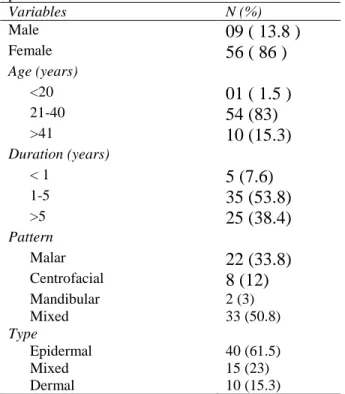
Baseline characteristics of the melasma patients are given in Table 1. Initially 70 subjects were enrolled in the study but five patients failed to complete the study and dropped out. Sixty five patients comprising 56 (86.2%) females and 9 (13.8%) males with moderate (50 patients) to severe (15 patients) melasma completed the study. The mean age of the patients was 36 years. The youngest patient was 17 years and the oldest was 55 years old at the time of inclusion into the study. Majority of the patients were in the age group 21-40 years (54 patients). All patients were with Fitzpatrick’s skin type III and IV skin. The duration of melasma ranged from 3 months to 17 years and the mean duration of melasma was 5.18 years. Onset of melasma during pregnancy was seen in 14 (25%) female patients. About 25 patients had a positive family history of melasma (38 %). Mixed type of
melasma was the most common type (50.8%), followed by malar type (33.8%). Eight (12%) patients had centrofacial pattern of melasma and only two (3%) presented with mandibular type. On Wood’s lamp examination, epidermal, dermal and mixed type of melasma was found in (61.5%), (15.3%) and (23%) cases, respectively. Significant reduction was observed after 16 weeks of treatment in all types of melasma (epidermal, dermal and mixed melasma). However in epidermal melasma improvement was more significant at the end of treatment as compared to other variants. None of the patient suffered worsening of melasma on treatment.
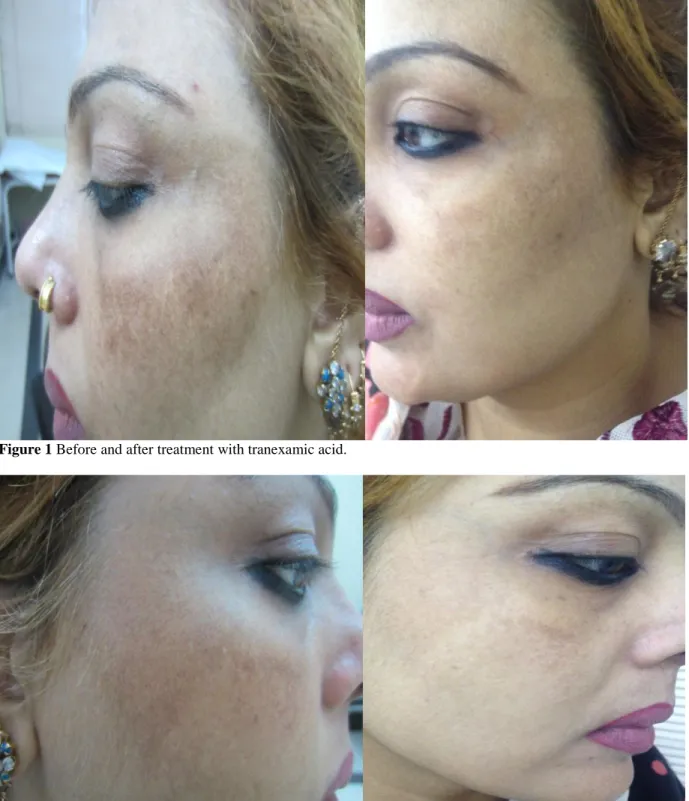
Patients rating for excellent, good, fair, and poor outcome accounted 15 (23%) patients, 41 (63%), 8 (12%), and 1 (1.5%) patient, respectively. Six months follow-up results after completion of treatment revealed no recurrence in 57 (87%)
Table 1 Baseline characteristics of the melasma patients.
Variables N (%)
Male
09 ( 13.8 )
Female
56 ( 86 )
Age (years)
<20
01 ( 1.5 )
21-40
54 (83)
>41
10 (15.3)
Duration (years)
< 1
5 (7.6)
1-5
35 (53.8)
>5
25 (38.4)
Pattern
Malar
22 (33.8)
Centrofacial
8 (12)
Mandibular 2 (3)
Mixed 33 (50.8)
Type
Epidermal 40 (61.5)
Mixed 15 (23)
Figure 1 Before and after treatment with tranexamic acid.
Figure 2 Before and after treatment with tranexamic acid.
patients and recurrence in 8 (12%) patients. In our study, we found low dose TA to be relatively safe with fewer side effects like four females had oligomenorrhoea (7.1 %), and two
Discussion
Melasma, a common disorder of Asian and Latin American, predominantly affecting women, occurs because of unknown causes. However, genetic factors, UV irradiation, pregnancy, hormonal therapy and imbalance, and using some drugs (e.g. phenytoin ) are the proposed factors.7 Melasma is a benign condition though psychologically disturbing, abiding, unruly, very distressing and resistant pigmentary disorder. The interest to find new modalities of treatment, which are cheap, safe, and readily-available, is non-stopping. The conventional approaches such as hypopigmenting agents, chemical peels, lasers and dermabrasion remains the gold standard. Among the commonly used agents, hydroquinone products, alone or in combination with other depigmenting agents are widely used agents for treatment of melasma over the past 50 years.8In fact, hydroquinone causes not only the inhibition of tyrosinase enzyme, a main enzyme in melanin production, but also destroys the melanosomes.9-12 Clinical trials have also shown that topical agents demonstrate some efficacy in the epidermal type but not in dermal or mixed type of melasma.13,14 Prolonged application, slow response, limited efficacy and recurrence are the major disadvantages of topical medication causing patients to abandon the treatment. In addition, irritant or allergic contact dermatitis, exogenous ochronosis and confetti-like depigmentation are unacceptable effects with topical bleaching agents. Laser treatment is a good option but recurrence is frequent.15 This has led to an increased search of alternative treatments for melasma with low profile of side effects. The most effective and safe treatment for melasma is yet to be explored. TA, which has been previously used as hemostatic agent due to its antifibrinolytic effect and is synthetic derivative of amino acid lysine, was first
introduced by Nijor in 197916 for treatment of melasma. Since then few studies are reported regarding use of TA in melasma. Role of TA in melasma is best studied by Dunn and Goa et al.17 who revealed that TA mediates its effects through inhibition of tyrosinase activity which is pivotal in melanin synthesis in epidermal melanocytes, by blocking melanocyte-keratinocyte interaction by inhibiting plasminogen/plasmin system. TA attaches itself to lysine-binding sites of plasmin and plasminogen. It also prevents UV rays induced pigmentation. Similar studies as ours with same dosing schedule were conducted in Nepali18 and Chinese population19and authors recommended TA as an effective and safe therapy for melasma patients. Another interesting aspect regarding TA reported in literature is its effectiveness as topical as well as localized intradermal microinjection for melasma.20,21,14 As dose of oral TA in melasma is far less than that prescribed for its hemostatic action, so fatal risks like thromboembolism, myocardial infarction, cerebrovascular accident are very rare. However, it is important to rule out any hypercaogulable state before commencement of treatment. Our results are comparable with the studies where beneficial effects in melasma treatment following oral administration of TA were observed. We observed very encouraging results in treatment of melasma with TA and very few side effects and recommend its routine use in treating melasma in Pakistani population.
Conclusion
Acknowledgement
We thank all the patients who participated in this study and the staff dermatology department of the Sheikh Zayed Hospital, Lahore.
References
1. Grimes PE. Melasma. Etiologic and therapeutic considerations. Arch Dermatol. 1995;131:1453-7.
2. Grimes PE. Management of
hyperpigmentation in darker racial ethnic groups. Semin Cutan Med Surg. 2009;28:77-85.
3. Gupta AK, Gover MD, Nouri K, Taylor S. Treatment of melasma: A review of clinical trials. J Am Acad Dermatol. 2006;55:1048-65.
4. Sanchez NP, Pathak MA, Sato S et al. Melasma: A clinical, light microscopic, ultra structural, and immunofluorescence study. J Am Acad Dermatol. 1981;4:698‑710. 5. Maeda K, Tomitab Y. Mechanism of the
inhibitory effect of tranexamic acid on melanogenesis in cultured human melanocytes in the presence of keratinocyte-conditioned medium. J Health Sci. 2007;53:389-96.
6. Maeda K, Naganuma M. Topical trans-4-aminomethylcyclohexanecarboxylic acid prevents ultraviolet radiation-induced pigmentation. J Photochem Photobiol. 1998;47:136-41.
7. Pawaskar MD, Parikh P, Markowski T et al. Melasma and its impact on health-related Quality of life in Hispanic women. J Dermatolog Treat. 2007;18:5-9.
8. Bukvić Mokos Z, Lipozenčić J, Ceović R et al. Laser therapy of pigmented lesions: pro and contra. Acta Dermatovenerol Croat. 2010;18:185-9.
9. Kligman AM, Willis I. A new formula for depigmenting human skin. Arch Dermatol. 1975;111:40-8.
10. Taylor SC, Torok H, Jones T et al. Efficacy and safety of a new triple-combination agent
for the treatment of facial melasma. Cutis. 2003;72:67-72.
11. Rendon M, Berneburg M, Arellano I, Picardo M. Treatment of melasma. J Am Acad Dermatol. 2006;54(Suppl):S272-81. 12. Ennes SBP, Paschoalick RC. Mota de
Avelar Alchorne M. A double-blind, comparative, placebo-controlled study of the efficacy and tolerability of 4% hydroquinone as a depigmenting agent in melasma. J Dermatolog Treat. 2000;11:173-9.
13. Ejaz A, Raza N, Iftikhar N, Muzzafar F. Comparison of 30 % salicylic acid with Jessner's solution for superficial chemical peeling in epidermal melasma. J Coll Physician Surg Pak. 2008;18:205-8.
14. Lee JH, Park JG, Lim SH, Kim JY. Localized Intradermal microinjection of tranexamic acid for treatment of melasma in Asian patients: A preliminary clinical trial. Dermatol Surg. 2006;32:626-31.
15. Karn D, K C S, Amatya A et al. Q-Switched neodymium-doped:yttrium aluminium garnet laser therapy for pigmented skin lesions: efficacy and safety. Kathmando Univ Med J. 2012;38:46-50.
16. Nijor T. Treatment of melasma with tranexamic acid. Clin Res. 1979;13:3129-31. 17. Dunn CJ, Goa KL. Tranexamic acid: a review of its use in surgery and other indications. Drugs. 1999;57:1005-32. 18. Karn D, K C S, Amatya A et al. Oral
tranexamic acid for the treatment of melasma. Kathmandu Univ Med J. 2012;10:40-3.
19. Wu S, Shi H, Wu H et al. Treatment of melasma with oral administration of tranexamic acid. Aesthetic Plast Surg. 2012;36:964-70.
20. Ayuthaya PKN, Niumphradit N, Manosroi A, Nakakes A. Topical 5% tranexamic acid for the treatment of melasma in Asians: A double-blind randomized controlled clinical trial. J Cosmet Laser Ther. 2012;14:150-4. 21. Na JI, Choi SY, Yang SH et al. Effect of