MMS MAIL
SYSTEM
CIS 505 P
ROJECT
, S
PRING
2007
Debajit Adhikary
([email protected])
Khader Naziruddin
([email protected])
Ayesha Muntimadugu
([email protected])
April 19, 2007
1
Design
MMS M
AIL: A D
ISTRIBUTEDC
LIENT-S
ERVERE
MAILS
YSTEMA
BSTRACTThe project builds an implementation of a client-server email system called anMMS Mail Systemcomprising multiple servers and clients. The system comprises the following entities:
• CLIENTS.Each client initially connects to one of the mail servers and opens a new account. Thereafter, it may connect to any other server to send and receive mail.
• SERVERS. Mail account information is stored across various servers in a distributed manner. Each
server can support multiple clients at the same time, and is replicated once for fault tolerance. Each server is aware of other servers in the system.
• PROTOCOLS. SMTP and POP3 are respectively used to send and receive email. The servers use a synchronization protocol (between themselves) that is transparent to the clients.
O
VERALLD
ESIGNAs noted above, the system comprises clients, distributed servers, and the various protocols they commu-nicate with. A broad design of the system is outlined below. System components are detailed later.
CIS 505 PROJECT, SPRING2007 DESIGN
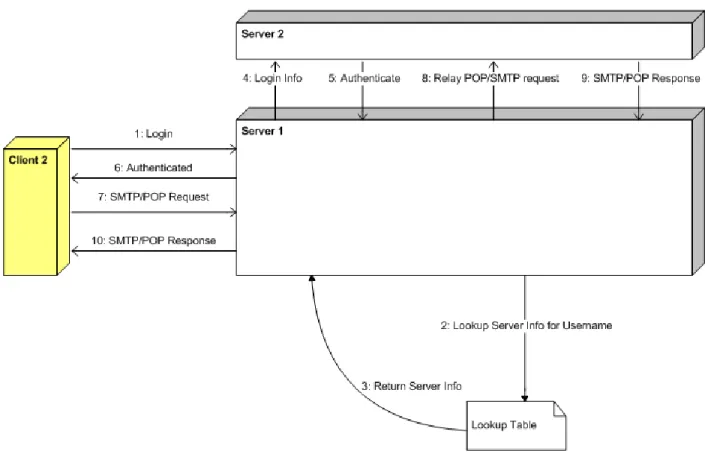
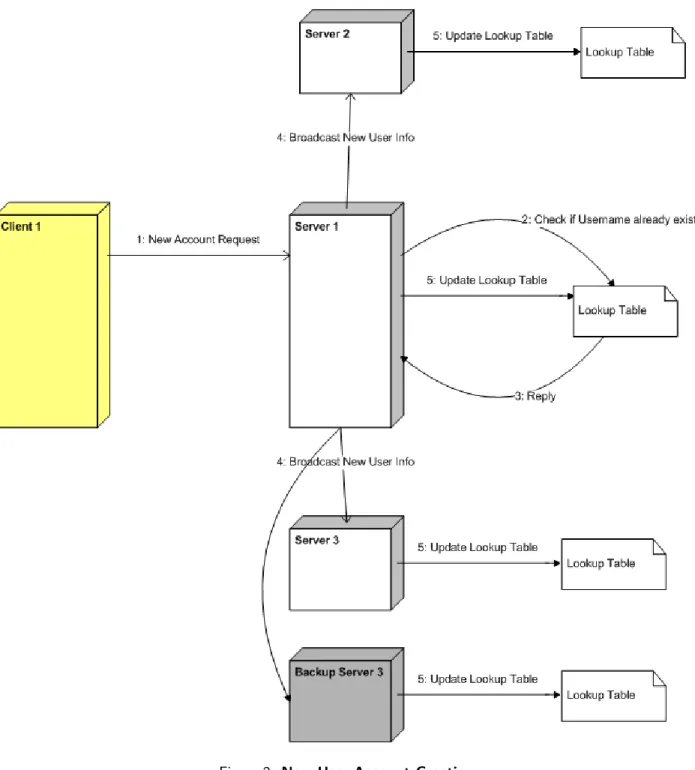
Given a username, these are used to lookup the server which contains account and mailbox in-formation for that username. Whenever a new user is created at a server, the server broadcasts a message with that username and its own infor-mation to all the other servers, which on receipt, update their local copies of these tables.
SERVERLOOKUPTABLE
Username Primary Server Port
BACKUPSERVERLOOKUPTABLE
Username Backup Server Port
This scheme was chosen as it provides the following advantages:
– No single point of failure, as opposed to a centralized lookup server.
– Lookups are cheapbecause each server reads its own local copy of the lookup table.
– Local validations are possible to check if a username exists. When a user attempts to log in to a mail server, the server can first locally check if the user exists without querying another server, thus reducing network traffic and possibly increasing response time. (If a username exists, only then would the server send an authorization request to the server that contains information on that user).
• SERVERCONFIGURATION.
Information about user accounts and mailboxes is stored in a database (each server has its own). A server configuration file is used to specify the various parameters for database connection. This design also allows multiple servers to share one database host, if required.
SERVERCONFIGURATIONFILE
DB Username DB Password DB Hostname DB Name
• DATASYNCHRONIZATION& REPLICATION FORFAULT-TOLERANCE.
Data related to user accounts and mailboxes stored at one server is mirrored to a backup server. Data is replicated each time any account operation or mail operation (like sending a mail, deleting a mail, creating a folder or creating an account) takes place.
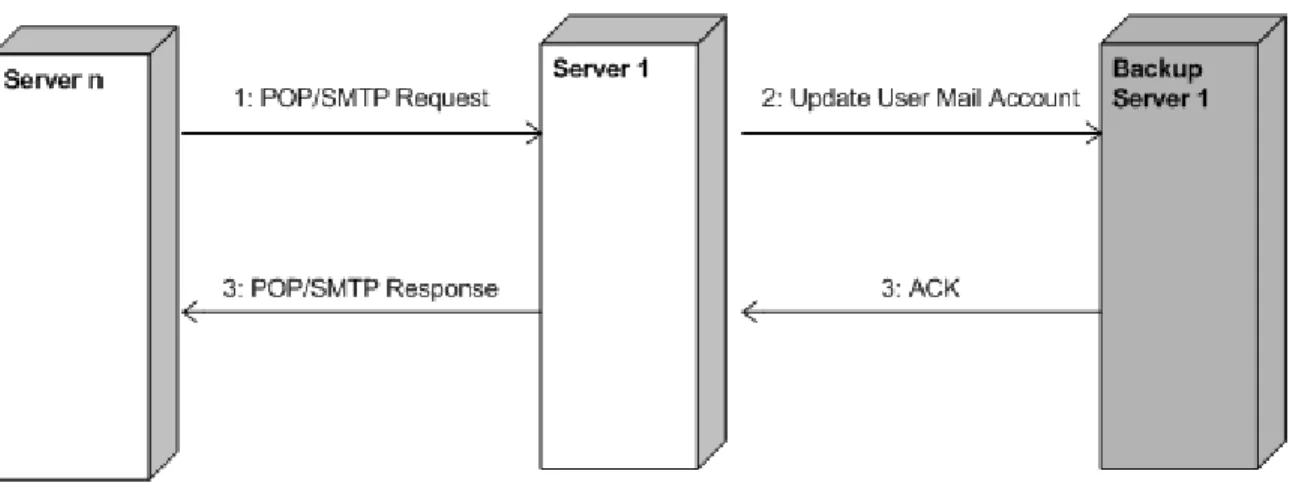
Each time a server updates its database, anRPC(remote procedure call) is made to its backup server via a database trigger, and the backup server then automatically updates itself with the new infor-mation. The backup server then sends anACK(acknowledgement) to the primary server.
In the eventuality that the primary server does not receive anACKfrom its backup, it adds the update request to async-queueand periodically attempts to sync its database with the backup.
CIS 505 PROJECT, SPRING2007 DESIGN
– MINIMUM NETWORK TRAFFIC. Network traffic for backups is minimized because a message is sent to the backup server only when required. This is as opposed to a polling scheme or a scheduled synchronization system, which circulate more messages on the network. (A primary server will reattempt synchronization only if the backup fails to acknowledge the sync request or vice versa)
– BETTER DATAINTEGRITY. Consider a scenario where the primary server fails after the user has performed some mail operation. If the user connects again, he would connect to the backup server (since the primary server is down). With this design, the chances of data integrity at the backup server side are maximized because the database trigger would ensure that if the primary database was updated, the backup data would also be updated, thus maximizing data integrity.
– REDUCEDSYSTEMLATENCY.Since synchronization is carried out immediately after a primary server updates itself, therefore the overall latency of the system is reduced.
This protocol is discussed in greater depth in theSynchronization Protocolsection.
A
SSUMPTIONSThe following assumptions have been made:
• Mail servers cannot be dynamically added or removed from the mail system network.
CIS 505 PROJECT, SPRING2007 INTERACTIONDIAGRAMS
2
Interaction Diagrams
U
SERA
UTHENTICATION ANDM
AILT
RANSACTIONSFigure 1: User Authentication and Mail Transactions
(In these collaboration diagrams, numbering denotes the relative ordering of a sequence of events and/or messages.)
CIS 505 PROJECT, SPRING2007 INTERACTIONDIAGRAMS
N
EWU
SERA
CCOUNTC
REATIONCIS 505 PROJECT, SPRING2007 INTERACTIONDIAGRAMS
B
ACKUPS
ERVERS
YNCHRONIZATIONFigure 3: Primary Server–Backup Server Synchronization
P
RIMARYS
ERVERF
AILURECIS 505 PROJECT, SPRING2007 SYNCHRONIZATIONPROTOCOL
3
Synchronization Protocol
CSP M
ODELPrimaryServer :: Node ? Request ;
(Request == Update) -> UpdateMyself (); Queue ! add(Request);
BackupServer ! Request ; PeriodicTimeOut -> [
Queue ! isNotEmpty() -> * [
Queue ? Request ; BackupServer ! Request BackupServer ? Ack; AckNotReceived -> NewQueue ! add(Request) ];
setQueue(NewQueue); ]
BackupServer :: Node ? Request;
NodeIsNotMyPrimaryServer -> PrimaryServer;
NodeIsMyPrimaryServer -> [
UpdateMyself(); PrimaryServer ! Ack; ]
A
DVANTAGES OF THEP
ROTOCOL• Synchronization is guaranteed even if either the backup or the primary is down. (The server that is alive will retry at periodic intervals and will synchronize with its target server (backup or primary) when it comes up again).
• The synchronization protocol applies equally to both the primary and backup server. (If the primary dies, the backup can function as an immediate transparent replacement for the primary and can even synchronize it when it comes back up).
• Only one message is required for synchronization if the backup server is up at that time. (The backup server will then send one acknowledgement message.) This minimizes network traffic.
CIS 505 PROJECT, SPRING2007 IMPLEMENTATION
Note: Since the synchronization protocol is “symmetric” vis-a-vis the primary and the backup server, the termsprimary serverandbackup serverare interchangeable for synchronization issues.
D
ISADVANTAGES OF THEP
ROTOCOL• If the backup server is down at the time of sending a sync-request, the primary server will reattempt synchronization by sending periodic messages till the backup server comes up again. This will lead to a small increase in network traffic between the primary and the backup.
4
Implementation
Language: Java (JDK 1.5, Servlets 2.4)
Database Backend: MySQL 5.0
Application/Web Server: Apache Tomcat 5.5 (For client user interface)
Mail Protocols: SMTP, POP3 Replication Scheme: Data Mirroring