http://www.jscdss.com
Vol.2 No.4 August 2015: 26-30 Article history:
Accepted 18 July 2015 Published online 18 July 2015
Journal of Soft Computing and Decision
Support Systems
Iris Recognition System based on Canny and LoG Edge Detection
Methods
Neda Ahmadi a,*, Gholamreza Akbarizadeh b a
Department of Computer Engineering, Faculty of Engineering, Shahid Chamran University,Ahvaz, Iran
b
Department of Electrical Engineering, Faculty of Engineering, Shahid Chamran University, Ahvaz, Iran
* Corresponding author email address: [email protected]
Abstract
Iris recognition has obtained an incredible consideration in a variety of fields such as border areas, industrial areas, secu rity susceptible areas and so on. In the eye, sclera and iris are utilized since the prior inputs employing to identify the eye with various systems such as segmentation incorporating with various versions. The internal edge in the eye isn't an ordinary circle that might produce di fficulty in exact recognition. The image has a smaller amount texture after that it causes iris legacy in segmentation step. In order to develop a good iris authentication algorithm for individual identification, the presented paper recognize iris images by utilizing two edge detection approaches like Canny and Laplacian of Gaussian (LoG) to reduce the noisy data and detect the edges. The experimental results demonstrate that Canny edge detector can better detect the edges than LoG.
Keywords: Iris recognition, Canny edge detection, LoG (Laplacian of Gaussian) edge detection
1. Introduction
Unique and trustworthy people identification is really a hard problem. The significance of security is definitely an indisputable fact that has an important role in our communities. Governments are prompt to make tighter security measures by having the security's high level. Without a doubt, using biometric attributes creates a basic portion of governments' attempts in order to provide countrywide security. A biometric template can provide an effective, normalized and extremely discriminating feature's depiction by utilizing distinctive physical (e.g. hand profile, palm vein, fingerprints, DNA testing, face, iris, palm print, retinal scanning, etc.) and behavioral (e.g. gait measurement, voice, keystroke, and signature) attributes of every people which will subsequently be in comparison with different templates to ascertain identity (Birgale and Kokare, 2009). Almost all biometric systems permit two operation modes. The enrollment mode in order to add templates into a database, and also an identification mode, in which a template is made for a person then the match will be looked for in the pre-enrolled templates database (Masek, 2003). Thus, the possibility of any two individual having the identical attribute is going to be minimum and be simply taken to provide comfort for the user, and cause not to happen feature's misrepresentation. Behavioral methods are generally much less trusted compared to physical methods since they're simpler to copy (Jain et al., 1999). Physical characteristics tend to be a
more reliable method in biometrics. Therefore, iris recognition is getting a lot of consideration and extended in industrial recognition systems (Jain et al., 2004).
Iris recognition recognizes people by utilizing the distinctive iris pattern info and contrasting it with database's reference. For example, it is stable during a person's lifetime and it can't change surgically. Its accuracy rate is higher in comparison with different biometric recognition approaches like voice recognition, fingerprint recognition, vein recognition, face recognition, etc. (Daugman, 1993; Ma et al., 2003; Wildes, 1997). As texture of iris pattern does not have any links with a person's genetic structure and because it is created by disorderly processes, it can work in verification and identification modes (Muron and Pospisil, 2000).
Iris is usually well protected interior organ that utilized to denote the thin rounded diagram and the colored part which is located at the rear of the cornea and the human eye's lens (Daughman, 1988) (see Fig. 1). The sclera is the eye's exterior part that is occupied just about 30% eye's area and pupil is located in the central part of the eye which include 5% eye's area. The operation of the iris would be to control the light's amount getting into the pupil. The iris's average diameter is 12 mm and the size of the pupil can differ between 10 to 80 percent of the diameter of the iris.
Fig. 1. Diagram of the eye structure (Courtesy of National Eye Institute).
Hence, in this paper, we employ two methods, Canny edge detection and LoG edge detection, to create a suitable iris recognition system in order to reduce the noisy data and detect the boundaries of an iris in the eye.
The remainder of the paper is organized as follows. In Section 2, we review existing works. Next, in Section 3, we provide a summary of the various methods of our method then go over technical features within additional detail. The experimental results are shown in Section 4. Lastly, Section 5 concludes this paper.
2. Related Work
Daugman )1994, 1998) worked on iris recognition technology. Almost all industrial iris recognition systems utilize trademarked algorithms (Daugman, 2004) to create the iris code employing 2D Gabor filters. By comparison, wavelet transform and Fourier descriptor are broadly used in pattern recognition (Chen and Bui, 1999). The wavelet transform (Mallat, 1999) is utilized to analyze the local frequency. Iris segmentation has an important part in the entire system accuracy since it isolates the appropriate portion of iris from the input eye image. This localizes the limbic and pupillary boundaries and finds and eliminates noise like specular insights, eyelashes, and the eyelids whenever they occlude (Jan et al., 2013). The research group recommended several iris segmentation methods. It offers thresholding and histogram based approaches (Khan et al., 2011, Ibrahim et al., 2012), edge and gradients descriptors (Chen, 2010), active contour models (Ross and Shah, 2006). The vast majority of methods are utilizing edge detection in order to localize the boundaries of the iris (Sung et al., 2004). The integro-differential operator draws the iris rounded boundaries that became a great way of iris segmentation, however, very time-consuming (Daugman, 2004). Also, an excellent method was proposed in order to pupil elimination (Lee Luan et al., 2010).
3. Methodology
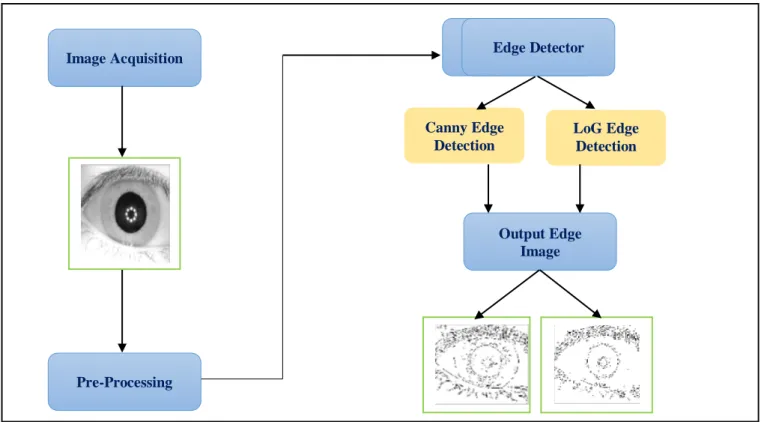
Preprocessing, feature extraction and matching are edge detection steps. Preprocessing step comprises the conversion of the image from a color image to grayscale image, iris localization, edge detection, filtration, etc. In this paper, Canny and LoG edge detection methods are considered (see Fig.2).
3.1 Edge Detection Methods
3.1.1 Canny Edge Detection
In order to find pupil and iris boundaries, Canny edge detection technique can be used that provides the efficient eye edges (Mai, 2008). The Cany algorithm includes several steps as following:
i. Gaussian smooth
ii. Find the image's intensity Gradients iii. Non-maximum suppression iv. Double threshold
In the first step which is smoothing step, the image became blur by the operators in order to eliminate noise. After that to find gradients step whenever the operator detects the big gradient size of the image it represents the edges. Euclidean distance can be applied for determining the gradient size that is shown in Eq. (1).
2 2
G G G
x y
(1)
The image shows the edges clearly, but the edges are usually wide and don't show precisely where the edges are. For determining this, edge directions have to be determined and saved. This is shown in Eq. (2).
arctangGx Gy
(2)
In next phase, for regional maxima and marking it, the operator just searches. In double thresholding phase, edges are generally settled by suppressing almost all edges which are not really linked to the powerful edge. Each of these techniques employed by utilizing MATLAB software.
3.1.2 Laplacian of Gaussian Edge Detection
2-D isotropic way of measuring the second spatial derivate of the image called the Laplacian. The image Laplacian shows parts of quick intensity modify which is consequently usually employed for detecting the edges. In order to minimize sensitivity, the Laplacian is generally used on the image which smoothed using estimating the Gaussian Smoothing filtration. The operator usually takes an image which is gray level as input and also generates an additional gray level image as output. The Laplacian L(x,y) is pixel intensity values and is shown by Eq. (3):
2 2
2 2
( , ) I I
L x y
x y
Edge Detector Edge Detector
Fig.2. Proposed model using Canny and LoG edge detection
The image that is as an input is showed as a discrete pixels collection. For estimating the second derivatives, we need to find a discrete convolution kernel (Gonzalez, 2009). Two popular kernels are demonstrated in Fig. 3.
Fig. 3. Two popular used discrete approximation of Laplacian filter (Maini & Aggarwal, 2009).
To use each of them, the Laplacian could be measured employing standard convolution techniques. The kernels are usually estimating the second derivative measuring for an image, stability to noise is low. In order to contrast, prior to using the Laplacian filtration, the image is usually Gaussian smoothed. In this preprocessing phase decreases the noise with high-frequency elements before the difference phase. Actually, because the convolution operation associative, we are able to convolve the Gaussian smoothing filtration using the Laplacian filtration to begin with, then convolve this filtration to get the necessary result. This has two benefits:
i. Because two Gaussian and also Laplacian kernels are significantly small compared to the image, these techniques typically needs fewer math operations.
ii. Gaussian kernel Laplacian could be calculate beforehand therefore just one convolution must be done on the image.
The 2-D Laplacian of Gaussian function aimed at Gaussian and zero standard deviation
are (see Fig. 4) and is shown by Eq. (4):2 2
2
2 2 2
4 2
1
( , ) [1 ]
2
x y
x y
LoG x y e
(4)
A discrete kernel which approximates this function (Gaussian
=1.4) (Maini & Aggarwal, 2009) (seeFig. 5).4. Result and Discussion
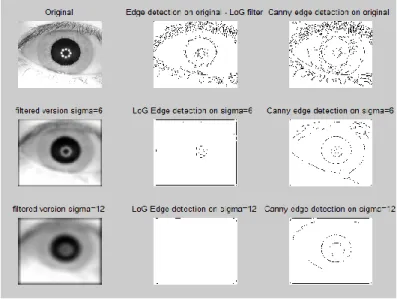
In order to obtain the better results, we use CASIA v4.0-interval (Phillips, 2007) iris dataset; it contains iris image samples belong to 249 people, with totally 2639 images of dimensions (320*280) pixels. The results attained by making use of the Canny and Laplacian of Gaussian (LoG) edge detection methods (see Fig. 6).
As it shown in Fig.6, Canny edge detection with
=6 could better detect than Log edge detection with
=6. The result indicates quick and smooth modifications of the image. A best operator even for images that have noise is Canny edge detector. It works with filling the weak and strong gap of image edges. In comparison to some other edge detection methods, Canny is much less noise. Usually horizontal edge detection much more understandable than the vertical one. The Canny edge detection method is better than LoG edge detection in order to detect the two slow changes of gray level. In LoG's method, locality is not greatImage Acquisition
Output Edge Image Canny Edge
Detection
Pre-Processing
and edges usually are not thin. Canny's method is chosen because it creates single pixel thick, continuous edges.
Fig. 4. The 2-D LoG function. The x and y axes are designated in standard deviations (
) (Maini & Aggarwal, 2009).0 1 1 2 2 2 1 1 0
1 2 4 5 5 5 4 2 1
1 4 5 3 0 3 5 4 1
2 5 3 -12 -24 -12 3 5 2
2 5 0 -24 -40 -24 0 5 2
2 5 3 -12 -24 -12 3 5 2
1 4 5 3 0 3 5 4 1
1 2 4 5 5 5 4 2 1
0 1 1 2 2 2 1 1 0
Fig. 5. Discrete approximation to Laplaciqan of Gaussian function with Gaussian
=1.4 (Maini & Aggarwal, 2009).Fig. 6. Edge detection by Canny and Laplacian of Gaussian (LoG) methods.
5. Conclusion
In this paper, we proposed a new method for detecting iris boundaries by using Canny and LoG edge detection. The proposed method’s performance is tested using CASIA v4.0-interval dataset; it contains iris image samples belong to 249 people, with totally 2639 images of dimensions
(320*280) pixels. We have utilized CASIA v4.0-interval, since it consists heterogeneous images, in addition, its iris images have a lot of noise such as illumination, contrast, brightness and poor image quality.
edge detection provides better efficiency and the higher detection rate and also execution speed has been well suited for the real time in contrast to LoG edge detection method. Unless the prerequisites are especially appropriate, it is nearly impossible to discover an edge detector which works considerably much better as compared to the Canny edge detector.
We will extend the proposed methods for color iris images in order to get better performance in future research.
Acknowledgments
This work was supported by the Shahid Chamran University of Ahvaz under grant number 93/3/02/27171. The authors would like to thank the Shahid Chamran University of Ahvaz for financial support.
References
Birgale, L. V., & Kokare, M. (2009, March). Iris recognition using discrete wavelet transform. In Digital Image Processing, 2009 International Conference on (pp. 147-151). IEEE.
Chen, G., & Bui, T. D. (1999). Invariant Fourier-wavelet descriptor for pattern recognition. Pattern recognition, 32(7), 1083-1088. Chen, Y., Adjouadi, M., Han, C., Wang, J., Barreto, A., Rishe, N., &
Andrian, J. (2010). A highly accurate and computationally efficient approach for unconstrained iris segmentation. Image and Vision Computing, 28(2), 261-269.
Courtesy of National Eye Institute, National Institutes of Health
Daugman, J. (1998). Recognizing people by their iris patterns. Information Security Technical Report, 3(1), 33-39. Daugman, J. (2004). How iris recognition works. Circuits and
Systems for Video Technology, IEEE Transactions on, 14(1), 21-30.
Daugman, J. G. (1988). Complete discrete 2-D Gabor transforms by neural networks for image analysis and compression. Acoustics, Speech and Signal Processing, IEEE Transactions on, 36(7), 1169-1179.
Daugman, J. G. (1993). High confidence visual recognition of persons by a test of statistical independence. Pattern Analysis and Machine Intelligence, IEEE Transactions on, 15(11), 1148-1161.
Daugman, J. G. (1994). U.S. Patent No. 5,291,560. Washington, DC: U.S. Patent and Trademark Office.
Gonzalez, R. C. (2009). Digital image processing. Pearson Education India.https://www.nei.nih.gov/photo/anatomy-of-eye
Ibrahim, M. T., Khan, T. M., Khan, S. A., Khan, M. A., & Guan, L. (2012). Iris localization using local histogram and other image statistics. Optics and Lasers in Engineering, 50(5), 645-654. Jain, A. K., Bolle, R., and Pankanti, S. (Eds.). (1999). Biometrics:
personal identification in a networked society. Springer Science & Business Media.
Jain, A. K., Ross, A., & Prabhakar, S. (2004). An introduction to biometric recognition. Circuits and Systems for Video Technology, IEEE Transactions on, 14(1), 4-20.
Jan, F., Usman, I., & Agha, S. (2013). Reliable iris localization using Hough transform, histogram-bisection, and eccentricity. Signal Processing, 93(1), 230-241.
Khan, T. M., Khan, M. A., Malik, S. A., Khan, S. A., Bashir, T., & Dar, A. H. (2011). Automatic localization of pupil using eccentricity and iris using gradient based method. Optics and Lasers in Engineering, 49(2), 177-187.
Ling, L. L., & de Brito, D. F. (2010). Fast and efficient iris image
segmentation.Journal of Medical and Biological
Engineering, 30(6), 381-391.
Ma, L., Tan, T., Wang, Y., & Zhang, D. (2003). Personal identification based on iris texture analysis. Pattern Analysis and Machine Intelligence, IEEE Transactions on, 25(12), 1519-1533.
Mai, F., Hung, Y. S., Zhong, H., & Sze, W. F. (2008). A hierarchical approach for fast and robust ellipse extraction. Pattern Recognition, 41(8), 2512-2524.
Maini, R., & Aggarwal, H. (2009). Study and comparison of various image edge detection techniques. International journal of image processing (IJIP), 3(1), 1-11.
Mallat, S. (1999). A wavelet tour of signal processing. Academic press.
Masek, L. (2003). Recognition of human iris patterns for biometric identification (Doctoral dissertation, Master’s thesis, University of Western Australia).
Muron, A., Pospisil, J. (2000). The human iris structure and its usages. Acta Univ. Palacki. Olomuc. Fac. Rerum Nat. Phys., 39, 87–95.
Phillips, J., Bowyer, K. W., & Flynn, P. J. (2007). Comments on the CASIA version 1.0 iris data set. Pattern Analysis and Machine Intelligence, IEEE Transactions on, 29(10), 1869-1870. Ross, A., & Shah, S. (2006, September). Segmenting non-ideal irises
using geodesic active contours. In Biometric Consortium Conference, 2006 Biometrics Symposium: Special Session on Research at the (pp. 1-6). IEEE.
Sung, H., Lim, J., Park, J. H., & Lee, Y. (2004, August). Iris recognition using collarette boundary localization. In Pattern Recognition, 2004. ICPR 2004. Proceedings of the 17th International Conference on (Vol. 4, pp. 857-860). IEEE. Wildes, R. P. (1997). Iris recognition: an emerging biometric
technology.Proceedings of the IEEE, 85(9), 1348-1363.
Author Biographies
Neda Ahmadi was born in Isfahan, Iran, on 14, 1987. She received the B.S. degree in computer engineering from University of Science and Culture in Feb. 2010. She is pursuing the M.S. degree in computer engineering from the Shahid Chamran University of Ahvaz (SCU), Ahvaz, Iran. Her research interests include machine vision, image processing, and biometric systems.
Gholamreza Akbarizadeh was born in Shiraz, Iran, on July 14, 1981. He received the B.S.
degree from the Khajeh-Nassir Tousi