Parallel Numerical Algorithm for Solving Advection Equation
for Coagulating Particles
Sergey A. Matveev1,3, Rishat R. Zagidullin2, Alexander P. Smirnov2,3, Eugene E. Tyrtyshnikov2,3
c
The Authors 2018. This paper is published with open access at SuperFri.org
In this work we present a parallel implementation of numerical algorithm solving the Cauchy problem for equation of advection of coagulating particles. This equation describes time-evolution of the concentrationf(x, v, t) of particles of sizevat the pointxat the time-momentt. Our numer-ical algorithm is based on use of total variation diminishing (TVD) scheme and perfectly matching layers (PML) for approximation of advection operator along spatial coordinatexand utilization of the fast numerical method for evaluation of coagulation integrals exploiting low-rank decomposi-tion of coaguladecomposi-tion kernel coefficients and fast FFT-based implementadecomposi-tion of convoludecomposi-tion operadecomposi-tion along particle size coordinate v. In our work we exploit one-dimensional domain decomposition approach along spatial coordinatexbecause it allows to avoid use of parallel FFT implementations which are very expensive in terms of data exchanges and have poor parallel scalability. Moreover, locality of finite-difference operator from TVD-scheme alongxcoordinate allows to obtain good scalability even for computing clusters with slow network interconnect due to modest volumes of data necessary for synchronization exchanges between times integration steps.
Keywords: aggregation equations, parallel algorithms, low-rank matrices, convolution.
Introduction
Coagulation and fragmentation processes stand in the basement of a wide class of physical phenomena starting from micro-polymer chains growth [6, 17] and finishing at the scale of stars formation from interstellar dust [5, 8]. The very first model of aggregation was suggested by Smoluchowski in 1916 [24] and generalized by Hans Muller [18] into the form of the following integro-differential equation:
∂f(t, v)
∂t =
1 2
v Z
0
K(u, v−u)f(t, u)f(t, v−u)du−f(t, v)
∞
Z
0
K(v, u)f(t, u)du (1)
This equation describes dynamics of concentration f(t, v) of the particles of size v per unit volume. The first term in the right-hand side corresponds to growth of concentration due to coalescence of the aggregates of sizes v and v−u. The second term describes decrease of the concentration due to their coalescence of the particles of size v with other particles. Kernel coefficients
K(v, u) =K(u, v)≥0
correspond to rates of aggregation process and have to be derived for each concrete application. If the initial conditionsf(t= 0, v) are known, then Cauchy problem for the coagulation equation is defined and can be solved numerically.
Under natural assumptions [8] the solution of the Cauchy problem for semi-infinite size domain v ∈ [0,∞) can be approximated by its finite part v ∈ [0, Vmax]. In fact, the class
1 Skolkovo Institute of Science and Technology, Moscow, Russian Federation
2Lomonosov Moscow State University, Faculty of Computational Mathematics and Cybernetics, Moscow, Russian Federation
of mathematical models of potential interest is extremely wide and may include description of various physical effects: inception and sinks of particles of concrete sizes [2], unary fragmentation process [1] due to instabilities of big clusters and binary collisional fragmentation process [5], and many others [3, 7, 12, 14, 20]. Even though the list of phenomena for application of spatially homogeneous aggregation and fragmentation equations is really huge [25, 26], there is an even broader class of spatially inhomogeneous models [19, 22]. In this work we concentrate on analysis of advection-coagulation equation [28]:
∂f(t, x, v)
∂t +c(v)
∂f(t, x, v)
∂x =
1 2
v Z
0
K(u, v−u)f(t, x, u)f(t, x, v−u)du−
(2)
−f(t, x, v)
∞
Z
0
K(u, v)f(t, x, u)du,
where function f(t, x, v) corresponds to concentration per unit volume of particles of size v at the point with coordinate x at moment t. Coagulating particles are transported along the axis of nonnegative coordinate x with velocityc(v). The velocities of the coalescence processes are again determined by the values of function K(u, v). In the similar manner with classical coagulation equation one needs initial conditionsf(t= 0, x, v) and one boundary condition e.g. f(t, x = 0, v) for definition of the Cauchy problem for advection-coagulation equation and its further numerical investigation.
Recently, we proposed an efficient numerical method solving the Cauchy problem for this equation [28] and demonstrated its efficiency for the concrete examples of modelling problems. We revisit description of this algorithm in Section 1.
Nevertheless, even modest simulations presented in our previous report required quite a lot of CPU-time. In this work we propose a parallel implementation of this algorithm. We should also emphasize, that there exists a special parallel algorithm allowing to perform evaluation of aggregation and fragmentation sums of the similar structure as coagulation integrals. Even though, a reasonable speedup of calculations was presented at [16], the parallel scalability of the algorithm is relatively poor [16]. This fact lies in motivation to exploit one-dimensional domain decomposition approach along spatial coordinate x for advection-coagulation equation but not along axis v and not two-dimensional domain decomposition.
In Section 2 we present a detailed description of novel parallel algorithm. Section 3 is devoted to tests of performance of the proposed algorithm at different computing clusters andLomonosov supercomputer. We obtain speedup of calculations more than by 300 times. This allows us consider a broader class of problems of potential interest for mathematical modelling and studies of advection-coagulation processes. In conclusions we discuss the presented results and possible directions for further generalization of the presented ideas.
1. Numerical Method, Revisited
scheme with time step ∆tfor solution of the Cauchy problem:
fn+1−fn ∆t =A(f
n) +S(fn),
whereA(f) is an approximation of the advection operator andS(f) approximates Smoluchowski integrals. Let us denoteM as number of grid nodes along particle size axis vwith grid step ∆v and parameters v1= 0, vM =M·∆v and N as number of spatial grid nodes alongx with step ∆x, x1 = 0, xN =N ·∆x. Finally, we denote fi,jn as value of numerical solution at grid node (xj, vi) at the momentn·∆t.
For S(f) we use skeleton decomposition of coagulation kernel and fast algorithms of linear algebra with overall algorithmic complexity of solution scheme to be O(M RlogM) at each grid node alongx axis [13]. Whereas without utilization of these ideas the complexity becomes O(M2). We discuss this method with more details in Section 2.2. We get significant acceleration for evaluation of Smoluchowski integrals if the rank R of the coagulation kernel is a modest number. For approximation of the advection partA(f) we exploit well-known TVD scheme [10] and PML layers [4] allowing us to keep monotonicity of numerical method. Detailed relations for advection part are presented in Section 2.3.
1.1. Handling Smoluchowski Integrals
Skeleton decomposition of coagulation kernel
K(u, v) = R X
α=1
aα(u)bα(v)
helps accelerate computations by reduction of the algorithmic complexity of the numerical eval-uation of Smoluchowski integrals [27, 29].
With use of skeleton decomposition we can perform transformation of the first integral:
Z v
0
K(u, v−u)f(t, x, u)f(t, x, v−u)du=
Z v
0 R X
α=1
aα(u)bα(v−u)f(t, x, u)f(t, x, v−u)du=
= R X
α=1
Z v
0
aα(u)f(t, x, u)bα(v−u)f(t, x, v−u)du.
Following this idea we also transform the second integral:
Z ∞
0
K(u, v)f(t, x, u)du≈
Z Vmax
0 R X
α=1
aα(u)bα(v)f(t, x, u)du= R X
α=1 bα(v)
Z v
0
aα(u)f(t, x, u)du.
1.2. Approximation of Advection Part
For approximation of the advection equation we use the following TVD-scheme.
fjn+1−fjn
dt =A(f
n) =− c 2dx(Cjf
n
j+1+ (2−Cj−Cj−1)fjn−(2−Cj−1)fjn−1) +
+c 2dt
2dx2(Cjf n
j+1−(Cj +Cj−1)fjn+Cj−1fjn−1),
where Cj is a flux limiter function that ensures that no artificial oscillations occur and has to satisfy the following restrictions
fjn−fjn−1 fn
j+1−fjn ≥
0→0≤Cj ≤2
fjn−fjn−1 fn
j+1−fjn
<0→Cj = 0.
For simplicity of notations we revisit this scheme ignoring volume index ibecause at each grid point along size coordinate vi we perform these operations along spatial axis x. In fact, there are a lot of possible choices forCj which were introduced by many authors [10, 11]. In our work, we use the one that is called “Monotonized Central Flux Limiter” [10].
Cj = max(0,min(2rj,0.5(1 +rj),2)),whererj =
fj−fj−1 fj+1−fj
The last thing that has to be done with respect to numerical solution of advection equation is incorporation of PML to emulate the absence of the right boundary condition in the grid. Hence, we modify the advection equation into following:
∂f ∂t =−c
∂f
∂x −cσ(x)f,
where
σ(x) =
(m+ 1)Wln 10 d
x−l d
m
x∈[l;l+d],
0 elsewhere,
where l is width of calculation domain along axis x without PML, d is width of PML andW, m are PML parameters and formal assumption f|x=l+d≡0 .
2. Parallel Algorithm
There are two possible ways of parallel implementation of our numerical method with use of pprocessors. First of all, we can perform simultaneous calculation by allocation of fixed particle size intervals to different processors. This is one-dimensional domain decomposition along axis v. But this option turns out to be bad due to quite poor parallel scalability of the algorithm for evaluation of the Smoluchoswki coagulation integrals what was reported in [16].
(a) Computation ofS(fn) (b) Data exchange (c) Computation ofA(fn) (d) Calculation offn+1
Figure 1. One parallel time-integration step with use of the suggested parallel algorithm. Areas bordered by black lines represent the grid areas allocated to separated processors
problematic due to extremely high communication costs (comparable with computational). Such bad parallel scalability of evaluation of the coagulation integrals also leads to loss of motivation to exploit two-dimensional domain decomposition along bothvandxcoordinates in application to our problem.
However another option of execution of parallel calculations is to distribute them along the spatial coordinatex. Such distribution of data among processors corresponds exactly to uniform one-dimensional domain decomposition into the segments along spatial coordinate x. This ap-proach allows to obtain very modest requirements in terms of number of communications – it is necessary just to synchronize the boundaries of spatial segments corresponding to neighboring processes for evaluation of advection operator with use of TVD-scheme stencil. In other words, we can allocate integrals at different points of the physical space to different processors and then transmit the data at the borders of the corresponding intervals. Thus, on the input each from p processes has set of grid nodes X and values of fn(xi, vj) at this domain X×(v1, . . . , vM). Total complexity of time-integration step for each processor is ON RMplogM operations and requires O(pM) data elements forO(p) data exchange operations.
We present our approach informally in Fig. 1. It shows the structure of the parallel nu-merical scheme and the areas of the grid which communicate with each other. Areas bordered by black lines represent the grid areas allocated to separated processors. Red stripes indicate how calculations are performed. Blue stripes pose organization of data transmission between the neighboring processes.
However, we should mention that grid parameter affects the parallel the efficiency of pre-sented algorithm. Number of grid points along spatial coordinatex must be greater or equal to number of used processes. Otherwise there will be a lack of opportunity to distribute the data among the processors. We assume that the best parallel performance can be achieved in case of uniform domain decomposition when number of grid points alongxcan be divisible by a number of used processes. In the next section we present benchmarks of the proposed algorithm.
Algorithm 1 Operations performed by each process 1: fori∈X do
2: Compute S(fn(xi;v1. . . , vM)) atxi along v .Requires O
N RMlogM p
operations 3: end for
4: Exchange data with left and right neighbors
5: and assign boundary conditions .Each process sends and receives 2M elements
6: fori∈X do .loop among grid points corresponding to process
7: forj∈V do
8: Apply advection operator A(fn(xi;vj)) . RequiresO
N M p
operations
9: end for
10: end for
11: fori∈X do .loop among grid points corresponding to process
12: forj∈V do
13: fn+1(x
i;vj) =fn(xi;vj) + ∆t·( S(fn(xi;vj)) +A(fn(xi;vj)) ) . RequiresO
N M p
operations
14: end for
15: end for
16: return fn+1(x
i;vj) . defined for X×(v1, . . . , vM)
3. Benchmarking Parallel Implementation
In our numerical tests we investigated the Cauchy problem for the advection-coagulation equation with zero-value initial conditions and the following left boundary condition:
f(t, x= 0, v) =e−v2. (3)
Thus, we model a constant flow of particles from one side of the grid to the other.
Also, calculations differ with respect to coagulation kernels. Tests were conducted for con-stant kernel
K(u, v)≡1,
which rank R= 1 and for ballistic coagulation kernel
K(u, v) = (u13 +v 1 3)2
r
1 u+
1 v
1 2 4 8 16 32 64 128 256 512
1 2 4 8 16 32 64 128 256 512
A
cc
e
le
ra
ti
o
n
,
ti
m
e
s
Number of cores
Strong scalability
Marchuk INM Lomonosov Pardus Skoltech Supermicro Skoltech Linear scalability
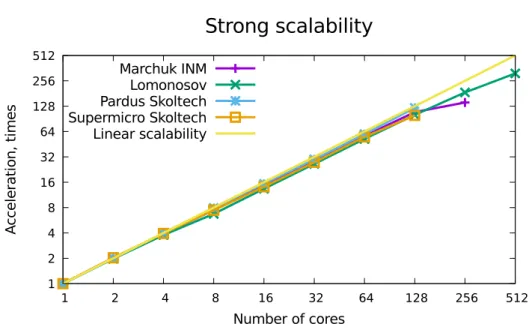
Figure 2. Strong scalability of the proposed parallel algorithm for different clusters. Visualized data corresponds to results presented in Tab. 1 – 4. We obtain almost linear speedup if number of processors is less than or equal to 128
Table 1.Supercomputer Lomonosov, tests for regular4 partition with 40 Gb/s QDRinterconnect. Constant coagulation kernel,R= 1, N =M = 8192, 32 time-integration steps
p Time, s Speedup
1 34.476 1
2 17.468 1.97
4 9.126 3.778
8 5.124 6.728
16 2.576 13.384 32 1.306 26.398
64 0.66 52.236
128 0.342 100.807 256 0.185 186.357 512 0.11 313.418
with results at Supermicro cluster of Skoltech 1 Gb/s Ethernet) and for heterogeneous cluster of Marchuk Institute of Numerical Mathematics (see Tab. 2) we obtain a reasonable speedup of calculations. Besides the fact that we obtain a good scalability of the algorithm for different clusters, we also see its good performance for different problem sizes (for each of Tab. 1 – 4 we tried a different problem size).
Table 2.Cluster of Marchuk Institute of Numerical
Mathematics RAS; test for heterogeneous cluster consisting of many different models of CPUs with 32 Gb/s QDR interconnect. Ballistic coagulation kernel,R = 12, N =M = 2048, 32 time-integration steps
p Time, s Speedup
1 133.43 1
2 66.112 2.018
4 34.49 3.869
8 17.775 7.507 16 8.997 14.83 32 4.618 28.893 64 2.353 56.706 128 1.227 108.745 256 0.943 141.495
Table 3.Pardus cluster of Skoltech with56 Gb/s FDR interconnect. Ballistic coagulation kernel,R = 14, N =M = 4992, 32 time-integration steps
p Time, s Speedup
1 1202.947 1
2 604.34 1.99
4 301.304 3.992 8 152.223 7.903 16 78.681 15.289
32 40.3 29.85
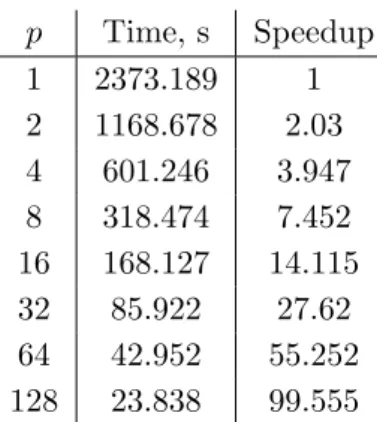
Table 4.Supermicro cluster of Skoltech with 1 Gb/s Ethernet interconnect. Ballistic coagulation kernel,R= 14, N =M = 8064, 32 time-integration steps
p Time, s Speedup
1 2373.189 1
2 1168.678 2.03 4 601.246 3.947 8 318.474 7.452 16 168.127 14.115 32 85.922 27.62 64 42.952 55.252 128 23.838 99.555
increasing costs of data exchanges between processors after each time integration step. Speedup also saturates with satisfactory results when the size of problems is not large enough (see Tab. 2).
Conclusions
In this work we propose a parallel implementation of the numerical method solving advection-coagulation equation from work [28]. The numerical scheme is parallelized along spa-tial axis x which promotes a good speedup of calculations. In the presented benchmarks we show that our scheme of finding the numerical solution of the problem might be accelerated by hundreds of times giving an almost linear speedup with respect to the amount of used CPU cores.
There is also an opportunity for additional increase of performance of the presented method. As far as coalescence integrals are evaluated sequentially at each processor their calculation can be additionally accelerated by use of GPU and Cuda technology. We will apply our ideas to more intricate multicomponent coagulation models [7, 15, 23] requiring special implementations of multidimensional convolutions based on utilization of low-rank tensor decompositions [15, 21].
Acknowledgements
This work is supported by the Program 1 of the Presidium of the Russian Academy of Sciences “Fundamental mathematics and its applications” and by Program 26 “Fundamental foundations of design of algorithms and software for prospective and high-performance comput-ing systems”. We also would like to acknowledge Center for Computational and Data-Intensive Science and Engineering of Skolkovo Institute of Science and Technology for comprehensive support of their Pardus cluster which we used during preparation of our benchmarks.
References
1. Aloyan, A.: Dynamics and kinematics of gas impurities and aerosols in the atmosphere. A Textbook (2002)
2. Ball, R., Connaughton, C., Jones, P., Rajesh, R., Zaboronski, O.: Collective oscillations in irreversible coagulation driven by monomer inputs and large-cluster outputs. Physical review letters 109(16), 168304 (2012), DOI: 10.1103/PhysRevLett.109.168304
3. Ball, R., Connaughton, C., Stein, T.H., Zaboronski, O.: Instantaneous gelation in Smoluchowskis coagulation equation revisited. Physical Review E 84(1), 011111 (2011), DOI: 10.1103/PhysRevE.84.011111
4. Berenger, J.P.: A perfectly matched layer for the absorption of electromagnetic waves. Journal of Computational Physics 114(2), 185–200 (1994), DOI: 10.1006/jcph.1994.1159
5. Brilliantov, N., Krapivsky, P., Bodrova, A., Spahn, F., Hayakawa, H., Stadnichuk, V., Schmidt, J.: Size distribution of particles in saturns rings from aggregation and frag-mentation. Proceedings of the National Academy of Sciences 112(31), 9536–9541 (2015), DOI: 10.1073/pnas.1503957112
6. Brilliantov, N., Bodrova, A., Krapivsky, P.: A model of ballistic aggregation and fragmen-tation. Journal of Statistical Mechanics: Theory and Experiment 2009(06), P06011 (2009), DOI: 10.1088/1742-5468/2009/06/P06011
7. Chaudhury, A., Oseledets, I., Ramachandran, R.: A computationally efficient technique for the solution of multi-dimensional PBMs of granulation via tensor decomposition. Computers & Chemical Engineering 61, 234–244 (2014), DOI: 10.1016/j.compchemeng.2013.10.020
8. Galkin, V.: Smoluchowski equation. Fizmatlit, Moscow (2001), (in Russian)
9. Gupta, A., Kumar, V.: The scalability of fft on parallel computers. Parallel and Distributed Systems, IEEE Transactions on 4(8), 922–932 (1993), DOI: 10.1109/71.238626
10. Leer, B.V.: Towards the ultimate conservative difference scheme. iv. a new approach to numerical convection. Journal of Computational Physics 23(3), 276–299 (1977), DOI: 10.1016/0021-9991(77)90095-X
11. Lyra, P.R.M., Morgan, K., Peraire, J., Peir, J.: TVD algorithms for the solution of the compressible euler equations on unstructured meshes. International Journal for Numerical Methods in Fluids 19(9), 827–847, DOI: 10.1002/fld.1650190906
12. Matveev, S.A., Krapivsky, P.L., Smirnov, A.P., Tyrtyshnikov, E.E., Brilliantov, N.V.: Os-cillations in aggregation-shattering processes. Phys. Rev. Lett. 119, 260601 (Dec 2017), DOI: 10.1103/PhysRevLett.119.260601
14. Matveev, S., Stadnichuk, V., Tyrtyshnikov, E., Smirnov, A., Ampilogova, N., Brilliantov, N.: Anderson acceleration method of finding steady-state particle size distribution for a wide class of aggregationfragmentation models. Computer Physics Communications 224, 154–163 (2018), DOI: 10.1016/j.cpc.2017.11.002
15. Matveev, S., Zheltkov, D., Tyrtyshnikov, E., Smirnov, A.: Tensor train versus Monte Carlo for the multicomponent Smoluchowski coagulation equation. Journal of Computa-tional Physics 316, 164–179 (2016), DOI: 10.1016/j.jcp.2016.04.025
16. Matveev, S.A.: A parallel implementation of a fast method for solving the smoluchowski-type kinetic equations of aggregation and fragmentation processes. Vychislitel’nye Metody i Programmirovanie 16(3), 360–368 (2015), (in Russian)
17. Mirzaev, I., Byrne, E.C., Bortz, D.M.: An inverse problem for a class of conditional probability measure-dependent evolution equations. Inverse Problems 32(9), 095005 (2016), DOI: 10.1088/0266-5611/32/9/095005
18. M¨uller, H.: Zur allgemeinen theorie ser raschen koagulation. Fortschrittsberichte ¨uber Kol-loide und Polymere 27(6), 223–250 (1928), DOI: 10.1007/BF02558510
19. Okuzumi, S., Tanaka, H., Kobayashi, H., Wada, K.: Rapid coagulation of porous dust aggregates outside the snow line: A pathway to successful icy planetesimal formation. The Astrophysical Journal 752(2), 106 (2012), DOI: 10.1088/0004-637X/752/2/106
20. Piskunov, V.: Analytical solutions for coagulation and condensation kinetics of composite particles. Physica D: Nonlinear Phenomena 249, 38–45 (2013), DOI: 10.1016/j.physd.2013.01.008
21. Rakhuba, M.V., Oseledets, I.V.: Fast multidimensional convolution in low-rank tensor for-mats via cross approximation. SIAM Journal on Scientific Computing 37(2), A565–A582 (2015), DOI: 10.1137/140958529
22. Sabelfeld, K.: A random walk on spheres based kinetic monte carlo method for simulation of the fluctuation-limited bimolecular reactions. Mathematics and Computers in Simulation (2016), DOI: 10.1016/j.matcom.2016.03.011
23. Smirnov, A., Matveev, S., Zheltkov, D., Tyrtyshnikov, E.: Fast and accurate finite-difference method solving multicomponent Smoluchowski coagulation equation with source and sink terms. Procedia Computer Science 80, 2141–2146 (2016), DOI: 10.1016/j.procs.2016.05.533
24. von Smoluchowski, M.: Drei vortrage uber diffusion, brownsche bewegung und koagulation von kolloidteilchen. Zeitschrift fur Physik 17, 557–585 (1916)
25. Sorokin, A., Strizhov, V., Demin, M., Smirnov, A.: Monte-Carlo modeling of aerosol kinetics. Atomic Energy 117(4), 289–293 (2015), DOI: 10.1007/s10512-015-9923-7
26. Stadnichuk, V., Bodrova, A., Brilliantov, N.: Smoluchowski aggregation–fragmentation equations: Fast numerical method to find steady-state solutions. International Journal of Modern Physics B 29(29), 1550208 (2015), DOI: 10.1142/S0217979215502082
28. Zagidullin, R.R., Smirnov, A.P., Matveev, S.A., Tyrtyshnikov, E.E.: An efficient numer-ical method for a mathematnumer-ical model of a transport of coagulating particles. Moscow University Computational Mathematics and Cybernetics 41(4), 179–186 (Oct 2017), DOI: 10.3103/S0278641917040082