11
Multi Layered Data Communication Framework for WSN
Ms. G. Menaka,
MPhil., Research Scholar,
Mrs. M.M. Kavitha MSc., MPhil., Assistant Professor, Department Of Computer Science,
SSM College Of Arts & Science , Komarapalayam, Tamilnadu, India
[email protected], [email protected]
ABSTRACT
The sensor data communication models are used to collect captured data values from the sensor nodes.
Energy and delay parameters are considered in the data communication schemes. Network lifetime is increased with minimum energy consumption under the sensor nodes. Relay routing method, cluster based method and mobile element based methods are applied for the data communication process. Intermediate node based route is used in the relay routing method. Cluster head manages the data transmission under the cluster based method. Mobile elements are separately assigned to manage the data communication process. Mobile collectors are used to take the burden of data routing from sensorsThe sensor data communication is achieved with Mobile Data Gathering (MDG) schemes. Multi layered data communication is carried out for the sensor data collection process. The sensor layer, cluster head layer and mobile collector layers are used in the multi layered framework. The distributed load balanced clustering and dual data uploading (LBC-DDU) method is adapted for the data communication process. The clusters are constructed with sensor nodes. Cluster heads are selected for each cluster. The cluster heads are used to manage the data transmission process. Clusters are integrated with the coverage values. The mobile collector movement is estimated with cluster head details.
The multi layered data communication is carried out with the cluster head interface. The sensor resource levels are considered in the cluster head pairing process. Feasible polling points are identified with the cluster pair information and coverage details. The Distributed Load Balanced Clustering with Dual Data Upload (LBC-DDU) scheme is enhanced to ensure the complete coverage of the network area. Parallel data transmission is achieved with MIMO scheduling scheme.
1. Introduction
Wireless sensor networks (WSNs) are deployed in an area to be monitored, referred to in this paper as the sensing region, for diverse applications such as habitat and environmental monitoring, battlefield surveillance, and industrial monitoring. Using active node mobility in the network, overall communication in the network can be reduced and specifically nodes close to the base station (BS) could be prevented from draining out. Various utilities that are possible using active node mobility in the network are: mobile relay, mobile data mule, and mobile BS. Alternatively, in-network data processing mechanisms such as data aggregation, network coding, and compressive sensing could be utilised for minimising the overall communication of the network. These two approaches, that is, node mobility, and in-network processing have been extensively explored individually and independently.
2 Related work
As stated earlier, the methods for minimising the energy consumption in the network can be broadly
categorised into node mobility and in-network data processing-based mechanisms.
2.1 Node mobility
A mobile node can function as mobile BS that would collect data from the nodes by traversing in their vicinity [1]. In this paper, we refer mobile BS as ME for comparison with DCFly. Numerous studies have dealt with data collection from a deployed network where the ME visits some data collection points that serve as sub-sink for other adjoining nodes [3], [5]. The basic underlying objective being to determine the shortest path that can serve the maximum collection points within the permissible operational limits. Basically, they are variations of the travelling salesman problem that is known to be NP hard.
12 encounter obstacles, but tackle it based on the consideration that a complete map of the sensing region is available that includes details of obstacles, so that the path of ME is adjusted to avoid them. ME-based data collection approaches can be classified into predetermined path [5] and autonomous movement. Cluster-based path planning for the ME has been presented where the ME is expected to be guided by routing agents (CHs). The advantage of cluster-based guiding is that nodes and ME are not required to be location aware; however, the limitation of ground conditions has not been taken into account. In addition, the clustering is not done following the principles of optimal clustering and without optimal clustering there would be localized trees between collection points and adjoining nodes. The most commonly accepted mechanism for path planning involves shortest path – minimal spanning tree and its variations. Throughout this paper for comparison a data collection round refers to one round by the DCFly or ME across the sensing region. The energy consumption of only the network nodes has been taken into account for the evaluations, energy consumption of mobile node is not considered, that is, DCFly and ME as it is case specific.
The actuation mechanism for movement of mobile nodes using springs, wings, and even passive mobility using water flow has been presented in addition to wheels [8], [9]. The concept of flying sensors has been proposed by Dantu et al. [9]. Flying sensors are intended to operate as an aerial mobile sensor network for addressing application such as crowd monitoring, urban surveillance, and indoor emergencies [10]. They are expected to sense for a given physical phenomenon, and report it to the BS. It is worth mentioning here that a major share of total energy in flying sensors is spent for actuation, leaving nominal energy resources for sensing operations. The DCFly would serve as an ME, and will not be involved with active sensing for any physical phenomenon; therefore, almost all energy resource would be available for actuation.
2.2 In-network data processing
In-network data processing refers to data operations that are intended to aggregate the raw data, and even eliminate surplus or undesired data; done with the intention of reducing the energy consumption in the network. Some nodes process the raw data based on the in-network data processing mechanism before transferring the data to the BS. Many data aggregation techniques for sensor networks have been proposed using different aggregation functions such as sum, average, and based on spatial/temporal factors. Similarly, different structures for
data aggregation such as tree based, cluster based, and structure free data aggregation have been put forward [11],[6]. Use of Slepian Wolf source coding technique for data collection has also been proposed, its main advantage being that it shifts computational complexity to the BS, compared with standard data aggregation techniques [7], [4]. This technique has an operation limitation that prior to commencing operations the spatial and temporal details of the sensing region are required. Compressive sensing-based data gathering in WSNs has been put forward in [2], as a mechanism to reduce inter-node communication required for data gathering in a network. In the proposed approach using DCFly, in-network data processing can be supported, as the CH could implement any appropriate data aggregation mechanism or even compressive sensing on the data.
3. Data Collection in WSN
Data collection from the nodes deployed in a sensing field is one of the most important tasks of wireless sensor networks. Typically, data collection relies on wireless communications between sensor nodes and the sink node, which may suffer from the following problems. First, wireless communications, especially long-range ones, may consume the limited on-board energy supply of sensor nodes excessively due to superlinear path loss exponents [16]. Second, even if shorter range, multihop wireless communications are adopted, due to the data aggregation toward the sink, nodes around the sink still have to consume much more energy than others due to heavier volumes of traffic transmitted by them, which leads to a lower overall network lifetime. Mitigation has appeared in the intrinsic high and unbalanced energy consumption still remains as a main challenge.
13 the communications and networking become possible in very sparse networks with a “store-carry-and-forward” approach.
Introducing mobility to the problem increases the dimension of the solution space to improve the network performance and the achievable solutions are always no worse than those obtained in a subspace with a reduced dimension. Data collection with MEs in sensor networks poses its own challenges as well. Due to the relatively lower speed of MEs when compared with electromagnetic or acoustic waves, data collection may suffer a much higher latency than multihop forwarding when the latter is feasible at a higher energy cost for sensor nodes. Large data collection latency not only degrades the timeliness of the data, but also may result in the buffer overflow of sensor nodes. The latency, mainly determined by the mobility and scheduling of MEs, i.e., how they traverse through the sensing field and when they collect data from which sensor, is the main focus of the research efforts on this topic and that this system.
4. Problem Statement
Mobile Data Gathering (MDG) schemes are used to collect sensor node data values in WSN. Mobile data collection framework is divided into three-layers such as sensor layer, cluster head layer and mobile collector (SenCar) layer. Mobile data collection is carried out using distributed load balanced clustering and dual data uploading (LBC-DDU) method. Distributed load balanced clustering (LBC) algorithm is used to construct clusters with sensor nodes. dual data uploading is performed with the support of multiple cluster heads. Connectivity ranges are used to manage the inter connectivity between the clusters. Cluster head information is forwarded to SenCar for its moving trajectory planning. SenCar is equipped with two antennas two enable the cluster heads simultaneously upload data to SenCar. The data upload process utilizes multi-user input and multiple-output (MU-MIMO) technique. Polling points are selected for each cluster to utilize dual data uploading benefits. The SenCar collects the data by visiting the polling points in the trajectory and transfer the data to the static data sink. The system is constructed with initialization, status claim, cluster formation, receive packets and cluster heads algorithms. The following problems are identified from the current data collection schemes. Polling point selection and cluster head pairing operations are not integrated. Polling point selection is not optimized. Spatial coverage properties are not considered. Multiple cluster based MIMO scheduling is not provided.
5. Multi Layered Data Communication Framework
Cluster head pair selection is improved with node property values. Discretization method is integrated with the system to select optimal polling point for the clusters. The Distributed Load Balanced Clustering with Dual Data Upload (LBC-DDU) scheme is enhanced to manage the overall spatial coverage. The MIMO scheduling is enhanced to support multiple cluster based transmissions.
Mobile collector (SenCar) based data collection scheme is constructed to perform data gathering operations in WSN. Network coverage analysis is adapted to identify the missing data collection regions. The data transfer process is improved with cluster based channel allocation mechanism. The system is partitioned into six modules. They are Sensor Layer, Clustering Process, Polling Point Selection, Scheduling Mobile Collector , Channel Assignment Process and Spatial Coverage Analysis
Sensor node deployment operations are carried out under sensor layer module. Clustering process is designed to group the sensor nodes with resource details. Polling point selection module is designed to assign data collection points. Mobile collector movements are planned using scheduling process. MIMO scheduling operations are carried out under Channel assignment process. Network coverage is verified under spatial coverage analysis.
The wireless sensor nodes are installed to capture the data from environment. Sensor node deployment operations are carried out under the sensor layers. Node properties are collected and updated under sensor layers. The initialization phase is applied to collect the residual energy and coverage details of the neighbor nodes. The clustering process is designed to group the nodes with the resource details. Residual energy, sensing coverage and transmission coverage factors are considered in the clustering process. Status claim algorithm is used to update the node status as member or cluster head. Distributed Load Balancing Cluster (LBC) algorithm is adapted for the cluster formation.
14 Channel assignment process is carried out to schedule the Dual Data Upload (DDU) process. Multi User Multi Input and Multi Output (MU-MIMO) technique is adapted for the data uploading process. The MU-MIMO scheme is enhanced to manage multi cluster environment. The Virtual Multi Input Multi Output (V-MIMO) scheme is applied to schedule the bandwidth for data upload process. Network coverage verification is performed in the spatial coverage analysis. Node coverage and proximity details are analyzed to estimate the cluster coverage. Cluster coverage details are summarized to estimate the data sensing coverage for the network. Network coverage and data collection regions are compared to identify the coverage missing area.
6. Performance Analysis
The mobile collector based data distribution scheme for Wireless Sensor Networks (WSN) is designed to perform data collection process. The sensor nodes are grouped with reference to the resource and proximity values. The cluster heads are selected to manage the data transfer process. A two tier framework is constructed to manage data transmission process. The mobile collector collects the data from the cluster heads. The cluster head collects the data values from the sensor nodes. Cluster head pair selection and pooling point selection tasks are carried out for the data collection process.
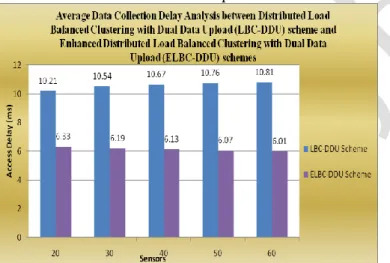
Figure No: 6.1. Average Data Collection Delay Analysis between Load Balanced Clustering with Dual
Data Upload (LBC-DDU) scheme and Enhanced Distributed Load Balanced Clustering with Dual Data
Upload (ELBC-DDU) schemes
The Load Balanced Clustering with Dual Data Upload (LBC-DDU) scheme is employed to perform the cluster head and pooling point selection process. The Multi User Multi Input and Multi Output scheduling scheme is adapted for the bandwidth scheduling process.
The Enhanced Distributed Load Balanced Clustering with Dual Data Upload (ELBC-DDU) scheme is designed to handle the spatial coverage optimization, optimal polling point selection and bandwidth scheduling process. The system is tested with two performance measures. They are data collection delay and traffic rate values. The data collection delay measures the time period taken for the data collection process. Figure 6.1. shows the data collection delay analysis between the Load Balanced Clustering with Dual Data Upload (LBC-DDU) and Enhanced Distributed Load Balanced Clustering with Dual Data Upload (ELBC-DDU) schemes. The analysis result shows that the Enhanced Distributed Load Balanced Clustering with Dual Data Upload (ELBC-DDU) scheme reduces the data collection delay 35% than the Load Balanced Clustering with Dual Data Upload (LBC-DDU) scheme.
The traffic rate analysis is carried out to measure the message transmission level for the data transmission process. Figure 6.2. shows the traffic rate analysis between the Load Balanced Clustering with Dual Data Upload (LBC-DDU) and Enhanced Distributed Load Balanced Clustering with Dual Data Upload (ELBC-DDU) schemes. The analysis result shows that the Enhanced Distributed Load Balanced Clustering with Dual Data Upload (ELBC-DDU) scheme reduces the traffic rate 20% than the Load Balanced Clustering with Dual Data Upload (LBC-DDU) scheme.
Figure No. 6.2. Traffic Rate Analysis between Load Balanced Clustering with Dual Data Upload
(LBC-DDU) scheme and Enhanced Distributed Load Balanced Clustering with Dual Data Upload
(ELBC-DDU) schemes
7. Conclusion
Sensor data gathering is performed using
15 Clustering with Dual Data Upload (LBC-DDU) scheme is employed for the data collection process. LBC-DDU scheme is enhanced with optimal polling point selection and spatial coverage management features. The Multiple Input and Multiple Output (MIMO) scheduling is improved to support multiple cluster model. The system reduces energy consumption in sensor node and cluster head level. Wireless sensor network data collection process is handled with energy and network lifetime management factors. Traffic level and mobile collector movement are controlled with Optimal polling point selection mechanism. Spatial coverage analysis is carried out to verify the network coverage achievement. The system reduces the computational and communication load in the data collection process. The system can be enhanced with the following features. The system can be adapted to support event detection operations. The sensor network data collection scheme can be enhanced with data security mechanism.
References
1. Prateek Mathur, Rasmus H. Nielsen, Neeli R. Prasad, Ramjee, “Data collection using miniature aerial vehicles in wireless sensor networks”, The Institution of Engineering and Technology 2016
2. Chong, L., Feng, W., Jun, S., et al.: „Compressive data gathering for large scale wireless sensor networks‟. Proc. of the 15th Annual Int. Conf. on Mobile Computing and Networking, ser. MobiCom „09, New York, NY, USA, 2009, pp. 145–156
3. Gao, S., Zhang, H., Das, S.K.: „Efficient data collection in wireless sensor networks with path-constrained mobile sinks‟, IEEE Trans. Mob. Comput., 2011, 10, pp. 592–608
4. Huang, Z., Zheng, J.: „A slepian-wolf coding based energy-efficient clustering algorithm for data aggregation in wireless sensor networks‟. 2012 IEEE Int. Conf. on Communications (ICC), 2012
5. Xing, G., Li, M., Wang, T., et al.: „Efficient rendezvous algorithms for mobility-enabled wireless sensor networks‟, IEEE Trans. Mob. Comput., 2012, 11, pp. 47– 60
6. Hoang, D., Kumar, R., Panda, S.: „Optimal data aggregation tree in wireless sensor networks based on intelligent water drops algorithm‟, IET Wirel. Sens. Syst., 2012, 2, pp. 282–292
7. Luo, C., Wu, F., Sun, J., et al.: „Efficient measurement generation and pervasive sparsity for compressive data gathering‟, IEEE Trans. Wirel. Commun. , 2010, 9, pp. 3728–3738
8. Lai, T.-t.T., Chen, Y.-h.T., Huang, P., et al.: „Pipeprobe: a mobile sensor droplet for mapping hidden pipeline‟. Proc. of the Eighth ACM Conf. on Embedded Networked Sensor Systems, 2010
9. Dantu, K., Kate, B., Waterman, J., et al.: „Programming micro-aerial vehicle swarms with karma‟. Proc. of the Ninth ACM Conf. on Embedded Networked Sensor Systems, 2011
10. Purohit, A., Sun, Z., Mokaya, F., et al.: „Sensorfly: controlled-mobile sensing platform for indoor emergency response applications‟. 2011 Tenth Int. Conf. on Information Processing in Sensor Networks (IPSN), 2011 11. Harb, H., Makhoul, A., Tawil, R., et al.: „Energy-efficient
data aggregation and transfer in periodic sensor networks‟, IET Wirel. Sens. Syst., 2014, 4, pp. 149–158