R E S E A R C H
Open Access
Age and African-American race impact the
validity and reliability of the asthma control
test in persistent asthmatics
Allison J. Burbank
1,6*, Krista Todoric
2, Pamela Steele
1, Jonathan Rosen
3, Haibo Zhou
3, Marcia Frye
4,
Ceila E. Loughlin
5, Sally Ivins
6, Katherine Mills
6, Lauren Dembnicki Massey
7, Bryce B. Reeve
8and Michelle L. Hernandez
1Abstract
Background:The Asthma Control Test (ACT) is widely used to assess asthma control, yet the validity and reliability of the test have not been specifically evaluated in adolescents or African-Americans. We conducted a prospective psychometric study of the ACT in African-American (AA) and non-African-American (nAA) adolescents with persistent asthma, with emphasis on the clinical utility of the test for medical decision making.
Methods:Participants completed the ACT and performed spirometry. A physician conducted a guidelines-based assessment of asthma control, blinded to the ACT score. Study procedures were repeated 6–8 weeks later. The ACT-based asthma control assessment was compared to physician assessment.
Results:For baseline and follow-up visits, internal consistency, as measured using Cronbach’s alpha, was 0.80 and 0.81 in AA teens and 0.80 and 0.83 in nAA teens. Intraclass correlation coefficients were 0.59 and 0.76 in AA and nAA teens, respectively, with stable asthma control over time. Agreement between ACT and physician assessment was moderate in AA teens and fair in nAA teens. An ACT score of≤19 showed reduced sensitivity for not well controlled asthma in both groups, while a score of≤21 had the greatest area under the ROC curve. ACT scores were marginally responsive to change in control status.
Conclusions:Concerns for the ACT’s ability to detect uncontrolled asthma in adolescents emphasizes the need for a more comprehensive evaluation of asthma control in clinical settings. A higher threshold ACT score to define not well controlled asthma may be needed if the ACT is to be used for medical decision making.
Trial registration:ClinicalTrials.gov:NCT02671643,NCT02662413.
Keywords:Asthma, The asthma control test (ACT), African-American, Adolescent, Questionnaire, Control, Validity, Reliability
Background
Asthma is a common chronic illness with significant morbidity and mortality, despite the availability of evidence-based treatment guidelines. There continues to be noticeable disparity in asthma outcomes among African-Americans, with rates of asthma-related healthcare
utilization and death approximately 2 to 3 times the rates seen in Caucasians [1]. Asthma among African-Americans is disproportionally not well controlled [2–4]. Adolescence may add additional risk, as children are becoming more independent from their parents and engaging in risk-tak-ing behaviors [5]. Teenagers with uncontrolled asthma are more likely to “normalize” their asthma and have a higher threshold for reporting symptoms and initiat-ing treatment [6].
The National Asthma Education and Prevention Pro-gram (NAEPP) guidelines recommend assessment of asthma control at each asthma visit, including frequency
* Correspondence:[email protected] 1
Division of Pediatric Allergy, Immunology and Rheumatology, University of North Carolina, Chapel Hill, NC, USA
6Center for Environmental Medicine, Asthma and Lung Biology, University of
North Carolina, 104 Mason Farm Road, Chapel Hill, NC 27599-7310, USA Full list of author information is available at the end of the article
of asthma symptoms and rescue medication use, activity limitation, unscheduled healthcare visits, and spirometry measurement [7], and have incorporated use of stan-dardized asthma questionnaires including the Asthma Control Test (ACT)™into this assessment. Asthma ques-tionnaires have taken a leading role in clinical manage-ment and are also frequently used in research for subject selection and for measurement of treatment effects. The self-administered questionnaire assessing impairment during the previous four weeks was validated for use in those 12 years and older [8], but concerns have been raised about the performance of the ACT in adolescents and ethnic minority populations [9], who were under-represented in previous validation studies. While a score of 19 or less out of a possible 25 points showed the greatest sensitivity and specificity for uncontrolled asthma [8], these findings were derived from predomin-antly Caucasian adult study populations, with median ages of 35 to 45 years [8,10]. Studies examining the use of the ACT in adolescents of European and Mexican an-cestry have reported higher optimal cut points to distin-guish well controlled from uncontrolled asthma [11–13]. This divergence may be in part due to cultural and de-velopmental or age-related differences in the way symp-toms are perceived and reported, as well as differences in health literacy when compared to Caucasian adults. While questionnaires like the ACT were initially devel-oped to serve as one component of the asthma control assessment, many busy practices have embraced the ACT as essentially a replacement for the recommended multidimensional assessment. This is especially concern-ing given the questions surroundconcern-ing the performance of the ACT in teens and minorities who may already be more likely to have their asthma severity underestimated by healthcare providers [14–17]. To avoid inappropriate medical management, it is imperative that tools like the ACT, which rely solely on patient-reported data, be vali-dated in the populations in which they are frequently used [18].
To address these questions, we conducted a prospect-ive study to evaluate the validity and reliability of the ACT in African-American and non-African-American adolescents with persistent asthma, with emphasis on the clinical utility of the ACT for asthma management.
Methods
Subjects/recruitment
Participants were recruited from the University of North Carolina’s pediatric allergy and pulmonology subspecialty clinics and general pediatric clinics. We enrolled adoles-cents ages 12 to 18 years with a physician diagnosis of persistent asthma who were using a controller medication (inhaled corticosteroid, combination inhaled corticoster-oid/long acting beta agonist, or leukotriene receptor
antagonist). Children were included in the African-Ameri-can (AA) or non-AfriAfrican-Ameri-can-AmeriAfrican-Ameri-can (nAA) cohorts based on their self-identification of racial/ethnic background. Children were excluded from study if they had a diagnosis of pulmonary disease other than asthma (such as vocal cord dysfunction or cystic fibrosis), if they were unable to perform spirometry, or if they were unable to speak and read English. Written informed consent and assent were obtained from participating children and their guardians (if the participant was less than 18 years of age).
Study protocol
Each participant presented for two study visits. At the baseline visit, teens completed the ACT questionnaire without the help of the parent/guardian. The coordin-ator obtained past medical history, reviewed home medi-cations, allergies, review of systems, and performed spirometry. Atopy was defined by a documented history of sensitization to 1 or more aeroallergens (by skin prick testing or serum IgE testing), history of allergic rhinitis, food allergy, or atopic dermatitis. A study physician, blinded to the ACT score, then obtained a standardized asthma history assessing the frequency of asthma symp-toms and rescue medication use, activity limitation, and asthma-related healthcare utilization over the prior 4 weeks (see Additional file1: Table S1 in the Online Re-pository) in addition to a focused physical exam. Taking into account history, patient-reported symptoms (other than the ACT), physical exam findings, and spirometry measurements, the study physician made an assessment of asthma control as being either well controlled or not well controlled. Participants returned six to eight weeks later for their follow up study visit, and the same proce-dures were repeated. The study protocol was approved by the University of North Carolina’s institutional re-view board.
ACT measurements Reliability
good, and greater than 0.9 is associated with excellent reliability [22].
Criterion and construct validity
We evaluated criterion validity by computing Cohen kappa (κ) statistics, which measure the agreement be-tween asthma control assessments (ACT vs physician assessment) [23, 24]. κvalues≤0 indicate no agreement, 0.01–0.2 slight agreement, 0.21–0.4 fair agreement, 0.41– 0.6 moderate agreement, 0.61–0.8 substantial agreement, and 0.81–1.0 almost perfect agreement. Pearson correl-ation coefficients were calculated between baseline ACT scores and spirometry measurements. Construct validity (specifically, known groups validity) was measured by comparing 1) mean ACT scores of teens with well con-trolled asthma to those with not well concon-trolled asthma using Student’s t test, and 2) mean ACT scores between groups differing by severity of airway obstruction (measured by spirometry) by ANOVA.
Screening accuracy
We determined the accuracy of the ACT for detecting not well controlled asthma in AA and nAA teens using re-ceiver operating characteristic (ROC) analyses. Physician assessment of asthma was used as the “gold standard”.
Sensitivity, specificity, positive and negative predictive values, and areas under the ROC curve were calculated for cut point scores from≤10 to≤24.
Responsiveness
Responsiveness of the ACT to change in asthma control status was determined by calculating Pearson correlation coefficients for the relationship between change in ACT score and 1) change in physician assessment of asthma control and 2) change in spirometry measurements. Mean change in ACT scores was compared between groups whose physician-assessed asthma control improved, remained stable, or worsened using ANOVA.
Results Participants
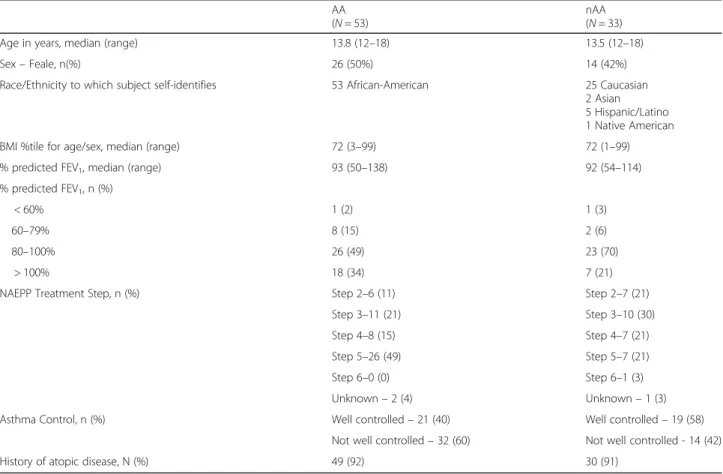
Fifty-four AA teens and 36 nAA teens with persistent asthma participated in the study. Fifty-two AA teens and 35 nAA teens completed both study visits. One AA teen and 3 nAA teens were receiving step 1 therapy despite a diagnosis of persistent asthma and were excluded from the analysis. The AA and nAA groups were similar in terms of age, sex distribution, BMI, % predicted FEV1,
and presence of atopy (Table1). Asthma severity for the two groups was approximated by treatment step, with
Table 1Subject Demographics
AA (N= 53)
nAA (N= 33) Age in years, median (range) 13.8 (12–18) 13.5 (12–18) Sex–Feale, n(%) 26 (50%) 14 (42%) Race/Ethnicity to which subject self-identifies 53 African-American 25 Caucasian
2 Asian 5 Hispanic/Latino 1 Native American BMI %tile for age/sex, median (range) 72 (3–99) 72 (1–99) % predicted FEV1, median (range) 93 (50–138) 92 (54–114)
% predicted FEV1, n (%)
< 60% 1 (2) 1 (3)
60–79% 8 (15) 2 (6)
80–100% 26 (49) 23 (70)
> 100% 18 (34) 7 (21)
NAEPP Treatment Step, n (%) Step 2–6 (11) Step 2–7 (21) Step 3–11 (21) Step 3–10 (30) Step 4–8 (15) Step 4–7 (21) Step 5–26 (49) Step 5–7 (21) Step 6–0 (0) Step 6–1 (3) Unknown–2 (4) Unknown–1 (3) Asthma Control, n (%) Well controlled–21 (40) Well controlled–19 (58)
85% of the AA group and 76% of the nAA group requiring Step 3 therapy or higher, indicating at least moderate per-sistent asthma in the majority of participants [7]. Eight AA and 5 nAA participants were receiving anti-IgE mono-clonal antibody therapy during the study period. At the baseline visit, 60% of AA teens and 42% of nAA teens had asthma that was not well controlled.
Reliability
Cronbach’s coefficient alpha was computed for both the AA and nAA groups at baseline and follow-up visits. Cronbach’s alpha of the ACT was 0.80 and 0.81 for the AA teens at baseline and follow-up visits, respectively. For the nAA teens, Cronbach’s alpha was calculated at 0.80 and 0.83 for baseline and follow up visits, respect-ively. Among those with stable asthma control during the study, ICC was 0.59 in the AA group (37 observa-tions) and 0.76 in the nAA group (19 observaobserva-tions).
Criterion and construct validity
The previously established cut point of ≤19 was associ-ated with a κof 0.43 in the AA group and 0.36 in the nAA group, consistent with moderate and fair agree-ment between physician and ACT assessagree-ment of asthma
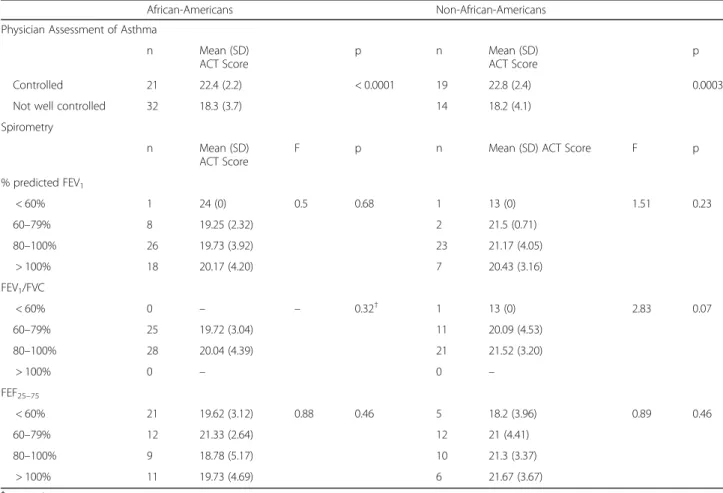
control, respectively [23,24]. These findings are compar-able to a recent systematic review and meta-analysis of studies examining the performance of the ACT [25]. To test construct validity, we compared the mean ACT scores for those with well controlled asthma to those with not well controlled asthma and found that in both AA and nAA teens, those with not well controlled asthma had sta-tistically significantly lower ACT scores than those with well controlled asthma (Table 2). For the AA group at baseline, mean ACT score difference was 4.13 (well con-trolled – not well controlled) (p< 0.0001). Similarly for the nAA group, the mean ACT score difference was 4.58 points (p= 0.0002). Baseline visit ACT scores were poorly correlated with baseline spirometry measurements in both AA and nAA teens (see Additional file1: Table S2 in the Online Repository).
Screening accuracy
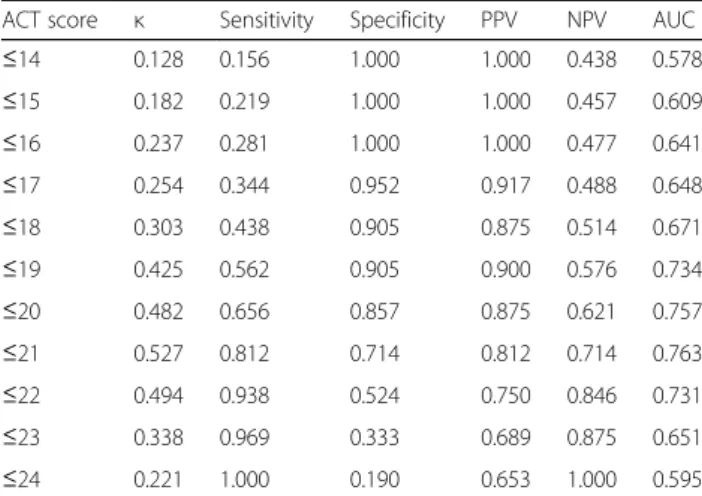
In AA teens, the currently recommended cut point score of≤19 to indicate not well controlled asthma showed re-duced sensitivity (56%) and NPV (58%) compared to pre-vious studies (Table3) [8,10]. A score of≤21 achieved the greatest area under the ROC curve at 0.76 with sensitivity and PPV of 81% and specificity and NPV of 71% (Fig.1).
Table 2Discriminant validity of the ACT at the first study visit in AA and nAA adolescents
African-Americans Non-African-Americans Physician Assessment of Asthma
n Mean (SD) ACT Score
p n Mean (SD) ACT Score
p Controlled 21 22.4 (2.2) < 0.0001 19 22.8 (2.4) 0.0003 Not well controlled 32 18.3 (3.7) 14 18.2 (4.1)
Spirometry
n Mean (SD) ACT Score
F p n Mean (SD) ACT Score F p % predicted FEV1
< 60% 1 24 (0) 0.5 0.68 1 13 (0) 1.51 0.23 60–79% 8 19.25 (2.32) 2 21.5 (0.71)
80–100% 26 19.73 (3.92) 23 21.17 (4.05) > 100% 18 20.17 (4.20) 7 20.43 (3.16) FEV1/FVC
< 60% 0 – – 0.32† 1 13 (0) 2.83 0.07 60–79% 25 19.72 (3.04) 11 20.09 (4.53)
80–100% 28 20.04 (4.39) 21 21.52 (3.20)
> 100% 0 – 0 –
FEF25–75
< 60% 21 19.62 (3.12) 0.88 0.46 5 18.2 (3.96) 0.89 0.46 60–79% 12 21.33 (2.64) 12 21 (4.41)
80–100% 9 18.78 (5.17) 10 21.3 (3.37) > 100% 11 19.73 (4.69) 6 21.67 (3.67)
Increasing the cut point to ≤21 improved the level of agreement between ACT and physician assessment, orκ, from 0.43 to 0.53. Similar to AA teens, for nAA teens a cut point score of≤21 provided the maximum area under the ROC curve at 0.79 with sensitivity and specificity of 79%, PPV of 73%, and NPV of 83% (Table4). Using≤21 as the cut point increasedκfrom 0.36 to 0.57.
Additionally, we conducted an analysis of baseline visit responses to each of the five ACT questions to deter-mine if particular questions were more or less predictive of not well controlled asthma (see Additional file1: Ta-bles S3 and S4 in the Online Repository). Within the AA group, we found that question 1 (“In the past 4 weeks, how much of the time did your asthma keep you from getting as much done at work, school or at home?”) and question 3 (“During the past 4 weeks, how often did your asthma symptoms (wheezing, coughing, shortness of breath, chest tightness or pain) wake you up at night or earlier than usual in the morning?”) had the best
screening properties for not well controlled asthma. We then examined the screening properties of every possible pair of ACT questions and again found that questions 1 and 3 produced the best results. At the baseline visit, a score of ≤9 for this “sub-test” amongst AA teens was 91% sensitive and 86% specific for not well controlled asthma, with an area under the ROC curve of 0.88. These findings were not replicated at the follow up visit for AA teens nor were similar results found at either visit for nAA teens.
Responsiveness to change
To determine the responsiveness of the ACT question-naire to changes in asthma control status over time, we calculated the correlation between change in ACT score and change in physician assessment of control between baseline and follow up study visits. Few participants ex-perienced a change in asthma control status during the study period. A small but statistically significant correl-ation was seen between change in ACT score and change in asthma control in AA teens (r= 0.29,p= 0.04) but not in nAA teens (r= 0.32, p= 0.08). Within the nAA group only, we identified a significant difference in mean change in ACT score between participants whose asthma improved, worsened, or stayed the same (F = 3.2, p= 0.05) (Table 5). Change in ACT score was significantly correlated with change in FEV1 (r= 0.53,
p= 0.002) and FEV1/FVC (r= 0.55, p= 0.001) in nAA
teens but not in AA teens (ΔFEV1, r= 0.11, p= 0.46 and ΔFEV1/FVC, r = 0.2, p= 0.15) (see Additional file 1:
Table S5 in the Online Repository).
Discussion
Standardized patient-reported questionnaires like the ACT allow providers to quickly assess asthma control in busy clinical practices. While previous studies have pro-vided evidence in support of the validity and reliability Table 3Screening accuracy of the ACT for not well controlled
asthma in African-American teens
ACT score κ Sensitivity Specificity PPV NPV AUC
≤14 0.128 0.156 1.000 1.000 0.438 0.578
≤15 0.182 0.219 1.000 1.000 0.457 0.609
≤16 0.237 0.281 1.000 1.000 0.477 0.641
≤17 0.254 0.344 0.952 0.917 0.488 0.648
≤18 0.303 0.438 0.905 0.875 0.514 0.671
≤19 0.425 0.562 0.905 0.900 0.576 0.734
≤20 0.482 0.656 0.857 0.875 0.621 0.757
≤21 0.527 0.812 0.714 0.812 0.714 0.763
≤22 0.494 0.938 0.524 0.750 0.846 0.731
≤23 0.338 0.969 0.333 0.689 0.875 0.651
≤24 0.221 1.000 0.190 0.653 1.000 0.595
0.0 0.2 0.4 0.6 0.8 1.0
0.0
0.2
0.4
0.6
0.8
1.0
False Positive Rate (1 − specificity)
T
rue P
ositiv
e Rate (sensitivity)
14
21
24
21
24
AA nAA
Fig. 1Receiver operating characteristic (ROC) curves generated from ACT scores from the first study visit for AA and nAA teens indicate a score of≤21 achieved the optimal balance of sensitivity and specificity for detection of not well controlled asthma and the largest area under the ROC curve
Table 4Screening accuracy of the ACT for not well controlled asthma in non-African-American teens
ACT score κ Sensitivity Specificity PPV NPV AUC
≤14 0.161 0.143 1.000 1.000 0.613 0.571
≤15 0.315 0.286 1.000 1.000 0.655 0.643
≤16 0.390 0.357 1.000 1.000 0.679 0.679
≤17 0.329 0.357 0.947 0.833 0.667 0.652
≤18 0.402 0.429 0.947 0.857 0.692 0.688
≤19 0.355 0.500 0.842 0.700 0.696 0.671
≤20 0.494 0.643 0.842 0.750 0.762 0.742
≤21 0.570 0.786 0.789 0.733 0.833 0.788
≤22 0.530 0.929 0.632 0.650 0.923 0.780
≤23 0.371 0.929 0.474 0.565 0.900 0.701
of the ACT for detecting suboptimal asthma control [8, 10, 25], information on how the test performs in ado-lescents and in ethnically diverse populations is lacking given concerns that the questionnaire may not be sensitive to how teenagers and minorities perceive asthma-related impairment. Because minorities and teens/young adults are already at higher risk of poor asthma outcomes, it is imperative to understand the value of the tools being used to drive management decisions in these groups, to avoid overestimating level of control and under-treating asthma. Our results suggest that the currently accepted ACT cut point score of ≤19 showed reduced accuracy com-pared to previous studies [8, 10, 25] in identifying asthma that is not well controlled in both AA and nAA adolescents. In both groups, use of a higher cut point score of ≤21 achieved the greatest area under the ROC curve and the best balance of sensitivity and specificity for identification of not well controlled asthma. That these results were seen in both AA and nAA groups sug-gests that a higher ACT cut point score may be neces-sary in adolescents. It is well established that children and adolescents are less accurate in describing their per-ceived asthma control [26–32], impacted by age and de-velopmental level. They may “normalize” their asthma symptoms and therefore not recognize them as being problematic, or they may minimize symptoms to avoid being categorized as different from their peers [33, 34]. Given these well documented differences in symptom perception and reporting, it seems logical to adjust the expectations of self-administered questionnaires that are based primarily on patient-reported data points. It is also important to emphasize that this is not a problem iso-lated to teenagers. In fact, using the childhood ACT (cACT) for children under 12 years, our group has pub-lished evidence that caregiver perception of asthma con-trol may be even more discrepent from physician assessment than teen perception [9].
Analysis of individual ACT questions demonstrates that certain elements of the assessment may be more predict-ive of uncontrolled asthma than others in AA teens, par-ticularly activity limitation and nighttime symptoms. This subtest requires further study to determine its potential utility as an adjunct measure of asthma control but em-phasizes the importance of considering cultural context in the design of standardized questionnaires. For example,
African-Americans with asthma may report less nighttime awakening and dyspnea, two symptoms that account for 20% of the ACT score [15, 26, 35]. This leads to under-reporting of symptoms, which reflects a false level of asthma control when queried by the ACT.
Our findings demonstrate acceptable levels of internal consistency reliability for both the AA and nAA teens at the group level; however, the reliability is below what is the recommended threshold for individual level assess-ment. This finding recognizes that there is a higher level of measurement error associated with the estimate that may caution providers to not solely rely on the ACT for determining asthma control. Further, the test-retest reli-ability of the ACT within the AA teen group was lower than the nAA teens. There should be some caution in overinterpreting the test-retest reliability as there was a 6–8 week time lapse between the baseline and follow up assessments; thus, patients’stable asthma control status could fluctuate and participants’memory of their control at baseline may be less clear.
Few participants experienced a change in level of asthma control, which was not surprising given the lack of an intervention and the brief 6–8 week study period. The responsiveness of the ACT to changes in asthma control was marginal in both AA and nAA adolescents. We found no significant correlation between change in ACT scores and change in asthma control status among nAA teens, with a small yet statistically significant cor-relation in AA teens. However, we found no difference in mean change in ACT scores between groups whose asthma worsened, improved, or remained stable in the AA group, suggesting that ACT scores do not signifi-cantly increase or decrease with improved or worsened asthma control, respectively. Interestingly, change in ACT score was strongly correlated with change in FEV1
and FEV1/FVC in nAA teens but very poorly correlated
in AA teens, despite similar median % predicted FEV1
between the two groups.
The ACT did not discriminate well between participants with higher lung function and those with lower lung func-tion, as seen in previous studies [8,10,36]. However, we recognize that in children especially, spirometry alone is often a poor measure of asthma control, since children often have normal spirometry despite poorly controlled asthma. Indeed in our study, the median %predicted FEV1
Table 5Responsiveness of the ACT to change in physician-assessed asthma control
African-American Non-African-American Physician Assessment Mean (SD) change
in ACT score
F p Physician Assessment Mean (SD) change in ACT score F p Worsened control (n= 4) −1.00 (3.56) 2.19 0.12 Worsened control (n = 5) 0.4 (2.07) 3.23 0.05 Unchanged (n= 37) 0.49 (3.66) Unchanged (n= 19) −0.32 (2.75)
for both AA and nAA teens was greater than 90%, despite a significant proportion of our subjects having asthma that was not well controlled.
The fair to moderate agreement (κ) between the ACT and NAEPP-based physician assessment of asthma con-trol is consistent with prior validation studies but, in our view, emphasizes the danger of relying too heavily on the ACT score for medical decision making. We argue that while the ACT using an optimized threshold score may be a useful screening tool, it should not replace a comprehensive physician assessment of control in the clinical setting. However, the context in which the ques-tionnaire is being used may impact its utility and the choice of cut point score. For example, when used in the clinical setting, a more sensitive cut point should be chosen to minimize false negatives (persons with asthma that is not well controlled whose ACT score indicates controlled disease). Conversely in the research setting if the goal is to recruit poorly controlled asthmatics, a cut point that maximizes specificity, reducing the rate of false positives, is desired to avoid recruiting well con-trolled asthmatics to the study.
Accurate assessment of asthma control requires evalu-ation of both of the essential elements that comprise control: impairment and risk of future exacerbations. Pediatric asthma is often associated with low levels of day-to-day impairment but excessive risk in the form of frequent exacerbations, often occurring with viral re-spiratory infections. The ACT primarily measures im-pairment and does not take into account elements that increase risk (such as history of exacerbations in the prior year, unscheduled healthcare visits or hospitaliza-tions for asthma), which may limit its utility in pediatric patients. The ACT also provides no mechanism to esti-mate asthma severity. The Composite Asthma Severity Index (CASI) takes into account impairment, exacerba-tions, controller medication requirement and lung func-tion to provide a more comprehensive evaluafunc-tion of asthma and to measure response to therapies [37]. A similar multipronged evaluation of asthma may be a bet-ter guide for stepping up or down treatment in clinical practice or for measuring asthma treatment responses in clinical research.
Our study has several limitations. The relatively small sample size increased the variance seen and did not allow us to explore sub-group differences by age (e.g., 12–15 years vs 16–18 years) to examine whether younger children had more challenges than older children in understanding the questionnaire or relating their asthma control experiences to answer the questions. All participants and their care-givers were required to speak English to participate in the study, which hindered recruitment of Latino children, an-other group at high risk of asthma-related morbidity. Our physician assessment of asthma control was binary (well
controlled vs not well controlled) in contrast to other stud-ies that incorporated terms such as “partly controlled”,
“somewhat controlled”, or “not at all controlled,” which may have limited our ability to assess the discriminant val-idity of the test. Few participants had a change in their asthma control status between the two study visits, which likely limits our ability to make inferences about respon-siveness of the ACT to change. While the AA and nAA teen groups were well matched in terms of age, sex, atopic status, BMI, and FEV1, the AA group contained a larger
proportion of participants on step 5 therapy or above com-pared to the nAA (49% vs 24%), suggesting increased asthma severity within the AA group. To address the possi-bility that our study populations may have contained a higher number of “poor perceivers” of asthma symptoms relative to the general adolescent population, we recruited from both general pediatrics clinics and subspecialty clinics in an effort to achieve more generalizable results. However, replication of this study in a larger group with a wider range of disease severity is needed before these findings can be applied to asthmatic teenagers in general.
Conclusions
We found some evidence for the validity of the ACT but not ideal levels of reliability for individual level assessment along with reduced sensitivity for detection of not well controlled asthma in adolescents with persistent asthma, independent of race. A higher threshold value to define asthma control improved the predictive properties of the ACT and requires further investigation. Additionally, AA teens’ scores were less responsive to change than nAA teens, suggesting that use of the ACT to detect changes in clinical status over time may be impaired in this popula-tion. While the ACT should be used to support the assess-ment of asthma control, it should not be relied upon as the sole indicator of control and should not replace the NAEPP-guidelines based physician assessment.
Additional file
Additional file 1:Table S1.Standardized asthma history obtained by study physicians at both study visits.Table S2.Correlation between baseline ACT score and spirometry measurements (as Pearson correlation coefficients).
Table S3.Screening accuracy of individual ACT questions for detection of not well controlled asthma in African-American adolescents.Table S4.Screening accuracy of individual ACT questions for detection of not well controlled asthma in non-African American adolescents.Table S5.Correlations between change in ACT score and change in spirometry measurements between study visits (as Pearson correlation coefficients). (DOCX 31 kb)
Abbreviations
Acknowledgements
We would like to thank the nursing staff of the NC State Park Scholars Children’s Specialty Clinic for their assistance with study visits.
Funding
This work was supported by the AAAAI/ARTrust Gail G. Shapiro Award. Dr. Zhou is supported by the following awards through the National Institute of Health: R01 ES021900, P01 CA142538, and P30 ES010126.
Availability of data and materials
The datasets analyzed during the current study are available from the corresponding author on reasonable request.
Authors’contributions
KT and MLH made substantial contributions ot the conception and design of the study. AJB, PHS, SI, KHM, LDM, MF, CEL and MLH all contributed significantly to the acquisition of data. AJB, JR, HZ, BBR, and MLH contributed to the analysis and interpretation of the data. All authors read and approved the final manuscript.
Ethics approval and consent to participate
This study was conducted in accordance with the Declaration of Helsinki and was approved by the University of North Carolina’s Biomedical Institutional Review Board (#14–1532, #15–1804). Written informed consent and assent were obtained from participating children and their guardians.
Consent for publication
Not applicable.
Competing interests
The authors declare that they have no competing interests.
Publisher’s Note
Springer Nature remains neutral with regard to jurisdictional claims in published maps and institutional affiliations.
Author details
1Division of Pediatric Allergy, Immunology and Rheumatology, University of
North Carolina, Chapel Hill, NC, USA.2Penn State Hershey Allergy, Asthma & Immunology, Hershey, PA, USA.3Department of Biostatistics, Gillings School
of Global Public Health, University of North Carolina, Chapel Hill, NC, USA.
4Naval Medical Center Portsmouth, Portsmouth, VA, USA.5Division of
Pediatric Pulmonology, University of North Carolina, Chapel Hill, NC, USA.
6Center for Environmental Medicine, Asthma and Lung Biology, University of
North Carolina, 104 Mason Farm Road, Chapel Hill, NC 27599-7310, USA.
7Sandhills Pediatrics, Southern Pines, NC, USA.8Department of Population
Health Sciences, Duke University School of Medicine, Durham, NC, USA.
Received: 27 June 2018 Accepted: 8 August 2018
References
1. Moorman JE, Rudd RA, Johnson CA, King M, Minor P, Bailey C, et al. National surveillance for asthma--United States, 1980-2004. MMWR Surveill Summ. 2007;56(8):1–54.
2. Akinbami LJ, Moorman JE, Bailey C, Zahran HS, King M, Johnson CA, et al. Trends in asthma prevalence, health care use, and mortality in the United States, 2001-2010. NCHS Data Brief. 2012;(94):1–8.
3. Silvers SK, Lang DM. Asthma in African Americans: what can we do about the higher rates of disease? Cleve Clin J Med. 2012;79(3):193–201. 4. Mayrides MRL. Ethnic disparities in the burden and treatment of asthma.
Washington, DC: Asthma and Allergy Foundation of America and National Pharmaceutical Council; 2005. p. 1–60.
5. Velsor-Friedrich B, Militello LK, Richards MH, Harrison PR, Gross IM, Romero E, et al. Effects of coping-skills training in low-income urban African-American adolescents with asthma. J Asthma. 2012;49(4):372–9. 6. Mammen JR, Rhee H, Norton SA, Butz AM. Perceptions and experiences
underlying self-management and reporting of symptoms in teens with asthma. J Asthma. 2017;54(2):143–52.
7. 3 EPR. Guidelines for the Diagnosis and Management of Asthma. 2007. Available from: https://www.nhlbi.nih.gov/health-topics/guidelines-fordiagnosis-management-of-asthma.
8. Schatz M, Sorkness CA, Li JT, Marcus P, Murray JJ, Nathan RA, et al. Asthma control test: reliability, validity, and responsiveness in patients not previously followed by asthma specialists. J Allergy Clin Immunol. 2006;117(3):549–56. 9. Todoric K, Bangdiwala S, Vadlamudi A, Alarcon L, Hernandez M. Assessing asthma
in African American children using the asthma control test and the childhood asthma control test. Ann Allergy Asthma Immunol. 2015;114(4):342–4. 10. Nathan RA, Sorkness CA, Kosinski M, Schatz M, Li JT, Marcus P, et al.
Development of the asthma control test: a survey for assessing asthma control. J Allergy Clin Immunol. 2004;113(1):59–65.
11. Leung TF, Ko FW, Sy HY, Wong E, Li CY, Yung E, et al. Identifying uncontrolled asthma in young children: clinical scores or objective variables? J Asthma. 2009;46(2):130–5.
12. Koolen BB, Pijnenburg MW, Brackel HJ, Landstra AM, van den Berg NJ, Merkus PJ, et al. Comparing global initiative for asthma (GINA) criteria with the childhood asthma control test (C-ACT) and asthma control test (ACT). Eur Respir J. 2011;38(3):561–6.
13. Shi Y, Tatavoosian AV, Aledia AS, George SC, Galant SP. Cut points for asthma control tests in Mexican children in Orange County. California Ann Allergy Asthma Immunol. 2012;109(2):108–13.
14. Raherison C, Tunon-de-Lara JM, Vernejoux JM, Taytard A. Practical evaluation of asthma exacerbation self-management in children and adolescents. Respir Med. 2000;94(11):1047–52.
15. Trochtenberg DS, BeLue R, Piphus S, Washington N. Differing reports of asthma symptoms in African Americans and Caucasians. J Asthma. 2008; 45(2):165–70.
16. Diette GB, Rand C. The contributing role of health-care communication to health disparities for minority patients with asthma. Chest. 2007;132(5 Suppl):802S–9S.
17. Okelo SO, Wu AW, Merriman B, Krishnan JA, Diette GB. Are physician estimates of asthma severity less accurate in black than in white patients? J Gen Intern Med. 2007;22(7):976–81.
18. Cloutier MM, Schatz M, Castro M, Clark N, Kelly HW, Mangione-Smith R, et al. Asthma outcomes: composite scores of asthma control. J Allergy Clin Immunol. 2012;129(3 Suppl):S24–33.
19. Nunnally JCB, I.H. Psychometric theory. 3 ed. New York: McGraw-Hill; 1994. 20. Aaronson N, Alonso J, Burnam A, Lohr KN, Patrick DL, Perrin E, et al.
Assessing health status and quality-of-life instruments: attributes and review criteria. Qual Life Res. 2002;11(3):193–205.
21. Reeve BB, Wyrwich KW, Wu AW, Velikova G, Terwee CB, Snyder CF, et al. ISOQOL recommends minimum standards for patient-reported outcome measures used in patient-centered outcomes and comparative effectiveness research. Qual Life Res. 2013;22(8):1889–905.
22. Koo TK, Li MY. A guideline of selecting and reporting Intraclass correlation coefficients for reliability research. J Chiropr Med. 2016;15(2):155–63. 23. McHugh ML. Interrater reliability: the kappa statistic. Biochem Med (Zagreb).
2012;22(3):276–82.
24. Landis JR, Koch GG. An application of hierarchical kappa-type statistics in the assessment of majority agreement among multiple observers. Biometrics. 1977;33(2):363–74.
25. Jia CE, Zhang HP, Lv Y, Liang R, Jiang YQ, Powell H, et al. The asthma control test and asthma control questionnaire for assessing asthma control: systematic review and meta-analysis. J Allergy Clin Immunol. 2013;131(3): 695–703.
26. Rhee H, Belyea MJ, Elward KS. Patterns of asthma control perception in adolescents: associations with psychosocial functioning. J Asthma. 2008; 45(7):600–6.
27. Horak E, Grassl G, Skladal D, Ulmer H. Lung function and symptom perception in children with asthma and their parents. Pediatr Pulmonol. 2003;35(1):23–8.
28. Cabral AL, Conceicao GM, Saldiva PH, Martins MA. Effect of asthma severity on symptom perception in childhood asthma. Braz J Med Biol Res. 2002; 35(3):319–27.
29. Baker RR, Mishoe SC, Zaitoun FH, Arant CB, Lucas J, Rupp NT. Poor perception of airway obstruction in children with asthma. J Asthma. 2000; 37(7):613–24.
31. Fritz GK, McQuaid EL, Spirito A, Klein RB. Symptom perception in pediatric asthma: relationship to functional morbidity and psychological factors. J Am Acad Child Adolesc Psychiatry. 1996;35(8):1033–41.
32. Mittal V, Khanna P, Panjabi C, Shah A. Subjective symptom perceptual accuracy in asthmatic children and their parents in India. Ann Allergy Asthma Immunol. 2006;97(4):484–9.
33. Santanello NC. Pediatric asthma assessment: validation of 2 symptom diaries. J Allergy Clin Immunol. 2001;107(5 Suppl):S465–72.
34. Eiser C, Morse R. Quality-of-life measures in chronic diseases of childhood. Health Technol Assess. 2001;5(4):1–157.
35. Trochtenberg DS, BeLue R. Descriptors and perception of dyspnea in African-American asthmatics. J Asthma. 2007;44(10):811–5. 36. Liu AH, Zeiger R, Sorkness C, Mahr T, Ostrom N, Burgess S, et al.
Development and cross-sectional validation of the childhood asthma control test. J Allergy Clin Immunol. 2007;119(4):817–25.