African Journal of Reproductive Health September 2018; 22 (3): 111
ORIGINAL RESEARCH ARTICLE
Knowledge and Attitudes of Women towards Human Papilloma
Virus and HPV Vaccine in Thulamela Municipality of Vhembe
District in Limpopo Province, South Africa
DOI: 10.29063/ajrh2018/v22i3.12
Dorah U. Ramathuba
1* and Doris Ngambi
2University of Venda, Thohoyandou, Limpopo Province1; Vhembe District, Primary Health Care Service, Limpopo Province2
*For Correspondence: Email: [email protected]; Phone: (+27) 15 962 8684, +27 82 303 965
Abstract
Human papillomavirus (HPV) is the most common sexually transmitted viral infection. HPV can cause cervical cancer and other cancers of the genitals, neck and throat. Two HPV vaccines are available, Cervarix and Gardasil, which are the first vaccines directed at the prevention of cervical cancer. The purpose of the study was to assess the knowledge of human papilloma virus and HPV vaccine among rural women in Vhembe district in Limpopo Province. A quantitative descriptive approach was adopted. The quantitative design enabled the discovery of more information by means of direct questioning of a sample of women 30years and older. A convenience sampling was used to select 1546 respondents. Data was analysed using the Statistical Package for Social Sciences. The findings revealed that (97.8%) of women lacked knowledge about Human Papilloma Virus and HPV vaccine and were also not aware of the transmission methods of HPV virus. Furthermore (94.3%) were not aware who was eligible for HPV vaccine and the age range for vaccination and (92.1%) displayed negative attitudes to the use of vaccines if given a pamphlet to let their daughters be immunized. The awareness on human papilloma virus and HPV vaccine among women in Vhembe district is limited. There is a need to educate and promote awareness on cervical cancer screening methods among women to reduce the burden of morbidity and mortality. (Afr J Reprod Health 2018; 22[3]: 111-119).
Keywords: Attitudes, Cervical cancer, Knowledge, Human Papilloma Virus, Human Papilloma Vaccine
Résumé
Le virus du papillome humain (VPH) est l'infection virale transmise sexuellement la plus commune. Le VPH peut causer le cancer du col de l'utérus et d'autres cancers des organes génitaux, du cou et de la gorge. Deux vaccins anti-VPH sont disponibles, Cervarix et Gardasil, qui sont les premiers vaccins destinés à prévenir le cancer du col utérin. L'objectif de cette étude était d'évaluer les connaissances sur le virus du papillome humain et le vaccin contre le VPH chez les femmes rurales du district de Vhembe. Une approche descriptive quantitative a été adoptée. La conception quantitative a permis de découvrir plus d'informations en interrogeant directement un échantillon de femmes de 30 ans et plus. Un échantillon de commodité a été utilisé pour sélectionner 1546 interviewées. Les données ont été analysées à l'aide du progiciel statistique pour les sciences sociales. Les résultats ont révélé que (97,8%) des femmes manquaient de connaissances sur le virus du papillome humain et le vaccin anti-HPV et n'étaient pas non plus au courant des méthodes de transmission du virus VPH. En outre (94,3%) ne savaient pas qui étaient éligibles pour le vaccin anti-HPV et la tranche d'âge pour la vaccination et (92,1%) affichaient des attitudes négatives vis-à-vis de l'utilisation des vaccins. La sensibilisation au virus du papillome humain et au vaccin contre le VPH chez les femmes du district de Vhembe est limitée. Il est nécessaire d‘éduquer et de sensibiliser les femmes aux méthodes de dépistage du cancer du col de l‘utérus afin de réduire le fardeau de la morbidité et de la mortalité. (Afr J Reprod Health 2018; 22[3]:111-119).
African Journal of Reproductive Health September 2018; 22 (3): 112
Introduction
The human papillomavirus can be transmitted through sexual contact and infects the anus and genitals causing precancerous lesions that increase the risks of cancer of the cervix, vulva, vagina, penis, anus, mouth or throat1. HPV is now being used within the cervical screening context around the world as a primary screening test and shows higher sensitivity in detecting cervical abnormalities than cytology2. In South Africa the Pap test screening recommended every 3 years for women aged 30yrs and above, has been introduced as a cervical cancer screening strategy, however the strategy did not make a desirable impact in reducing the morbidity and mortality of cervical cancer as the uptake of screening was low especially among blacks in rural areas3. A new strategy of HPV vaccination targeting young girls in primary schools has been included.
Dodd et al4 reported that a higher proportion of women from developed countries have heard of HPV testing, but this did not translate to greater knowledge about HPV testing. Studies world-wide have indicated that adults as well as adolescent have limited understanding of HPV, with some having not heard about HPV vaccine and the infection5-7 also reported an association between race and socioeconomic status with awareness of HPV and the HPV vaccine, with low awareness prevalence among non-Hispanic African Americans. South African rural communities are not exempted, majority of women have never heard about HPV as a risk factor to cervical cancer and lacked knowledge of other cancer preventive strategies as well as HPV vaccine.
A study conducted in urban South Africa indicated that lack of knowledge about cervical cancer and screening has been found to impede the screening programme in South Africa7. However, in Vhembe district of Limpopo there has not been any study undertaken to assess the knowledge, attitudes and acceptability of the vaccine.
Knowledge of cancer prevention strategies is of paramount importance as knowledge may increase uptake, thereforethe study assessed the knowledge of human papilloma virus and HPV vaccine among rural women in Vhembe district in Limpopo Province.
The vaccines, Gardasil and Cervarix, became available and were registered by the United States Food and Drug Administration (FDA) in 2006 and similarly in South Africa by the Medicines Control Council (MCC) in 2006, however its roll-out was delayed until 2015 in rural primary schools of Limpopo. Gardasil also known as Silgard is a vaccine proven to prevent certain types of HPV, specifically HPV types 6, 11, 16, and 18. HPV types 16 and 18 are currently associated with about 70% of cervical, 26% of head and neck and many vulvas, vaginal, penile and anal cancer cases, HPV types 6 and 11 are associated with about 90% of anogenital warts cases1, 8. However the roll-out of these drugs in the rural health care facilities are still lagging, roll-out is being done in schools but no adequate information about efficacy is been given to the community to change their attitudes and perceptions so as to improve its uptake. Similarly, Cassidy and Schlenk7 report that if women lack the necessary information in this regard it will translate negatively to having their daughters immunized. Furthermore, Pandey et al9 reported that the major obstacles to implementation of HPV vaccine programs in various countries may be related to cost, acceptability, lack of public awareness and infrastructure concerns.
African Journal of Reproductive Health September 2018; 22 (3): 113 vaccine coupled with information dissemination
and targeting population at risks such as rural communities.
Methods
A quantitative cross- sectional survey was employed in Vhembe district where 1546 women 30years and above were recruited from the four clinics to participate in the study between June and August 2015. Most participants were black women of Vha-Venda and Vatsonga ethnic groups, the mean age was 41years. Most had secondary education and were mostly unemployed. Data was collected through self- reporting questionnaires, interested women were given a package of information leaflet and consent together with the questionnaire, and a free space was provided to increase participant privacy, prevent distraction and encourage honest responses, thereafter the questionnaires were collected by the researcher and research assistant. The study was approved by the University of Venda research ethics committee (SHS/14/PDC/05/1809). Data was analysed by means of frequencies to summarize background characteristics, HPV awareness, and knowledge about HPV vaccine. The validity and reliability of the instrument used in this study was determined by checking the items in the data collection instrument against the research objective to determine if they measured all the variables of interest in the study. Pilot was done to ascertain if participants understood the questions in similar ways to ensure reliability.
Results
A total of 1600 women aged 30yrs and above were recruited from the clinics in Vhembe and 1546 completed the questionnaire, 336 (21.7%) were aged 30-35, 490 (31.7%) were 36-40yrs and 720(46.6%) were 41years and above. Majority 886 (57.3%) were married, 488 (31.6%) were single, 12 (7.2%) widows and 60 (3.9%) divorced.
Educational achievement, 140 (9.1%) never attended school, 558(36.1%) had grade 1-7, while 600 (38.8%) had grade 8-11 and 248 (16.0%) had grade 12. Majority 1292 (83.6%) were unemployed and 254(16.4%) were employed but not professionally.
Results on having heard about HPV are shown Figure 1. The results indicate that only 246 (25.9%) of the respondents had heard about HPV and the majority, 1146 (74.1%) had not heard about HPV.
The results confirmed that the majority 1312 (85%) did not know how the virus was transmitted, 149 (9.6%) indicated transmission through sexual contact, 51 (3.2%) reported through kissing and 34 (2.1%) by not condomising.
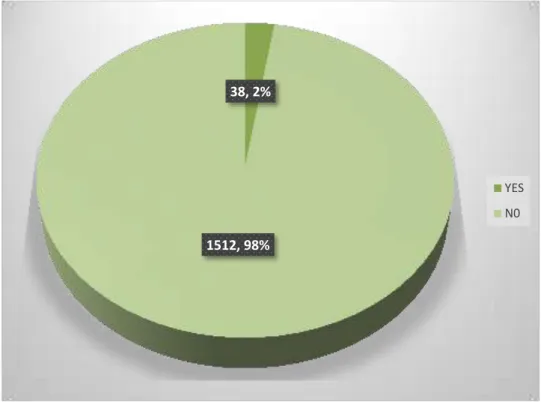
The results (Figure 3) showed that most of the respondents, 1512 (97.5%) did not know that HPV caused cervical cancer, only 38 (2.5%) of the respondents indicated that HPV caused cervical cancer.
Regarding knowledge of HPV and HPV vaccine the findings revealed that the respondents had limited information on who gets infected with HPV, only a minority 32 (2.1%) had knowledge that both sexes can get infected with HPV and majority of respondents had no knowledge. The results revealed that 1410 (91.2%) of respondents did not know about the HPV vaccine and only136 (8.8%) had heard about the HPV vaccine. The results indicated lack of knowledge about vaccine. Furthermore, majority of the respondents, 1440 (93.1%) indicated that they did not know the age range, 50 (3.2%) indicated age range 9 to 26, 28 (1.8%) indicated age range 26 to 40, and another 28 (1.8%) indicated age range 41 to 50. The results confirmed lack of knowledge among respondents about HPV vaccine.
African Journal of Reproductive Health September 2018; 22 (3): 114
Figure 1: Distribution of women in Limpopo province, South Africa according HPV information
Figure 2: Distribution of women in Limpopo province, South Africa on cervical cancer virus transmission methods 400, 26%
1146, 74%
YES
N0
85.10%
9.60%
3.20% 2.10%
0.00% 10.00% 20.00% 30.00% 40.00% 50.00% 60.00% 70.00% 80.00% 90.00%
Do not know Sexual
Intercourse
Kissing Not using
condoms
Distribution of respondents on cervical cancer virus
African Journal of Reproductive Health September 2018; 22 (3): 115
Figure 3: Respondents‘ view on the causative effect of HPV in cervical cancer
indicated males and then 26 (1.7%) indicated both female and male eligible. The results showed that most of the respondents did not know who was eligible for HPV vaccine. Again, the respondents‘ willingness to allow their daughter to receive HPV vaccine when given a pamphlet on HPV vaccine information, was also a cause for concern as majority 1424 (91.2%) were not certain or undecided, which reflects lack of knowledge. As for the highest level of education attained, X2 (3, N=1546) =17.297, p<0.001, statistics indicated a significant association between the two variables. Cross-tabulation results also showed that 60% of the respondents whose level of education was Grades 1 to 7 were more likely not to be worried about contracting HPV than 40% of the respondents who attained Grade 12 and above. It could be tentatively concluded that age range, highest level of education attained were significantly associated with knowledge of HPV.
Discussion
Women need to understand the link between HPV and cervical cancer to make appropriate, evidence-based choices among existing prevention strategies such as Pap test, HPV test, and HPV vaccine11. The study assessed knowledge of HPV among women aged thirty and above, findings revealed that the majority 1146 (74.1%) of the women had never heard about HPV, only 400 (25.8%) of the women had heard about HPV. This is an indication that many of the respondents did not have any information about HPV, which places them at risk of contracting the virus. This also indicates that health information is poorly disseminated or lacking in the rural communities. The findings established that the majority (97.8%) of the women, had no knowledge that HPV caused cervical cancer with only 35 (2.2%) having knowledge. The limited number having knowledge
38, 2%
1512, 98%
YES
African Journal of Reproductive Health September 2018; 22 (3): 116 Table 1: Knowledge regarding HPV and HPV vaccine
among women in Limpopo Province, South Africa
Distribution of respondents according to who gets infected by HPV
Responses Frequency (n=1546)
Do not know 1314 (85%) Women only 196 (12.7%) Both men and women 32 (2.1%) Men only 4 (0.3%)
Total 1546 (100%)
Distribution of respondents according to information about HPV vaccine
Responses Frequency (n=1546)
No 1410 (91.2%)
Yes 136 (8.8%)
Total 1 546 (100%)
Distribution of respondents on the recommended age group for HPV vaccine
Do not know 1440 (93.1%)
9 to 26yrs 26 to 40yrs 41 t0 50yrs
50 (3.2%) 28 (1.8%) 28 (1.8%)
Total 1546 (100%)
Distribution of respondents on willingness to allow their daughters to receive HPV vaccine when given pamphlet
Not sure 1424 (92.1%)
No 2 (0.1%)
Yes 120 (7.8%)
Total 1546 (100%)
is not convincing because knowledge does not translate to action, respondents may have knowledge but not have taken a test in their lifetime or requested it when accessing the health services, knowledge should translate to taking responsibility. Furthermore, women were not sure about who gets infected by the HPV, eighty five per cent lacked knowledge of who were likely to be infected with HPV, 196 (12.7%) indicated that only women were likely to be infected, 32 (2.1%) indicated that both men and women were likely to be infected by HPV and 4 (0.3%) indicated that only man could be affected by HPV. The result showed the precarious position regarding HPV infection prevailing among women population in the Thulamela Municipality villages. HPV is a sexually transmitted infection, and 1312 (85.1%) women had no knowledge while (9.6%) indicated that it is transmitted through sexual contact, 51
African Journal of Reproductive Health September 2018; 22 (3): 117 having received at least one vaccine dose,
demonstrated low HPV knowledge, as the vaccine was widely publicised as ‗the cervical cancer vaccine‘ rather than the HPV vaccine. The findings concur with the situation in Vhembe that lack of knowledge is attributed to the fact that HPV vaccine was not available in rural clinics of Limpopo and only recently became available after the initiation of roll-out of vaccines was done at primary schools. Parents may have heard about the vaccines as consent forms were distributed to children to give to their parents to sign and return to school. This raises a concern of informed consent as parents were not informed adequately, to get information and in turn asks questions for clarity. The availability of these vaccines is still a problem and not all primary schools were covered, which raises the issue of sustainability. Pandey et al9 indicated that vaccine is a new concept, awareness and education is important in the implementation of this strategy by targeting health care professionals to foster vaccine acceptance. The school health service and nurses should intensify health education campaigns in communities targeting adolescents, women and men so that they understand the etiology of cervical cancer and its association with sexually transmitted infections as well as preventative measures (screening tests).
A similar study in China indicated that many participants (90%) were totally unaware of HPV and could not link HPV and cervical cancer17. Another study conducted in Tshwane community also reported that long-term use of oral contraceptives, smoking, and multiparity can double and even triple the risk of women infected with oncogenic type HPV to develop cervical cancer3. Cultural norms such as early marriage and polygamous marriage, socio-economic factors as well as poverty also increase the risk of cervical cancer 2. The women in this study lacked knowledge about cervical cancer, HPV and HPV vaccine. Moreover, majority of women in the study had four children and above which places them at
risk of cervical cancer, and the fact that their relations or union are of a polygamous nature in the rural communities of Vhembe.
Furthermore, the results indicated a significant association between knowledge of HPV and age range of respondents. Comparatively, 33% of the women aged 40 and below were likely to be knowledgeable about HPV to 67% of the women aged 41 and above confirmed lack of knowledge on HPV. However, it is important to keep in mind that greater awareness and knowledge of HPV may not necessarily translate into HPV prevention behaviors as these women are sexually active, and at risk of contracting HPV viruses. A strong association between knowledge of HPV and highest level of education was also observed. From the cross-tabulation results, 60% of the respondents with level of education Grades 1 to 7 were more likely not to be worried about contracting HPV than 40% of the respondents who attained Grade 12 and above. These results show that the worriedness of contracting HPV was more likely to increase with the level of education one possessed. Gerend et al 6also asserts that awareness and knowledge of HPV are likely to be higher in university populations than in the general population.
African Journal of Reproductive Health September 2018; 22 (3): 118 to 75% as compared to before reading the
information sheet where 55% were in favour of vaccinating their children, 23% were opposed, and 22% were undecided. Haesebaert et al.19 reported that mothers trust information from physician and health care providers about vaccination, and mothers who were provided with HPV vaccine information were significantly more likely to intend to vaccinate their daughters than those who did not receive such information.
Recommendations
The issue of women‘s health is of paramount importance in reducing cervical cancer morbidity and mortality. Health workers should be fully immersed in health education and health promotion as providers of information, dispelling myths and beliefs surrounding cervical cancer. Incorporating community-based carers and community radio stations to educate women and reinforce regular screening.
Governments and policy makers need to put more effort in providing resources to increase the uptake of vaccination, screening and co-ordinating further checks to confirm cervical lesions for histology.
Conclusion
The study confirms that there is still a lack of information or access to information about HPV and that more needs to be done to raise awareness of HPV and HPV vaccination especially amongst rural poor communities. It is important that health professionals provide comprehensible information about HPV and health related diseases and screening test. The findings highlight the need to increase education regarding cervical cancer, HPV and HPV vaccination.
Acknowledgements
The researchers are grateful to the women who participated in the study and the health
professionals who assisted with data collection.
Competing Interest
The authors declare that they have no financial or personal relationship(s) that may have inappropriately influenced them in writing this article.
Contributions
DUR, conceptualized the study and DN collected data, drafted the initial manuscript and both worked on the final manuscript.
References
1. Kessels SJM, Marshalla HS, Watsone M, Braunack-Mayera AJ, Reuzel R and Toohera RL. Factors associated with HPV vaccine uptake in teenage girls: A systematic review. Vaccine 2012, (30):3546–56 2. Reitera PL, McReea A, Kadisa JA, and Brewera, NT. HPV
vaccine and adolescent males. Vaccine 29 (2011) 5595– 5602
3. Maree J, Lu X and Wright S. Cervical cancer: South African women's knowledge, lifestyle risks and screening practices. Africa Journal of Nursing and Midwifery 2015, 14(2): 104-115
4. Dodd RH, McCaffery KJ, Marlow LAV, Ostini R, Zimet GD and Waller J. Knowledge of human papillomavirus (HPV) testing in the USA, the UK and Australia: an international survey. Sexually Transmitted Infections 2014, (90):201–7. doi:10.1136/sextrans-2013-051402
5. Bowyer HL, Marlow LA, Hibbitts S, Pollock KG and Waller J. Knowledge and awareness of HPV and the HPV vaccine among young women in the first routinely vaccinated cohort in England. Vaccine 2013(31): 1051–56
6. Gerend MA, Zita F and Magloire BS. Awareness, Knowledge, and Beliefs about Human Papillomavirus in a Racially Diverse Sample of Young Adults. Journal of Adolescent Health2008, (42):237–242
7. Cassidy B and Schlenk EA. Uptake of the Human Papillomavirus Vaccine: A Review of the Literature and Report of a Quality Assurance Project. Journal of Pediatric Health Care Volume 26 (2) doi:10.1016/j.pedhc.2010.06.015
African Journal of Reproductive Health September 2018; 22 (3): 119 papillomavirus (HPV) vaccination in Indonesia: a
cross-sectional study. Vaccine 2011, 29(44):7785-93.
9. Pandey D, Vanya V, Bhagat S, Binu VS and Shetty J. Awareness and Attitude towards Human Papillomavirus (HPV) Vaccine among Medical Students in a Premier Medical School in India. PLoS
ONE 2012, 7(7): e40619.
doi:10.1371/journal.pone.0040619
10. Tomljenovic L and Shaw CA. Human papillomavirus (HPV) vaccine policy and evidence-based medicine: Are they at odds? Annals of Medicine, Early Online, 2011; 1–12
11.Tiro JA, Meissner HI, Kobrin S and Chollette V. What do women in the U.S. know about human papillomavirus and cervical cancer? Cancer Epidemiol Biomarkers Prev. 2007, 16 (2):288-94. 12. Giamb C, D‘Ancona F, Del Manso M, De Mei B,
Giovannelli I, Cattaneo C, Possenti V, Declich S. and Local Representatives for VALORE Exploring reasons for non-vaccination against human papillomavirus in Italy. BMC Infectious Diseases 2014, (14):545
13. Dubai SAR, Alshagga MA, Naggar RA, Al-Jashamy K, Baobaid MF, Tuang CP and Ab Kadir SY. Knowledge, Attitudes and Barriers for Human Papilloma Virus (HPV) Vaccines among Malaysian Women. Asian Pacific J Cancer Prevention 2010, (11): 887-92
14. Wong LP. Young multi-ethnic women‘s attitudes toward the HPV vaccine and HPV vaccination. International Journal Gynaecology and Obstetrics, 2008; 103, 131-5.
15.Moreira ED, Oliveira B, Ferraz, FM, Costa S, Costa Filho JO and Karic G. Knowledge and attitudes about human papillomavirus, Pap smears, and cervical cancer among young women in Brazil: implications for health education and prevention. International Journal of Gynaecological Cancer, 2006, (16): 599-603.
16. Donders GG, Gabrovska M, Bellen G, Van Keirsbilck J, Van Den Bosch T, Riphagen I and Verjans M. Knowledge of cervix cancer, Human Papilloma Virus (HPV) and HPV vaccination now of introduction of the vaccine in women in Belgium. Archives Gynecological Obstetrics, 2008, (277): 291-8.
17. Abudukadeer A, Azam S, Mutallipu AZ, Qun L, Gulin G and Mijiti S. 2015. Knowledge and attitudes of Uyghur women in Xinjiang Province in China related to the prevention and early detection of cervical cancer. World Journal of Surgical Oncology 2015, (13):110
18. Zimet GD. Improving adolescent health: Focus on HPV vaccine acceptance. Journal of Adolescent Health 2005, (37): S17–S23