African Journal of Reproductive Health December 2018; 22 (4):102
ORIGINAL RESEARCH ARTICLE
Postpartum Sexual Abstinence and its Implications for Under-Five
Health Outcome among Childbearing Women in South-east Nigeria
DOI: 10.29063/ajrh2018/v22i4.11
Chukwuechefulam K. Imo
1,2*, Ethelbert Okoronkwo
3,
Vitalis Ukoji
4and Chidi Mbah
5Demography and Population Studies Programme, Schools of Public Health and Social Sciences, University of the Witwatersrand, Johannesburg, South Africa1; Department of Sociology, Adekunle Ajasin University, Akoko-Akungba, P. M. B. 001, Ondo State, Nigeria2; Department of Sociology/Psychology/Sociology/Criminology & Security Studies, Federal University Ndufu-Alike, Ikwo, Ebonyi State, Nigeria3; Department of Sociology, Nigerian Police Academy, Wudil, Kano State, Nigeria4; Department of Sociology, Abia State University, Uturu, Abia State, Nigeria5
*For Correspondence: Email: [email protected]; Phone: +2348069226978
Abstract
Abstinence from sexual intercourse after childbirth is a common practice deeply rooted in the cultures of different communities, including Nigeria with varying duration. Despite the high level of postpartum abstinence in the South-east compared to other neighbouring regions of Nigeria, under-five mortality is relatively higher in the South-east. This paper examined postpartum sexual abstinence as a predictive factor for under-five health outcome in Abia State with data from a sample of 609 childbearing women within 15-49 years. The mean duration of postpartum abstinence was 3.1±1.5 months; shorter in rural than urban areas with 2.7±1.4 and 3.5±1.3 months, respectively. The months of abstinence from sexual activity after childbirth is significantly related to experiences of under-five mortality and childhood diseases (p<0.05). The qualitative data showed that period of abstinence from sexual activity after childbirth is rooted in culture and was alluded to have great influence on under-five health outcomes. It is concluded that most women resumed sexual activity early after childbirth mostly to secure their marriages which affect their under-five children‘s health. Proper guidelines on resumption of sexual activity after childbirth to avoid its negative effects on under-five health outcome should be instituted to facilitate the achievement of sustainable development. (Afr J Reprod Health 2018; 22[4]: 102-112).
Keywords: Sexual behaviour, reproductive health, cultural practices, health consequences
Résumé
L'abstinence des relations sexuelles après l'accouchement est une pratique courante profondément enracinée dans les cultures de différentes communautés, y compris le Nigéria, et pour des durées variables. En dépit du niveau élevé d'abstinence post-partum dans le sud-est par rapport aux autres régions voisines du Nigéria, la mortalité des moins de cinq ans est relativement plus élevée dans le sud-est. A partir des données d'un échantillon de 609 femmes en âge de procréer âgées de 15 à 49 ans, ce document examine l'abstinence sexuelle postnatale en tant que facteur prédictif de l'évolution de l'état de santé des enfants de moins de cinq ans dans l'État d'Abia. La durée moyenne de l'abstinence post-partum était de 3,1 ± 1,5 mois; plus courtes dans les milieux ruraux que dans les milieux urbains avec 2,7 ± 1,4 et 3,5 ± 1,3 mois, respectivement. Les mois d'abstinence sexuelle après l'accouchement sont significativement liés aux expériences de mortalité des moins de cinq ans et de maladies infantiles (p <0,05). Les données qualitatives ont montré que la période d‘abstinence sexuelle après l‘accouchement est enracinée dans la culture et qu‘elle aurait une grande influence sur les résultats de santé des enfants de moins de cinq ans. On en conclut que la plupart des femmes ont repris leurs activités sexuelles tôt après l‘accouchement, principalement pour sécuriser leurs mariages qui affectent la santé de leurs enfants de moins de cinq ans. Des directives appropriées sur la reprise de l'activité sexuelle après l'accouchement afin d'éviter ses effets négatifs sur les résultats pour la santé des enfants de moins de cinq ans, devraient être mises en place pour faciliter la réalisation du développement durable. (Afr J Reprod Health 2018; 22[4]: 102-112).
African Journal of Reproductive Health December 2018; 22 (4):103
Introduction
Postpartum abstinence refers to the period of voluntary sexual inactivity after childbirth and is mainly a period when a nursing and breastfeeding mother is expected to keep away from the husband sexually1. In the cultures of the east, South-south and South-west Nigeria, it is a taboo to engage in sexual intercourse with a woman who has just given birth2. During this period, the body of the woman is said to be ―wet‖ and needs to settle down properly and dry up. Also, it is believed that seminal fluid or ejaculate of the man would go directly into the breast milk which is considered injurious to the infant3, while the woman herself is said to be well predisposed to infection through infected men4. It has been observed that abstinence from sexual intercourse after childbirth is a common practice that is deeply rooted in the cultures of different communities worldwide with varying duration and almost all women desire to delay or prevent their next pregnancy for two years5. It has been reported that within the first year after delivery, only 68% of women who could become pregnant are using a modern form of contraception6. Postpartum period is especially critical for newborns and mothers as most deaths of mothers and babies occur within this period7-8. It is an ideal time to deliver interventions that improve the health and survival of both the newborn and mother. There are evidences that young and postpartum women who desire more children have expressed worries about contraceptive side-effects, infertility, thus reinforcing the burden of misinformation and misperceptions5,9-12.
African women tend to follow established community norms and traditions in making decisions that influence resumption of sexual intercourse after giving birth13. Early initiation of sexual intercourse was observed in women who had spontaneous vaginal delivery and in those who stayed at home with their mothers, then in-laws and aunts14. Mothers who earned more money had early resumption of sexual intercourse during their postpartum period compared to those who earned
less money15-16. In addition, it has been revealed that age of the child and parity are associated with early resumption of sexual intercourse as postpartum women with few children resume sexual intercourse earlier than women who had many children17-18.
Globally, every day more than 26,000 children under the age of five die around the world; and nearly all of them, live in developing countries19. More than one-third of these children die during the first month of life, usually at home and without basic attention that might save their lives. In Nigeria, the infant mortality rate was 69 per 1,000 live births for the five years preceding the 2013 NDHS, the child mortality rate was 64 per 1,000 children surviving to age 12 months, and under-5 mortality rate was 128 per 1,000 live births 1. This implies that one in 15 Nigerian children die within 12 months and one in eight die before their fifth birthday. In spite of the high level of postpartum abstinence in the South-east (4.6) compared to South-west (3.8) and South-south (3.7) of Nigeria, under-5 mortality is relatively higher in the South-east with 131 per 1000 live births, which includes Abia State, compared to South-south with 91 per 1000 live births and South-west with 90 per 1000 live births1. This is far above the Sustainable Development Goals (SDGs) targets of 25 under-five deaths per 1,000 live births by 2030.
Understanding the mothers‘ sexual behaviour that is inimical to child survival can be very helpful in reducing under-five mortality in Nigeria. It is evident from the above reviewed studies that adequate social research attention has not been given to the issues of postpartum sexual abstinence which plays a vital role in a child‘s health outcome in the South-eastern Nigeria. It is against this background that this study explores postpartum sexual abstinence among childbearing women as a predictor of under-five children health outcome in Abia State.
African Journal of Reproductive Health December 2018; 22 (4):104 observed that the chances for child survival are
influenced by several variables which include maternal socioeconomic factors through demographic variable like methods of breastfeeding20. On the other hand, socio-ecological model provides a set of conceptual and methodological principles, drawn largely from systems theory21. The model is unique in the study of mortality because it takes into account the physical environment and its relationship to people at intrapersonal, interpersonal, organizational, community, and public policy levels that help individuals make health choices in their daily lives. The main focus of the socio-ecological model is not on the individuals who are making specific health-significant decisions, but how to promote healthy behaviours.
Methods
Study sample and selection process
The study utilized an exploratory design involving social survey with asample size of 609 women of childbearing age 15 – 49 years, who had given birth to at least one child in the last five years that preceded the study. The sample size was calculated using Cochran‘s statistical formula for calculating minimum sample proportion. The minimum sample size needed to estimate the prevalence of under-five mortality to within 5% of the estimate of 157 per 1,000 (NPC and ICP Macro, 2009), at a 5% level of significance was derived using the formula below:
N= (Zα)² × pq
d² where N = Minimum sample
Zα = Standard score: 1.96 (Assuming a level of error of 5%)
p = Prevalence of outcome measure: 0.157 (under-five mortality)
q = 1-p = 1-0.157 = 0.843
d = Absolute deviation: 5% = 0.05 (this mean that the estimate for under-five mortality is within 5% from the assumed true rate); assuming a prevalence rate of 50%
N = 203 × 100
50 N = 406.
The sample size for the study was increased by 50% (N= 609) to allow for statistical analysis of different variables and direct estimation of mortality in the study area. A multi-stage sampling technique was adopted in selecting the sample size drawn from the three Senatorial Districts of Abia State, Nigeria (Abia North, Abia Central and Abia South). The respondents were selected using the simple random selection of two Local Government Areas (LGAs) each from the three Senatorial Districts. There was a simple random sampling of six roads/streets each from the urban centres and three communities each from the rural areas, using the lists provided from each of the LGAs. The final stage of the procedure was the purposive selection, from a selected building, of a woman who had given birth to at least one child in the last five years that preceded the study.
Data collection and analyses
African Journal of Reproductive Health December 2018; 22 (4):105 sorted and codified with the major themes as well
as the use of verbatim quotation. Also, some of the interview data were collected in Ibo language, transcribed and translated into English language with the aim to discuss holistically the generated results from the interview data in comparison with quantitative data.
Results
Socio-demographic Characteristics of the
Respondents by Residence
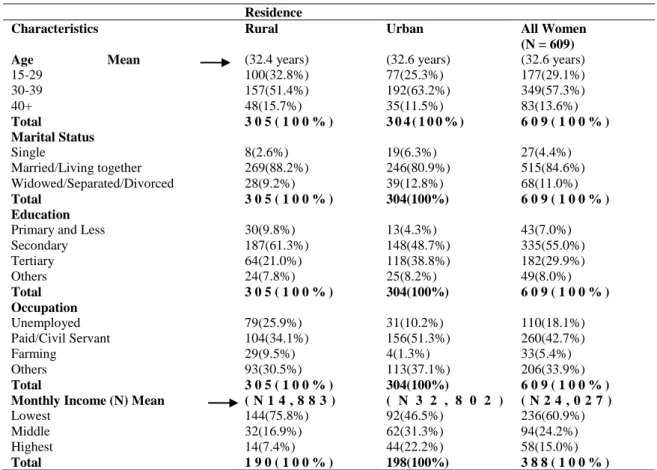
The socio-demographic characteristics of the respondents as displayed in Table 1 showed that the mean age of the respondents was 32.6±5.8 years with little variation by place of residence. This is an indication that most women in the sample were in the prime child bearing age. The majority of the respondents (84.6%) were married and living together with their spouses. Data on educational attainment revealed that the largest proportion of the respondents (55.0%) had secondary education followed by 29.9% with tertiary education with significant variation between urban and rural residents. Generally, the largest proportion the women (42.7%) were found in paid/civil service jobs. More rural respondents (25.9%) were unemployed compared to 10.2% of their urban counterparts. Only 5.4% of the respondents engaged in farming. In all, a good number of the respondents belonged to the middle income level, while rural dwellers belonged to the lowest compared to their urban counterparts who were found in the highest income level. The disparity in the mean monthly income of the respondents in the areas is expected as a result of the gap in educational attainment and occupation of rural and urban respondents.
Respondents’ postpartum abstinence and
previous under-five health experience
Table 2 shows postpartum abstinence and previous under-five health experience of the respondents. The respondents‘ mean duration of postpartum abstinence was 3.1±1.5 months; shorter in rural
areas (2.7±1.4 months) than urban areas (3.5±1.3 months). The majority of the respondents (63.9%) reported to have abstained from sexual intercourse after child birth before the sixth month. It was revealed that rural dwellers were 22.5% more likely than urban residents to abstain from sexual activity before the sixth month after their delivery. The period of time a woman stays away from her husband sexually after childbirth might depend on the nature of her job and the understanding between the couples. This is supported by the submissions made by rural respondents during in-depth interviews, thus: -
....it is our culture to abstain from sexual activity after childbirth for a period of time. Once I consider myself clean and strong, I have sex with my husband within the first two months of childbirth. Besides, I am not working for now and if l should say no to my husband‘s sexual overture, he might suspect me. So the understanding between the couple is important in this situation (Rural IDI, respondent aged 24, Umuahia South LGA).
Another rural respondent reported:
...in most cases, it becomes difficult as a woman to negotiate time to indulge in sexual activity with your partner when the woman does not do anything, but stays at home (Rural IDI, respondent aged 32, Bende LGA).
African Journal of Reproductive Health December 2018; 22 (4):106
Table I: Socio-demographic characteristics by childbearing women in South East, Nigeria
Residence
Characteristics Rural Urban All Women
(N = 609) Age Mean
15-29 30-39 40+
Total
(32.4 years) 100(32.8%) 157(51.4%) 48(15.7%)
3 0 5 ( 1 0 0 % )
(32.6 years) 77(25.3%) 192(63.2%) 35(11.5%)
3 0 4 ( 1 0 0 % )
(32.6 years) 177(29.1%) 349(57.3%) 83(13.6%)
6 0 9 ( 1 0 0 % ) Marital Status
Single
Married/Living together Widowed/Separated/Divorced
Total
8(2.6%) 269(88.2%) 28(9.2%)
3 0 5 ( 1 0 0 % )
19(6.3%) 246(80.9%) 39(12.8%)
304(100%)
27(4.4%) 515(84.6%) 68(11.0%)
6 0 9 ( 1 0 0 % ) Education
Primary and Less Secondary Tertiary Others
Total
30(9.8%) 187(61.3%) 64(21.0%) 24(7.8%)
3 0 5 ( 1 0 0 % )
13(4.3%) 148(48.7%) 118(38.8%) 25(8.2%)
304(100%)
43(7.0%) 335(55.0%) 182(29.9%) 49(8.0%)
6 0 9 ( 1 0 0 % ) Occupation
Unemployed Paid/Civil Servant Farming
Others
Total
79(25.9%) 104(34.1%) 29(9.5%) 93(30.5%)
3 0 5 ( 1 0 0 % )
31(10.2%) 156(51.3%) 4(1.3%) 113(37.1%)
304(100%)
110(18.1%) 260(42.7%) 33(5.4%) 206(33.9%)
6 0 9 ( 1 0 0 % ) Monthly Income (N) Mean
Lowest Middle Highest
Total
( N 1 4 , 8 8 3 )
144(75.8%) 32(16.9%) 14(7.4%)
1 9 0 ( 1 0 0 % )
( N 3 2 , 8 0 2 )
92(46.5%) 62(31.3%) 44(22.2%)
198(100%)
( N 2 4 , 0 2 7 )
236(60.9%) 94(24.2%) 58(15.0%)
3 8 8 ( 1 0 0 % )
I resorted to personal remedies whenever I had strange development in my husband‘s absence during my first pregnancy. At a time, l was fed up with the pregnancy until l finally gave birth to the child, though he passed away after some months...though I resumed sexual activity with my husband shortly after I gave birth to the baby (Urban FGD, respondent aged 27, Umuahia North LGA).
Another respondent posited that;
... it is not easy to be a woman. This was my comment the first time l was pregnant of my dead child. In fact, both my husband and I became confused at a point. I thank God for saving my life because it was totally as if l was in another realm during that period (Rural IDI, respondent aged 26, Umunnaochi LGA).
Distribution of respondents’ postpartum
abstinence by some selected demographic
characteristics
Table 3 reveals that a little above three-quarters of rural respondents abstained from sexual activity after child birth between 1-5 months compared to 52.6% of those in urban centres. Urban women were 22.5% more likely to abstain from sexual activity between 6 months and above than rural women. The respondents interviewed alluded to the fact that occupation differentials were major factors that better explained limitation of women sexual activity after birth. Some excerpts to support this assertion by the respondents are: -
A nursing mother‘s abstinence from sexual
African Journal of Reproductive Health December 2018; 22 (4):107
Table 2: Postpartum abstinence and previous childhood health experience of childbearing women in South East, Nigeria
Place of Residence A l l W o m e n
Characteristics Rural Urban N=609
Postpartum abstinence Mean
< 2 months 2 – 3 months 4 – 5 months 6 +
Total
2.7
50(16.4%) 149(48.9%) 30(9.8%) 76(24.9) 305(100%)
3.5
9(3.0%) 88(28.9%) 63(20.7%) 144(47.4%) 304(100%)
3.1
59(9.7%) 237(38.9%) 93(15.3%) 220(36.1%) 609(100%)
Previous experience (U-5 death)
Yes No Total
181 (59.3%) 124(40.7%) 305(100%)
120(40.0%) 180(60.0%) 300(100%)
301(49.8%) 304(50.2%) 605(100%)
Sex of the dead child
Male Female Total
101(55.8%) 80(44.2%) 181(100%)
68(56.7%) 52(43.3%) 120(100%)
169(56.1%) 132(43.9%) 301(100%)
Age at which child died Mean
Less than 1 year 1 – 5 years Total
2.0
95(52.5%) 86(47.5%) 181(100%)
2.2
60(50.0%) 60(50.0%) 120(100%)
2.1
155(51.5%) 146(48.5%) 301(100%)
The dead child’s position Mean
1 – 2 3 – 4 5 + Total
2.2
125(69.1%) 46(25.4%) 10(5.5%) 181(100)
1.9
100(83.3%) 16(13.3%) 4(3.3%) 120(100)
2.1
225(74.8%) 62(20.6%) 14(4.7%) 301(100%)
Experience of Child Disease
Yes No Total
144(63.0) 67(37.0) 181(100)
68(56.7) 52(43.3) 120(100)
182(60.5) 119(39.5) 301(100)
Name of Disease
Measles Tetanus Fever Diarrhoea
Pertussis (Whooping cough) Others
24(21.1) 18(15.8) 56(49.1) 36(31.6) 12(10.5) 18(15.8)
24(35.3) 4(5.9) 44(64.7) 1623.5) 4(5.9) 4(5.9)
48(26.4) 22(12.1) 100(54.9) 52(28.6) 16(8.8) 22(12.1)
understanding. And talking about contraceptive usage, it is unacceptable to me because it could result infertility in some cases
(Urban IDI, respondent aged 47, Aba North LGA).
A rural respondent said:
...occupation of the nursing mother contributes a lot because when she is always around at home, there are possibilities of drawing the husband‘s attention and she may not be able to run away from it. You should
understand what I mean (Rural IDI, respondent aged 31, Umuahia South LGA).
African Journal of Reproductive Health December 2018; 22 (4):108
Table 3: Postpartum abstinence by some selected demographic characteristics of childbearing women in South East, Nigeria
Variables/ Categories
Less than 6 months
6 – 9
months
10 + Total (P-value)
𝒳2 Residence Rural Urban 75.1 52.6 19.7 41.4 5.2 6.0 100 100 (0.000) 80.7 Age
Less than 25 years 25 – 34 years 35 + 46.7 58.2 76.1 40.0 35.0 21.6 13.3 6.8 2.3 100 100 100 (0.000) 157.5 Marital Status Single Married/Living together Widowed/Separated/Divorced 47.1 61.2 44.8 18.5 28.7 49.3 34.4 4.1 5.9 100 100 100 (0.000) 78.5 Education
Primary and Less Secondary Tertiary Others 69.8 75.8 40.1 65.3 30.2 17.6 55.5 26.5 - 6.6 4.4 8.2 100 100 100 100 (0.000) 155.2 Religion Catholic Protestant
New Generational Churches
52.4 71.1 65.5 41.3 26.4 27.7 6.3 2.5 6.8 100 100 100 (0.000) 124.3 Occupation Unemployed Paid/Civil servant Farming Petty Trading Others 65.5 56.2 75.8 66.7 80.0 34.5 40.8 12.1 20.6 10.0 - 3.0 12.1 12.7 10.0 100 100 100 100 100 (0.000) 141.7
Monthly Income (N)
Lowest Middle Highest 76.0 69.1 36.2 16.7 22.7 62.1 7.3 8.2 1.7 100 100 100 (0.000) 245.5
Significant at p < 0.05
her sexual activity after birth. The reasons for the disparity by level of education could be a function of some reasons ranging from couples‘ living arrangement to presence of family members from FGDs and IDI. For instance, excerpts from rural and urban respondents read thus: -
.... whenever the woman in question considers herself to be clean and strong, she can indulge in sexual activity with her partner. We stay together almost all the time since his shop is in front of our compound and I have nothing doing as a result of my level of education. I think the reverse would have been the case if he had his shop far away from the house and I
am employed (Rural IDI, respondent aged 35, Bende LGA).
Another informant claimed that;
African Journal of Reproductive Health December 2018; 22 (4):109
Table 4: Postpartum abstinence by some selected previous under-five health experience of childbearing women in South East, Nigeria
Variables/ Categories
Less than 6 months
6 – 9
months
10 + Total P-value
(X2)
Previous experience (U-5 death)
Yes No
57.9 67.7
33.6 29.4
8.6 2.8
100.0 100.0
0.012 (14.6)
Sex of the dead child
Male Female
71.6 66.6
23.7 33.4
4.7 -
100.0 100.0
0.028 (12.5)
Age at which child died
Less than 1 year 1 year
2 years 3 years 4 years
69.0 85.0 73.9 55.0 60.0
25.8 15.0 26.1 45.0 40.0
5.2 - - - -
100.0 100.0 100.0 100.0 100.0
0.000 103.5
Experience of Child Disease
Yes No
78.1 56.3
22.0 36.9
- 6.7
100.0 100.0
0.000 47.3 Significant at p < 0.05
Distribution of respondents’ postpartum
abstinence by some selected previous
under-five health experience
The results in Table 4 revealed significant relationships between under-five mortality experience, sex of the said child, age at child‘s death, experience of child disease and postpartum abstinence. The large proportion of the respondents (67.7%) and (78.1%) who reported to have experienced under-five mortality and childhood diseases, respectively abstained from sexual intercourse within 5 months. In all, the period of abstinence from sexual intercourse after child birth amongst respondents whose babies had child diseases could be pointed out as a contributory factor to under-five mortality experience as revealed in the qualitative findings. Some participants interviewed alluded to the fact that childhood diseases might be as a result of short postpartum sexual abstinence which is opposed by the stipulation of their culture could culminate into under-five mortality experience. Some excerpts to support this assertion by the respondents are: -
Yes, I resumed sexual activity with my partner before the sixth week without using any
contraceptive and do not think that was responsible for my baby‘s death. The problem is that some health care workers are not specific on the period of time to abstain from sexual activity after child birth. Though, some cultures stipulate different periods to abstain from sexual activity after childbirth (Rural IDI, respondent aged 38, Umunnaochi LGA).
Another rural respondent said:
When my baby of 2 months was sick, I was asked by an elderly woman who was my neighbour to desist from sexual activity if I was indulging in it since I was still breastfeeding. I was meant to understand the need to always stay away from sexual activities with my husband until after 6 months to avoid affecting my breastfeeding baby. Surprisingly, the baby became completely healed after I put into practice such an advice
(Rural IDI, respondent aged 40, Bende LGA).
Discussion
African Journal of Reproductive Health December 2018; 22 (4):110 the eventual death of the child was high in the
study area. Our results indicated that rural women were more likely to indulge in sexual activity earlier than their counterparts in urban areas. Plausible explanation for the differentials in postpartum experiences among nursing mothers by place of residence is living arrangement and the relatively higher job stress among urban residents. In urban areas couples may, due to better accommodation, choose to sleep in different rooms unlike in rural areas. Again, couples might spend longer hours at work and be tired on return. The above findings were also supported by the qualitative results that the period of time a woman stays away from sexual activity with her husband after childbirth is dependent on the nature of her job and the understanding between the couples. This validates observations that there is a significant relationship between occupation of the mother and timing of resumption of sexual intercourse13-14.
Our analyses found that mother‘s age, education and marital status tend to influence her sexual activity after child birth as was also alluded by the qualitative results. Considering age, the result could be attributed to the fact that young childbearing married women with few children tend to resume sexual activity early. This is in line with the observations of previous studies that postpartum women with few children resume sexual intercourse earlier than women who have had many children14-15. Our findings revealed that women who are married or living together with their partners tend to indulge in sexual activity within the first six months after childbirth compared to their counterparts in other categories. This further suggests that this category of women who are married or living together with their partners might likely have grown too familiar with their partners and could find it difficult to resist their partners‘ sexual overtures. On the other hand, women in the other categories might still be in romantic relationships, with the absence of a husband predisposing them to short sexual abstinence.
It is evident from the findings on monthly income and postpartum abstinence that respondents‘ monthly income is inversely related to postpartum abstinence. Hence, women‘s sexual activity after childbirth decreases with increasing monthly income as they tend to be autonomous and have effective sexual bargaining power with their partners. This is not consistent with previous studies which observed that mothers who earned more money had early resumption of sexual intercourse during their postpartum period compared to those who earned less money15-16.
There are significant relationships between under-five mortality experience, sex of the said child, age at child‘s death, experience of childhood disease and postpartum abstinence. The results on under-five mortality and experience of childhood diseases are in line with observation that postpartum period is especially critical for newborns and mothers as most deaths of mothers and babies occur within this period7-8. In all, the qualitative results showed that postpartum sexual abstinence is inherent in peoples‘ cultures and women tend to respect their partners‘ sexual overture irrespective of the period after childbirth as well as fear of side effects of contraception. In line with the respondents‘ age and postpartum abstinence, the result validates a lot of studies that young and postpartum women who were not finished with their childbearing described worries about fear of contraceptive side effects, especially those contraceptives that would cause infertility
5,9-12
.
Consequently, our analysis revealed that women who reported a shorter period of abstinence from sexual activity after childbirths and experienced any of the childhood diseases could be a pointer to under-five health outcome. Also, it is revealed that the medical stipulation to resume sexual activity after six weeks of vaginal birth contradicts cultural values which might state otherwise as reflective of the qualitative data. It further suggests a higher value placement of cultural values about
postpartum abstinence over medical
African Journal of Reproductive Health December 2018; 22 (4):111 after 6 weeks of delivery for women with no
complication5.
Ethical consideration
Ethical approval was obtained from the Review Committee of the Federal Medical Centre (FMC), Umuahia, capital city of Abia State. The data collection was guided with the social science research ethics: confidentiality, voluntariness, beneficence, non-malfeasance and translation to protocol language. All the respondents and participants who were recruited in both quantitative and qualitative data collection were given informed consent forms prior to the survey to consent or decline to participate in the data collection. In this study, none of the respondents or participants suffered any form of physical or emotional harm as a result of their participation in the survey. Data were encrypted and stored in computer with password to protect the anonymity of respondents and participants‘ information.
Conclusion
In conclusion, the study revealed that incidence of childhood diseases which culminates into under-five mortality is influenced by early resumption of sexual activity after child birth. The behaviour of early resumption of sexual activity after childbirth by women as opposed by the culture was mostly as a result of the fear of jeopardizing their marriages and is inversely related to child health. The period of time a woman stays away from sexual intercourse with her husband after a child birth is dependent on the nature of her job and the understanding between the couples. Information generated from this study could guide service providers and policy makers to improve on the information given to childbearing women during antenatal care and after childbirth regarding postpartum resumption of sexual intercourse and children‘s health outcome. To achieve sustainable development, it is imperative that Nigerian Health Policy recognizes the need to reduce the current high infant and childhood morbidity and mortality rates; there is the need to adequately integrate
childbearing women postpartum abstinence after childbirths into the health intervention programmes with consideration to varying cultural practices.
Acknowledgments
The authors acknowledged the support of University Research Committee, University of the Witwatersrand, Johannesburg, South Africa.
Contributions of Authors
ICK conceptualised and designed the study. ICK led the data collection, data analysis, interpretation of findings and writing of the manuscript. OE, UV and MC participated in the collection of data, data analysis, interpretation of findings, and revision of the manuscript. All the authors read and approved the final version of the manuscript.
References
1. National Population Commission (NPC) [Nigeria] and ICF International. Nigeria Demographic and Health Survey 2013. Abuja, Nigeria, and Rockville, Maryland, USA: 2014 NPC and ICF International. 2. Isenaiumhe AE and Oviawe O. The changing pattern of
Post-Partum Sexual Abstinence in a Nigerian Rural community. Social Science and Medicine. 1986, 23 (7): 683 – 686.
3. Cleland JG, Ali MM and Capo-Chichi V. Postpartum Sexual Abstinence in West Africa: Implications for AIDS – Control and Family Planning Programmes. 1999, 13(1): 125-31.
4. Udry JR and Deang L. Determinants of Coitus after child birth. Journal of Biological Science. 1993, 25: 177 – 125.
5. Pasha O, Goudar SS, Patel A, Garces A, Esamai F, Chomba E and Moore JL. Postpartum Contraceptive Use and Unmet Need for Family Planning in Five Low Income Countries. BMCReproductive Health
2015; 12 (2): 1–7. doi:10.1186/1742-4755-12-S2-S11.
6. Rossier C, Bradley SE, Ross J and Winfrey W.
Reassessing Unmet Need for Family Planning in the Postpartum Period. Studies in Family Planning
2015; 46 (4): 355–367.
7. Ahman E and Zupan JN. Neonatal and perinatal mortality: country regional and global estimates. Geneva: 2004 World Health Organization.
African Journal of Reproductive Health December 2018; 22 (4):112
9. World Health Organisation. WHO Technical
Consultation on Postpartum and Postnatal Care. Geneva, Switzerland: World Health Organization 2010; 11-16. WHO/MPS/10.03.
10. Burke HM and Ambasa-Shisanya C. Qualitative Study of Reasons for Discontinuation of Injectable Contraceptives among Users and Salient References Groups in Kenya. African Journal ofReproductive Health 2011; 15 (2): 67–78.
11. Diamond-Smith N, Campbell M and Madan S.
Misinformation and Fear of Side-effects of Family Planning. Culture, Health & Sexuality 2012; 14 (4): 421–433.
12. Hindin MJ, McGough LJ and Adanu RM.
Misperceptions, Misinformation and Myths about Modern Contraceptive Use in Ghana. Journal of Family Planning and Reproductive Health Care
2014; 40 (1): 30–35.
13. Ochako R, Mbondo M, Aloo S, Kaimenyi S, Thompson R, Temmerman M and Kays M. Barriers to Modern Contraceptive Methods Uptake among Young Women in Kenya: A Qualitative Study. BMC Public Health 2015; 15: 2991. doi:10.1186/s12889-015-1483-1
14. Desgrées-du-Loû A and Brou H. Resumption of Sexual Relations Following Childbirth: Norms, Practices and Reproductive Health Issues in Abidjan, Côte d'Ivoire.‖ Reproductive Health Matters 2005; 13(25): 155–63.
15.Ekabua JE, Ekabua KJ, Odusolu P, Agan TU and Etokidem AJ. Factors associated with contraceptive use and initiation of coital activity after child birth. Open Access Journal of Contraception 2010; 1: 85–91.
16. Radziah M, Shamsuddin K, Jamsiah M, Normi M, Zahari TH and Syimah AT. Early resumption of sexual intercourse and its determinants among postpartum Iban mothers. International Journal of Reproduction, Contraception, Obstetrics and Gynaecology 2013; 2(2):124–9.
17. Alice CA, Irene BK, Charles PO, Godfrey K and Dan KK. Factors associated with early resumption of sexual intercourse among postnatal women in Uganda. Reproductive Health 2015; 12 (107): 121-134.
18.Rowland M, Foxcroft F, Hopman MW and Patel R. Breastfeeding postpartum immediately postpartum‖
Canadian Family Physician 2009; 51:1366–7. 19. United Nations Children‘s Fund (UNICEF). The State of
the World‘s Children. New York: 2008 UNICEF. 20. Mosley WH and Chen IC. An analytical framework for
the study of child survival in developing countries.
Population and Development Review 1984; 10: 25-45.