Accommodating Learning Styles in an Adaptive Educational System
Elvira Popescu, Costin Badica and Lucian Moraret
University of Craiova, A.I.Cuza 13, 200585 Craiova, Romania
E-mail: [email protected], [email protected]
Keywords:intelligent e-learning application, adaptive educational system, learning style, learner modeling
Received:May 11, 2010
Integrating learning styles in adaptive educational systems is a relatively recent trend in technology en-hanced learning. The rationale is that adapting courses to the learning preferences of the students has a positive effect on the learning process, leading to an increased efficiency, effectiveness and/or learner satisfaction. The purpose of this paper is twofold: i) to provide an extensive review of existing learning style-based adaptive educational systems (LSAES); ii) to propose an innovative system (called WELSA), which alleviates some of the encountered limitations. Specifically, WELSA is based on: i) a comprehen-sive set of learning style preferences; ii) an implicit and dynamic learner modeling method; iii) a dynamic adaptation approach. The system’s architecture is presented, together with the main components respon-sible for its functionalities: authoring tool, data analysis tool and adaptation component. Encouraging experimental data are also reported.
Povzetek: V prispevku je podan pregled sistemov za uˇcenje, ki se prilagajajo uˇcencu, in nov sistem WELSA.
1 Introduction
An important class of intelligent applications in e-learning are the adaptive ones, namely those that aim at individu-alizing the learning experience to the real needs of each student. The rationale behind them is that accommodat-ing the individual differences of the learners (in terms of knowledge level, goals, learning style, cognitive abilities, etc.) is beneficial for the student, leading to an increased learning performance and/or learner satisfaction. A com-mon feature of these systems is that they build a model of learner characteristics and use that model throughout the interaction with the learner [3]. An adaptive system must be capable of managing learning paths adapted to each user, monitoring user activities, interpreting them using specific models, inferring user needs and preferences and exploit-ing user and domain knowledge to dynamically facilitate the learning process [4].
The idea dates back to 1995-1996, when the first intel-ligent and adaptive Web-based educational systems (AI-WBES) were developed [3]. Since then, both the intelli-gent techniques employed evolved and the range of learner characteristics that the systems adapt to expanded. A rela-tively recent characteristic that has started to be taken into account is the learning style of the student, i.e., the individ-ual manner in which a person approaches a learning task, the learning strategies activated in order to fulfill that task. More formally, learning styles represent a combination of cognitive, affective and other psychological characteristics that serve as relatively stable indicators of the way a learner perceives, interacts with and responds to the learning envi-ronment [16].
For example, some learners prefer graphical representa-tions and remember best what they see, others prefer audio materials and remember best what they hear, while others prefer text and remember best what they read. There are students who like to be presented first with the definitions followed by examples, while others prefer abstract con-cepts to be first illustrated by a concrete, practical example. Similarly, some students learn easier when confronted with hands-on experiences, while others prefer traditional lec-tures and need time to think things through. Some students prefer to work in groups, others learn better alone. These are just a few examples of the many different preferences related to perception modality, processing and organizing information, reasoning, social aspects, etc., all of which can be included in the learning style concept [24].
2 Related works
In what follows, we will provide a summary of the state-of-the-art LSAES, classified from the point of view of the adaptation methods offered by these systems. Some of them combine adaptation provisioning based on several cri-teria: learning styles, knowledge level, goals, etc.; how-ever, in what follows, we are only interested in the adap-tation techniques used for learning style personalization. One of the most widely used techniques is the so-called fragment sorting [2], i.e., presenting the educational re-sources in an order considered most suitable for each stu-dent. So, basically, all the students are presented with the same learning resources, just ordered differently. This ap-proach is used in several works, such as:
– [5] → The adaptation criteria in the CS383 sys-tem are represented by 3 constructs of the Felder-Silverman model (FSLSM) [9]: Sensing/Intuitive, Vi-sual/Verbal, Sequential/Global. For each category of resources (i.e., hypertext, audio files, graphic files, digital movies, instructor slideshows, lesson objec-tives, note-taking guides, quizzes, etc.), the teacher has to mention its suitability (support) for each learn-ing style (by ratlearn-ing it on a scale from 0 to 100). When a student logs into the course, a CGI executable loads the student profile (i.e., his/her learning style as re-sulted from answering a dedicated questionnaire); it then computes a unique ranking of each category of resources, by combining the information in the stu-dent’s profile with the resource ratings. Next, the CGI dynamically creates an HTML page containing an or-dered list of the educational resources, from the most to the least effective from the student’s learning style point of view.
– [19]→The adaptation criteria in the INSPIRE system include the 4 learning styles in Honey and Mumford model [13]: Activist, Pragmatist, Reflector and Theo-rist. All learners are presented with the same knowl-edge modules, but their order and appearance (either embedded in the page or presented as links) differ for each learning style. Thus for Activists (who are mo-tivated by experimentation and challenging tasks), the module "Activity" appears at the top of the page, fol-lowed by links to examples, theory and exercises. In case of Pragmatists (who are motivated by trying out theories and techniques), the module "Exercise" ap-pears at the top of the page, followed by links to ex-amples, theory and activities. Similarly, in case of Re-flectors the order of modules is: examples, theory, ex-ercises, and activities, while in case of Theorists the order is: theory, examples, exercises and activities. The system offers also the students the possibility to choose their preferred order of studying.
– [12] → The adaptation criteria are represented by three FSLSM dimensions (Active/Reflective, Sens-ing/Intuitive, Sequential/Global). The authors
pro-pose an add-on for Moodle Learning Management System [18], which supplies the required adaptation. More specifically, it provides an individualized se-quence and number of learning objects of each type (i.e., examples, exercises, self assessment tests, con-tent objects).
Another adaptation technique is to customize the sys-tem’s interface according to students’ preferences. This technique is used for example in [6]. The adaptation crite-rion is represented by the Felder-Silverman learning style model. The interface is adaptively customized: it contains 3 pairs of widget placeholders (text/image, audio/video, Q&A board/Bulletin Board), each pair consisting of a pri-mary and a secondary information area. The space allo-cated on the screen for each widget varies according to the student’s FSLSM learning style: e.g., for a Visual learner the image data widget is located in the primary information area, which is larger than the text data widget; the two wid-gets are swapped in case of a Verbal learner. Similarly, the Q&A Board and Bulletin Board are swapped in case of the Active versus Reflective learners.
A similar approach is used by [1]. However, besides layout customization, they also alter the sequencing and structure of the learning content, as well as the naviga-tion opnaviga-tions. The adaptanaviga-tion criterion is represented by the FSLSM Sequential / Global preference. The pages for Global students contain diagrams, table of contents, overview of information, summary, while pages for Se-quential learners only include small pieces of information, and Forward and Back buttons.
AES-CS allows students to modify the adaptation options provided by the system, making their own choices between program / learner control, minimal / maximal feedback, etc. Another approach is the adaptive selection of learning objects, among the set of equivalent ones (from the point of view of the domain concept that they explain). The learning object (LO) that best suits the learning style of the current student is included in the learning path. Two papers that use this method are:
– [27] → The adaptation criteria include the four FSLSM dimensions. Each LO is manually annotated by the teacher using IMS Metadata Standard [14]. Each of the possible "Learning Resource Type" meta-data values (i.e., "Exercise", "Simulation", "Ques-tionnaire", "Diagram", "Figure", "Graph", "Index", "Slide", "Table", "Narrative Text", "Exam", "Exper-iment", "ProblemStatement", "SelfAssesment") are classified with the help of pedagogic experts accord-ing to the Felder and Silverman’s teachaccord-ing styles. First, the system finds the set of necessary domain concepts to be taught to the current student, based on the domain ontology and student’s knowledge level. Next, for each domain concept, the set of LOs that ex-plain it are found; the system selects one of these LOs taking into account the value of the attribute "Learning Resource Type" and trying to minimize the distance between the learning style and teaching style (inter-preted as Euclidian distance).
– [17]→Again, the adaptation criterion is represented by the Felder-Silverman model. Each learning object is annotated by the teacher with a set of weights cor-responding to its suitability for each of the 4 FSLSM dimensions. First, the system automatically gener-ates a personalized learning path by means of a plan-ner which takes into account the student’s knowledge level and her FSLSM score. At each step, the sys-tem can output a new Learning Object Sequence, in case the student model has changed. For each knowl-edge item on the learning path, the system selects the associated LO which is the most suited for the learn-ing style of the student, based on the assigned weights (i.e., having the smallest Euclidian distance from the student’s learning style).
A more generic adaptation approach is proposed by Stash [28]. She uses an XML Learning Style Adaptation Language, called LAG-XSL, based on the LAG language (i.e., generalized adaptation model for generic adaptive hy-permedia authoring [8]). LAG-XSL is a high level lan-guage, including adaptation actions such as: selection of different representations of concepts (media, level of diffi-culty, type of activity) and sorting of concepts. By means of these actions, authors can define their own adaptation strategies for their own learning styles. However, there is a limitation in the types of strategies that can be defined and consequently in the set of learning preferences that can be
used. Paper [28] includes examples of 3 such instructional strategies, for Verbalizer versus Imager style, Global versus Analytic style and Activist versus Reflector style.
As far as themethod for identifying the learning styleof the student is concerned, the existing LSAES can be clas-sified in two categories:
1. those that use an explicit modeling method (i.e., rely on the measuring instruments associated to the learn-ing style models for diagnoslearn-ing purposes)
2. those that use an implicit modeling method (i.e., based on the analysis of students’ observable behavior).
The main advantages of the second category of systems are:
1. they don’t require any additional work form the part of the students (for filling in the questionnaires)
2. they overcome the psychometric flaws of the tradi-tional measuring instruments (which sometimes lack internal consistency, test-retest reliability or construct and predictive validity)
3. the student model can be continuously updated - it doesn’t have to be static, created at the beginning of the course and stored once and for all.
Examples of works that fall in the first category are: [1], [5], [17], [19], [30], [31]. Examples from the second cat-egory include: [7], [10], [11], [12], [20], [27], [28], [29], [33].
In this paper we report a system (WELSA), which uses an implicit modeling method, combined with adaptive sort-ing and adaptive annotations techniques. Furthermore, WELSA is based not on a single learning style model (as all the systems included above), but on a complex of features extracted from several such learning style models. Finally, WELSA was thoroughly tested and experimental data is available regarding the accuracy of the modeling method as well as the efficiency and effectiveness of the adaptation on the learning process.
3 WELSA Overview
Figure 1 shows how WELSA appears for a learner who is studying a course on Artificial Intelligence (more specif-ically the chapter on "Constraint Satisfaction Problems", based on the classical textbook of Poole, Mackworth and Goebel [21]).
A few notes should be made regarding the course pages: the first resource (LO) on the page is entirely visible (ex-panded form), while for the rest of LOs only the title is shown (collapsed form). Of course, the student may choose to expand or collapse any resource, as well as lock them in an expanded state by clicking the corresponding icons. Also, there are specific icons associated to each LO, de-pending on its instructional role and its media type, in or-der to help the learner browse more effectively through the resources. Finally, navigation can be done by means of the Next and Previous buttons, the course outline or the left panel with the chapter list.
3.1 Architecture
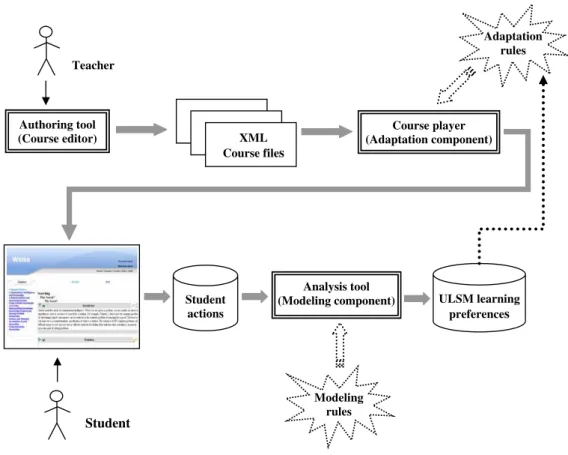
The overall architecture of WELSA is illustrated in Fig. 2. WELSA is composed of three main modules:
– an authoring tool for the teachers, allowing them to create courses conforming to the internal WELSA for-mat (XML-based representation)
– a data analysis tool, which is responsible for inter-preting the behavior of the students and consequently building and updating the learner model, as well as providing various aggregated information about the learners
– a course player (basic learning management system) for the students, enhanced with two special capabili-ties: i) learner tracking functionality (monitoring the student interaction with the system); ii) adaptation functionality (incorporating adaptation logic and of-fering individualized course pages).
The three modules will be presented in more details in the next three sections.
As far as the implementation is concerned, Java-based and XML technologies are employed for all WELSA com-ponents. Apache Tomcat 6.0 is used as HTTP web server and servlet container and MySQL 5.0 is used as DBMS.
4 WELSA authoring tool
The course structure that we propose in WELSA is a hier-archical one: each course consists of several chapters, and each chapter can contain several sections and subsections. The lowest level subsection contains the actual educational resources. Each such elementary learning object corre-sponds to a physical file and has a metadata file associated to it [22]. These metadata are independent of any learning style; they describe the LO from the point of view of media
type, format, instructional role, abstractness level, prereq-uisite, hierarchical and similarity relations with other LOs. Apart from being widely used for organizing the teaching materials, this approach also insures a high reusability de-gree of the educational resources. Furthermore, due to the fine granularity level of the LOs, a fine granularity of adap-tation actions can also be envisaged. Finally, since each LO has a comprehensive metadata file associated to it, we know all the information about the learning resource that is accessed by the learner at a particular moment, so we can perform a detailed learner tracking.
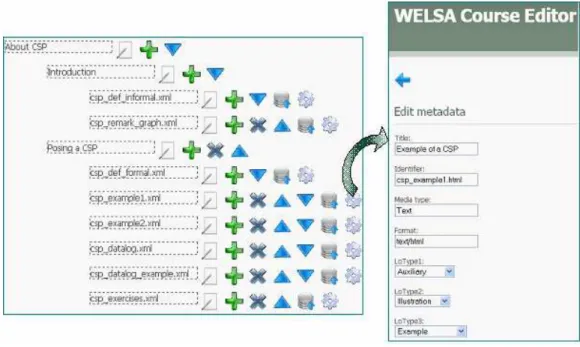
In order to support the teacher in creating courses con-forming to WELSA internal format, we have designed a course editor tool, which allows authors to easily assem-ble and annotate learning resources, automatically gener-ating the appropriate file structure. It should be noted that WELSA course editor does not deal with the creation of ac-tual content (text, images, simulations, etc.) - a variety of existing dedicated tools can be used for this purpose (text editors, graphics editors, HTML editors, etc.). Instead, WELSA course editor provides a tool for adding metadata to existing learning resources and defining the course struc-ture (specifying the order of resources, assembling learning objects in pages, sections and subsections). The teacher can define this chapter structure in a simple and intuitive way, by using the course editor, as shown in Fig. 3. The cor-responding XML files are subsequently generated by the application and stored on the server [23].
5 WELSA analysis tool (modeling
component)
The adoption of a suitable taxonomy of learning styles plays an important role in the overall quality of the system. The result of the adaptation process can only be as accurate and comprehensive as the underlying student model. As mentioned in section 2, WELSA is based not on a single learning style model, like the rest of the similar systems, but on a complex of features extracted from several such learning style models (called ULSM - Unified Learning Style Model). This model integrates characteristics related to: perception modality, way of processing and organizing information as well as motivational and social aspects (e.g.,
Visual / Verbal, Abstract / Concrete, Serial / Holistic, Active experimentation / Reflective observation, Individual work /
Team work, Intrinsic motivation / Extrinsic motivation). A
detailed description of the ULSM characteristics, together with the model’s rationale and advantages, is included in [25].
Expand/Collapse resource & Lock/Unlock resource in
expanded state
Procedure
Example
Figure 1: A snapshot of WELSA (student view)
is depicted in Fig. 4.
In order to compute the pattern values, a pre-processing phase of the raw data (i.e., the student actions and the asso-ciated timestamps) is necessary. The first step is to compute the duration of each action for each student, eliminating the erroneous values (for example, accessing the outline for more than 3 minutes means that the student actually did something else during this time). Next, the access time for each LO is computed, again filtering the spurious val-ues (for example, an LO access time of less than 3 seconds was considered as random or a step on the way to another LO and therefore not taken into account). The data are then aggregated to obtain the pattern values for each stu-dent (e.g., total time spent on the course, total number of actions performed while logged in, time spent on each type of LO, number of hits on each category of LOs, the order of accessing the LOs, the number of navigation actions of a specific type, the number of messages in chat / forum, etc.). The reliability levels of these patterns are calculated as well (i.e., the larger the number of available relevant actions, the more reliable the resulted pattern). Next, the Analysis tool computes the ULSM preferences values, using modeling
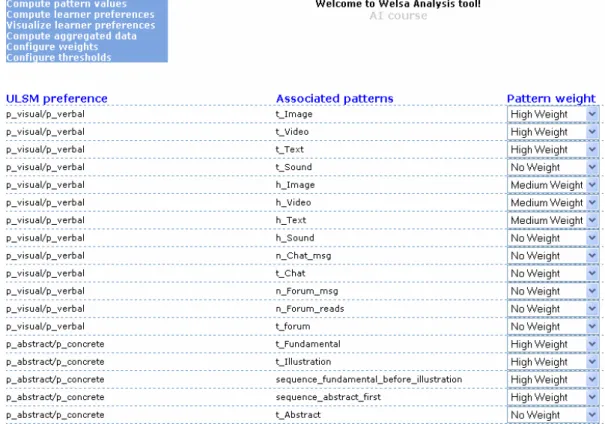
rules based on the pattern values, their reliability levels and their weights, as detailed in [24]. It should be noted that these rules also take into account the specificities of each course: the pattern thresholds as well as the importance of each pattern may vary with the structure and subject of the course. Therefore, the teachers should have the possibility to adjust the predefined values to correspond to the partic-ularities of her/his course or even to eliminate some of the patterns, which are not relevant for that course. This is why the Analysis tool has a configuration option, which allows the teacher to modify the weight and threshold values, as seen in Fig. 5.
com-XML Course files Authoring tool
(Course editor)
Student actions
Analysis tool
(Modeling component) ULSM learning
preferences Teacher
Student
Adaptation rules
Modeling rules
Course player (Adaptation component)
Figure 2: Overall WELSA architecture
putes and displays aggregated information, such as the total number of students with each ULSM preference, the total and average number of student actions, the average relia-bility and confidence values, etc. These data can be used for further analysis (e.g., by processing them in a dedicated statistical package). The roles and interactions of the actors with the Analysis tool are illustrated in Fig. 6.
In order to test the modeling method implemented in the Analysis tool, an experiment involving 71 undergrad-uate students was realized. The learners studied an AI course module on "Search strategies and solving problems by search" and all of their interactions with WELSA were recorded by the course player. Next, the Analysis tool com-puted the values of the behavioral patterns and applied the modeling rules, inferring the ULSM learning preferences of each student. In order to evaluate the validity of our modeling method, the results obtained by the Analysis tool (implicit modeling method) were compared with the refer-ence results obtained using the ULSM questionnaire (ex-plicit modeling method). Good precision results were ob-tained, with an average accuracy of 75.70%, as reported in [24].
6 WELSA course player (adaptation
component)
WELSA course player is responsible with the generation of individualized web pages for each student; furthermore, it incorporates some basic LMS (learning management sys-tem) functions, such as: administrative support (registra-tion and authentica(registra-tion) and communica(registra-tion and collabo-ration tools (discussion forum, chat).
Another function of the course player is to track student actions (down to click level) and record them in a database for further processing by the Analysis tool. This is done with the help of JavaScript code added to the HTML page, coupled with Ajax technology. Thus the application can communicate with the web server asynchronously in the background, without interfering with the display and be-havior of the existing page.
In what follows we will give some details regarding the most important functionality of the course player, namely the adaptation mechanism, which allows the dynamic gen-eration of individualized courses for each student.
Figure 3: Snapshot of WELSA authoring tool: editing course structure (left-hand side) & editing metadata (right-hand side)
Learner actions Behavioral indicators ULSM learning preferences
Preprocessing Modeling rules
t_total n_nextButton n_msg_chat grade_tests
…
Visual / Verbal Abstract / Concrete Serial / Holistic Individual / Team
. . . Action | Date | Description
| | | | | | | |
Figure 4: WELSA learner modeling mechanism
from defining the characteristics of the learners belonging to each learning style, for most of the models there are pro-posed teaching practices that effectively address the educa-tional needs of students with the identified styles. However, as noted in [15], "learning styles models are usually rather descriptive in nature, in the sense that they offer guidelines as to what methods to use to best attain a given goal; they are not usually prescriptive in the sense of spelling out in great detail exactly what must be done and allowing no variation". Starting from these teaching methods (which only include a traditional learning view), enhancing them with e-learning specific aspects (technology-related prefer-ences) and inspiring from other works that dealt with learn-ing style based adaptation (as mentioned in section 2), we extracted the adaptation rules for our LSAES.
More specifically, we decided to use adaptive sorting and adaptive annotation techniques. The LOs are placed in the page in the order which is most appropriate to each learner;
additionally, a "traffic light metaphor" was used to differen-tiate between recommended learning objects (LOs) (with a highlighted green title), standard LOs (with a black title) and not recommended LOs (with a dimmed light grey title) [26]. It should be mentioned however that the learning path suggested by the system is not compulsory: it is simply a recommendation that the student may choose to follow or not. We consider that offering control to students, instead of strictly guiding them, is a more flexible and rewarding pedagogical approach.
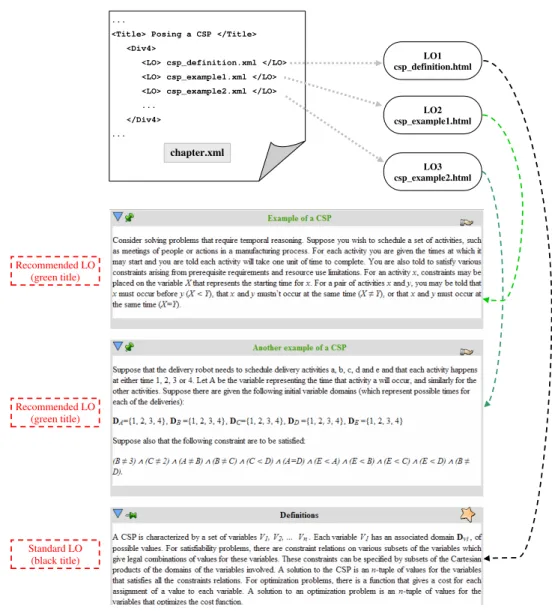
The adaptation mechanism is illustrated in Fig. 7, with a fragment of a Web page from an AI course generated for a student with a preference towardsConcrete, practical
ex-amplesrather thanAbstract concepts and generalizations.
Figure 5: A snapshot from WELSA Analysis tool, illustrating the configuration options
correspondingly (first the notion of "Constraint satisfaction problem" is illustrated by means of two examples and only then a definition is provided).
Formally, the corresponding adaptation rules are in-cluded in Fig. 8. Note thatLoTyperefers to the instruc-tional role of the LO, as described in the metadata. More details regarding the LO indexing can be found in [22].
Figure 8: Adaptation rules for Abstract/Concrete prefer-ence
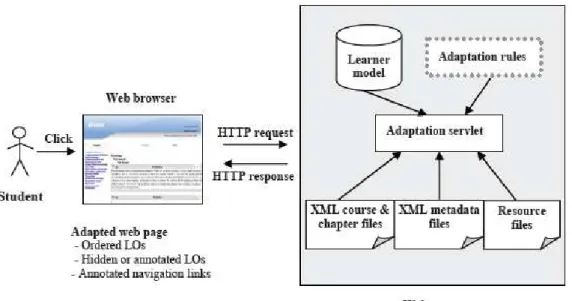
The adaptation component consists of a Java servlet which automatically generates the individualized web page, each time an HTTP request is received by the server,
as illustrated in Fig. 9. WELSA doesn’t store the course web pages but instead generates them on the fly, following the structure indicated in the XML course and chapter files. The adaptation servlet queries the learner model database, in order to find the ULSM preferences of the cur-rent student. Based on these preferences, the servlet applies the corresponding adaptation rules and generates the new HTML page. These adaptation rules involve the use of LO metadata, which as already stated in section 4, are indepen-dent of any learning style. However, they convey enough information to allow for the adaptation decision making (i.e., they include essential information related to the media type, the level of abstractness, the instructional role, etc.). Next the web page is composed from the selected and or-dered LOs, each with its own status (highlighted, dimmed or standard).
Student actions
Configure patterns
Teacher Pattern thresholds &
weights
Analysis tool
Learner preferences
Pre-processed data & pattern values
Aggregated data
Researcher Compare with learners' answers to questionnaires
Perform statistical analysis with SPSS
Visualize and analyze
Refine inference rules
Adjust pattern thresholds and weights
Figure 6: Users’ interaction with the Analysis tool
of the prerequisites mechanism included in the metadata). The validity and effectiveness of our adaptation ap-proach were empirically confirmed by means of an exper-iment involving 64 undergraduate students in the field of Computer Science. The students were split in two groups: one which was provided with a matched version of the course (further referred to as "matched group") and one which was provided with a mismatched version of the course (further referred to as "mismatched group"), with respect to the students’ learning preferences.
The objective evaluation consisted in performing a sta-tistical analysis on the behavioral patterns exhibited by the students, comparing the values obtained for the matched and mismatched groups in order to find significant differ-ences. The results showed that the matched adaptation approach increased the efficiency of the learning process, with a lower amount of time needed for studying and a lower number of randomly accessed educational resources (lower level of disorientation). The effectiveness of the matched adaptation and its suitability for addressing stu-dents’ real needs are also reflected in the statistically signif-icant higher time spent on recommended versus not recom-mended resources, as well the higher number of accesses of those recommended learning objects. Finally, the recom-mended navigation actions were followed to a larger extent than the not recommended ones.
As far as students’ subjective evaluation of the system is concerned (as assessed by means of an opinion question-naire), the students in the matched group reported signifi-cantly higher levels of enjoyment, overall satisfaction and
motivation, compared to their mismatched peers. The over-all results of the experimental study are very promising, proving the positive effect that our adaptation to learning styles has on the learning process. However, in order to allow for generalization, the system should be tested on a wider scale, with users of variable age, field of study, back-ground knowledge and technical experience, which is one of our future research directions. Further details regarding the evaluation process can be found in [26].
7 Conclusion
The WELSA system described in this paper is an intelli-gent e-learning platform, aimed at adapting the course to the learning preferences of each student. We opened this paper with an extensive review of related LSAES. Starting from the existing systems, we introduced an innovative ap-proach, based on an integrative set of learning preferences (ULSM). The technical and pedagogical principles behind WELSA were presented, focusing on the three main mod-ules of the system. The learner modeling and adaptation methods were briefly introduced, together with their real-ization in WELSA.
per-...
<Title> Posing a CSP </Title> <Div4>
<LO> csp_definition.xml </LO> <LO> csp_example1.xml </LO> <LO> csp_example2.xml </LO> ...
</Div4> ...
LO1 csp_definition.html
LO2 csp_example1.html
chapter.xml
LO3 csp_example2.html
Recommended LO (green title)
Recommended LO (green title)
Standard LO (black title)
Figure 7: Composing a page from elementary LOs for a student withConcretepreference
turbations introduced by adaptation on students’ actions; students’ behavior in the adaptive version could be used as a valuable feedback on the effect of adaptation. Finally, the course player could incorporate a wider variety of adapta-tion acadapta-tions, including also collaboraadapta-tion level adaptaadapta-tion techniques which are currently out of the scope of the sys-tem. In this respect, a wider range of communication and collaboration tools should be included in the system, in-cluding social software applications (e.g., blog, wiki, social bookmarking tool, etc.). Extending WELSA into a social and adaptive learning environment would be a challenging research direction.
8 Acknowledgment
This work was partially supported by the strategic grant POSDRU/89/1.5/S/61968, Project ID 61968 (2009), co-financed by the European Social Fund within the
Secto-rial Operational Program Human Resources Development 2007 – 2013.
References
[1] Bajraktarevic, N., Hall, W., Fullick, P. (2003) Incor-porating learning styles in hypermedia environment: Empirical evaluation. Proc. Workshop on Adaptive
Hypermedia and Adaptive Web-Based Systems, pp.
41–52.
[2] Brusilovsky, P. (2001) Adaptive Hypermedia. User
Modeling and User-Adapted Interaction, 11, pp.
87-110.
[3] Brusilovsky, P., Peylo, C. (2003) Adaptive and Intel-ligent Web-based Educational Systems.International
Journal of Artificial Intelligence in Education, 13
Figure 9: Adaptation component schematic architecture
[4] Boticario, J.G., Santos, O.C., van Rosmalen P. (2005) Issues in Developing Standard-based Adaptive Learn-ing Management Systems. EADTU 2005 Working Conference: Towards Lisbon 2010: Collaboration for Innovative Content in Lifelong Open and Flexible
Learning.
[5] Carver, C. A., Howard, R. A., Lane, W. D. (1999) En-hancing student learning through hypermedia course-ware and incorporation of student learning styles.
IEEE Transactions on Education, 42, pp. 33–38.
[6] Cha, H. J., Kim, Y. S., Lee, J. H., Yoon, T. B. (2006) An Adaptive Learning System with Learning Style Diagnosis based on Interface Behaviors. Workshop Proceedings of Intl. Conf. E-learning and Games
(Edutainment 2006).
[7] Cha, H. J., Kim, Y. S., Park, S. H., Yoon, T. B., Jung, Y. M., Lee J. H. (2006) Learning styles diag-nosis based on user interface behaviors for the cus-tomization of learning interfaces in an intelligent tu-toring system.Procs. ITS 06. Lecture Notes in Com-puter Science, Vol. 4053, Springer, pp. 513–524.
[8] Cristea, A., Calvi, L. (2003) The Three Layers of Adaptation Granularity.Proc. UM 2003, pp. 4–14.
[9] Felder, R. M., Silverman, L. K. (1988) Learn-ing and TeachLearn-ing Styles in EngineerLearn-ing Educa-tion. Engineering Education, 78(7). Preceded by a preface in 2002: http://www4.ncsu. edu/unity/lockers/users/f/felder/ public/Papers/LS-1988.pdf.
[10] Garcia, P., Amandi, A., Schiaffino, S., Campo, M. (2007) Evaluating Bayesian NetworksŠ Precision for
Detecting StudentsŠ Learning Styles. Computers &
Education, 49(3), pp. 794–808.
[11] Gilbert, J.E., Han, C.Y. (1999) Adapting instruction in search of ´Sa significant differenceŠ. Journal of
Network and Computer Applications, 22(3), pp. 149–
160.
[12] Graf, S. (2007)Adaptivity in Learning Management
Systems Focussing on Learning Styles. PhD Thesis,
Vienna University of Technology, Austria.
[13] Honey, P., Mumford, A. (2000)The Learning Styles
Helper’s Guide. Maidenhead: Peter Honey
Publica-tions Ltd.
[14] IMS Metadata Standard (2010) http://www. imsglobal.org/metadata/.
[15] Karagiannidis, C., Sampson, D. (2004) Adaptation Rules Relating Learning Styles Research and Learn-ing Objects Metadata.Proc. Workshop on Individual
Differences in Adaptive Hypermedia in AH2004, pp.
60-69.
[16] Keefe, J.W. (1979) Learning style: an overview.
NASSP’s Student Learning Styles: Diagnosing and
Prescribing Programs, pp. 1–17.
[17] Limongelli, C., Sciarrone, F., Temperini, M., Vaste, G. (2009) Adaptive Learning with the LS-Plan Sys-tem: A Field Evaluation. IEEE Transactions on
Learning Technologies2(3), pp. 203–215.
[18] Moodle (2010)http://moodle.org.
in a Web-based educational hypermedia system: the case of INSPIRE.User-Modeling and User-Adapted
Interaction, 13, pp. 213–267.
[20] Paredes, P., Rodriguez, P. (2004) A Mixed Approach to Modelling Learning Styles in Adaptive Educa-tional Hypermedia.Advanced Technology for Learn-ing, 1(4), pp. 210–215.
[21] Poole, D., Mackworth, A., Goebel, R. (1998)
Com-putational Intelligence: A Logical Approach. Oxford
University Press.
[22] Popescu, E., Badica, C., Trigano, P. (2008) Descrip-tion and organizaDescrip-tion of instrucDescrip-tional resources in an adaptive educational system focused on learning styles,Procs. IDC 2007, Studies in Computational In-telligence, Vol. 78, Springer, pp. 177–186.
[23] Popescu, E., Trigano, P., Badica, C., Butoi, B., Duica, M. (2008) A Course Authoring Tool for WELSA Adaptive Educational System.Proc. ICCC 2008, pp. 531–534.
[24] Popescu, E. (2009) Diagnosing Students’ Learning Style in an Educational Hypermedia System. Cog-nitive and Emotional Processes in Web-based Edu-cation: Integrating Human Factors and Personaliza-tion, Advances in Web-Based Learning Book Series, IGI Global, pp. 187–208.
[25] Popescu, E. (2010) A Unified Learning Style Model for Technology-Enhanced Learning: What, Why and How?.International Journal of Distance Education
Technologies, 8(3), IGI Global, pp. 65–81.
[26] Popescu, E. (2010) Adaptation Provisioning with re-spect to Learning Styles in a Web-Based Educational System: An Experimental Study. Journal of
Com-puter Assisted Learning, 26(4), Wiley, pp. 243–257.
[27] Sangineto, E., Capuano, N., Gaeta, M., Micarelli, A. (2008) Adaptive course generation through learning styles representation.Journal of Universal Access in
the Information Society, 7(1), pp. 1–23.
[28] Stash, N. (2007) Incorporating Cognitive/Learning Styles in a General-Purpose Adaptive Hypermedia
System. PhD Thesis, Eindhoven University of
Tech-nology, Netherlands.
[29] Stathacopoulou, R., Grigoriadou, M., Samarakou, M., Mitropoulos, D. (2007) Monitoring studentsŠ actions and using teachersŠ expertise in implementing and evaluating the neural network-based fuzzy diagnos-tic model.Expert Systems with Applications, 32, pp. 955–975.
[30] Triantafillou, E., Pomportsis, A., Demetriadis, S. (2003) The design and the formative evaluation of an adaptive educational system based on cognitive styles.Computers & Education, 41, pp. 87–103.
[31] Wang, T., Wang, K., Huang, Y. (2008) Using a Style-based Ant Colony System for Adaptive Learning.
Expert Systems with Applications, 34(4), pp. 2449–
2464.
[32] Witkin, H.A. (1962) Psychological Differentiation:
Studies of Development. New York: Wiley.
[33] Wolf, C. (2002) iWeaver: Towards an Interactive Web-Based Adaptive Learning Environment to Ad-dress Individual Learning Styles. European
Jour-nal of Open, Distance and E-Learning. Available