A Framework for Automatic Generation of Processes for Self-Adaptive
Software Systems
Carlos Eduardo da Silva and Rogério de Lemos School of Computing, University of Kent Canterbury, Kent, CT2 7NF, UK
E-mail: {ces26, r.delemos}@kent.ac.uk
Keywords:self-adaptive systems, workflow generation, planning, process, architectural reconfiguration
Received:May 10, 2010
The self-adaptation of software systems is a complex process that depends on several factors that can change during the system operational lifetime. Hence, it is necessary to define mechanisms for providing a self-adaptive system the capability of generating during run-time the process that controls its adapta-tion. This paper presents a framework for the automatic generation of processes for self-adaptive software systems based on the use of workflows, model-based and artificial intelligence planning techniques. Our approach can be applied to different application domains, improves the scalability associated with the gen-eration of adaptation plans, and enables the usage of different planning techniques. For evaluating the approach, we have developed a prototype for generating during run-time the workflows that coordinate the architectural reconfiguration of a web-based application.
Povzetek: Opisano je okolje za generiranje procesov za prilagodljive sisteme.
1
Introduction
It is commonly agreed that self-adaptive software systems should have the capability of modifying their own structure and/or behaviour at run-time due to changes in the system, its requirements, or the environment. In order to deter-mine the actions to be taken to adapt itself, a self-adaptive software system observes and analyses itself and its envi-ronment, and if an adaptation is deemed to be necessary, a plan is generated for altering the system in a controlled manner. These systems are usually implemented in terms of a feedback control loop, and one of its key activities is the generation of adaptation plans [6].
The self-adaptation of a software system is a complex process that depends on several factors that may change during the system operational lifetime. In this context, an adaptation plan should respect the relationships and depen-dencies among the elements that compose the system, tak-ing into account the actual state of the system and its en-vironment. Thus, it is expected that self-adaptive software systems should be able to generate adaptation plans during run-time, in order to deal effectively with the variability and uncertainty involved in the adaptation. Otherwise, the self-adaptation process would cease to be consistent with the actual system that it controls, since the adaptation pro-cess would not be able to consider the actual system state, thus restricting what and how can be adapted. Some ex-isting approaches for software self-adaptation (such as [7] [15]) explore mechanisms for the selection of adaptation plans, where each available plan and the conditions asso-ciated with the selection of that plan are defined at design-time through the use of adaptation policies. However, it is
difficult to anticipate, at design-time, all the possible con-texts of adaptation for some types of systems. For example, resources considered during the design of the adaptation policies may not be available during the system execution, or new adaptation possibilities that have not been consid-ered at design-time may become feasible due the availabil-ity of new resources. To deal with this problem, it is nec-essary the definition of mechanisms for providing a self-adaptive software system the capability of generating, dur-ing run-time, the process that controls and coordinates soft-ware adaptation. In a previous work [8], we have outlined an approach based on the use of dynamic workflows for co-ordinating the self-adaptation of software systems. In this paper, we detail that approach by defining a framework that enables the dynamic generation of processes during run-time. This framework consists of a process and collection of languages, mechanisms and techniques, and its support-ing computational infrastructure, consistsupport-ing of open source and in-house tools,
applied to different application domains, and that can han-dle the scalability associated with the generation of adapta-tion plans. In order to achieve this, our framework is based on a combination of techniques, such as, workflows, arti-ficial intelligence (AI) planning and model transformation. Workflows are used as a means to implement the processes, AI planning is used to dynamically generate the processes, while model transformation is employed in the translation between domain specific models into planning problems. A more specific contribution, which is an integral part of the framework, is the use of model-based technology for the generation of adaptation plans, thus enabling the usage of different planning techniques according to the needs of the application domain. In order to increase the scalability of the framework, the generation of processes is split into two levels of abstraction, namely, strategic and tactical, and to reduce the complexity of the overall interaction between these levels, the framework depends on the explicit repre-sentation of feedback loops [6], [18]. In order to evaluate the proposed approach, we have implemented a prototype where the proposed framework is being applied for gener-ating adaptation plans that manage the architectural recon-figuration of a web-based self-adaptive application.
The rest of this paper is organised as follows. Section 2 presents some preliminary information that constitute the basis of the defined framework. Section 3 describes the proposed framework. Section 4 presents the application of the framework in the context of architectural reconfigura-tion of self-adaptive software systems, and evaluates the overall effectiveness of the proposed framework. Section 5 discuss some related work, while the conclusions and fu-ture directions of research are presented on Section 6.
2
Background
This section presents a brief overview of some of the key technologies on which the proposed framework for dy-namic process generation is based.
We have adopted as a basis for generating processes the three-layer reference model for architecture-based self-managed systems adopted by Kramer and Magee [18]. In their model, the component control layer (the bottom layer) consists of the components that accomplish the system function, and includes facilities for supporting the manipu-lation of components (e.g., status query, creation and inter-connection). The change management layer modifies the component architecture in response to changes that occur at the bottom layer, or in response to new goals from the layer above. The goal management layer (top layer) deals with high level goals of the system by changing manage-ment plans according to requests from the layer below and in response to the introduction of new goals.
The techniques for the generation of workflows can be divided into static and dynamic [13]. Static techniques for generating workflows are employed during design or compile-time, when workflows are not expected to change
during run-time. On the other hand, dynamic techniques support the generation or modification of workflows at run-time in order to handle changes that may occur. Static tech-niques can receive as input an abstract model of the tasks that should be carried out, without identifying the resources to be used during execution, and workflow generation con-sists of selecting the actual resources for the abstract model. While dynamic techniques are able to automatically create the abstract model and select the appropriate resources for its execution. Our approach is classified as a dynamic gen-eration technique where we apply AI planning for create the abstract model.
AI planning endeavours to find from a particular initial state a sequence of actions that are able to achieve an objec-tive. In order to use AI planning, it is necessary to define a domain representation, which identifies among other things the available actions (or tasks) that can be used for gener-ating a plan, and a problem representation, which includes the initial state and the desired goal. Currently, there is a wide variety of planners available that employ different al-gorithms and techniques, and support different heuristics. These planners allow tasks to be represented in different ways, including, pre- and post-conditions, temporal infor-mation (time for executing the task), and hierarchical task networks (tasks that can be decomposed in further tasks). For supporting this wide range of planning systems, there is a standard language called the Planning Domain Defini-tion Language (PDDL), which is used to specify domain and problem representations [14].
Model-based technology explores the use of models at different levels of abstraction, and transformations be-tween levels to manage complexity. These models con-form to specific meta-models, which define the relation-ships among the concepts that can be used in a particular domain. Transformations allow the generation of different artefacts (e.g., source code) based on high level models, en-suring consistency between the models and the generated artefacts [19].
3
Framework for process generation
approach for the dynamic generation of workflows.
Figure 1: Overview of workflow generation.
The proposed approach can be placed in the context of the three layers reference model for self-managed system adopted by Kramer and Magee [18]. At the goals manage-ment layer, corresponding to our strategic phase, abstract workflows are generated according to a particular objective (or goal). These workflows are used as a basis for gen-erating the concrete workflows at the change management layer, corresponding to our tactical phase. Once a concrete workflow has been generated, it is executed at the compo-nent control layer, corresponding to the operational phase. In our approach, similar to the three layers reference model, if errors occur at a particular phase and that phase is not able to handle the error, these are propagated to the previ-ous phase in which they should be dealt with. In case of a problem occurs during the execution of the concrete work-flow, a new concrete workflow is generated at the tactical phase, without the need to generate a new abstract work-flow. If it is not possible to generate a concrete workflow (e.g., there are not enough resources), the generation goes back to the strategic phase, where a new abstract workflow is generated. In the eventuality it is not possible to generate an abstract workflow, the generation finishes with an error. In the rest of this section, we provide more details con-cerning key aspects of the proposed framework. The first step, though, is to elaborate on the type of workflows sup-ported by our approach, then we describe the task tem-plates that are used for generating workflows, and finally, we present the actual process that enables the dynamic gen-eration of workflows.
3.1
Types of workflows
In the context of the proposed framework for the dynamic generation of processes during run-time, it is important to distinguish how workflows are related to the system itself. Workflows can either be an integral part of the system or they can be peripheral to the system.
A workflow is an integral part of a system if its execu-tion constitutes the system itself. This is the case of work-flows that implement business processes, where each exe-cuted task contributes to the service to be delivered by the business (the goal of the workflow). In these workflows, the non-functional properties associated with the workflow may influence the non-functional properties of the system itself. For example, the execution time associated with a
particular task should influence the time it takes for the workflow to execute. Moreover, the criteria for selecting which tasks should be part of a workflow and how they should be composed should be dictated by the requirements associated with the system. For example, in the case of web service orchestration, depending on the expected overall execution time of the workflow, the appropriate combina-tion of tasks should be identified to compose the workflow. A workflow is a peripheral part of a system if its exe-cution has as an outcome the system that is expected to deliver the actual services. This is the case of workflows, for example, that coordinate architectural reconfiguration of software systems, where the goal of the workflow is to generate a system that can deliver the actual services. In these workflows, the non-functional properties associated with the workflow have almost no relation with the proper-ties of the system being generated by the workflow. Thus, it is expected that the criteria for generating the workflow, and the criteria for generating the system from the execu-tion of the workflow to be distinct. For example, in the architectural configuration of a software system, reliability could be a key property for that system, and it may not be considered when generating the workflow that would pro-duce the actual system.
3.2
Defining task templates
In order to use AI planning, it is necessary to define task templates to be used by the planner in terms of their pre-and post-conditions. In our work we have used Planning Domain Definition Language (PDDL) to define task tem-plates, and these templates are implemented as workflows. These implementations are structured in terms of atomic actions [10], as a means for incorporating fault tolerance, based on exception handling, into the workflow execution. Figure 2 presents the base structure defined for implement-ing task templates. Followimplement-ing the task templates specifica-tion, task template implementations include pre- and post-conditions checks, respectively, before and after the execu-tion of the associated task.
Figure 2: General structure for task templates implementa-tion.
recovery can be implemented in different ways (forward or backward) according to the application domain, and the task only finishes successfully when the post-condition is fully satisfied. In our approach, it is the system developer who decides how to implement the recovery. For now, we are restricting the implementation of our approach to back-ward error recovery, where the effects of a task are undone before finishing with a failure.
3.3
Workflow generation process
As previously mentioned, our framework is partitioned into three different phases, where the two first phases are associ-ated with the generation of workflows, and the last phase is related to the workflow execution. Each phase of the gen-eration process is composed by several activities1, where some of these activities are dependent on the application domain in which the generation framework is being used, while others are completely independent of the application domain. In the following, we detail the activities associated with the strategic and tactical phases, while focusing on the domain independent activities.
3.3.1 Strategic phase
The main objective at this phase is to find the sequence of tasks that will compose an abstract workflow. This is achieved by means of AI planning techniques. In order to generate a workflow, an AI planner receives as input the goal to be achieved, the initial state, and a set of available task templates (with associated pre- and post-conditions).
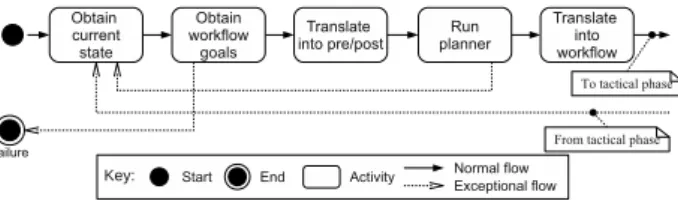
Figure 3 presents an overview of how a workflow is gen-erated at the strategy phase. In order to use AI planning, it is necessary, first, to obtain the initial state and the goals associated with the workflow, which are represented by the Obtain current stateandObtain workflow goalsactivity. These activities are dependent of the application domain in which the generation framework is being used.
Figure 3: Overview of the activities of the strategic phase.
The Translate into pre/postrepresents the activity of translating the goal and the initial state from the notation (or representation format) used by the application domain to the notation employed by the planning technique. This translation receives as input one or more models and pro-duces a planning problem representation in PDDL. These input models describe the goal and the initial state associ-ated with the workflow in a domain dependent format. For
1Activities refer to the steps of the generation, while tasks are
associ-ated with the generassoci-ated workflow.
example, goal-oriented models can be used to represent the objective associated with business processes [16], while ar-chitectural models can be used when considering software reconfiguration [20].
Once the pre- and post-conditions have been defined, the next step is the execution of the planner being used (Run planner activity). Depending on the planning technique used, there are several possibilities for generating work-flows, and one workflow must be selected based on certain criteria. This selection can be incorporated in the planning technique through the use of different heuristics (such as the number of tasks in the generated workflow, or the time/-cost for executing the generated workflow), or can be a second step after the several possible workflows have been identified. In our approach, we have decided to represent it as a single activity, since it is affected by the planning tech-nique used. Since most planners support PDDL, and re-ceive as input pre- and post-conditions in this language, we can easily change the planner used with no, or very small impact in the task templates specification and the other ac-tivities of the strategy level. In case it is not possible to find a plan for a given set of pre- and post-conditions, theRun planner activity finishes with an error, and the strategic phase is restarted.
TheTranslate into workflowactivity receives the out-put of the planner and translates it into an abstract workflow in the format used for specifying workflows in the execu-tion platform, in our case, the YAWLworkflow modelling language [23]. This translation involves the instantiation of each action identified in the PDDL plan as a YAWL work-flow task, where the names identified in the action are used for populating the associated workflow task.
It is important to mention that the tasks that compose an abstract workflow are referred to asstrategic tasks, and the resources associated with these tasks are referred to using logical names, which are sufficient to identify the actual resources at the next phase. In case of a problem at the tactical phase, or during theRun planneractivity, the cur-rent state is updated (Obtain current stateactivity) and theObtain workflow goalsactivity is activated to decide whether a new goal should be tried, or if the generation finishes with an error.
3.3.2 Tactical phase
pa-rameters. Considering those two types of workflows, we have structured the activities of this phase in a way that al-lows the use of any of the cases (or both at the same time) according to the application domain. Figure 4 presents an overview of the activities at this phase.
Figure 4: Activities of the tactics level.
The first activity at the tactical phase consists in ex-tracting the strategic tasks that compose the received ab-stract workflow (Extract strategic tasks). The next activ-ity (Select concrete parameters) is responsible for iden-tifying the concrete parameters of a peripheral workflow. These concrete parameters are then used as replacement for the logical parameters in the extracted tasks (Replace tasks parameters). These tasks, with the concrete param-eters identified, are then used in the next activity (Select tactical tasks) for selecting the tactical tasks of an inte-gral workflow. Once the tactical tasks have been selected, they are used as replacement in the tasks of the abstract workflow (Replace tasks), resulting in a concrete work-flow that can be executed at the next phase.
In case of failure during the execution of the generated workflow, new tactical tasks are selected for generating a new concrete workflow. If no tactical tasks are selected based on the concrete parameters, new concrete parame-ters are selected and the process repeated. If there are no available resources for the concrete parameters, the tacti-cal phase finishes with a failure, and the process goes back to the strategical phase. It is important to note that it is necessary to control the relationship between the selection of concrete parameters, and the selection of tactical tasks. For example, in case there are no tactical tasks for a de-termined set of parameters, this set must be identified, and eliminated from the possible parameters in order to avoid an infinite loop. The same thing happens in the interaction between the execution of a concrete workflow and the se-lection of new tactical tasks, and between the strategic and tactical phase.
Apart from the changes in the task template implemen-tation, the tactical phase is also customised according with the considered type of workflow. In this way, it is possible to deal withperipheral workflows by eliminating the Se-lect tactical tasks activity, only with integral workflows
by eliminating theSelect concrete parametersand the Replace tasks parametersactivities, or with both types by not eliminating any of the activities. This decision must be made during the instantiation of the framework into a particular domain. For example, different web service in-stances could be captured as tactical tasks of an integral workflow.
Figure 5: Overview of the infrastructure for supporting pro-cess generation.
3.4
Infrastructure
In the sequence, we describe the tools and techniques of the infrastructure that provides the basis for dynamically generating workflows. We present the infrastructure’s main components, and identifying those components that must be modified according with the application domain.
Figure 5 presents the infrastructure that underpins the proposed framework. The generation process is managed through a workflow. Workflow specifications are modelled using the YAWLworkflow modelling language [23], and are executed in the YAWL Workflow Management Sys-tem (WfMS). All elements have been implemented using the Java programming language, and the communication among them uses web service technology. The Model translatorcomponent must be customised based on the ap-plication domain by providing the transformation rules that translates domain specific models into planning problems. We have successfully used different planners, implemented in C and Python (Satplan, Sgplan6, LPG-td, LAMA)2by building Java wrappers for each one of them. When deal-ing with planndeal-ing based only on pre- and post-conditions, the replacement of the planner used has no impact in the other components of the framework. We also used tempo-ral based planning, requiring the modification of the task template specification for including the appropriated non-functional property (e.g., the cost of each action), and the transformation rules of the Model translator component for including the metric used by the planner (e.g., mini-mize the total execution time of the generated plan) in the problem representation. The Workflow translator com-ponent is responsible for translating a PDDL plan into an YAWLworkflow specification. It does that by parsing a PDDL plan and recovering the task implementation associ-ated with each task of the plan. These task implementations are them composed together as the tasks of a new work-flow specification using the services of theWorkflow spec handler component. TheWorkflow spec handler pro-vides different services for manipulating workflow speci-fications, and has been implemented based on the API of the YAWLWfMS. All repositories have been implemented as Java classes. TheWorkflow spec repositoryinteracts with the YAWLWfMS and its worklets service [1] for
load-2Participants of different editions of the International Planning
ing concrete workflows into the WfMS engine. The Tac-tical tasks selector is responsible for implementing the decision making associated with the selection of tasks in the tactical phase, while theTactical tasks repositoryis used for storing all available tactical tasks.
4
Process generation for
architectural reconfiguration
This section describes how the proposed framework is be-ing used for generatbe-ing the workflows that manage the ar-chitectural reconfiguration of a self-adaptive application, presenting the case study application used for its evalua-tion, its prototype implementation and a brief discussion about some experiments results.
4.1
The reconfiguration process
In the context of the Collect/Analyse/Decide/Act (CADA) feedback control loop [12], our reconfiguration process is related to the decide and act phases, while we assume the existence of mechanisms responsible for the collect and analyse phases. The decide phase of the feedback loop is responsible for identifying what to adapt (the selection of a configuration), and how to adapt (the generation of a work-flow for connecting this configuration), while the act phase is responsible for executing the generated workflow. In this scenario, it is important to mention that we are not con-cerned with the selection of an architectural configuration for the system. This is outside the scope of our work, and there are several existing approaches that can be used to implement this (e.g., [2]). Instead, our focus is in demon-strating how adaptation plans can be generated based on the selected configuration.
In our approach, we divided a configuration model in two different levels of concerns, reflecting the division be-tween abstract and concrete workflows. In this way, an
abstract configurationdescribes a system configuration in terms of its components, identified by a logical names, their types and connections, identifying the structure of the sys-tem, but abstracting away from the actual component in-stances. Aconcrete configuration, on the other hand, de-scribes a system configuration in terms of actual compo-nent instances, and their respective attributes. Similar to an abstract workflow, an abstract configuration can be instan-tiated into different concrete configurations depending on the availability of actual component instances.
Figure 6 presents an overview of the reconfiguration pro-cess. At the strategic phase, the initial state and goal cor-respond, respectively, to the current and selected rations. The selected configuration is an abstract configu-ration, where the affected elements are treated as abstract elements. For example, when dealing with the replacement of a component, the new component can be treated as an abstract component, allowing the reuse of the abstract con-figuration by replacing this abstract component. If the
pro-cess is being applied to establish a new configuration, all elements are treated as abstract elements. The Translate into Pre/post activity generates the planner inputs from architectural models using a translation algorithm based on model comparison techniques, where the architectural models are compared, and the results of this comparison are translated into a problem specification in PDDL using a set of model transformation rules. This algorithm fol-lows the idea of model transformation employed in model-driven engineering, where a model (the comparison results) is transformed into another model (pre- and post-conditions expressed in PDDL) [19]. In case the planner can not find a plan for a given set of pre- and post-conditions, a new con-figuration is selected, or the reconcon-figuration finishes with a failure.
At the tactical phase, the Obtain concrete configura-tionis responsible for finding a concrete configuration for the system, which is used for generating a concrete work-flow. This activity corresponds to the Select concrete parameters activity presented in Section 3.3.2. It is im-portant to mention that in the present context, the gener-ated workflows are a peripheral part of the system, where abstract workflows are characterised by the use of logical names as tasks parameters. In this way, we do not consider theSelection of tactical tasksactivity at the tactics phase. The generated workflow is then executed changing the target system. In case of a failure during its execution (e.g., a failure while connecting two components), a new con-crete configuration is selected, and a new concon-crete work-flow is generated and executed. For now, we are assuming the existence of exception handling mechanisms capable of undoing the effects of the failed workflow before returning to the tactical phase. In case there are not enough resources for establishing a new concrete configuration based on the selected abstract configuration, a new abstract configura-tion is selected, and a new abstract workflow is generated. If it is not possible to find a new configuration for the sys-tem, the process finishes with an error.
4.2
Case study
In the sequence, we present an example scenario of a dis-tributed system that was used to evaluate our work.
The developed prototype application provides stock quotes portfolio reports with suggestions of investments based on historical and current information about the client, and the actual stock quotes values. In this scenario, we con-sider the existence of different resources that are captured by different component types, which can be combined in different configurations for the provision of the mentioned service. For each of these component types, there are sev-eral component instances that can be used. New instances and resource types can become available, resulting in con-figurations not envisioned at design-time.
ser-Figure 6: Overview of the process for generating reconfiguration plans.
vice logic represents the application logic of the offered service (stock quote portfolio report), and requires services from internal and external providers. External providers are used for obtaining stock quote values, which can be ob-tained from different sources. These are captured through Bridge components. A bridge component handles archi-tectural mismatches between the service providers and the system, providing an uniform interface for the different on-line providers. The Client info logiccomponent, an in-ternal service, provides information about the client, and requires aDatabasecomponent.
Figure 7: Example of a configuration.
Follow the division between abstract and concrete figurations, each component instance of a concrete con-figuration is associated to a logical name and type. In this way, GUI1 :C1 :Front End indicates that the com-ponent instanceGUI1is associated with logical nameC1 with functional requirements associated with components of typeFront End.
4.3
Prototype implementation
The infrastructure for supporting the defined reconfigura-tion process has been implemented based on the architec-ture presented in Figure 5, and is presented in Figure 8.
In this prototype, architectural models are represented using Eclipse Modelling Framework (EMF) models based on xADL 2.0 [9]. In order to run our experiments, we have implemented a simplified execution platform in which components must be blocked (a kind of quiescent state [17]) before being involved in a reconfiguration, blocked components are not considered when selecting a new con-figuration, and all architectural elements provide two dif-ferent types of interfaces, application and configuration ser-vices interfaces, as explained in [10]. The Model trans-lator component has been implemented based on EMF
Figure 8: Overview of the overall system architecture.
and Atlas Transformation Language3. This component re-ceives architectural models as input, and applies a set of ATL transformation rules for generating a problem descrip-tion in PDDL. Figure 9 presents an example of a PDDL problem description generated by the Model translator component. This example considers the establishment of the configuration presented in Figure 7. Thus, the inputs used are an empty xADL description, corresponding to the current configuration, and a xADL description of the configuration of Figure 7, corresponding to the selected configuration. The header has an identifier for the prob-lem (reconfigurationProblem) and a reference to the do-main representation where the actions and predicates are described. The list of objects involved includes all com-ponents (identified by logical names) and their provided and required interfaces. In this example, all involved com-ponents are unblocked, and all connections are not estab-lished.
Since we consider the generation of peripheral work-flows, the Tactical tasks selectorcomponent is deacti-vated by removing the respective activity from the flow that controls the reconfiguration. The generated work-flow changes the configuration of theTarget system. The Registryis where all available components, their respec-tive attributes, and a current model of the target system are stored. We assume that the Registry is responsible for monitoring the available resources, and for providing an accurate view of theTarget system. Any changes in
Figure 9: Example of pre- and post-conditions in PDDL.
the resources’ availability should be reflected at the Reg-istry. TheMonitorcomponent represents the mechanisms used for the collect and analysis phases of the feedback control loop. This component observes the components of the established configuration, checking the values of the component attributes (e.g., response time) against a defined threshold. In case of violation, it starts a reconfiguration by starting the execution of the reconfiguration workflow. The Configurator is responsible for selecting a configu-ration for the system. It has been implemented based on the use of a utility function that is a linear combination of the utilities of the different elements. TheConfigurations repositorystores the configuration models used during the reconfiguration.
4.4
Discussion
In order to demonstrate and evaluate the proposed ap-proach, we have conducted some experiments involving the architectural reconfiguration of a case study application.
Among the experiments, we have considered the estab-lishment of a particular configuration, which for the plan-ner, is the toughest scenario, since it involves all compo-nents of the configuration. In this experiment, we have ob-served the search space (number of possible actions) of the LPG-td planner, changing the number of resources avail-able and the size of the generated workflow.
The size of the generated workflow depends on the num-ber of components and connections in the selected con-figuration. Every component of a configuration must be blocked before being connected, and unblocked at the end of the reconfiguration. In this way, a configuration withn
components andn-1connections will have3n-1tasks. For example, the configuration of Figure 7, with five compo-nents and four connections, requires a workflow with 14 tasks (blocking the five components, establishing the four connections, and unblocking the five components). In these experiments we have considered three different abstract configurations, which require three, four and five compo-nents, and contains respectively two, three and four con-nections.
We have implemented two variations of our approach.
Figure 10: Search space variation changing the resources available.
Figure 11: Search space variation considering the selection of a configuration by the planner.
The main difference between these variations is the amount of information passed to the planner. Our approach (iden-tified by A in the graphs) explores the division between strategy and tactics using logical names for representing the components of a configuration. The second approach (identified byB) separates the selection of a configuration from the generation of the plan, but includes all available resources in the planner. While the third approach (iden-tified byC), based on [4], uses the planner for selecting a configuration for the system, including all possible config-urations and all available resources in the planner.
Figure 10 shows the variation in the search space as we vary the number of resources available. In this graph, A-3 means the numbers obtained by our approach (A) for a workflow related with a configuration that requires three different components. Since we use logical names to rep-resent the resources required by a configuration, and do not consider all available resources in the planner, the number of resources available does not affect the search space. We notice a linear progression of the search space when we in-clude all available resources in the planner (B-3, B-4and B-5). The starting points of each curve represents the min-imum number of resources required by the correspondent configuration.
As expected, the search space increases with number of resources known by the planner, and the selection of a con-figuration by the planner further aggravate its scalability. The division between strategy and tactics helps to reduce the search space since the planner does not need to know about all available resources, but only about those involved in the reconfiguration, which are represented by logical names.
5
Related work
The focus of this section is to review how existing ap-proaches generate adaptation plans for self-adaptive soft-ware, and we start with those approaches that specify adap-tation plans at design-time. Cheng et al. [7] capture adapta-tion plans as a set repair strategies, consisting of condiadapta-tion- condition-action rules, where conditions are evaluated based on util-ity functions. Georgas and Taylor [15] propose the use of adaptation policies, also captured as condition-action rules, that indicate what actions should be taken in response to events. Both approaches are focused on the definition of the mechanisms for selecting one adaptation plan from the set of available plans, where each available plan, identify-ing what and how to adapt, is defined at design-time. A major limitation with these approaches is the difficulty in anticipating all possible contexts in which system adapta-tion may take place. This has a major impact on identifying the appropriate adaptation plans because of the combina-torial nature between conditions and actions, which also affects the management of the available plans. Different from these approaches, our approach provides the means for defining adaptation plans during run-time.
There are other approaches (such as [5]) that provide support for selecting what to adapt at run-time. However, there is a cost to be paid in these approaches, since the adaptation is enacted by deactivating and reactivating the whole software system, even for the case when a single el-ement needs to be replaced. Moreover, the main focus of these approaches is on the selection of what to adapt based on the state of the environment and the resources required for enabling it, and not on how to enact the selected adap-tation. Differently from these approaches, our focus is on the dynamic generation of the process that enacts the adap-tation in a way that does not require the complete deactiva-tion of the system.
Some approaches use model comparison techniques, in the context of architectural reconfiguration, for generating adaptation scripts that impact only those elements affected by the adaptation. Alia et al [2] compare the models of the current and the selected system configuration for iden-tifying the actions of the adaptation script. Morin et al. [20] build on top of model comparison by applying priority rules for ordering the identified adaptation actions. How-ever, model comparison and priority rules are not enough to generate plans with complex relationships among the adap-tation actions and the involved system components. For it,
it is necessary to consider pre- and post-conditions associ-ated with the actions, as demonstrassoci-ated in [22]. Moreover, the focus of these approaches is not the generation of adap-tation scripts, but the selection of the system configuration [2], and coping with the exponential growth in the number of possible configurations [20]. Thus, they do not consider the possible issues associated with the generation of the adaptation scripts. Our approach also applies model com-parison for generating adaptation plans, but the results of the comparison are used for identifying the inputs for an AI planner, supporting the generation of plans that can deal with complex relationships between its constituent tasks.
Other approaches have applied AI planning for selecting a configuration and deciding how to change the system at the same time [3], [4]. Both these approaches require the inclusion of all available resources in the planner, which, together with the mix of configuration selection and plan generation, affects the scalability of the planer. Moreover, both approaches require the specification of the current sys-tem state and the target syssys-tem state using PDDL. In our approach, we are not restricted to a fixed set of resources for generating adaptation plans, and we employ model-based technology for translating domain specific models into planning problems. The partition of our approach into different levels of abstraction provides support for dealing with variations in the resources availability and reduces the search space considered by the planner, increasing its scal-ability, while more specific and scalable techniques can be used for selecting an adaptation for the system (such as [2]).
Concerning workflow generation, several approaches ap-ply AI planning techniques in different domains [21], such as, grid computing [11] and web service composition [13]; however, these approaches are very specific to their respec-tive domains. Our approach is based on ideas from [11] [13], in which the generation is partitioned into strategi-cal and tactistrategi-cal for increasing sstrategi-calability. Differently from these approaches, we are focused on providing an frame-work that can be applied to different domains, and consider two types of workflows, integral and peripheral, support-ing different decision maksupport-ing and plannsupport-ing mechanisms ac-cording with the application domain.
6
Conclusions and future work
a prototype was developed for experimenting our approach, and comparing it with similar approaches. The effective-ness of the whole approach was evaluated in the context of a web-based self-adaptive application for obtaining stock quotes reports, where the processes generated at run-time are responsible for coordinating the architectural reconfig-uration of the system.
Although the proposed approach for the dynamic gener-ation of process for self-adaptive software systems has pro-duced quite promising results, we have identified a couple of limitations that if properly handled could enhance over-all effectiveness of the approach. First, the type of work-flows being generated are simple sequential workwork-flows, however, the intent is to incorporate non-determinism and other planning techniques to capture uncertainty into the generation of workflows, and to support different control flow constructs, such as, conditional and parallel execu-tion branches. Second, although the task templates for our framework are structured using atomic actions, one issue that was not yet fully investigated is how to exploit this for the provision of fault tolerance. The intent is to incor-porate exception handling mechanisms for tolerating faults that might occur during the execution of generated work-flows.
As future work, we would like to simplify the reuse of the framework, and this could be achieved by using meta-transformation languages for translating domain specific models into pre- and post-conditions. Also in this direc-tion, the intent is to incorporate ideas from software prod-uct lines into our framework for dealing with the variabil-ity of processes. Another future work would be the ap-plication of the proposed framework into other apap-plication areas to evaluate its overall effectiveness since our initial idea was to see this framework applied to support software self-adaptation whenever processes need to generated dur-ing run-time. Concerndur-ing the domain of reconfiguration, we intent to consider more complex scenarios in which, for example, there exists transfer of state between compo-nents).
Acknowledgement
Carlos Eduardo da Silva is supported by the Pro-gramme Alβan, the European Union Programme of High Level Scholarships for Latin America, scholarship No. E07D401107BR.
References
[1] M. Adams et al. Worklets: A service-oriented im-plementation of dynamic flexibility in workflows. In
Proc. of the OTM CoopIS’06, pages 291–308, 2006.
[2] M. Alia et al. A component-based planning frame-work for adaptive systems. In Proc. of the OTM DOA’06, pages 1686–1704, 2006.
[3] A. Andrzejak et al. Feedbackflow-an adaptive work-flow generator for systems management. InProc. of the ICAC’05, pages 335–336, 2005.
[4] N. Arshad et al. Deployment and dynamic reconfigu-ration planning for distributed software systems. Soft-ware Quality J., 15(3):265–281, 2007.
[5] M. Autili et al. Towards self-evolving context-aware services. In Proc. of the DisCoTec CAMPUS’08, 2008.
[6] Y. Brun et al. Engineering self-adaptive systems through feedback loops. InSoftware Engineering for Self-Adaptive Systems, pages 48–70. 2009.
[7] S.-W. Cheng et al. Architecture-based self-adaptation in the presence of multiple objectives. InProc. of the ICSE SEAMS’06, pages 2–8, 2006.
[8] C. E. da Silva and R. de Lemos. Using dynamic workflows for coordinating self-adaptation of soft-ware systems. In Proc. of the ICSE SEAMS 2009, pages 86–95, 2009.
[9] E. M. Dashofy et al. A comprehensive approach for the development of modular software architec-ture description languages. ACM Trans. Softw. Eng. Methodol., 14(2):199–245, 2005.
[10] R. de Lemos. Architectural reconfiguration using coordinated atomic actions. In Proc. of the ICSE SEAMS’06, pages 44–50, 2006.
[11] E. Deelman et al. Mapping abstract complex work-flows onto grid environments. Journal of Grid Com-puting, 1(1):25–39, 2003.
[12] S. Dobson et al. A survey of autonomic communi-cations. ACM Trans. Auton. Adapt. Syst., 1(2):223 – 259, 2006.
[13] S. Dustdar and W. Schreiner. A survey on web ser-vices composition. International Journal of Web and Grid Services, 1(1):1–30, 2005.
[14] M. Fox and D. Long. Pddl2.1: An extension to pddl for expressing temporal planning domains. J. of AI Research, 20:61–124, 2003.
[15] J. C. Georgas and R. N. Taylor. Towards a knowledge-based approach to architectural adaptation manage-ment. InProc. of the WOSS’04, pages 59–63, 2004.
[16] D. Greenwood and G. Rimassa. Autonomic goal-oriented business process management. InProc. the ICAS’07, page 43, 2007.
[18] J. Kramer and J. Magee. Self-managed systems: an architectural challenge. In Proc. of the FOSE’07, pages 259–268, 2007.
[19] J. Miller and J. Mukerji. MDA guide version 1.0.1. Technical report, OMG, 2003.
[20] B. Morin et al. An aspect-oriented and model-driven approach for managing dynamic variability. InProc. of the MoDELS’08, pages 782–796, 2008.
[21] D. Nau. Current trends in automated planning. AI Magazine, 28(4):43–58, 2007.
[22] C. Shankar and R. Campbell. Ordering manage-ment actions in pervasive systems using specification-enhanced policies. In Proc. of the PERCOM’06, pages 234–238, 2006.
![Figure 1: Overview of workflow generation. The proposed approach can be placed in the context of the three layers reference model for self-managed system adopted by Kramer and Magee [18]](https://thumb-us.123doks.com/thumbv2/123dok_us/8043734.2129928/3.892.102.435.162.289/figure-overview-workflow-generation-proposed-approach-reference-managed.webp)