Training a Genre Classi
fi
er for
Automatic Classi
fi
cation of Web Pages
Vedrana Vidulin, Mitja Lu
strek and Matja
ˇ
z Gams
ˇ
Jozef Stefan Institute, Ljubljana, SloveniaˇThis paper presents experiments on classifying web pages by genre. Firstly, a corpus of 1 539 manually labeled web pages was prepared. Secondly, 502 genre features were selected based on the literature and the observation of the corpus. Thirdly, these features were extracted from the corpus to obtain a data set. Finally, two machine learning algorithms, one for induction of decision trees (J48)
and one ensemble algorithm(bagging), were trained and tested on the data set. The ensemble algorithm achieved on average 17% better precision and 1.6% better accu-racy, but slightly worse recall; F-measure did not vary significantly. The results indicate that classification by genre could be a useful addition to search engines.
Keywords: genre classification, web page, genre fea-tures, ensemble algorithm
1. Introduction
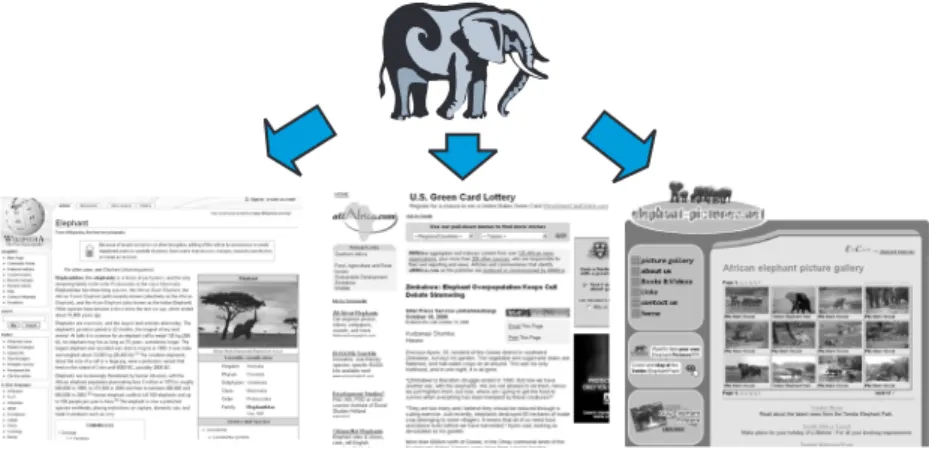
A good question to start with is why we want to classify a web page by genre. For example, if we are interested in elephants and search for the keyword “elephant”, a search engine will return web pages that describe the life of elephants, but
it will also return web pages with elephant pic-ture gallery, newspaper articles about saving the elephants in Africa etc. (see Figure 1). How-ever, if we were able to specify that we want to search only for journalistic materials about elephants, we would get more specific results in accordance with our interest. Classification of web pages by genre would make our life easier. What exactly is a genre? In general, a genre could be described as a style of a web page[7]. A web page is used to send a message to the user. Message has a topic, for example the life of elephants, but it also tries to communicate that topic in a specific way. To a zoologist, it will give a high number of objective facts about elephants. When wishing to entertain, it will communicate a message about elephants to amuse the user by presenting pictures and video material. In the light of the previous ex-planation, genre can be described as intentional styling of a web page with the objective to com-municate the topic in a specific manner.
Classification of web pages by genre is a chal-lenging task[2, 5-9, 12, 16-20]. Even humans with their advanced semantics and understand-ing of concepts misclassify some web pages, therefore computer programs face a difficult task indeed.
Another problem is to find appropriate features, i.e. properties of a web page that adequately de-scribe a web page in terms of genre. The quality of classifier strongly depends on the choice of features.
The corpus we experimented with is presented in Section 2. Section 3 lists the features used to describe web pages. Section 4 deals with machine learning(ML) algorithms chosen for training the classifier. Results of the experi-ments are given in Section 5. A conclusion is presented in Section 6.
2. 20-Genre Collection of Web Pages
20-Genre Collection[21]was compiled at Jozefˇ
Stefan Institute and consists of 1 539 web pages belonging to 20 genres. The genres are: Blog, Children’s, Commercial/Promotional, Commu-nity, Content Delivery, Entertainment, Error Message, FAQ, Gateway, Index, Informative, Journalistic, Official, Personal, Poetry, Porno-graphic, Prose Fiction, Scientific, Shopping, User Input. Each page can belong to multiple genres.
The web pages were collected from the Internet using three methods. Firstly, we used highly-ranked Google hits for popular keywords like “Britney Spears”. The keywords were cho-sen according to Google Zeitgeist statistics[24]. Our purpose was to build a classifier that will not have a problem with recognizing the most popular web pages. Secondly, we gathered ran-dom web pages. And finally, we specifically searched for web pages belonging to genres un-derrepresented to that point.
The corpus was manually labeled by two inde-pendent annotators. Their labels disagreed on about a third of the web pages in the corpus, so those were reassessed by a third and sometimes even a fourth annotator.
3. Genre Features
There is no generally accepted set of genre fea-tures, which can be seen from[2, 5-9, 12, 16-20],
particularly since the feature set depends on the type of documents under consideration. Most past research dealt with pure text with little ad-ditional information(such as formatting), so it used only text-based features. Since we were classifying web pages, we also used URL- and HTML-based features[12].
3.1. URL Features
URL features are based on the structure and the content of an URL. Structural features follow URL syntax defined by[3]:
foo: scheme //example.com:8042 authority
/over/there
path
?name=ferret
query
#nose fragment
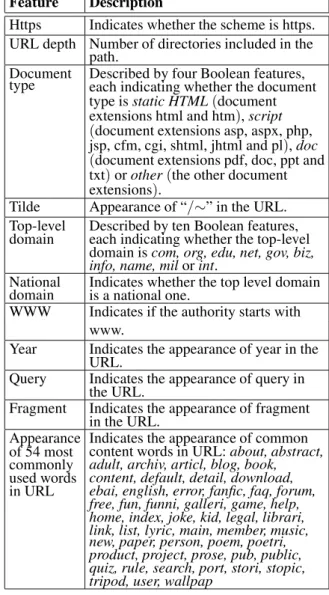
URL content is analyzed by marking the ap-pearances of 54 words most commonly present
Feature Description
Https Indicates whether the scheme is https. URL depth Number of directories included in the
path. Document
type Described by four Boolean features,each indicating whether the document type isstatic HTML(document extensions html and htm),script
(document extensions asp, aspx, php, jsp, cfm, cgi, shtml, jhtml and pl),doc
(document extensions pdf, doc, ppt and txt)orother(the other document extensions).
Tilde Appearance of “/∼” in the URL. Top-level
domain Described by ten Boolean features,each indicating whether the top-level domain iscom, org, edu, net, gov, biz, info, name, milorint.
National
domain Indicates whether the top level domainis a national one. WWW Indicates if the authority starts with
www.
Year Indicates the appearance of year in the URL.
Query Indicates the appearance of query in the URL.
Fragment Indicates the appearance of fragment in the URL.
Appearance of 54 most commonly used words in URL
Indicates the appearance of common content words in URL:about, abstract, adult, archiv, articl, blog, book, content, default, detail, download, ebai, english, error, fanfic, faq, forum, free, fun, funni, galleri, game, help, home, index, joke, kid, legal, librari, link, list, lyric, main, member, music, new, paper, person, poem, poetri, product, project, prose, pub, public, quiz, rule, search, port, stori, stopic, tripod, user, wallpap
Feature
Number of hyperlinks to the same domain/
Total number of hyperlinks
Number of hyperlinks to a different domain/
Total number of hyperlinks
Number of tags/Total number of tags for 5 tag groups:
1. Text Formatting–<abbr>, <acronym>, <address>, <b>, <basefont>, <bdo>, <big>, <blockquote>, <center>, <cite>, <code>, <del>, <dfn>, <em>, <font>, <h1>, <h2>, <h3>, <h4>, <h5>, <h6>, <i>, <ins>, <kbd>, <pre>, <q>, <s>, <samp>, <small>, <strike>, <strong>, <style>, <sub>, <sup>, <tt>, <u>, <var>
2. Document Structure–<br>, <caption>, <col>, <colgroup>, <dd>, <dir>, <div>, <dl>, <dt>, <frame>, <hr>, <iframe>, <li>, <menu>, <noframes>, <ol>, <p>, <span>, <table>, <tbody>, <td>, <tfoot>, <th>, <thead>, <tr>, <ul>
3. Inclusion of external objects-<applet>, <img>, <object>, <param>, <script>, <noscript>
4. Interaction–<button>, <fieldset>, <form>, <input>, <isindex>, <label>, <legend>, <optgroup>, <option>, <select>, <textarea>
5. Navigation– Counting href attribute of tags
<a>, <area>, <link> and <base> Table 2.A set of HTML features.
in URL. The words were stemmed with Porter stemming algorithm[14].
In total, 76 features were obtained, all Boolean except for URL depth, which is numeric. Fea-tures and their descriptions are presented in Ta-ble 1.
3.2. HTML Features
HTML features correspond to HTML tags. Ac-cording to the general trend in literature[18]we grouped tags into five categories according to their functionalities. In addition, we counted the hyperlinks in the web page and separated external from internal.
We have chosen 7 HTML features, all numeric and normalized(see Table 2).
3.3. Text Features
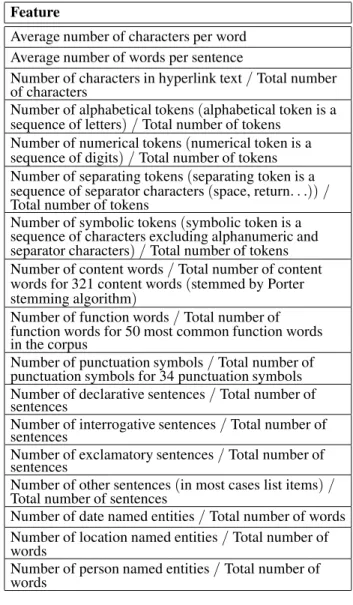
From web pages, 419 text features were ex-tracted, all numeric and normalized. They are listed in Table 3.
The set of 321 content words is a combination of manually extracted content words and most common content words automatically extracted from our corpus. A punctuation symbol set is obtained equally.
Feature
Average number of characters per word Average number of words per sentence
Number of characters in hyperlink text/Total number of characters
Number of alphabetical tokens(alphabetical token is a sequence of letters) /Total number of tokens
Number of numerical tokens(numerical token is a sequence of digits) /Total number of tokens Number of separating tokens(separating token is a sequence of separator characters(space, return. . .)) /
Total number of tokens
Number of symbolic tokens(symbolic token is a sequence of characters excluding alphanumeric and separator characters) /Total number of tokens Number of content words/Total number of content words for 321 content words(stemmed by Porter stemming algorithm)
Number of function words/Total number of function words for 50 most common function words in the corpus
Number of punctuation symbols/Total number of punctuation symbols for 34 punctuation symbols Number of declarative sentences/Total number of sentences
Number of interrogative sentences/Total number of sentences
Number of exclamatory sentences/Total number of sentences
Number of other sentences(in most cases list items) /
Total number of sentences
Number of date named entities/Total number of words Number of location named entities/Total number of words
Number of person named entities/Total number of words
Table 3.A set of text features.
4. ML Problem
Weka, a collection of ML algorithms[23], was chosen as the tool for genre classification. Since the ML algorithms in Weka do not support mul-tilabeled classification, we divided the problem into 20 binary sub-problems, one for each genre. The task was thus to train 20 classifiers, each to decide whether an input web page belongs to one of the 20 genres. Each page was typically assigned 2–3 genres, but the number varied from 1 to 10 or more.
simplicity, transparency and speed, which were important criteria because the classifier was in-tended to be integrated into the Alvis search engine[1].
We used J48 to build standalone decision trees and to construct bagging ensembles[23]. Al-though ensemble classifiers are more complex and thus demand more time, they are often ben-eficial in terms of tradeoff between additional time and improved performance.
5. Results
For the experiments, J48 and bagging were run with the default Weka parameters. 10-fold cross validation[10] was used for testing. The clas-sifier performance was measured by accuracy, precision, recall and F-measure. The statistical significance test of J48 vs. bagging was
per-J48 Bagging Diff.
Blog 95.84 97.08 1.24
Children’s 94.80 95.45 0.65
Commercial/Promotional 89.34 92.07 2.73
Community 95.65 96.69 1.04
Content Delivery 90.38 91.81 1.43
Entertainment 94.87 95.78 0.91
Error Message 97.47 97.73 0.26
FAQ 98.38 98.70 0.32
Gateway 93.31 95.32 2.01
Index 81.94 87.39 5.45
Informative 79.73 83.56 3.83
Journalistic 85.90 89.54 3.64
Official 96.56 97.01 0.45
Personal 91.49 93.24 1.75
Poetry 97.01 97.27 0.26
Pornographic 97.14 97.79 0.65
Prose Fiction 95.39 96.17 0.78
Scientific 95.78 97.08 1.3
Shopping 94.80 96.36 1.56
User Input 95.71 97.08 1.37
Average 93.07 94.66 1.58
Paired T-Test (7/13/0)
Table 4.Accuracy of the genre classifiers in percent.
formed using the corrected resampled paired t-test with significance level of 5%.
Accuracy is the degree of conformity of a mea-sured quantity to its actual value. In our ex-periments it denotes the percentage of correctly classified web pages [10]. The results of the experiments are presented in Table 4. The dif-ferences between the performance of classifiers built by J48 and by bagging in terms of accu-racy are on average 1.58%. Considering the results of paired t-test, bagging outperformed J48, performing significantly better in 7 genres and equally well in other 13 genres. However, accuracy is not the most suitable performance measure in our setting, because for each genre the corpus contains higher number of web pages that do not belong to observed genre. A clas-sifier that would assign no genre to any web page would have a high accuracy, because most web pages indeed do not belong to most genres. Therefore, other standard information retrieval
J48 Bagging Diff.
Blog 61 83 22
Children’s 71 81 10
Commercial/Promotional 21 40 19
Community 63 76 13
Content Delivery 40 64 24
Entertainment 53 69 16
Error Message 83 87 4
FAQ 85 98 13
Gateway 35 45 10
Index 38 63 25
Informative 31 30 -1
Journalistic 43 62 19
Official 56 73 17
Personal 39 72 33
Poetry 72 76 4
Pornographic 66 78 12
Prose Fiction 46 69 23
Scientific 62 85 23
Shopping 42 72 30
User Input 63 83 20
Average 53 70 17
Paired T-Test (5/15/0)
measures are needed: precision, recall and F-measure.
Precision is the proportion of retrieved and rel-evant web pages to all web pages retrieved from the corpus[22]. In our experiments it denotes the percentage of web pages classified as posi-tive, that are in fact positive. It is presented in Table 5. In 11 genres the precision of both classifiers was higher than 50%, which sounds reasonable, having in mind that there are 20 gen-res and the process is multilabeled. For 6 gengen-res in particular(Content Delivery, Index, Journal-istic, Personal, Prose Fiction and Shopping)the precision was significantly improved by the use of the bagging algorithm. In two genres( Com-mercial/Promotional and Gateway), the situa-tion did improve, but the precision still stayed below 50%. Only in the Informative genre bag-ging performed worse, but the difference was insignificant (1%). The overall improvement by bagging was highly significant, on average
J48 Bagging Diff.
Blog 56 56 0
Children’s 49 48 -1
Commercial/Promotional 13 4 -9
Community 52 55 3
Content Delivery 25 23 -2
Entertainment 30 27 -3
Error Message 68 68 0
FAQ 80 73 -7
Gateway 19 12 -7
Index 32 37 5
Informative 27 9 -18
Journalistic 40 36 -4
Official 29 27 -2
Personal 26 16 -10
Poetry 63 61 -2
Pornographic 61 71 10
Prose Fiction 39 30 -9
Scientific 53 51 -2
Shopping 35 33 -2
User Input 57 57 0
Average 43 40 -3
Paired T-Test (0/19/1)
Table 6.Recall of the genre classifiers in percent.
17%. Considering results of paired t-test, bag-ging outperforms J48, performing significantly better in 5 genres and equally well in other 15 genres.
Recall is the proportion of relevant web pages that are retrieved out of all relevant web pages available in the corpus[22]. In our experiments it denotes the percentage of positive web pages classified as such. Recall and precision are in-versely related: as you attempt to increase one, the other tends to decline[11]. This can be seen in Table 6. The increase in precision gained by using the bagging algorithm resulted in a decline of recall in 14 genres. Recall was im-proved only for three genres(Community, Index and Pornographic), but in the cases of Commu-nity and Index not significantly. Three genres did not manifest any change in recall. Consid-ering results of paired t-test bagging performed worse in one genre and had the same level of performance in other 19 genres.
J48 Bagging Diff.
Blog 57 65 8
Children’s 56 58 2
Commercial/Promotional 16 7 -9
Community 56 62 6
Content Delivery 30 33 3
Entertainment 36 39 3
Error Message 73 75 2
FAQ 81 83 2
Gateway 22 18 -4
Index 34 46 12
Informative 28 14 -14
Journalistic 41 45 4
Official 37 37 0
Personal 31 24 -7
Poetry 66 67 1
Pornographic 63 73 10
Prose Fiction 42 37 -5
Scientific 55 63 8
Shopping 36 43 7
User Input 59 67 8
Average 46 48 2
Paired T-Test (1/18/1)
F-measure is the weighted harmonic mean of precision and recall [22]. The purpose of us-ing F-measure is to obtain a sus-ingle measure that characterizes performance of the classifier[23]. It is calculated as presented in Eq. 1.
2×recall×precision
recall+precision (1)
F-measure is higher than 50% in 9 genres(see Table 7). In spite of using the bagging algo-rithm, F-measure did not improve enough to pass the 50% value in 11 genres. The use of bagging resulted in poorer performance of 5 genre classifiers (Commercial/Promotional, Gateway, Informative, Personal and Prose Fic-tion). F-measure remained unchanged only for the Official genre. Performance did improve in 14 genres, but the improvement was signifi-cant only for the Index and Pornographic genres. Considering results of paired t-test bagging per-formed better in one genre, worse in one genre and had the same level of performance in other 18 genres.
6. Conclusion
Because of the huge variety of the web and be-cause genres are difficult to define in a machine-understandable way, classification of web pages by genre is a challenging task. However, we have managed to achieve a reasonable preci-sion, particularly with bagging, which brought a 17% improvement over standalone J48. For the use in a search engine, where web pages need to be labeled with a genre, precision is much more critical than recall, because it is more problematic if a page is mislabeled than if it is not labeled at all. Independent real-life experiments with the Alvis prototype[4], where the genre classifier was implemented as part of the search engine, confirmed that the classifier’s performance is satisfactory.
References
[1] ALVIS, 2007, http://www.alvis.info/alvis/
[01/23/2007].
[2] S. ARGAMON, M. KOPPEL, G. AVNERIRouting Doc-uments According to Style. Presented at the First International Workshop on Innovative Information Systems,(1998).
[3] T. BERNERS-LEE, R. T. FIELDING, L. MASINTER Uni-form Resource Identifier (URI): Generic Syntax. Internet Society, RFC 3986, STD 66, 2005.
[4] W. BUNTINEPrivate communication. 2007.
[5] N. DEWDNEY, C. VANESS-DYKEMA, R. MACMIL
-LAN The form is the substance: classification of
genres in text. Presented at theProceedings of the workshop on Human Language Technology and Knowledge Management – Volume 2001, (2001)
Toulouse, France.
[6] A. FINNMachine Learning for Genre Classification. MSc. Thesis, University College, Dublin, Ireland, 2002.
[7] J. KARLGREN Stylistic Experiments for Informa-tion Retrieval. PhD. Thesis, Swedish Institute of Computer Science, Stockholm, Sweden, 2000.
[8] J. KARLGREN, D. CUTTINGRecognizing Text Genres with Simple Metrics Using Discriminant Analysis. Presented at theProceedings of the 15th. Interna-tional Conference on ComputaInterna-tional Linguistics – Volume 2,(1994)Kyoto, Japan.
[9] B. KESSLER, G. NUMBERG, H. SCHUTZE¨ Automatic Detection of Text Genre. Presented at the Proceed-ings of the 35th annual meeting on Association for Computational Linguistics,(1997)Madrid, Spain.
[10] R. KOHAVIA Study of Cross-Validation and
Boot-strap for Accuracy Estimation and Model Selection. Presented at theIJCAI,(1995)Montr´eal, Qu´ebec, Canada.
[11] A. LARGE, L. A. TEDD, R. J. HARTLEYInformation seeking in the online age: Principles and practice. Bowker-Saur, London, UK, 1999.
[12] C. S. LIM, K. L. LEE, G. C. KIMMultiple sets of
fea-tures for automatic genre classification of web doc-uments. Information Processing & Management, Vol. 41, No. 5(2005), pp. 1263–1276.
[13] T. M. MITCHELLMachine Learning. McGraw-Hill,
USA, 1997.
[14] M. PORTERThe Porter Stemming Algorithm, 2007,
http://www.tartarus.org/∼martin/ PorterStemmer/[01/10/2007].
[15] J. R. QUINLANC4.5: Programs for Machine Learn-ing. Morgan Kaufmann, San Francisco, CA, USA, 1993.
[16] M. SANTINIA Shallow Approach to Syntactic Fea-ture Extraction for Genre Classification. Presented at theProceedings of the 7th Annual Colloquium for the UK Special Interest Group for Computational Linguistics,(2003)Brighton, UK.
[17] M. SANTINI Common Criteria for Genre
Classifi-cation: Annotation and Granularity. Presented at theWorkshop on Text-based Information Retrieval (TIR-06). In Conjunction with ECAI 2006,(2006)
[18] M. SANTINIDescription of 3 feature sets for auto-matic identification of genres in web pages, 2006, http://www.itri.brighton.ac.uk/∼Marina. Santini/three feature sets.pdf
[12/19/2006].
[19] E. STAMATATOS, G. KOKKINAKIS, N. FAKOTAKIS
Au-tomatic Text Categorization in Terms of Genre and Author. Computational Linguistics, Vol. 26, No. 4
(2000), pp. 471–495.
[20] V. VIDULIN, M. LUSTREKˇ , M. GAMSComparison of the Performance of Genre Classifiers Trained by Different Machine Learning Algorithms; Presented at the Proceedings of the 9thInternational
Multi-conference Information Society,(2006)Ljubljana, Slovenia.
[21] WEBGENREDATASET, 2007,http://dis.ijs. si/mitjal/genre/[04/30/2007].
[22] WIKIPEDIA– INFORMATION RETRIEVAL, 2007,
http://en.wikipedia.org/wiki/ Information retrieval[01/28/2007].
[23] I. H. WITTEN, E. FRANK Data Mining-Practical Machine Learning Tools and Techniques. Morgan Kaufmann-2ndedition, San Francisco, CA, 2005. [24] GOOGLEZEITGEIST, 2005,http://www.google.
com/press/zeitgeist.html[06/25/2005].
Received:June, 2007
Accepted:September, 2007
Contact addresses:
Vedrana Vidulin Jozef Stefan Instituteˇ
Jamova 39 SI-1000 Ljubljana e-mail:[email protected]
Mitja Lustrekˇ
Jozef Stefan Instituteˇ
Jamova 39 SI-1000 Ljubljana e-mail:[email protected]
Matjaz Gamsˇ
Jozef Stefan Instituteˇ
Jamova 39 SI-1000 Ljubljana e-mail:[email protected]
VEDRANAVIDULINreceived her university degree in 2005 from the
Fac-ulty of Philosophy, University of Rijeka, Croatia, by defending her thesis “Neural Networks: Algorithms and Applications in Education”. She is continuing her education at the Joˇzef Stefan International Postgradu-ate School, study program New Media and e-Science, and is receiving scholarship from the Jozef Stefan Institute, Ljubljana, Slovenia. Herˇ
research interests include machine learning and data mining, especially text mining.
MITJALUˇSTREKreceived his Ph. D. degree in computer and informa-tion science in 2007 from the Faculty of Computer and Informainforma-tion Science, University of Ljubljana, Slovenia. He is now a researcher at Joˇzef Stefan Institute, Department of Intelligent Systems. His research interests include heuristic search, computer game playing and machine learning, particularly for text processing. He has published his papers in a number of scientific journals, including Artificial Intelligence and ICGA Journal. He is an executive editor of Informatica journal and a member of executive board of Slovenian Artificial Intelligence Society.
MATJAZˇGAMSis an Associate Professor of computer and information