1
WHERE DO RESEARCH TOPICS COME
FROM?
Marina Gair, St. Francis College
INTRODUCTION
This assignment, one of several leading to a final student research paper, is designed to provide emerging qualitative researchers with graduated support in developing a research topic. The aim of this and subsequent, cumulative assignments is to “unpack,” “chunk,” or break down the research process into manageable parts. In doing so, an instructor is able to scaffold instruction, and in the process conduct a diagnostic assessment (e.g., gathering baseline data about prior knowledge) and formative assessment (e.g., in-process evaluations to check for understanding and/or comprehension) and modify instruction in the best interest of students.
The assignment is embedded in several undergraduate and graduate-level teacher education courses including Assessment and Evaluation, Action Research, Educational Psychology, and Honors Programs wherein senior theses are required for graduation.
“Where Do Research Topics Come From” is assigned as a worksheet and completed early in the semester as a first installment in the research undertaking. It is followed by other cumulative assignments including “The Anatomy of a Research Question,” “Seeing with the Ethnographic Eye,” “The Anatomy of Field Notes,” “The Typology of Interview Questions,” and “Coding,” among others. The “Topic Worksheet” assignment is graded against a twenty-point rubric with five general criteria including amount of information, quality of information, depth of content, mechanics, and timely submission. For each criterion, the performance level ranges from competent (four points) to patchy (one point), with distinctions identified in each cell. The criteria are evenly weighted for this particular rubric because it serves primarily as a responsibility measure. In contrast, the capstone research project is worth 200 points and graded using a more analytic rubric with weighted criteria. However, a more meaningful assessment of the compartmentalized assignments takes place during research progress conferences. For instance, upon completion of the assignments, students are required to seek the feedback of a critical peer and then sign up for a conference with the professor. During the progress conference, students’ strengths and study limitations are identified, followed by teaching points, and the establishment of mutually agreed upon targets to be reached by the time of subsequent conferences. Anecdotal notes generated during progress conferences are recorded and maintained in an iPad application called Confer. This practice is useful in both tracking student progress and also as a means of informing instruction. In general, this constructive but disciplined approach has been effective in keeping up the momentum of the research activities and supporting students in navigating the qualitative research process.
2 project—including masters and doctoral theses that can be daunting and more often solitary endeavors.
INSTRUCTIONS TO STUDENTS: WHERE DO
TOPICS COME FROM WORKSHEET
Isolating a topic is often one of the big humps to cross on the road to inquiry. Look around you. Topics can come from wonderings and curiosities, from issues that intrigue and move you, to circumstances that perplex and unsettle you. First and foremost, the topic has to genuinely interest you enough for you to dedicate yourself to prolonged exposure in the field. If you are not fully engaged in your topic, it is unlikely that it will keep you motivated in those times of uncertainty. In an effort to jumpstart your thinking, in the text box are a series of questions over which you can ruminate in determining a focus and getting your mind around a specific topic. Use your research notebook to jot down some wonderings or answers to these questions. It often eases students’ minds to know that a topic does not necessarily have to be one that has never been approached before, but you must make your own contribution to further understanding of the topic under investigation.
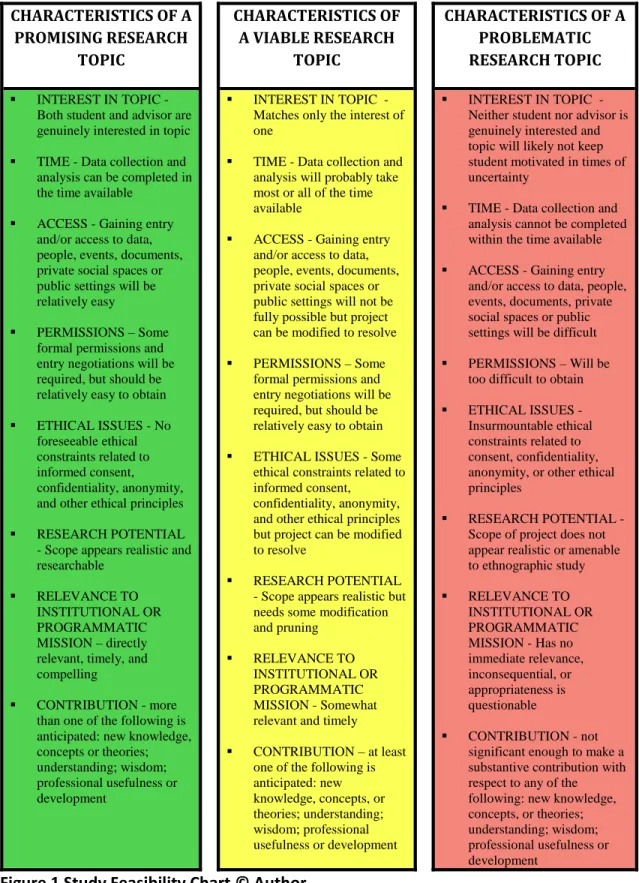
After you identify a topic or two, there are some pre-study considerations related to feasibility that you will want to think over and discuss with your critical peer and professor before you fully embark. Refer to the study feasibility chart in Figure 1 created for you to evaluate how realistic and within your capabilities your inquiry is.
What do you wonder about?
What intrigues you?
Have you noticed something?
Are you puzzled by something?
What have you observed of your surroundings?
What places, people, and events have you
encountered?
Are there some intriguing features, plans, and challenges facing a particular institution, community, group, organization, program, or social milieu that you would like to explore?
Is there a particular community or social issue that you would like to better understand?
What do you want to know about this issue or state of affairs that you do not already know?
What is happening that has piqued your curiosity?
Is there a particular process, behavior, trend, structure, conflict, tension, debate, or phenomenon that is of current interest to you?
Is there a particular policy issue in the local political arena about which you want to know more?
3
CHARACTERISTICS OF A PROMISING RESEARCH
TOPIC
CHARACTERISTICS OF A VIABLE RESEARCH
TOPIC
CHARACTERISTICS OF A PROBLEMATIC RESEARCH TOPIC
INTEREST IN TOPIC - Both student and advisor are genuinely interested in topic
TIME - Data collection and analysis can be completed in the time available
ACCESS - Gaining entry and/or access to data, people, events, documents, private social spaces or public settings will be relatively easy
PERMISSIONS – Some formal permissions and entry negotiations will be required, but should be relatively easy to obtain
ETHICAL ISSUES - No foreseeable ethical constraints related to informed consent, confidentiality, anonymity, and other ethical principles
RESEARCH POTENTIAL - Scope appears realistic and researchable
RELEVANCE TO INSTITUTIONAL OR PROGRAMMATIC MISSION – directly relevant, timely, and compelling
CONTRIBUTION - more than one of the following is anticipated: new knowledge, concepts or theories; understanding; wisdom; professional usefulness or development
INTEREST IN TOPIC - Matches only the interest of one
TIME - Data collection and analysis will probably take most or all of the time available
ACCESS - Gaining entry and/or access to data, people, events, documents, private social spaces or public settings will not be fully possible but project can be modified to resolve
PERMISSIONS – Some formal permissions and entry negotiations will be required, but should be relatively easy to obtain
ETHICAL ISSUES - Some ethical constraints related to informed consent,
confidentiality, anonymity, and other ethical principles but project can be modified to resolve
RESEARCH POTENTIAL - Scope appears realistic but needs some modification and pruning
RELEVANCE TO INSTITUTIONAL OR PROGRAMMATIC MISSION- Somewhat relevant and timely
CONTRIBUTION – at least one of the following is anticipated: new knowledge, concepts, or theories; understanding; wisdom; professional usefulness or development
INTEREST IN TOPIC - Neither student nor advisor is genuinely interested and topic will likely not keep student motivated in times of uncertainty
TIME - Data collection and analysis cannot be completed within the time available
ACCESS - Gaining entry and/or access to data, people, events, documents, private social spaces or public settings will be difficult
PERMISSIONS – Will be too difficult to obtain
ETHICAL ISSUES - Insurmountable ethical constraints related to consent, confidentiality, anonymity, or other ethical principles
RESEARCH POTENTIAL - Scope of project does not appear realistic or amenable to ethnographic study
RELEVANCE TO INSTITUTIONAL OR PROGRAMMATIC MISSION- Has no immediate relevance, inconsequential, or appropriateness is questionable
CONTRIBUTION - not significant enough to make a substantive contribution with respect to any of the following: new knowledge, concepts, or theories; understanding; wisdom; professional usefulness or development
Figure 1 Study Feasibility Chart © Author
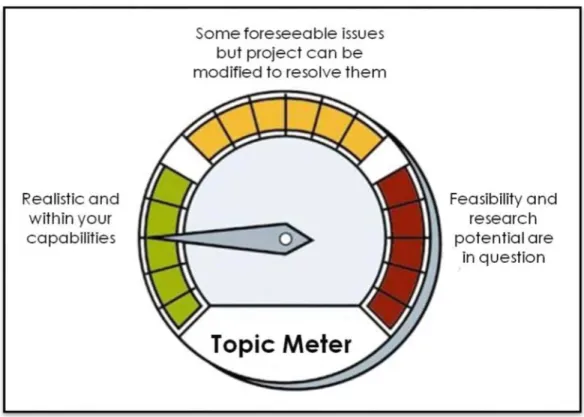
4 Are there some foreseeable issues that can be resolved as necessary? Or are you concerned about its research potential?
Next, use the “Topic Worksheet” to write out an at-a-glance plan for your project. Meet with a critical peer, modify the worksheet in light of the conversation that took place, submit the assignment on the due date identified in class, then schedule a conference with the professor for comments, support, and further direction. Be sure to bring your research journal to the conference. The assignment is worth twenty points and will be graded using the rubric attached.
Before you get started, take a few minutes to check for understanding.
CHECKING FOR UNDERSTANDING
1) Name three “places” from which a research topic can originate.
a. ________________________________________ b. ________________________________________ c. ________________________________________
2) Identify three characteristics of a problematic research topic.
a. ________________________________________ b. ________________________________________
5 c. ________________________________________
3) A research topic cannot be one that has been approached before as you must make your own unique contribution to your respective field.
a. True b. False
4) An inquiry is still realistic and within your capabilities even if formal permissions and entry negotiations will be required.
a. True b. False
5) Independence is encouraged, therefore, projects need not be approved by a faculty member.
6
MY TOPIC AT A GLANCE (20 POINTS)
Name: ________________________________________
1. TOPIC—What is the area of interest, situation, process, behavior, trend, structure, or phenomenon that is of current interest to you that you would like to pursue in a research project? Ask yourself: What moves me? Consider processes, phenomena, behaviors, trends, teaching dilemmas, puzzlement, intrigue, wonderings, or sources of tension that you have encountered/observed that pique your interest. Is there a particular student(s), teaching strategy, administrative or school-community issue that interests or is of concern to you? Is there a particular issue that you would like to understand better? What do you want to know about this that you don't already know? What is happening now that has stimulated your curiosity? What motivates your interest in this topic? (This will develop into the research “problem”/question.)
2. SETTING—Where will the research be conducted? What community, place, or environment? What do you need to know about this community, place, or environment? Are there some relevant historical features of the site of which you need to become aware?
3. PARTICIPANTS—Who will be involved in the research? How will you choose the participants or gain access to them? Why will you choose particular participants? (This will develop into a discussion about sample size and sampling procedure.)
4. DATA SOURCES—Where will you go to obtain the information that you need? How will you generate data? In other words, by what means will you collect data? What information will be accessible and available to you? How often will you or can you collect data?
5. ETHICAL CONSIDERATIONS—What ethical issues may arise in the research process and how will you address them? Do you need permission from an administrator? Parents? Community leaders? Local authorities? Others? How will you gain the necessary consent where required? How will you present this undertaking to participants or community members, where
applicable? How will you build credibility and trustworthiness in the study?
7 7. HARDWARE—What hardware (cameras, voice recorders, computer programs, etc.) do you have that you could use to help in the data collection process and analysis? What is your level of expertise with these devices and/or tools?
8. QUESTIONS—What questions do you have that can be addressed during the progress conference?
Professor’s Comments
Topic Approved
Almost There, Some Adjustments Required
8
TOPIC WORKSHEET GRADING RUBRIC
Student Name: ________________________________________
Category Competent 4 Adequate 3 Emerging 2 Patchy and 1
Unfinished Subtotals
Amount of
Information All elements of the topic worksheet are addressed and all questions are answered.
All elements of the topic worksheet are addressed and most questions are answered. All elements of the topic worksheet are addressed but questions are answered with 1-2 sentences about each.
One or more topics were not fully reflected upon or addressed.
Quality of
Information Information includes several supporting details and/or examples. Information provides 1-2 supporting details and/or examples. No details and/or examples are given. Information given has little or nothing to do with the main topic. Depth & Breadth of Content Clear evidence that higher level thinking skills of analysis and critical habits of mind were used in the completion of the topic worksheet. Some evidence that higher level thinking skills of analysis and critical habits of mind were used in the completion of the topic worksheet. Limited evidence that higher level thinking skills of analysis and critical habits of mind were used in the completion of the topic worksheet.
The
assignment reads as a gloss, and no evidence that higher level thinking skills of analysis and critical habits of mind were used in the completion of the topic worksheet. Mechanics No misspellings or grammatical errors.
One or two misspellings and/or mechanical errors. Three misspellings and/or grammatical errors. More than three errors in spelling or grammar.
Timeliness of
Completion Topic worksheet is submitted in Topic worksheet is submitted 1 Topic worksheet is submitted 2 days past the
9 class on the
due date. day past the due. due date but prior to the scheduled progress conference.
due date but prior to the scheduled progress conference.
Total