ORIGINAL ARTICLE
Nasal Growth and Maturation Age in Adolescents
A Systematic Review
Perry van der Heijden, MD; Astrid G. Korsten-Meijer, MD, PhD; Bernard F. van der Laan, MD, PhD; Hero P. Wit, PhD; Sieneke M. Goorhuis-Brouwer, PhD
Objective:To define the end of the nasofacial growth spurt in order to schedule rhinoseptoplasty in patients with cleft without disturbing nasofacial growth.
Data Sources: We searched the PubMed and
Coch-rane bibliographic databases from inception through De-cember 31, 2007, using the primary indexing term fa-cial growthwith the confining search termsgrowthAND (face OR nose)AND(cephalometryORanthropometry). The reference lists of the retrieved articles were searched for missed relevant studies. Articles written in English, German, or Dutch were included in the review. Study Selection:Studies of white adolescents without genetic disorders or malformations whose growth pat-terns had been followed up from at least 12 years of age until 18 years of age, with intervals between relevant mea-surements not longer than 2 years, were selected for this review.
Data Extraction: A reviewer performed data extrac-tion by obtaining raw study data from the selected stud-ies or by requesting them from the authors.
Data Synthesis:Growth velocity curves were fit to dif-ferent relevant measures for nasofacial growth. The end of the nasofacial growth spurt was defined as the age at which these growth velocity curves have their steepest descend-ing slope. This definition yielded an average age of 13.1 years for adolescent girls and 14.7 years for adolescent boys. Be-cause no information could be found for the spread in age of nasal growth spurt of individuals, 2 SDs of the age dis-tribution for body height growth velocity were added. This resulted in 98% of white adolescent girls being nasally ma-ture at the age of 15.8 years and 98% of white adolescent boys being nasally mature at the age of 16.9 years. Conclusion:Rhinoseptoplasty can safely be performed after the age of 16 years in girls and 17 years in boys. Arch Otolaryngol Head Neck Surg. 2008;134(12):1288-1293
P
ATIENTS WITH CLEFT MAYneed many operations be-tween childhood and adoles-cence, with revising rhino-septoplasty being one of the last operations to be performed. Because the septal cartilage and nasal bones have an important role in the outgrowth of the midface, reservation in operating on these structures is recommended.1-3On the ba-sis of the growth characteristics of the sep-tal cartilage, nasal bones, and midface, growth is expected to cease at the age of 18 years. Therefore, the prevalent opin-ion of most cleft specialists in the Neth-erlands is to postpone rhinoseptoplasty un-til that age. However, the dogma stating that nasal surgery in growing individuals must be avoided is coming under ques-tion,4and surgery with or without oste-otomies is performed in several clinics on patients younger than 18 years.5-7
Primary corrections and presurgical treatments are evolving rapidly. The fairly new technique of presurgical nasoalveo-lar molding plates, originally used to facili-tate the primary correction of the palate, is often combined with nasal stents to shape
the alar cartilage into a more normal posi-tion.8-11This combination probably has the positive effect of preventing internal and ex-ternal nose deviations.9However, current preadolescent patients with cleft were un-able to profit from nasoalveolar molding plates in their early years.
In addition to the physical changes, many psychological changes occur dur-ing adolescence, and it is common for pa-tients to be preoccupied with and inse-cure about their appearance. For many young adolescents, facial appearance is a concern within their social environ-ment,12especially with a deformity such as a cleft-related nose deviation. A major proportion (54%-68%) of children with cleft are unhappy with their facial appear-ance,13and 59% of children with cleft tween 8 and 11 years of age and 37% be-tween 12 and 15 years of age claim to be teased.14By far the main focus of teasing is the child’s nose and lip.14This teasing may lead to decreased self-esteem, social isolation, or worse. Adolescents with cleft indicate that they have a strong desire to have surgeons correct their noses,15and they retain that desire into adulthood.15,16To Author Affiliations:
Department of
Otorhinolaryngology/Head and Neck Surgery, University Medical Center Groningen, and Faculty of Medical Sciences, University of Groningen, Groningen, the Netherlands.
them, improved appearance is even more important than better nasal function.17However, if surgeons intend to ful-fill this desire, they must take care not to disturb growth by respecting the limitations of rhinoseptoplasty. To that end, surgeons should be aware of the nasofacial growth pat-tern. Several authors3,18-22suggest that the end of the na-sofacial growth spurt takes place earlier than 18 years of age, but no conclusive research concerning children with or without cleft has been performed.
In our opinion, based on clinical experience at our oto-rhinolaryngology clinic, 5 measures are relevant in ob-serving nasal growth (Figure 1): (1) nasal bridge length from nasion to pronasal; (2) nasal protrusion from nasal to pronasal; (3) nasal height from nasion to sub-nasal; (4) palatal length from anterior nasal spine (ANS) to posterior nasal spine (PNS); and (5) midfacial protru-sion from sella to ANS.
The aim of this study is to describe the nasofacial growth pattern of the normal child and adolescent to pro-mote the identification of an adolescent growth spurt and the subsequent slowing of growth. From this, a defini-tion of maturadefini-tion is derived.
METHODS
MATERIALS AND METHODS
This article is based on a PubMed and Cochrane search from database inception to December 31, 2007. The following in-clusion criteria were used to identify studies for this article: (1) white adolescents without genetic disorders or malforma-tions; (2) growth pattern must be observed between the ages of 12 and 18 years; (3) facial growth evaluated through direct and/or indirect measurements; (4) intervals between measure-ment ages are not longer than 2 years; (5) the article must pro-vide at least 1 of the 5 relevant measures; and (6) the article must be written in English, German, or Dutch.
Both libraries were searched on the keywordfacial growth. Because of the large number of search results obtained from PubMed, we adjusted the relative search terms usinggrowth AND(faceORnose)AND(cephalometryORanthropometry). The full text was obtained for articles considered relevant based on the title or the abstract. The reference lists of the retrieved articles were searched for relevant studies that could have been missed by the computer search.
The search yielded 25 articles and 1 book describing sev-eral nasofacial growth items.18-43In 4 studies18,23,24,33the popu-lation was not white, in 10 studies*the measurements were not taken from 12- to 18-year-olds or followed up less than ev-ery 2 years, and in 8 studies22,25,30,35,37,39,40,43elaborated or raw data could not be retrieved. The authors of these studies were requested by e-mail to clarify their data. This request yielded no additional information.
STUDY SELECTION
Farkas20published extensive facial measurements in a refer-ence book. Among many other measurements, results were found for nasal height, nasal protrusion, and nasal bridge length. In total, data were obtained transversally (50 persons per age) for 2326 white adolescents from Calgary, Alberta, Toronto, On-tario, Montreal, and Quebec, Canada, from birth to 25 years of age at intervals of 1 year.
Zankl et al27studied the growth of the nasal bridge length, nasal protrusion, and philtrum length from birth until 97 years of age. Their study population was acquired from nurseries for newborn children, day care centers, schools, large companies, the military service, and nursing homes for elderly people. All study participants were of central European descent living in Switzerland. Fifty persons were measured each year of age from birth until 28 years of age.
Ochoa and Nanda32compared maxillary growth with man-dibular growth by making many measurements using lateral cephalograms, including measuring the distance from ANS to PNS (palatal length). The lateral cephalograms were derived from the Denver Growth Study.44This is a longitudinal study conducted by the Denver Child Research Council between 1927 and 1967. All study participants were white and healthy. Ochoa and Nanda investigated 15 males and 13 females aged 6 to 20 years. Unfortunately, age was determined by hand radio-graphic analysis instead of chronologic age.
Nanda36studied the anteroposterior facial growth shown in lateral cephalograms of female patients conducted annually from the age of 3 years to 18 years, including palatal length (ANS-PNS) and midfacial protrusion (ANS sella). The study popu-lation was 18 female patients derived from the Denver Growth Study.44Age was determined chronologically.
STATISTICAL ANALYSIS
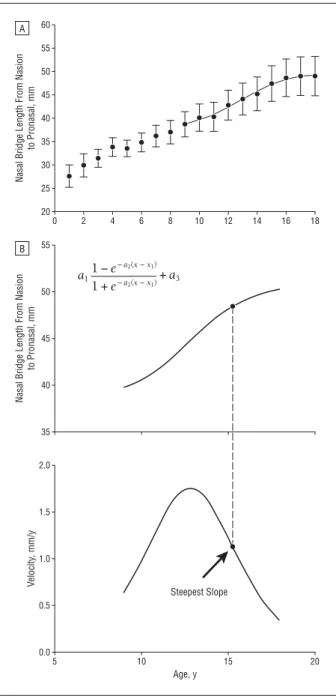
The data included were plotted as a function of age. At ap-proximately the age of maximum growth velocity, data were least squares fitted with an S-shaped curve with the following formula:
y=a1{1− exp[−a2(x−x1)]}/{1⫹exp[−a2(x−x1)]}⫹a3, withyindicating length in millimeters andxindicating age in years;a1,a2,a3, andx1are parameters to be fitted (Figure 2A). *References 19, 21, 26, 28, 29, 31, 34, 38, 41, 42. prn sn n se PNS ANS
Figure 1.The 5 measures relevant in observing nasal growth: (1) nasal bridge length from nasion (n) to pronasal (prn); (2) nasal protrusion from subnasal (sn) to prn; (3) nasal height from n to sn; (4) palatal length from anterior nasal spine (ANS) to posterior nasal spine (PNS); and (5) midfacial protrusion from sella (se) to ANS.
Growth velocity as a function of age is obtained by differen-tiation of this formula (Figure 2B). The basis for the formulae used is the observation that growth proceeds at high velocity in early childhood and lower velocity in later childhood, with a growth spurt during adolescence that continues at a low steady pace until old age.20,27,28,38The vertical scale inFigure 3and Figure 4is not expressed as growth velocity in millimeters per year; for a better comparison between the different mea-sures, it is expressed as the percentage of the length at the age of 18 years per year. For example, if length at the age of 18 years is 50 mm, a velocity of 1 mm/y is thus 2% per year of the length at the age of 18 years.
The criterion chosen for maturity is the age at which the velocity curve descends most steeply. At this age, the second derivative of the formula is 0. From that age on, the growth velocity gradually decreases to almost 0.
RESULTS
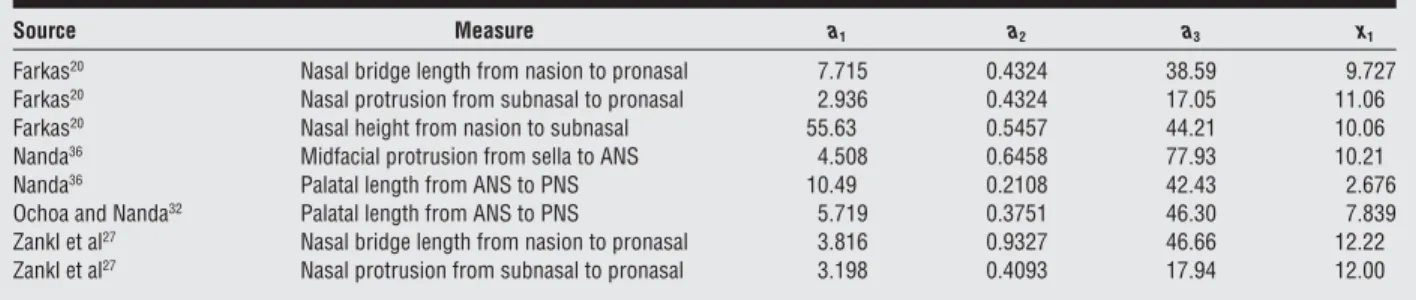
Curves were fitted to 8 growth measures in female pa-tients and to 6 measures in male papa-tients (Figure 2A). The parameters that provided the best fits are given in
Table 1 andTable 2. All measures for male and
fe-male patients show a period of growth acceleration. In girls (Figure 3), maximum growth velocity ranges from before the age of 8 years until the age of 12 years.32,36In boys (Figure 4), all growth velocity curves (except 1) have their maximum at approximately the age of 13 years. Table 3andTable 4give the ages for maximum growth deceleration for girls and boys.
COMMENT
Palatal length lacks a growth spurt in adolescence in girls and boys and has a deviating growth pattern compared with the other nasal measures in boys and girls. This can 60 50 55 45 40 35 30 25 20 0 2 4 6 8 10 12 14 16 18
Nasal Bridge Length From Nasion
to Pronasal, mm A 55 50 45 40 35
Nasal Bridge Length From Nasion
to Pronasal, mm B 2.0 1.0 1.5 0.5 0.0 5 10 15 20 Age, y V elocity , mm/y a11 −e − a2(x−x1) 1 +e − a2(x−x1)+ a3 Steepest Slope
Figure 2.Data plotted as a function of age. At approximately the age of maximum growth velocity, data were least squares fitted with an S-shaped curve with the following formula:
y=a1{1− exp[−a2(x−x1)]}/{1⫹exp[−a2(x−x1)]}⫹a3, withyindicating
length in millimeters andxindicating age in years;a1,a2,a3, andx1are
parameters to be fitted. A, Example of raw data fitted with an S-shaped curve. B, Example of a fitted curve with a first derivative and a point of steepest slope. 4 2 3 1 0 8 10 1 3 7 2 4 6 5 8 12 14 16 18 Age, y Growth, % of Length at 18 Y ears
Figure 3.Female growth per year expressed as a percentage of length at the age of 18 years. Numbers next to the curved lines correspond to the order of the authors in Table 1.
6 4 5 3 2 1 0 8 10 12 14 16 18 Age, y Growth, % of Length at 18 Y ears 6 1 2 5 3 4
Figure 4.Male growth per year expressed as a percentage of length at the age of 18 years. Numbers next to the curved lines correspond to the order of the authors in Table 2.
be explained by the fact that the PNS and ANS grow from the sella. Although we did not select a study in which this is measured , it might be concluded that the PNS sella distance has an adolescent growth spurt parallel to the ANS sella distance. Because of the lack of a growth spurt in adolescence, we consider palatal length not to be rep-resentative of nasal maturation and have therefore not taken it into account.
The age of maturation can be defined in different ways. An obvious definition is the age at which the growth curve flattens to horizontal after the growth spurt during ado-lescence. This, however, does not occur. Ferarrio et al,28 Lang et al,38West and McNamara,45and particularly Zankl
et al27have shown that the nose continues growing un-til old age.
Farkas20defined the age of maturation of the nose sta-tistically by comparing distance measures at a certain age with the corresponding measure at 18 years of age, tak-ing standard errors of the mean of the measurements into account. Personal correspondence by e-mail did not re-veal the underlying rationale for this definition.
We have defined the age of maturity for a certain na-sal measure as the age at which the growth velocity curve for this measure has its steepest descending slope. Ma-turity ages for the representative measures are given in Tables 3 and 4. The ANS-PNS values shown in Tables 3
Table 1. Parameters That Gave the Best Fits for the S-Shaped Curve for Adolescent Girlsa
Source Measure a1 a2 a3 x1
Farkas20 Nasal bridge length from nasion to pronasal 7.715 0.4324 38.59 9.727
Farkas20 Nasal protrusion from subnasal to pronasal 2.936 0.4324 17.05 11.06
Farkas20 Nasal height from nasion to subnasal 55.63 0.5457 44.21 10.06
Nanda36 Midfacial protrusion from sella to ANS 4.508 0.6458 77.93 10.21
Nanda36 Palatal length from ANS to PNS 10.49 0.2108 42.43 2.676
Ochoa and Nanda32 Palatal length from ANS to PNS 5.719 0.3751 46.30 7.839
Zankl et al27 Nasal bridge length from nasion to pronasal 3.816 0.9327 46.66 12.22
Zankl et al27 Nasal protrusion from subnasal to pronasal 3.198 0.4093 17.94 12.00
Abbreviations: ANS, anterior nasal spine; PNS, posterior nasal spine.
aAt approximately the age of maximum growth velocity, data were least squares fitted with an S-shaped curve with the following formula:
y=a1{1− exp[−a2(x−x1)]}/{1⫹exp[−a2(x−x1)]}⫹a3, withyindicating length in millimeters andxindicating age in years;a1,a2,a3, andx1are parameters to be
fitted.
Table 2. Parameters that Gave the Best Fits for the S-Shaped Curve for Adolescent Boysa
Source Measure a1 a2 a3 x1
Farkas20 Nasal bridge length from nasion to pronasal 6.189 0.5664 43.77 12.82
Farkas20 Nasal protrusion from subnasal to pronasal 2.500 0.5311 17.76 12.35
Farkas20 Nasal height from nasion to subnasal 6.477 0.5173 47.72 12.33
Ochoa and Nanda32 Palatal length from ANS to PNS 43.59 0.0995 17.63 −9.701
Zankl et al27 Nasal bridge length from nasion to pronasal 4.643 0.6888 47.25 12.39
Zankl et al27 Nasal protrusion from subnasal to pronasal 2.720 0.8512 18.92 12.98
Abbreviations: ANS, anterior nasal spine; PNS, posterior nasal spine.
aAt approximately the age of maximum growth velocity, data were least squares fitted with an S-shaped curve with the following formula:
y=a1{1− exp[−a2(x−x1)]}/{1⫹exp[−a2(x−x1)]}⫹a3, withyindicating length in millimeters andxindicating age in years;a1,a2,a3, andx1are parameters to be
fitted.
Table 3. Age of Maximum Growth Deceleration (the Age at Which the Second Derivative of the Velocity Curve Is Zero) in Adolescent Girls
Source Measure
Maturity Age, y
Farkas20 Nasal bridge length from nasion to pronasal 12.78
Farkas20 Nasal protrusion from subnasal to pronasal 14.08
Farkas20 Nasal height from nasion to subnasal 12.48
Nanda36 Midfacial protrusion from sella to ANS 12.25
Nanda36 Palatal length from ANS to PNS 8.92a
Ochoa and Nanda32
Palatal length from ANS to PNS 11.36a
Zankl et al27 Nasal bridge length from nasion to pronasal 13.30
Zankl et al27 Nasal protrusion from subnasal to pronasal 15.22
Abbreviations: ANS, anterior nasal spine; PNS, posterior nasal spine.
aThese numbers are not taken into account (see the “Comment” section).
Table 4. Age of Maximum Growth Deceleration (the Age at Which the Second Derivative of the Velocity Curve Is Zero) in Adolescent Boys
Source Measure
Maturity Age, y
Farkas20 Nasal bridge length from nasion to pronasal 15.15
Farkas20 Nasal protrusion from subnasal to pronasal 14.83
Farkas20 Nasal height from nasion to subnasal 14.88
Ochoa and Nanda32
Palatal length from ANS to PNS 3.54a
Zankl et al27 Nasal bridge length from nasion to pronasal 14.30
Zankl et al27 Nasal protrusion from subnasal to pronasal 14.53
Abbreviations: ANS, anterior nasal spine; PNS, posterior nasal spine.
and 4 for girls36and boys32deviate largely from the other values. This finding is unremarkable because palatal length lacks a growth spurt during adolescence. It has a growth pattern that deviates from that of other nasal measures because PNS and ANS grow from the sella,46considered to be a stable point of the skull base during growth.47
If palatal length is not taken into account, the aver-age aver-age of maturity is 13.4 years for girls and 14.7 years for boys. These numbers are in agreement with results from cephalometric studies of facial growth (Burke and Hughes-Lawson,19el-Batouti et al,41Thilander et al,42and Bergersen43). The larger spread in the position of the maxima of the growth velocity curves for girls (Figure 3) compared with boys (Figure 4) is remarkable.
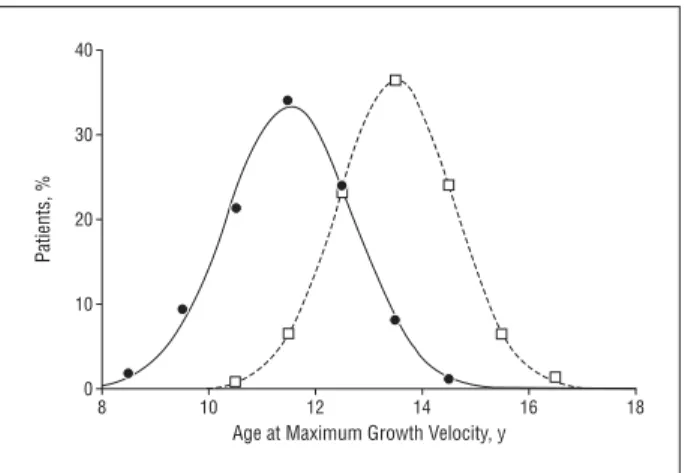
If the average age of maturity in a large group of girls or boys follows a symmetric distribution, this age will be higher than the given values for half of the group. Unfortunately, no information could be found for the spread in indi-vidual nasal growth as a function of age. However, if we assume that this spread does not differ much from the spread in body height velocity, useful information can be derived from the results of the study by Berkey et al.48These au-thors provide longitudinal height velocity standards for US adolescents. The data points inFigure 5were derived from their Figure 1. An almost perfect fit to these points could be made with a gaussian curve. The maximum of the curve is at the age of 11.5 years for girls and 13.5 years for boys. The SD (derived from the fit parameters) is 1.2 years for girls and 1.1 years for boys.
Nasal growth velocity is maximal at the mean (SD) age of 11.0 (0.9) years for girls and 12.6 (0.3) years for boys. Therefore, it may be concluded that no substan-tial difference exists between the age of maximal body height velocity and the age of maximal nasal growth locity. If (to be on the safe side) 2 SDs for the height ve-locity distributions are added to the average age of ma-turity for the nose (as defined in this article), an age of 15.8 years is obtained for girls and 16.9 years for boys. In a systematic review, Flores-Mir et al49found that skeletal maturity, determined by hand-wrist radio-graphic analysis, was well related to overall facial growth velocity. This finding supports the assumption that
na-sal growth velocity is related to body height velocity. Fur-thermore, it provides the possibility of determining the stage of individual growth.
In conclusion, in 98% of adolescent girls the nose is ma-ture at the age of 15.8 years. For 98% of adolescent boys, this age is 16.9 years. Because the results of nasal interventions performed after maturation age are not likely to be disturbed by nasal growth, rhinoseptoplasty can be performed safely, in most cases, in adolescent girls after the age of 16 years and in adolescent boys after the age of 17 years.
Submitted for Publication:January 2, 2008; accepted
Feb-ruary 11, 2008.
Correspondence:Perry van der Heijden, MD,
Depart-ment of Otorhinolaryngology/Head and Neck Surgery, University Medical Center Groningen, PO Box 30.001, 9700 RB Groningen, the Netherlands (p.van.der.heijden @kno.umcg.nl).
Author Contributions:All authors had full access to all
the data in the study and take responsibility for the in-tegrity of the data and the accuracy of the data analysis. Study concept and design:van der Heijden, Korsten-Meijer, and Wit.Acquisition of data: van der Heijden. Analysis and interpretation of data: van der Heijden, Korsten-Meijer, van der Laan, Wit, and Goorhuis-Brouwer.Drafting of the manuscript:van der Heijden, Korsten-Meijer, and Wit.Critical revision of the manu-script for important intellectual content:van der Heijden, Korsten-Meijer, van der Laan, and Wit.Statistical analy-sis:Wit.Obtained funding:van der Heijden. Administra-tive, technical, and material support:van der Heijden, van der Laan, and Wit.Study supervision:Korsten-Meijer, van der Laan, Wit, and Goorhuis-Brouwer.
Financial Disclosure:None reported.
Additional Contributions: Andreas Zankl, MD,
pro-vided us with his raw data. REFERENCES
1. Gilbert JG, Segal S Jr. Growth of the nose and the septorhinoplastic problem in youth.Arch Otolaryngol. 1958;68(6):673-682.
2. Huizing EH. Septum surgery in children [in German].Ned Tijdschr Geneeskd. 1966;110(29):1293-1296.
3. Nolst Trenite´ GJ.Rhinoplasty: A Practical Guide to Functional and Aesthetic Sur-gery of the Nose. 2nd ed. The Hague, the Netherlands: Kugler Publications; 1998. 4. El-Hakim H, Crysdale WS, Abdollel M, Farkas LG. A study of anthropometric mea-sures before and after external septoplasty in children: a preliminary study.Arch Otolaryngol Head Neck Surg. 2001;127(11):1362-1366.
5. Duskova´ M, Kristen M, Smahel Z. The anthropometric verification of corrective surgery outcome in cleft secondary deformities.J Craniofac Surg. 2006;17 (3):447-453.
6. Lo LJ, Wong FH, Mardini S, Chen YR, Noordhoff MS. Assessment of bilateral cleft lip nose deformity: a comparison of results as judged by cleft surgeons and laypersons.Plast Reconstr Surg. 2002;110(3):733-738.
7. Sundine MJ, Phillips JH. Treatment of the unilateral cleft lip nasal deformity.
J Craniofac Surg. 2004;15(1):69-76.
8. Grayson BH, Cutting CB. Presurgical nasoalveolar orthopedic molding in pri-mary correction of the nose, lip, and alveolus of infants born with unilateral and bilateral clefts.Cleft Palate Craniofac J. 2001;38(3):193-198.
9. Maull DJ, Grayson BH, Cutting CB, et al. Long-term effects of nasoalveolar mold-ing on three-dimensional nasal shape in unilateral clefts.Cleft Palate Craniofac J. 1999;36(5):391-397.
10. Pai BC, Ko EW, Huang CS, Liou EJ. Symmetry of the nose after presurgical na-soalveolar molding in infants with unilateral cleft lip and palate: a preliminary study.Cleft Palate Craniofac J. 2005;42(6):658-663.
11. Suri S, Tompson BD. A modified muscle-activated maxillary orthopedic
appli-40 20 30 10 0 8 10 12 14 16 18
Age at Maximum Growth Velocity, y
Patients, %
Figure 5.Distribution of the age of maximum height growth velocity for adolescent girls (solid circles) and adolescent boys (open squares). Data were taken for white adolescent boys and adolescent girls from Figure 1 in the article by Berkey et al.48The solid and the dashed lines are least-squares
ance for presurgical nasoalveolar molding in infants with unilateral cleft lip and palate.Cleft Palate Craniofac J. 2004;41(3):225-229.
12. Verhulst F.De ontwikkeling van het kind. 8e geheel herz dr ed. Assen, Germany: Koninklijke Van Gorcum; 2005.
13. Hunt O, Burden D, Hepper P, Stevenson M, Johnston C. Self-reports of psycho-social functioning among children and young adults with cleft lip and palate.Cleft Palate Craniofac J. 2006;43(5):598-605.
14. Semb G, Brattstrom V, Molsted K, et al. The Eurocleft study: intercenter study of treatment outcome in patients with complete cleft lip and palate, part 4: relation-ship among treatment outcome, patient/parent satisfaction, and the burden of care.Cleft Palate Craniofac J. 2005;42(1):83-92.
15. Hunt O, Burden D, Hepper P, Johnston C. The psychosocial effects of cleft lip and palate: a systematic review.Eur J Orthod. 2005;27(3):274-285. 16. Sinko K, Jagsch R, Prechtl V, Watzinger F, Hollmann K, Baumann A. Evaluation
of esthetic, functional, and quality-of-life outcome in adult cleft lip and palate patients.Cleft Palate Craniofac J. 2005;42(4):355-361.
17. Noor SN, Musa S. Assessment of patients’ level of satisfaction with cleft treat-ment using the cleft evaluation profile.Cleft Palate Craniofac J. 2007;44(3): 292-303.
18. Arat M, Koklu A, Ozdiler E, Rubenduz M, Erdogan B. Craniofacial growth and skel-etal maturation: a mixed longitudinal study.Eur J Orthod. 2001;23(4):355-361. 19. Burke PH, Hughes-Lawson CA. Stereophotogrammetric study of growth and
de-velopment of the nose.Am J Orthod Dentofacial Orthop. 1989;96(2):144-151. 20. Farkas L.Anthropometry of the Head and Face. 2nd ed. New York, NY: Raven
Press; 1994.
21. Prahl-Andersen B, Ligthelm-Bakker AS, Wattel E, Nanda R. Adolescent growth changes in soft tissue profile.Am J Orthod Dentofacial Orthop. 1995;107(5): 476-483.
22. Smith SL, Buschang PH. Midsagittal facial soft-tissue growth of French Cana-dian adolescents.Am J Hum Biol. 2002;14(4):457-467.
23. Akgüner M, Barutcu A, Karaca C. Adolescent growth patterns of the bony and cartilaginous framework of the nose: a cephalometric study.Ann Plast Surg. 1998; 41(1):66-69.
24. Van Loosen J, Van Zanten GA, Howard CV, Verwoerd-Verhoef HL, Van Velzen D, Verwoerd CD. Growth characteristics of the human nasal septum.Rhinology. 1996;34(2):78-82.
25. Chvatal BA, Behrents RG, Ceen RF, Buschang PH. Development and testing of multilevel models for longitudinal craniofacial growth prediction.Am J Orthod Dentofacial Orthop. 2005;128(1):45-56.
26. Sforza C, Dellavia C, Colombo A, Serrao G, Ferrario VF. Nasal dimensions in nor-mal subjects: conventional anthropometry versus computerized anthropometry.
Am J Med Genet A. 2004;130(3):228-233.
27. Zankl A, Eberle L, Molinari L, Schinzel A. Growth charts for nose length, nasal protrusion, and philtrum length from birth to 97 years.Am J Med Genet. 2002; 111(4):388-391.
28. Ferrario VF, Sforza C, Poggio CE, Schmitz JH. Three-dimensional study of growth and development of the nose.Cleft Palate Craniofac J. 1997;34(4):309-317.
29. Foley TF, Duncan PG. Soft tissue profile changes in late adolescent males.Angle Orthod. 1997;67(5):373-380.
30. Meng HP, Goorhuis J, Kapila S, Nanda RS. Growth changes in the nasal profile from 7 to 18 years of age.Am J Orthod Dentofacial Orthop. 1988;94(4):317-326.
31. Genecov JS, Sinclair PM, Dechow PC. Development of the nose and soft tissue profile.Angle Orthod. 1990;60(3):191-198.
32. Ochoa BK, Nanda RS. Comparison of maxillary and mandibular growth.Am J Orthod Dentofacial Orthop. 2004;125(2):148-159.
33. van Loosen J, Baatenburg de Jong RJ, Van Zanten GA, Engel T, Lanjewar DN, Van Velzen D. A cephalometric analysis of nasal septal growth.Clin Otolaryngol Allied Sci. 1997;22(5):453-458.
34. Buschang PH, De La Cruz R, Viazis AD, Demirjian A. Longitudinal shape changes of the nasal dorsum.Am J Orthod Dentofacial Orthop. 1993;104(6):539-543. 35. Snodell SF, Nanda RS, Currier GF. A longitudinal cephalometric study of
trans-verse and vertical craniofacial growth.Am J Orthod Dentofacial Orthop. 1993; 104(5):471-483.
36. Nanda SK. Differential growth of the female face in the anteroposterior dimension.
Angle Orthod. 1992;62(1):23-34.
37. Buck DL, Brown CM. A longitudinal study of nose growth from ages 6 to 18.
Ann Plast Surg. 1987;18(4):310-313.
38. Lang J, Bachmann C, Raabe S. Postnatal growth of the exterior nose [in German].
Gegenbaurs Morphol Jahrb. 1987;133(1):5-32.
39. Groenewald MB. Postero-anterior nose growth [in Afrikaans].J Dent Assoc S Afr. 1983;38(6):367-369.
40. Posen JM. A longitudinal study of the growth of the nose.Am J Orthod. 1967;53 (10):746-756.
41. el-Batouti A, Ogaard B, Bishara SE. Longitudinal cephalometric standards for Nor-wegians between the ages of 6 and 18 years.Eur J Orthod. 1994;16(6):501-509.
42. Thilander B, Persson M, Adolfsson U. Roentgen-cephalometric standards for a Swedish population: a longitudinal study between the ages of 5 and 31 years.
Eur J Orthod. 2005;27(4):370-389.
43. Bergersen EO. The male adolescent facial growth spurt: its prediction and rela-tion to skeletal maturarela-tion.Angle Orthod. 1972;42(4):319-338.
44. McCammon R.Human Growth and Development.Springfield, IL: Thomas; 1970. 45. West KS, McNamara JA Jr. Changes in the craniofacial complex from adoles-cence to midadulthood: a cephalometric study.Am J Orthod Dentofacial Orthop. 1999;115(5):521-532.
46. Enlow D, Hans M.Essentials of Facial Growth. Philadelphia, PA: Saunders; 1997. 47. Berkowitz S.Cleft Lip and Palate. 2nd ed. Berlin, Germany: Springer; 2005. 48. Berkey CS, Dockery DW, Wang X, Wypij D, Ferris B Jr. Longitudinal height
ve-locity standards for U.S. adolescents.Stat Med. 1993;12(3-4):403-414. 49. Flores-Mir C, Nebbe B, Major PW. Use of skeletal maturation based on
hand-wrist radiographic analysis as a predictor of facial growth: a systematic review.