Interactive Speech Understanding
Iliroaki Saito Dept. of Mathematties
Keio U n i v e r s i t y Y o k o h a m a , 223, J A P A N E-mail: h x s @ n a k . m a t h . k e i o . a e . j p
A b s t r a c t
This paper introduces at robust interactive method for speech understatnding. The gener- atlized LR patrsing is enhanced ill this approach. Patrsing proceeds fl'om left to right correcting mi- nor errors. When at very noisy portion is detected, the patrser skips that portion using a .fake non- terminal symbol. The unidentified portion is re- solved by re-utterance of thatt portion which is parsed very efliciently by using the parse record of the first utterance. The user does not have to speak the whole sentence again. This method is also catpatble of hatndling unknown words, which is imlmrtatnt in pra.ctical systems. 1)erected un- known words earn I)e incrementatlly incorporatted into the dictionary after the interatction with tile user. A pilot system has shown great elfectiveness of this atpproach.
1 I n t r o d u c t i o n
It has been continuously mentioned thatt some kind of latnguage knowledge is essential in good- quality speech understanding. Until recently, however, most research has focused mainly oil word recognition atnd one of the excellent recogni- tion systems built to date is S p h i n x developed by Lee [7]. Although SI)hinx atttained atn excellent word accuracy of 96 % on at 997-word task, its sentence recognition accuracy drops slgnificatntly clue to its use of only at stattisticaJ trigra~l gratm- i i l a l ' .
There hatve been at few atttempts to integratte at speech recognition device with a nattural language understanding syste,n, ltatyes el al. [3] adopted technique of case fi'ame i n s t a n t i a t i o n to patrse at continuously spoken English sentence in the form of at word lattice (a set of word catndldattes hy- pothesized by at st)eech recognition module) and
produce at frame representation of the utterance. The case frame patrsing hats been pursued by Poe- sio et al. [8] and Giatchin et al. [2] for instance.
Meanwhile, at compiler-oriented shift-reduce LR parsing technique hats been used for speech recognition recently due to its no-batcktracking tatl)le-drlven ei[iciency [12, iII, 6]. Becatuse the parsing proceeds from left to right pruning low- l)robatl)ility t)atrtiatl-parses, the correct parse catn not be obtained if the parsing fails to find the correct path in the beginning. Moreover, it is sometimes difficult to handle tim very noisy input, esl)ecially the input with missing words. T h u s an Lll. parser sometimes yields totally incorrect but syntactically-sound hypotheses or no hypotheses att all. This weakness is occasionally cited to demonstrate superiority of the pa.rsing method nsing much simI)ler bigram or trigratm g r a m m a r s in which the re.covery in the middle of the in- put earn be done at eatse. In this paper, we de- scribe at method of enllatncing the generalized 1,R (GLR) parsing towatrds interactive speech under- standing.
Section 2 describes the enhatnced GLR parrs- lug. Section 3 describes the rol)ustness of the parser and presents an interatctive method to re- solve the unclcatr I)ortion of the input and un- known words. Section 4 experiments the effec- tiveness of the technique in parsing spoken sen- tences. Finally the concluding rematrks atre given in Section 5.
2 E n h a n c e d G L R P a r s i n g f o r S p e e c h U n d e r s t a n d i n g
Ill this section, tile GI,R patrsing method is de- scribed first. Then some techniques which en- hatnce the robustness are described.
2.1 B a c k g r o u n d : G L R P a r s i n g
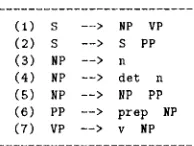
The LR parsing technique was originally devel- oped for the compilers of programming languages [1] and has been extended for natural language processing [11]. The GLI[ parsing analyzes the in- put sequence from left to right with no backtrack- ing by looking at the parsing table constructed from the context-flee g r a m m a r rules in advance. An example g r a m m a r and its parsing table are shown in Figure l and Figure 2 respectively.
Entries "s n" in the action table (the left part of the table) indicate the action "shift one word from the input 1)uffcr onto the stack and go to state n". Entries "r n" indicate tile action "re- duce constituents on the stack usiug rule n". The entry "ace" stands for the action "accept", and t)lank spaces represent "error". "$" in the action table is the end-of-inl)ut symbol. The goto table (the right part of the table) decides to which state the parser shouhl go after a reduce action. The LR parsing table in Figure 2 is different fi'om reg- ular LR tables utilized by the compilers in that
there are multiple entries, called conflicts, on the
rows of state 11 and 12. While the encountered entry has only one aztion, parsing proceeds ex- actly the same way as the regular LR parsing. In case there are multiple actions in an entry, all
the actions are executed with the graph-structured
stack [11].
( 1 ) S - - > NP VP
(2) S --> S PP
( 3 ) NP - - > n
(4) NP --> det n
(5) NP --> NP PP
(6) PP - - > prep NP
(7) VP --> v NP
Figure 1: Example CFG Rules
2 . 2 G L R P a r s i n g f o r E r r o n e o u s S e n - t e n c e s
The original GLR parsing method was not de- signed to handle ungrammatical sentences. This feature is acceptable if the domain is strictly de- fined and input sentences are correct at all times. Unfortunately, accuracy of speech recognition is not 100%. Common errors in speech recognition are insertions, deletions (missing words), and sub-
< A c t i o n T a b l e > I < G o t o T a b l e > d e t n v p r e p $ I N P PP VP S . . .
s3 s4 s6 s7 s6
slO
0 1 2 3 4 5 6 7 8 9 10 t l 12
s3 s4
s3 s4 r3 r3
r2 r2
r l r l
r5 r5 r5
r4 r4 r4
r6 r 6 , s 6 r6 rT,s6 r7
2 1
ace 5
9 8
r 3
11 12
9 9
Figure 2: GI, R Parsing Table
stitntions. Some techniques have been developed to handle erroneous sentences for the GLR pars- ing [12, 10].
• The action table can be looked up in a predictive way to handle a missing word. Namely, a set of possible terminal symbols {Ti} at State i can be missing word candi- dates.
• This way of using the action table is also use- ful to handle s u b s t i t u t i o n and insertion er- rors. I.e., the table can tell which part of the input should be replaced by a specific symbol or ignored.
'['he parser explores every possibility in paralleP.
2 . 3 G a p - f i l l i n g T e c h n i q u e
The techniques described in tile previous section can not handle such a big noise as two consecutive missing words. To cope with this, the gap-filling technique [9] is presented here.
In tile gap-filling GLR parsing, the goto table is consulted just the same way as the action table, in addition to its regular usage. Namely, at state
si which is expecting shift action(s), the parser
also consults the gore table. If an entry m ex- ists along the row of s t a t e sl under the column
lie practice, pruning is incorporated to reduce search by using the likelihood attached to each word in the speech hy potheses,
[image:2.432.73.170.326.399.2]labeled w i t h nontel'nlinM 1), the parser shifts D
onto the stack an(l goes to s t a t e m. Note t h a t no .:zINP] -~
i n p u t is scanned when this action is performed. ..~):]~-+~
W h e n the i n p u t is in<:omplete, the parser pro 0%
\ " , . wo cut Bad duces hyl)otheses w i t h a fake n o n t e r m i n a l a t tile +"+ ~ n .+~v". adj
noisy position. ::, ...." +"....
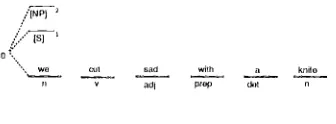
We show an e x a m p l e of l)arsing a n incorrectly NO 2 W p ] -B INP] ~2
recognized sentence "we cut sad w i t h a kuife" us- ing t h e g r a m m a r in I:igure 12 a n d the LI¢ t a b l e in Figure 2. :~ At the initial s t a t e 0, the got() ta- Ill( +, tells t h a t the n o n t e r m i n a l s N P and S can I>e shifte(1 using the gap-filling technique. A l t h o u g h the first wor<t "we" ( n o u n ) is e x p e c t e d at s t a t e 0, these fake+ n o n t e r m i n a l s are ere+areal (]"igure 3) in ca+se "we" is an incorrectly recognized word. Tile new s t a t e s for the fake t l o n t e r m i n a l s N P and S are 2 and 1, resi>ectively, q'he g o t o t a b l e tells t h a t fake n o n t e r m i n a l s PP and VP can be place([ at s t a t e 2. In this case, however, we do not create t h e s e n o n t e r l l t i n a l s ~ l ) e e a u s e t w o fake l / o I l t e l ' l l t i -
[image:3.432.220.387.31.278.2] [image:3.432.40.208.263.325.2]nals r+u'ely need to I>e I)[a(:e<] a d j a c e n t l y in prac
|ice. No f u r t h e r fake n o n t e r m i n a l is att, a.ched to ii i
tile fake n o n t e r m i n a l S for the same reason. ~! v+,
/[NP) 2
O%
'",, w e OOl had with a knilo
n v ad i prop e l l n
l:igure 3: I'arse Trace
Iu p a r s i n g the t h i r d word " s a d " , a fake nonter- m i n a l [NP] to word "cut" keeps the correct p a t h ( F i g u r e ,1).
l ' a r s i n g c o n t i n u e s in t h i s way and t h e linal situ- ation is shown in Figure 5. As a result, the parser tinds two snccessfifl parses:
( n ( v ( [ N P ] ( p r e p ( d e t n ) ) ) ) )
( ( n ( v [ N P ] ) ) ( p r e p ( d e | n ) ) )
Namely, the ])arser Jinds <rot t h a t the third word is incorrect and m u s t be the word(s) in NP category.
2'J'he terminal symbols of this grammar are grammati- cal category names called prcterminals. A lexicon should
be prepared to map all actual word to its pretcrmina].
:~'l'hc techniques in the previous section arc enough for parsing this erroneous se/dencc. We use this eXaml>le only for describing Ihe gal~ |iliing techJ,illue.
with a knMe
p e ~ ~ 1 n
F i g u r e 4: Parse T r a c e ( c o n t ' d )
+,"[NPl
~";',. ~ eel ~¢+ wi~h / .
'\ n ," v ~-, a d I .,' I)t ~+*;~ ", dol
~i! ".. \ - - k~
!!! \' VP
k.m n io
i1
S
.r" ,,," 1
pp
F i g u r e 5: P a r s e T r a c e (conq)lete)
3
Interactive
Speech
Under-
standing
In this section, the rot)tLstness <)f tlw ( ; L R parser with various error-recovery techniques (esl)ecia.lly the gap-filling te(:htdque) aga.inst a noisy i n p u t is described. T h e n an i n t e r a c t i v e way to resolve the u n i d e n t i f i e d portion is I(reseld.ed.
3 . 1 R e s o l v i n g U n i d e n t i f i e d P o r t i o n
T h e gap-filling teehniqtm e n h a n c e s the r o b u s t n e s s of the (HAl p a r s i n g in h a n d l i n g a noisy int)ut as folk>ws:
• A fake n o n t e r m i n a l s fills big m i s s i n g con- s t i t u e n t s of the i n p u t which would yiehl no h y l m t h e s e s w i t h o u t the gap-.tilling func+tion.
* T h e gap+filling fiHtction e n a b l e s a n L R p a r s e r to perform reduce actions o n l y when t h e ac- tion c r e a t e s a definite high-score n o n t e r m i - hal. T h e fake n o n t e r m i n a l is likely to I)e ci- t l l e l +111 illSel'ti<')ii o f a l l t l l l k l l o ~ , v i i w o r d ,
A gap filled with a fake nonterminal can be resolved by reanalysis of the input under the constraint that that portion of the input should yield the specific nonterminal. This top-down re- analysis would be effective against the genuinely bottom-up GLR parsing. In practice, however, a more reliable way is to ask the user to speak only the missed portion. In the previous example, only the portion of [NP] shouhl lie st)oken again.
The parser can analyze the re-utterance effi- ciently ,as follows:
1. The parser keeps the parse record of the first input.
2. The parser starts parsing the new input just where the fake nonterminal was created. 3. The parsing ends when tim same-name real
nonterminal symbol is created out of the re- utterance.
3.2 H a n d l i n g U n k n o w n W o r d s If the reutterance cau not be parsed correctly even by the reutteraime, the unidentified portion is likely to contain an unknown word. Finding an unknown word by a specific nonterminal symbol enables the interactive grammar augmentation as the following, for instance.
The parser can not identily the ~ollowing portion of your input.
We cut [NP] with a knife
If this is a new word in the category of [NP] a r u l e
NP --> (recog. result o f the 2nd utterance) will be added to the grammar. Is this ok?
Handling unknown words is important in natu- ral language processing. For example, Kainioka et al. [5] proposed a mechanisnl which parses a sen- tencc with unknown words
nsing
Delinite C, lause Gralumars. The efficient gap-filling technique of handling unknown words is quite useful in prac- tical systems and enhances the robustness of the GLR parsing greatly.When an unknown word W,,~, is detected, the word should be incorporated into the system. If the grammar is separated from the lexicon, the word can be easily added to the dictionary. If the grammar contains the lexicon, the LR table should be augmented incrementally in the follow- ing way.
1. For each state si which has an entry u n d e r the column of the nonterminal D($~k,) in the goto table, add shift action "s m" (m is the new state number) for W . . . . (If Wnew con- sists of such multiple words as "get rid of', a new state should be created for each element of the words. )
2. Add reduce action "r p" (p is the new rule number) for all the terminals on the row of state nl.
Before we close this section, wc should consider side etfects of the gap-tilling technique. It is true that putting fake nonterminals expands search. Thus, some side effect might appear if the accu- racy of input is not good. Namely, input should be good enough to produce distinct fake nonter- minals and real nonterminals. Although it is dif- ficult to analyze this phenomenon theoretically, the following natural heuristics can minimize the search growth.
o Two consecutive fake uontermiuals are not allowed as shown in the previous section. • When a word (Wi) can be shifted to both
a fake nonternfinal
D.fake
and a same-name real nonterminal D~e,z, only D ~ , t should be valid.• When D : , ~ and D,.~l (:an be bundled using the local ambiguity packing [111 tecbnique, discard l) f (,k,,.
4 E x p e r i m e n t s : P a r s i n g S p o - k e n S e n t e n c e s
We evaluated effectiveness of tlle enhanced GLR parsing by spoken input. We used a device which recognizes a .lapanese utterance and produces its phoneme sequence [4]. The parser we used is 1)ased on the (-HA/ parser exploring the possi- bilities of substituted/inserted/deleted phonemes [10] by looking up the eonfilsion mntrix, which was constructed from the large vocabulary data. The confusion matrix is also used to mssign the score to each explored phoneme, because the recogldtion device gives neither the alternative phoneme candidates nor the likelihood of hypoth- esized phonemes. The gap-filling fimction is in- corporated iuto the parser in the following experi- ments. Parsing a l>honeme seqnence might sound less pot>ular than I)arsing a word lattice in speech
recognition. Because the parser builds a lattice dynamically in parsing the sequence from left to right using a CFG which contains the dictionary, no static lattice is necessary.
125 sentences (five speakers pronounced 25 sen- tences) were tested in tim domain called "conver- sation between doctors and patients." 111 sen- tences were parsed correctly [88.8 %] (the correct sentence was obtained as the top-scored hypoth- esis). 14 failed sentences can be classified into three groups:
(i) 4 sentences were parsed as the top-scored hypotlmses with fake nonterminals. Thus the parser asked the user to speak the unidentitied portion again.
(ii) 6 sentences were parsed incorrectly in that the correct sentence did not get the highest score mainly because the incorrect nonterminal had a slightly higher score than the correct one. In this case, both the closely-scored correct and incof rect nontermin~s are packed into one nouterllli- nal using the local ambiguity packing technique in an efficient implementation. In this situation the parser should ask the user to speak only that un- clear portion in the same way as in (i) instead of producing a barely top-scored hypothesis. In the current implementation the parser asks the user which word is the correct one.
(iii) 4 sentences were pronounced very I)adly. The user has to speak the whole sentence again.
5 sentences with unknown words were also tested, in all eases, the unknown word was de- tected.
This result shows that interactive partial re- utterance is very effective both for error-recovery and for detection of unknown words.
5
C o n c l u d i n g R e m a r k s
We presented a robust interactive apl)roach for speech understanding. The GLR parsing method
WaS e n l l a l i c e d t o recover e r r o r s a n d t o skip a very noisy portion. These techniques remedy ",dl-or- nothing-imss of the CF(Lbased LR t)arsing. The skipped portion is represented by a fake non- termimd which is resolved l)y re-utterance. An unknown word is also detected by a fake non- terminal and is incorporated into the dictionary incrementally through interaction with the user. Exl)eriments in t)arsing a Jal)anese l)honeme se- quence have shown a great effectiveness of this interactive approach.
R e f e r e n c e s
[1] Sethi R. Aho, A. V. and J. D. Ullman. Compilers. Addison Wesley, 1986.
[2] E. Giachin and C. l{,ullent. Robust Pars- ing of Severely Corrupted Spoken Utterances. In Proceedings, 12th lnte~mational Conference on Computational Linguistics (COLING), Bu- dapest, ltungary, August 1988.
[3] llauptmmm A. G. Carbonell J. G. Hayes, P. J. and M. Tomita. Parsing spoken language: A semantic caseframc approach. In Proceedings,
l lth lnleT~aalional Conference on Computational Linguistics (COLING), West Germany, August 1986. Bonn.
[4] Morii S. lloshimi M. Hiraoka, S. and K. Niyada. Compact isolated word recognition system for large vocabulary. In Proceedings, IEEF-IEC'EJ- ASJ International Conference ou Acoustics, Speech, and Signal Processin 9 (ICASSP), Tokyo, April 1986.
[5] T. Kamioka and Y. Anzai. Analysis of sentences including unknown words by hypothesis genera- tion mechanism. Journal of Japanese Society for Artificial Intelligence, Vol.3 No.5, pages 6 2 7 - 6 3 8 , September 1!)88. [In Japanese].
[0] Kawabat, a T. Kits, K. and I1. Saito. tlMM Con- tinuous Speech Recognition Using Predictive LR Parsing. In ICASSP, May 1989.
[7] K.F. Lee. Large- Vocabulary Speaker-htdependenl Continuous Speech Recognition: The SPHINX System. Phi) thesis, Computer Science Depart- ment, Carnegie Mellon Uniw;rsity, April 1988. [8] M. Poesio and C. lhlllent. Modified Cm'~eframe
Parsing for Speech Understanding Systems. In Proceedings, lOth International Joint Conference on Artificial Intelligence (IJCAI), Milan, August 1987.
[9] II. Saito. Gap-tilling LR Parsing for Noisy Spoken Input: "Ibwards Interactive Speech Hx~eognition. In Proceedings, httcTmattonal Conference on Spo- ken Language Processing (ICSLP), Kobe, Japan, November 1990.
[10] II. Saito and M. Tomita. Parsing Noisy Sen- tences. In Proceedings, 12th International Con- ference on G'omputalional Linguistics (COL- IN(;), Budapest, lhmgary, August 1988. [11] M. Tomita. l';Jlieient Parsing for Natural Lan.
guage, l(luwer Academic Publishers, Boston, MA, 1985.
M. qbmita. An efficient word lattice parsing algo- rithm for continuous speech recognition. In Pro- ceedin.qs, IEEE-1ECEJ-ASJ htternational Con- ference on Acoustics, Speech, and Signal Process- ing (ICASSP), 2bkyo, April 1986.