Machine Readable Travel Document
with „ICAO Application”, Basic Access Control
Foreword
This ‘Protection Profile — Machine Readable Travel Document with ICAO Application (MRTD-PP), Basic Access Control’ is issued by Bundesamt für Sicherheit in der Informationstechnik, Germany. The document has been prepared as a Protection Profile (PP) following the rules and formats of Common Criteria version 3.1 [1], [2], [3], Revision 2.
Correspondence and comments to this Machine Readable Travel Document (MRTD-PP) should be referred to:
CONTACT ADDRESS
Bundesamt für Sicherheit in der Informationstechnik Godesberger Allee 185-189 D-53175 Bonn, Germany Tel +49 228 99 9582-0 Fax +49 228 99 9582-5400 Email [email protected]
Table ofContent 1 PP Introduction 5 1.1 PP reference 5 1.2 TOE Overview 5 2 Conformance Claims 9 2.1 CC Conformance Claim 9 2.2 PP Claim, 9 2.3 Package Claim 9 2.4 Conformance rationale 9 2.5 Conformance statement 9
3 Security Problem Definition 10
3.1 Introduction 10
3.2 Assumptions 12
3.3 Threats 13
3.4 Organizational Security Policies 15
4 Security Objectives 17
4.1 Security Objectives for the TOE 17
4.2 Security Objectives for the Operational Environment 19
4.3 Security Objective Rationale 21
5 Extended Components Definition 25
5.1 Definition of the Family FAU_SAS 25
5.2 Definition of the Family FCS_RND 25
5.3 Definition of the Family FMT_LIM 26
5.4 Definition of the Family FPT_EMSEC 28
6 Security Requirements 30
6.1 Security Functional Requirements for the TOE 31
6.1.1 Class FAU Security Audit 31
6.1.2 Class Cryptographic Support (FCS) 31
6.1.3 Class FIA Identification and Authentication 35
6.1.4 Class FDP User Data Protection 40
6.1.5 Class FMT Security Management 43
6.1.6 Class FPT Protection of the Security Functions 46
6.2 Security Assurance Requirements for the TOE 49
6.3 Security Requirements Rationale 49
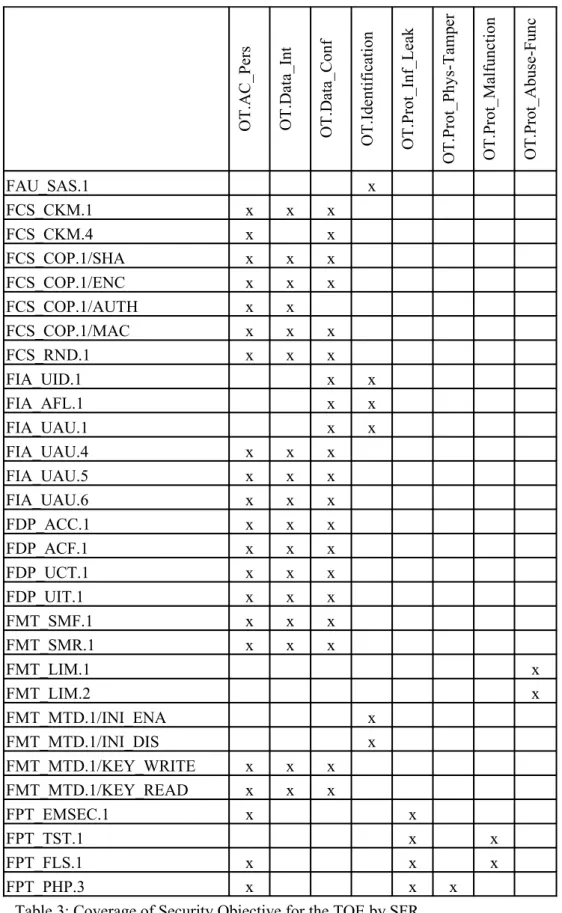
6.3.1 Security Functional Requirements Rationale 49
6.3.3 Security Assurance Requirements Rationale 56 6.3.4 Security Requirements – Mutual Support and Internal Consistency 56
7 Glossary and Acronyms 58
1 PP Introduction
1.1 PP reference
1 Title: Protection Profile — Machine Readable Travel Document with ICAO Application and Basic Access Control (MRTD-PP)
Sponsor: Bundesamt für Sicherheit in der Informationstechnik CC Version: 3.1 (Revision 2)
Assurance Level: The minimum assurance level for this PP is EAL4 augmented. General Status: Final
Version Number: 1.10
Registration: BSI-CC-PP-0055
Keywords: ICAO, machine readable travel document, basic access control
1.2 TOE Overview
2 The protection profile defines the security objectives and requirements for the contactless chip of machine readable travel documents (MRTD) based on the requirements and recommendations of the International Civil Aviation Organization (ICAO). It addresses the advanced security methods Basic Access Control in the ‘ICAO Doc 9303’ [6].
TOE definition
3 The Target of Evaluation (TOE) is the contactless integrated circuit chip of machine readable travel documents (MRTD’s chip) programmed according to the Logical Data Structure (LDS) and providing the Basic Access Control according to ‘ICAO Doc 9303’ [6].
4 The TOE comprises at least
• the circuitry of the MRTD’s chip (the integrated circuit, IC)
• the IC Dedicated Software with the parts IC Dedicated Test Software and IC Dedicated Support Software,
• the IC Embedded Software (operating system),
• the MRTD application and
• the associated guidance documentation.
TOE usage and security features for operational use
5 A State or Organization issues MRTDs to be used by the holder for international travel. The traveler presents a MRTD to the inspection system to prove his or her identity. The MRTD in context of this protection profile contains (i) visual (eye readable) biographical data and portrait of the holder, (ii) a separate data summary (MRZ data) for visual and machine reading using OCR methods in the Machine readable zone (MRZ) and (iii) data elements on the MRTD’s chip according to LDS for contactless machine reading. The authentication of the traveler is based on (i) the possession of a valid MRTD personalized for a holder with the claimed identity as given on the biographical data page and (ii) optional biometrics using the reference data stored in the
MRTD. The issuing State or Organization ensures the authenticity of the data of genuine MRTD’s. The receiving State trusts a genuine MRTD of an issuing State or Organization.
6 For this protection profile the MRTD is viewed as unit of
(a) the physical MRTD as travel document in form of paper, plastic and chip. It presents visual readable data including (but not limited to) personal data of the MRTD holder (1) the biographical data on the biographical data page of the passport book, (2) the printed data in the Machine-Readable Zone (MRZ) and
(3) the printed portrait.
(b) the logical MRTD as data of the MRTD holder stored according to the Logical Data Structure [6] as specified by ICAO on the contactless integrated circuit. It presents contactless readable data including (but not limited to) personal data of the MRTD holder
(1) the digital Machine Readable Zone Data (digital MRZ data, EF.DG1), (2) the digitized portraits (EF.DG2),
(3) the optional biometric reference data of finger(s) (EF.DG3) or iris image(s) (EF.DG4) or both1
(4) the other data according to LDS (EF.DG5 to EF.DG16) and (5) the Document security object.
7 The issuing State or Organization implements security features of the MRTD to maintain the authenticity and integrity of the MRTD and their data. The MRTD as the passport book and the MRTD’s chip is uniquely identified by the Document Number.
8 The physical MRTD is protected by physical security measures (e.g. watermark on paper, security printing), logical (e.g. authentication keys of the MRTD’s chip) and organizational security measures (e.g. control of materials, personalization procedures) [6]. These security measures include the binding of the MRTD’s chip to the passport book.
9 The logical MRTD is protected in authenticity and integrity by a digital signature created by the document signer acting for the issuing State or Organization and the security features of the MRTD’s chip.
10 The ICAO defines the baseline security methods Passive Authentication and the optional advanced security methods Basic Access Control to the logical MRTD, Active Authentication of the MRTD’s chip, Extended Access Control to and the Data Encryption of additional sensitive biometrics as optional security measure in the ‘ICAO Doc 9303’ [6]. The Passive Authentication Mechanism and the Data Encryption are performed completely and independently on the TOE by the TOE environment.
11 This protection profile addresses the protection of the logical MRTD (i) in integrity by write-only-once access control and by physical means, and (ii) in confidentiality by the Basic Access Control Mechanism. This protection profile does not address the Active Authentication and the Extended Access Control as optional security mechanisms.
12 The Basic Access Control is a security feature which is mandatory supported by the TOE. The inspection system (i) reads optically the MRTD, (ii) authenticates itself as inspection system by means of Document Basic Access Keys. After successful authentication of the inspection system
the MRTD’s chip provides read access to the logical MRTD by means of private communication (secure messaging) with this inspection system [6], normative appendix 5.
TOE life cycle
13 The TOE life cycle is described in terms of the four life cycle phases. (With respect to the [18], the TOE life-cycle the life-cycle is additionally subdivided into 7 steps.)
Phase 1 “Development”
14 (Step1) The TOE is developed in phase 1. The IC developer develops the integrated circuit, the IC Dedicated Software and the guidance documentation associated with these TOE components. 15 (Step2) The software developer uses the guidance documentation for the integrated circuit and the
guidance documentation for relevant parts of the IC Dedicated Software and develops the IC Embedded Software (operating system), the MRTD application and the guidance documentation associated with these TOE components.
16 The manufacturing documentation of the IC including the IC Dedicated Software and the Embedded Software in the non-volatile non-programmable memories (ROM) is securely delivered to the IC manufacturer. The IC Embedded Software in the non-volatile programmable memories, the MRTD application and the guidance documentation is securely delivered to the MRTD manufacturer.
Phase 2 “Manufacturing”
17 (Step3) In a first step the TOE integrated circuit is produced containing the MRTD’s chip Dedicated Software and the parts of the MRTD’s chip Embedded Software in the non-volatile non-programmable memories (ROM). The IC manufacturer writes the IC Identification Data onto the chip to control the IC as MRTD material during the IC manufacturing and the delivery process to the MRTD manufacturer. The IC is securely delivered from the IC manufacture to the MRTD manufacturer.
18 If necessary the IC manufacturer adds the parts of the IC Embedded Software in the non-volatile programmable memories (for instance EEPROM).
19 (Step4) The MRTD manufacturer combines the IC with hardware for the contactless interface in the passport book.
20 (Step5) The MRTD manufacturer (i) creates the MRTD application and (ii) equips MRTD’s chips with pre-personalization Data.
21 Application Note1: Creation of the application implies:
o For file based operating systems: the creation of MF and ICAO.DF
o For JavaCard operating systems: the Applet instantiation.
22 The pre-personalized MRTD together with the IC Identifier is securely delivered from the MRTD manufacturer to the Personalization Agent. The MRTD manufacturer also provides the relevant parts of the guidance documentation to the Personalization Agent.
Phase 3 “Personalization of the MRTD”
23 (Step6) The personalization of the MRTD includes (i) the survey of the MRTD holder’s biographical data, (ii) the enrolment of the MRTD holder biometric reference data (i.e. the digitized portraits and the optional biometric reference data), (iii) the printing of the visual readable data onto the physical MRTD, (iv) the writing of the TOE User Data and TSF Data into the logical MRTD and (v) configuration of the TSF if necessary. The step (iv) is performed by the Personalization Agent and includes but is not limited to the creation of (i) the digital MRZ data (EF.DG1), (ii) the digitized portrait (EF.DG2), and (iii) the Document security object.
24 The signing of the Document security object by the Document Signer [6] finalizes the personalization of the genuine MRTD for the MRTD holder. The personalized MRTD (together with appropriate guidance for TOE use if necessary) is handed over to the MRTD holder for operational use.
25 Application note 2: The TSF data (data created by and for the TOE, that might affect the operation of the TOE; cf. [1] §92) comprise (but are not limited to) the Personalization Agent Authentication Key(s) and the Basic Authentication Control Key.
26 Application note 3: This protection profile distinguishes between the Personalization Agent as entity known to the TOE and the Document Signer as entity in the TOE IT environment signing the Document security object as described in [6]. This approach allows but does not enforce the separation of these roles. The selection of the authentication keys should consider the organization, the productivity and the security of the personalization process. Asymmetric authentication keys provide comfortable security for distributed personalization but their use may be more time consuming than authentication using symmetric cryptographic primitives. Authentication using symmetric cryptographic primitives allows fast authentication protocols appropriate for centralized personalization schemes but relies on stronger security protection in the personalization environment.
Phase 4 “Operational Use”
27 (Step7) The TOE is used as MRTD chip by the traveler and the inspection systems in the “Operational Use” phase. The user data can be read according to the security policy of the issuing State or Organization and can be used according to the security policy of the issuing State but they can never be modified.
28 Application note 4: The authorized Personalization Agents might be allowed to add (not to modify) data in the other data groups of the MRTD application (e.g. person(s) to notify EF.DG16) in the Phase 4 “Operational Use”. This will imply an update of the Document Security Object including the re-signing by the Document Signer.
29 Application note 5: The intention of the PP is to consider at least the phases 1 and parts of phase 2 (i.e. Step1 to Step3) as part of the evaluation and therefore to define the TOE delivery according to CC after this phase 2 or later. Since specific production steps of phase 2 are of minor security relevance (e. g. booklet manufacturing and antenna integration) these are not part of the CC evaluation under ALC. Nevertheless the decision about this has to be taken by the certification body resp. the national body of the issuing State or Organization. In this case the national body of the issuing State or Organization is responsible for these specific production steps.
Note, that the personalization process and its environment may depend on specific security needs of an issuing State or Organization. All production, generation and installation procedures after TOE delivery up to the “Operational Use” (phase 4) have to be considered in the product evaluation process under AGD assurance class. Therefore, the Security Target has to outline the split up of P.Manufact, P.Personalization and the related security objectives into aspects relevant before vs. after TOE delivery.
Non-TOE hardware/software/firmware required by the TOE
30 There is no explicit non-TOE hardware, software or firmware required by the TOE to perform its claimed security features. The TOE is defined to comprise the chip and the complete operating system and application. Note, the inlay holding the chip as well as the antenna and the booklet (holding the printed MRZ) are needed to represent a complete MRTD, nevertheless these parts are not inevitable for the secure operation of the TOE.
2 Conformance Claims
2.1 CC Conformance Claim
31 This protection profile claims conformance to
• Common Criteria for Information Technology Security Evaluation, Part 1: Introduction and General Model; CCMB-2006-09-001, Version 3.1, Revision 1, September 2006, [1]
• Common Criteria for Information Technology Security Evaluation, Part 2: Security Functional Components; CCMB-2007-09-002, Version 3.1, Revision 2, September 2007, [2]
• Common Criteria for Information Technology Security Evaluation, Part 3: Security Assurance Requirements; CCMB-2007-09-003, Version 3.1, Revision 2, September 2007, [3]
as follows
- Part 2 extended, - Part 3 conformant. 32 The
• Common Methodology for Information Technology Security Evaluation, Evaluation Methodology; CCMB-2007-09-004, Version 3.1, Revision 2, September 2007, [4] has to be taken into account.
2.2 PP Claim,
33 This PP does not claim conformance to any another Protection Profiles.
2.3 Package Claim
34 This PP is conforming to assurance package EAL4 augmented with ALC_DVS.2 defined in CC part 3 [3].
2.4 Conformance rationale
35 Since this PP is not claiming conformance to any other protection profile, no rationale is necessary here.
2.5 Conformance statement
3 Security Problem Definition
3.1 Introduction
Assets
37 The assets to be protected by the TOE include the User Data on the MRTD’s chip. 38 Logical MRTD Data
The logical MRTD data consists of the EF.COM, EF.DG1 to EF.DG16 (with different security needs) and the Document Security Object EF.SOD according to LDS [6]. These data are user data of the TOE. The EF.COM lists the existing elementary files (EF) with the user data. The EF.DG1 to EF.DG13 and EF.DG 16 contain personal data of the MRTD holder. The Chip Authentication Public Key (EF.DG 14) is used by the inspection system for the Chip Authentication. The EF.SOD is used by the inspection system for Passive Authentication of the logical MRTD.
39 Due to interoperability reasons as the ‘ICAO Doc 9303’ [6] the TOE described in this protection profile specifies only the BAC mechanisms with resistance against enhanced basic attack potential granting access to
o Logical MRTD standard User Data (i.e. Personal Data) of the MRTD holder (EF.DG1, EF.DG2, EF.DG5 to EF.DG13, EF.DG16),
o Chip Authentication Public Key in EF.DG14,
o Active Authentication Public Key in EF.DG15,
o Document Security Object (SOD) in EF.SOD,
o Common data in EF.COM.
40 The TOE prevents read access to sensitive User Data
o Sensitive biometric reference data (EF.DG3, EF.DG4)2. 41 A sensitive asset is the following more general one.
42 Authenticity of the MRTD’s chip
The authenticity of the MRTD’s chip personalized by the issuing State or Organization for the MRTD holder is used by the traveler to prove his possession of a genuine MRTD.
Subjects
43 This protection profile considers the following subjects: 44 Manufacturer
The generic term for the IC Manufacturer producing the integrated circuit and the MRTD
Manufacturer completing the IC to the MRTD’s chip. The Manufacturer is the default user of the TOE during the Phase 2 Manufacturing. The TOE does not distinguish between the users IC Manufacturer and MRTD Manufacturer using this role Manufacturer.
45 Personalization Agent
The agent is acting on behalf of the issuing State or Organization to personalize the MRTD for the holder by some or all of the following activities (i) establishing the identity the holder for the biographic data in the MRTD, (ii) enrolling the biometric reference data of the MRTD holder i.e. the portrait, the encoded finger image(s) and/or the encoded iris image(s) (iii) writing these data on the physical and logical MRTD for the holder as defined for global, international and national interoperability, (iv) writing the initial TSF data and (iv) signing the Document Security Object defined in [6].
46 Terminal
A terminal is any technical system communicating with the TOE through the contactless interface.
47 Inspection system (IS)
A technical system used by the border control officer of the receiving State (i) examining an MRTD presented by the traveler and verifying its authenticity and (ii) verifying the traveler as MRTD holder. The Basic Inspection System (BIS) (i) contains a terminal for the contactless communication with the MRTD’s chip, (ii) implements the terminals part of the Basic Access Control Mechanism and (iii) gets the authorization to read the logical MRTD under the Basic Access Control by optical reading the MRTD or other parts of the passport book providing this information. The General Inspection System (GIS) is a Basic Inspection System which implements additionally the Chip Authentication Mechanism. The Extended Inspection System (EIS) in addition to the General Inspection System (i) implements the Terminal Authentication Protocol and (ii) is authorized by the issuing State or Organization through the Document Verifier of the receiving State to read the sensitive biometric reference data. The security attributes of the EIS are defined of the Inspection System Certificates. .
48 Application note 6: This protection profile does not distinguish between the BIS, GIS and EIS because the Active Authentication and the Extended Access Control is outside the scope.
49 MRTD Holder
The rightful holder of the MRTD for whom the issuing State or Organization personalized the MRTD.
50 Traveler
Person presenting the MRTD to the inspection system and claiming the identity of the MRTD holder.
51 Attacker
A threat agent trying (i) to identify and to trace the movement of the MRTD’s chip remotely (i.e. without knowing or optically reading the printed MRZ data), (ii) to read or to manipulate the logical MRTD without authorization, or (iii) to forge a genuine MRTD.
52 Application note 7: An impostor is attacking the inspection system as TOE IT environment independent on using a genuine, counterfeit or forged MRTD. Therefore the impostor may use results of successful attacks against the TOE but the attack itself is not relevant for the TOE.
3.2 Assumptions
53 The assumptions describe the security aspects of the environment in which the TOE will be used or is intended to be used.
54 A.MRTD_Manufact MRTD manufacturing on steps 4 to 6
It is assumed that appropriate functionality testing of the MRTD is used. It is assumed that security procedures are used during all manufacturing and test operations to maintain confidentiality and integrity of the MRTD and of its manufacturing and test data (to prevent any possible copy, modification, retention, theft or unauthorized use).
55 A.MRTD_Delivery MRTD delivery during steps 4 to 6
Procedures shall guarantee the control of the TOE delivery and storage process and conformance to its objectives:
- Procedures shall ensure protection of TOE material/information under delivery and storage. - Procedures shall ensure that corrective actions are taken in case of improper operation in the
delivery process and storage.
- Procedures shall ensure that people dealing with the procedure for delivery have got the required skill.
56 A.Pers_Agent Personalization of the MRTD’s chip
The Personalization Agent ensures the correctness of (i) the logical MRTD with respect to the MRTD holder, (ii) the Document Basic Access Keys, (iii) the Chip Authentication Public Key (EF.DG14) if stored on the MRTD’s chip, and (iv) the Document Signer Public Key Certificate (if stored on the MRTD’s chip). The Personalization Agent signs the Document Security Object. The Personalization Agent bears the Personalization Agent Authentication to authenticate himself to the TOE by symmetric cryptographic mechanisms.
57 A.Insp_Sys Inspection Systems for global interoperability
The Inspection System is used by the border control officer of the receiving State (i) examining an MRTD presented by the traveler and verifying its authenticity and (ii) verifying the traveler as MRTD holder. The Basic Inspection System for global interoperability (i) includes the Country Signing Public Key and the Document Signer Public Key of each issuing State or Organization, and (ii) implements the terminal part of the Basic Access Control [6]. The Basic Inspection System reads the logical MRTD under Basic Access Control and performs the Passive Authentication to verify the logical MRTD.
58 Application note 8: According to [6] the support of the Passive Authentication mechanism is mandatory whereas the the Basic Access Control is optional. This PP does not address Primary Inspection Systems therefore the BAC is mandatory within this PP.
59 A.BAC-Keys Cryptographic quality of Basic Access Control Keys
The Document Basic Access Control Keys being generated and imported by the issuing State or Organization have to provide sufficient cryptographic strength. As a consequence of the ‘ICAO Doc 9303’ [6], the Document Basic Access Control Keys are derived from a defined subset of the individual printed MRZ data. It has to be ensured that these data provide sufficient entropy to
withstand any attack based on the decision that the inspection system has to derive Document Access Keys from the printed MRZ data with enhanced basic attack potential.
60 Application note 9: When assessing the MRZ data resp. the BAC keys entropy potential dependencies between these data (especially single items of the MRZ) have to be considered and taken into account. E.g. there might be a direct dependency between the Document Number when chosen consecutively and the issuing date.
3.3 Threats
61 This section describes the threats to be averted by the TOE independently or in collaboration with its IT environment. These threats result from the TOE method of use in the operational environment and the assets stored in or protected by the TOE.
62 The TOE in collaboration with its IT environment shall avert the threats as specified below.
63 T.Chip_ID Identification of MRTD’s chip
Adverse action: An attacker trying to trace the movement of the MRTD by identifying remotely the MRTD’s chip by establishing or listening to communications through the contactless communication interface.
Threat agent: having enhanced basic attack potential, not knowing the optically readable MRZ data printed on the MRTD data page in advance
Asset: Anonymity of user,
64 T.Skimming Skimming the logical MRTD
Adverse action: An attacker imitates an inspection system trying to establish a communication to read the logical MRTD or parts of it via the contactless communication channel of the TOE.
Threat agent: having enhanced basic attack potential, not knowing the optically readable MRZ data printed on the MRTD data page in advance
Asset: confidentiality of logical MRTD data
65 T.Eavesdropping Eavesdropping to the communication between TOE and inspection system
Adverse action: An attacker is listening to an existing communication between the MRTD’s chip and an inspection system to gain the logical MRTD or parts of it. The inspection system uses the MRZ data printed on the MRTD data page but the attacker does not know these data in advance.
Threat agent: having enhanced basic attack potential, not knowing the optically readable MRZ data printed on the MRTD data page in advance
Asset: confidentiality of logical MRTD data
66 T.Forgery Forgery of data on MRTD’s chip
Adverse action: An attacker alters fraudulently the complete stored logical MRTD or any part of it including its security related data in order to deceive on an inspection system by means of the changed MRTD holder’s identity or biometric reference data. This threat comprises several attack scenarios of MRTD forgery. The attacker may alter the biographical data on the biographical data page of the passport
book, in the printed MRZ and in the digital MRZ to claim another identity of the traveler. The attacker may alter the printed portrait and the digitized portrait to overcome the visual inspection of the inspection officer and the automated biometric authentication mechanism by face recognition. The attacker may alter the biometric reference data to defeat automated biometric authentication mechanism of the inspection system. The attacker may combine data groups of different logical MRTDs to create a new forged MRTD, e.g. the attacker writes the digitized portrait and optional biometric reference finger data read from the logical MRTD of a traveler into another MRTD’s chip leaving their digital MRZ unchanged to claim the identity of the holder this MRTD. The attacker may also copy the complete unchanged logical MRTD to another contactless chip.
Threat agent: having enhanced basic attack potential, being in possession of one or more legitimate MRTDs
Asset: authenticity of logical MRTD data
67 The TOE shall avert the threats as specified below.
68 T.Abuse-Func Abuse of Functionality
Adverse action: An attacker may use functions of the TOE which shall not be used in the phase “Operational Use” in order (i) to manipulate User Data, (ii) to manipulate (explore, bypass, deactivate or change) security features or functions of the TOE or (iii) to disclose or to manipulate TSF Data.
This threat addresses the misuse of the functions for the initialization and the personalization in the operational state after delivery to MRTD holder.
Threat agent: having enhanced basic attack potential, being in possession of a legitimate MRTD
Asset: confidentiality and authenticity of logical MRTD and TSF data, correctness of TSF
69 T.Information_Leakage Information Leakage from MRTD’s chip
Adverse action: An attacker may exploit information which is leaked from the TOE during its usage in order to disclose confidential TSF data. The information leakage may be inherent in the normal operation or caused by the attacker.
Leakage may occur through emanations, variations in power consumption, I/O characteristics, clock frequency, or by changes in processing time requirements. This leakage may be interpreted as a covert channel transmission but is more closely related to measurement of operating parameters, which may be derived either from measurements of the contactless interface (emanation) or direct measurements (by contact to the chip still available even for a contactless chip) and can then be related to the specific operation being performed. Examples are the Differential Electromagnetic Analysis (DEMA) and the Differential Power Analysis (DPA). Moreover the attacker may try actively to enforce information leakage by fault injection (e.g. Differential Fault Analysis).
Threat agent: having enhanced basic attack potential, being in possession of a legitimate MRTD
70 T.Phys-Tamper Physical Tampering
Adverse action: An attacker may perform physical probing of the MRTD’s chip in order (i) to disclose TSF Data or (ii) to disclose/reconstruct the MRTD’s chip Embedded Software. An attacker may physically modify the MRTD’s chip in order to (i) modify security features or functions of the MRTD’s chip, (ii) modify security functions of the MRTD’s chip Embedded Software, (iii) modify User Data or (iv) to modify TSF data.
The physical tampering may be focused directly on the disclosure or manipulation of TOE User Data (e.g. the biometric reference data for the inspection system) or TSF Data (e.g. authentication key of the MRTD’s chip) or indirectly by preparation of the TOE to following attack methods by modification of security features (e.g. to enable information leakage through power analysis). Physical tampering requires direct interaction with the MRTD’s chip internals. Techniques commonly employed in IC failure analysis and IC reverse engineering efforts may be used. Before that, the hardware security mechanisms and layout characteristics need to be identified. Determination of software design including treatment of User Data and TSF Data may also be a pre-requisite. The modification may result in the deactivation of a security function. Changes of circuitry or data can be permanent or temporary.
Threat agent: having enhanced basic attack potential, being in possession of a legitimate MRTD
Asset: confidentiality and authenticity of logical MRTD and TSF data, correctness of TSF
71 T.Malfunction Malfunction due to Environmental Stress
Adverse action: An attacker may cause a malfunction of TSF or of the MRTD’s chip Embedded Software by applying environmental stress in order to (i) deactivate or modify security features or functions of the TOE or (ii) circumvent, deactivate or modify security functions of the MRTD’s chip Embedded Software.
This may be achieved e.g. by operating the MRTD’s chip outside the normal operating conditions, exploiting errors in the MRTD’s chip Embedded Software or misusing administration function. To exploit these vulnerabilities an attacker needs information about the functional operation.
Threat agent: having enhanced basic attack potential, being in possession of a legitimate MRTD
Asset: confidentiality and authenticity of logical MRTD and TSF data, correctness of TSF
3.4 Organizational Security Policies
72 The TOE shall comply with the following Organizational Security Policies (OSP) as security rules, procedures, practices, or guidelines imposed by an organization upon its operations (see CC part 1, sec. 3.2).
The Initialization Data are written by the IC Manufacturer to identify the IC uniquely. The MRTD Manufacturer writes the Pre-personalization Data which contains at least the Personalization Agent Key.
74 P.Personalization Personalization of the MRTD by issuing State or Organization only
The issuing State or Organization guarantees the correctness of the biographical data, the printed portrait and the digitized portrait, the biometric reference data and other data of the logical MRTD with respect to the MRTD holder. The personalization of the MRTD for the holder is performed by an agent authorized by the issuing State or Organization only.
75 P.Personal_Data Personal data protection policy
The biographical data and their summary printed in the MRZ and stored on the MRTD’s chip (EF.DG1), the printed portrait and the digitized portrait (EF.DG2), the biometric reference data of finger(s) (EF.DG3), the biometric reference data of iris image(s) (EF.DG4)3 and data according to LDS (EF.DG5 to EF.DG13, EF.DG16) stored on the MRTD’s chip are personal data of the MRTD holder. These data groups are intended to be used only with agreement of the MRTD holder by inspection systems to which the MRTD is presented. The MRTD’s chip shall provide the possibility for the Basic Access Control to allow read access to these data only for terminals successfully authenticated based on knowledge of the Document Basic Access Keys as defined in [6].
76 Application note 10: The organizational security policy P.Personal_Data is drawn from the ICAO ‘ICAO Doc 9303’ [6]. Note that the Document Basic Access Key is defined by the TOE environment and loaded to the TOE by the Personalization Agent.
3 Note, that EF.DG3 and EF.DG4 are only readable after successful EAC authentication not
4 Security Objectives
77 This chapter describes the security objectives for the TOE and the security objectives for the TOE environment. The security objectives for the TOE environment are separated into security objectives for the development and production environment and security objectives for the operational environment.
4.1 Security Objectives for the TOE
78 This section describes the security objectives for the TOE addressing the aspects of identified threats to be countered by the TOE and organizational security policies to be met by the TOE. 79 OT.AC_Pers Access Control for Personalization of logical MRTD
The TOE must ensure that the logical MRTD data in EF.DG1 to EF.DG16, the Document security object according to LDS [6] and the TSF data can be written by authorized Personalization Agents only. The logical MRTD data in EF.DG1 to EF.DG16 and the TSF data may be written only during and cannot be changed after its personalization. The Document security object can be updated by authorized Personalization Agents if data in the data groups EF.DG 3 to EF.DG16 are added.
80 Application note 11:The OT.AC_Pers implies that
(1) the data of the LDS groups written during personalization for MRTD holder (at least EF.DG1 and EF.DG2) can not be changed by write access after personalization,
(2) the Personalization Agents may (i) add (fill) data into the LDS data groups not written yet, and (ii) update and sign the Document Security Object accordingly. The support for adding data in the “Operational Use” phase is optional.
81 OT.Data_Int Integrity of personal data
The TOE must ensure the integrity of the logical MRTD stored on the MRTD’s chip against physical manipulation and unauthorized writing. The TOE must ensure that the inspection system is able to detect any modification of the transmitted logical MRTD data.
82 OT.Data_Conf Confidentiality of personal data
The TOE must ensure the confidentiality of the logical MRTD data groups EF.DG1 to EF.DG16. Read access to EF.DG1 to EF.DG16 is granted to terminals successfully authenticated as Personalization Agent. Read access to EF.DG1, EF.DG2 and EF.DG5 to EF.DG16 is granted to terminals successfully authenticated as Basic Inspection System. The Basic Inspection System shall authenticate itself by means of the Basic Access Control based on knowledge of the Document Basic Access Key. The TOE must ensure the confidentiality of the logical MRTD data during their transmission to the Basic Inspection System.
83 Application note 12: The traveler grants the authorization for reading the personal data in EF.DG1, EF.DG2 and EF.DG5 to EF.DG16 to the inspection system by presenting the MRTD. The MRTD’s chip shall provide read access to these data for terminals successfully authenticated by means of the Basic Access Control based on knowledge of the Document Basic Access Keys.
The security objective OT.Data_Conf requires the TOE to ensure the strength of the security function Basic Access Control Authentication. The Document Basic Access Keys are derived from the MRZ data defined by the TOE environment and are loaded into the TOE by the Personalization Agent. Therefore the sufficient quality of these keys has to result from the MRZ data’s entropy. Any attack based on decision of the ‘ICAO Doc 9303’ [6] that the inspection system derives Document Basic Access is ensured by OE.BAC-Keys. Note that the authorization for reading the biometric data in EF.DG3 and EF.DG4 is only granted after successful Enhanced Access Control not covered by this protection profile. Thus the read access must be prevented even in case of a successful BAC Authentication.
84 OT.Identification Identification and Authentication of the TOE
The TOE must provide means to store IC Identification and Pre-Personalization Data in its non-volatile memory. The IC Identification Data must provide a unique identification of the IC during Phase 2 “Manufacturing” and Phase 3 “Personalization of the MRTD”. The storage of the Pre-Personalization data includes writing of the Pre-Personalization Agent Key(s). In Phase 4 “Operational Use” the TOE shall identify itself only to a successful authenticated Basic Inspection System or Personalization Agent.
85 Application note 13: The TOE security objective OT.Identification addresses security features of the TOE to support the life cycle security in the manufacturing and personalization phases. The IC Identification Data are used for TOE identification in Phase 2 “Manufacturing” and for traceability and/or to secure shipment of the TOE from Phase 2 “Manufacturing” into the Phase 3 “Personalization of the MRTD”. The OT.Identification addresses security features of the TOE to be used by the TOE manufacturing. In the Phase 4 “Operational Use” the TOE is identified by the Document Number as part of the printed and digital MRZ. The OT.Identification forbids the output of any other IC (e.g. integrated circuit card serial number ICCSN) or MRTD identifier through the contactless interface before successful authentication as Basic Inspection System or as Personalization Agent.
86 The following TOE security objectives address the protection provided by the MRTD’s chip independent of the TOE environment.
87 OT.Prot_Abuse-Func Protection against Abuse of Functionality
After delivery of the TOE to the MRTD Holder, the TOE must prevent the abuse of test and support functions that may be maliciously used to (i) disclose critical User Data, (ii) manipulate critical User Data of the IC Embedded Software, (iii) manipulate Soft-coded ICEmbedded Software or (iv) bypass, deactivate, change or explore security features or functions of the TOE. Details of the relevant attack scenarios depend, for instance, on the capabilities of the Test Features provided by the IC Dedicated Test Software which are not specified here.
88 OT.Prot_Inf_Leak Protection against Information Leakage
The TOE must provide protection against disclosure of confidential TSF data stored and/or processed in the MRTD’s chip
• by measurement and analysis of the shape and amplitude of signals or the time between events found by measuring signals on the electromagnetic field, power consumption, clock, or I/O lines and
• by a physical manipulation of the TOE.
89 Application note 14: This objective pertains to measurements with subsequent complex signal processing due to normal operation of the TOE or operations enforced by an attacker. Details correspond to an analysis of attack scenarios which is not given here.
90 OT.Prot_Phys-Tamper Protection against Physical Tampering
The TOE must provide protection of the confidentiality and integrity of the User Data, the TSF Data, and the MRTD’s chip Embedded Software. This includes protection against attacks with enhanced-basic attack potential by means of
• measuring through galvanic contacts which is direct physical probing on the chips surface except on pads being bonded (using standard tools for measuring voltage and current) or
• measuring not using galvanic contacts but other types of physical interaction between charges (using tools used in solid-state physics research and IC failure analysis)
• manipulation of the hardware and its security features, as well as
• controlled manipulation of memory contents (User Data, TSF Data) with a prior
• reverse-engineering to understand the design and its properties and functions. 91 OT.Prot_Malfunction Protection against Malfunctions
The TOE must ensure its correct operation. The TOE must prevent its operation outside the normal operating conditions where reliability and secure operation has not been proven or tested. This is to prevent errors. The environmental conditions may include external energy (esp. electromagnetic) fields, voltage (on any contacts), clock frequency, or temperature.
92 Application note 15: A malfunction of the TOE may also be caused using a direct interaction with elements on the chip surface. This is considered as being a manipulation (refer to the objective OT.Prot_Phys-Tamper) provided that detailed knowledge about the TOE´s internals.
4.2 Security Objectives for the Operational Environment
Issuing State or Organization
93 The issuing State or Organization will implement the following security objectives of the TOE environment.
94 OE.MRTD_Manufact Protection of the MRTD Manufacturing Appropriate functionality testing of the TOE shall be used in step 4 to 6.
During all manufacturing and test operations, security procedures shall be used through phases 4, 5 and 6 to maintain confidentiality and integrity of the TOE and its manufacturing and test data. 95 OE.MRTD_ Delivery Protection of the MRTD delivery
Procedures shall ensure protection of TOE material/information under delivery including the following objectives:
- non-disclosure of any security relevant information, - identification of the element under delivery,
- meet confidentiality rules (confidentiality level, transmittal form, reception acknowledgment), - physical protection to prevent external damage,
- secure storage and handling procedures (including rejected TOE’s), - traceability of TOE during delivery including the following parameters:
• origin and shipment details,
• reception, reception acknowledgement, • location material/information.
Procedures shall ensure that corrective actions are taken in case of improper operation in the delivery process (including if applicable any non-conformance to the confidentiality convention) and highlight all non-conformance to this process.
Procedures shall ensure that people (shipping department, carrier, reception department) dealing with the procedure for delivery have got the required skill, training and knowledge to meet the procedure requirements and be able to act fully in accordance with the above expectations.
96 OE.Personalization Personalization of logical MRTD
The issuing State or Organization must ensure that the Personalization Agents acting on behalf of the issuing State or Organization (i) establish the correct identity of the holder and create biographical data for the MRTD, (ii) enroll the biometric reference data of the MRTD holder i.e. the portrait, the encoded finger image(s) and/or the encoded iris image(s) and (iii) personalize the MRTD for the holder together with the defined physical and logical security measures to protect the confidentiality and integrity of these data.
97 OE.Pass_Auth_Sign Authentication of logical MRTD by Signature
The issuing State or Organization must (i) generate a cryptographic secure Country Signing CA Key Pair, (ii) ensure the secrecy of the Country Signing CA Private Key and sign Document Signer Certificates in a secure operational environment, and (iii) distribute the Certificate of the Country Signing CA Public Key to receiving States and Organizations maintaining its authenticity and integrity. The issuing State or Organization must (i) generate a cryptographic secure Document Signer Key Pair and ensure the secrecy of the Document Signer Private Keys, (ii) sign Document Security Objects of genuine MRTD in a secure operational environment only and (iii) distribute the Certificate of the Document Signer Public Key to receiving States and Organizations. The digital signature in the Document Security Object relates all data in the data in EF.DG1 to EF.DG16 if stored in the LDS according to [6].
98 OE.BAC-Keys Cryptographic quality of Basic Access Control Keys
The Document Basic Access Control Keys being generated and imported by the issuing State or Organization have to provide sufficient cryptographic strength. As a consequence of the ‘ICAO Doc 9303’ [6] the Document Basic Access Control Keys are derived from a defined subset of the individual printed MRZ data. It has to be ensured that these data provide sufficient entropy to withstand any attack based on the decision that the inspection system has to derive Document Basic Access Keys from the printed MRZ data with enhanced basic attack potential.
Receiving State or Organization
99 The receiving State or Organization will implement the following security objectives of the TOE environment.
100 OE.Exam_MRTD Examination of the MRTD passport book
The inspection system of the receiving State or Organization must examine the MRTD presented by the traveler to verify its authenticity by means of the physical security measures and to detect any manipulation of the physical MRTD. The Basic Inspection System for global interoperability (i) includes the Country Signing Public Key and the Document Signer Public Key of each issuing State or Organization, and (ii) implements the terminal part of the Basic Access Control [6]. 101 OE.Passive_Auth_Verif Verification by Passive Authentication
The border control officer of the receiving State uses the inspection system to verify the traveler as MRTD holder. The inspection systems must have successfully verified the signature of Document Security Objects and the integrity data elements of the logical MRTD before they are used. The receiving States and Organizations must manage the Country Signing Public Key and the Document Signer Public Key maintaining their authenticity and availability in all inspection systems.
102 OE.Prot_Logical_MRTD Protection of data from the logical MRTD
The inspection system of the receiving State or Organization ensures the confidentiality and integrity of the data read from the logical MRTD. The receiving State examining the logical MRTD being under Basic Access Control will use inspection systems which implement the terminal part of the Basic Access Control and use the secure messaging with fresh generated keys for the protection of the transmitted data (i.e. Basic Inspection Systems).
4.3 Security Objective Rationale
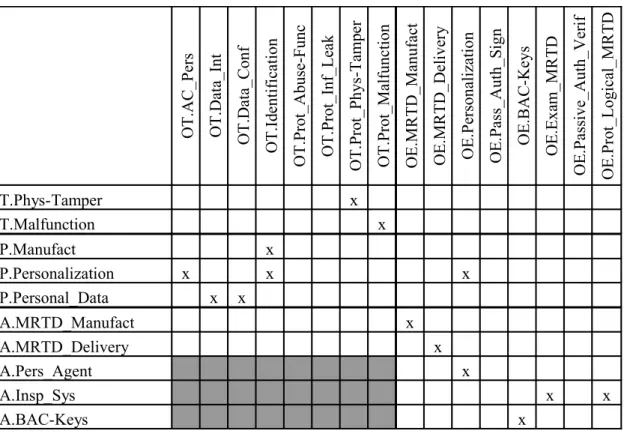
103 The following table provides an overview for security objectives coverage.
O T .A C _P er s O T .D at a_ Int O T .D at a_C onf O T .I de nt if ic at ion O T .P ro t_A bus e-F unc O T .P ro t_I nf _L ea k O T .P ro t_P hys -T am pe r O T .P ro t_M al func ti on O E .M R T D _M anuf ac t O E .M R T D _D el ive ry O E .P er sona li za ti on O E .P as s_A ut h_S ign O E .B A C -K eys O E .E xa m _M R T D O E .P as si ve _A ut h_V er if O E .P ro t_L ogi ca l_M R T D T.Chip-ID x x T.Skimming x x T.Eavesdropping x T.Forgery x x x x x x T.Abuse-Func x x T.Information_Leakage x
O T .A C _P er s O T .D at a_ Int O T .D at a_C onf O T .I de nt if ic at ion O T .P ro t_A bus e-F unc O T .P ro t_I nf _L ea k O T .P ro t_P hys -T am pe r O T .P ro t_M al func ti on O E .M R T D _M anuf ac t O E .M R T D _D el ive ry O E .P er sona li za ti on O E .P as s_A ut h_S ign O E .B A C -K eys O E .E xa m _M R T D O E .P as si ve _A ut h_V er if O E .P ro t_L ogi ca l_M R T D T.Phys-Tamper x T.Malfunction x P.Manufact x P.Personalization x x x P.Personal_Data x x A.MRTD_Manufact x A.MRTD_Delivery x A.Pers_Agent x A.Insp_Sys x x A.BAC-Keys x
Table 1: Security Objective Rationale
104 The OSP P.Manufact “Manufacturing of the MRTD’s chip” requires a unique identification of the IC by means of the Initialization Data and the writing of the Pre-personalization Data as being fulfilled by OT.Identification.
105 The OSP P.Personalization “Personalization of the MRTD by issuing State or Organization only” addresses the (i) the enrolment of the logical MRTD by the Personalization Agent as described in the security objective for the TOE environment OE.Personalization “Personalization of logical MRTD”, and (ii) the access control for the user data and TSF data as described by the security objective OT.AC_Pers “Access Control for Personalization of logical MRTD”. Note the manufacturer equips the TOE with the Personalization Agent Key(s) according to OT.Identification “Identification and Authentication of the TOE”. The security objective OT.AC_Pers limits the management of TSF data and management of TSF to the Personalization Agent.
106 The OSP P.Personal_Data “Personal data protection policy” requires the TOE (i) to support the protection of the confidentiality of the logical MRTD by means of the Basic Access Control and (ii) enforce the access control for reading as decided by the issuing State or Organization. This policy is implemented by the security objectives OT.Data_Int “Integrity of personal data” describing the unconditional protection of the integrity of the stored data and during transmission. The security objective OT.Data_Conf “Confidentiality of personal data” describes the protection of the confidentiality.
107 The threat T.Chip_ID “Identification of MRTD’s chip” addresses the trace of the MRTD movement by identifying remotely the MRTD’s chip through the contactless communication interface. This threat is countered as described by the security objective OT.Identification by Basic Access Control using sufficiently strong derived keys as required by the security objective for the environment OE.BAC-Keys.
108 The threat T.Skimming “Skimming digital MRZ data or the digital portrait” and T.Eavesdropping “Eavesdropping to the communication between TOE and inspection system” address the reading of the logical MRTD trough the contactless interface or listening the communication between the MRTD’s chip and a terminal. This threat is countered by the security objective OT.Data_Conf “Confidentiality of personal data” through Basic Access Control using sufficiently strong derived keys as required by the security objective for the environment OE.BAC-Keys.
109 The threat T.Forgery “Forgery of data on MRTD’s chip” addresses the fraudulent alteration of the complete stored logical MRTD or any part of it. The security objective OT.AC_Pers “Access Control for Personalization of logical MRTD“ requires the TOE to limit the write access for the logical MRTD to the trustworthy Personalization Agent (cf. OE.Personalization). The TOE will protect the integrity of the stored logical MRTD according the security objective OT.Data_Int “Integrity of personal data” and OT.Prot_Phys-Tamper “Protection against Physical Tampering”. The examination of the presented MRTD passport book according to OE.Exam_MRTD “Examination of the MRTD passport book” shall ensure that passport book does not contain a sensitive contactless chip which may present the complete unchanged logical MRTD. The TOE environment will detect partly forged logical MRTD data by means of digital signature which will be created according to OE.Pass_Auth_Sign “Authentication of logical MRTD by Signature” and verified by the inspection system according to OE.Passive_Auth_Verif “Verification by Passive Authentication”.
110 The threat T.Abuse-Func “Abuse of Functionality” addresses attacks using the MRTD’s chip as production material for the MRTD and misuse of the functions for personalization in the operational state after delivery to MRTD holder to disclose or to manipulate the logical MRTD. This threat is countered by OT.Prot_Abuse-Func “Protection against Abuse of Functionality”. Additionally this objective is supported by the security objective for the TOE environment: OE.Personalization “Personalization of logical MRTD” ensuring that the TOE security functions for the initialization and the personalization are disabled and the security functions for the operational state after delivery to MRTD holder are enabled according to the intended use of the TOE.
111 The threats T.Information_Leakage “Information Leakage from MRTD’s chip”, T.Phys-Tamper “Physical Tampering” and T.Malfunction “Malfunction due to Environmental Stress” are typical for integrated circuits like smart cards under direct attack with high attack potential. The protection of the TOE against these threats is addressed by the directly related security objectives OT.Prot_Inf_Leak “Protection against Information Leakage”, OT.Prot_Phys-Tamper “Protection against Physical Tampering” and OT.Prot_Malfunction “Protection against Malfunctions”.
112 The assumption A.MRTD_Manufact “MRTD manufacturing on step 4 to 6” is covered by the security objective for the TOE environment OE.MRTD_Manufact “Protection of the MRTD Manufacturing” that requires to use security procedures during all manufacturing steps.
113 The assumption A.MRTD_Delivery “MRTD delivery during step 4 to 6” is covered by the security objective for the TOE environment OE.MRTD_ Delivery “Protection of the MRTD delivery” that requires to use security procedures during delivery steps of the MRTD.
114 The assumption A.Pers_Agent “Personalization of the MRTD’s chip” is covered by the security objective for the TOE environment OE.Personalization “Personalization of logical MRTD” including the enrolment, the protection with digital signature and the storage of the MRTD holder personal data.
115 The examination of the MRTD passport book addressed by the assumption A.Insp_Sys “Inspection Systems for global interoperability” is covered by the security objectives for the TOE environment OE.Exam_MRTD “Examination of the MRTD passport book”. The security objectives for the TOE environment OE.Prot_Logical_MRTD “Protection of data from the logical MRTD” will require the Basic Inspection System to implement the Basic Access Control and to protect the logical MRTD data during the transmission and the internal handling.
116 The assumption A.BAC-Keys “Cryptographic quality of Basic Access Control Keys” is directly covered by the security objective for the TOE environment OE.BAC-Keys “Cryptographic quality of Basic Access Control Keys” ensuring the sufficient key quality to be provided by the issuing State or Organization.
5 Extended Components Definition
117 This protection profile uses components defined as extensions to CC part 2. Some of these components are defined in [16], other components are defined in this protection profile.
5.1 Definition of the Family FAU_SAS
118 To define the security functional requirements of the TOE a sensitive family (FAU_SAS) of the Class FAU (Security Audit) is defined here. This family describes the functional requirements for the storage of audit data. It has a more general approach than FAU_GEN, because it does not necessarily require the data to be generated by the TOE itself and because it does not give specific details of the content of the audit records.
119 The family “Audit data storage (FAU_SAS)” is specified as follows. FAU_SAS Audit data storage
Family behavior
This family defines functional requirements for the storage of audit data. Component leveling
FAU_SAS Audit data storage 1
FAU_SAS.1 Requires the TOE to provide the possibility to store audit data. Management: FAU_SAS.1
There are no management activities foreseen.
Audit: FAU_SAS.1
There are no actions defined to be auditable.
FAU_SAS.1 Audit storage
Hierarchical to: No other components. Dependencies: No dependencies.
FAU_SAS.1.1 The TSF shall provide [assignment: authorized users] with the capability to store [assignment: list of audit information] in the audit records.
5.2 Definition of the Family FCS_RND
120 To define the IT security functional requirements of the TOE a sensitive family (FCS_RND) of the Class FCS (cryptographic support) is defined here. This family describes the functional requirements for random number generation used for cryptographic purposes. The component
FCS_RND is not limited to generation of cryptographic keys unlike the component FCS_CKM.1. The similar component FIA_SOS.2 is intended for non-cryptographic use.
121 The family “Generation of random numbers (FCS_RND)” is specified as follows. FCS_RND Generation of random numbers
Family behavior
This family defines quality requirements for the generation of random numbers which are intended to be used for cryptographic purposes.
Component leveling:
FCS_RND Generation of random numbers 1
FCS_RND.1 Generation of random numbers requires that random numbers meet a defined quality metric.
Management: FCS_RND.1
There are no management activities foreseen.
Audit: FCS_RND.1
There are no actions defined to be auditable. FCS_RND.1 Quality metric for random numbers Hierarchical to: No other components.
Dependencies: No dependencies.
FCS_RND.1.1 The TSF shall provide a mechanism to generate random numbers that meet [assignment: a defined quality metric].
5.3 Definition of the Family FMT_LIM
122 The family FMT_LIM describes the functional requirements for the Test Features of the TOE. The new functional requirements were defined in the class FMT because this class addresses the management of functions of the TSF. The examples of the technical mechanism used in the TOE show that no other class is appropriate to address the specific issues of preventing the abuse of functions by limiting the capabilities of the functions and by limiting their availability.
FMT_LIM Limited capabilities and availability Family behavior
This family defines requirements that limit the capabilities and availability of functions in a combined manner. Note that FDP_ACF restricts the access to functions whereas the Limited capability of this family requires the functions themselves to be designed in a specific manner. Component leveling:
FMT_LIM Limited capabilities and availability
1
2
FMT_LIM.1 Limited capabilities requires that the TSF is built to provide only the capabilities (perform action, gather information) necessary for its genuine purpose.
FMT_LIM.2 Limited availability requires that the TSF restrict the use of functions (refer to Limited capabilities (FMT_LIM.1)). This can be achieved, for instance, by removing or by disabling functions in a specific phase of the TOE’s life-cycle.
Management: FMT_LIM.1, FMT_LIM.2
There are no management activities foreseen.
Audit: FMT_LIM.1, FMT_LIM.2
There are no actions defined to be auditable.
124 To define the IT security functional requirements of the TOE a sensitive family (FMT_LIM) of the Class FMT (Security Management) is defined here. This family describes the functional requirements for the Test Features of the TOE. The new functional requirements were defined in the class FMT because this class addresses the management of functions of the TSF. The examples of the technical mechanism used in the TOE show that no other class is appropriate to address the specific issues of preventing the abuse of functions by limiting the capabilities of the functions and by limiting their availability.
125 The TOE Functional Requirement “Limited capabilities (FMT_LIM.1)” is specified as follows.
FMT_LIM.1 Limited capabilities
Hierarchical to: No other components.
Dependencies: FMT_LIM.2 Limited availability.
FMT_LIM.1.1 The TSF shall be designed in a manner that limits their capabilities so that in conjunction with “Limited availability (FMT_LIM.2)” the following policy is enforced [assignment: Limited capability and availability policy].
126 The TOE Functional Requirement “Limited availability (FMT_LIM.2)” is specified as follows. FMT_LIM.2 Limited availability
Hierarchical to: No other components.
Dependencies: FMT_LIM.1 Limited capabilities.
FMT_LIM.2.1 The TSF shall be designed in a manner that limits their availability so that in conjunction with “Limited capabilities (FMT_LIM.1)” the following policy is enforced [assignment: Limited capability and availability policy].
127 Application note 16: The functional requirements FMT_LIM.1 and FMT_LIM.2 assume that there are two types of mechanisms (limited capabilities and limited availability) which together shall provide protection in order to enforce the policy. This also allows that
(i) the TSF is provided without restrictions in the product in its user environment but its capabilities are so limited that the policy is enforced
or conversely
(ii) the TSF is designed with test and support functionality that is removed from, or disabled in, the product prior to the Operational Use Phase.
The combination of both requirements shall enforce the policy.
5.4 Definition of the Family FPT_EMSEC
128 The sensitive family FPT_EMSEC (TOE Emanation) of the Class FPT (Protection of the TSF) is defined here to describe the IT security functional requirements of the TOE. The TOE shall prevent attacks against the TOE and other secret data where the attack is based on external observable physical phenomena of the TOE. Examples of such attacks are evaluation of TOE’s electromagnetic radiation, simple power analysis (SPA), differential power analysis (DPA), timing attacks, etc. This family describes the functional requirements for the limitation of intelligible emanations which are not directly addressed by any other component of CC part 2 [2]. 129 The family “TOE Emanation (FPT_EMSEC)” is specified as follows.
Family behavior
This family defines requirements to mitigate intelligible emanations. Component leveling:
FPT_EMSEC.1 TOE emanation has two constituents:
FPT_EMSEC.1.1 Limit of Emissions requires to not emit intelligible emissions enabling access to TSF data or user data.
FPT_EMSEC.1.2 Interface Emanation requires to not emit interface emanation enabling access to TSF data or user data.
Management: FPT_EMSEC.1
There are no management activities foreseen.
Audit: FPT_EMSEC.1
There are no actions defined to be auditable. FPT_EMSEC.1 TOE Emanation
Hierarchical to: No other components. Dependencies: No dependencies.
FPT_EMSEC.1.1 The TOE shall not emit [assignment: types of emissions] in excess of [assignment: specified limits] enabling access to [assignment: list of types of TSF data] and [assignment: list of types of user data].
FPT_EMSEC.1.2 The TSF shall ensure [assignment: type of users] are unable to use the following interface [assignment: type of connection] to gain access to [assignment: list of types of TSF data] and [assignment: list of types of user data].
6 Security Requirements
130 The CC allows several operations to be performed on functional requirements; refinement, selection, assignment, and iteration are defined in paragraph C.4 of Part 1 [1] of the CC. Each of these operations is used in this PP.
131 The refinement operation is used to add detail to a requirement, and thus further restricts a requirement. Refinement of security requirements is denoted by the word “refinement” in bold text and the added/changed words are in bold text. In cases where words from a CC requirement were deleted, a separate attachment indicates the words that were removed.
132 The selection operation is used to select one or more options provided by the CC in stating a requirement. Selections that have been made by the PP authors are denoted as underlined text and the original text of the component is given by a footnote. Selections to be filled in by the ST author appear in square brackets with an indication that a selection is to be made, [selection:], and are italicized.
133 The assignment operation is used to assign a specific value to an unspecified parameter, such as the length of a password. Assignments that have been made by the PP authors are denoted by showing as underlined text and the original text of the component is given by a footnote. Assignments to be filled in by the ST author appear in square brackets with an indication that an assignment is to be made [assignment:], and are italicized. In some cases the assignment made by the PP authors defines a selection to be performed by the ST author. Thus this text is underlined and italicized like this.
134 The iteration operation is used when a component is repeated with varying operations. Iteration is denoted by showing a slash “/”, and the iteration indicator after the component identifier. 135 The definition of the subjects “Manufacturer”, “Personalization Agent”, “Basic Inspection
System” and “Terminal” used in the following chapter is given in section 3.1. Note, that all these subjects are acting for homonymous external entities. All used objects are defined in section 7. The operations “write”, “read”, “modify”, and “disable read access” are used in accordance with the general linguistic usage. The operations “transmit”, “receive” and “authenticate” are originally taken from [2].
136 Definition of security attributes:
security attribute values meaning
terminal authentication status
none (any Terminal) default role (i.e. without authorisation after start-up)
Basic Inspection System
Terminal is authenticated as Basic Inspection System after successful Authentication in accordance with the definition in rule 2 of FIA_UAU.5.2.
Personalisation
Agent Terminal is authenticated as Personalisation Agent after successful Authentication in accordance with the definition in rule 1 of FIA_UAU.5.2.
6.1 Security Functional Requirements for the TOE
137 This section on security functional requirements for the TOE is divided into sub-section following the main security functionality.
6.1.1 Class FAU Security Audit
138 The TOE shall meet the requirement “Audit storage (FAU_SAS.1)” as specified below (Common Criteria Part 2 extended).
139 FAU_SAS.1 Audit storage
Hierarchical to: No other components. Dependencies: No dependencies.
FAU_SAS.1.1 The TSF shall provide the Manufacturer4 with the capability to store the IC Identification Data 5 in the audit records.
140 Application note 17: The Manufacturer role is the default user identity assumed by the TOE in the Phase 2 Manufacturing. The IC manufacturer and the MRTD manufacturer in the Manufacturer role write the Initialization Data and/or Pre-personalization Data as TSF Data of the TOE. The audit records are write-only-once data of the MRTD’s chip (see FMT_MTD.1/INI_DIS).
6.1.2 Class Cryptographic Support (FCS)
141 The TOE shall meet the requirement “Cryptographic key generation (FCS_CKM.1)” as specified below (Common Criteria Part 2). The iterations are caused by different cryptographic key generation algorithms to be implemented and key to be generated by the TOE.
142 FCS_CKM.1 Cryptographic key generation – Generation of Document Basic Access Keys by the TOE
Hierarchical to: No other components.
Dependencies: [FCS_CKM.2 Cryptographic key distribution or FCS_COP.1 Cryptographic operation]
FCS_CKM.4 Cryptographic key destruction
FCS_CKM.1.1 The TSF shall generate cryptographic keys in accordance with a specified cryptographic key generation algorithm Document Basic Access Key Derivation Algorithm 6 and specified cryptographic key sizes 112 bit7 that meet the following: [6], normative appendix 58.
4 [assignment: authorised users]
5 [assignment: list of audit information]
6 [assignment: cryptographic key generation algorithm]