St. Cloud State University St. Cloud State University
theRepository at St. Cloud State
theRepository at St. Cloud State
Culminating Projects in Information Media Department of Information Media
12-2019
Feasibility of Implementing Fine-Forgiveness Program in Public
Feasibility of Implementing Fine-Forgiveness Program in Public
School District Libraries
School District Libraries
Jacquelyn WardSt. Cloud State University, [email protected]
Follow this and additional works at: https://repository.stcloudstate.edu/im_etds
Recommended Citation Recommended Citation
Ward, Jacquelyn, "Feasibility of Implementing Fine-Forgiveness Program in Public School District Libraries" (2019). Culminating Projects in Information Media. 25.
https://repository.stcloudstate.edu/im_etds/25
This Starred Paper is brought to you for free and open access by the Department of Information Media at
theRepository at St. Cloud State. It has been accepted for inclusion in Culminating Projects in Information Media by an authorized administrator of theRepository at St. Cloud State. For more information, please contact
Feasibility of Implementing Fine-Forgiveness Program In Public School District Libraries
by Jacquelyn Ward
A Starred Paper
Submitted to the Graduate Faculty of St. Cloud State University
in Partial Fulfillment of the Requirements for the Degree of
Master of Science in Information Media
December, 2019
Starred Paper Committee: Kristen Carlson, Chairperson
Jennifer Hill Jennifer Christensen
2 Table of Contents Page List of Table ...5 List of Figures ...6 Chapter 1. Introduction ...7 Background ...7 Context ...8 Problem ...10
Rationale for the Study ...10
Research Questions ...11 Significance...11 Definitions of Terms ...11 Summary ...12 2. Literature Review...14 Introduction ...14 Methodology ...14
Selection of literature review ...14
Analysis Method ...15
Review of Literature ...15
Information access (and barriers to access) ...16
Two common justifications for library fine use ...17
Chapter Page
Library budgetary concerns ...20
Fine-forgiveness programs...22 Gaps in research ...23 Summary ...24 3. Methodology ...25 Introduction ...25 Research Design...26
Institutional Review Board ...26
Research Methods and Procedures ...26
Assumptions ...27
Limitations ...28
Delimitations ...28
Pilot Study ...29
Data Collection Procedures and Instruments ...30
Confidentiality ...31
Validity and Reliability ...31
Timeline ...32 Summary ...32 4. Results ...34 Introduction ...34 Response Rates ...34 Demographics ...34
4
Chapter Page
Familiarity and Previous Experience ...35
Willingness ...36
Qualitative Examples ...37
Conclusion ...37
5. Conclusions ...38
Introduction ...38
Analysis of Survey Results ...38
Recommendations for Further Research ...44
Sharing Research Results ...45
Conclusion ...45
References ...46
Appendix A: IRB Decision Letter ...51
Appendix B: Survey Cover Letter Email ...53
Appendix C: Survey Questionnaire ...54
List of Table
Table Page
6
List of Figures
Figure Page
4.1 Percent of SLMSs with each student population size ...35
4.2 Percent of SLMSs with each percentage range of free/reduced lunch ...35
4.3 Percent of SLMSs who had familiarity with fine forgiveness programs ...36
4.4 Percent of SLMSs who had previous experience with fine forgiveness programs...36
4.5 Percent of SLMSs willingness to implement a fine forgiveness program ...36
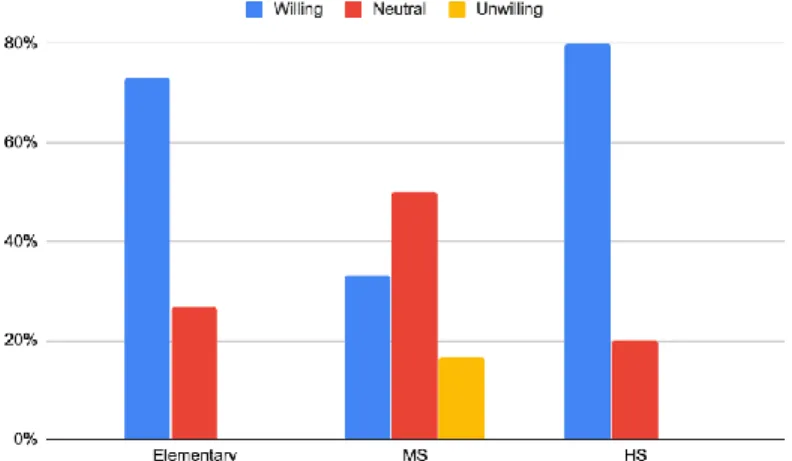
5.1 Grade level of students served and SLMSs percent willingness to implement a fine forgiveness program...40
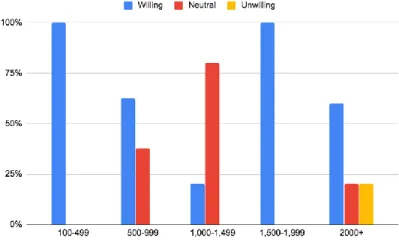
5.2 Number of students served by school library and SLMSs willingness to implement a fine forgiveness program...41
5.3 Percent of student who qualify for free/reduced lunch and SLMSs percent willingness to implement a fine forgiveness program ...41
5.4 Percent of SLMSs who had familiarity and also previous experience with fine forgiveness programs ...42
5.5 Percent of willingness of SLMSs who had familiarity with but no experience with fine forgiveness programs ...43
5.6 Percent of willingness of SLMSs who had neither familiarity or previous experience with fine forgiveness programs ...43
Chapter I: Introduction Background
Maximum access to information, including books, is a priority supported by the universal mission of public-school libraries in providing “equal and equitable access” (American Library Association [ALA], 2018, para 1) to all students; a mission which is legally supported by the First Amendment to the United States Constitution. Publicly funded libraries, such as public-school libraries, must consider information access a top priority, even in the face of “economic pressures and competition for funding” (ALA, 2018, para 2). Access to information may be obstructed, however, by barriers such as fines assessed for late or damaged library materials (Adams, 2010).
Studies show the immense and direct correlation between strong school library programs and student achievement (Johnson & Donham, 2012; Krashen, Lee & McQuillan, 2012;
Krashen, 2013). In a multivariate analysis naming contributing factors to higher reading scores, Krashen, Lee, and McQuillan (2013) find that the “library factor was by far the strongest predictor” (p. 29). In order for students to gain the achievement boost provided by a strong school library program, students must have access to the library and its resources.
This paper explores a barrier to access of information sometimes found in school
libraries: the practice of library fines. This first chapter highlights the context and background of using fines in both the public and the school library. This introductory chapter will also explain the rationale for the research study. The second chapter of this paper examines the existing research available regarding the subjects of school library access barriers and the effectiveness of library fines in general. The third chapter defines the characteristics of the research study which examined the fine practices and mindsets of teacher librarians in a specific suburban school
8 district. Researching the fine practices and mindsets within this district created a foundation from which more feasible fine-alternative practices can be designed and put into place. Following a description of the study, the fourth chapter presents findings of the study while the fifth chapter discusses study results in relation to the research questions and application recommendations.
Context
Despite the universal information access mission, founded on the principles of the First Amendment, of publicly funded libraries, barriers exist that threaten this equal and equitable access in school libraries. Scheduling can be one such barrier, as students may be restricted from library access by limited library hours, fixed class schedules, or lack of library staff (Dickinson, Gavigan, & Pribesh, 2008). Secondly, the usability of a school library catalog can affect
students’ access to the library and its resources, potentially serving as a barrier. Suggested ways to avoid this catalog barrier include making the catalog available to students from home,
providing book cover images in catalog listings, and allowing students to digitally place holds on resources (National Library of New Zealand, n.d., Review Access to the Library Catalogue section, para. 2). A third potential barrier to access is the practice of restricting the number of resources a student may borrow at any given time. Although borrowing restrictions are often set by librarians who fear book loss due to young students’ lack of responsibility, research by Downes & Krueger (2017) shows borrowing restrictions to be an access barrier that has little correlation to library book loss. A fourth potential barrier to access, the barrier which this paper addresses, is that of library fines.
Fines have become almost inherent to library policy. Monetary charges, in the form of fines, are often assessed to patrons because of overdue or damaged materials. The requirement of payment for public library or public school library use in any form could be viewed as a direct
violation of the American Library Association’s Library Bill of Rights, supported by the U.S. Constitution’s First Amendment, which guarantees “free, equal, and equitable access to information for all people of the community the library serves” (ALA, 2018, para 1). School library fines are theoretically viewed as a barrier to student access of information, as fines require payment for continued use and, therefore, access of information (Adams, 2010; ALA, 2018; Wood & Almeida, 2017; Woolls & Weeks, 2014).
Despite the theoretical view of fines as an access barrier, school libraries include fine assessment in program policies for a variety of reasons, often reasons of budget or citizenship. When books are returned late or damaged, library collections suffer. Students cannot access a book that has not yet been returned by a previous student and also cannot use a book that has been returned damaged. School library staff must make decisions whether to buy replacement copies of yet unreturned or damaged books to be made available to other patrons. In many cases, school library programs, which are funded by taxpayer monies, may stress a fiduciary obligation to charge the original patron for causing a wrinkle in circulation for all users. Fines are often included in school library policy as a perceived budgetary consideration and responsibility.
Another justification for including fine policies in school library practice can be found in the unique educational characteristic of school libraries. School libraries differ from public libraries in that they exist within a school, a larger educational institution, and are folded into the mission and vision of that institution. School librarians, also known as teacher librarians or media specialists, are supporting the education of students as learners, as well as library patrons. Classroom teachers incorporate lessons of responsibility and accountability into grading policies and classroom management expectations. Teacher librarians who practice fine assessment may consider the action as an embedded lesson of student responsibility and accountability. Students
10 who fail to return their book promptly or who return a book damaged will be held accountable, they will experience a consequence in the form of a fine that serves as a reminder not to repeat those actions and, therefore, become more responsible.
Although the justifications for including the assessment of fines in school library policy reflect a professional desire to run an effective school library program, a multitude of research (Adams, 2010; Bundy, 2012; Caywood, 1994; Dixon, 2017) finds the common use of fines not only ineffective in the areas of budget and education, but actually harmful to overall library missions. While exploring current research on the subject of library fines, Chapter 2 of this paper reveals the rationale, offered by researchers and practitioners in the field, for recommending the discontinuation, or forgiveness, of library fines.
Problem
Students who have access to a strong school library system have been shown to perform better in reading assessments, regardless of outside factors; therefore, students who encounter barriers to library access will not statistically perform as well on assessments (Krashen, Lee &McQuillen, 2012). The practice of fine assessment can be detrimental to library practice in general (Kohn, 2015). School libraries that continue to use a fine assessment practice, without implementing any type of fine forgiveness program, could be restricting access for a population of their students.
Rationale for the Study
Students could benefit from greater information access through the implementation of a fine forgiveness program. Research into current practices of a specific district is beneficial prior to designing a fine forgiveness program for that district. A descriptive non-experimental study was designed and targeted at approximately forty school library media specialists within a
specific school district. Through this study, data analysis revealed feasibility solutions, leading to a higher probability of an effective fine forgiveness implementation within this district.
Research Questions
By enforcing a fine assessment practice, without implementation of a fine forgiveness program, school library policies restrict access for a population of their students. To determine the feasibility of implementing a fine forgiveness program in school libraries of this district, the following research questions were considered while designing, conducting, and analyzing the study:
1. Are district school library media specialists willing to try a (new) fine-forgiveness program?
2. Do any variables exist which correlate to the level of willingness district school library media specialists have in trying a (new) fine-forgiveness program?
3. What are examples of fine-forgiveness programs with which district school library media specialists have previous experience?
Significance
Fine policies and implementation of fine forgiveness programs vary from school to school, even within the same school district. A mixed method study of both qualitative and quantitative data was used to investigate the current use, and willingness for future use, of fine forgiveness programming. The study provided greater understanding of obstacles to the initiation of such programming, as well as possible ways to overcome obstacles and increase the likelihood of amnesty programming, therefore creating greater student access to the library.
12
Definition of Terms
Amnesty programs: An event or time frame during which students can have their library
fines removed, sometimes in exchange for a money-alternative such as a library chore or canned good (Zettervall, 2012).
Fine forgiveness: The fine on a student’s account is waived or deleted at the discretion
of library policy (Zettervall, 2012).
Library fee: A monetary charge assessed to a student’s library account for use of a
library resource, usually for use of printer, copier, or computer. A lost or unreturned book may result in a replacement fee (Adams, 2010).
Library fine: A monetary charge assessed to a student’s library account as a
consequence for an overdue or damaged library book (Caywood, 1994).
Library Patron: Someone who supports and/or uses the services of a library. May also
be referred to as “library user”, “library customer”, or “library member”. School library patrons include students and staff within the school district (Pundsack, 2015).
Public Library: An establishment of curated print and non-print materials, as well as,
services provided for citizens of a community that is funded and regulated, at least in part, by state laws or guidelines (Gerber, 2019).
Public School Library: A facility within a public school that provides services to
students, staff, administration, and sometimes, parents, of that school community. Services include a collection of print and non-print resources which support curriculum and/or personal interest (Library Research Service, 2014).
Replacement Fee: A monetary charge assessed to a student’s library account as a
Summary
Libraries share a common mission of making information accessible to the community of which they serve. School libraries share this mission of making information resources accessible to students of their school. While there are several potential obstacles to providing maximum access, this paper takes particular note of introducing the barrier effect fine assessment plays on school library accessibility. Having looked at the background and context of the use of fines in libraries, a summary of current research and a rationale for further research has been introduced.
The following chapter delves deeper into a literature review of current research addressing libraries, fines, academic achievement, and the effectivity of the relationships between them. The third chapter of this paper outlines a research study investigating the use of fines and fine forgiveness in the school libraries of a single school district, while chapters four and five report the results of the study, the relationships of the results in regards to the research questions, and recommendations for future action based on these results and relationships.
14
Chapter II: Literature Review Introduction
Library fines have historically been an integral part of library, including school library, policy (Wood & Almeida, 2017). The relationship between library fines and library access, as well as the practice of fine-forgiveness programs is explored in this chapter. This chapter discusses the methods of collecting and reviewing literature regarding library fines and fine-forgiveness programs. The following section of this chapter begins this discussion by defining the selection and analysis methods used for the literature review.
Methodology
Selection of the literature review. The search for and collection of relevant print and
non-print literature, published by both researchers and practitioners, on the practice of library fines and the implementation of fine-forgiveness programs was conducted through online academic databases and a web-based search engine.
The online academic search began within databases provided through St. Cloud State University including Academic OneFile, Academic Search Premier, Directory for Open Access Journals, EBSCO, ERIC, Library, Information Science & Technology Abstracts, MasterFILE Premier, Google Scholar, Professional Development Collection, as well as access to interlibrary loans. An initial inquiry used the keywords school library and student access, using the Boolean operator AND. In skimming through search results, a theme of access barriers was found; barriers that prevented students from accessing information in the school library (American Library Association, 2018). A particular barrier that recurred often in the search results was that of library fine policies. Revising the search indicators, literature specifically on school library and
library fine forgiveness. All articles reviewed were available as full text through St. Cloud State University Library and were peer reviewed. In an effort to highlight the longevity of discrepancy between knowledge of the library fine access barrier and lack of fine forgiveness
implementation, date search limiters were expanded to include articles published up to fifty years ago.
A web-based search was conducted through Google to assess the availability of literature from information media professional organizations and peer reviewed journals with the Boolean operator AND and keyword phrases school library and library fines, student access and library fines, school library and amnesty program.
Analysis method. Descriptive information, such as author and publication date, from
article results were charted in a literature matrix (Table 2.1). Variables used in the literature review and therefore added to the matrix include information access, correlation of library fine and/or the development student responsibility, correlation of library fine use and library budget concerns, and library fine-forgiveness or amnesty programs. Results of this analysis, and how each article addresses the variables considered, is discussed in the next section.
Review of Literature
Much literature exists regarding the use of, and justification for, library fine assessment. A credible amount of literature also exists addressing library fines as a barrier to information access. This section reviews literature by focusing first on information access (and its barriers), then on two common justifications for library fines and, finally on the introduction of fine-alternative practices.
16 Table 2.1
Research Variables Found in Literature Review
Information access (and barriers to access). The American Library Association (2018)
correlates the rights guaranteed by the United States First Amendment to the right all persons have “to receive the constitutionally protected expression of others” (para 1). Libraries provide access for people to receive these expressions, in the form of print and non-print materials and services. School libraries provide access to print and non-print information and services to
students of the school. Numerous studies prove an additional benefit of student access to a school library as a positive relationship to student academic achievement (Johnson & Donham, 2012;
5/20/2019 Literature Matrix2.JWardCopy - Google Docs
https://docs.google.com/document/d/1y7Llg8OE9hDR7kiwZ-DrvMAY1NQMEREDbueSLPKiIJg/edit 1/1
Author(s) Year Variables Considered in the Study Information Access Fine/ Patron Responsibility Fine/ Budget Concerns Fine Forgiveness/ Amnesty Program School Library Policy Adams 2010 X X X Bundy 2012 X X X Caywood 1994 X X X X X Dickinson, Gavigan & Pribesh 2008 X X X Dixon 2017 X X X X Downes, Krueger, Taylor 2017 X X Ford 2001 X X X Griffith 1977 X X X X Johnson & Donham 2012 X X X X Kohn 2015 X X X Krashen 2013 X X Krashen, Lee & McQuillan 2012 X X Livingston 1975 X X X X X Morrison, Blood, Thorsborne 2005 X X Schoenberg 2016 X X X X Wood & Almeida 2017 X X X X
Note: Matrix of literature reviewed. Adapted from Educational Research: Competencies for Analysis and Applications (pg. 98), by L.R. Gay, G.E. Mills & P. Airasian, 2012, Boston: Pearson.
Krashen, 2013; Krashen, Lee & McQuillan, 2012). Access to information through school libraries is important for students. Sometimes, however, there are barriers, such as library fines, to that access of information.
The American Library Association (2018) warns that library fine policies can be potential barriers to information access for some patrons (Principles Governing Fines, Fees, and User Charges section). The threat of fines may make people in lower socioeconomic statuses, or with limited abilities to get to a library regularly, simply avoid using library materials (Bundy, 2012). Parents may restrict their children, the very population that school libraries serve, from
borrowing library resources due to the threat of fines (Caywood, 1994). Caywood notes that restrictions of library privileges, instead of fines, forbid patrons from borrowing additional materials, literally barring access to information. Even patrons who are financially able to pay a library fine may avoid returning an overdue book in an effort to avoid the sometimes unpleasant, or even embarrassing, interaction with library staff regarding the fine (Kohn, 2015).
Despite the potentiality as a barrier to library’s important mission of providing
information access, the practice of using library fines remains common in both public and school libraries. The next section delves into justifications for the use of library fines.
Two common justifications for library fine use. Fines have long been an intrinsic part
of library policy, “even though a non-negligible proportion of librarians and patrons have long considered fines at best an unpleasant hassle and at worst a serious barrier to resources…” (Dixon, 2017, para 1). More than forty years ago, Griffith (1977) and Livingston (1975) recognized that some librarians continued to assess fines due both to intentional collection maintenance efforts and to simple habitual practice. Both researchers recommended, forty years ago, the abolishment of fine practice or at least the implementation of fine-forgiveness programs.
18 These recommendations have failed to be universally adopted, however, and researchers
(Caywood, 1994, Kohn, 2015) continue to explore the obstacles to implementation of fine-forgiveness programs and the justifications for the persistent practice of library fine assessment. Two frequently reported reasons for a fine policy are discussed in this section; the first being to teach patrons/students responsibility (Bundy, 2012; Caywood, 1994; Dixon, 2017) and the second being to address library budgetary concerns (Kohn, 2015; Livingston, 1975; Woods & Almeida, 2017).
Teaching student responsibility. Caywood (1994) sums up the main perspectives of
library mission as being either regulatory or service oriented. Caywood qualifies school
librarians who use fines “to teach children responsibility” (p. 44) as library professionals with a regulatory orientation. These school librarians fear that students will not be responsible with borrowed books unless there is a stated consequence, such as a fine, for neglecting responsibility (Kohn, 2015). In a study of school librarians, Johnson and Donham (2012) found that the most restrictive borrowing policies were found in schools with the most experience of students losing books. Although this is an interesting statistic, Johnson and Donham’s study was, unfortunately, unable to determine whether the restrictive policies had direct correlation, positive or negative, to the proportion of lost books. Fines are often “instituted to motivate borrowers to return
materials…” (Caywood, 1994, p. 44), a method of regulating the circulation of library materials. A service-oriented school librarian will remember that “not every child or young adult has a stable home or a good example of adult responsibility in their life” (Adams, 2010) and will seek flexible ways to provide students agency in maintaining library access. As demonstrated in the next paragraph, research shows that fine-alternative methods may be more effective in
In their article, “If we charge them, will they come?”, Wood and Almeida (2017) examine the practice of a small academic library in which fines are not assessed for overdue resources. While the theory of attaching a fine to an overdue resource is meant to help expedite the return of said item, Wood and Almeida concluded that, in this particular library, the opposite was true. According to Wood and Almeida, students who discovered they would not be charged for tardiness in returning their books were universally more apt to return books on time, due to a sense of intrinsic social obligation instead of an extrinsic threat of consequence. Wood and Almeida provide examples of direct correlation between fine-free programming, or what they label as “service-forward practices” (p. 159) and the self-regulating timely return of library materials by students. By eliminating the punitive climate of fine assessment, the library creates instead, a culture of kindness and reciprocity, which leads to increased student responsibility, patronage and access.
In a study observing the number of book circulations before and after a lending policy revision, Downes, Krueger, and Taylor (2017) found an increase in both overall circulations and in lost books. Having discovered a unique situation of a school about to change borrowing limits, Downes, Krueger, and Taylor were able to gather statistics from two years of the former, more restrictive policy and then also statistics from two years of the revised, more generous borrowing policy. While a librarian’s fear of lost books from the collection is often what keeps strict
borrowing limits in place, the results of Downes, Krueger, and Taylor’s study show a significantly lower increase in lost books (55%) than in overall circulations (80%). The conclusion from this study, which took place in a K-5 elementary school, was that loosening restrictions on borrowing limits did not directly correlate to an increase in lost or damaged books. In fact, after the first year of transition, total circulations continued to increase while total
20 lost books dropped back to pre-revision numbers. Easing restrictions on borrowing limits did not result in proportionally more lost books.
Loosening library fine policies, like loosening circulation policies, does not inherently result in more lost books. Dixon (2017) discusses a library in Vermont that, after abolishing their fine policy, reported seeing not only an increase in the timely return of books but also an increase of patron satisfaction in the more welcoming climate. The San Francisco Public Library (2018) announced the return of nearly 700,000 library items returned as result of a single fine
forgiveness event; books that patrons hadn’t returned earlier for fear of the fine. Knowing they would not be charged with a fine, patrons felt more comfortable coming back to the library, returning their books, and accessing other library materials.
Some patrons may view a fine as an optional cost, instead of the consequence, of keeping a book longer. Patrons who can afford the fine may simply pay for the convenience of keeping the book longer (Bundy, 2012). This phenomenon exacerbates the inequity of access due to a patron’s ability, or inability, to satisfy a library fine.
Library fines do not effectively achieve the goal of teaching responsibility. Although library fines were originally implemented to ensure patron responsibility, current research by Dixon (2017) and by Bundy (2012) show that such practice may not be the most effective strategy. A second justification used for library fines is discussed in the following section.
Library budgetary concerns. A second reason used for the implementation of fines is that
of library budgeting concerns. Libraries are not in the business of giving books away for free. When books are not returned or are returned damaged, they are not available to be borrowed by another patron. The library must spend money to repair the books or to purchase replacement copies. Many libraries distinguish a difference between a fee assessment for the replacement of
lost books and a fine charged for overdue or damaged books (Ford, 2001; Kohn, 2015: Livingston, 1975). Adams points out that “school library professionals have a fiduciary responsibility to ensure that the users of the collection return or pay for the replacement of library resources damaged or lost” (2010, p. 48). Wood and Almeida (2017) caution that the desire to subsidize increasingly reduced budgets with library fines should be heavily considered against simultaneous struggle of libraries to maintain substantive library patronage. While requiring a replacement fee for lost books may be necessary, continuing the use of fines for overdue books is simply not good for public relations.
Fines are assessed in an effort to ensure smooth circulation and retention of library resources (Livingston, 1975). In actuality, however, fines cost time and money to collect (Caywood, 1994). Assessing, communicating, and collecting library fines also has a negative cost to library/patron relations, often resulting in lowered usage and, therefore, reduced budgets (Ford, 2001; Wood & Almeida, 2017). Fines are often communicated to patrons by library staff at the point of check-out. Dixon (2017) points out that this interaction is stressful both for patrons and for library staff. Some libraries even include dollars in their budget for training to help staff navigate these oft negative fine communications. In a school library, the interaction of fine communication can strain relations between the teacher librarian and student patrons, patrons who are financially dependent upon their guardians. Dixon concludes that the costs of imposing library fines are often found to outweigh the infractions they were meant to deter.
Considering first that the universal mission of libraries is to provide information access to all (ALA, 2018), secondly that fines initiated to teach responsibility can be ineffective
22 often cost more than they recoup, the next section explores fine-forgiveness options (Dixon, 2017; Ford, 2001; Wood & Almeida, 2017).
Fine-forgiveness programs. While fines may remain a necessary part of business in
many libraries, fine-forgiveness programs can be an effective strategy in both motivating responsibility and in recouping library materials (Adams, 2010; Dixon, 2017). When the San Jose Public Library, the San Francisco Public Library, and the Chicago Public Library offered fine amnesty, or fine forgiveness, programs lasting one to two weeks, they each experienced better than expected results in number of books returned (Dixon, 2017; San Francisco Public Library, 2018; Schoenberg, 2016). During these amnesty programs, accumulated fines could be removed from patron accounts when overdue library materials were returned within the
advertised time frame. Library collection materials are returned, not only making the materials accessible to other patrons but also allowing the library to retain budget for new materials instead of replacement copies. Additionally, positive public relationships are not only maintained but enhanced by the goodwill of an amnesty program (Dixon, 2017).
While fine amnesty programs can also be effective in school libraries, Adams (2010) suggests other potential strategies that simultaneously teach students responsibility and sustain equal and equitable access to all patrons. Strategies such as allowing students to purchase a replacement book through an outside book source, at a lower cost than the library’s vendor, will maintain the book’s accessibility to other patrons while providing flexibility and understanding of student/family financial resources. Allowing students to complete small library chores as a non-monetary fine payment is another strategy to teach responsibility while being conscious of varied student/family economic statuses (Adams, 2010). Many libraries, including the Ramsey County Library (2015), invite students to read off their fines, offering amnesty compensation for
specified time intervals, such as a dollar removed from accumulated fines for every 15 minutes of reading. This strategy demonstrates another option that emphasizes borrowing responsibilities while also recognizing the financial limitations of students/families. Having the option and agency to read off a fine promotes responsibility and creates greater library access for a student patron.
Ford (2001) offers yet another unique fine forgiveness option. Detailing the planning, implementing, and collection of the Williamsburg Regional Libraries’ Food for Fines program, Ford provides positive results of returned materials and an overall improved library/public relationship. The Food for Fines program allows patrons to bring in donations for a food drive in exchange for fine amnesty. Much like reading off a fine mentioned earlier, during the Food for Fines program, patrons can have accumulated fines cleared with a prescribed ratio of
dollar/donated food. For example, every food item donated may clear a dollar from a patron account or every item may clear the entire fine from one overdue book. Benefits noted from the Food for Fines program include an increased return rate of overdue and lost books, improved staff morale, elevation of community respect, and the strengthening of a positive library public image (Ford).
Gaps in Research
Literature reviewed addresses both public library policy and school library policy. There is a noted gap, however, in articles on fine-forgiveness programs implemented specifically in school library programs. School library policy and programming can vary greatly from district to district and even from school to school within the same district. The reviewed literature provides room for analysis of fine procedures and recommended fine forgiveness programs for school libraries in general. More targeted research is needed, however, on the level of implementation
24 within school libraries in a specific singular school district. A study examining the level of willingness school library media specialists, within this single targeted school district, have in implementing fine forgiveness programs reveals the feasibility of actualizing such programs and provides a pathway for a district wide initiative.
Summary
The review of literature addressed in this chapter led to a deeper understanding of the background and justification of fine assessment practice in library policies. Fines are typically charged for overdue or damaged materials, while lost books are charged a fee. Two recurring goals of fine practice discovered in the literature were that of maintaining library budget and that of teaching student/patron responsibility. Further review highlighted the effectiveness of fine forgiveness programs in better accomplishing both of these goals. A description of the study of both qualitative and quantitative data collected from school library media specialists within a single large school district on their willingness to implement a fine forgiveness program is discussed in the next chapter.
Chapter III: Methodology Introduction
The previous chapter reviewed literature weighing the benefits and challenges of fine forgiveness programs in the library. In the effort to reveal school library practices in the
researcher’s district, a study was designed and executed with a final goal of gaining support for implementation of such amnesty programs. This chapter provides an explanation of methods used to design the survey study, as well as methods used to collect descriptive data from survey responses in order to answer the following research questions:
1. Are district school library media specialists willing to try a (new) fine-forgiveness program?
2. Do any variables exist which correlate to the level of willingness district school library media specialists have in trying a (new) fine-forgiveness program?
3. What are examples of fine-forgiveness programs with which district school library media specialists have previous experience?
The first two questions required examination into quantitative data percentages of media specialists’ survey responses on demographic information and on willingness to implement a new fine forgiveness program. These two questions also delved into possible relationships between willingness to implement and other factors such grade level of students served, socio-economic status of students served, and the population sizes of students served. Additional factors considered include the SLMSs’ familiarity of and previous experience with fine-forgiveness implementation. The third research question allowed the collection of qualitative data.
26 This chapter includes information on this study’s research design, methods, and
procedures, as well as, the pilot study and data collection. Research parameters and subject considerations are also addressed in this chapter.
Research Design
A descriptive research study, using a survey method, was conducted in the fourth week of a new school year. The population for this study was all school library media specialists in the researcher’s school district. Following approval from the Institutional Review Board, the school district’s Media Services department granted permission for researcher to send a cover letter (Appendix B) and a link to a Google Form survey (Appendix C) to media specialists via email. Email addresses are publicly available on the district website. The survey was designed using Google forms, a frequently used application in this district and, therefore, familiar to
participants. Survey questions were designed to extract relevant information targeting each of the research questions.
Institutional Review Board
After successfully completing Institutional Review Board (IRB) training, the researcher submitted an application for IRB process, including copies of the informed consent to participate (Appendix B) and the proposed survey (Appendix C). Because the survey falls under a category of minimal risk to subjects, exemption status was approved and granted (Appendix A).
Research Methods and Procedures
This midwestern suburban public K-12 school district was purposefully selected for two reasons. The first being that it is the researcher’s employment district, making results from the study professionally relevant. The second reason being that is the largest district in the state of Minnesota, with nearly 38,000 students. The district boundaries cover 172 square miles and
serves 13 municipalities in 2 metro-area counties (Anoka-Hennepin School District, n.d.). Being such a large district provided a meaningful size of population to conduct such a survey.
Subjects for the study were every K-12 school library media specialist (SLMS) employed by the researcher’s school district. This sampling lent the greatest convenience to the researcher as well as appropriateness as to the targeted population. The survey questionnaire (Appendix C) and cover letter (Appendix B) were distributed via email on a Sunday evening, asking SLMSs for voluntary participation in completing and submitting the survey within the timeframe of five days, making a deadline of the following Friday. A reminder email was sent to all SLMSs on Thursday, the day before the deadline. Upon the deadline date, only 22 responses had been submitted. In an effort to increase participation, the researcher sent an additional email to all 36 district SLMSs on the Monday following the deadline, with an update on participation level, as well as a repeated request and two-day extension for those who had not yet submitted a response. Information about access to study results was included in the original cover letter, and also attached to the reminder emails and extension emails. Some bias was inherent in the study, as a familiarity exists between researcher and subjects.
Assumptions
An assumption was held that survey participants would have no reason to falsify responses and would answer honestly. Another assumption was that subjects share a common professional goal of being effective stewards of their respective library collections; that policies and/or opinions are made by SLMSs with this in mind. The researcher’s district hires only licensed SLMSs, therefore the assumption was inherent that all subjects have been formally educated and were licensed in school library programming. While one SLMS shares time between two buildings, all other district SLMSs are in individual schools. Therefore, an
28 assumption was made that multiple surveys, addressing separate schools, need not have been sent. Because the researcher is a member of the professional group of subjects, the assumption was made that subjects would be willing to participate in the study, as well as would be open to further discussion of amnesty program implementation. Qualitative open-ended questions can provide subjects space to explain answers that multiple choice questions do not. The researcher made an assumption that providing such space, and therefore the inclusion of qualitative open-ended questions, would stimulate not only more accurate answers to the survey’s multiple-choice questions, but also motivate discussions resulting from the study and contributing to the design of new fine forgiveness programming within the district.
Limitations
The beginning of the school year can put district SLMSs under excessively tight time constraints which may explain why some chose not to participate in the survey. Possibly significant data from these particular SLMSs is not, therefore, included in the study results, an omission that may have limited the study’s final interpretation. Another limitation was the number of subjects who did choose to participate. Although the desired amount was set at 75% of the total population (27 participants), the actual degree of participation, 72%, was just slightly lower.
Delimitations
Being a K-12 SLMS, the researcher sought to find effective ways to improve K-12 school library programming. Research questions in this study focused on SLMSs methods of
implementing fine-forgiveness programming within the district. Therefore, the target population for the study was defined as all district K-12 SLMSs. This population included 25 elementary (K-5), six middle school (6-8), and five high school (9-12) library teachers.
Pilot Study
In order to test the validity of survey questions, a pilot study was conducted prior to sending out the study survey. A request to participate in a pilot study was sent, via private social media message, to seven Minnesota K-12 SLMSs outside of the targeted study population. The pilot survey study was then sent via email to the five consenting SLMSs who responded to the request. Informal email discussions followed the pilot study, allowing feedback from participants on question readability, terminology clarity, friendliness of available answer options, and ease (time and effort) of survey completion.
Question readability. All respondents agreed that the questions were well written and
appropriate with the exception of question #11 which read, “How willing would you be to forgive library fines of former students who complete the requirements of a fine forgiveness program at another school?” After reviewing the question, a determination was made that the question will be of better use in implementation conversations of the future. The question is not pertinent to answering the stated research questions and has, therefore, been removed from the survey.
Terminology Clarity. The pilot study responses showed that terminology was clear and
appropriate. One respondent made specific comments to having actually learned from the terminology explanation and examples.
Friendliness of available answer options. No changes were suggested in regard to the
available answer options for the survey questions. The levelled answer options in questions 8, 9, and 10 were determined appropriate.
Ease (time and effort) of survey completion. While one pilot study participant commented
30 provocation of the inclusion of open-ended questions, another participant felt the survey seemed too long and suggested the cover letter state the exact number of questions. This participant felt that knowing the total number of questions beforehand might eliminate the feeling of lengthiness. A statement regarding the exact number of questions (16) was added to the cover letter.
Participants of the pilot study did not participate in the final study, as they are not members of the targeted district audience. Results from the pilot study aided in revising the final study, eliminating an unclear question, and adding assumptions that were previously unrecognized.
Data Collection Procedures and Instruments
The researcher approached the district media department, gaining approval to invite members to complete the survey questionnaire. A link to the Google Form survey, as well as, a cover letter was then emailed to targeted participants. District SLMSs decided whether or not to participate. Those who chose to participate clicked on the Google Form survey link and were led through a concise series of 16 questions regarding use of fine assessment and fine-forgiveness practices in their school library programming. The survey was kept as brief as possible to encourage participants to complete. On the survey submission deadline, the survey submission option was deactivated. Using Google Forms responses module, data was collected which captured both individual participant responses and summaries of responses.
After printing all individual responses, the researcher created a Google Sheets spreadsheet. The researcher then analyzed the quantitative data by comparing the level of willingness a SLMS has in implementing a fine forgiveness program (question 10) to other data collected from survey response. Qualitative data collected from the remaining questions
regarding support, justification, and procedural practices of fine assessment will be used for future design of a district fine forgiveness program.
Confidentiality
The survey link was emailed and accessible only to district SLMSs. Participants were able to access the survey and submit responses through a Google Form. Because of the local nature of the survey and the identifying possibilities of answers, lack of anonymity was
addressed in the cover letter. The cover letter also detailed the open discussion possibilities and district programming development opportunities offered by the study data so that participants became aware of results visibility.
Validity and Reliability
Survey questions for this study were carefully crafted to result in responses that both answer the research questions regarding district implementation of amnesty programming and that promote universal understanding which is pertinent prior to programming design.
The face validity of the questionnaire was established through a pilot study of media specialists outside of the district who completed the survey and followed-up with discussion evaluating the survey’s usability and effectivity. Conducting a pilot study allowed questions to be revised, ensuring higher levels of validity.
Most questions in the survey were of a quantitative, closed answer variety such as whether or not the SLMS has ever implemented a fine-forgiveness program. The answer was either ‘yes’ or the answer was ‘no’. There were, however, questions with space for the SLMS to add open responses, providing qualitative data. Open responses may have created less reliability as SLMSs may have been more or less inclined to add details depending on amount of time available for the survey. Wherever possible, multiple choice and Likert-type scale questions were
32 added to provide as many predetermined responses as possible, therefore increasing the
reliability of results.
Timeline
The researcher’s graduate committee was formed in May 2019 with a preliminary
meeting held on July 16, 2019. After approval from the committee, the researcher applied for and was granted IRB approval to proceed. Upon attaining IRB approval, a request was made to and granted by the district media department for approval to send a cover letter and survey link to all district SLMSs. The cover letter and survey link were emailed to district media specialists on September 22, with a response deadline set for September 27. An email reminder was sent on September 26, the day before the original deadline. An email announcing an extension to the deadline was sent on September 30, with the extended deadline set and maintained for October 2. On October 2, the survey was closed by deactivating the Google Form submissions option. When the survey closed, data collected from the submitted responses was analyzed. Results of the study will be shared with those participants who have requested such and with district media
department personnel in the future.
Summary
While library fines may be a necessity in some school library programs, they can create barriers to student access of the library. Fine forgiveness programs may be an avenue around those barriers. In an effort to continually improve school library programming, this study sought data on library demographics/statistics and their relationship to the level of willingness district media specialists have in implementing a fine-forgiveness program. This chapter has identified a need to examine the researcher’s school district for further insight into obstacles that could prevent fine forgiveness programs from effective implementation.
The following two chapters present findings from the survey, as well as, analysis and discussion of results.
34
Chapter IV: Results Introduction
Having, in the first and second chapters, established the context and need for a study regarding the feasibility of implementing a fine forgiveness program in a specific district’s school libraries, as well as having reviewed relevant available literature, Chapter Three detailed the methodology of designing, distributing, and collecting data from a questionnaire survey study. This chapter reveals results of that survey of SLMSs from the largest school district in Minnesota regarding their willingness to implement a fine forgiveness program. Survey response data can be found in Appendix D and implications of these results will be discussed in Chapter Five.
Response Rates
The survey was sent to all 36 SLMSs in the targeted district. Of those 36, 22 responded by the initial deadline. After a follow-up email request and submission deadline extension, four more responses were generated, bringing the total response submissions to 26, establishing a 72% response rate. Being only slightly lower than the desired response rate of 75%, it provided substantive data for interpretation.
Demographics
Respondents from the survey included SLMSs from 15 elementary schools, six middle schools, and five high schools. Respondents represented schools ranging in size from less than 500 to more than 2,000 students (Figure 4.1) with percentages of student populations qualifying for free/reduced lunch ranging between zero and eighty percent (Figure 4.2).
Figure 4.1. Percent of SLMSs with each student population size
Figure 4.2. Percent of SLMSs with each percentage range of free/reduced lunch
Familiarity & Previous Experience
Sixty-nine percent of the 26 respondents said they were somewhat to very familiar with fine forgiveness programs, while 19% of the 26 said they had little to no familiarity with such programs. Nearly 12% of respondents selected a neutral response to the question (Figure 4.3). Sixty-two percent of respondents had no experience with implementing a fine forgiveness program in a library, while 38% said that they had some previous experience with fine forgiveness programs (Figure 4.4).
36
Figure 4.3. Percent of SLMSs who had familiarity with fine forgiveness programs
Figure 4.4. Percent of SLMSs who had previous experience with fine forgiveness programs
Willingness
Responses to the direct question of willingness to implement a fine forgiveness program revealed 65% respondents (n=17) identifying as somewhat to very willing, 31% (n=8) were neutral to the idea, and only four percent (n=1) stated little to no willingness (Figure 4.5).
Qualitative Examples
Respondents provided comments and examples in the open-ended questions of the survey. Twelve responses to these open-ended questions address the two common justifications for the inclusion of fine assessment: that of teaching student responsibility and that of budgetary obligation. Other open-ended responses included examples of fine forgiveness programs already implemented by some of the 38% of SLMSs who have previous experience with such programs. These examples include variations of reading or working down/off fines. Reasons for not having yet implemented fine forgiveness responses, provided by the other 62% of SMLSs, include lack of administrative support, complications with the textbook manager module in the library management system software, the nonpermanent nature of student patronage, and lack of knowledge, awareness or interest in such programs. This qualitative data will be used in future discussions among district media specialists when designing a fine forgiveness program.
Conclusion
This chapter presents the results of survey research investigating the willingness of public-school media specialists to implement a fine forgiveness program in the library. Although serving students from a variety of demographics, roughly two-thirds of respondents profess a willingness to implement a fine forgiveness program. In the next chapter, analysis of the survey results will be followed by recommendations for application, future continued research and possibilities for sharing this study.
38
Chapter V: Conclusions Introduction
This final chapter provides discussion regarding the results of the survey study. Conclusions drawn in this chapter are founded based on the review of literature examined in Chapter 2 and analysis of variables in both quantitative and qualitative data collected from survey results. After discussing analysis of the survey results, this chapter will suggest
recommendations for application and for future continued research, as well as explore options for sharing study results.
Analysis of Survey Results
One question on this study’s survey simply asked respondents whether or not they were willing to implement a fine forgiveness program. Although the responses to this question might provide a short answer to the main inquiry of this study, feasibility of implementation, variables may exist which impacted the way respondents answered that direct question of willingness. Reviewing some of the survey’s other questions illuminates possible relationships between these other variables and willingness to implement a new program. Through analysis of multiple survey results, this study’s original research inquiries are addressed.
Are district school library media specialists willing to try a fine forgiveness program?
With nearly 65% of respondents professing willingness to implement, the answer to this question is affirmative. However, there remains roughly 35% of the respondents in the neutral or
unwilling categories. It is beneficial to review further analysis of results from both demographic and experiential survey questions in order to determine a truer answer to feasibility.
Do any variables exist which correlate to the level of willingness district school library media specialists have in trying a fine forgiveness program? Analysis of the relationships
between variables, in the quantitative data collected from the survey, reveals interesting insight into how both demographic and experiential survey question results relate to a SLMS’s
willingness to implement fine forgiveness.
When analyzing the relationship between each respondent’s self-assessment of
willingness (Survey Question #10) to each same respondent’s answer to demographic questions, such as the number of students served (Survey Question #2), the grade level of students served (Survey Question #1), and the socio-economic status as measured by the percentage of students who qualify for free or reduced lunch (Survey Question #4), some patterns are detected while others are not.
Comparing SLMSs’ willingness to forgive fines to grade levels of students served shows that elementary and high school SLMSs were predominantly more willing to forgive fines, with no respondents unwilling to do so. Middle school SLMSs, however, responded as predominantly neutral, with some even unwilling to try fine forgiveness. The researcher speculates that the reason may lie in the fewer number of years students spend in middle school versus years spent in elementary and high school, as well as the fact that these middle school years are sandwiched between the other two school levels. Elementary SLMSs have students for the first six years of a K-12 education. Through six years, SLMSs can get to know students more extensively, are often privy to student family situations, and are empathetic to the responsibility expectations of this age group. For all of these reasons, elementary SLMSs may be more willing to try a fine forgiveness program. High school SLMSs have students for the final four years of a K-12 education. While some high schools may limit non-academic privileges, such as social events like prom or ceremonial events like commencement, as a consequence for students’ unpaid library fines, there is little else of consequence that happens once students graduate and leave the
40 school. Implementing a fine forgiveness program may be a high school SLMS’s last effort to have a student take responsibility for a library fine. Middle school SLMSs acquire students who may have racked up substantial fines in elementary school and are only in the middle school for three years. These SLMSs may be unable to become acquainted with a student’s situational need for a fine forgiveness. Middle school SLMSs may also have heightened budget concerns as students are in their middle school environment for such a short time. Offering a non-monetary option seems to be least attractive to middle school SLMSs (Figure 5.1).
Figure 5.1. Grade level of students served and SLMSs’ percent willingness to implement a fine forgiveness program
When comparing SLMSs’ willingness to forgive fines to the number of students served, a relational pattern is not evident (Figure 5.2). The number of students served does not seem to affect a SLMSs willingness to implement fine forgiveness.
Figure 5.2. Number of students served by school library and SLMSs’ percent willingness to implement a fine forgiveness program
Similarly, comparing SLMSs’ willingness for fine forgiveness to the socio-economic status (as determined by qualification for free and reduced lunch) of students served, presents no correlational pattern in results (Figure 5.3). SLMSs from schools with high percentages of students who qualify for free/reduced lunch present results showing complete willingness to forgive fines. Explanation may lie in those SLMSs understanding of their students’ inability to satisfy a monetary fine.
Figure 5.3. Percent of students who qualify for free/reduced lunch and SLMSs’ percent willingness to implement a fine forgiveness program
42 Two other variables analyzed were the study participants’ familiarity with and previous experience with fine forgiveness programming. Respondents who were familiar with fine forgiveness programming and also had history in implementing such programming proved highly likely (90%) to be willing to try a new implementation (Figure 5.4). As research reviewed in Chapter 2 showed, fine forgiveness programs can increase positive outcomes in teaching student responsibility, as well as goals of budgetary maintenance (Adams, 2010; Dixon, 2017). SLMSs who have implemented fine forgiveness programs and experienced these positive outcomes seem to be more willing to try fine forgiveness again.
Figure 5.4. Percent of willingness of SLMSs who had familiarity with and also previous experience with fine forgiveness programs
Sixty-four percent of respondents who are familiar with fine forgiveness, yet have had no experience in implementing a program, were willing to try implementation (Figure 5.5). This is lower than the willingness of SLMSs who had familiarity as well as experience (64% compared to 90%). Analysis of responses from SLMSs who had little to no familiarity, as well as no experience with fine forgiveness programs shows that the level of willingness is only twenty percent (Figure 5.6). SLMSs who were not familiar with such programming and who, therefore had no experience with fine forgiveness, were unsure of their willingness to implement, therefore
making up the 80% neutral response. The more familiarity and experience SLMSs have with fine forgiveness programs, the more willing they are to implement a new fine forgiveness program. The variables of familiarity and experience have a clearly favorable relationship to a SMLS’s willingness to implement a fine forgiveness program.
Figure 5.5: Percent of willingness of SLMSs who had familiarity with but no experience with fine forgiveness programs
Figure 5.6: Percent of willingness of SLMSs who had neither familiarity or previous experience with fine forgiveness programs
What are examples of fine forgiveness programs with which district school library media specialists have previous experience? Having analyzed survey results and found that SLMSs’ prior familiarity and experience will favorably affect the feasibility of a fine forgiveness implementation, it made sense to ask which programs these respondents have already tried. Examples found in the survey results illustrate variations of ways students can either work in the
44 library or read for extended periods of time as payment for their fines. A respondent from an elementary school described offering students an option to shelve books, straighten shelves, dust, clean Chromebooks, or wipe down tables in the media center to work off their fine. The amounts forgiven from a fine per number of minutes worked or read varies a great deal. Three separate middle school SMLSs allow students to read or work in the library during a homeroom period, earning one dollar forgiveness for every 10 minutes of reading at one school, one dollar for every five minutes at another school, and one dollar for every 20 minutes at the third school. Although a district initiative may benefit from more consistent forgiveness ratios, a program of reading or working off fines is one that has worked in this district.
Recommendations for Further Research
Future research into feasibility of fine forgiveness implementation would be beneficial, especially in the relationships of demographic variables. For future surveys, questions regarding school library budget, books per student, and annual book repair costs would be included to better explain demographic patterns in relation to SLMSs willingness to forgive fines. The distributed intervals of variables embedded in survey questions would be more detailed as 80% of students qualifying for free/reduced lunch can be quite different from 61%. This difference may be significant. While a multiple-choice question may create greater ease for respondents in completing the survey, requiring exact answers to demographic questions would allow more detailed analysis of results. While this study created greater awareness of fine forgiveness programs in this district, further research would create even greater awareness, a variable which has proven to positively influence feasibility of implementation.
Sharing Research Results
The results of this study will be made available in St. Cloud State University’s
Institutional Repository. Research participants were made aware of access to an available link to the study and have inter-district access to the researcher via email, phone, and face-to-face meetings. Research findings will be discussed in district collaborative team meetings. At least two participants from the pilot study have reached out to the researcher, requesting information and discussion of literature reviewed in Chapter Two. Sharing this information and information about this study is important in that it creates awareness of fine forgiveness programs, increasing the likelihood that more school libraries will implement such programming and therefore
increase student access to information.
Conclusion
The literature review of this research study revealed how ineffective, yet historically prevalent, fine assessment policy is to both public and school libraries. Fine assessment practices were shown to create barriers to information access and to fail at achieving the goals of teaching patron/student responsibility and in maintaining budget obligations. The reviewed literature also brought to light the more rewarding practice of fine forgiveness programming.
The survey of this research study revealed district library media specialists’ willingness to try a fine forgiveness implementation. Awareness of and experience with fine forgiveness programs was shown to positively influence adoption of fine forgiveness practices. This study has been, and will continue to be, a tool in that greater awareness, therefore pushing fine forgiveness practices into a more prevalent status norm. Wide spread use of fine forgiveness practices in district school libraries will reinforce equal and equitable access of information for all students.
46
References
Adams, H. R. (2010). The “overdue” blues: A dilemma for school librarians. School Library Monthly, 26(9), 48–49. Retrieved from http://login.libproxy.stcloudstate.
edu/login?qurl=http%3a%2f%2fsearch.ebscohost.com%2flogin.aspx%3fdirect%3dtrue% 26db%3dlxh%26AN%3d49574386%26site%3dehostlive%26scope%
3dsite
Anoka-Hennepin School District. (n.d.). About Us: Welcome to the Anoka-Hennepin School District. [Online] Retrieved from https://www.ahschools.us/domain/74
American Library Association. (2018). Economic Barriers to Information Access. [Online] Retrieved from http://www.ala.org/advocacy/intfreedom/librarybill/
interpretations/economicbarriers
Bundy, A. (2012). In Australia’s first national year of reading; Another reason why library fines are not so fine. APLIS, 25(2), 55. Retrieved from http://login.
libproxy.stcloudstate.edu/login?qurl=http%3a%2f%2fsearch.ebscohost.com%2flogin.asp
x%3fdirect%3dtrue%26db%3daph%26AN%3d76118270%26site%3dehost-live%26scope%3dsite
Caywood, C. (1994). Penny wise, pound foolish. School Library Journal, 40(11), 44. Retrieved from http://login.libproxy.stcloudstate.edu/login?qurl=http%
3a%2f%2fsearch.ebscohost.com%2flogin.aspx%3fdirect%3dtrue%26db%3daph%26AN %3d9411157750%26site%3dehost-live%26scope%3dsite
Dickinson, G., Gavigan, K., & Pribesh, S. (2008). Open and accessible: The relationship between closures and circulation in school library media centers. School Library Media Research,
qurl=http%3a%2f%2fsearch.ebscohost.com%2flogin.aspx%3fdirect%3dtrue%26db%3de ric%26AN%3dEJ823035%26site%3dehost-live%26scope%3dsite
Dixon, J. A. (2017). Doing fine(S)? Library Journal, 142(6), 40–44. Retrieved from
http://login.libproxy.stcloudstate.edu/login?qurl=http%3a%2f%2fsearch.ebscohost.com% 2flogin.aspx%3fdirect%3dtrue%26db%3dlxh%26AN%3d122229362%26site%3dehost-live%26scope%3dsite
Downes, Krueger & Taylor. (2017). Impact of a less restrictive circulation policy in an
elementary library. Curriculum & Instruction Faculty Publications, 22. Retrieved from: https://scholarworks.uni.edu/cgi/viewcontent.cgi?article=1021&context=
ci_facpub
Ford, A. (2001). ‘Food for fines’ drives: Positive PR that works! Marketing Library Services,
15(2). Retrieved from http://www.infotoday.com/mls/mar01/ford.htm
Gay, L.R., Mills, G.E., & Airasian, P.W. (2012). Educational research: Competencies for analysis and applications. Boston: Pearson.
Gerber, R. (2019). Definition of a library: General definition. LibGuides at American Library Association. Retrieved from https://libguides.ala.org/library-definition
Griffith, J. W. (1977). There is an alternative to fines. School Library Journal, 23(8), 50. Retrieved from http://login.libproxy.stcloudstate.edu/login?qurl=http%3a%2f%
2fsearch.ebscohost.com%2flogin.aspx%3fdirect%3dtrue%26db%3dlxh%26AN%3d5610 712%26site%3dehost-live%26scope%3dsite
Johnson, L. & Donham, J. (2012). Reading by grade three: How well do school library circulation policies support early reading? Teacher Librarian, 40(2), 8-12. Retrieved from http://login.libproxy.stcloudstate.edu/login?qurl=http%3a%