LANGUAGE POLICIES OF THE INTERCULTURAL BUSINESS
COMMUNICATION ON THE WWW
Anita Nuopponen
University of Vaasa
1. Introduction
The World Wide Web (WWW, web) is a medium for intercultural communication and information exchange. In business communication it has brought a new era both in com-pany internal and external communication. It integrates several types of communication forms, partly replaces old media and gives new dimensions to intercultural business communication.
In this article an attempt is made to describe language policies that companies apply to intercultural communication on the web, i.e. in which language(s) do companies address their customers. Questions to be asked are as follows: which languages are used for the domestic and international customers? Are they treated in different ways? What are the roles of English and other languages? How is multilingualism realized on the websites? In order to describe the language usage classifications of website types, content types, and languages will be made.
The material consists of websites of airlines with international flights, i.e. companies that have already long before the web established themselves in the international and inter-cultural market. They sell their services both in their own country and throughout the world. I became interested in this theme when I noticed that some airlines offered information on their services to their domestic clientele only in English even though English was not an official language of the country in question (e.g. Finnair and Icelandair 1998). At the same time, a foreign company could offer these customers information in their own language on its website (e.g. Lufthansa, KLM had Finnish WWW-pages).
2. Intercultural communication on the World Wide Web
The commercialisation of the Internet and the World Wide Web1 started in the mid 1990’s. At first many companies hesitated to invest in this new form of communication, but now-adays it is already a necessity for any company to have its own website. Today the concept of e-commerce (electronic commerce) encompasses all business transactions and com-munication from selling products, including customer service functions, sales, marketing, PR, advertising, etc. (E-Commerce Glossary). Websites combine several business text genres and imitate or compensate different communication media, such as printed matter (brochures, advertising, time-tables, catalogues, manuals, company reports, etc.), slide shows, video, animation, audio presentations, consumer feedback, sales events, etc.
Communicating on the Internet is not restricted by national boundaries. What restricts the communication and information today is often language. Hopkins summarises this problem:
The world is a small place, and there’s nothing better than the Web to prove it. Thanks to the Web, almost all the barriers to communication and trade of former years have evaporated. All except one, that is: language. A website that is accessible worldwide is hardly understandable to all of its audiences. (Hopkins 1996-97)
The selection of the language of a website is connected with delimiting the target audience. For example, using only Finnish on the website makes the site available only to Finnish speakers. At the other end there are websites written in English when targeting anyone around the world.
For languages other than English the Internet posed problems for a long time, but the situation has now been changing rapidly and there are no more unsolvable technical barriers to producing websites in languages other than English. In 1994 a consortium (The
World Wide Web Consortium, W3C) was created with the goal of making the WWW
technically able to meet the needs of modern business, research and interpersonal communication in all writing systems and languages, thus serving the whole global
1
WWW is an Internet hypertext application based on the use of Hypertext Markup Language (HTML) to create hypertext documents that are independent of the type of computer or operating system. (Internationalization of the Hypertext Markup Language.)
community.2 Different kinds of coded character set standards, e.g. UNICODE, provide the means for languages that use different type set to English. The possibility to add sound has given further possibilities, e.g. to present information in languages that do not have a writing system.
For intercultural business communication, the WWW has brought new solutions. Website
globalization, internationalisation, and localisation as well as multilingual websites belong
to the jargon and sales talk of commercial WWW designers. Internationalisation and
localisation became known as concepts in connection with software development.
Inter-nationalisation means in that context that the software is ”developed without the cultural characteristics embedded” and it ”can be localized parametrically for different cultures; for example, the same software can run for Germany with the German conventions, or for Italy with the Italian conventions” (Benitez 1996). As to the websites, in many cases localisation restricts only to the extent that the information is available in the national language(s). Internationalisation or globalisation means very often that an international/global audience is targeted by selecting English as the sole language of the Web site.
3. Websites of the airlines
Since 1998 I have been following the development of the websites of 8 European airlines (AirFrance, Finnair, Iberia, Icelandair, KLM, Lufthansa, Scandinavian Airlines and Swissair). Most of these companies had introduced their websites in 1998 or a little earlier. Not all airlines could be found on the web at that time, however, e.g. British Airways did not have a website. Today every airline has its website. Online booking and other forms of interactive services and e-commerce are becoming normal features of these websites. Once a year I have been checking the changes in the number of countries that the airlines address their websites to, the number of languages used and which language or languages are used for each country.
2
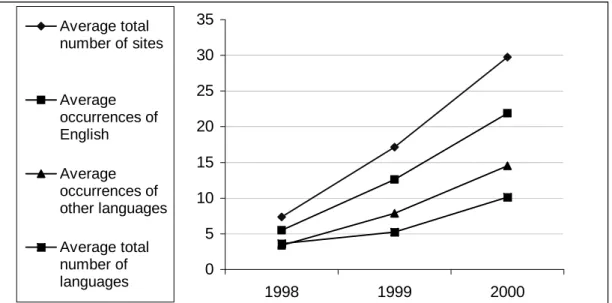
0 5 10 15 20 25 30 35 1998 1999 2000 Average total number of sites Average occurrences of English Average occurrences of other languages Average total number of languages
Figure 1. The development of 8 airlines’ websites and languages used on them
The average number of sites per airline has quadrupled (from 7.4 to 30) while the average number of languages used by the airlines has nearly tripled (from 3.6 to 10.1) (see table 1 and figure 1). The use of English has increased notably.
Table 1. The development of 8 airlines’ websites and languages used on them
Airlines 1998 1999 2000 C o u n tr ie s N r. o f la n g . E n g lis h O th e r C o u n tr ie s N r. o f la n g . E n g lis h O th e r C o u n tr ie s N r. o f la n g . E n g lis h O th e r Air France 2 2 1 2 7 5 3 6 28 18 10 18 Finnair 1 1 1 0 2 1 2 1 15 8 9 9 Iberia 8 5 4 6 12 3 8 11 15 4 7 13 Icelandair 1 1 1 0 13 4 8 9 11 7 7 7 KLM 18 9 16 11 38 10 30 12 70 14 70 28 Lufthansa 14 8 7 7 42 14 27 21 61 18 34 27 SAS 13 2 12 1 20 3 20 2 25 5 24 4 Swissair 2 1 2 0 3 2 3 1 13 7 14 10 Total 59 29 44 27 137 42 101 63 238 81 175 116 Average 7.4 3.6 5.5 3.3 17.1 5.35 12.6 7.9 30.0 10.1 21.9 14.5
Countries = number of countries or areas that have received a separate web page or website Nr. of lang. = number of different languages used on the websites
English = number of occurrences of English on the websites
When trying to describe the language use on the websites, three aspects proved to be essential: target country or area of the website, structure of the website and type of the content.
3.1 Websites according to the target area
The first classification to be made was to distinguish between domestic, local and
international (or global) websites, according to which geographic area the website or pages
are targeted. There were clear differences between these in terms of the content and language choices of the analysed websites.
a) Domestic websites
Mostly an airline has a website that is clearly addressed to customers in the airline’s home country (e.g. www.finnair.fi). These domestic websites are usually (but not always) in the official language(s) of the country and contain more documents than the airline’s other websites. In some cases the domestic sites are also translated into other language(s). Translations of these web pages into English are, however, often made global by leaving out any local domestic information.
b) Local websites
Websites that airlines have for other countries where they have operations are called local
websites by some of the airlines, and this term will also be used here. In fact, domestic
websites are also local, but I want to distinguish them from other local websites, because their content and language selections seem to be different. Another type of local website is the regional websites that is common to several countries, e.g. North Africa, Central America.
Local websites may have two different functions: to offer information either to those living in the country or those planning to travel there. In many cases both these aspects appear in the content but in some cases the website is only meant as to serve incoming travellers, not local customers.
c) International websites
In addition to the local and regional pages or websites, companies often have an international page or a whole website (often in English) containing material that is common to all countries and does not have any local references except for links to the local sites (e.g. Finnair, Lufthansa, Swissair). Often this page or site can be accessed with address of the type www.airline.com, e.g. www.lufthansa.com. SAS has adapted the domain name
scandinavian.net for its international website, because www.sas.com has been taken by
another company. For Icelandair and Air France the .com address is reserved for the American website. The international website may function as a kind of super-ordinate home page or an entrance page for accessing the local sites.
3.2 Structure of the websites
While collecting information on the websites, I observed that often a part of the content is given in the language of the target country, but many links lead to an international website. The concept of website needs clarification at this point. Some sources define a website as a ”group of web pages created by a certain organisation or dealing with a certain subject, thus forming a well-defined entity” (Tietotekniikan termitalkoot). According to this definition we could talk about e.g. Finnair’s and Lufthansa’s website, when we enter their international home pages and can select our country there. But if we enter directly their home page in our country, i.e. our local home page, the pages in many cases are not necessarily linked with the pages for other countries. So they can also be treated as websites of their own. Without taking into account the technical side of the websites, but only the content and how the Internet user sees them, I make a distinction between centralised and decentralised websites.
a) Centralised websites
When the different countries have their own pages on the same website - perhaps even on the same server - the result of the website design looks like only one big website with separate sections for international, domestic and local websites. In these cases the addresses follow the same pattern and the graphical design and the content structure are uniform.
b) Interconnected websites for different target countries
If the websites are interconnected, even though they are maintained in different countries, for the user they may look like one and the same website. Only the URLs reveal the technical structure if the design is uniform. Quite often there are, however, also differences in the design, e.g. in 2000 Finnair had given some freedom to the local site designers as to the graphics and layout.
c) Isolated websites for different target countries
Isolated websites for different target countries are not necessarily a problem for the customer if he/she can find the local website with a transparent domain name, e.g.
www.finnair.jp, www.icelandair.uk. For me it was, however, problematic to find different
local websites in cases where there were no links from one website to another, or even from the international or domestic website.
3.3 Website content
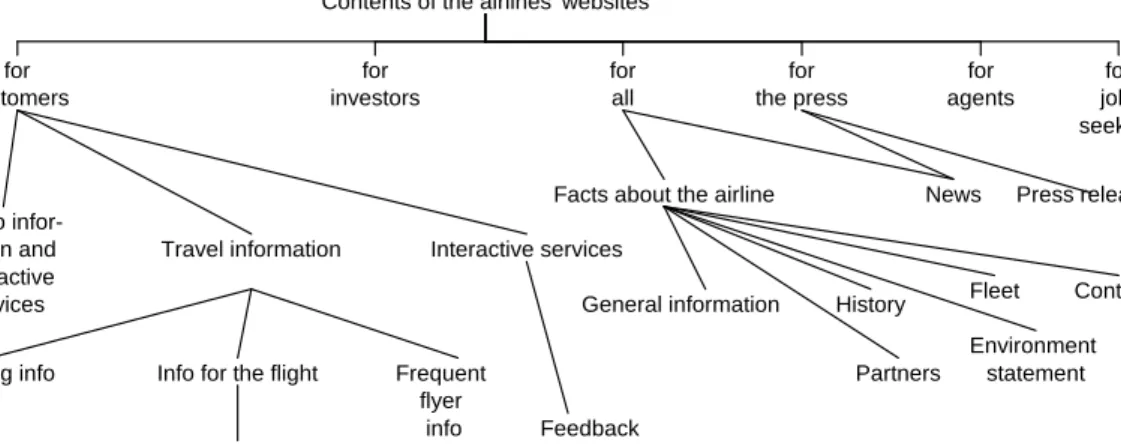
In order to find out more about the connection between the language choices and the content, I selected the websites of three airlines - Finnair, Lufthansa and SAS - for further study. For each of them I drew a content map for the website with the widest range of topics, i.e. domestic or international website. With the help of these maps, I created a general content type classification. The sites themselves classify the information in many different ways to build up the hierarchical structure for the pages. I selected target group as the main classification criteria. In addition to clearly targeted content, there is content that does not have any specific audience that e.g. tells about the company for any website visitor or any of the specified target groups. Figure 2 shows some of the most usual categories of information.
Figure 2. Classification of the website contents
The websites contain several types of documents that were earlier published as brochures, timetables, price lists, newsletters, press releases, etc. In addition they contain interactive services, which have been increasing from the beginning.
4. Languages used on the websites
During the observation period (1998-2000) all the airlines extended their websites to cover all their destination countries. The selection of languages does not, however, cover all the languages - not even the official languages - spoken in these countries. In the beginning (1998), several of the airlines had only an international or global website and possibly a domestic website for their own home country and a couple of local websites. In order to analyse the languages used on the websites, I have classified them analogically with the types of websites into domestic, local and international languages.
for customers for investors for all for the press for agents for job seekers Contents of the airlines' websites
Travel information Cargo
infor-mation and interactive
services
News Press releases
Fleet Contacts Interactive services
Planning info Info for the flight Frequent flyer
info Airport info
Inflight service info Shopping info Baggage info Conditions Medical info Special services Timetables Prices Offers Product info Booking info Destination info Offices Feedback Booking Auction Flight-scheduler Check-in Own profile Frequent flyer services
Facts about the airline
Environment statement Partners
History General information
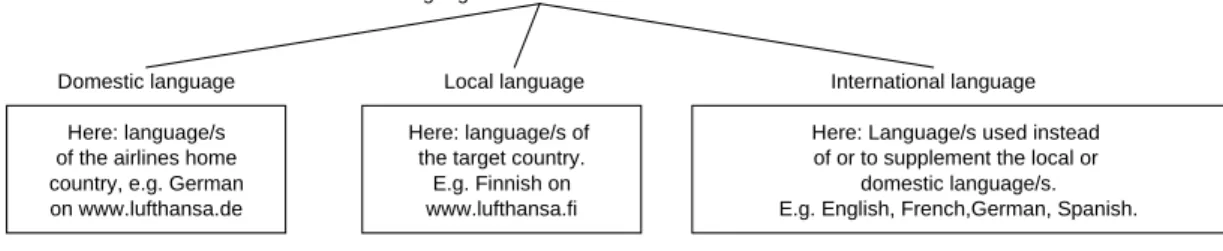
Figure 3. Classification of the languages of the websites 4.1 Domestic language
Domestic languages are here the (official) language/s of the airlines’ home country, e.g. German on www.lufthansa.de. Finnair started with one single site in English with the promise of a Finnish site. By the year 2000 Finnair had established an extensive Finnish domestic site alongside the English one, but the other official language of the country, Swedish, was not yet that well represented. Part of the content had been translated into Swedish, for the rest a link to the Swedish local site for Sweden was given. On the Swedish local website, however, many links lead to pages on the international website in English. Also Icelandair had only an English website and nothing in the domestic language – even though Iceland has language politics that favour the domestic language (Laurén et al. 1998: 281f.).
While Icelandair and Finnair added the domestic languages to their websites (Finnair only in Finnish) by the year 1999, the pages of SAS for the Scandinavian countries, Sweden, Denmark and Norway, aroused publicity, because they were all in English. The Nordic Language Council criticised SAS for removing the Nordic languages from its website. According to web sources the press officer of SAS said that it is best to use English so everyone can understand. (Noregs Mållag 28.01.2000.) This despite the fact that the most important traveller group for SAS are Swedes, Danes and Norwegians. This would imply that their languages would also be the basic languages of the site. The Nordic Language Council suggested to SAS that if the Scandinavians do not take care of their own languages and use them, so who then will do it (Aftonbladet 30.11.1999). An interesting point is that
Languages used on the websites
Domestic language Local language International language
Here: language/s of the target country.
E.g. Finnish on www.lufthansa.fi Here: language/s
of the airlines home country, e.g. German on www.lufthansa.de
- Local pages - Local content - From whole web-site to minimal use (e.g. Welcome!) - Domestic home page
- International home page - Other home pages with the same local language
Here: Language/s used instead of or to supplement the local or
domestic language/s. E.g. English, French,German, Spanish.
- International home page - Supplementing texts and services, e.g. Investor information
the three Scandinavian governments are also the majority shareholders in the airline company. The only Swedish pages in 1999 were the pages for young travellers. Some pages in Norwegian and Danish appeared as late as the year 2000.
Swissair also started with English pages, adding German pages in 1999, and French and Italian domestic pages in 2000. However, in 2001 only German and French domestic pages were left. Unlike these airlines, Lufthansa, AirFrance, KLM, and Iberia had their domestic sites in their domestic language from the beginning of the observation period.
4.2 Local languages
Local languages I define in this context as the (official) language/s of the target country, e.g. Finnish on the www.lufthansa.fi site. In a similar way, Finnair’s pages for Germany were in German with only a few exceptions. Compared to the international site the German texts were, however, very much shorter and not as detailed. For Sweden Finnair had made another solution, the pages in the local language were short, but had links that lead directly to more detailed information on the international English pages. SAS did the same, even for the pages for its Swedish customers.
4.3 International language
It seems that a part of the content in the local or even domestic sites may be borrowed from the international pages by linking to e.g. English texts, which give more detailed information. Sometimes the change of language comes without any warning in the link text. The international languages are used not only to supplement a local or domestic language, but also to substitute for it. The use of languages has been varying during the years and there have been changes in both directions: from English to local languages, and from local languages to English. As an international language on some websites appear also Spanish, French or German.
4.4 Monolingual, multilingual and hybrid websites
To combine what has been said above, a classification into monolingual, multilingual or hybrid websites could be made according to the languages appearing on the websites. Monolingual websites use only one single language, while multilingual websites have the
same information in two or more languages. Websites that give part of the content in the domestic or local language and complete it with pages in an international language I call ”hybrid websites”. According to this classification, only those sites with pages with same content in different languages would be ”real” multilingual websites.
5. Conclusion
In this article an attempt was made to describe language policies that companies apply on their websites. Websites were studied as products of the processes of website globalisation, internationalisation and localisation, and divided into international (or global), local and
domestic. A more thorough survey is needed to answer exhaustively the questions
presented, but some patterns could be seen and classifications could be formed.
As to the languages companies use on their websites, the dominant role of English in the world of the Internet cannot be denied. During the first years some airlines had only English web pages. During the observation period other languages seemed to be gaining importance, too. In my material, the customers were often addressed in their own language (local language), but not always, not even in the country of the airline (domestic language). From the visitor’s point of view the websites could be divided into real multilingual
websites, where each targeted audience receives information in their own language and hybrid websites, where the domestic or local websites are completed with international
pages in an international language (see figure 4). Often local information targeted for local customers was given in the local language, while more general information (e.g. air miles) was in English only.
Translating and writing texts in several languages and updating all the language versions is a costly effort. None of the studied European airlines had, however, opted for a single monolingual website for all audiences - not after the first years of web presence.
Figure 4. Linking local information to the international information
The number of Internet users is growing not only in English speaking countries, and web presence and electronic commerce are becoming natural components of companies’ marketing and PR activities all over the world. To meet the needs of customers the choice of languages may often be a crucial factor.
Local language -Local offers -Local timetables -Local airport info -Local offices International language -Timetables -Booking -Frequent flyer information Local Domestic International website
References
About the World Wide Web Consortium (W3C). Available: http://www.w3.org/
Consortium/ .
Aftonbladet (30.11.1999). Språkråd kritiskt till SAS hemsida. Available: http://www. aftonbladet.com/vss/telegram/0,1082,20620354_INR_p_19991130,00.html.
Benitez, M.T. Carrasco (1996). WInter - Web Internationalization & Multilinguism. Available: http://www.dragoman.org/winter/draft0.html.
E-Commerce Glossary. Volta Digital Media Ltd. Available: http://www.voltapublishing.
com/netgains/features/ecommerce_glossary.html.
Hopkins, Robert. (1996). Website Translation: A Primer for Webmasters, Authors and
Owners. Available: http://www.glreach.com/eng/ed/art/trans.html.
Internationalization of the Hypertext Markup Language. Available: http://www.ietf.org/
rfc/rfc2070.txt.
Laurén, Christer & Johan Myking & Heribert Picht (1998). Terminologie unter der Lupe.
Vom Grenzgebiet zum Wissenschaftszweig. Vienna: Termnet.
Noregs Mållag (28.01.2000). Offentleg målbruk. SAS berre på engelsk? Available: http:// www.nm.no/side.cfm/ 13197.
Tietotekniikan termitalkoot. Available: http://www.tsk.fi/termitalkoot/index.html (14.5.2000), translation: Efcot, http://www.efcot.org/Term_intro.htm.