March 2015
Thesis presented in partial fulfilment of the requirements for the degree of Master of Education in the Faculty of
Education at Stellenbosch University by
Andrew George Fair
ii
DECLARATION
By submitting this thesis, I declare that the entirety of the work contained therein is my own, original work, that I am the sole author thereof (save to the extent explicitly otherwise stated), that reproduction and publication thereof by Stellenbosch University will not infringe any third party rights and that I have not previously in its entirety or in part submitted it for obtaining any qualification.
Signature ………. ………
Date: ………..7 November 2014……….
Copyright © 2015 Stellenbosch University All rights reserved
iii
ABSTRACT
South Africa is in the midst of a mathematics and science education crisis that challenges all key role-players. The Institute for Mathematics and Science Teaching at the University of Stellenbosch (IMSTUS), was involved in several university-school partnership (systemic intervention) projects that sought to provide continuing professional development to mathematics and science teachers and to help them make a greater impact on the learners that they teach. One of these intervention projects was the Sciences and Mathematics Initiative for Learners and EducatorS (SMILES) that targeted mathematics and science teachers and learners in under-resourced schools in the Western Cape.
The effects of an intervention aimed at supporting and enhancing teacher professional development will only be seen in the learners once teachers have accepted and mastered the pedagogies proposed. Professional development that does not “enthuse, support, train and renew, and encourage” will probably fail. When considering this, the question that must be asked is whether the SMILES project was in fact enthusing, supporting, training, renewing and encouraging. The purposes and aims of the SMILES project with specific reference to professional development of science teachers were to enhance teachers’ pedagogical content knowledge and address the critical issues confronting science education of which three are: constructivist teaching, understanding the nature of science, and scientific argumentation. The characteristics of effective professional development, the core features of professional development and the theoretical constructs to evaluate professional development of teachers were used in this study to evaluate the effectiveness of the model used in the SMILES project.
A concurrent version of the mixed method approach was adopted for the collection and analysis of the data. Although causality is always difficult to prove in a school setting because of the many variables that affect student performance, improved student achievement is the ultimate litmus test for teacher professional development effectiveness. Analysis of the National Senior Certificate results of the project schools compared with the National and Provincial results indicated that the project schools on the whole fared better than the National results. The project schools outperformed the
iv
national and provincial results for Life Sciences in 2011, 2012 and 2013 by at least four percentage points. The highest result achieved was 85,5% in 2011. In 2012 and 2013 these results were 82,7% and 83,0% respectively. In Physical Sciences the project schools started with results below that achieved nationally (34,7%) and then ended up with a pass percentage within half a percentage point of the provincial result (72,1%). The Mathematics results were not as positive. The project schools started by achieving a 63,4% pass rate and ended with a percentage pass rate of 63,3% having initially taking a dip down to 51,3%. At the end of the intervention the Mathematics results were better than the national results but were 10% lower than the Provincial average.
Although it is difficult to pin down the results solely to the effects of the intervention, the comparison with provincial and national results reasonably controls for most of the extraneous variables including variations in enrolments in these subjects. On the affective side it is almost certain that the attitude of the learners and the teachers toward their respective subjects improved during the tenure of the project. This could have had a positive effect on the National Senior Certificate results achieved by the project schools.
v
OPSOMMING
Suid-Afrika is midde in 'n wiskunde en wetenskap onderwyskrisis wat alle sleutelrolspelers uitdaag. Die Instituut vir Wiskunde en Wetenskaponderwys aan die Universiteit van Stellenbosch (IWWOUS), was betrokke by verskeie universiteit-skool vennootskapsprojekte (sistemiese intervensie) wat gepoog het om voortgesette professionele ontwikkeling te bied aan wiskunde en wetenskap onderwysers en hulle te help om 'n groter impak op die leerders wat hulle onderrig, te maak. Een van hierdie intervensie-projekte was die Wetenskappe en Wiskunde-inisiatief vir leerders en opvoeders (SMILES) wat wiskunde en wetenskap onderwysers en leerders, in hulpbronarm skole in die Wes-Kaap, geteiken het.
Die impak van 'n intervensie wat daarop gemik is om onderwyser professionele ontwikkeling te ondersteun en bevorder, sal eers in die leerders waargeneem kan word, wanneer onderwysers die voorgestelde pedagogieë aanvaar en bemeester. Professionele ontwikkeling wat nie "begeester, ondersteun, oplei en vernuwe asook aanmoedig” nie, sal waarskynlik misluk. Hierdie stelling in ag genome, is die vraag wat gevra moet word, of die SMILES-projek werklik onderwysers begeester, ondersteun, opgelei, vernuwe en aangemoedig het. Die doelstellings en doelwitte van die SMILES projek, met spesifieke verwysing na die professionele ontwikkeling van Wetenskap-onderwysers, was om onderwysers se pedagogiese inhoudelike kennis te versterk en om kritieke kwessies waarmee wetenskap-onderwys gekonfronteer word, aan te spreek. Drie van hierdie kwessies is, konstruktivistiese onderrig, begrip van die aard van wetenskap en wetenskaplike argumentering. Die eienskappe van effektiewe professionele ontwikkeling, die kern kenmerke van die professionele ontwikkeling en die teoretiese konstrukte om professionele ontwikkeling van onderwysers te evalueer, is in hierdie studie gebruik om die doeltreffendheid van die model wat in die SMILES-projek gevolg is, te evalueer.
'n Gelyklopend gemengde-metode benadering is gevolg vir die insameling en ontleding van die data. Hoewel oorsaaklikheid altyd moeilik is om in 'n skoolopset te bewys, as gevolg van die baie veranderlikes wat studente se prestasie beïnvloed, is verbeterde studente prestasie die uiteindelike lakmoestoets vir doeltreffendheid van professionele
vi
onderwyser-ontwikkeling. Ontleding van die Nasionale Senior Sertifikaat-uitslae van die projek-skole, in vergelyking met die nasionale en provinsiale resultate, dui daarop dat die projek-skole oor die algemeen beter gevaar het as die nasionale uitslae. Die projek-skole het die nasionale en provinsiale skole se resultate vir Lewenswetenskappe in 2011, 2012 en 2013 met ten minste vier persentasie punte oortref. Die hoogste resultaat behaal was 85,5% in 2011. In 2012 en 2013 was hierdie uitslae onderskeidelik 82,7% en 83,0%. In Fisiese Wetenskappe het die projek-skole met resultate onder wat nasionaal behaal was (34,7%) begin, en geëindig met ʼn uiteindelike slaagpersentasie binne 'n halwe persentasiepunt van die provinsiale resultate (72,1%). Die wiskunde-uitslae was nie so positief nie. Die projek-skole het begin met 'n 63,4% slaagsyfer en geëindig met 'n slaagpersentasie van 63,3% na ʼn aanvanklike insinking na 51,3%. Aan die einde van die intervensie was hul Wiskunde-resultate beter as die nasionale Wiskunde-resultate, maar 10% laer as die provinsiale gemiddelde.
Alhoewel dit moeilik is om die resultate slegs vas te pen aan die gevolg van die intervensie, dien die vergelyking met provinsiale en nasionale resultate as redelike kontroles vir meeste van die eksterne veranderlikes insluitend variasies in inskrywings in hierdie vakke. Op die affektiewe vlak is dit byna seker dat die gesindheid van die leerders en die onderwysers ten opsigte van hul onderskeie vakke verbeter het tydens die projek. Dit kon moontlik 'n positiewe uitwerking op die projek-skole se Nasionale Senior Sertifikaat resultate gehad het.
vii
ACKNOWLEDGEMENTS
I would like to express my gratitude to all of the following who played an indispensible role in supporting me in the writing of this thesis:
Dr Mdutshekelwa Ndlovu, my supervisor, for his patience, understanding, guidance, mentorship and willingness to share his immense knowledge and experience with me.
All my colleagues at SUNCEP and the former IMSTUS for affording me this opportunity, supporting me and encouraging me throughout.
The members of the Christian Forum, and all my friends who supported me in prayer during this time.
My parents and parents in-law for supporting me and encouraging me.
My wife, Kerry, and our two children, Robert and Jessica, for giving me the time and space to work, for encouraging me and for supporting me during this process.
viii
ACRONYMS
CAPS Curriculum and Assessment Policy Statement DBE Department of Basic Education
FET Further Education and Training Band (Grade 10-12)
IMSTUS Institute of Mathematics and Science Teaching at the University of Stellenbosch
MMR Mixed methods research NDP National Development Plan NOS Nature of Science
NSC National Senior Certificate
PCK Pedagogical Content Knowledge PLC Professional learning community SACE South African Council for Educators
SACMEQ Southern African Consortium for Measurement of Education Quality SMILES Sciences and Mathematics Initiative for Learners and EducatorS
STEM Science, Technology , Engineering and Mathematics SUNCEP Stellenbosch University Centre for Pedagogy
TAP Toulmin's argument pattern
TIMSS Third International Mathematics and Science Study (prior to 2003) TIMSS Trends in International Mathematics and Science Study (after 2003) WCED Western Cape Education Department
ix
TABLE OF CONTENTS
DECLARATION ... ii ABSTRACT ... iii OPSOMMING ... v ACKNOWLEDGEMENTS ... vii ACRONYMS ... viii TABLE OF CONTENTS ... ixLIST OF FIGURES ... xiv
LIST OF TABLES ... xv
CHAPTER 1 ... 1
INTRODUCTION AND ORIENTATION TO THE STUDY ... 1
1.1 INTRODUCTION ... 1
1.2 BACKGROUND TO THE STUDY ... 1
1.3 STATEMENT OF THE PROBLEM ... 5
1.4. RESEARCH QUESTIONS ... 6
1.5 SIGNIFICANCE OF THE STUDY ... 7
1.6 DELIMITATIONS OF THE STUDY ... 9
1.7 METHODOLOGY OF THE STUDY ... 9
1.8 LIMITATIONS OF THE STUDY ... 10
1.9 DEFINITION OF KEY TERMS ... 10
1.10 THESIS OUTLINE ... 12
x
CHAPTER 2 ... 14
LITERATURE STUDY ... 14
2.1 INTRODUCTION ... 14
2.2 CRITICAL ISSUES CONFRONTING SCIENCE EDUCATION ... 15
2.2.1 The creation of constructivist learning environments in reformed science classrooms ... 15
2.2.2 Understanding the nature of science in reformed science teaching ... 16
2.2.3 Understanding the role of argumentation in the construction of scientific knowledge in the classroom ... 17
2.2.4 Schematic summary of critical issues in science education ... 19
2.3 FUNDAMENTALS OF SCIENCE TEACHER PROFESSIONAL DEVELOPMENT 20 2.3.1 Pedagogical Content Knowledge ... 20
2.3.2 Distinction between pre-service and Teacher Professional Learning ... 25
2.4 THE PURPOSE OF TEACHER PROFESSIONAL DEVELOPMENT ... 29
2.5 CHARACTERISTICS OF EFFECTIVE PROFESSIONAL DEVELOPMENT ... 33
2.5.1 Time spent on Professional development ... 35
2.5.2 Collaboration between teachers in different schools in the project ... 35
2.5.3 Assessment ... 36
2.5.4 Context in which school is placed ... 37
2.5.5 Relevance of professional development for teachers ... 38
2.5.6 Sustained input ... 39
2.6 CORE FEATURES OF TEACHER PROFESSIONAL DEVELOPMENT ... 39
2.7 GUSKEY’S LEVELS OF PROFESSIONAL DEVELOPMENT EVALUATION ... 43
2.8 CONCEPTUAL FRAMEWORK FOR THIS STUDY ... 48
2.9 CONCLUSION ... 48
CHAPTER 3 ... 50
xi
3.1 INTRODUCTION ... 50
3.2 RESEARCH DESIGN ... 50
3.2.1 Selection of Schools in the SMILES project ... 54
3.2.2 Context of the Study ... 55
3.3 Research Instruments ... 62
3.3.1 Teacher Development Workshops Evaluation Questionnaire? ... 62
3.3.2 Annual overall project evaluation by means of structured interviews. ... 64
3.3.3 Evaluation of teacher/learner sessions by learners ... 65
3.3.4 The Department of Basic Education NSC Examination Results ... 66
3.3.5 Ethical Considerations ... 67
3.4 SUMMARY... 67
CHAPTER 4 ... 69
PRESENTATION AND INTERPRETATION OF RESULTS ... 69
4.1 INTRODUCTION ... 69
4.2 PERCEPTIONS OF THE TEACHERS. ... 70
4.3 PERCEPTIONS OF SCHOOL MANAGEMENT TEAMS (SMTS) ... 74
4.3.1 School 1 Principal’s comments regarding the SMILES project ... 74
4.3.2 School 2 Principal’s comments regarding the SMILES project ... 75
4.3.3 School 3 Management Team’s comments regarding the SMILES project . 76 4.3.4 School 4 Management Team’s comments regarding the SMILES project . 76 4.3.5 School 5 Management Team’s comments regarding the SMILES project . 76 4.3.6 Discussion of trends emerging from the interviews with Principals of each of the schools ... 77
4.3.6.1 Facilitation ... 77
4.3.6.2 Learning opportunities for teachers ... 79
4.3.6.3 Principals’ awareness of the project activities ... 80
4.3.6.4 Improvements to the project ... 80
4.4 LEARNERS PERCEPTIONS ... 81
xii
4.4.2 Word Clouds ... 83
4.4.2.1 Most helpful teacher/learner session ... 83
4.4.2.2 Positive aspects of teacher/learner sessions ... 85
4.4.2.3 Teacher/learner session improvements ... 85
4.4.2.4. General Comments ... 87
4.5 SCHOOL BY SCHOOL ANALYSIS OF GRADE 12 NATIONAL SENIOR CERTIFICATE RESULTS ... 88
4.5.1 Project school learner achievement in Mathematics ... 89
4.5.2 Project schools’ learner performance in Physical Sciences ... 92
4.5.3 Project schools’ learner performance in Life Sciences ... 96
4.6 COMPARISON OF PROJECT SCHOOL PERFORMANCE WITH PROVINCIAL AND NATIONAL TRENDS ... 98
4.6.1 Comparison of NSC Mathematics results ... 99
4.6.2 Comparison of Physical Sciences results ... 100
4.6.3 Comparison of NSC Life Sciences results ... 101
4.7 SUMMARY... 101
CHAPTER 5 ... 103
SUMMARY OF FINDINGS, CONCLUSIONS AND RECOMMENDATIONS ... 103
5.1 INTRODUCTION ... 103
5.2 SUMMARY OF EACH CHAPTER ... 103
5.2.1 Chapter 1 ... 103
5.2.2 Chapter 2 ... 104
5.2.3 Chapter 3 ... 105
5.3.4 Chapter 4 ... 105
5.3 SUMMARY OF MAIN FINDINGS ... 106
5.3.1 Perceptions of the teachers regarding the impact of the intervention ... 106
5.3.2 Perceptions of the School Management Teams (SMTs) regarding the impact of the intervention ... 107
5.3.3 Perceptions of the learners regarding the impact of the intervention ... 108
xiii
5.3.5 Other factors at play during the intervention ... 109
5.3.5.1 Soccer World Cup and Public Servants strike ... 109
5.3.5.2 Teacher turnover ... 110
5.3.5.3 Teacher contact time with learners ... 110
5.3.5.4 Promotion of Principal ... 111
5.5 LIMITATIONS OF THE STUDY ... 111
5.5.1 Bias ... 111
5.5.2 Hours spent in Professional development learning opportunities. ... 111
5.5.3 Financial ... 112
5.5.4 Available time ... 112
5.5.5 Teacher Turnover ... 112
5.5.6 Causality difficult to prove ... 113
5.6 GENERAL RECOMMENDATIONS ... 113 5.6.1 Practitioners ... 113 5.6.2 Funders ... 114 5.6.3 Policy Makers ... 114 5.6.4 Schools... 115 5.6.5 Teachers ... 115 5.7 Further research ... 116
5.7.1 Model applied to all schools ... 116
5.7.2 Intervention Length ... 116 REFERENCE LIST ... 117 ADDENDUM A ... 124 ADDENDUM B ... 125 ADDENDUM C ... 126 ADDENDUM D ... 128 ADDENDUM E ... 129
xiv
LIST OF FIGURES
# Title of figure Page
Figure 2.1 Toulmin’s argument pattern (Adapted from Erduran, Simon, &
Osborne, 2004, p. 918) 17
Figure 2.2 The critical issues in science education. 19
Figure 2.3 Tailored model for PCK (Adapted from Rollnick et al., 2008, p.
1381) 21
Figure 2.4
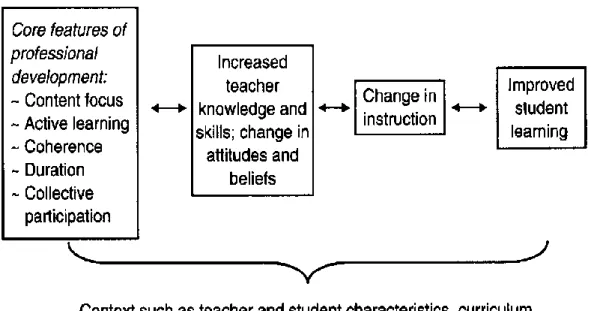
Desimone’s conceptual framework for studying the effects of professional development of teachers and students(Adapted from Desimone 2009, p. 184)
40
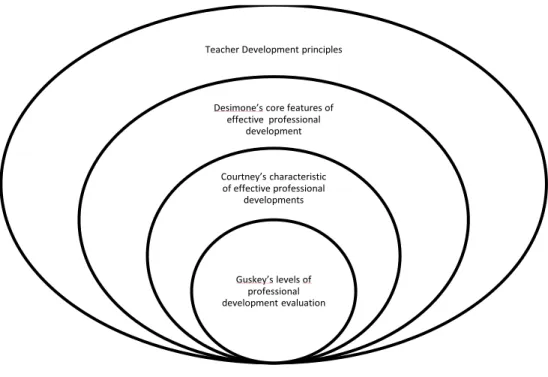
Figure 2.5 A conceptual framework for this study 45
Figure 3.1
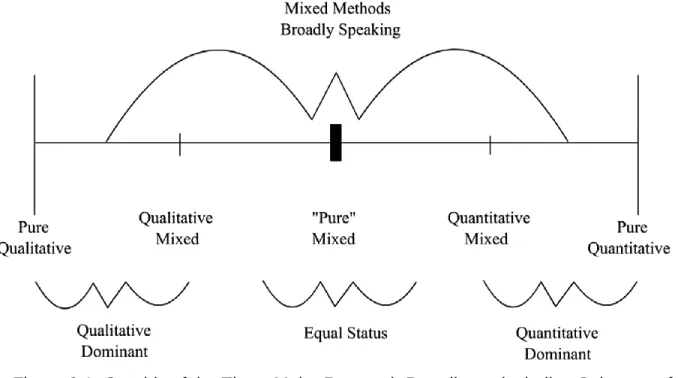
Graphic of the Three Major Research Paradigms, including Subtypes of Mixed Methods Research (Adapted from Johnson et al., 2007)
48
Figure 3.2 Logic Model of SMILES Project 59
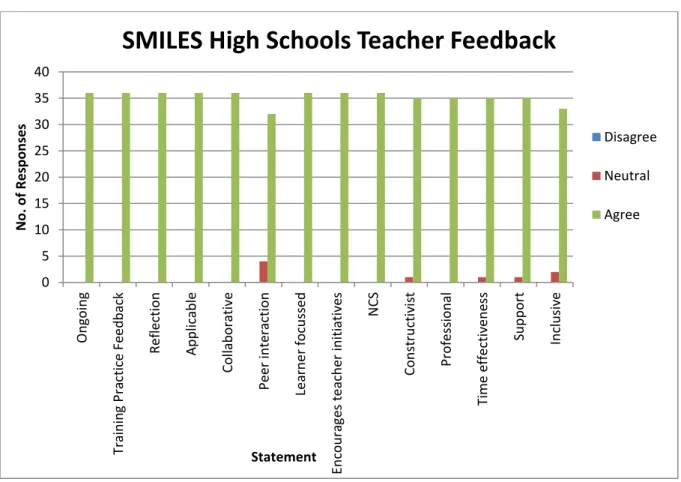
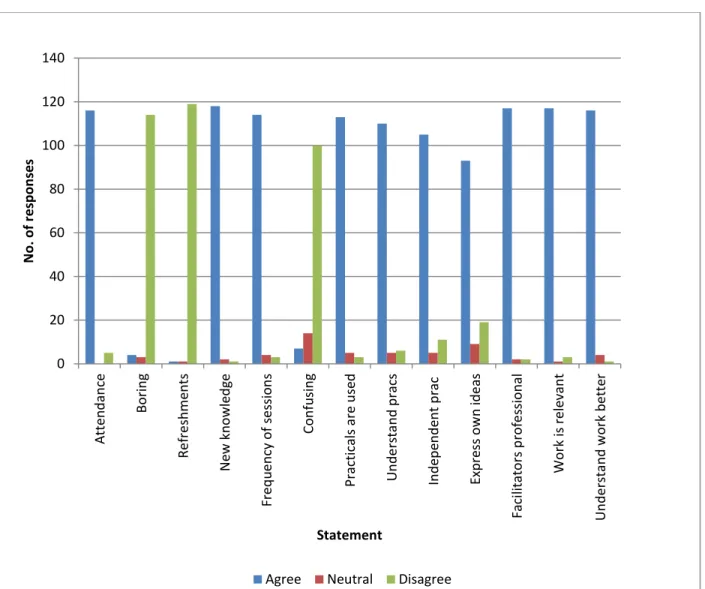
Figure 4.1 Figure 4.1: Results of the Likert Survey conducted with teachers
testing their perceptions of the SMILES project 68
Figure 4.2 Figure 4.2: Likert Survey done with the teachers comparing the “Agree” responses and the “Disagree” responses. 69
Figure 4.3 Figure 4.3: Likert survey conducted with Learners testing their
perceptions of the teacher/learner sessions. 78
Figure 4.4 Word Cloud generated in response to the question: “Which teacher learner sessions helped you the most?” 81
Figure 4.5
Word Cloud generated in response to the question: “What are all the positive aspects that you can think of regarding teacher learner sessions?”
82
Figure 4.6 Word Cloud generated in response to the question: “What can be done to improve the teacher learner sessions?” 83
Figure 4.7 Word Cloud generated in response to the request: Write down
any general comments that you may have. 84
Figure 4.8 Graph of the number of learners who wrote Grade12 NSC
Mathematics 86
Figure 4.9 Graph of the percentage of learners who passed Grade 12 NSC
Mathematics 87
Figure 4.10
Graph of the number of learners who wrote Grade12 NSC
Physical Sciences 89
Figure 4.11
Graph of the percentage of learners who passed Grade 12 NSC
xv Figure
4.12
Graph of the number of learners who wrote Grade12 NSC Life
Sciences 91
Figure 4.13
Graph of the percentage of learners who passed Grade 12 NSC
Life Sciences 92
Figure 4.14
Comparison of average marks of all the schools in the project for
Mathematics with provincial and national results 94
Figure 4.15
Comparison of average marks of project school results for
Physical Sciences with provincial and national results. 95 Figure
4.16
Comparison of average marks of the project schools for Life
Sciences with provincial and national results 96
LIST OF TABLES
# Title of table Page
Table 1.1 Table 1.1 The relative position of South Africa when compared with the rest of the TIMSS participating countries in mathematics and science.
1
CHAPTER 1
INTRODUCTION AND ORIENTATION TO THE STUDY
1.1 INTRODUCTION
In this chapter the rationale for this study is introduced by sketching the background and context in which this study is framed. The problem that this study wishes to address is stated and the main research question is spelled out and the research sub-questions are highlighted. The significance of the study is outlined and the limitations and delimitations thereof discussed. The key terms of the study are then identified and defined before the outline of the thesis is finally given detailing what can be expected in each chapter.
1.2 BACKGROUND TO THE STUDY
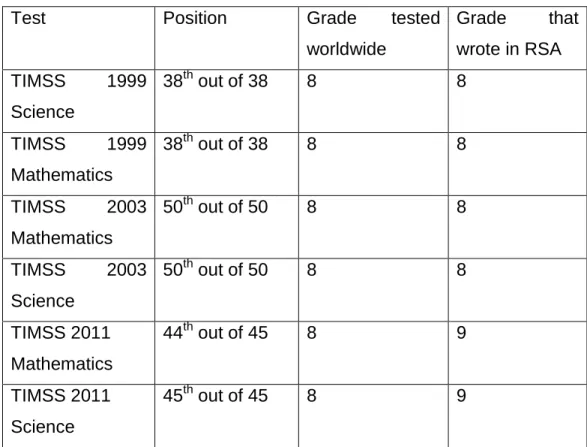
South Africa is in the midst of a mathematics and science education crisis that challenges all key role-players with the capacity to make a change to come to the party and make a contribution. The crisis has been confirmed through several international benchmark studies for example TIMSS-1995 (Third International Mathematics and Science Study), TIMSS-R 1999, TIMSS 2003 (Trends in International Mathematics and Science Study) and TIMSS 2011. Martin, et al. (2000); Martin, Mullis, & Chrostowski (2004); Reddy (2006); Mullis, et al. (2000); Reddy (2012) report the following results found in table 1.1 obtained in Mathematics and Science for the South African schools in the TIMSS assessments.
In table 1.1 it can be seen that South African schools were ranked the lowest in the TIMSS assessments for mathematics and science every year except for the mathematics assessment in 2011 when they came second last. In 2011 South Africa and two other countries tested grade 9 learners using the grade 8 test which was written by the other 42 countries. (Ndlovu & Mji, 2012)
2
Test Position Grade tested
worldwide Grade that wrote in RSA TIMSS 1999 Science 38th out of 38 8 8 TIMSS 1999 Mathematics 38th out of 38 8 8 TIMSS 2003 Mathematics 50th out of 50 8 8 TIMSS 2003 Science 50th out of 50 8 8 TIMSS 2011 Mathematics 44th out of 45 8 9 TIMSS 2011 Science 45th out of 45 8 9
Table 1.1 The relative position of South Africa when compared with the rest of the TIMSS participating countries in mathematics and science.
In the 2012 report of The National Senior Certificate examinations (Department of Basic Education, 2012, p5) it is reported that there is a marked increase in the results achieved in Physical Sciences and Mathematics. The pass rate for Physical Sciences increased from 36.8% in 2009 to 61.3% in 2012. This is indeed a big increase but unfortunately the report of 2012 also shows that the number of learners offering the subject has declined by over 40000. In Mathematics the pass rate is reported to have increased from 46% to 54% over the 4 years but the number of learners writing Mathematics has declined by almost 70000. The increased pass rate due to less and less learners taking these gateway subjects indicates a problem in the system that has to be addressed urgently.
The picture becomes bleaker if one considers that the pass rates quoted above are valid for those who achieved more than 30 % in the final examination. The minimum requirement in Mathematics and Physical Sciences at most tertiary institutions for related degrees is above 50%. This requirement effectively closes the gate for those learners who do not reach this bench mark.
3
The Global Competitiveness Report of the World Economic Forum (Schwab, 2012,p41) states the following about South Africa:
“Efforts must also be made to increase the university enrollment rate in order to better develop its innovation potential.”
And then in general the following is said:
“Basic education increases the efficiency of each individual worker. Moreover, workers who have received little formal education can carry out only simple manual tasks and find it much more difficult to adapt to more advanced production processes and techniques, and therefore contribute less to come up with or execute innovations. In other words, lack of basic education can become a constraint on business development, with firms finding it difficult to move up the value chain by producing more sophisticated or value-intensive products with existing human resources.” (p5)
The emphasis placed on basic education by the World Economic Forum is clear because it has a direct link to the economy. South Africa’s unemployment rate and the widespread poverty could therefore be a symptom of the education crisis. The TIMSS 2011 (Reddy, 2012, p4) results of Korea were the best in science which correlates with their health and primary education score of 15th out of 144 countries reported on in the Global Competitiveness Report for 2011-2012 (Schwalb, 2011,p18).
The most problematic factor for doing business in South Africa, as listed by the World Economic Forum in its global competitiveness report is an “inadequately educated workforce”. South Africa’s quality of mathematics and science education is rated 2nd
worst in the world (Schwab, 2012, p443).
In the National Development Plan (NDP) (National Planning Commission, 2011) it is made clear that Science and Technology are important for economic development. “Science and technology are key to development, because technological and scientific revolutions underpin economic advances, improvements in health systems, education and infrastructure.” (p. 70)
4
The emphasis on education and the role that it plays in our economy is highlighted in the NDP. One of the targets for schools to achieve by 2030 is that 80% of schools and learners must achieve 50% or more in literacy, mathematics and science in grades 3, 6 and 9 (National Planning Commission, 2011, p. 275). Another target highlights mathematics and science as gateway subjects by saying that the number of students eligible to study mathematics and science at university must increase to 450 000 per year (National Planning Commission, 2011, p. 276). This would more than triple the results achieved in 2010.
As a consequence of this crisis, South Africa has a severe shortage of learners matriculating with mathematics and science marks that qualify them for further study in Science, Technology, Engineering and Mathematics (STEM) (Fricke, Horak, Meyer, & Van Lingen, 2008). The shortage of learners qualifying to follow degrees in the sciences points to a lack of suitably qualified teachers (Fricke, Horak, Meyer, & Van Lingen, 2008) (Maree, 2006).
The Institute for Mathematics and Science Teaching at the University of Stellenbosch (IMSTUS), like many other similar institutional efforts, was involved in several university-school partnership (systemic intervention) projects that sought to provide continuing professional development to mathematics and science teachers and to help them make greater impact on the learners that they teach. One of these intervention projects was the Sciences and Mathematics Initiative for Learners and EducatorS (SMILES) that targeted mathematics and science teachers and learners in under-resourced schools in the Cape Winelands District of the Western Cape. The author conducted research to inform as to whether an intervention of this nature made a positive contribution to teachers and learners or not. This study took into account the Integrated Strategic Planning Framework for Teacher Education and Development in South Africa (Departments of Basic Education & Higher Education and Training, 2011). The Integrated Strategic Planning Framework for Teacher Education and Development in South Africa emphasises the importance of building professional learning communities (PLC). In these PLCs teachers recognise their own experience and expertise and come to a point where they share this experience with other teachers. This process has many assumed benefits, one being that teachers feel valued by their
5
colleagues and the education system in general, but is still largely unexplored in the context of disadvantaged and marginalised schools.
1.3 STATEMENT OF THE PROBLEM
The question that must constantly be answered by those engaged in the continuing professional development of teachers through in-service training is: Is this model or form of professional development achieving the desired change in the professional practices of the participating science teachers and are the clients (the learners) ultimately benefitting in terms of learning enhancement?
This question is not easily answered as there is a multitude of factors that influence teachers as well as the facilitators who try to bring about change. Those seeking quantitative validation of their efforts are often disillusioned as the ultimate measure of success lies in the assessment results obtained by the learners after being subjected to the improved practices of the teachers. It stands to reason that the effects of an intervention aimed at supporting and enhancing teacher professional development will only be seen in the learners once teachers have accepted and mastered the pedagogies proposed.
The process of acceptance and mastery takes a great deal of time and there are many factors that could jeopardise it. As such the effects of the interventions are only seen in learners results sometimes long after the intervention has ended. The model of an intervention therefore could be more effective if it could change according to the needs of the teachers at the different stages of the project. For instance if the project could focus on the acceptance phase as long as is needed before moving on to mastery of the pedagogy by the teachers it would be more effective than simply pushing ahead because of time constraints.
The funder of the SMILES project gave the service provider freedom to adapt the model of the project in order to better address the unique needs of the different teachers in the different schools. For this reason the model constantly evolved and could be nuanced for each school, teacher and phase in the project. Generic solutions were the exception as each mathematics teacher or science teacher and school had different needs. The one common thread to the project was that the facilitators had to
6
be supportive and helpful on site in order to effect change rather than being critical and aloof.
In the IQMS (Integrated Quality Management System) (Department of Basic Education, 2004) documents that teachers use to appraise each other, the professional development needs of the educator are mentioned, if not addressed. It is clear that the professional development of educators is not just needed, it is critical for quality education. This is borne out by the following written by Graeme Bloch in his book, “The Toxic Mix What’s wrong with South Africa’s schools and how to fix it”.
Improving the quality of teachers, helping teachers teach well, is the most urgent task. More than anything else what happens at the coalface of interaction between teacher and pupil is the key. This means a whole new package of attempts to enthuse, support, train and renew, and to encourage a new teaching corps, as well as to establish non-negotiables on agreed and acceptable behaviours. (My Italics, (Bloch, 2009, p169)
Professional development that does not “enthuse, support, train and renew, and encourage” is a waste of time. When considering this, the question that must be asked is whether the SMILES project was in fact enthusing, supporting, training and renewing or was it something that was done to teachers in a top down fashion where teachers felt undermined and belittled? This leads us to the research questions that guided this study.
1.4. RESEARCH QUESTIONS
This study sought to investigate whether the SMILES intervention made a positive contribution to the teachers and learners involved in the project.
The following research question and sub-questions were therefore primary to this study:
What was the impact of the SMILES intervention model on teaching effectiveness? a) What were the perceptions of the teachers regarding the impact of the intervention?
7
b) What were the perceptions of the School Management Teams (SMTs) regarding the impact of the intervention?
c) What were the perceptions of the learners regarding the impact of the intervention? d) What was the impact of the intervention on learning outcomes, if any?
e) What other factors were significantly at play during the intervention?
A distinction is made in this study between “teacher effectiveness” and “teaching effectiveness”. Teacher effectiveness refers to the effectiveness of the teacher themselves and not necessarily the outcomes of their teaching. A study on teacher effectiveness would be a particularly useful unit of analysis when researching pre-service offerings. In this study teaching effectiveness refers to the outcomes of teaching as well as the process of reaching those outcomes which would include “teacher effectiveness”. Studying teaching effectiveness therefore necessitates the analysis of learners performances based on the teaching in question.
1.5 SIGNIFICANCE OF THE STUDY
Continuing teacher professional development lies at the heart of nearly every educational effort to improve student achievement (Supovitz and Turner, 2000). Yet nearly every major work on the topic of staff development has produced inconclusive results regarding effectiveness. On the one hand, Guskey (1986) attributes this inconclusiveness to a poor understanding of teachers’ motivations and a lack of insight into both the individual and environmental factors in the change seeking process. Understanding the motivations, environmental and personal factors of the teachers involved in the SMILES project was key. On the other hand (Little (1993) concludes that existing models of continuing professional development are inadequate to achieve ambitious learning goals. This suggests that professional development models should set realistic goals for themselves and take into account all the local factors. SMILES project schools were selected taking the context, amongst other factors which will be unpacked in chapter 3, into account.
Notwithstanding the failure of traditional models of professional development to realize their potential, continuing professional development is still widely seen as the best bet for changing teaching practices, because alternative methods, such as policies and
8
programmes that regulate teacher behaviour , have fared no better (Smylie, 1996). Traditional models could be lectures or workshops given out of the context of the teacher and not embedded in their realm. The evolving nature of the design of the SMILES project meant it could meet the changing demands of the teachers. The study would help map the nature of the changes in needs as the project unfolded. The SMILES project had to work within policies and programmes dictated by the Western Cape Education Department (WCED) and could not form their own policy and programme as if on an island. The policies and programmes of the provincial and national education departments affected not only the SMILES project but also each individual school and subject team. For the project to offer professional development to the different teachers in the different schools these policies had to be taken into account and adhered to, or else the acceptance by the different role players would have been minimal. The flexibility of the programme meant that the different aspects of the programme could be tailor made according to each need as and when it arose. Policy constraints, however, would always be there hence the study would shed light on the nature of the policy constraints and the nature of the adaptations that the constraints induced.
The tragedy is that the poor performance in mathematics and science was, and still is, a national crisis. To address this problem this study recognises Karpati’s (2009) observation that no system of education can exceed the quality of its own teachers. Accordingly one fundamental way in which to address the challenge was to design and implement an intervention programme that could be responsive to the professional development needs of the educators as repeatedly identified by them. The study would shed light on the feasibility and sustainability of such a design feature of the model to better inform both theory and practice of school-based professional teacher learning. For Supovitz and Turner (2000) it is not just the quantity of the intervention that matters the most but also the quality of professional development in which teachers participate that is strongly linked to positive change in teaching practice and classroom culture. Desimone’s (2009) core features of effective professional development will be discussed in chapter 2 which will describe the nature of quality professional development.
9 1.6 DELIMITATIONS OF THE STUDY
The teachers who were asked to participate in this study were teaching either Mathematics, Natural Sciences, Life Sciences or Physical Sciences in the SMILES Secondary schools.
Mathematics included all mathematics content taught at high school. After learners have completed grade 9 they have the choice of either doing Mathematics Literacy or Mathematics. This project excluded Mathematical Literacy as it is not a subject that aids access to the Sciences at tertiary level. The project focussed rather on teachers and learners who opted for pure mathematics which is a key subject for access to university studies.
Natural Sciences refers to the general science that is taught to learners in Grades 8 and 9 in secondary schools. It includes four strands namely Life and Living, Matter and Material, Energy and Change and finally Earth and Beyond. These four strands prepare learners for the next phase in which they can choose to do Physical Sciences or Life Sciences. Life and Living links directly with Life Sciences and the other three strands link with Physical Sciences. Physical Sciences can then be broadly divided into two categories namely Physics and Chemistry.
The SMILES schools were selected after consultation with the WCED and the schools themselves. Ten schools were considered and five were chosen after initial information sessions were conducted with the teachers and the management teams of the schools. The five schools were situated in the Paarl, Kraaifontein and Stellenbosch regions in the Western Cape. Their close proximity made school visits and teaching sessions accessible to both facilitators and teachers.
All the teaching sessions and school visits by facilitators were made available to all the teachers in the SMILES schools. Input and feedback from these teachers, amongst others was used to produce the data for this study.
1.7 METHODOLOGY OF THE STUDY
This study makes use of a mixed methods approach and therefore takes on both a qualitative and a quantitative collation and analysis of data. According to Mathison
10
(1998) good research practice obligates the researcher to triangulate, that is, to use multiple methods and data sources to enhance validity of research findings. The interpretive paradigm frames this study in that the author seeks to understand the effect that the project is having on the teachers and their perceptions thereof.
In order to get a fuller picture of the project, semi-structured interviews with teachers, school management and learners was undertaken. These were transcribed and the trends found in these interviews are highlighted. Further to this a survey using a Likert type questionnaire was administered which seeks to ascertain the perceptions of teachers regarding the SMILES project. A similar survey was given to the school management and the learners of those teachers to triangulate and to verify the results. In any areas where there were ambiguous statements, face validity or member checking was conducted where the researcher verified what the teacher or learner meant in the interview.
Observations made by facilitators in the project were also used to further verify trends or results that emerged.
1.8 LIMITATIONS OF THE STUDY
Establishing a causal link between the inputs of the SMILES project and the achievements made by learners is not easy as there are many factors that influence the ultimate achievement of learners. With this in mind it is felt that merely looking at the results that learners achieve in high stakes summative testing may be a flawed measurement of the success or failure of a specific intervention. Controlling for factors that influence schools on a national and provincial scale will be included by comparing provincial and national results with the project schools.
1.9 DEFINITION OF KEY TERMS Facilitator
This term in this study refers to the people who were employed to develop material, present and facilitate professional learning opportunities and to mentor and support teachers through classroom visits.
11
This term refers to the educators in their respective schools who were on the programme because their schools bought into the project. These teachers either taught Mathematics or the Sciences.
Learner
This term most commonly used in South Africa, refers to the students of the teachers.
Teacher/learner sessions
Teacher/learner sessions are extra lessons offered out of the normal school hours presented by the facilitators and attended by learners and teachers.
Workshops
Workshops refer to professional learning opportunities that were given to teachers out of the school context.
Co-teaching
Co-teaching refers to facilitators teaching in collaboration with the teacher. This is not merely observing and evaluating the teacher, it is taking an active role in facilitating the lesson to help ensure that learning takes place.
Shoestring science
Shoestring science can be defined as teaching science using apparatus that can be made on a very tight budget. Recyclable material is often modified and used in a variety of different ways when teaching science on a shoestring budget.
Teacher Professional Development
Professional development consists of all natural learning experiences and those conscious and planned activities which are intended to be of direct or indirect benefit to the individual, group or school and which contribute, through these, to the quality of education in the classroom.(Day, 1999). Although teacher professional learning has
12
come to have a different meaning these two terms will be used interchangebly in this thesis.
Intervention
An intervention in this study refers to an act or series of actions that are put into place to effect positive growth.
Teacher Effectiveness
Teacher effectiveness, in this study, refers specifically to the teacher and not necessarily the outcomes of the learning process. It includes all the factors that make teachers effective but focuses on the teacher and not necessarily their learners or their learner’s perceptions or their learner’s results.
Teaching Effectiveness
Teaching effectiveness includes everything associated with teacher effectiveness but takes it a step further to include the learning outcomes associated with the teaching. For this reason the results of learners associated with the teacher and their response to the teaching is also considered.
1.10 THESIS OUTLINE
Chapter two consists of a literature study detailing drawing on prior research in professional development and evaluative studies. The methodology used in conducting this research will be explained in chapter three as well as the reasons for choosing this methodology. The results from the data collected will be presented and analysed here in chapter four. Discussion of the results and presentations of conclusions that can be drawn from the resulted will form the final chapter.
1.11 CONCLUSION
The SMILES project and more specifically the need for a project of this nature is clear when one looks at the state of mathematics and science education in South Africa. The
13
principal aims of the Constitution, Act No. 108 of 1996 include healing the divisions of the past, establishing a society based on democratic values, social justice and fundamental human rights, improving the quality of life of all citizens and freeing the potential of each person. This means that the constitution entitles every learner to quality education in order to fully realize the individual’s potential. The constitution also makes provision for the state to redress the imbalances and inequities of the past. Education as a basic human right includes quality mathematics and science education for all. Equal opportunities irrespective of race or class should be made available to all.
The various international assessment tools show that South Africa has an education system that is at the bottom end of the global scale. The economic link with education is strong and unfortunately is proven true in South Africa where our unemployment and poverty indices are horrendous.
In the next chapter the existing literature will be reviewed pertaining to professional development of teachers and the evaluation of projects that seek to develop teachers professionally.
14
CHAPTER 2
LITERATURE STUDY
2.1 INTRODUCTION
This chapter will review the current research pertaining to effective science teacher professional development models and articulating the theoretical framework that underpinned the SMILES project together with the research that supports it. This research informed the SMILES facilitators and the project management team of current trends as well as best practice gleaned from other similar projects.
The literature review culminates in a logic framework for the SMILES project as a local adaptation to address the perceived professional development needs of the teachers in the project.
The purposes and aims of the SMILES project with specific reference to science in-service teacher education were to address the critical issues confronting science education of which three are: constructivist teaching, understanding the nature of science, and scientific argumentation.
Schuster and Carlsen (2009) argue that scientific research as practiced in industry is far removed from the way science is taught by teachers. The narrowing of this gap can be brought about through teacher professional learning where teachers are exposed to the research and methods used by practicing scientists. One of the characteristics of the nature of science (NOS) is that scientific knowledge is tentative. This in itself lends itself to constructivist or inquiry based approaches to science teaching. A shift such as this in teaching practice will require teachers to be in full control of their subject matter knowledge (SMK) and their pedagogical content knowledge (PCK). If this is not the case and they are not adequately knowledgeable then they will probably avoid constructivist or open enquiry approaches which could expose their lack of knowledge. We should be ready to try new ideas in an effort to provide a new mode of teaching for a different world from the one in which we were taught. Albert Einstein’s statement comes to mind: “A new type of thinking is essential if mankind is to survive and move toward higher levels.”
15
He was not talking about education per se but it does apply to education and the development of professional teachers nonetheless.
2.2 CRITICAL ISSUES CONFRONTING SCIENCE EDUCATION
2.2.1 The creation of constructivist learning environments in reformed science classrooms
Windschitl (2002) lists the following as the key features of a constructivist classroom:
Teachers elicit students' ideas and experiences in relation to key topics, and then fashion learning situations that help students elaborate on or restructure their current knowledge.
Students are given frequent opportunities to engage in complex, meaningful, problem-based activities.
Teachers provide students with a variety of information resources as well as the tools (technological and conceptual) necessary to mediate learning.
Students work collaboratively and are given support to engage in task-oriented dialogue with one another.
Teachers make their own thinking processes explicit to learners and encourage-age students to do the same through dialogue, writing, drawings, or other representations.
Students are routinely asked to apply knowledge in diverse and authentic con-texts, to explain ideas, interpret con-texts, predict phenomena, and construct arguments based on evidence, rather than to focus exclusively on the acquisition of predetermined "right answers."
Teachers encourage students' reflective and autonomous thinking in conjunction with the conditions listed above.
Teachers employ a variety of assessment strategies to understand how students' ideas are evolving and to give feedback on the processes as well as the products of their thinking. (p137)
It is clear from the above that learning is centred on the student and that the role of the teacher is to make resources, situations and conditions available in order that learners
16
can begin to think autonomously and reflectively. Learners are given opportunities to engage with meaningful actual problems and are supported in developing problem solving strategies. The process of gaining the knowledge is as important as the product of that knowledge and as such different ways of assessment have to be employed to reflect the process knowledge gained by learners. In the SMILES project, the teacher professional learning opportunities were based on these constructivist principles and facilitators would model this approach during these opportunities.
Transmission models of instruction where the teacher is the authority and everything that is done in the classroom is geared towards transferring knowledge from the teacher or textbook to the learner in the hope that the learners can deliver that knowledge back during assessments seems to be the default teaching model in Western schooling according to Windschitl (2002). This model of teaching was also prevalent in the SMILES project schools and facilitators constantly tried to model the constructivist approach to teaching as the preferred model. In the transmission model learners’ prior knowledge or ideas are not considered but in the constructivist teaching model this is the starting point. Their ideas and input are valuable because they give the necessary platform on which the teacher needs to build the lessons.
2.2.2 Understanding the nature of science in reformed science teaching
In the physical sciences CAPS (Department of Basic Education, 2011b) under the paragraph titled “Specific Aims of Physical Sciences” the following paragraph is found:
“Physical Sciences promotes knowledge and skills in scientific inquiry and problem solving; the construction and application of scientific and technological knowledge; an understanding of the nature of science and its relationships to technology, society and the environment.” (p. 8)
From this it is clear that the Department of Basic Education (DBE) values the promotion of an understanding of the nature of science (NOS). It was therefore important for the facilitators in the SMILES project to make teachers aware of NOS and the implications that this awareness would have for the teaching of physical sciences. Linneman, Lynch, Kurup, Webb, & Bantwini (2003) contend that generally studies show that there is a vague or shallow understanding of the NOS by teachers and they have regarded it as increasingly less important for mathematics and the sciences. Linneman et al (2003) go on to say that “…the NOS remains a difficult and problematic
17
construct to deal with and presents many challenges for the teacher and teacher educator.” Considering Abd-El-Khalick, Bell, & Lederman’s (1998) description of the Nature of Science it is understandable that the NOS is a complex construct and that there are many factors to consider when applying it to the classroom situation. The characteristics of NOS that they list are as follows: 1) scientific knowledge is tentative (subject to change); 2) empirically based (based on and/or derived from observations of the natural world); 3) subjective (value-laden); 4) partly the product of human inference, imagination, and creativity (involves the invention of explanation); and 5) socially and culturally embedded. It is these characteristics of science that teachers in the SMILES project were exposed to by the facilitators during workshops and other learning opportunities.
Teachers in the SMILES project were constantly shown that physical sciences is not just something that happens in the classroom but that it is indeed a part of everything that takes place in the natural world. They were also given opportunities to share their own ideas and theories particularly when dealing with indigenous knowledge. Investigations to prove empirically that theories were true were carried out. In the Natural Sciences CAPS (Department of Basic Education, 2011a, p. 8) it is stated that the science knowledge that is taught in schools is not in doubt however when the knowledge was first investigated there would have been doubts and it would have changed once new evidence was exposed. Abd-El-Khalick et al (1998) make the point that scientific knowledge is subject to change and here we see in the CAPS document that teachers should make learners aware of this even though the knowledge contained in the curriculum has been accepted as true for years. The NOS was modelled to the teachers, however it was not explicitly taught.
2.2.3 Understanding the role of argumentation in the construction of scientific knowledge in the classroom
Scientific argumentation is the process of constructing a logical piece of writing where relevant information is used to come to valid conclusions. This argumentation is not debate, but rather refers to drawing conclusions from observations in a logical manner.
In the Natural Sciences CAPS (DBE, 2011a, p. 10) the following is stated under process skills: “The teaching and learning of Natural Sciences involves the
18
development of a range of process skills that may be used in everyday life, in the community and in the workplace. Learners also develop the ability to think objectively and use a variety of forms of reasoning while they use these skills” Argumentation has to be one of the forms of reasoning alluded to here.
Newton, Driver, and Osborne (1999) list the reasons for explicitly teaching argumentation in science classes. These are:
Firstly, scientific knowledge is developed through the process of argument. Scientists perform investigations, observe the results and then present their findings to others. In this presentation the argumentation process begins. The peers then will probe, debate, criticize and review the presentation which is how science knowledge is generated. Secondly, through argumentation learners will build up their scientific knowledge and scientific vocabulary through the texts they write and presentations they make in support of their findings. Finally, learning argumentation skills are not just applicable in the sciences but can be used and applied in any free and democratic society. Presentation of an argument in a clear and coherent way is a skill that can be applied universally.
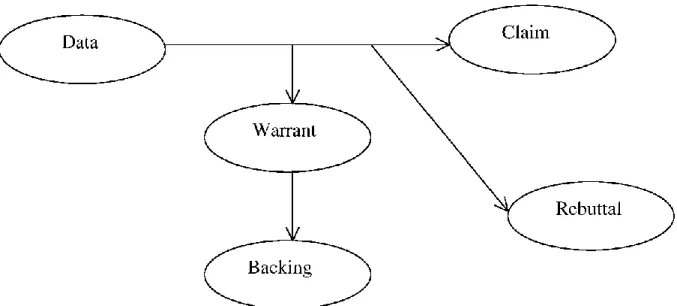
Toulman’s argument pattern (TAP) gives a starting point for teachers and teacher educators for applying argumentation in the classroom (Erduran, Simon, & Osborne, 2004). Figure 4.1 shows the starting point to be data followed by the process.
Figure 2.1: Toulmin’s argument pattern
19
Claims refer to assertions regarding what exists or what people believe to be true. Data is any evidence which can be used to support the claim. Warrants make the relationship between the claim and data clear. Underlying assumptions that are not explicit are referred to as backings in TAP. Rebuttals are responses to the data, warrants, or backing that contradict or refute them. The rebuttal will of course begin the argument again with either new data or the existing data. The rebuttal then will have all the components of TAP. This framework can be particularly useful for teachers to categorise the elements of the argumentation process in the classroom to highlight to learners what each are saying and how it fits in with the process of knowledge production. When teachers are aware of TAP it could lead to a healthier non-confrontational response to argumentation as the process is seen as growth in understanding and knowledge. In the SMILES project this was not explicitly taught but the process was modelled during the professional learning opportunities. Teachers’ conceptions relating to the content and how the content could be presented were entertained. Whenever misconceptions arose this would be an opportunity to use argumentation as a strategy to create a new conception.
2.2.4 Schematic summary of critical issues in science education
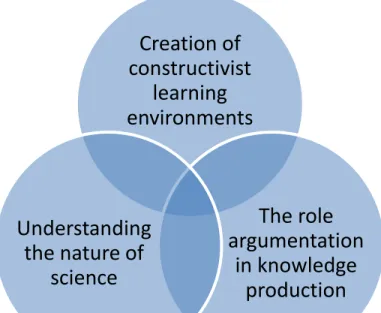
The three critical issues in science education are interlinked and where they all intersect is when the richest learning is taking place using the nature of science as a platform for constructivism and argumentation.
20
Figure 2.2 The critical issues in science education.
2.3 FUNDAMENTALS OF SCIENCE TEACHER PROFESSIONAL
DEVELOPMENT
The following are fundamental concepts of teacher professional development discourse in general which also apply to mathematics and science teachers.
2.3.1 Pedagogical Content Knowledge
Shulman (1986) states clearly that the difference between those who practice a skill and those who practice a profession is that the professional knows not only how, but what and why as well. He adds that the professional teacher is “capable of reflection leading to self-knowledge” and “capable of communicating the reasons for professional decisions and actions to others” (Shulman, 1986).
In an interview with Lee Shulman at the Annual Meeting of the American Educational Research Association in Chicago in April 2007 conducted by Berry, Loughran, & Van Driel (2008) the questions that Shulman says he asked was “What is it that a teacher knows and is able to do that a specialist in the subject matter that the teacher is teaching, no matter how smart they are, doesn’t understand and can’t do? What are the sorts of things that only teachers know? That only teachers do?” Teachers are not
Creation of
constructivist
learning
environments
The role
argumentation
in knowledge
production
Understanding
the nature of
science
21
always aware of the cognitive knowledge they possess and use in their lessons because it may be known unconsciously or only applied to specific classes in specific contexts (Kagan, 1990) . Berry et al (2008) point out that “The foundation of PCK is thought to be the amalgam of a teacher’s pedagogy and understanding of content such that it influences their teaching in ways that will best engender students’ learning for understanding”.
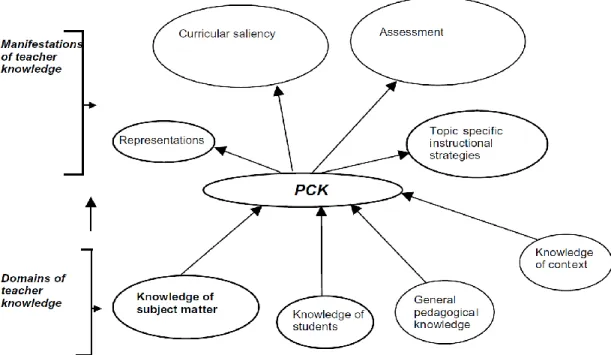
The four domains of teacher knowledge that contribute to PCK as listed by Rollnick, Bennet, Rhemtula, Dharsey, & Ndlovu (2008) and defined by Shulman (1986) are knowledge of subject matter, knowledge of students, general pedagogical knowledge, and knowledge of context. Subject matter knowledge (SMK) refers to the content of the subject which any expert in the subject will have regardless of whether they teach or not. Knowledge of students is knowledge that can decribe the students’ prior knowledge, their language skills, what interests them and the best way for them to learn according to their intelligences. General pedagogical knowledge is knowledge that descibes good teaching practice for the context based on learning theory. Knowledge of context is information about the teaching situation like rural or urban, class size, the community in which learners live, the curriculum and time available for learning (Rollnick et al., 2008). In Figure 2.2 it can be seen that the four knowledge domains all contribute to PCK which is then manifested in the classroom as subject matter representations, curricular saliency, assessment and topic specific instructional strategies. Representations would be any representation of the content that helps learning. Curricular saliency would be tailormaking the lesson to incorporate the curriculum and how it is assessed. The importance of the curriculum and not veering off the subject would be an example of how a teacher structures the lesson so that the curriculum can be covered. Assessment refers to both assessment for learning and assessment of learning which will definitely rely on the teachers’ PCK. Topic specific instructional strategies include taking into account the prior knowledge of the learners, the resources available and the content to be addressed.
22
Figure 2.3: Tailored model for PCK (Adapted from Rollnick et al., 2008, p. 1381)
Abell (2008) refers to four characteristics of PCK which are important to take note of when trying to understand PCK. Firstly, PCK comprises of discrete categories of knowledge which when put together are used to address problems encountered in practice. Teachers use components of PCK to best solve problems that arise during instruction. The components of PCK are integrated by teachers in their planning, delivery and reflection.
Secondly, PCK is always changing and morphing according to the needs of the group being addressed, it is dynamic and organic. This dynamic nature of PCK means that PCK is constantly being built or constructed by the teacher which implies that the more experienced a teacher is, the more PCK they would have gained.
Thirdly, content is central to PCK. The starting point for the development of PCK is content. Once the content is understood, then questions about how it can be engaged with effectively in order that learning takes place can then be addressed.
Finally, PCK is not an independent category of knowledge but an integration of content and pedagogy that is used by the teacher. PCK transforms subject matter knowledge,
23
pedagogical knowledge and contextual knowledge into a viable construct that can be relevant, viable and applicable to the practice of teaching in order to enable learning.
If one sets out to help teachers develop professionally, as the SMILES project intended to do, then in the light of the above it is important to take into consideration the skills and knowledge that teachers already have. This is a complex process as decribed by Kagan (1990) but it was important for the SMILES facilitators to be conscious of the teachers’ skills and abilities before offerring professional development opportunities. SMILES facilitators spent the first six months interacting with and observing teachers in their classrooms prior to offering any formal learning opportunities. This served to make the training relevant and applicable to teachers at the outset of the project.
Teachers who have many years of experience are more likely to have stronger PCK than teachers who are just beginning their careers because of the dynamic nature of PCK in that it is constantly being developed in the life of the teacher. Teachers who have just completed their professional qualifications but have not officially taught full time or who have little or no experience can be regarded as novices. Much has been written about the retention of teachers and particularly novice teachers (e.g. Smith & Ingersoll, 2004; Fry, 2010; Clark, 2012; Chubbuck, Clift, Allard, & Jane, 2001; Goodwin & Judd, 2005). Novice teachers are sometimes referred to as beginning teachers. In this study they are referred to as novice teachers. Novice teachers are faced with many challenges and in many cases, if they are not supported, they leave the profession (Goodwin & Judd, 2005; Chubbuck et al., 2001; Clark, 2012). In the SMILES project schools there was a large teacher turnover in physical sciences. Three out of fifteen teachers remained in the project schools throughout the project for the full four years. During the project there were always between ten and fifteen Physical Sciences teachers involved. Some of these were involved for the full duration, others for three out of the four years and others for at least two years. Some of the teachers who left physical sciences did not necessarily leave the project as they were sometimes given other subjects to teach which were still serviced by the project. These other subjects included Natural Sciences, Mathematics and Life Sciences. For the duration of the project, Natural Sciences and Life Sciences teachers amounted to between thirteen and fifteen teachers each for both subjects. In some cases teachers who taught
24
Physical Sciences or Life Sciences also taught Natural Sciences. In these cases teachers had the option of attending workshops and other learning opportunities for both or either subject. The total number of Science teachers at any given stage was approximately twenty three made up of Physical Sciences, Life Sciences and Natural Sciences teachers some of whom taught more than one subject. The Mathematics teachers in the project totalled approximately twenty eight. Many of these teachers also taught some of the Sciences in their schools.
Out of the twelve Physical Sciences teachers that exited the project completely four were novice teachers. One of these left the teaching profession completely to pursue an engineering degree with a view to working in the private sector. The other three novice teachers remained in the teaching profession but went to other schools that were not part of the project. This could have been due to the fact that all of the SMILES schools served communities who were previously disadvantaged. In order to find employment novice teachers would accept the position in one of these schools in the hope of landing employment at better resourced schools later on. The three novice teachers who left the programme but remained in teaching all went to better resourced schools who were serving wealthier communities. The other eight experienced teachers who left the project either retired or were promoted to other positions elsewhere or simply transferred to other schools. The fluctuations in numbers of teachers teaching a specific subject was not perculiar to Physical Sciences but also applied to the other subjects supported by the SMILES project namely Mathematics, Natural Sciences and Life Sciences.
Of the ten to fifteen physical sciences teachers, who were involved in the project at any given time, approximately one third could be classified as novice or beginner teachers in their first three years of teaching. According to Fry (2010) induction programmes can help novice teachers adjust to their nascent roles as qualified teachers. The facilitators in the SMILES project took particular care and gave these teachers more time and support than the more experienced teachers in the programme. These programmes can be in the form of mentorships , seminars with other novice teachers and regular planning sessions with other teachers involved in the same subject (Smith & Ingersoll,