• No results found

Data driven from the perspective of administrators and teachers

N/A
N/A
Protected

Academic year: 2021

Share "Data driven from the perspective of administrators and teachers"

Copied!
113
0
0

Loading.... (view fulltext now)

Full text

(1)

DATA-DRIVEN INSTRUCTION FROM THE PERSPECTIVE OF

ADMINISTRATORS AND TEACHERS

A DISSERTATION

SUBMITTED TO THE GRADUATE SCHOOL

IN PARTIAL FULFILLMENT OF THE REQUIREMENTS

FOR THE DEGREE

DOCTOR OF EDUCATION

BY

TODD A. TERRILL

DISSERTATION ADVISOR: DR. QUICK

BALL STATE UNIVERSITY

MUNCIE, IN

(2)

TEACHERS

SIGNATURE PAGE

DATA-DRIVEN INSTRUCTION FROM THE PERSPECTIVE OF ADMINISTRATORS AND

TEACHERS

A DISSERATION

SUBMITTED TO THE GRADUATE SCHOOL

IN PARTIAL FULFILLMENT OF THE REQUIREMENTS

FOR THE DEGREE

DOCTOR OF EDUCATION

BY

TODD ALAN TERRILL

DISSERTATION ADVISOR: DR. MARILYNN MARKS QUICK

APPROVED BY:

___________________________________________ ___________________

Committee Chairperson

Date

___________________________________________ ___________________

Committee Member

Date

___________________________________________ ___________________

Committee Member

Date

___________________________________________ ___________________

Committee Member

Date

___________________________________________ ___________________

Dean of the Graduate School

Date

BALL STATE UNIVERSITY

MUNCIE, INDIANA

(3)

ACKNOWLEDGEMENTS

Dr. Boyland, Dr. Elam, and Dr. Jones, thank you for serving on my dissertation

committee and providing me with your expertise and guidance.

Dr. Quick, I appreciate your continued guidance throughout this process. I began this

journey with my principal licensure work and you supervised my principal internship. At that

time, I never would have thought I would pursue my doctorate and you would be my committee

chair. Your patience and persistence have been greatly appreciated.

I want to recognize Miss Diane Westphall, my 6

th

grade teacher, for her dedication and

willingness to push me to be better and not accept just getting by. Your constant direction is the

only thing that kept me from having to repeat 6

th

grade.

To my Parents Donna and the late Jerry Terrill, I appreciate all that you did for us as a

family and your approach to parenting. You both always encouraged me to pursue my interest

and supported me in every venture even the ones that took me across the country and away from

home. Dad, I appreciate the example you were to me as an educator and the importance you

placed on loving people. Your example drives me every day, I Peter 2:15.

Caytlin and Zachary, may this be a testament to you that you can do anything you set

your mind to do. Be willing to go through doors as God opens them and allow him to change

your interest and goals and then pursue them with everything you have within you.

Finally, my wife Christy I love you with all my heart and I appreciate your support

through both master’s degrees and now my doctorate. I realize doing all this while being an

assistant principal, principal, district administrator, and superintendent, meant you spent many

nights alone or pulling double duty with the kids. I could not have accomplished this without

you and I thank you for continually encouraging me and believing in me. Thank you and I love

you.

(4)

ABSTRACT

DISSERTATION PROJECT: Data-Driven Instruction from the Perspective of Administrators

and Teachers

STUDENT: Todd Alan Terrill

COLLEGE: Teachers

DATE: December 2018

PAGES: 114

This study took place in an urban high school that implemented the data-driven school

improvement plan after it received a grade of “F” in 2010. This school experienced significant

growth during the next three years and received a letter grade of “C” in 2011, “B” in 2012, and

“A” in 2013. I examined the role of the school administrators and teachers in implementing a

school improvement plan that utilized a data-based decision-making model as well as strengths

and weaknesses of the implementation. I specifically studied the principals’ relationship to the

teachers, the teachers’ relationships to each other, and the teachers’ relationships with the

students when they were using data to drive the instructional process. I also examined the

expectations and processes the administrators established to ensure the appropriate use of data.

The qualitative data was collected from teacher learning log meeting agendas and administrator

interviews utilizing the data analysis software NVivo as a tool to organize and sort the data. The

data-driven decision-making process presented in this study provided examples of teachers and

administrators working together to meet the needs of students. The process provided a

non-threatening culture where student achievement and educational practices aligned to ensure that

(5)

student needs were addressed at their individual levels and educational leadership and

collaboration thrived among educators.

(6)

TABLE OF CONTENTS

ACKNOWLEDGEMENTS ... 3

LIST OF TABLES ... 10

LIST OF FIGURES ... 11

CHAPTER 1 ... 12

INTRODUCTION ... 12

Purpose of the Study ... 13

Research Questions ... 13

Limitations ... 14

Definition of Terms The key terms used throughout the dissertation are defined below: ... 14

Summary ... 16

CHAPTER TWO ... 18

LITERATURE REVIEW ... 18

The Historical Perspective of Using Data ... 20

What Works with the Data Decision-Making Process ... 26

Barriers to the Data Decision-Making Process ... 34

Summary ... 36

CHAPTER THREE ... 40

RESEARCH METHODS ... 40

(7)

Research Questions ... 40

Description of the Sample ... 41

Data Disaggregation ... 42

Curriculum Timeline ... 43

Instructional Focus ... 43

Assessment ... 44

Tutorials/Remediation ... 44

Enrichment ... 44

Maintenance... 44

Monitoring ... 45

Data Collection ... 46

Coding ... 46

Data Analysis ... 48

POTENTIAL RISKS ... 49

SUMMARY ... 50

CHAPTER FOUR ... 51

RESULTS ... 51

Purpose of the Study ... 51

Research Questions ... 51

(8)

Methods ... 52

First Cycle Coding ... 52

Data. ... 54

Monitoring. ... 55

Teaching practices. ... 56

Daily routine. ... 57

Common language. ... 57

Second Cycle Coding ... 58

Administrative leadership. ... 59

Teacher leadership. ... 60

Data. ... 60

Findings Related to the Research Questions ... 61

Strengths ... 65

Weaknesses ... 67

Summary ... 69

CHAPTER FIVE ... 70

CONCLUSIONS... 70

Purpose of the Study ... 73

Research Questions ... 74

(9)

Summation of Major Findings and Findings Related to Literature Review... 75

Limitations ... 79

Implications for Action ... 80

Recommendations for Further Research ... 81

Summary ... 82

References ... 84

Appendix A ... 95

IC 20-32-5 Regarding ISTEP ... 95

Appendix B ... 98

IC 20-32-5 Assessment Scoring ... 98

Appendix C ... 101

Learning Log Meeting Agenda ... 101

Appendix D ... 102

First Administrative Interview... 102

Appendix E ... 103

Second Administrative Interview ... 103

Appendix F: ... 104

(10)

LIST OF TABLES

Table 1. Number of Students Who Took IMAST and the Percent Passing………..22

Table 2. Five Year Comparison of ISTEP Passing Rates………...…44

(11)

LIST OF FIGURES

Figure 1. Plan-Do-Check-Act School Improvement Model……….……17

Figure 2. 8-Step Process………...27

Figure 3. 8-Step Process Flow Chart...40

Figure 4. First Cycle Coding Results...51

Figure 5. First Cycle Coding Most Frequently Used Codes...52

(12)

CHAPTER 1

INTRODUCTION

As a veteran educator of 25 years, I have personally witnessed the change in school

accountability based on high stakes testing and student academic performance. As school

accountability has increased, so has the need to ensure that every student is achieving at his or

her highest level. This led to many school improvement models and multiple initiatives aimed at

raising student achievement. Educators attempt to reach students by using different instructional

strategies and methods to address the different learning styles. One of the growing trends in

school improvement strategies is data-driven instruction. Data-driven instruction is the use of

student data to drive the instructional practices, which are used daily in the classroom, to ensure

that every student’s individual learning style and needs are addressed (Laffee, Dawson, Alwin, &

Yeagley, 2002). This is what it means to be a data-driven school (Mandinach & Honey, 2008).

My interest in using data to drive instructional practices and the decision-making process

in the educational setting began 11 years ago when I became the principal of a middle school.

My school consistently performed well enough to avoid negative press and pressure from the

Department of Education, but not well enough to ever see any real gains as a school or perform

at the top level. The teachers were satisfied with the status quo and I realized very quickly that

they were not going to change their practices simply because I believed we needed to, but they

might be more motivated toward change if they had appropriate and reliable data that indicated

change was necessary. I believed that, as a faculty and staff, if we weren’t going forward we

were going backward. Once we began to delve into our student’s academic data, our teachers

began to realize that we were obligated to help our students if we could. This began my research

around using data to drive the instructional decision-making process.

(13)

I wanted to study the role of the building administrators in the process of implementing a

data-driven model in their schools. I had observed the data-driven process in multiple schools

and it seemed that while each administrator must play an active role in this process, each has

their own approach to the process. I was also interested in how each administrator addressed the

barriers and concerns of this process.

Purpose of the Study

The purpose of this qualitative study was to address my research questions regarding the

role of the school administrator in the implementation of a data-driven decision school

improvement plan. A qualitative study enabled me to explore the relationship of the principal’s

approach to data-driven instruction and to gain a deeper understanding of the data-driven process

by discerning common themes among the participants. I was not looking for a relationship of

correlation as would be found in quantitative research. I specifically studied the principals’

relationship to the teachers, the teachers’ relationships to each other, and the teachers’

relationships with the students when they were using data to drive the instructional process. I

also examined the expectations and processes that the principal established to ensure the

appropriate use of data.

Research Questions

The research questions that will guide my study are:

1.

In a district that is implementing a data based decision-making process as their school

improvement model, what is the role of the school administrator?

2.

What are the strengths as well as the barriers and concerns in the implementation of this

process?

(14)

Limitations

The following limitations were in place for this research:

1.

Only one educational level, a high school, was a part of the research. However, this

study was conducted at a school with 1,800 students and included two administrators and

four English 10 teachers and four Algebra 1 teachers. For a qualitative study those two

departments were well represented.

2.

At the time the research was performed, and the data was collected, I supervised the

secondary schools of this district. While I did not directly evaluate these administrators

or teachers, I was responsible for their school and their student achievement. There were

less weaknesses and barriers identified and perhaps the teachers and administrators would

have been more explicit if an external person had done the research.

Definition of Terms The key terms used throughout the dissertation are defined below:

8-Step Process: A school improvement model based on a Plan, Do, Check, Act

instructional model that includes eight steps: data disaggregation, curriculum timeline,

instructional focus, assessment, tutorials/remediation, enrichment, maintenance, and monitor

(Davenport & Anderson, 2002).

Acuity Assessments: Online formative and benchmark assessments that are produced by

CTB McGraw Hill and are aligned with the Indiana Department of Education’s standards and

curriculum maps (McGraw Hill Education - CTB Acuity Website, n.d.).

Adequate Yearly Progress (AYP): Is an accountability system to ensure that

every American student is proficient on all state academic standards for reading, language

arts, mathematics, and science (Shannon, 2004,).

(15)

and needs are addressed is what it means to be a data-driven school (Mandinach & Honey,

2008).

Data Literacy: “… is the ability to understand and use data effectively to inform

decisions. It is composed of a specific skill set and knowledge base that enables educator to

transform data into information and ultimately into actionable knowledge …” (Mandinach &

Honey, 2008, p. 20).

Formative Assessment: The goal of formative assessment is to monitor student learning

to provide ongoing feedback that can be used by instructors to improve their teaching and by

students to improve their learning. More specifically, formative assessments: help students

identify their strengths and weaknesses and target areas that need work and help teachers

recognize where students are struggling and address problems immediately. Formative

assessments are generally low stakes, which means that they have low or no point value (Eberly

Center: Teaching Excellence & Educational Innovation, n.d.).

Indiana Statewide Testing for Educational Progress (ISTEP): Is a program is to

measure student achievement in the subject areas of English/Language Arts, Mathematics,

Science (Grades 4 and 6), and Social Studies (Grades 5 and 7). ISTEP reports student

achievement levels according to the Indiana Academic Standards that were adopted by the

Indiana State Board of Education. An applied skills assessment and a multiple-choice

assessment, which are required components of the ISTEP+ program, are used to measure these

standards (Indiana Department of Education, n.d.).

Indiana Student Achievement Institute (INSAI): A school improvement model based on

local benchmark assessments and ISTEP data facilitated by the American Student Achievement

Institute (The American Student Achievement Institute, 2006).

(16)

Learning Log Meeting: A meeting where grade level and subject level teachers meet

with an administrator and data coach to review the latest trend data for their students and develop

a plan to address the needs of their students based on this data (Davenport & Anderson, 2002).

No Child Left Behind Act of 2001 (NCLB): Established the goal that 100% of all K-12

students would be performing at grade level in both math and reading by the year 2014(U.S.

Department of Education, n.d.).

Public Law 221 (PL221): Indiana’s comprehensive accountability system for K-12

education. Passed by the Indiana General Assembly in 1999 (prior to the federal No Child Left

Behind Act of 2001), the law aims to establish major educational reform and accountability

statewide. To measure progress, PL 221 assigns Indiana schools (both public and accredited

non-public) easy to understand A-F letter grades (Indiana Department of Education, n.d.).

Summative Assessment: The goal of summative assessment is to evaluate student

learning at the end of an instructional unit by comparing it against some standard or benchmark.

Summative assessments are often high stakes, which means that they have a high point value.

(Eberly Center: Teaching Excellence & Educational Innovation, n.d.)

Summary

Researching data-driven decision-making is valuable to the field of education today

because of the continual pressure schools face to perform well on high stakes tests. Educators

understand that test results are used to determine if schools are successful. High stakes testing,

and accountability have their downfalls, but those policy initiatives have brought to light that

educators can do much more for their students to help them achieve academically (Wiggins,

2010). Schools that use data consistently and effectively have seen dramatic increases in student

(17)

academic achievement because teachers are using the data to drive what takes place daily in the

classroom (Laffee, Dawson, Alwin, & Yeagley, 2002).

(18)

CHAPTER TWO

LITERATURE REVIEW

Data-driven schools is a common phrase that educators continually hear in the field of

education, but what does it mean to be a data-driven school? Mandinach and Honey (2008)

define a data-driven school as when a school uses student data to drive the daily instructional

practices in the classroom, to ensure that every student’s individual learning style and needs are

addressed. This is a skill that must be developed by educators to ensure proper utilization of the

data that is gathered.

The act of using this information in an effective way is described as data literacy. Data

literacy is “the ability to understand and use data effectively to inform decisions. It is composed

of a specific skill set and knowledge base that enables an educator to transform data into

information and ultimately into actionable knowledge” (Mandinach & Honey, 2008, p. 20).

There are many models of school improvement that are being implemented today and

those that show sustained academic improvement for students use student data that is collected

regularly in short increments and used to address the individual needs of each student (Laffee,

Dawson, Alwin, & Yeagley, 2002). These models include teachers and administrators that

understand data literacy and then use the information that is gathered to drive their instructional

practices.

The purpose of this study is to identify the roles of the building level administrators, and

teachers implement as they use student academic achievement data to drive instructional

practices in the classroom. There are two main models that I have looked at, the 8-Step Model

by Pat Davenport and the other by William Saunders. Both employ the basic Plan, Do, Check,

Act model (Davenport & Anderson, 2002, p. 60).

(19)

Figure1. Plan-Do-Check-Act School Improvement Model (Davenport, 2010)

District administrators, building administrators, and teachers all play different, yet vital, roles in

each of these areas.

This model indicates that when student data is disaggregated appropriately, and action

plans are developed accordingly, student achievement is impacted positively (Davenport &

Anderson, 2002). Some of the variables that affect this process are reliable data points,

appropriate interpretation of the data, understanding how to use data, time for planning based on

the data, and a common vision for this process (Davenport, 2010).

This study is important to the field of education because it will study the relationship of

the building principals in the process of using student data to drive instructional practices.

Teachers, school administrators, and corporate administrators all play key roles in this process,

(20)

yet each is peculiar to the individual position. I will also look at the barriers and identify

solutions that can be employed to navigate these barriers.

The Historical Perspective of Using Data

School accountability is not a new idea in education. The battle between standards and

the customization of curriculum have been debated for many years. The No Child Left Behind

Act of 2001 (NCLB) is thought by many to be the beginning of school accountability. While it

is true that NCLB refocused the nation’s attention on accountability, educational accountability

began in the nineteenth century when schools tested their students for mastery and those who did

not pass where retained (Ravitch, 2002). Teachers were also required to pass a test of their

knowledge. In 1900 students who applied to enter Harvard, Princeton, and Yale were required to

pass specific admission exams. During the 1930s and 1940’s, Progressivism supported student

testing in an effort to place education on a scientific plan. This was also the time when social

promotion began to gain ground in part to keep young people in school and out of the job market

(Ravitch, 2002). In 1965 the Elementary and Secondary Education Act required schools that

received Title 1 funds to make Adequate Yearly Progress (AYP) in their test scores.

In 1966 a report entitled Equality of Educational Opportunity, also known as the

Coleman Report, compared the redistribution of resources and opportunities among children of

different races as well as the achievement scores or outcomes (Coleman et al., 1966). This report

shifted the focus from inputs to results (Ravitch, 2002). In 1983, The Imperative for Educational

Reform report was prepared for President Reagan by the National Commission on Excellence in

Education (NCEE) and identified pervasive academic underachievement and declining test

scores in the United States. The report ushered in the era of standards and accountability in

public K-12 education (Hiller, Tommaso, & Plucker, 2012,). NCLB had a goal that 100% of all

(21)

K-12 students would be performing at grade level in both math and reading by the year 2014.

This goal has been the driving force behind school accountability at the national level. Prior to

NCLB, the goals of the Elementary and Secondary Education Act (ESEA) were to provide equal

access to education, establish high standards and accountability, and close the achievement gaps.

While these are good and admirable goals, NCLB established clear goals of all children

performing at grade level.

Individual states also have accountability measures. The state of Indiana, which is the

state where the data is being collected for this study, first responded to the calls for educational

reform from Governor Robert D. Orr and State School Superintendent H. Dean Evans in the year

of 1987 with the “A+ Program”. The A+ Program created a performance-based system of

accreditation and awards, added five days to the school year, established the Indiana Principal

Leadership Academy, and implemented the Indiana Statewide Testing for Educational Progress

(ISTEP) program (Hiller et al., 2012).

During the next 12 years there was much debate about the effectiveness of the

educational system of accountability. In 1999, the Indiana General Assembly enacted the next

round of educational accountability reform. Indiana PL 146 and Indiana PL 221 were passed at

the same time and were intended to complement each other. PL 146 established the Indiana

Educational Roundtable with the purpose of making recommendations on educational matters to

the Indiana State Board of Education. The Roundtable is chaired by the governor and the state

superintendent, and its members include representatives from the business, labor, higher

education, and K-12 education communities, as well as other community leaders. Although the

group can make recommendations regarding any educational matter, their primary role, as

codified in the legislation, is to review and make recommendations on academic standards and

(22)

assessments as found in IND CODE § 20-19-4, 2005 (Education Roundtable, 2005). PL 146

also called for the Indiana Department of Education (IDOE) to adopt academic standards for

every grade level from kindergarten through Grade 12 for English, mathematics, social studies,

and science that should be based in part, on the results of ISTEP+ testing. These standards

developed by the IDOE are to be reviewed by the Education Roundtable in order to comply with

the section of legislation that states the standards are to “clear, concise, and jargon free” IND

CODE § 20-19-4 (Education Roundtable, 2005), allowing them to be easily understood not only

by administrators and teachers, but also by parents and community members. To ensure that the

standards would remain current through the years, the standards for each subject area are to be

reviewed/revised every six years, in conjunction with the textbook adoption for each subject IND

CODE § 20-31-3-3 (Revising and updating academic standards, 2005). State standards must

align with the needs of college and career requirements (Rothman, 2012). PL 221 created a

performance-based system of accreditation and accountability, financial incentives for

high-performing schools called Student Educational Achievement Grants, funding for professional

development, and annual performance reporting. PL 221 also adapted three-year school

improvement plans, to be revised annually, as a core component of the new accountability

system. These elements and their framework form the bulk of this legislation (Hiller et al.,

2012).

The earlier established PL 221 had differing accountability measurements than NCLB.

NCLB categorized student performance by Annual Yearly Progress (AYP) and PL 221

categorized student performance in one of five different categories. Therefore, the IDOE had to

equate AYP with their measurement scale in some manner so if a school or district failed to meet

(23)

AYP for two consecutive years, schools or districts could not be categorized any higher than

“Academic Progress” regardless of their students’ performance and state categorization.

In 2005 the Indiana General Assembly determined many of the parameters for education

in our state. The ISTEP assessment process was the subject of many public laws based on House

and Senate Enrolled Acts. IND CODE § 20-32-5 established the intended purpose of the ISTEP

assessments, guidelines for what subjects would be tested, the content of the tests, and the duties

of the state superintendent, the state school board, and the department of education. For more

information, please refer to Appendix A.

In 2005, the US Department of Education passed a new policy that permitted states to

create alternate assessments for students with disabilities.

The U.S. Department of Education recently announced a new policy with respect to students

with persistent academic disabilities under the bipartisan No Child Left Behind (NCLB)

education reform law.

New Policy: States may develop modified academic achievement standards and use

alternate assessments based on those standards for students who have persistent academic

disabilities and are served under the Individuals with Disabilities Education Act. States

may include proficient scores from such assessments in making adequate yearly progress

(AYP) decisions but those scores will be capped at 2% of the total tested population.

This provision does not limit how many students may be assessed against modified

achievement standards. Individualized education program (IEP) teams will make the

decision about which individual students should take such an assessment.

Continued Policy: States may continue to use alternate assessments based on alternate

achievement standards for students with the most significant cognitive disabilities. States

may continue to include proficient scores from such assessments in making AYP

decisions and those scores will still be capped at 1% of the total tested population.

Proficiency for all other students above the 1% and 2% cap will be measured against

grade-level achievement standards. IEP teams will continue making the decision about

which individual students should take such an assessment. ("U.S. Department of

Education," 2005, para. 2)

Indiana created the Indiana Standards Tool for Alternate Reporting (ISTAR) to use as an

assessment for students who are significantly below grade level and have personal learning

(24)

goals. The percent of students that are permitted to participate in these assessments are limited

to 1% of the total number of students tested.

The IDOE also created the Indiana Modified Achievement Standard Test (IMAST) for

students with disabilities who were still on track to earn a diploma. This assessment aligned

the-grade appropriate standards with the ISTEP assessment and is an appropriate assessment tool for

the qualifying students and as a result many of these students began to see success on the

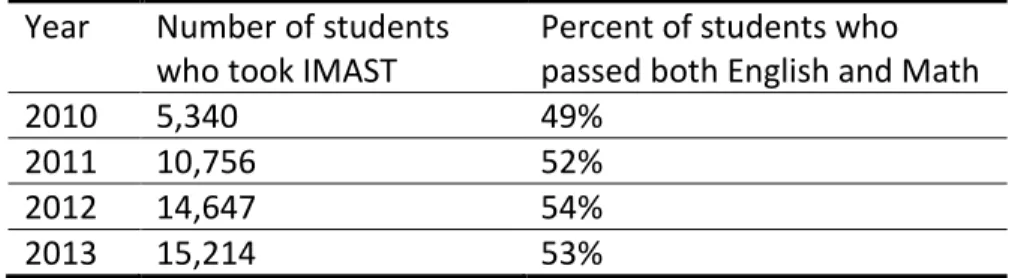
assessments. The number of students participating in the IMAST assessment as well as the

percent of students passing has increased every year in the state of Indiana (see Table 1).

Table 1. Number of students who took IMAST and the percent

passing

Year

Number of students

who took IMAST

Percent of students who

passed both English and Math

2010

5,340

49%

2011

10,756

52%

2012

14,647

54%

2013

15,214

53%

(Indiana Department of Education Compass, 2014)

The number of students who were permitted to use this assessment was not limited, but

each the school district could only designate 2% of their total tested students as IMAST students.

This means that if a district has more than 2% of their total tested population of students take the

IMAST and pass they cannot count these students as passing for their district passing rate, so

these students are then classified as “not passing” and lower the district’s accountability score.

Every year, district leaders have to decide which students are going to count against them and

then submit those students name to the DOE. The 2013-2014 school year will be the last year

that students in the state of Indiana will be permitted to be assessed using the IMAST

(25)

federal accountability process, the IMAST assessment that has been used by many students in

the state of Indiana will no longer exist. This means that those students who have experienced

success with the IMAST assessment will now have to begin taking the ISTEP assessment again.

This could have a negative impact on the students who have experienced success with the

IMAST assessment.

The scoring expectations of the ISTEP assessments are established in IND CODE §

20-32-5. These expectations have been consistent since their inception in 2005 with exceptions in

the areas of essay questions and the inspection of student’s scores. Please refer to Appendix B.

The IDOE began to implement changes to school accountability and performance

measures as well as the classifications for school performance in January of 2011. One of the

IDOE’s concerns was to meet the requirements of IND CODE § 20-31-3-1(Revising and

updating academic standards, 2005), which called for “clear, concise, and jargon free” language

in the school accountability measures. IDOE did not believe that this was fulfilled with the

current system. Part of the new accountability measures was based on applying for and

obtaining a waiver from the United States Department of Education (USDE) from the

requirements of the Federal Guidelines included in AYP. In early 2012 the USDE granted the

wavier to the state of Indiana and nine other states as well. Then, based on a 6-2 vote by the

State Board of Education (SBOE) the IDOE began to implement the new framework for school

accountability measures. The IDOE plan had three parts: first, it aimed to separate AYP from

state accountability; second, it revised the criteria used to place schools in accountability

categories; and third, it adopted letter grades for accountability determinations to clarify the

murky “performance and improvement” categories. The elementary and middle school models

base the schools’ grades on students’ performance in English/Language Arts (ELA) and Math.

(26)

The high school model is based on End of Course Assessment (ECA) scores in Algebra I and

English 10, as well as attendance rates, graduation rates, and college and career readiness.

Currently school reform is based on student academic achievement data and this means

educators must learn how to best use the data that is available to drive instruction in the

classroom daily “Educators need to gain data literacy skills to inform practice. Although some

professional development opportunities exist for current educators, fewer formal courses and

opportunities for data literacy development in schools of education have been developed and

implemented” (Mandinach & Gummer, 2013, p. 30). This is a change from just having data to

now using the data daily to drive instruction (Davenport & Anderson, 2002).

What Works with the Data Decision-Making Process

At this point I must clarify that while educators may say that they have used data for

years, it is crucial to articulate that what I am describing is not having binders of data from

ISTEP, ECA’s or other yearly testing. Educators must use data that is collected on a regular

basis from multiple sources and address the individual needs of students. Good teachers know

how each of their students learns and this influences what they do in their classroom and how

their teaching strategies address the student’s learning styles (Fahey, 2013).

Research has indicated that teachers have the biggest impact on student learning and the

challenge is how to influence teachers (Marzano, Marzano, & Pickering, 2003). Teachers and

schools are the primary factor in student achievement (Jensen, 2013). “The most powerful

strategy for improving both teaching and learning, however, is not by micromanaging instruction

but by creating the collaborative culture and collective responsibility of a professional learning

community” (DuFour & Mattos, 2013, p. 37).

(27)

Teachers are continually challenged to fit more into the daily schedule in their

classrooms. The key is finding a way to ensure that all teachers are teaching more effectively,

more frequently (DuFour & Mattos, 2013; Barnett, 2011). Data many times is viewed as

something that is happening to teachers. Data often comes from state or even federal

assessments and teachers do not see this type of data as providing the full picture (Harvey, 2014).

“In a study by the Gates Foundation, 60% of teachers said that student engagement was a ‘very

accurate’ measure of a teacher’s performance, but just 7% said the same about student scores on

standardized tests” (Scholastic & Bill and Melinda Gates Foundation, 2010, p. 4). Educators use

formal and informal assessments, benchmark assessments, previous academic performance, class

presentations, and projects to gain a comprehensive picture of each student. Research has

indicated that when teachers are provided with consistent meeting times, instructional leadership,

and explicit protocols for meetings there are significant gains in academic achievement

(Saunders, Goldernburg, & Gallimore, 2009; Little, 2012).

Saunders, Goldernburg, and Gallimore (2009) suggested the following protocol should be

used by grade-level teams to focus their meeting:

1.

Identify and clarify specific and common student needs to work on together.

2.

Formulate a clear objective for each common need and analyze related student work.

3.

Identify and adopt a promising instructional focus to address each common need.

4.

Plan and complete necessary preparation to try the instructional focus in the classroom.

5.

Try the team’s instructional focus in the classroom.

6.

Analyze student work to see if the objective is being met and evaluate the instruction.

7.

Reassess: Continue and repeat cycle or move on to another area of need.

(28)

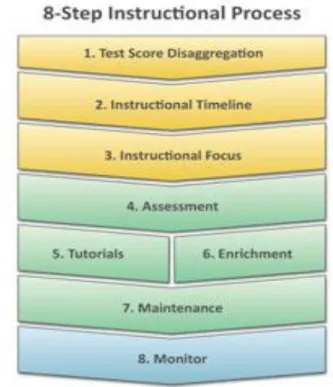
Davenport and Anderson suggested that these 8-Steps are followed in the implementation

of the data based decision-making process (see Figure 2):

1.

Data disaggregation: analyze student performance data to inform instruction.

2.

Curriculum timeline: establish a timeline teaching the identified essential knowledge and

skills.

3.

Instructional focus: direct instruction to students with focus on specific skills and

standards.

4.

Assessment: assess student progress on the standards using formative, standards based,

and summative, comprehensive, assessments.

5.

Tutorials/Enrichment: provide time to re-teach those students who have not yet become

proficient.

6.

Enrichment: provide enrichment opportunities for students who are proficient.

7.

Maintenance: provide ongoing maintenance to ensure students retain mastery of the

standards.

8.

Monitor: monitor all progress of students through data meetings, collaboration among

staff, and focused leadership.

(29)

Figure 2. 8-Step Process (Davenport, 2010)

These two examples recommended consistent meeting times, instructional leadership,

and explicit protocols for these data meetings and suggested that these protocols should produce

significant gains in academic achievement (Saunders, Goldernburg, & Gallimore, 2009). The

key to these processes is the fidelity of the implementation. “Data can help teachers to monitor

their constantly changing environment, their functioning and to what extent curriculum aims are

met and react to timely and in an evidence-based manner when problems need to be solved”

(Schildkamp & Kuiper, 2010).

School administrators can have a substantial impact on the teachers by communicating

the importance of using to data to drive the decision-making process (Mandinach et al., 2009).

Schools that had leaders who were supportive and enthusiastic about the use of data and set

established a clear vision and expectations for the use of data had much more buy in from their

teachers (Schildkamp & Kuiper, 2010, p. 40). Principals also influence the use of student data

(30)

by empowering their teachers. The idea of teacher empowerment is crucial to the academic

success of our students. Teacher empowerment is not simply allowing teachers to teach

whatever they want, when they want, but rather there must be a spirit of collaboration from

district administrators, building administrators, and teachers (Saunders et al., 2009, p. 1029;

Strasser, 2014).

Another way that school administrators influence teachers is through their own use of

student data. School administrators also use student academic performance data to identify

grade, class, and school wide strengths and weaknesses (Smith, Johnson, & Thompson, 2012).

This information provides direction for professional development and strategic planning for the

school (Schildkamp & Kuiper, 2010; Bernhardt, 1998). This vision and strategic planning will

prevent continual shifts in the focus of school improvement plans. Many times, schools will

focus on math and then their ELA scores will rapidly decline or vice versa. Administrators

should see the big picture and develop a strategic plan that addresses student needs but also

provides balance (Johnson, 2013).

Principals need to be educational leaders and not just building managers (Mendels &

Mitgang, 2013; Stewart, 2013; Hoerr, 2010). The focus of their positions must shift from

cafeteria manager, registrar, disciplinarian, social worker, nurse, and chief financial officer to

educational leader. Strong (2013) explained the importance of strong leaders in the school by

stating “You can’t have great schools without having great teachers and principals”. Many years

ago, principals were called principal teachers and this title is more appropriate for the role

principals must play because principals must continue to understand effective teaching

techniques and protocol (Elliot & Carson, 2009; Mendels & Mitgang, 2013). In the state of

Indiana, there has been some push to lower the requirements for principal licensure, while the

(31)

pressure on principals continues to grow and the knowledge base required for the position

increases. Principals must find a way to balance the mundane tasks with the educational tasks

that will truly make a difference in students’ academic achievement (Fahey, 2013).

Central office administrators also play a key role in academic achievement. As school

administrator roles continue to change it is vital that central office administrators adjust their

roles as well (Mendels & Mitgang, 2013). Based on a meta-analysis of the relationship between

the district-level administrative actions and the average student achievement, there is an

underlying relationship between district administrator’s actions and student achievement. The

meta-analysis indicated that the relationship was .24 and was statistically significant at the .05

level. This would equate to a gain of 9.5 percentile points for the average student (Marzano &

Waters, 2009). This is quite a finding as district administrators typically do not provide any

direct instruction to students.

What are the actions that district administrators can take that will impact student

academic success? Pat Davenport stated, “We knew that the mission statement – no matter how

eloquent – could not emanate from the school superintendent, our management group, or any

other single department, its creation had to involve the entire school district” (Davenport &

Anderson, 2002, p. 41). This inclusive vision must meet the needs of administrators and

teachers. Earlier I mentioned the barriers to using student data to drive instruction and the role of

district office administrators is to find ways to negate these barriers. The vision will then set the

direction for all educational initiatives (Murray, 2012). Professional development must be

provided for administrators and teachers alike so that they understand how to interpret and

appropriately use data, so that both groups have a working understanding of the process and

desired results

(32)

Central office administrators must define data literacy for the entire school system so that

teachers and administrators understand the expectations and speak a similar language (Marzano,

2013). It is vital that schools and teachers feel empowered, but there must be established norms

for the corporation. The use of data to drive instruction equates to data literacy. “Data literacy is

the ability to understand and use data effectively to inform decisions. It is a composed skill set

and knowledge base that enables educators to transform data into information and ultimately into

actionable knowledge” (Mandinach & Gummer, 2013, p. 30). This is a major shift in practices

for educators from lesson plans that were designed with a single approach to instruction to lesson

plans that take into account the learning styles and needs of each student and, therefore, it is

crucial that central office administrators understand their roles and function in those roles

appropriately and intentionally. True change in practices is not going to happen simply by hiring

good people, having a great program, or demanding that it happens. True change is the result of

intentional actions and behaviors. Many times, educators do not know what to do differently and

it is the responsibility of the central office administrators to provide the necessary tools and

support to initiate and sustain change. According to Hall and Hord (2006), there are six essential

functions in the change process:

1.

Developing, articulating, and communicating a shared vision of the intended change

2.

Planning and providing resources

3.

Investing in professional learning

4.

Checking on progress

5.

Providing continuous assistance

(33)

This list establishes important ideas that can help eliminate many of the barriers that were

identified early on in this review such as collecting data from a single source, collecting data but

never allowing it to influence what takes place in the classroom, testing that takes place once a

year, and a lack of direction of how to use the data in their classrooms. Marzano and Waters also

identified five specific actions for district leadership to consider (Marzano & Waters, 2009).

1.

Ensuring collaborative goal setting

2.

Establishing nonnegotiable goals for achievement and instruction

3.

Creating board alignment with and support of district goals

4.

Monitoring achievement and instructional goals

5.

Allocating resources to support the goals for achievement

There are many similarities in these two lists. Central office administrators develop and

articulate the vision and establish goals for the district (Marzano, 2013). Another key thought is

the establishment of the “nonnegotiable” aspects. The district administrators must see the big

picture and then establish the goals for the district and then they must enable and support the

building administrators and teachers as they develop an action plan for their buildings with all

the unique issues of their individual buildings. District administrators must also invest in

professional learning in the appropriate areas to support these goals and in so doing must align

the board support for these initiatives. This is a continual process that calls for teachers and

school administrators to depend on central office administrators and central office administrators

to continually depend on teachers and schools’ administrators (Goren, 2012, p. 234). Another

essential aspect that is mentioned in both lists is the idea of monitoring the process. Monitoring

is a key component of using student data to drive instruction and it is also a key to making these

(34)

essential changes. “What gets monitored is what gets done” (DuFour, DuFour, Eaker, & Many,

2006, p. 20) is a philosophy that is found in schools that use data to drive instruction.

District administrators as well as school administrators are finding themselves in the

coaching and counseling role as opposed to the authoritarian role that demands change (Honig,

2008; Louis, 2008; Mitgang, 2013). Teachers are the professionals in the classroom. When they

are supported appropriately with professional development opportunities, given the necessary

time for data disaggregation, and empowered to make appropriate decisions regarding the

educational practices within their classrooms, the outcome is positive for students (Dobbertin,

2012). This may seem like administrators are taking a step back and removing themselves from

the process, but the opposite is true. It is a matter of influence throughout the process by

coaching and counseling (Honig, 2008; Louis, 2008; Mitgang, 2013).

Barriers to the Data Decision-Making Process

There are many barriers that are identified in using student data to drive instruction. The

first one is in the area of administrative support, specifically in the areas of providing time for

teachers to be able to collaborate regarding the data that is received. Teachers need time to

discuss and interpret the results so that they can then develop a plan that addresses the needs of

their students. Time is also necessary for teacher buy-in. Using data appropriately is a difficult

task and administrators should consider that amount of time that is necessary for this initiative

(Schildkamp & Kuiper, 2010; Reeves & Burt, 2006).

Accurate data is another barrier to using data in the decision-making process. There is a

great amount of data that is collected today from the federal level, state level, and local level and

while data is available, it is not all suitable for day-to-day planning in the classroom, “For

assessment data to be useful for instructional planning they need to be current, accurate and in

(35)

the hands of knowledgeable decision makers at the appropriate levels” (Mandinach et al., 2009,

p. 3). As Mandinach stated, student data need to be made available in a timely and accurate

manner. Triangulation of data is suggested, and it is important for teachers to view the data in

light of what they see on a daily basis in the classroom (Davenport & Anderson, 2002; Goren,

2012).

Understanding the data and being able to interpret the data is another barrier (Jaquith,

2013). Educators have not typically been trained in the area of data disaggregation. Providing

meaningful and appropriate professional development is necessary. “Having mountains of data

doesn’t guarantee better decision-making. That requires expertise and time that district and

school employees frequently lack, opening the way for misuse of data” (Mendels & Mitgang,

2013, p. 27). Teachers also must guard against “hyper-individualizing” the curriculum. It is

important for teachers to remember that all students will not learn or master the information at

the same time. Students will progress at different paces and the key is that they are progressing

Professional learning communities or teacher groups have been found to be effective as a

professional development model for relaying new techniques and strategies to teachers. These

models also contribute to teacher collaboration, buy in, and support of one another (DuFour &

Eaker, 1998; Hall & Hord, 2006; Williams et al., 2003; Saunders et al., 2009).

Closely related to proper use of the data, the interpretation of the data is another barrier

because educators may interpret it differently. Therefore it is important to provide time for

collaboration and implementation development among teachers and administrators.

Our research suggests that teachers are more inclined to examine factors that contribute

to individual patterns of behavior and to think on a case-by-case basis, rather than to look

for patterns in data at different levels of aggregation, such as classroom-wide patterns.

(36)

As a result, teachers’ decision-making strategies often lack systematic approach, from

student-to-student, classroom-to-classroom, and year-to-year are unintentionally tinged

with personal bias, and ignore key statistical concepts like distribution, variation, and

reliability. (Mandinach, Honey, & Light, 2009, p. 2)

Different groups of educators use data differently and a common vision will help with the

systemic interpretation of data (Marzano & Waters, 2009). Another issue embedded in this

barrier is at times educators will ignore difficult data. “Unintended responses occur if schools

use data in undesirable ways. Schools use data in undesirable ways when they, for example,

select only easy to use data to change, and ignore data that involve more complicated long-term

improvement trajectories” (Schildkamp & Kuiper, 2010, p. 7).

The barriers to the data decision-making process are numerous, but they can be overcome

by dedicated educators who will accept nothing less than the best that they can give to their

students. This means focusing on what happens during the time that the students are at school.

Barriers to the data decision-making process have been effectively addressed through the

collaborative efforts of teachers, school administrators, and district administrators and when this

happens, students benefit dramatically (Chenoweth, 2007, Behrstock-Sherratt & Rizzolo, 2014;

Goodwin, 2014)).

Summary

School accountability based on student data is a growing trend in the world of education.

The review of existing literature indicates that accountability has not yet reached the pinnacle,

but rather there are still states that are continuing to add accountability measures based on

student achievement data. The challenge with this is that “Most teachers see standardized tests

as an inexact and partial measure of student learning at best. According to Public Agenda

(37)

research, only about 1 in 10 teachers considers student scores on district tests an excellent way to

judge student learning” (Coggshall, Ott, Behrstock, & Lasagna, 2009, p. 2). Teachers have the

most direct use of data and when used appropriately it can have a positive impact on student

academic success.

The barriers that were identified in my review are valid concerns and they must be

addressed in order for data to truly drive the decision-making process. Teachers and

administrators have not been trained to use student data appropriately and while they are fully

capable of this process, the appropriate training and time must be provided to facilitate this

change in philosophy and practice (Goren, 2012). The importance of administrative support is

necessary to this process at every level. Central office administrators must understand and

commit to providing the resources necessary for the building level administrators. This means

that building level administrators must receive assistance with building management tasks so that

they are able to spend time reviewing data and classroom practices so that students’ needs are

addressed (Chenoweth, 2010). Building administrators must be committed to providing the

resources such as flexible scheduling so that teachers have the time that they need to meet

together.

Professional development also must be provided for all educators in the areas of data

disaggregation and interpretation as well as formulating plans to address deficiencies.

“Data-driven decision-making must become part of an educator’s preparation. Educators must receive

systematic training in how to use data, preferably beginning in their pre-service years, but

continuing throughout their careers” (Mandinach & Gummer, 2013, p. 34). School boards and

central office administrators must commit to this educational shift of using data to drive the

decision-making process. This is a difficult task, but one that can have a positive impact on

(38)

students’ academic success if it is implemented appropriately. Administrators must lead the way

in this area as their attitudes and practices in data disaggregation set the stage for the entire

school or school system and can have a positive or negative impact across the board. The vision

of the school corporation must be established from the top in data based decision-making

process. The vision establishes protocols that all schools adhere too and follow and when

expectations are high for administrators, teachers and students everyone achieves more (Ross &

Cousins, 1995).

My review focused on two different models that are used with the data-based

decision-making process. Saunder’s model used seven steps and Davenport and Anderson’s model used 8

steps. Both are based on the plan, do, check, act models. I have personal experience with the

Davenport and Anderson’s 8-Step Process and I have found that when it is followed and

implemented with fidelity appears to be powerful in addressing student needs and results in

increased student achievement. This process is not just about testing. It is about much more it

includes all of the steps mentioned before and monitoring is the step that ensures the validity of

the other steps. Using student data to drive instruction is a test supported process. It isn’t the tests

that make this process effective it is all of the elements together (Popham, 2009). An essential

element of the monitoring step is creating a culture where student data is not used to judge

teacher’s effectiveness, but rather the data is used to find solutions and ensure student academic

achievement (Chenoweth & Theokas, 2013). An advantage to using a model as a district is, all

stakeholders speak the same language and have a plan in place that is consistent from school to

school and grade level to grade level.

The research indicates that accountability tied to high stakes testing does not show any

signs of slowing down and, in fact, it appears that it will continue to increase in many states.

(39)

Educators, for the most part, do not question the need for standards, or even accountability, but

the issue that they have is with the severity of the sanctions that take place because of the results

(Abrams, Pedulla, & Madaus, 2010).

(40)

CHAPTER THREE

RESEARCH METHODS

Chapter Three includes the methods I used during my research. This chapter is organized

with a review of my purpose statement, research questions, setting and methods. This chapter

describes the setting of my research as well as the school improvement process that was utilized

in the district and the methods I used during my research.

Purpose of the Study

The purpose of this qualitative study was to address my research questions regarding the

role of the school administrator in the implementation of a data-driven decision school

improvement plan. A qualitative study enabled me to explore the relationship of the principal’s

approach to data-driven instruction and to gain a deeper understanding of the data-driven process

by discerning common themes among the participants. I was not looking for a relationship of

correlation as would be found in quantitative research. I specifically studied the principals’

relationship to the teachers, the teachers’ relationships to each other, and the teachers’

relationships with the students when they were using data to drive the instructional process. I

also examined the expectations and processes that the principal established to ensure the

appropriate use of data.

Research Questions

The research questions that will guide my study are:

1.

In a district that is implementing a data based decision-making process as their school

improvement model, what is the role of the school administrator?

2.

What are the strengths as well as the barriers and concerns in the implementation of this

process?

(41)

Description of the Sample

When conducting this qualitative study, I used a case study of Middletown High School.

The community of Middletown has a population of 70,000 according to the 2010 Census. As a

community Middletown was transitioning from being an automotive town with multiple factories

that provided services for the automotive industry to community where most of the jobs were

connected to retail and restaurants. The population of Middletown has been relatively steady for

the last 50 years, and the ethical makeup of the city has remained consistent as well over the last

20 years with 84% being white and the remaining 16% being a combination of African

American, Native American, Asian, Pacific Islander, and Hispanic races. While the population

of the city has remained relatively consistent over the last 50 years the population of Middletown

Community Schools has not. In the early 1970’s, Middletown Schools had a student population

of 21,000 students. When this research was performed, Middletown Community School had a

student population of 6,800 students. The drastic change in the manufacturing industry had

changed the type of jobs that were available. This had impacted the makeup of the community

from middle class families to the point that almost 75% of the students were free or reduced

lunch students. During the 2009/2010 school year Middletown Community Schools, as a school

corporation made an intentional move as a district to become a district that used student

academic achievement data to drive instruction. The implementation of this process was unique

at each level of instruction (elementary, middle school, high school) and was based on local

benchmark assessments and the available state required assessments. The elementary schools

began to use the 8-Step Process model based on local benchmark assessments, Acuity, and

ISTEP data. The middle schools began to use the Indiana Student Achievement Institute,

(INSAI) model based on local benchmark assessments and ISTEP data and the high school

began to use the INSAI model based on local benchmark assessments and End of Course

(42)

Assessment (ECA) data. The move to using data-driven instruction was unified during the

2011/2012 school year and beginning in the 2012/2013 school year the middle schools and high

school joined the elementary schools and implemented the 8-Step Process. With this integration

Middletown Community Schools became an 8-Step Process district (Davenport & Anderson,

2002).

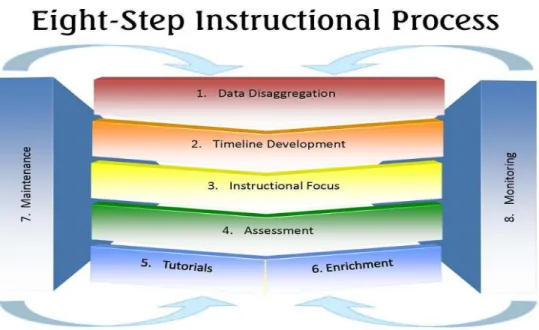
The 8-Step Process is based on eight steps that are expected to drive all instructional

practices within the Middletown Community Schools.

Figure 3. 8-Step Process Flow Chart (Peggy Hinckley - 8 Step Process, 2012)

Data Disaggregation

Data disaggregation is the process used to analyze student performance data to inform

instruction. The process of learning how to analyze data takes time. Learning Log Meetings are

scheduled to facilitate collaboration for teachers of the same grade level and subject matter, so

they can meet to review the latest student data and develop a plan to address their students’

deficiencies. This is also an opportunity to develop enrichment plans for those students who

(43)

Curriculum Timeline

The curriculum timeline establishes a time-line for teaching the identified essential

knowledge and skills. The curriculum timelines ensure that grade level subject area teachers are

at similar points throughout the school year and cover the required standards. This is vital to a

comprehensive and viable curriculum (Powell & Kusuma-Powell, 2012).

Instructional Focus

Instructional focus is the direct instruction to students with a focus on specific skills and

standards.

It is important for students to know what they are supposed to be learning (Brookhart, 2012).

As teachers prepare their lessons and establish the instructional focus they should focus on the

following questions (Marzano, 2013, p. 81):

What basic terms and facts do I assume that students already know, and what is my plan for

students who don’t know them?

What basic relationships do I assume that students already know, and what is my plan for

students who don’t know them?

What basic skills and processes do I assume that students already can execute, and what is

my plan for students who can’t execute them?

What mental models do I assume that students already have, and what is my plan for

students who don’t have them?

Students enter the classroom with multiple experiences that are common to many, but not all and

teachers who teach with these experiences provide an advantage to their students (Ball &

(44)

lesson plans from year to year and even from class period to class period because they will never

have the same dynamic in a class (Christenbury, 2011).

Assessment

Assessment is the process of using formative (standards based) and summative

(comprehension based) assessments to measure the student mastery of standards.

Tutorials/Remediation

Tutorials/remediation is the method of providing time to re-teach those students who

have not yet become proficient. It is important students see and understand their data so that

they can focus on what needs to happen in order for them to achieve. Feedback needs to be

actionable information that is specifically related to the data and the student (Wiggins, 2012;

William, 2012). The tutorials/remediation efforts are based on the grouping of students for a

three to four-week window of direct instruction based on the student’s latest data collected from

the benchmark assessments. It is important to note that these groups should change after every

benchmark assessment so that students are not placed in a group for the school year (Tovani,

2010).

Enrichment

Enrichment opportunities are provided for students who are proficient on the

assessments. Teachers must be cautious when using the students who master the material to help

those who don’t master the material because many times those students learn differently and

therefore cannot help the other students (Rakow, 2012; Tomlinson & Javius, 2012; Brulles &

Winebrenner, 2012; Noddings, 2014).

Maintenance

Figure

Table 1. Number of students who took IMAST and the percent  passing
Figure 2. 8-Step Process (Davenport, 2010)
Figure 3. 8-Step Process Flow Chart (Peggy Hinckley - 8 Step Process, 2012)  Data Disaggregation

References

Related documents

In this work, a method to predict the insertion-loss of rectangular ventilation unit with input and output openings at various positions is proposed by solving the wave equation,

This conclusion is further supported by the following observations: (i) constitutive expression of stdE and stdF in a Dam + background represses SPI-1 expression (Figure 5); (ii)

After examining all combinations of house prices in regions other than London, we find evidence of convergence in the subgroup consisting of South East, South West, East Anglia

CFD analysis of ventilative cooling in a generic isolated building equipped with ventilation louvers.. • PhD research:

Furthermore, it argues that the performance evaluation of a classification model for multi-class imbalanced datasets in terms of simple “accuracy rate” can possibly provide

Using a likert scale reading interest survey, a released SOL reading comprehension test, and teacher observations data were collected to determine if independent choice in a

The extension of the Child Support Grant to all children under 18 years of age is one of the recommendations of the Report of the Committee of Inquiry into Comprehensive

# Exceed the limit of the composite test and Individual testing of mixed components is performed automatically as per CLIENT requested... Analysis was conducted