DistNeo4j: Scaling Graph Databases
through Dynamic Distributed Partitioning
by
Daniel Nicoara
A thesis
presented to the University of Waterloo in fulfillment of the
thesis requirement for the degree of Master of Mathematics
in
Computer Science
Waterloo, Ontario, Canada, 2014
c
I hereby declare that I am the sole author of this thesis. This is a true copy of the thesis, including any required final revisions, as accepted by my examiners.
Abstract
Social networks are large graphs which require multiple servers to store and manage them. Providing performant scalable systems that store these graphs through partitioning them into subgraphs is an important issue. In such systems each partition is hosted by a server to satisfy multiple objectives. These objectives include balancing server loads, reducing remote traversals (number of edges cut), and adapting the partitioning to changes in the structure of the graph in the face of changing workloads. To address these issues, a dynamic repartitioning algorithm is required to modify an existing partitioning to maintain good quality partitions. Such a reparti-tioner should not impose a significant overhead to the system. This thesis introduces a greedy repartitioner, which dynamically modifies a partitioning using a small amount of resources. In contrast to the existing repartitioning algorithms, the greedy repartitioner is performant (in terms of time and memory), making it suitable for implementing and using it in a real system. The greedy repartitioner is integrated into DistNeo4j, which is designed as an extension of the open source Neo4j graph database system, to support workloads over partitioned graph data distributed over multiple servers. Using real-world data sets, this thesis shows that DistNeo4j leverages the greedy repartitioner to maintain high quality partitions and provides a 2 to 3 times performance improvement over the de-facto hash-based partitioning.
Acknowledgements
I would like to thank Shahin Kamali for the invaluable input on the theorems. I would also like to thank Gobaan Raveendran and Nika Haghtalab for their support.
Additionally, special thank you to Professor Khuzaima Daudjee for in-depth feedback and suggestions on the content of this document. Special thank you to my thesis readers, Professors Tamer ¨Ozsu and Wojciech Golab, who took the time to read and provide comments to improve the content.
Table of Contents
List of Tables viii
List of Figures ix
1 Introduction 1
1.1 Graph Repartitioning Problem . . . 3
1.2 Thesis Outline . . . 5 2 Related Work 8 2.1 Databases . . . 8 2.1.1 Graph Databases . . . 8 2.1.2 Related Systems . . . 10 2.1.3 Summary . . . 12
2.2 Graph Partitioning Survey . . . 15
2.2.1 Graph Partitioning . . . 15
2.2.2 Graph Repartitioning . . . 19
2.2.3 Summary . . . 20
3 Proposed Greedy Repartitioner 23 3.1 Algorithm Description . . . 23
3.3 Algorithm Analysis . . . 31
3.3.1 Memory and Time Analysis . . . 31
3.3.2 Parallelism . . . 32
3.3.3 Algorithm Convergence . . . 33
3.3.4 Alternate Optimizations . . . 36
4 Prototype Distributed Graph Database 37 4.1 Neo4j Description . . . 37
4.1.1 Storage . . . 37
4.1.2 Transactions . . . 38
4.2 From Neo4j to DistNeo4j . . . 39
4.2.1 Initial Partitioning . . . 39 4.2.2 Online Repartitioning . . . 41 4.2.3 Storage . . . 45 4.2.4 Inter-Partition Communication . . . 47 4.2.5 Deadlock Detection. . . 47 4.2.6 Transaction Manager . . . 48 4.2.7 Recovery . . . 48 5 Evaluation 50 5.1 Experimental Setup . . . 50 5.2 Datasets . . . 50 5.3 Experiment Description . . . 51 5.4 Repartitioner Experiments . . . 52 5.4.1 One-hop Performance . . . 53
5.4.2 2-hop Traversal Performance . . . 59
5.5 Variation of Repartitioner Parameters . . . 62
5.5.2 Varying Number of Iterations . . . 65
5.5.3 Repartitioning from Scratch . . . 67
5.5.4 Summary . . . 69 5.6 DistNeo4j Experiments . . . 69 5.6.1 Scale Up . . . 69 5.6.2 Scale Out . . . 69 5.6.3 Read/Write Experiments . . . 71 6 Conclusion 74 References 75
List of Tables
2.1 Comparison of different graph systems . . . 14
2.2 Summary comparison of partitioning algorithms. n represents the number of vertices,erepresents the number of edges,prepresents the number of partitions andirepresents the number of iterations the algorithm is executed. . . 21
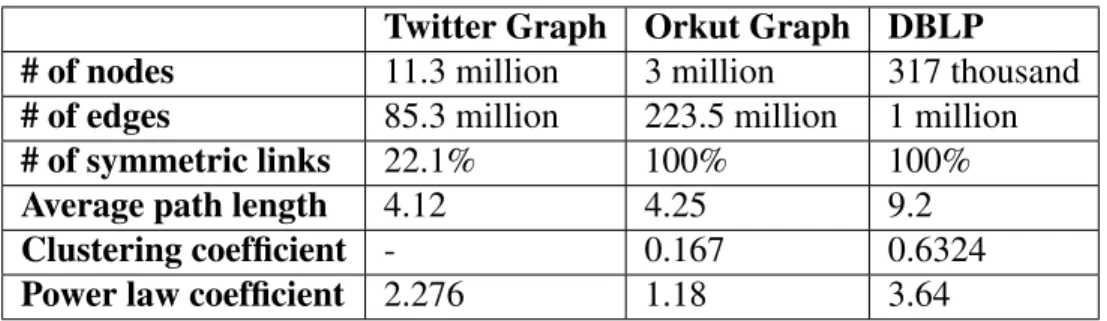
5.1 Summary description of datasets . . . 51
5.2 Query locality . . . 60
5.3 Comparison of average traversal size using 1-hop and 2-hop traversals . . . 61
5.4 Number of iterations required to achieve a stable state where the edge-cut im-provements are below 0.01% . . . 68
5.5 Edge cut for Metis partitioning and hash based random on Orkut. Percentage of edges cut is shown in parenthesis . . . 70
5.6 Edge cut for Metis partitioning and hash based random on Twitter. Percentage of edges cut is shown in parenthesis . . . 70
5.7 Edge cut for Metis partitioning and hash based random on DBLP. Percentage of edges cut is shown in parenthesis . . . 71
List of Figures
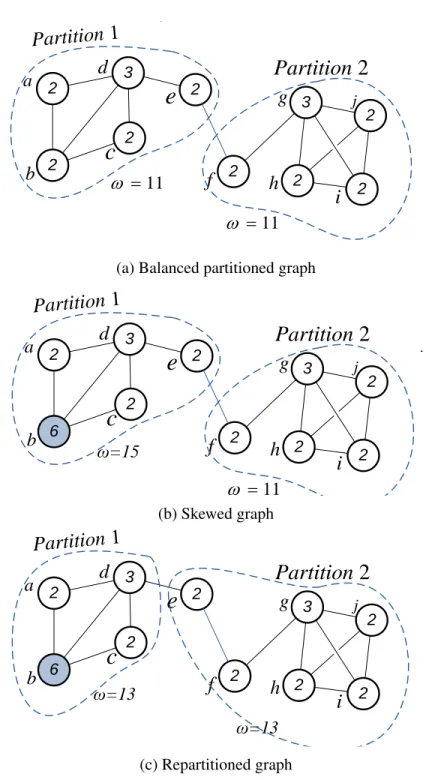
1.1 Example graph evolution and effects of repartitioning as response to imbalances . 7
3.1 An unsupervised repartitioning might result in oscillation. Consider the parti-tioning depicted in (a). The repartitioner on partition 1 detects that migrating
d, e, f to partition 2 improves edge-cut; similarly, the repartitioner on partition 2
tends to migrateg, h, ito partition 1. When the vertices move accordingly, as de-picted in (b), the edge-cut does not improve and the repartitioner needs to move
d, e, f andh, iagain. To resolve this issue, in the first stage of rerpartioning of
(a), the vertices d, e, f are migrated from partition 1 (lower ID) to partition 2 [dark arrows]. After this, as depicted in (c), the only vertex which requires to migrate in the second stage is vertexgwhich moves from partition 2 (higher ID) to migration 1 (d). . . 26
3.2 Choosing the migration target partition . . . 27
3.3 Repartitioning algorithm . . . 28
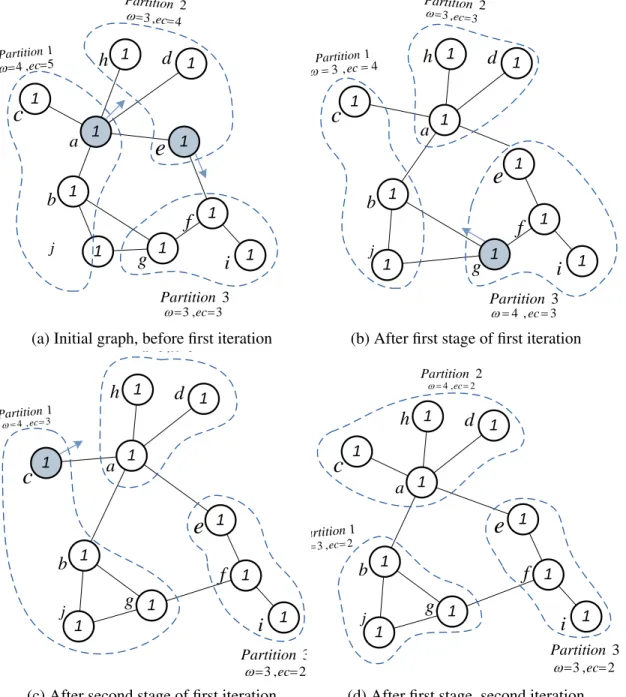
3.4 Example of 2 iterations of repartitioning. 2 metrics are attached to every parti-tion:wrepresenting the weight of the partition andecrepresenting the edge-cut. . 30
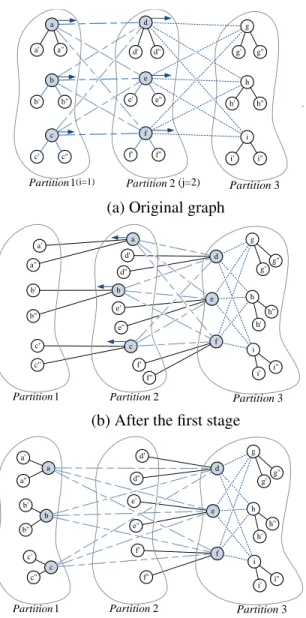
3.5 The number of edge-cuts might increase in the first stage (in the worst case), but it decreases after the second stage. In this example, the number of edge-cuts is initially 18 (a); this increases to 21 after the first stage (b), and decreases to 15 at the end of the second stage (c). . . 34
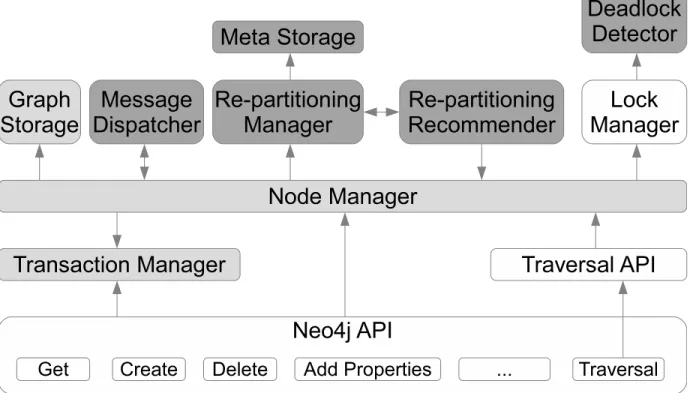
4.1 Neo4j system layers together with modified and new components designed make it run in a distributed environment. . . 40
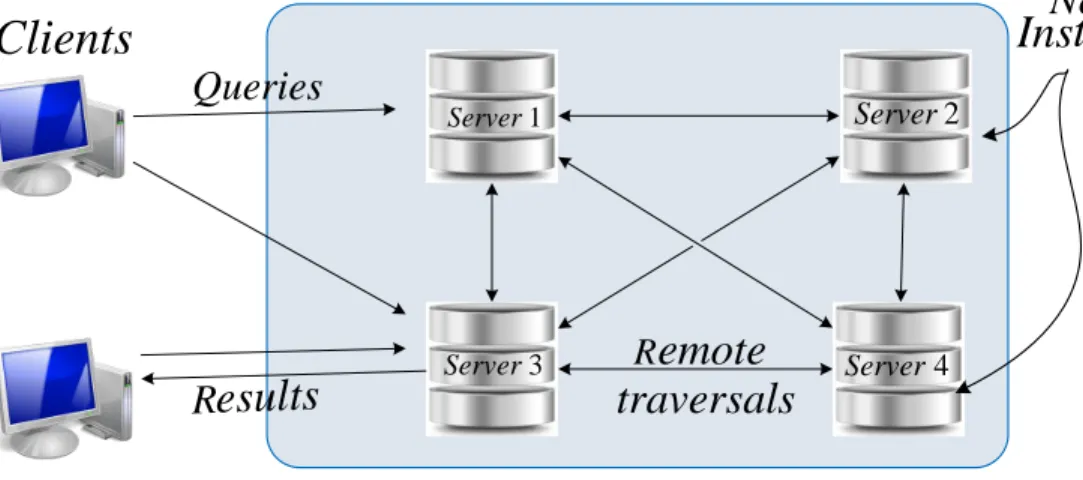
4.2 Overview of how DistNeo4j servers interact with clients . . . 41
4.4 Repartitioning Recommender. . . 43
4.5 Sharded graph - The dotted lines represent the ghost relationships while the con-tinuous lines represent the actual relationships. . . 45
5.1 CCDF distribution of number of relationships over data sets. . . 52
5.2 Compares the edge-cut resulting from repartitioning with running Metis. Results are presented as a percentage of edges cut from the total number of edges in each specific dataset. . . 54
5.3 Compares the number of vertices migrated when using the repartitioner versus Metis. . . 55
5.4 Compares the number of relationships changed or migrated as a result of repar-titioning versus running Metis. . . 55
5.5 Throughput performance over time for Orkut dataset . . . 56
5.6 Aggregate throughput results for datasets. The first three, 5.6a, 5.6b and 5.6c, show throughput aggregate over the entire experiment, while 5.6d and 5.6e show the aggregate over the last hour of the experiment . . . 57
5.7 Throughput performance over time for Twitter dataset . . . 58
5.8 Throughput performance over time for DBLP dataset . . . 59
5.9 Throughput performance over time for Orkut dataset using 2-hop traversals . . . 60
5.10 Throughput performance over time for Twitter dataset using 2-hop traversals . . . 60
5.11 Throughput performance over time for DBLP dataset using 2-hop traversals . . . 61
5.12 Performance comparison while varying thetop-kparameter . . . 63
5.13 Performance over time while varying thetop-kparameter . . . 64
5.14 Partition balance while varying thetop-kparameter . . . 65
5.15 Performance comparison while varying theiterationsparameter . . . 66
5.16 Performance over time while varying theiterationsparameter. . . 66
5.17 Partition balance while varying theiterationsparameter . . . 67
5.18 Ratio of edge-cut improvement when varyingk . . . 68
5.20 Shows the throughput rate while increasing the number of partitions for the Orkut dataset . . . 71
5.21 Shows the throughput rate while increasing the number of partitions for the Twit-ter dataset . . . 72
5.22 Shows the throughput rate while increasing the number of partitions for the DBLP dataset . . . 72
Chapter 1
Introduction
Large scale, connected, graphs permeate our lives. Online social networks are used to connect millions of people through many relationships. RDF triples in the context of the semantic web form graphs that are used to represent many real-world applications. The scale of such large graphs, often in millions of vertices or more, means that it is often infeasible to store, query and manage them on a single server. Thus, there is a need to partition, or shard, such large graphs across multiple servers, allowing the load and concurrent processing to be distributed over multiple servers to provide good performance and to increase availability. The focus of this work is on partitioning of the graphs associated with social networks. These networks exhibit a high degree of correlation for accesses of certain groups of records, for example through frictionless sharing [24]. In such cases users are free to access and repost the activities of all users they are connected to without asking for permision. To achieve a good partitioning which improves the overall performance, the following objectives should be met:
• The partitioning needs to bebalanced. Each vertex of the graph has aweightwhich indi-cates the popularity of the vertex (e.g., in terms of the frequency of queries to that vertex). In the context of social networks, a small number of users (e.g., celebrities, politicians) are extremely popular while a large number of users are relatively unpopular. This discrepancy reveals the importance of achieving a balanced partitioning in which all partitions have al-most equal aggregate weight. Here, aggregate weight of a partitioning is the total weight of vertices in the partition and defines the load on the server which hosts the partition. • The partitioning should minimize the number of edges cut. An edge-cut is defined by an
edge which connects vertices in two different partitions. Each edge-cut involves queries that need to transition from a partition on one server to a partition on another server, shift-ing from local traversal to remote traversal, thereby incurrshift-ing significant network latency.
Particularly for social networks, it is critical to minimize edgecuts since most operations are done on the user’s data and his neighbors. Since these1-hop traversaloperations are so prevalent in these networks, minimizing the edge-cut is analogous to keeping communities intact. This leads to highly local queries similar to those in SPAR [45] and minimizes the network load, allowing for better scalability by reducing network IO [5].
• The partitioning should be incremental. Social networks are dynamic in the sense that users and their relations are always changing, e.g., a new user might be added, two users might get connected, or an ordinary user might become popular. A good partitioning solution should dynamically adapt its partitioning to the changing state of the network. Considering the size of the graph, it is infeasible to create a partitioning from scratch; hence, a repartitioning solution (a repartitioner) is needed to improve upon an existing partitioning. This usually involvesmigrating some vertices from one partition to another (moving data from one server to another). Excessive migration incurs excess network latency and decreases performance. Hence, it is desirable to migrate as few vertices as possible.
• The repartitioning solution should perform well in terms of time and memory require-ments. To achieve this, it is desirable to perform repartitioning locally by accessing a small amount of information about the structure of the graph. From a practical point of view, this requirement is critical and prevents us from using almost all existing approaches for the repartitioning problem.
There are several partitioning algorithms which result in relatively balanced solutions with small edge-cuts (e.g., [27, 48, 29, 26, 9]). Some of these algorithms also tend to minimize vertex migration [48]. However, these algorithms require an almost complete or global view of the graph in their repartitioning step which makes them infeasible for incremental, online partitioning. Furthermore, these approaches perform a large number of look-ups on the structure of the graph in the repartitioning phase. This significantly drops the performance of the system. Because of these issues, these algorithms are not implemented on real data management systems. From a data management perspective, the current storage model used in online social net-works (OSNs) is based on traditional database management systems (DBMSs). While relational databases can store this type of data, they are optimized to perform index based queries. Their storage model is often very complex since it is made to handle very complex data structures and queries. Hence the performance will generally suffer. Thus, the current trend is to migrate to more simplistic models such as key-value stores. Key-value stores trade off the flexibility of the relational model for the more simplistic API supporting only simple read and write operations. Key-value stores also take advantage of simple locking models (such as optimistic locking) to
increase performance. However key-value stores assume no correlation between records, a prop-erty at the core of OSN access patterns. In addition, both DBMSs and key-value stores can not easily represent the traversal based operations used in OSNs.
In contrast, graph databases use a simplistic data representation model which is often very similar to key-value stores, however graph databases also provide a complex querying model based on traversals. These queries are processed fully on the server side before results are re-turned to the user. Traversals are recursive joins, however due to the way data is represented in graph databases, performing these queries is a highly optimized process.
The focus of this thesis is on the design and provision of apractical partitioned graph data management system that can support remote traversals while providing an effective method to
dynamicallyrepartition the graph using only local views. The dynamic distributed partitioning aims to co-locate vertices of the graph so as to satisfy the above requirements. The contribu-tions of this thesis are: (i) a dynamic partitioning algorithm, referred to aslightweight, greedy repartitioner, that can identify which parts of graph data can benefit from co-location. The algo-rithm is designed to improve performance by applying a fast repartitioning algoalgo-rithm which uses only a small amount of knowledge on the graph structure (ii) a system called DistNeo4j, which extends the existing Neo4j1 open source graph database system to provide the functionality to move data on-the-fly to achieve data locality and reduce the cost of remote traversals for graph data. Experimental evaluation on real-world data shows that our techniques are effective in pro-ducing performance gains and work almost as well as the popular Metis partitioning algorithms [27, 29,9] that have the advantage of performing static partitioning offline and relies on having a global view of the graph.
1.1
Graph Repartitioning Problem
Social graphs are evolving structures that change over time due to user interaction. The most common changes are the addition of relationships between different users [12] and changes in user popularity. These changes will create long lived skews on some partitions, which reduce the performance of the system. [33] shows that traffic patterns are generally well defined. Popular users generally have more relationships [33, 16]. Celebrities, companies or bloggers will gen-erate and consume more information. As such users come online and form relationships their popularity will generate different traffic patterns. However, the change in the social graph can be much slower when compared to the read traffic [12]. This process leads to a slowly, but constantly evolving graph structure.
1Neo4j is being used by a wide variety of customers, among them are Adobe and HP. A full list of customers
A variety of partitioning methods can be used to create an initial, static, partitioning of the graph resulting in highly localized read traffic patterns (i.e., a small number edge-cuts) and good load balance. This should be followed by a repartitioning strategy to maintain good partitioning which adapt to changes in the graph. One solution is to periodically run an algorithm on the whole graph to get new partitions. However, running an algorithm to get new partitions from scratch is costly in terms of time and space. Moreover, the newly created partitions might be far different from previous partitions which results in high migration cost. Hence, an incremental partitioning algorithm needs to adapt the existing partitions to changes in the graph structure.
It is desired to have a lightweight repartitioner which maintains only a small amount of meta-data to perform repartitioning. Since such an algorithm refers to only metameta-data (which is signif-icantly smaller than the actual data required for storing the graph), the repartitioning algorithm is not a system performance bottleneck. The metadata maintained in each machine (partition) consists of the list of accumulated weight of vertices in each partition, as well as thenumberof neighbors of each hosted vertex in each partition. In particular, if a partition hostsn1vertices, it maintainsα+n1αnumbers (integers) as metadata which is easy to maintain and update. Note that maintaining the number of neighbors is far cheaper that maintaining thelistof neighbors in other partitions. In what follows, the main ideas behind the greedy repartitioner is introduced through an example.
Example: Consider the partitioning problem on the graph shown in Figure 1.1. Assume
there are α = 2 partitions in the system and the imbalance factor is γ = 1.1, i.e.,in a valid solution, the aggregate weight of a partition is at most 1.1 times more than the average weight of partitions. Assume the numbers on vertices denote their weight. During normal operation in social networks, users will request different pieces of information.The most common operations are 1-hop traversals (see what your friends are up to) or single get requests (check a popular user such as a celebrity or news source). In this sense, the weight of a vertex is the number of read requests to that vertex. Figure1.1a shows a partitioning of the graph into two partitions, where there is only one edge-cut and the partitions are well balanced, i.e., the weight of both partitions is equal to the average weight, i.e., 11.
Assuming user b is a popular web blogger who posts a post, the request traffic for vertex
b will increase as its neighbors poll for updates, leading to an imbalance in load on the first partition. Figure 1.1b shows the state of the graph after userbbecomes popular and skews the aggregate weight to 15 on partition 1. Such skews will degrade performance by increasing the response time of queries and lowering query throughput on a skewed partition. Here, the ratio between aggregate weight of partition 1 (i.e., 15) and the average weight of partitions (i.e., 13) is more than γ. This means that the repartitioning needs to be triggered to rebalance the load across partitions (while maintaining the number of edge-cuts as small as possible).
The metadata of the lightweight repartitioner available to each partition includes the weight of each of the two partitions, as well as the number of neighbors of each vertexv hosted in the partition, e.g., metadata available to partition 1 in Figure1.1bimplies that vertexeis connected to one vertex in each partition. Provided with this metadata, a partition can determine whether load imbalances exist and the extent of the imbalance in the system (to compare it withγ). If there is a load imbalance, a repartitioner needs to indicate where to migrate data to restore load balance. Migration is an iterative process which will identify vertices that when moved will balance loads (aggregate weights) while keeping the number of edge-cuts as small as possible. In doing so, our greedy repartitioner makes use of its metadata which includes the number of neighbors of each vertex in each partition. For example, when the repartitioner starts from the state in Figure1.1b, on partition 1, vertices a through d are poor candidates for migration because their neighbors are in the same partition. Vertex e, however, has a split access pattern between partitions 1 and 2. Since vertex e has the fewest neighbors in partition 1, it will be migrated to partition 2. On partition 2, the same process is performed in parallel; however, vertex f will not be migrated since partition 1 has a higher aggregate weight. Once vertexeis migrated, the load (aggregate weights) becomes balanced, thus any remaining iterations will not result in any migrations . The resulting graph is depicted in Figure1.1c.
The above example is a simple case to illustrate how the greedy repartitioner works. Note that the only information maintained by the algorithm for each partition is the cumulative weight of all partitions as well as the number of neighbors of each hosted vertex in the other partition. Several issues are left out of the example, e.g., two highly connected clusters of vertices might repeatedly exchange their clusters to decrease edge-cut. This results in anoscillation which is considered in detail in Section3.1.
It should be mentioned that replicating graph data to deal with changes in the workload like that illustrated in the above example is also possible. However, replication in this context is complementary to partitioning and the system could be augmented for replication. Replication introduces a different set of problems that include consistent maintenance of replicas and con-trolling replication in the face of storage space constraints (to mention a few) and this is not the focus of this paper.
1.2
Thesis Outline
Chapter2will survey the existing databases that have been used with similar workloads as graph databases. The chapter will then survey existing partitioning and repartitioning algorithms, de-scribing how they work. Chapter3presents the proposed lightweight greedy repartitioner. Chap-ter4details the changes made to Neo4j in order to allow distributed querying. Chapter5presents
the experimental evaluation of DistNeo4j and the greedy repartitioning algorithm. Finally, Chap-ter6concludes the thesis.
2 2 3 2 2 2 3 2 2 2 a b
c
d
e
f
g
h
i
j1
Partition
2
Partition
11
11
2 6 3 2 2 2 3 2 2 2 a bc
d
e
f
g
h
i
j1
Partition
2
Partition
11
ω=15 2 6 3 2 2 2 3 2 2 2 a bc
d
e
f
g
h
i
j1
Partition
2
Partition
ω=13 ω=13 (a) Balanced partitioned graph 2 2 3 2 2 2 3 2 2 2 a bc
d
e
f
g
h
i
j1
Partition
2
Partition
11
11
2 6 3 2 2 2 3 2 2 2 a bc
d
e
f
g
h
i
j1
Partition
2
Partition
11
ω=15 2 6 3 2 2 2 3 2 2 2 a bc
d
e
f
g
h
i
j1
Partition
2
Partition
ω=13 ω=13 (b) Skewed graph 2 2 3 2 2 2 3 2 2 2 a bc
d
e
f
g
h
i
j1
Partition
2
Partition
11
11
2 6 3 2 2 2 3 2 2 2 a bc
d
e
f
g
h
i
j1
Partition
2
Partition
11
ω=15 2 6 3 2 2 2 3 2 2 2 a bc
d
e
f
g
h
i
j1
Partition
2
Partition
ω=13 ω=13 (c) Repartitioned graphChapter 2
Related Work
2.1
Databases
2.1.1
Graph Databases
Previous work on graph databases focused on a centralized approach [25, 39, 2]. Some of the most popular graph databases[19] are Dex[39], Neo4j[2] and HyperGraphDB[25]. All of these systems support a similar traversal based querying model, however they focus on optimizing different parts of the system.
Dex is presented as a layered implementation where query processing is broken down in multiple stages. The initial querying stage scans the stores and filters results to form collections of sub-graphs. The next stage is a preparation and mining stage where the sub-graphs are further modified due to creation, removal operations or further filtering. The key insight is that graph manipulations are highly parallelizable since they generally require only local information to sub-graphs. The optimizations involved reducing the memory footprint, allowing queries to filter or identify valid records by using optimized data structures such as bitmaps. Their experimental evaluation focused on relatively large queries such as minimum collaboration distance between two individuals or between one individual and everyone else. Other queries looked at finding the context of keywords. Their experiments show good scalability and high optimization of the data-layout such that query performance is roughly the same in memory constrained system to the ones where data fully fits in memory.
Neo4j is designed around a network model where data is stored as nodes and different records are linked through relationships. The storage layer resembles key-value stores where nodes, re-lationships and properties are stored separately in their own store. This allows the system to
perform quick traversals as record sizes are kept small and reads do not need to process unneces-sary information. Neo4j is build to support transactions with ACID consistency properties. For increased performance the Neo4j high availability mode is currently recommended to scale read traffic[3]. [56] compares Neo4j and MySQL using different types of queries. They show that on structural queries (such as joins) and text searches Neo4j clearly performs better than MySQL.
HyperGraphDB is a graph database system built to represent hypergraph problems. The reasoning is that some problems, such as multi-input/output problems are easier to represent in hypergraph format allowing much simpler operations[25]. In addition, HyperGraphDB’s format is highly desirable in learning algorithms or natural language processing. HyperGraphDB can also be considered an object store as every record is considered an atom and the user is able to perform complex type based queries on top of it. HyperGraphDB has been extended to pro-vide a simple peer-to-peer distribution model in which different instances of HyperGrapbDB can communicate. However data management and distributed query processing is left to the user, meaning that the user needs to know which peer holds data to be able to perform any query. Un-fortunately [25] focuses more on the flexibility of the system leaving out performance evaluation. [35] presents Concerto, a distributed, in-memory graph database built on-top of Sinfonia (a distributed shared memory system). The focus of their work is on interactive event processing triggered by updates to the system. Concerto extends the concept of a view from DBMSs to graph databases. The use of views is relevant to systems such as highway monitoring where sensor events are processed on a regular basis. Given specific definitions of views the system is able to monitor and respond to changes in the graphs based on events. Another use is in load balancing as views can be used to monitor for system usage. Changes in the workload triggers a process responsible for migrating hotspots. They compare their system to MySQL, Neo4j and GemFire (an in-memory distributed store). Their results show significant performance gains during k-hop traversals and full graph queries (k-core).
In [19] a performance-centric evaluation of some graph databases is performed. They use different query types (insertions, single record queries and variations of traversals, such as find-ing neighbours to complex queries such as multi-hop queries or computfind-ing the betweenness centrality of the graph). The results show DEX is the fastest system overall showing the best scalability. Neo4j is second being faster than DEX only on a few query types, though it shows worse scalability than DEX. Finally, HyperGraphDB is placed last, showing good performance on the smallest dataset. Due to its poor scalability it is omitted from further experiments.
2.1.2
Related Systems
This section will present other systems that work in a similar way, or are meant to process similar queries but they cannot be classified as a graph database.
SPAR[45] is a middleware that runs on top of key-value stores or relational databases to pro-vide on-the-fly partitioning and replication of data. SPAR’s use case is1-hop traversals where users want or need access to their direct neighbours for querying purposes. Thus SPAR’s parti-tioning algorithm guarantees data locality through replication. SPAR’s partiparti-tioning and replica-tion algorithm is presented as an optimizareplica-tion problem where the goal is to minimize the number of replicas while keeping all 1-hop traversals local. Their experimental evaluation shows that SPAR can triple the request rate over Cassandra with random, hash based partitioning. SPAR also reduces the network traffic overhead by a factor of 8. In comparison to random and Metis partitioning, their results show a lower number of required replicas to preserve 1-hop local se-mantics. Unfortunately OSNs exhibit traffic patterns that require multi-hop traversals as well. In addition, even for 1-hop traversals, the replication overhead they present in the paper may be unacceptable, especially since the replication overhead increases as the number of servers increases.
Titan[7] is another middleware which builds on top of key-value stores to provide a graph querying interface but uses only static hash-based, random partitioning scheme supported by the underlying key-value store. Titan also provides ACID and eventual consistency. [8, 1] show performance numbers while running with typical OSN queries, unfortunately there are no com-parisons with different systems. [1] uses a domain based partitioner which allows communities to be co-located. However it is not always possible to know communities ahead of time and social graphs tend to be more flexible and change more often than the educational dataset used by Titan.
Pregel[38] is a distributed graph processing framework built around the graph structure. The computational model relies on the bulk synchronous parallel (BSP) [55] processing model to process information. Pregel algorithms implement a vertex interface where each vertex processes some piece of information and transmits intermediate results to its neighbours. The algorithm in executed in successive steps until all vertices finish processing. Pregel is ideal for large scale graph computations such as PageRank where performance of batch processing is important.
SEDGE[60] is a system built on top of Pregel which focuses on partition replication such that workloads can be diverted to one of the replicas that exhibits the best query locality. SEDGE uses multiple partitioning techniques to achieve the best diversity of partitionings such that multiple query types can be handled at the same time. The first type of partitioning is named complemen-tary partitioning which focuses on finding multiple partition sets such that each set’s partition
boundries differ from other sets. Intuitively this allows queries that may land on the border of one set to be fully local to a partition in another set. The second type is partition replication which is used to handle highly localized queries to certain partitions by replicating them to idle machines. In order to handle cross-partition hotspots they employ a third type of partitioning algorithm, referred to as dynamic partitioning which relies on a coarsening stage to discover node clus-ters with high communication patterns. Their experiments compare simple partition replication with complementary partitioning and with complementary partitioning and dynamic partitioning combined. The results show 2 to 3 times improvement in processing time of queries. The results show that long lived queries benefit much more from these partitioning and replication schemas. Surfer[15] is built on top of Pregel. Surfer’s contribution relates optimizing initial data place-ment in a cloud based environplace-ment. Their motivation relates to the uneveness of the network topology in cloud systems. Due to the hierarchical model of cloud environments, servers located within the same rack will have much better network bandwidth than servers located in different racks, which in turn will have better bandwidth to those located in different parts of the data-center or even different datadata-centers. Surfer proposes using a topology aware graph partitioner in combination with ParMetis to partition the graph efficiently. Since cloud operators do not release topology information to users, their algorithm first tries to map the network’s topology with small data transfers, allowing them to create a weighted graph of the server network. Given a network graph and a data graph, the next step is to partition the data graph such that it respects the constraints in the network graph. As an optimization, they perform this operation as recur-sive bissection on the graphs, allowing them to fully parallelize each inner recurrecur-sive step. The key insight is that in the initial partitioning levels, the quality of the partitioning is much higher than in the next recursive levels. In hierarchical datacenter networks, the top level links represent the most oversubscribed links. Thus, but optimizing the initial bissections, they optimize the traffic on the most constrained network links. Their evaluation shows a significant performance increase from using ParMetis without any topology information.
Mizan[32] is another system built on Pregel. Mizan’s scope is to migrate data during execu-tion to minimize load skew. Their motivaexecu-tion is that no single partiexecu-tioning algorithm can reduce run time consistently over all types of datasets while running different types of algorithms. Mizan monitors the system for three key metrics: 1) outgoing messages, 2) incoming messages and 3) response time. Each metric represents a system constraint: network cost, disk paging and load. Based on these metrics, their migration planner will find the strongest cause of workload imbal-ance from these three and migrate vertices to reduce imbalimbal-ance. Their experiments show that on variable workloads (hotspots tend to vary in the system throughout the run), Mizan is able to improve the run time up to two orders of magnitude. Though, in less variable algorithms, such as PageRank, where the base algorithm dominates the run time, the slight imbalances resulting from the partitioning algorithms mean Mizan has little room to improve run times.
GraphChi[34] is a centralized system used for bulk graph processing tasks such as PageRank. Their work focuses on optimizing the updating process such that disk I/O overhead is minimized. They take advantage of the compressed sparse row (CSR) and compressed sparse column (CSC) storage format for graphs such that disk accesses are sequential. In addition, their work proposes a parallel sliding windows (PSW) model in order to reduce the number of non-sequential disk writes. In this model, they load ashard(sub-graph) in memory, execute the update algorithm on the shard and perform all updates in memory. After processing the shard, it is written back to disk in a sequential manner. Their evaluation shows that the system’s performance is comparable (per-server basis) with other existing distributed systems.
[41] is a middleware implemented on top of CouchDB key-value store that performs dy-namic replication, similar to SPAR. While they have similar goals, this system does not try to keep data fully local to 1-hop traversals. Instead they only replicate frequently accessed records. In addition, they also use two different types of updates. For frequently updated records a push based update system is used where the master is responsible for updating all replicas. For in-frequently updated records a pull based system is used where the replica queries the master for updates. They go further and analyze the access patterns over periods of time which allows them to switch between the two update modes based on time of day. Combined with a lazy replication model, this allows the system to keep replicas only for frequently accessed records.
Horton[47] is a query execution engine built for distributed in-memory graphs. Horton pro-vides a graph processing interface to abstract distributed graph queries. The graph engine han-dles the intricacies of sending the query to the appropriate server and returning the results to the user. Unlike systems such as MapReduce[18] and Pregel[38] which optimize for large, batch processes, Horton focuses on ad-hoc, small queries and tries to optimize query latencies.
2.1.3
Summary
Current graph database systems focus on a cetralized approach and optimize for this case. Hy-perGrahpDB is the only one providing an interface for distributed data storage and querying, however it leaves data placement to the user. In addition due to its low performance compared to the other graph databases it is a poor candidate. SPAR focuses on 1-hop traversals only keeping data local for these queries by using replication. Titan uses key-value stores as backend, but uses the partitioning algorithms supplied by the underlying store. Pregel, Sedge, Surfer and Mizan are used for bulk processing, so they are not suitable for short-lived ad-hoc traversals. The CouchDB middleware is similar to SPAR, but relaxes the fully local constraint. By providing replicas only for the frequently accessed records it reduces the number of replicas needed. Horton is an in-memory store and focuses on the system and querying details leaving partitioning for future
work.
DistNeo4j extends Neo4j to allow dynamic, distributed management of graph data in two ways. First it allows automatic data sharding across multiple servers and abstracts communi-cation within the system such that queries spanning multiple servers are executed on multiple servers transparently to the user. Second, DisNeo4j dynamically partitions data such that data locality is maintained.
Table2.1summarizes the key features of each system presented in this chapter, allowing easy comparison between the system and with the proposed DistNeo4j system.
Pr ocessing Model P ersistence T ransactional Model Distrib uted P artitioning Dex ad-hoc tra v ersals disk-based -no -Neo4j ad-hoc tra v ersals disk-based A CID no -HyperGraphDB ad-hoc tra v ersals disk-based A CID yes (limited) none Concerto ad-hoc tra v ersals in-memory A CID yes random, hash-based SP AR 1-hop ad-hoc tra v ersals disk-based (depends on back end) atomic get/set yes replication based guaranteeing 1-hop locality T itan ad-hoc tra v ersals disk-based (depends on back end) A CID or atomic get/set yes random, hash-based Pr egel b ulk synchronous processing disk-based -yes random, hash-based Sedge b ulk synchronous processing disk-based -yes replication based combined with greedy heuristics Surfer b ulk synchronous processing disk-based -yes netw ork topology based Mizan b ulk synchronous processing disk-based -yes greedy partition-ing CouchDB Mid-dlewar e ad-hoc tra v ersals disk-based atomic get/set yes replication based GraphChi b ulk asyn-chronous disk-based atomic get/set no -Horton ad-hoc tra v ersals in-memory atomic get/set yes random, hash-based DistNeo4j ad-hoc tra v ersals disk-based A CID yes greedy partition-ing T able 2.1: Comparison of dif ferent graph systems
2.2
Graph Partitioning Survey
2.2.1
Graph Partitioning
In the classical(α, γ)-graph partitioning problem, the goal is to partition a given graph into α
vertex-disjoint subgraphs. The weight of a partition is the total weight of vertices in that partition. In avalid solution, the weight of each partition is at most a factorγ ≥ 1away from the average weight of partitions. More precisely, for a partitionP of a graphG, we have:
ω(P)≤γ× X
v∈V(G)
ω(v)/p
Here,ω(P)andω(v)denote the weight of a partitionP and vertexv, respectively. Parameter
p denotes the number of partitions and parameter γ is called the imbalance load factor and defines how imbalanced the partitions are allowed to be. Practically,γ is in range [1,2]. Here,
γ = 1implies that partitions are required to be completely balanced (all have the same aggregate weights), whileγ = 2 allows the weight of one partition to be up to twice the average weight of all partitions. (Unbounded values forγ relate the problem to the min-cut problem which is not the focus of this thesis.) The goal of the minimization problem is to achieve a valid solution in which the number of edges between components (the number of edges cut, or edge-cut) is minimized. Thus, in this context, an optimal solution has the least number of edges cut and the weights are evenly distributed across all partitions (is a valid solution). Note, there may be other solutions with a lower number of edges cut but with skewed weight distribution.
The partitioning problem is NP-hard even for the simple case of (2,1)-partitioning problem which is also referred to as the bisection problem [23]. Moreover, there is no approximation algorithm with a constant approximation ratio unless P=NP [11]. This reveals the very hard nature of the problem. To facilitate the analysis forγ > 1, the performance of the algorithm is compared to an optimal solution in which partitions have equal size (i.e., the optimal algorithm is more restricted). However, even in this relaxed setting, the best existing approximation algorithm achieves a ratio ofO(log2n)in general [11] andO(logn)when n ≥ 2[21]. Interestingly, the problem remains NP-hard (and even Approximate-hard) for simple graph families like trees and grids [20]. To conclude, from a theoretical point of view, it is not possible to introduce algorithms which provide worst-case guarantees on the quality of solutions, and it makes more sense to study the typical behavior of algorithms. Consequently, the problem is mostly approached through heuristics which are aimed to improve the average-case performance.
To choose an adequate partitioning scheme, a survey of existing partitioning schemes is per-formed. Each algorithm is evaluated based on the following categories: partitioning quality,
memory usage, network communication and degree of scalability. The evaluated algorithms can be divided in six classes: greedy, spectral, geometric, stochastic, multilevel and streaming.
Most partitioning algorithms measure partitioning quality by minimizing the number of edges crossing partition boundries (edge-cuts). As a secondary goal, some algorithms try to keep the aggregate partition weights similar. In general, vertices are assigned some weight based on the problem domain. The aggregate partition weight is the sum of vertex weights in the par-tition. Some algorithms will also allow optimizations of edge-weights or even minimizing the number of vertices migrated.
Greedy Algorithms
The two major algorithms in this category areKernighan-Lin (KL)[31] andFiduccia-Mattheyses (FM)[22].
KL is an iterative algorithm whose goal is to move sets of vertices between two partitions such that it maximizes the decrease in the number of edges cut. The algorithm finishes when no swaps can be performed that improve the edge-cut. In order to measure the decrease in edge-cut they define a gain function for each vertex asg =E−IwhereE is the cost of edges connecting it to vertices from a different partition andI is the cost of edges connecting it to vertices from the same partition. In each iteration, the algorithm will try to find pairs of vertices such that swapping them maximizesga+gb −2ca,b, whereca,b is the cost of the edges between vertexa
andb. Note that in the simplest case where each edge has unit weight, then the cost is the sum of the number of edges.
Unfortunately, due to the greedy nature, it is possible to have sub-optimal matchings leading to a sub-optimal solution. Due toca,bKL requires frequent communication between partitions in
order to find the best pairs.
FM is inspired by KL and improves partitioning by iteratively selecting a vertex from the largest partition and moving it, rather than moving groups. One key factor is that by moving one vertex at a time the algorithm is guaranteed to select a vertex with the most impact on edge-cut.
From a storage perspective, the data required for intermediate state is O(n*p) where n is the number of vertices and p is the number of partitions. All the intermediate results can be incrementally updated as vertices and edges are added or removed. However, the serial nature of these algorithms makes them difficult to scale in terms of time complexity.
Spectral Algorithms
The major algorithm in this category is Spectral Clustering[37]. Spectral Clustering uses the sim-ilarity matrix of a dataset to cluster similar elements. In graph partitioning the simsim-ilarity matrix is represented by the adjacency matrix, thus,similar vertices are part of the same communities and will cluster as they form a dense relationship graph. Given the similarity matrix S where
Sij represents the similarity between vertices i and j, and matrix D, a diagonal matrix where
Dii=
P
jSij, the eigenvectors for theklarges eigenvalues of the matrixP =D−1S [51] can be
used to partition the graph inkpartitions using clustering algorithms such ask-means clustering. An alternative method to computing the eigenvectors is to compute them from the Laplacian matrixLrw =I−D−1/2SD−1/2[52].
Spectral algorithms have high quality, however they do not scale beyond local parallelism due to the high data sharing requirements.
Power Iteration Clustering[36] is an alternative to spectral clustering that approximates the largest eigenvector using power iteration. Their results show linear scalability with graph sizes. The network communication is dependent on the cross-partition vertices. Since social networks have good clustering coefficients (the degree to which vertices cluster together), the expected communication overhead is low. However the quality of the resulting partitions are influenced by the initial vector chosen in power iteration. Their solution is to run PIC multiple times with random initial values, however this would negate the performance benefits of PIC.
Geometric Algorithms
Algorithms such asRecursive Coordinate Bisection (RCB)[43] take advantage of the coordinates of vertices to perform bisections. Such algorithms look at the coordinate distance between ver-tices and bisects the graph such that the distance within partitions is minimized. While geometric algorithms perform orders of magnitude faster[43] than other methods, the resulting partitions are often imbalanced. In addition, since the algorithm does not look at the edge-cut it often leads to partitions with a high edge cut.
Stochastic Algorithms
One representative algorithm isSimulated Annealing(SA)[43] which is an iterative method that searches the solution space. In the context of SA, a solution is one possible partitioning and a neighbouring solution is a partitioning with exactly the same grouping with the exception of one vertex which has been migrated to a different partition. In each iteration, the algorithm visits
a neighbouring solution and selects it if the solution improves quality or randomly, by a user defined probability. This allows SA to move towards more optimal solutions, however it does allow some degree of flexibility such that it can leave locally optimum solutions. SA doesnt perform as well as other methods on sparse graphs[43] and its computation model is inherently sequential.
Multilevel Algorithms
Multilevel algorithms are based on a three stage process[49]. In the first stage the graph is repeatedly coarsened into smaller graphs. In the second stage the smallest graph is partitioned using a traditional partitioning method such as KL or FM. Finally, in the last stage the partitions are projected back to the initial graph.
In the coarsening phase vertices are matched and form a smaller graph. In the process of coarsening vertices, edges may be collapsed as well since they refer the same source and desti-nation vertices. When edges are collapsed, the edge representing them will be assigned a weight equal to the sum of the weights of the represented edges.
In the uncoarsening stage, algorithms generally employ some refinement algorithms such that the edge-cut or the partitioning balance is improved.
The most representative algorithm in this category isMetis[29,27]. In the coarsening phase [29, 27] propose different heuristics for matching vertices. The most trivial heuristic israndom matching, where a vertex is randomly matched with a neighbour which has not been matched yet. A more complex heuristic proposed isheavy edge matching(HEM). HEM tries to match vertices that are connected by heavy weight edges. By matching vertices with heavy weights the algorithm maximizes the decrease in edge-cut. In the uncoarsening stage they propose a variation of the KL algorithm. Since the KL algorithm only assesses border vertices, they optimize the algorithm by computing the vertex weights and gains for border vertices only and updating the set of border vertices on demand as migrations happen.
[9] further improves the coarsening stage by allowing matching already matched vertices. The optimization improves the convergence on power law graphs where the least popular users tend to be left unpaired, resulting in larger number of iterations until they can be paired such that the graph size is significantly reduced.
While the original algorithm was sequential, it has since been parallelized [30,50] and results show near linear scaling with the number of processors allocated.
More recently [57] proposes a multi-level label propagation (MLP) method to partitioning graphs. Label propagation (LP) is a heuristic used to detect communities in social networks. In
LP each vertex is initialy assigned a label. In each iteration each vertex will take the most popular label in its neighbourhood. The process terminates when labels no longer change. [57] adapts LP in the multi-level partitioning algorithm. In each coarsening stage, vertices with the same label are coarsened together. They evaluate their algorithm against Metis showing that MLP can produce high quality partitionings with significantly less memory resources and significantly lower run-time.
Streaming Algorithms
Streaming algorithms are greedy algorithms that partition data as it is read. Normally, these algorithms will only know of data they already processed and often, they only buffer a limited amount of it. The insight is that low cost partitioning may improve partition quality over random, hash based without having a computational overhead (or at least a minimal one). Compared to offline partitioners that require a global view of the data, streaming algorithms are one pass algorithms which limited knowledge of the graph.
[53] proposes such an algorithm and assesses the quality of multiple heuristic functions. They show that some heuristics can significantly improve quality over random partitioning. Their re-sults also show that these heuristics are also consistent over multiple types of data sets. Compared to Metis, their results show that data set types are important. In the best case scenario their algo-rithm was within 10% of Metis. Unfortunately, on average, 25% of cross partition edges can still be optimized.
Fennel [54] proposes an improved heuristic algorithm that improves data locality, but at the cost of increased partition imbalance. Unlike the heuristics in [53], Fennel, does not guarantee partition balance.
2.2.2
Graph Repartitioning
I further looked at repartitioning algorithms to analyze their performance and quality. Most of the repartitioning algorithms are modifications of partitioning algorithms mentioned above. In addition most (KL, FM, SA) suffer from the same scalability problems mentioned in the previous section. Thus I will not mention them again.
Linear Programming Repartitioning
[44] presents a repartitioning algorithm based on linear programming. It tries to optimize the edge-cut by ”smoothing” the partition borders by applying linear constraints on the edge cut,
partition sizes and vertices moved. They compared it withrecursive spectral bisection(special case of spectral clustering optimized using a multilevel approach) and found that a sequential im-plementation is two orders of magnitude faster. In addition, by parallelizing their imim-plementation they gain up to 20 times the performance over the sequential.
One potential problem mentioned in the paper is the inability to solve the linear programming problem due to constraint values which would require user intervention.
ParMetis
[49] presents a modification of the Metis algorithm. They take advantage of the relatively parti-tioned state of the graph and completely parallelize the coarsening stage by collapsing only local vertices. In the un-coarsening stage they apply a diffusion scheme in order to balance vertex dis-tribution and decrease edge-cut. Their results show that the quality of the partitions are similar to those generated by Metis while taking orders of magnitude less time.
Re-streaming Algorithms
[42] extends the work on streaming algorithms from [53, 54] to multi-iteration streaming. The basic idea is that the same data sets will often be streamed periodically, thus, keeping track of results from the previous streaming can improve quality. Their results show that this process can significantly improve quality after a few iterations. The partition quality was similar to Metis’ quality while requiring less memory.
Unfortunately, their focus is on data sets that need to be fully loaded. A problem with this assumption is the amount of vertices that will have a new partition at the end of an iteration can be high. Additionally they need to process the full graph to be able to repartition it.
P artition Quality Memory Usage Communication Migrations Scalability K er nighan-Lin medium-high O(n*p) high lo w lo w Fiduccia- Matheyses high O(n*p) lo w lo w lo w Spectral Clus-tering high O(n+e) lo w lo w lo w P o wer Iteration Clustering high-unstable O(n+e) lo w lo w high Recursi v e Coor -dinate Bisection lo w O(n+e) lo w lo w high Simulated An-nealing high O(n*p) lo w lo w lo w Metis high O(i*(n+e)) lo w high high MLP high O(i*(n+e)) lo w high high Str eaming medium lo w (depends on settings) lo w high high Re-str eaming high O(n) lo w high high T able 2.2: Summary comparison of partitioning algorithms. n represents the number of v ertices, e represents the number of edges, p represents the number of partitions and i represents the number of iterations the algorithm is ex ecuted.
A summary of the partitioning comparison can be viewed in Table2.2. Greedy algorithms do not scale well and they require large numbers of iterations to converge. Spectral and stochastic algorithms can not scale well. Geometric algorithms require additional information what is not available. Multi-level algorithms have good quality and scale well, however memory require-ments are high. Streaming algorithms are one shot algorithms and have average gains. Linear programming repartitioners have good quality and performance, though they can get stuck or are unable to solve the problem. Re-streaming algorithms improve the quality of streaming algo-rithms, though they require full graph processing to finish any additional iterations and do not guarantee minimization of data migration.
Overall the algorithms that performed best in each analyzed category werePICandMetis. To my knowledge there is no published work that compares these two methods. I initially planned on using both methods and analyze the performance differences. However my initial tests on PIC showed that the partition quality can be severely impacted by the initial start parameters. I found that running PIC multiple times as suggested in [36] to be unacceptable as it decreases performance of the algorithm. Metis also suffers from decreased performance as graph sizes increase. In addition, due to the high memory overhead of the coarsening stage, using Metis or its variants is unfeasible.
Repartitioning algorithms show better run-time performance as they assume relatively well partitioned graphs. This key insight allows them to optimize several expensive operations or even discard them. Unfortunately, Linear Programming Repartitioning has limited experiments on very small and very sparse graphs. It is also possible that the linear optimization problem cannot be solved without loosening some constraints[44]. ParMetis improves run-time performance over Metis, however it still suffers from large memory constraints making it unfeasible.
Chapter 3
Proposed Greedy Repartitioner
The previous chapter presented the most significant partitioning and repartitioning algorithms in the literature. The survey shows that these algorithms are generally used to solve generic graph partitioning problems with little to no prior knowledge of graph structure or partitioning quality. In addition to the goals present in the partitioners, the surveyed repartitioning algorithms add additional assumptions, such as the number of changes to the graph partitioning is minimized. Using this assumption allows them to optimize certain stages of existing partitioning algorithms to decrease the time required to completion. Unfortunately, by re-using parts of partitioning algorithms, repartitioners require large amounts of in-memory state, making them unfeasible to execute in parallel in a database system.
This chapter presents a greedy, iterative algorithm used to repartition a graph. The key con-straint imposed on the graph is: the graph should be well partitioned, such that when running the repartitioner, the graph would have only changed by small amounts. With respect to the algorithm, the constraints include: small memory footprint, small network overhead, and high parallelization in order to allow the algorithm to scale.
3.1
Algorithm Description
When new nodes join the network or the traffic patterns (weights) of nodes change, it is required to update the partitioning by migrating vertices between partitions. This helps to reduce the number of remote traversals. The greedy repartitioner uses an iterative process to rebalance vertex weights while decreasing edge-cut. To increase performance, instead of looking at the graph structure, the algorithm makes use of aggregate vertex weight information as its metadata.
Assuming there areαpartitions, for each vertexv, the metadata includesαintegers indicating the number of neighbors ofv in each of theαpartitions. This metadata is insignificant compared to thephysical dataassociated with the vertex which include adjacency list and other information referred to aspropertiesof the vertex (e.g., pictures posted by a user in a social network). The repartitioning metadata is collected and updated based on execution of user requests e.g., when a new edge is added, the metadata of the partitioning(s) including the endpoints of the edge get updated (two integers are incremented). Hence, the cost involved in maintenance of metadata is proportional to the rate of changes in the graph. As mentioned earlier, social networks change quite slowly (when compared to the read traffic); hence, the maintenance of metadata is not a bottleneck of the system. Each partition collects and stores aggregate vertex information relevant to only the local vertices. Moreover, the metadata includes the total weight of all partitions, i.e., in doing repartitioning, each server knows the total weight of all other partitions.
The repartitioning process has two phases. The first phase is an iterative process; in each iteration, each server runs the repartitioner algorithm using the metadata to indicates some ver-tices in its partition that should be migrated to other partitions. Before the next iteration, these vertices arelogicallymoved to their target partitions. Logical movement of a vertex means that only the metadata associated with them is sent to the other partition. This process continues up to a point (iteration) in which no further vertices are indicated for migration. At this point the second phase is performed in which the physical data is moved based on the result of first phase. The algorithm is split into two phases because border vertices are likely to change partitions more than once (this will be described later) and metadata records are lightweight compared to the physical data records, allowing the algorithm to finish faster. In what follows, we describe how vertices are selected for migration in an iteration of the repartitioner. Note that this process continues up until a point where no further vertex is selected for migration. Consider a partition
Ps(source partition) is running the repartitioner algorithm. Letv be a vertex in partitionPs. The
gainof moving v from Ps to another partition Pt (target partition) is defined as the difference
between the number neighbors of v in Pt and Ps, respectively, i.e., gain(v) = dv(t)− dv(s)
(wheredv(k)denotes the number of neighbours ofv in partitionk). Intuitively, the gain
repre-sents the decrease of the number of edge-cuts when migratingv fromPstoPt(assuming that no
other vertex migrates). Note that the gain can be negative, meaning that it is better, in terms of edge-cuts, to keepv in Ps rather than moving it to Pt. In each iteration and on each partition,
the repartitioner selects some vertices as thecandidatesfor migrating. Basically, the algorithm selects vertices which result in the maximum gain when moving from the partition. However, to avoidoscillationand ensure a valid packing in term of load balance, the algorithm has some rules in migrating vertices. First, it defines twostagesin each iteration. In the first stage, the migration of vertices is only allowed from partitions with lower ID to higher ID, while the second stage allows the migration only in the opposite direction, i.e., from partitions with higher ID to those
with lower ID. Here, partition ID defines a fixed ordering of partitions (and can be replaced by any other fixed ordering). Migrating vertices in one-direction manner in two stages prevent the algorithm from oscillation. Oscillation happens when two group of vertices, shared in two dif-ferent partitions, share a large number of edges (see Figure3.1). If the algorithm allows two-way migration of vertices, the vertices in each group migrate to the partition of the other group, while the edge-cut does not improve (Figure3.1b). In a one-way migration, however, the vertices in one group remain in their partitions while the other group joins them in that partition (Figure
3.1d).
In addition to preventing oscillation, the repartitioner algorithm should prevent load imbal-ance. A vertexv on a partition Ps is a candidate for migration to partitionPt if the following
conditions hold:
• PsandPtfulfill the above one-way migration rule.
• Moving v from Ps to Pt does not cause Pt to be overloaded nor Ps to be underloaded.
Recall that the imbalance ratio of a partition is the ratio between the weight of the partition (the total weight of vertices it is hosting) and the average weight of all the partitions. A partition is overloaded if its imbalance load is more thanγ and underloaded if its weight is less than 2−γ times the average partition weight. Here, γ is the maximum allowed imbalance factor (1 < γ <2); the default value ofγ in the system is set to be1.1, i.e., a partition’s load is required to be in range(0.9,1.1)of the average partition weight. This is so that imbalances do not get too high before repartitioning triggers.
• EitherPsis overloadedorthere is a positivegainin movingv fromPttoPs. When a
par-tition is overloaded, vertices are tagged as candidates for migrating to any other parpar-titions as long as they do not cause an overload of the target partitions. When the partition is not overloaded, it is good to move only vertices which have positive weight, i.e., improve the edge-cut.
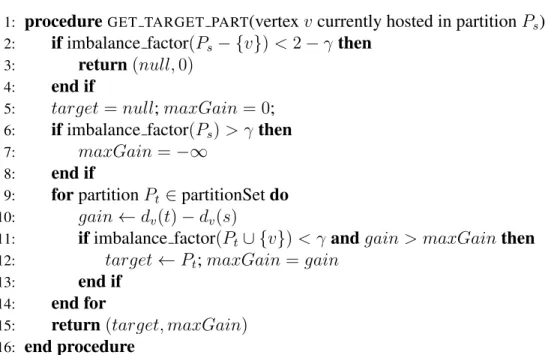
When a vertex v is a candidate for migration to more than one partitions, the partition with maximum gain is selected as the target partition of the vertex. This is illustrated in Algorithm3.2. Note that detecting whether a vertexvis a candidate for migration and selecting its target partition is performed using only the repartitioning metadata. Precisely, for detecting underloaded and overloaded partitions (respectively Lines 2, 5 and 11) the algorithm uses the weight of the vertex and all partitions; these are included in the metadata. Similarly, for calculating the gain of moving
v from partition Ps to partition Pt (Line 8), it uses the number of neighbors ofv in any of the
Recall that the repartitioning algorithm runs on each partition separately. Here, we describe d g f h e i 1 Partition 2 Partition c a b d g f h e i 1 Partition 2 Partition c a b d g f h e i 1 Partition 2 Partition c a b d g f h e i 1 Partition 2 Partition c a b
(a) Initial graph, before the first iteration.
d g f h e i 1 Partition 2 Partition c a b d g f h e i 1 Partition 2 Partition c a b d g f h e i 1 Partition 2 Partition c a b d g f h e i 1 Partition 2 Partition c a b
(b) The resulted graph if vertices migrate at the same stage. d g f h e i 1 Partition 2 Partition c a b d g f h e 1 Partition c a b d g f h e i 1 Partition 2 Partition c a b d g f h e i 1 Partition c a b
(c) The resulted graph after the first stage.
d g f h e i 1 Partition 2 Partition c a b d g f h e i 1 Partition 2 Partition c a b d g f h e i 1 Partition 2 Partition c a b d g f h e i 1 Partition 2 Partition c a b
(d) The final graph after the second stage. Figure 3.1: An unsupervised repartitioning might result in oscillation. Consider the partition-ing depicted in (a). The repartitioner on partition 1 detects that migratpartition-ingd, e, f to partition 2 improves edge-cut; similarly, the repartitioner on partition 2 tends to migrateg, h, ito partition 1. When the vertices move accordingly, as depicted in (b), the edge-cut does not improve and the repartitioner needs to moved, e, f and h, iagain. To resolve this issue, in the first stage of rerpartioning of (a), the vertices d, e, f are migrated from partition 1 (lower ID) to partition 2 [dark arrows]. After this, as depicted in (c), the only vertex which requires to migrate in the second stage is vertexg which moves from partition 2 (higher ID) to migration 1 (d).
1: procedureGET TARGET PART(vertexv currently hosted in partitionPs) 2: ifimbalance factor(Ps− {v})<2−γ then
3: return(null,0)
4: end if
5: target=null;maxGain= 0;
6: ifimbalance factor(Ps)> γthen
7: maxGain=−∞
8: end if
9: forpartitionPt ∈partitionSetdo
10: gain←dv(t)−dv(s)
11: ifimbalance factor(Pt∪ {v})< γ andgain > maxGainthen
12: target←Pt;maxGain=gain
13: end if
14: end for
15: return(target, maxGain)
16: end procedure
Figure 3.2: Choosing the migration target partition
how the algorithm works in each iteration. For each partitionPs, after selecting the candidate
vertices for migration and their target partitions, the algorithm selectskcandidate vertices which have the highest gains among all vertices and proceeds by (logically) migrating these top-k ver-tices to their target partitions. Here, migrating a vertex means sending (and updating) the meta-data associated with the vertex to its target destination [and updating the metameta-data associated with partition weights accordingly]. The algorithm restricts the number of migrated vertices in each iteration (to k) to avoid imbalanced partitionings. Note that, when selecting the target partition for a migrating vertex, the algorithm does not know the target partition of other vertices; hence, there is a chance that a large number of vertices migrate to the same partition to improve edge-cut. Selecting only k vertices enables the algorithm to control the cumulative weight of partitions by restricting the number of migrating vertices. Later, we discuss how the value ofkis selected. In general, takingk as a small, fixed fraction ofn(size of the graph) gives satisfactory results.
Algorithm3.3shows the details of one iteration of the repartitioner algorithm performed on a partitionPs. The algorithm detects the candidate vertices (Lines 4-8), selects the top-k candidates
(Line 9), and moves them to their respective target partitions. Note that the migration in Line 11 is a logical migration only, in the sense that only the metadata associated with vertices is migrated. After each phase of each iteration, the metadata associated with each migrated vertex