Dynamic Service Chain Composition in
Virtualised Environment
by
Wajdi Hajji
A Doctoral Thesis
Submitted in partial fulfilment
of the requirements for the award of
Doctor of Philosophy
of
Loughborough University
28th October 2018
Abstract
Network Function Virtualisation (NFV) has contributed to improving the flex-ibility of network service provisioning and reducing the time to market of new services. NFV leverages the virtualisation technology to decouple the software im-plementation of network appliances from the physical devices on which they run. However, with the emergence of this paradigm, providing data centre applications with an adequate network performance becomes challenging. For instance, virtu-alised environments cause network congestion, decrease the throughput and hurt the end user experience. Moreover, applications usually communicate through multiple sequences of virtual network functions (VNFs), aka service chains, for policy enforcement and performance and security enhancement, which increases the management complexity at to the network level.
To address this problematic situation, existing studies have proposed high-level approaches of VNFs chaining and placement that improve service chain perform-ance. They consider the VNFs as homogenous entities regardless of their specific characteristics. They have overlooked their distinct behaviour toward the traffic load and how their underpinning implementation can intervene in defining resource usage. Our research aims at filling this gap by finding out particular patterns on production and widely used VNFs. And proposing a categorisation that helps in reducing network latency at the chains.
Based on experimental evaluation, we have classified firewalls, NAT, IDS/IPS, Flow monitors into I/O- and CPU-bound functions. The former category is mainly sensitive to the throughput, in packets per second, while the performance of the latter is primarily affected by the network bandwidth, in bits per second. By doing so, we correlate the VNF category with the traversing traffic characteristics and this will dictate how the service chains would be composed. We propose a heuristic calledNatif, for a VNF-Aware VNF insTantIation and traFfic distribution scheme, to reconcile the discrepancy in VNF requirements based on the category they belong to and to eventually reduce network latency. We have deployed Natif in an OpenStack-based environment and have compared it to a network-aware VNF composition approach. Our results show a decrease in latency by around 188% on average without sacrificing the throughput.
Acknowledgements
I would like to thank Loughborough University and Liverpool John Moores Uni-versity for supporting me during my PhD study.
I am grateful to my supervisors, Dr Posco Tso, Dr Iain Phillips, and Prof Qi Shi, for the help and guidance. I cannot forget how collaborative was the administrative staff in the Universities above, Tricia Waterson, Elizabeth Hoare, Bill Atherton, and Judith Poulton.
Thanks to my colleagues Akeel, Raul, Thiago for their kindness. My best wishes to them.
My gratitude goes also to my friend Slim, who has helped me in developing my career.
I would like to thank Ramzi, Riadh, Mohamed, my family, and my parents for their kind words and support.
Publications
Conference Proceedings
(i) Jeremy Singer, Herry Herry, Philip J Basford,Wajdi Hajji, Colin S Perkins, Fung Po Tso, Dimitrios Pezaros, Robert D. Mullins, Eiko Yoneki, Simon J. Cox, and Steven J. Johnston. “Next Generation Single Board Clusters”. In:Network Operations and Management Symposium (NOMS), 2018 IEEE / IFIP (Accepted). IEEE.
(ii) Wajdi Hajji, Thiago Lopes Genez, Fung Po Tso, Lin Cui, and Iain Phillips. “Dynamic Network Function Chain Composition for Mitigating Network Latency”. In:Computers and Communications (ISCC), 2018 IEEE Sym-posium on. IEEE. 2018.
(iii) Gabor Kecskemeti, Wajdi Hajji, and Fung Po Tso. “Modelling Low Power Compute Clusters for Cloud Simulation”. In:Parallel, Distributed and Net-work based Processing (PDP), 2017 25th Euromicro International Conference on. IEEE. 2017, pp. 3945.
(iv) Wajdi Hajji, Fung Po Tso, Lin Cui, and Dimitrios P Pezaros. “Experi-mental evaluation of SDN-controlled, joint consolidation of policies and vir-tual machines”. In:Computers and Communications (ISCC), 2017 IEEE Symposium on. IEEE. 2017, pp. 13381343.
Journal Papers
(i) Wajdi Hajji and Fung Po Tso. “Understanding the performance of low power Raspberry Pi Cloud for big data”. In Electronics 5.2 (2016), p. 29.
Contents
Abstract ii Acknowledgements iii Publications iv 1 Introduction 1 1.1 Motivation . . . 11.2 Research hypothesis and objectives . . . 5
1.3 Original contributions . . . 5
1.4 Thesis overview . . . 6
2 Background and Key Concepts 8 2.1 Virtualisation . . . 8
2.2 Software Defined Networks . . . 9
2.3 Network Function Virtualisation . . . 11
2.3.1 NFV considerations . . . 11
2.3.2 NFV architecture . . . 12
2.4 Service Function Chaining . . . 12
2.4.1 SFC definitions . . . 13
2.4.2 SFC architecture . . . 14
2.4.3 A catalogue of middleboxes . . . 15
2.5 Summary . . . 18
3 Literature Review 19 3.1 Data centre networks . . . 20
3.2 Network latency . . . 24
3.3 Service chains . . . 26
3.4 Summary . . . 32
4 Research Methodology 33 4.1 Finding system characteristics from testbed experiments . . . 33
4.1.1 Studying the virtualisation impact . . . 33
4.1.2 Characterising the NF performance . . . 34
4.1.3 Running big data applications on a cluster of IoT devices . . 35
4.2 Mathematical modelling . . . 35
4.3 Tesbted evaluation . . . 36
4.4 Limitations of the method . . . 37
4.5 Other methods . . . 38
4.5.1 Simulation . . . 38
4.5.2 Emulation . . . 38
4.6 Summary . . . 39
5 Virtualisation and NF Characterisation 40 5.1 Virtual Network Function (VNF) . . . 40
5.1.1 Experiment Setup . . . 40
5.1.2 Experiment Results . . . 42
5.2 Network Function performance bottlenecks . . . 43
5.3 Network Function Software implementation . . . 46
5.4 Network Function reordering in the network chain . . . 47
5.5 Proof-of-concept experiments . . . 48
5.5.1 Idea . . . 49
5.5.2 Method . . . 49
5.5.3 Experiment set-up . . . 50
5.5.4 Results and conclusion . . . 54
5.6 Summary . . . 56
6 Dynamic Network Function Composition 57 6.1 Problem formulation and modelling . . . 57
6.1.1 Problem notations . . . 57
6.1.2 Problem definition . . . 61
6.2 Natif’s mechanisms . . . 62
6.2.1 Network Function instantiation . . . 63
6.2.2 Traffic distribution . . . 65
6.2.3 Traffic prediction . . . 66
6.3 Conclusions . . . 67
7 Experimental Evaluation 68 7.1 System design and implementation . . . 68
7.1.1 System architecture . . . 68
7.1.2 Controller modules . . . 68
7.2.1 Testbed experiment . . . 70
7.2.2 Network performance evaluation . . . 71
7.2.3 Computational utilisation . . . 73
7.2.4 Algorithm evaluation . . . 73
7.2.5 Prediction model evaluation . . . 75
7.3 Conclusion . . . 76
8 Conclusions and Future Work 77 8.1 Summary . . . 77
8.2 Conclusions . . . 77
8.3 Future work . . . 78
8.3.1 Application performance benchmarking on Raspberry Pi . . 78
8.3.2 Service Chains Cloning and Placement in the Context of Edge Computing . . . 79
References 81 A Understanding the Performance of Low Power Raspberry Pi Cloud for Big Data 90 A.1 Experiment Setup . . . 90
A.1.1 Single Node Experiments . . . 91
A.1.2 Cluster Experiments . . . 91
A.2 Experiment Results . . . 93
A.2.1 Single Node Performance . . . 93
A.2.2 Spark and HDFS in the Native Environment . . . 94
A.2.3 Spark and HDFS in Docker-Based Virtualised Environment 98 A.3 Summary . . . 101
B Experimental Evaluation of SDN-Controlled, Joint Consolidation of Policies and Virtual Machines 103 B.1 Sync Algorithm . . . 103
B.1.1 Get Communicating VM Groups . . . 104
B.1.2 Policy Migration . . . 104
B.1.3 VM Migration . . . 105
B.2 System Design and Implementation . . . 105
B.2.1 System Architecture . . . 105
B.2.2 Controller Modules . . . 106
B.2.3 Communication . . . 108
B.3 Experimental Evaluation . . . 109
B.3.2 Group Formation . . . 110
B.3.3 Overall Performance Results . . . 110
B.3.4 Resources Utilisation . . . 113
List of Figures
1.1 Service function chains in data centre [1] . . . 2
1.2 Latency traps . . . 3
1.3 Traffic changing effects of network functions. NF m1 doubles the traffic volume while m2 cuts it in half [2] . . . 3
1.4 VNF performance bottlenecks . . . 4
2.1 Logical layers in SDN [3] . . . 10
2.2 NFV architecture [?] . . . 13
2.3 Service classifier [4] . . . 15
2.4 SFC architecture [5] . . . 15
3.1 VNF placement problem: find a location of each VNF in the chain on the available servers according to a specific goal, e.g., latency, bandwidth, resource utilisation, and number of forwarding rules . . 27
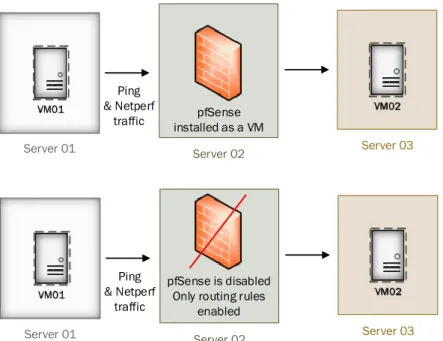
5.1 Network Topology in pfSense Experiment . . . 41
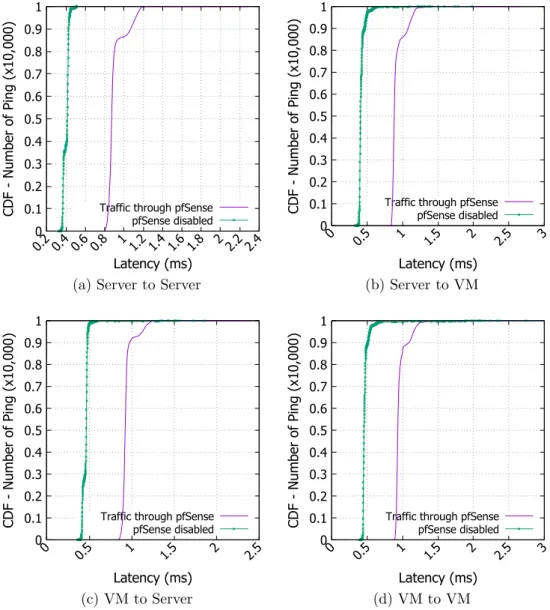
5.2 Latency measurements . . . 44
5.3 Netperf test with virtual VNF (pfSense FW) . . . 45
5.4 Different impacts of high packet rate and throughput on the re-sources utilisation at network functions . . . 45
5.5 NF implementation impact on the CPU usage . . . 46
5.6 Parallel “Detect” in Suricata IDS . . . 47
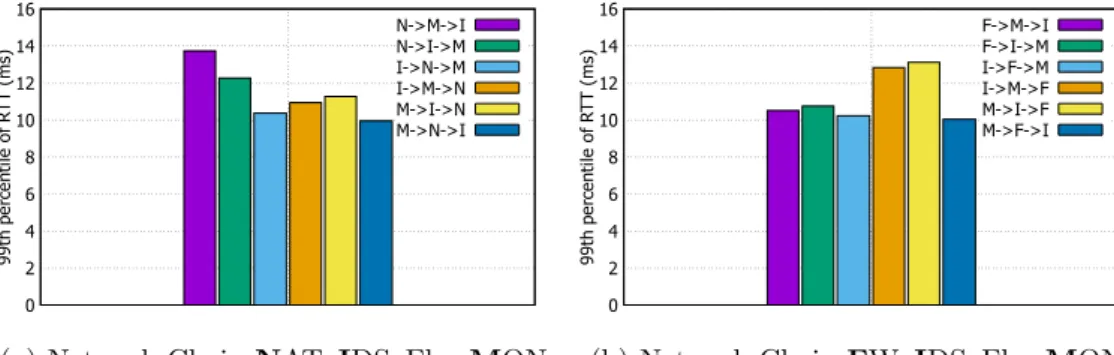
5.7 Impact of VNF order on the end-to-end delay of network chains. However, we ignore the implementation of the VNF. . . 48
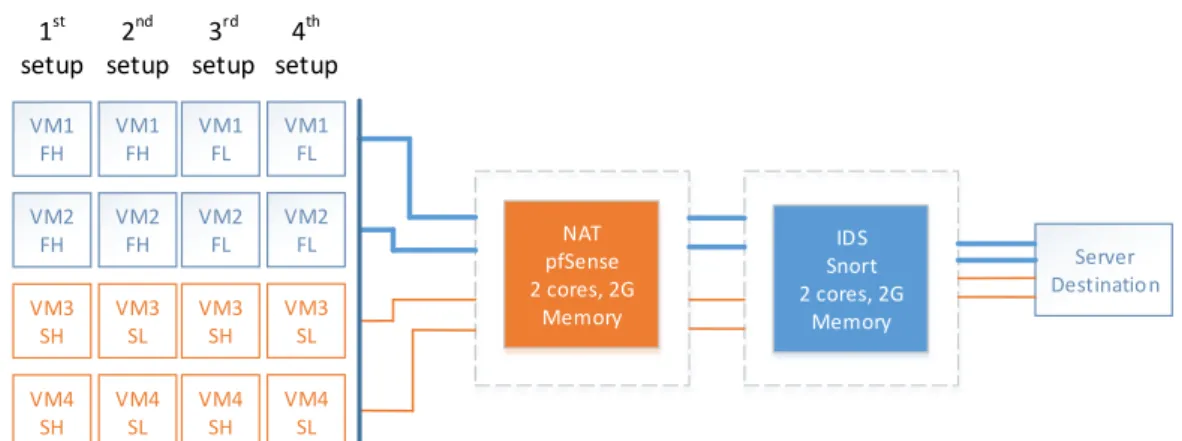
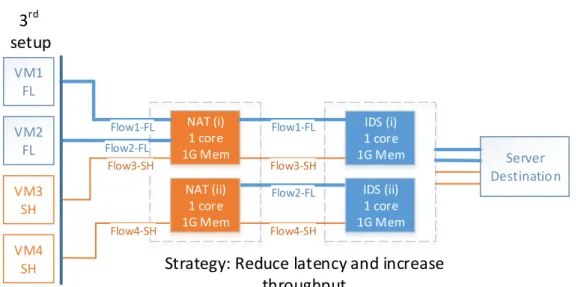
5.8 A particular use case where N flows belong to SH traffic category and M flows to FL category – see “Traffic characteristics” for SH and FL meaning . . . 50
5.9 Traffic traversing a service chain composed of a NAT and an IDS . 51 5.10 Applied traffic: FHSH – Packets at high rate are sent to the NFs, extreme network conditions. Traffic distribution takes place to re-duce or avoid the packet loss and then to improve the network latency and throughput as much as possible . . . 52
5.12 Applied traffic: FLSH – Same objective as for the traffic category
FHSL . . . 52
5.11 Applied traffic: FHSL – Traffic at high and low packet rates, the traffic distribution plays crucial role to reduce latency and increase throughput, and also to reduce the packet loss . . . 53
5.13 Applied traffic: FLSL – The network conditions are ideal (traffic at low rate), the objective of traffic distribtion is to stabilise the network performance . . . 53
5.14 Packet loss has been significantly reduced for FH and SH traffics. We must note that these results have been conducted as a proof of concept for proving the usability of our approach. We stressed our experiment environment to highlight the benefit of our idea. So in real data centre, resources will be sufficiently supplied to the infrastructure and we will not that high packet loss. . . 54
5.15 Network latency decreases for all kinds of traffic - except for FLSL where it remains the same . . . 54
5.16 Network throughput increases more for FH traffic . . . 55
6.1 Chain sub-branches . . . 60 6.2 Algorithms application . . . 66 7.1 OpenStack setup . . . 69 7.2 System design . . . 70 7.3 RTT (ms) . . . 71 7.4 Throughput (Mbps) . . . 72
7.5 CPU and memory usage captured at the compute node where all the VNFs are running . . . 73
7.6 Runtime and CPU usage of the three algorithms while performing VNF instantation and flow mapping. G, SB, and N refer to Greedy, StratosB, and Natif, respectively . . . 74
7.7 Arima prediction mode accuracy . . . 76
8.1 Differences between Container, Unikernel, and Virtual Machine [6] . 79 8.2 Simple scenario of chain cloning and placement . . . 80
A.1 Cluster Layout. (a) Native set-up; (b) Virtualised set-up. . . 92
A.2 Single server performance. (a) Server throughput; (b) Network throughput; (c) CPU utilisation. . . 93
A.3 CPU and memory usage. (a) 1 GB file; (b) 4 GB file; (c) 6 GB file. 95 A.4 Network transmission (TX) and reception (RX) rates. (a) 1 GB file; (b) 4 GB file; (c) 6 GB file. . . 96
A.5 Energy measurement in a Raspberry Pi Worker node in WordCount job. (a) WordCount Job 4-6 GB files); (b) WordCount Job (1-4-8 GB files). . . 97
A.6 Energy measurement in a Raspberry Pi Worker node in Sort job. (a) Sort job (1-4-6 GB files); (b) Sort job (1-4-8 GB files). . . 97
A.7 CPU and memory usage in WordCount job. (a) 1 GB file; (b) 4 GB file; (c) 6 GB file. . . 99
A.8 CPU and memory usage in Sort job. (a) 1 GB file; (b) 4 GB file; (c) 6 GB file. . . 99
A.9 Transmission (TX) and reception (RX) rates in WordCount job. (a) 1 GB file; (b) 4 GB file; (c) 6 GB file. . . 100
A.10 Transmission (TX) and reception (RX) rates in Sort job. (a) 1 GB file; (b) 4 GB file; (c) 6 GB file. . . 100
A.11 Energy measurement in WordCount job. (a) 1 GB file; (b) 4 GB file; (c) 6 GB file. . . 101
A.12 Energy measurement in Sort job. (a) 1 GB file; (b) 4 GB file; (c) 6 GB file. . . 101
B.1 Architecture design . . . 106
B.2 Group distribution . . . 109
B.3 Sync performance evaluated with growing number of flows, group sizes in the three levels are 36, 31, 19, respectively. . . 109
B.4 Sync performance evaluated with growing number of VMs, group sizes in the three levels are 4, 14, 19, respectively. . . 111
B.5 Sync performance evaluated with growing number of MBs, group sizes in the three levels are 25, 21, 19, respectively. . . 111
B.6 Group average runtime measured with growing number of VMs, Flows, and MBs . . . 113
List of Tables
2.1 Examples of middleboxes [7] . . . 16
3.1 Summary of efforts made in the area of data centre networks . . . . 22
3.2 Summary of some works tackling latency problem . . . 25
3.3 Summary of service chains related works . . . 29
5.1 Classification of studied VNFs . . . 47
A.1 Execution times for WordCount and Sort jobs in the Native Envir-onment. . . 94
A.2 Execution times for WordCount and Sort jobs in Virtualised Envir-onment. . . 98
Chapter 1
Introduction
1.1
Motivation
A wide range of data centre applications are sensitive to latency, for example, high-frequency trading [8], high-performance computing, RAM-Cloud [9–11], and Online Data-Intensive (OLDI) [12]. As a result, a network performance degrad-ation seen in these applicdegrad-ations can risk user engagement and potential business revenue [13]. It is reported that every 100ms of latency cost Amazon 1% in sales [14].
In data centres, applications are typically communicating through a set net-work functions (NFs) [15], as demonstrated in Fig. 1.1, which are, according to IETF, “functional building blocks within a network infrastructure”, having “well-defined external interfaces and a well-“well-defined functional behavior. In practical terms, a Network Function is today often a node or physical appliance”. NFs such as firewall, proxies and WAN optimisers have become a critical part of today’s data centres. They are essential in guaranteeing security and improving perform-ance. A survey on Enterprise middlebox (a synonym of network appliance) in 2011 has revealed that the number of middleboxes was on par with the number of layer-3 routers [16]. Also, these NFs are rarely being used in isolation, they are commonly deployed in chains and are typically interposed between the com-municating hosts [17,18]. For instance, to fulfil changing policy requirements, multiple NFs need to be dynamically chained in an ordered sequence for the deliv-ery of end-to-end services. Nevertheless, being in composition, NFs can provoke a mutual interference as they can change the volume of the processed traffic [2], which can cause resource, such as network and CPU, bottlenecks in the chain. As a result, network latency starts to build up and degrade the performance of latency-sensitive applications [19].
NFV has facilitated the transformation of NFs to software applications running
Figure 1.1: Service function chains in data centre [1]
on vendor-independent commodity servers in virtual forms (Virtual Machines or Containers), which provides flexibility in offering dynamic services fulfilling rapidly changing user demands [3].
Whereas, in addition to the performance problem caused by the NF chaining, virtualisation technology leveraged by NFV is considered one of the main reasons behind network congestion at computational and network appliances. Fig. 1.2
shows four latency traps in a simple network comprising communicating hosts (Virtual Machines (VMs)), a virtual network function, and a forwarding device (switch). At point (1) the hypervisor on the physical host schedules the transmis-sion of the packets to the server VMs. This has turned out to be a real problem in Amazon EC2, and it causes large tail latency between EC2 instances [20]. At (2), the physical host network stack has to fulfil I/O requests for multiple VMs, which is another source of excessive latency [21]. Similarly, at (3) both traps described
VM1 VM2 VM3 Switch (4) Switch queuing delay (1) VM scheduling delay Virtualisation layer Host OS Virtualisation layer (3) queuing delay Virtualisation layer (3) queuing delay
Virtual Network Function
(2) Host network queuing delay
Figure 1.2: Latency traps
Figure 1.3: Traffic changing effects of network functions. NFm1doubles the traffic
volume while m2 cuts it in half [2]
in (1) and (2) coexist since the network function is running in a virtual host such as VM or LXC (Linux Containers). Lastly, (4) is where traffic can experience queuing at switch. Also, VMs on the same physical host can contend for lim-ited bandwidth available to that host ignoring the specific requirements of each other [21].
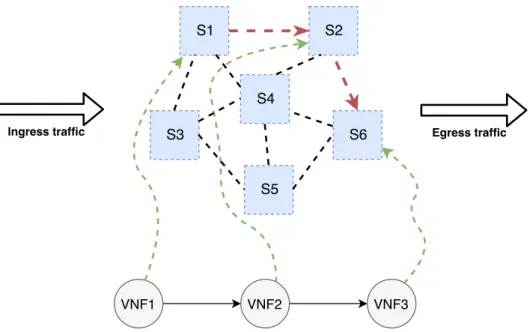
In service composition, current studies tackle the latency problem in the service chains by proposing high-level strategies managing the VNF instances without considering their characteristics such as the ways they are handling the traffic load. For example, VNF placement optimisation [22], VNF chaining [23,24] and VNF parallelisation [25] improve latency by shortening end-to-end paths. How-ever, they see VNFs as black boxes and neglect their internal packet processing characteristics.
VNFs are software applications running inside a virtualised environment. While software performance is bounded by either I/O or CPU or both of them. In
0 20 40 60 80 100 120 5 10 15 20 25 30 35 >90% CPU
interrupts >90% CPU interrupts
<5% CPU interrupts <5% CPU interrupts C P U u sa ge ( %) Runtime (s) 20kpps x 1400 bytes / NAT
20kpps x 8 bytes / NAT 20kpps x 1400 bytes / IDS20kpps x 8 bytes / IDS
(a) CPU use at pfSense NAT and Snort IDS
0 20 40 60 80 100 120 0 10 20 30 40 50 60 70 C P U u sa ge ( % ) Runtime (s) Suricata/core(1)
Suricata/core(2) Snort/core(1)Snort/core(2)
(b) Multi-threaded Suricata IDS vs. single-threaded implementation in Snort
Figure 1.4: VNF performance bottlenecks
eral, I/O bound application is when the completion time primarily depends on the waiting time for input/output operations to complete. CPU-bound application is when the completion time principally depends on the speed of central processor or widely known as CPU.
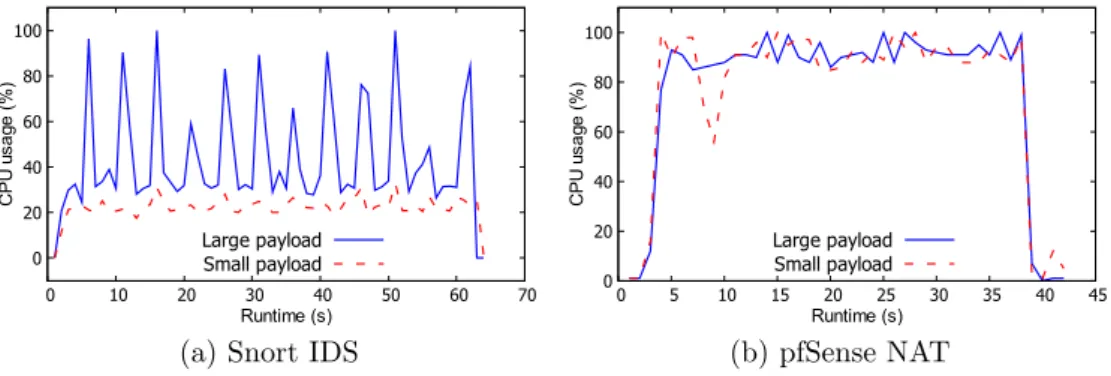
We argue that VNFs are no exception. To demonstrate this, we have eval-uated the resources usage at three VNFs, pfSense Network Address Translator (NAT), Snort Intrusion Detection System (IDS), and Suricata IDS. Each one of them is deployed on a Virtual Machine (VM) with 1Gbps vNIC, 1vCPU, and 1GB RAM. Fig. 1.4a depicts a distinct CPU usage, and CPU interrupts activities at pfSense NAT and Snort IDS despite being allocated similar resources and hand-ling the same network traffic. This is because pfSense NAT is insensitive to the packet payload since it only handles the packet header. At each packet arrival, it calls its subroutine running in the user space which results in high CPU inter-rupts (interrupt-driven I/O), hence I/O-bound. We have found that the effective computation of pfSense NAT is only around 2% of the total CPU usage. In com-parison, the Snort IDS, using community rules1, buffers and inspects the data
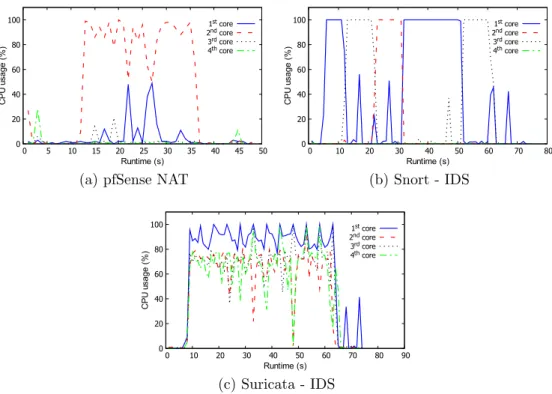
carried out in the packet payloads, a CPU-intensive task, hence CPU-bound. In-terestingly, our experiments have also revealed that Suricata IDS, a multi-threaded application, efficiently uses the CPU resources while Snort IDS, a single-threaded implementation, only uses one core at a time, as shown in Fig.1.4b.
To sum up, we have shown three main challenges in the current data centre environments, namely, virtualisation overhead effect on the application network performance, VNF chaining, and lack of exploiting the VNF proprieties in the existing VNF management schemes. In next section, we, therefore, present our research hypothesis and aims in investigating and addressing the problems above.
1https://www.snort.org/downloads/#rule-downloads
1.2
Research hypothesis and objectives
We aim to mitigate the network latency at the service chain, ordered or partially ordered sequence of general network functions (NFs). This will have a signific-ant impact of the network performance of latency-sensitive applications. For this purpose, we aim to experimentally understand to what extent the virtualised en-vironment can degrade NFs performance. On the other hand, unlike the existing NF management approaches that neglect the NF characteristics [22][23][24][25], we are looking for studying different types of NFs to find out a particular pattern relating them or an interesting characterisation that can be exploited in the chain composition and traffic steering. To do so, we leverage Software Defined Net-works, Service Function Chaining, and NFV paradigms in designing testbed and for preliminary assessment and solution implementation. Lastly, we demonstrate how our research can be an extension of the state-of-the-art through showing the advantage of its outcomes comparing with concurrent works.
We define the following aim and the corresponding objectives.
• Aim: Provide a novel VNFs characterisation that is able, where exploited, to improve the service chain network performance.
In order to achieve the above aim. We proceed with the following steps.
– Study a set of open source and production VNFs, namely, pfSense NAT, pfSense firewall, Snort IDS, Suricata IDS, and Open vSwitch as a traffic monitoring VNF.
– Exploit the experimental study of the above VNFs in a mathematical formulation and modelling of the VNF instantiation and traffic distri-bution problem.
– Propose a heuristic for VNF-aware service chain composition.
– Implement the proposed solution in an OpenStack based testbed to demonstrate its efficiency compared to a network-aware approach.
1.3
Original contributions
Contrary to the existing approaches that work on VNF composition, parallelisation and placement. Ours consider the specificity of each VNF. The classification we propose is inspired from the fact that any software application can belong to one or both of these categories I/O- and CPU-bound. This observation is still applicable on VNFs and we aim to exploit it in our chain composition. In this section, we
show how the research questions we pose lead to the main contribution of our work.
• RQ1: How can we understand the virtualisation affect on the network func-tions performance?
– Study the network performance of a production VNF, virtual firewall, and compare its performance with its counterpart in bare-metal deploy-ment.
• RQ2: Is it possible to classify the network functions based on their perform-ance bottlenecks?
– We use the categorisation that applies on any software application, which is I/O- versus CPU-bound. We also experimentally study open source and production virtual network functions regarding 1) the im-pact of the software implementation on their resource utilisation, 2) their sensitivity to traffic load, and 3) how their order can impact the performance of the service chain.
• RQ3: How does the experimental analysis of the network functions help in improving the service chains network performance?
– We exploit the experimental knowledge to mathematically model the virtual network function instantiation and traffic distribution problem. Since the problem has been proved NP-hard, we design a heuristic that correlates the network function and the traffic characteristics based on the VNFs categorisation. We validate our approach through conducting testbed experiments in production environment.
• RQ4: How does our research advance the state-of-the-art?
– Through the literature review, we have identified occasions to improve-ments in the existing service chain composition schemes. Current stud-ies in service composition neglect the particularitstud-ies of network func-tions, they instead treat them as black boxes. We highlight how our research differs from the existing studies. We demonstrate how exploit-ing the VNF characteristics improve the overall performance of service chains.
1.4
Thesis overview
This thesis is organised as follows.
Chapter 1 (this chapter) illustrates the main motivations of our research work. It highlights the significance of latency in today’s data centre networks and its particular impact on latency-sensitive applications. Also, it shows the ubiquitousness of service chains and how the sequential processing of packets at virtual NFs can degrade the network performance of data centre applications. Moreover, it demonstrates the lack of considering the performance bottlenecks at the NFs in the existing approaches. Afterwards, the chapter describes our aims and objectives, and our contribution to the research, then it gives an overview of the thesis structure (this section) and ends up with listing our publications.
Chapter 2 defines the background of our research such as the leveraged paradigms, namely, virtualisation technology, SDN, NFV, and SFC.
Chapter 3 describes the literature review, e.g., works achieved in the con-text of data centre networks, attempts made to reduce network latency, and more related to our research, network function composition, chaining, design, and man-agement studies.
Chapter 4shows the methods we have adopted in our research. For example, benchmarking VNFs and setting up an OpenStack based experiment to run mul-tiple service chains. Also, the chapter illustrates other methods such as network simulation used to evaluate joint policy management and VM placement approach. Chapter 5 shows how the virtualisation can affect the performance of open source and production VNFs. It also describes the conducted experiments regard-ing the VNF characterisation, and it ends up with demonstratregard-ing how the ex-ploited knowledge on the VNFs can improve the network performance of a sample of service chains.
Chapter 6 describes the main contribution of our research work which is proposing a dynamic VNF composition that relates the traffic characteristics with the VNF performance bottleneck. We prove that the VNF instantiation and traffic distribution problem is an NP-hard problem which means that it does not have an optimal solution. As so, we formulate and model the problem, we propose our heuristic called Natif, and we describe the algorithms behind.
Chapter 7 describes the experimental setup for the solution evaluation, we show howNatif mitigates the latency without sacrificing the network throughput. We also compare it with a well-known network-aware approach for NF orchestra-tion. For instance, we evaluate the algorithms of the two methods as well as the resources utilisation of service chains composed and managed by each one of them. Chapter8concludes the thesis and shows the proposed approach’s limitations and new research directions. It also demonstrates how the acquired knowledge as well as the experimental evaluation can be usable and applicable in the context of edge computing. It illustrates practical ideas regarding such applicability.
Chapter 2
Background and Key Concepts
In this chapter, we describe the main concepts and paradigms that have been explored and leveraged. We explain the virtualisation technology as a key enabler of the Network Function Virtualization (NFV) and the broad adoption of virtual network appliances or functions (VNFs) in data centres. We also present the Software Defined Networks (SDN) as a concept calling for the centralisation of the network management and the dissociation of the control plane and the data plane. In the end, we describe the Service Function Chaining, and we highlight how it has enabled the application of our proposed approach in reducing the network latency.
2.1
Virtualisation
Virtualisation has been widely leveraged to fulfil the growing user needs asso-ciated with the advent of smart-phones and cloud computing service models. A wide range of resources has been virtualised such as computation process, memory, storage, and network [26]. Virtual Machines are the virtual form of the traditional computer units, and they are nowadays ubiquitous in data centres and work-places. Behind the concept of VM, related components have been consequently virtualised such as NIC (Network Interface Cards) and CPU resources. Open vSwitch, known as OVS, is among the first initiatives to implement virtual net-work switches. Moreover, the netnet-work has been virtualised like VLAN (virtual LAN) and VXLANs (virtual extensible LANs).
Virtualisation has been introduced for numerous reasons. 1) Sharing, which means that the same cable/link can be utilised by two different networks, the same processor or the same hard disk can be shared between more than a VM. As a result, sharing reduces the cost of hardware. 2) Isolation is a critical feature when multiple applications are running on the same server. Virtualisation ensures that
each resource can only be accessible by the right application or the right person. 3) Aggregation, contrary to the resources segregation, is achieved by grouping inexpensive resources to make up reliable resource, e.g., storage or memory. 4) flexibility, for, e.g., dynamic resource allocation, resource management and server provisioning and deployment. Also, VMs can be instantiated, deleted, cloned or migrated within minutes, which increases the productivity and reduces the customer’s waiting time [27]. In our research, virtualisation is utilised in virtual NFs and running data centre applications on testbed environments.
2.2
Software Defined Networks
SDN is an umbrella term that includes several technologies to facilitate the network management and improve the network flexibility to respond to changing business requirements. For example, network administrators can change network policies for specific network traffic from the controller without directly re-configuring the network devices, e.g., routers or switches. So, OpenFlow network protocol has been proposed to ensure the communication between the controller and the for-warding devices. Also, a network virtualisation approach is an SDN application that allows flexible network provisioning and dynamic flow scheduling [28] due to resources virtualisation. SDN is mainly bringing four innovations [27]:
• Separation of control and data plane: The traditional way to perform traffic steering is to configure the forwarding devices individually. This is apparently tedious especially if the traffic characteristics (e.g., source and destination IPs) can change over the time or there are many points on the forwarding path. Hence, SDN comes to resolve the problem above by separ-ating the control plane, where forwarding decisions and policy are set, from the data plane, where packets are forwarded. For example, implementations of the control plane such as Ryu, NOX, Floodlight allow applying custom-ised treatment over the packets and prepare the forwarding tables of the connected OpenFlow switches.
• Centralisation of the control plane: Distributed methods in forwarding packets were widely adopted before the emergence of SDN. For example, through network protocols like OSPF, IS-IS, and BGP, routers exchange information about their neighbours and available nodes in a way that the forwarding decision would be shared between the existing routers on the net-work. This achieves more reliable message transmission since the system can tolerate the failure of some routers. However, it presents performance issues comparing to the centralised approach in a sense that the routing algorithm
convergence depends on the routers’ status and consequently the information takes a while to be exchanged between them. Whereas in the centralisation approach, the controller probes the network topology, and since it would have visibility on the network, it can, therefore, decide which path should be used to forward the packers. Centralisation has scalability issues such as the impact of increasing workload with growing traffic on the controller’s performance, but this is addressed by setting up a controller cluster. For in-stance, the set of controllers can share the workload, or standby controllers can be launched in case of failure of the central controller.
• Programmable control plane: The control plane can be programmed according to the defined objectives. This has not been feasible in the dis-tributed method. Network administrators can develop and deploy applica-tions on the control plane, which offers high flexibility as well as innovation opportunities for network developers.
• Standarised APIs: Control plane needs standardised APIs to facilitate the development and deployment of network applications which are ensur-ing the traffic management. For example, OpenFlow as a Southbound API; interacting with the forwarding devices. Floodlight and OpenDaylight as Northbound API as it enables the integration with the developed applica-tions, and lastly the East-West API that enables the communication between different controllers. We show in Fig. 2.1 such layers in SDN architecture.
Figure 2.1: Logical layers in SDN [3]
2.3
Network Function Virtualisation
Network infrastructure should respond to the growing demands and the perform-ance challenges caused by the increasing workloads, a result of the proliferation of cloud and mobile applications. However, the network functions (NFs) and the computational nodes responsible for handling the incoming requests have been deployed using physical proprietary equipment. Also, NFs usually belong to net-work chains (sequence of NFs) and are configured within the chain according to a specific order to correctly ensure network services. Because of these constraints, deployment and validation could take weeks and months and require significant human involvement to maintain and manage the network asset [29].
Therefore, Telecommunication Service Provides (TSPs) have been looking for inventing ways and proposing new approaches to reduce their operating expenses (OPEX) and capital expenses (CAPEX). The solution has been to adopt the Network Function Virtualisation (NFV) leveraging the virtualisation technology to break the dependency on proprietary hardware, improve the network management and service agility, and reduce the time-to-market of new services. NFV is defined as an initiative to decouple the physical network equipment from the functions that are running on. NFV achieves that by virtualising the NF to mimic the VM concept in a way, they can run on commodity hardware. For instance, a firewall becomes a piece of software that can be installed on a VM or a container and afterwards deployed on commodity servers, or it is possible to aggregate multiple NFs and spin up them on the same server. As a consequence, managing NFs becomes as simple as managing VMs through hypervisors which means offering automation capabilities such as monitoring, deletion, live migration, instantiation and configuration.
2.3.1
NFV considerations
NFV to be convincing to the industry and academia, it should satisfy the following requirements. The first two requirements are exploited in our research while the last ones have been highlighted for informational purpose.
• Network architecture and performance: NFV should provide a reliable alternative to the physical deployment of the NFs. Otherwise, its contri-bution would be questionable. For instance, NFV should address possible network performance issues that can be a consequence of the virtualisation technology.
• Network scalability and automation: NFV should scale with the grow-ing number of subscribers and so the increasgrow-ing computation needs.
mation can play a critical role to overcome the scalability challenge, e.g., setting up controllers for resources management and usage optimisation (en-hancing the throughput or reducing the latency) [3].
• Security and high availability requirements: Diverse NFs can be de-ployed on the same commodity server, but they can belong to different ten-ants or subscribers. So, there is a need to isolate them from each other and resources allocation should be reliable and consistent to avoid performance interference between the NFs. Also, NF deployment plan should consider the availability requirements of each NF.
• Support for heterogeneity: Since NFV is a new approach and not yet totally adopted in production environments, its introduction should be pro-gressive and should take into consideration the legacy support. As a con-sequence, there should be an orchestration layer that can manage both vir-tual and physical infrastructure. Another aspect of supporting heterogeneity consists of breaking the dependence on proprietary hardware so that NFs can be deployable on servers from different vendors.
2.3.2
NFV architecture
NFV architecture is composed of three main components as shown in Fig. 2.2. 1) Network Function Virtualisation Infrastructure (NFVI), which represents the set of software and hardware needed to set up the environment on which VNFs run. 2) VNFs, which are the deployed virtual network appliances. A VNF can be deployed on VM. Moreover, 3) NFV Management and Orchestration (NFV MANO), which provides tools for monitoring and provisioning of VNFs.
2.4
Service Function Chaining
Network service chaining, also known as service function chaining (SFC) is a cap-ability that uses software-defined networking (SDN) capabilities to create a service chain of connected network services (such as L4-7 like firewalls, network address translation [NAT], intrusion protection) and connects them in a virtual chain. This capability can be used by network operators to set up suites or catalogues of connected services that enable the use of a single network connection for many services, with different characteristics [?]. However, in this thesis, we refer to the way VNF are instantiated and how traffic is steered within the chain by network service composition.
Figure 2.2: NFV architecture [?]
2.4.1
SFC definitions
NFV has reduced the time-to-market of new network services by virtualising the hardware-based network appliances or functions and thus accelerating their de-ployment on commodity servers. However, a proper interconnection of the net-work services is required to ensure the correct implementation of netnet-work policies. The mechanism allowing various virtual functions to be connected for a complete end-to-end service is called Service Function Chaining (SFC).
We list below essential definitions related to SFC.
• Classification: Locally instantiated matching of traffic flows against policy for subsequent application of the required set of network service functions. The policy may be a customer, network, or service specific.
• Network Overlay: A logical network built, via virtual links or packet encap-sulation, over an existing network (the underlay).
• Network Service: An offering provided by an operator that is delivered using one or more service functions. This may also be referred to as a composite service. The term “service” is used to denote a “network service” in the context of this document.
• Service Function (SF): it is a synonym to virtual functions, a function that is responsible for specific treatment of received packets. A service function can act at various layers of a protocol stack (e.g., at the network layer or other OSI layers). As a logical component, a service function can be realised
as a virtual element or be embedded in a physical network element. One or more service functions can be embedded in the same network element. Mul-tiple occurrences of the service function can exist in the same administrative domain. A non-exhaustive list of service functions includes firewalls, WAN and application acceleration, Deep Packet Inspection (DPI), server load bal-ancers, NAT44 [RFC3022], NAT64 [RFC6146], HTTP header enrichment functions, and TCP optimisers. The generic term ”L4-L7 services” is often used to describe many service functions.
• Service Overlay: An overlay network created for forwarding data to essential service functions.
• Service Function Chain: it defines an ordered or partially ordered set of general service functions (SFs) and ordering constraints that must be applied to packets, frames, and flows selected as a result of classification. An example of an abstract service function is a firewall. The implied order may not be a linear progression as the architecture allows for SFCs that copy to more than one branch, and also allows for cases where there is flexibility in the order in which service functions need to be applied. The term “service chain” is often used as shorthand for “service function chain” [30].
2.4.2
SFC architecture
The SFC architecture proposed by IETF suggests encapsulating the packets with information describing the service path of a service function chain. This is achieved by adding Network Service Header (NSH) to the packets at the service classifier (SC) located at the data plane, e.g., as shown in Fig. 2.3. The SC determines which packets need treatment and what the service path that should follow. The SF Forwarder (SFF) considers the NSH field in the packet for the traffic steering. An SFC Aware SF can update the NSH header. In particular, the first node in the service chain adds NSH field while the last node removes it [31].
In case the SFC SF is NHS-unaware (e.g., legacy service functions), an SFC-Proxy can be used to ensure the NSH packet encapsulation between the SF and the SFF (Fig.2.4).
Figure 2.3: Service classifier [4]
Figure 2.4: SFC architecture [5]
2.4.3
A catalogue of middleboxes
The table 2.1 introduces some examples of middleboxes to give an overview on the types of middleboxes used in data centre networks.
Table 2.1: Examples of middleboxes [7]
Middlebox Description
NAT Network Address Translator. A function, often built into a router, that dynamically assigns a globally unique address to a host that doesn’t have one, without that host’s knowledge.
NAT–PT
NAT with Protocol Translator. A function, normally built into a router, that performs NAT between an IPv6 host and an IPv4 network, additionally translating the entire IP header between IPv6 and IPv4 formats.
SOCKS gateway It is a stateful mechanism for authenticated firewall traversal, in which the client host must communicate first with the SOCKS server in the firewall before it is able to traverse the firewall
IP Tunnel Endpoints
Tunnel endpoints, including virtual private network endpoints, use basic IP services to set up tunnels with their peer tunnel endpoints which might be anywhere on the Internet. Tunnels create entirely new “virtual” networks and network interfaces based on the Internet infrastructure, and thereby open up some new services. Tunnel endpoints base their forwarding decisions at least partly on their policies, and only partly if at all on information visible to surrounding routers.
Packet classifiers, markers and schedulers
Packet classifiers classify packets flowing through them according to policy and either select them for special treatment or mark them, in particular for differentiated services. They may alter the sequence of packet flow through subsequent hops, since they control the behaviour of traffic conditioners.
TCP performance enhancing proxies
“TCP spoofer” is often used as a term for middleboxes that modify the timing or action of the TCP protocol in flight to enhance performance.
Load balancers that divert/munge packets
There is a variety of techniques that divert packets from their intended IP destination or make that destination ambiguous. The motivation is typical to balance the load across servers, or even to split applications across servers by IP routing based on the destination port number.
IP Firewalls
The simplest form of firewall is a router that screens and rejects packets based purely on fields in the IP and Transport headers (e.g., disallow incoming traffic to certain port numbers, disallow any traffic to certain subnets, etc.)
Application Firewalls Applicationlevel firewalls act as a protocol endpoint and relay (e.g., an SMTP client/server or a Web proxy agent).
Application-level gateways
These come in many shapes and forms. NATs require ALGs for certain addressdependent protocols such as FTP; these do not change the semantics of the application protocol but carry out mechanical
substitution of fields. At the other end of the scale, still using FTP as an example, gateways have been constructed between FTP and other file transfer protocols such as the OSI and DECnet (R) equivalents. In any case, such gateways need to maintain state for the sessions they are handling, and if this state is lost, the session will normally break irrevocably.
Gatekeepers/ session control boxes
Particularly with the rise of IP Telephony, the need to create and manage sessions other than TCP connections has arisen. In a multimedia environment that has to deal with name lookup, authentication, authorisation, accounting, firewall traversal, and sometimes media conversion, the establishment and control of a session by a thirdparty box seems to be the inevitable solution.
Transcoders Transcoders are boxes performing some onthefly conversion of application-level data.
Proxies An intermediary program which acts as both a server and a client to make requests on behalf of other clients.
2.5
Summary
This chapter has illustrated the background and fundamental concepts used in our research. We have illustrated how the virtualisation technology is a key enabler for NFV, SFC, and SDN paradigms. It has also presented the essential definitions in the SFC context and illustrated examples of network functions. In the next chapters, we show use cases of SDN, SFC, and NFV applications. For instance, development of a joint consolidation of policies and virtual machines, VNF de-ployment and characterisation VNFs, and service chain composition using SFC principles to reduce the network latency.
Chapter 3
Literature Review
Many cloud applications in multi-tenant data centres are distributed in nature and require guaranteed latency and bandwidth to afford an acceptable user ex-perience [12]. Providing such guarantees has been challenging for several consid-erations; queues the most disturbing factor of network performance is an additive end-to-end property [12], and it is developing in many points in data centres, e.g. Virtual Machines, Switches and Virtual Appliances. Moreover, low latency and high throughput are two contradictory goals and prioritising one of them leads to the regression of other [11,13]. Recent studies have proposed approaches that reconcile between these two ends, whereas after the emergence of NFV techno-logy and with the broad adoption of network appliances in data centres, those approaches have still been limited to improve network performance at the level of the forwarding devices with no particular consideration of the network functions performance. The existing studies are worth to explore as they present relevant techniques to our current research. Thus, one of the aims of the chapter is to give an overview of these works, what challenges they have been addressing and how they have overcome.
We also cover the renewed focus on network latency metric and the efforts that have been made to mitigate it in data centre environments. We also highlight the noticeable degradation of network performance caused by the virtualisation technology and how such an overhead has been addressed.
Lastly, we describe the studies that have been looking at improving the net-work chains performance regarding the end-to-end delay and the throughput. We illustrate the different approaches to tackling the problem, such as NF chaining and placement, NF parallelisation, and NF resources requirement provisioning and prediction.
3.1
Data centre networks
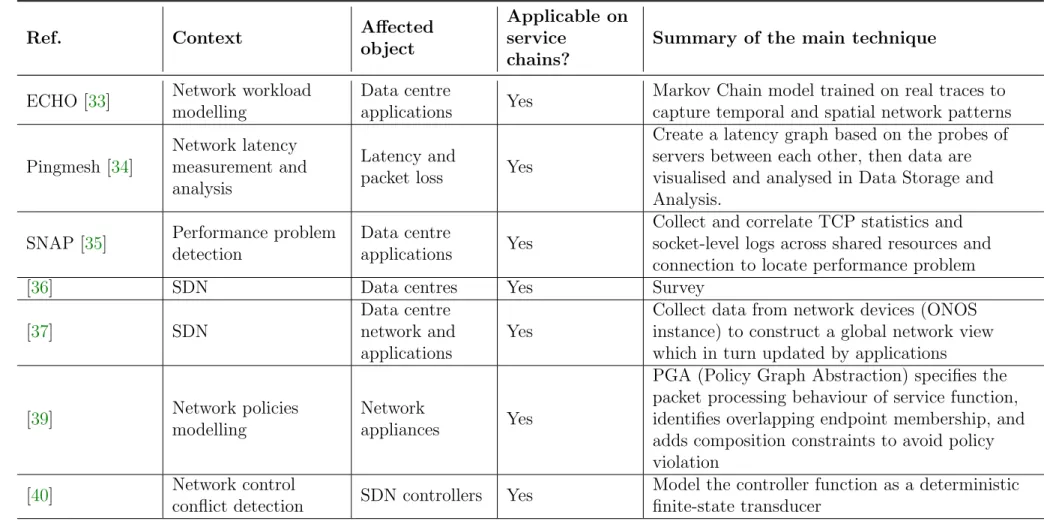
Several works have proposed techniques to assess the overall performance, under-stand network topology, and detect network degradation within the data centre en-vironment. For instance, Everflow [32], ECHO [33], Pingmesh [34] and SNAP [35] have presented ways for debugging faults in data centre networks, measuring and analysing latency of servers in large multi-tenant data centres and providing net-work administrators with performance monitoring interfaces. They have contrib-uted to mitigating servers’ downtime, improving the quality of services, helping developers and operators to identify and diagnose network performance problems in the reasonable and acceptable time frame.
Others have focused on improving and renewing the architecture of data centres following the emergence of NFV and SDN. For instance, work in [36] has pointed out the usefulness of the SDN approach to facilitate and enable network manage-ment and programmability and allow more control of the underlying infrastructure. Authors of [37] have proposed Open Network Operating System (ONOS) proto-type for global network view on the network topology and state. Authors in [38] have proven how VM placement can be efficient and improving the overall data centre performance if network traffic and topology information have been taken into account
Researchers have also drawn attention to the network policy issues in data centres and have proposed mechanisms to tackle them. Work presented in [39] has developed a high-level Policy Graph Abstraction (PGA) to describe network policies clearly and independently, and by using graph theory, it has been proven possible resolving conflicts between policies in a compelling way. The same re-conciliation objective has been considered in [40] for network policies, and [41] for routing rules and [42] for network updates.
In a virtualised environment, Virtual Machines placement has been thought of as one of data centres management knobs that could improve general network performance. Net-Cohort [43] has aimed at reducing the bisection bandwidth by proposing VM ensembles detection and placement based on information collected about VM network interactions. Cloud Mirror [44] has used as well the VM placement technique and what called Tenant Application Graph (TAG) to set guarantees for network bandwidth. AppAware [45] also has come up with an application-aware VM migration algorithm that, in simulation, has led to a vital network traffic reduction.
There have also been application-aware approaches to improve the applica-tion and network performance. For instance, [46] and [47] have implemented an application-aware data plane processing and packet forwarding mechanisms in
the light of SDN paradigm. Also, work in [48] has demonstrated how YouTube application performance can be enhanced if application recognition is leveraged while serving web requests. Table 3.1 summarises the above works and tells if the described technique can be applied in the perimeter of service chains.
Table 3.1: Summary of efforts made in the area of data centre networks
Ref. Context Affected
object
Applicable on service
chains?
Summary of the main technique
ECHO [33] Network workload modelling
Data centre
applications Yes
Markov Chain model trained on real traces to capture temporal and spatial network patterns
Pingmesh [34]
Network latency measurement and analysis
Latency and
packet loss Yes
Create a latency graph based on the probes of servers between each other, then data are visualised and analysed in Data Storage and Analysis.
SNAP [35] Performance problem detection
Data centre
applications Yes
Collect and correlate TCP statistics and socket-level logs across shared resources and connection to locate performance problem
[36] SDN Data centres Yes Survey
[37] SDN
Data centre network and applications
Yes
Collect data from network devices (ONOS instance) to construct a global network view which in turn updated by applications
[39] Network policies modelling
Network
appliances Yes
PGA (Policy Graph Abstraction) specifies the packet processing behaviour of service function, identifies overlapping endpoint membership, and adds composition constraints to avoid policy violation
[40] Network control
conflict detection SDN controllers Yes
Model the controller function as a deterministic finite-state transducer
Fibbing [41] Routing and traffic
steering Network traffic Yes
Inject fake network nodes to the existing topology to change the routing behaviour
Net-Cohort [43] Dependency analysis
Application throughput, bi-section bandwidth
Yes Monitor traffic exchanged between VMs in order to use it for VM placement
CloudMirror [44] Application performance Bandwidth and High-Availability No
Propose TAG (Tenant Application Graph) to allow applications to precise their network requirements which defines the workload
distribution scheme to guarantee bandwidth and high availability requirements.
AppAware [45] Application-aware
VM placement Network traffic No
Model the VM placement problem based on the dependency of applications running on VMs, the underlying topology, and the capacity of hosting physical servers
[46] SDN Data plane Yes
Augment the programmable Open vSwitch with stateless app processing capability (app table), similar to the typical OpenFlow flow table.
Atlas [47] Application classification
Data centre
applications Yes
Implement a Machine Learning consuming traffic data from OpenFlow switch to recognise
applications
[48] Quality of Experience (QoE)
Data centre
applications Yes
Improve the QoE for a YouTube user by using application signature to define a custom network behaviour particularly regarding path selection
3.2
Network latency
Researching in reducing network latency has gained momentum because of the application strict requirements and the significance of latency metric to the user experience satisfaction. We aim in this section to give an overview on the tech-niques addressing network latency in data centre environment.
Work in [21] has introduced a novel host-centric solution to mitigate latency in a virtualised environment, it tackles three latency traps induced by VM scheduling delay, host network queuing delay, and Switch queuing delay. It relies on applying the Shortest Remaining Time First (SRTF) scheduling policy at the level of end-host to control traffic to reduce latency in respect to the throughput requirement. Fastpass [49] has proposed a data centre network architecture that in a cent-ralised arbiter schedules all network traffic at a fine-grained level so that packets queuing would be reduced. Silo [12], QJUMP [13] and HULL [11] have aimed at improving the network performance of two types of applications; latency-sensitive and throughput-intensive. The idea in QJUMP consists of recognising these ap-plications and set up a sort of packet-level prioritisation at network Switches. Silo relies on VM placement and end-host packet limiters to lower congestion and also to improve throughput. However, another work like [50] shows how the software rate limiters can increase the latency by order of magnitude in cloud networks. CONGA [51] and Presto [52] have proposed mechanisms for load balancing that aims at reducing congestion and so mitigating latency. The above works have been summarised in Table 3.2.
Table 3.2: Summary of some works tackling latency problem
Ref. Context Location of
latency
Applicable on service
chains?
Summary of the main technique
[21] GuaranteedLatency VMs, hosts, and
switches Yes
Use Shortest remaining time first to schedule traffic at the end-hosts
Fastpass [49] Data centre network
architecture Switches Yes
Schedule packets transmission in specific timeslot and network path
Silo [12] Guaranteed Latency Switches Yes VM placement + rate limiter at end-hosts
QJUMP [13] Guaranteed Latency Switches Yes Packets are prioritised at the switches according to their application sensitivity to latency
HULL [11] Data centre network
architecture Switches Yes
Define a bandwidth headroom that triggers a phantom queues signal which invokes the application of DCTCP algorithm used for congestion control
CONGA [51] Load balancing Switches Yes Split TCP flows into flowlets and use switch feedback to balance traffic to reduce congestion
Presto [52] Load balancing Switches Yes Fine-grained flowcells (defined portion of flow) load balancing at virtual switches
3.3
Service chains
SFC and NFV have facilitated the introduction of network services implement-ing network policies for security and performance purposes. Also, service chains have become ubiquitous in data centre environment which explains the significant growth in a number of studies on this topic.
In this context, Stratos [53] has investigated a network-aware orchestration layer for middle-boxes. For this purpose, it has come up with three mechanisms; 1) elastic scaling, to determine how many middle-boxes needed to be deployed. 2) middle-boxes Rack-aware placement algorithm that considers the bandwidth avail-ability on network links, and 3) network-aware flow distribution that is triggered once a scaling decision is taken to improve the network utilisation. Sync [54] has proposed a synergistic middle-boxes and VMs placement that reduces the end-to-end delay and the communication cost.
Other studies issued from the telecom industry have proposed architectures and models to manage the virtual appliance instances. VNF-P [55] has presented a model for efficient placement of virtualised network functions, [56] and [57] have offered ways for efficient dynamic placement of chains of virtual network functions, other general works like [58] and [59] have aimed at improving the performance of middle-boxes and facilitating its management. Even though the context and the environment to which these studies belong are partly different from those of data centres, they are worthy to be investigated for possible reuse.
The number of studied on the optimal and efficient middle-boxes placement has increased significantly in the recent years. For instance, the authors in [22] have proposed a middle-boxes placement algorithm to decrease the number of rules implemented on SDN switchs responsible for traffic steering. Work in [60] has presented an incremental solution that seeks to reduce the utilisation of the links and the available CPU cores. Quokka [61] schedules the deployment of middle-boxes according to the changing traffic in a bid to reduce the transmission latency. Work in [62] has introduced a pre-planned placement scheme that con-siders the tenants’ requirement for network bandwidth to reduce the migration cost due to dynamic middle-boxes placement. [63] and [64] have also proposed heuristic middle-boxes placement algorithms to reduce the end-to-end delay and the bandwidth consumption. Moreover, [65] has described and formulated the problem of placing the network functions with minimal resource consumption. Other approaches proposed in [23,25] focus on the placement problem to reduce the end-to-end delay at the chains without considering the VNF performance. Instead, they model and manage the VNFs as identical entities.
SIMPLE [66] uses both an online and offline formulation to keep limiting the
Figure 3.1: VNF placement problem: find a location of each VNF in the chain on the available servers according to a specific goal, e.g., latency, bandwidth, resource utilisation, and number of forwarding rules
size of forwarding rules due to the limits in the TCAM memory of SDN switches. The online formulation is for online load balancing on the available switches. OpenBox [67] proposed an SDN-based framework for developing, deploying, and managing network functions. The platform is composed of data plane entities called OpenBox instances (OBIs) and logically-centralised control plane, called OpenBox controller (OBC). One of the interesting ideas presented in this work is how to move a typical core logic (usually computationally-intensive) of multiple network functions to the control plane so that that logic will be executed once (in-stead of executing it each time the packet goes through an NF). ClickOS [68] is a runtime platform for virtual NFs based on the Click modular router as the under-lying packet processor and running on Xen MiniOs. ClickOS provides I/O optim-isations for NFs and reduced latency for packets that traverse multiple NFs in the same physical location. CoordVNF [69]: coordinate the resolution of resource al-location problem on network substrate by formulating the chain composition and VNF-FG embedding (VMs hosting NFs) sub-problem to reduce the bandwidth utilisation. Research presented in [15] has demonstrated how poor CPU schedul-ing can lower throughput of NF chains by 50%, and inefficient NF placement is causing service chains to cross sockets can triple latency and reduce throughput by 60%. The work has presented a way that allows the service chains to share the same CPU cores rather than spread them across multiple cores, despite fewer resources being available.
VNF-VITAL [70], close work to ours dealing with the VNF performance, has
presented a framework for VNF characterisation. The study has been based on Clearwater IMS VNF and two IDS VNFs (Snort and Suricata). It examines the horizontal and vertical scaling impact on the VNF performance regarding the CPU and memory utilisation. However, the study shows no consideration of the pos-sible performance interference incurred by the VNFs since the evaluation did not cover performance of a sequence of VNFs where chained, which we have achieved in this paper. Work presented in [71] has proposed a graph neural network-based algorithm that predicts future VNF components (VNFCs) resource requirements based on the collected CPU and RAM utilisation data. So, it would be possible to proactively allocate necessary resources to the VNFCs even before they could experience performance degradation. However, we believe that in some cases only considering the CPU or memory utilisation to understand the VNF performance would not be sufficient since the CPU usage metric can be misleading such as in the case of pfSense NAT. In the experiments presented in Section5.2of Chapter5, we show how the high CPU usage at pfSense NAT does not reflect the real com-putation need but it is a consequence of high CPU interrupts caused by the high rate of incoming packets (only 2% effective computation of the total CPU usage). The authors in [2] have focused on an interesting aspect in the service chains. They have illustrated the traffic changing effects of middleboxes and formulated the middleboxes placement problem to reduce the maximum link load ratio. Their proposed VNF chaining is relying on the gain/drop factor of each VNF but neg-lecting the fact that such chaining should fulfil well-defined requirements such as the order of the VNF within the chain. Otherwise, this could probably lead to breaching the network policies that should have been correctly implemented by the chains. Table 3.3 summarises the service chain related works.
Table 3.3: Summary of service chains related works
Ref. Context Affected
metric Summary of the main technique
Consider VNF performance? Stratos [53] Middlebox orchestration Number of MBs and network utilisation
MBs rack-aware placement + network-aware traffic distribution
Only CPU utilisation
Sync [54] Chain performance optimisation
communication cost and
end-to-end delay
A joint consolidation of policy migration and VM placement + shortest path for the policy
implementation
No
VNF-P [55] NF placement Resource utilisation
NFs placement based on their resources requirements (mathematical formulation)
Generic capacity assigned to VNFs [56] Service Chain placement Resource utilisation
Service chains based on the physical host limited resources and NF requirements (mathematical formulation) Generic capacity assigned to VNFs [57] NF placement Resource utilisation
Dynamically placing VNFs based on the
behaviour of the resources No
[58] NF design State of the NF Store the state of an NF in a separate backend
store using DRAM technique No
[59] MB management MB state Explain the MB state management and
representation No
LightChain [22] VNF placement Flow rules in the switches
Place VNF in a way to reduce the number of rules on the switches using Directed Acyclic Graph (DAG)
No
[60] NF placement and routing
Resource utilisation and end-to-end delay
Formulate the problem of network function placement and routing as a mixed integer linear programming (MILP) problem
Generic capacity assigned to VNFs
Quokka [61] NF placement Latency
Define two model of latency at NF based on its packet processing and places NFs to reduce latency
Yes in latency modelling
[62] VNF placement Bandwidth
Pre-planned allocation of NFs based on changing workload to reduce network resources utilisation including VM migration overhead
No
[63] MB placement
End-to-end delay and bandwidth
Formulate the MB placement problem as 0-1
programming problem No [64] VNF placement and chaining Resource utilisation and end-to-end delay
Formulate the VNF placement and chaining as
Integer Linear Programming (ILP) model No
[65] VNF placement and chaining
Resource utilisation
Formulate the VNF placement as an Integer
Linear Programming problem No
[23] VNF embedding
Cost of VNF mapping on physical network
Use VNF decomposition in resolving the Virtual
Network Embedding Problem (VNEP) No
[25] VNF parallelisation
End-to-end delay and throughput
Run NFs at the same level of the chains for
packet parallel processing No
OpenBox [67] MB design NA
Provide platform to develop MBs with the
possibility to run computationally-intensive tasks shared between NFs at the controller
Yes
ClickOS [68] MB design Latency and I/O
Locate MiniOS-based VNF on same physical
server Yes
CoordVNF [69] Resource allocation Bandwidth Formulate the chain composition and VNF-FG embedding problem
Generic capacity assigned to VNFs
[15] Resource allocation Service chain throughput
Allow service chains to share the same CPU cores rather than spread them across multiple cores Yes
VNF-VITAL [70] VNF characterisation
Resource utilisation
Experimental VNF resource utilisation
assessment Yes
[71] Resource allocation Resource utilisation
Predicts future VNF components (VNFCs) resource requirements based on the collected CPU and RAM utilisation data
Yes
[2] VNF placement
End-to-end delay and throughput
Place VNFs based on their gain/drop factor No
3.4
Summary
In the literature review, we have classified the works related to our research in three main categories. 1) works on data centre networks that aim to improve the quality of service and the application performance in the data centres. For example, monitoring network activity and optimising the resources utilisation and workload distribution. 2) works for reducing the network latency. These studies have tackled the latency in two main locations: VMs/hosts and switches. techniques such as optimising traffic scheduling, fine-grained traffic management, and traffic rate limiters at end hosts have improved both latency and throughput. 3) Category of works that aims at improving the performance of service chains provides. For instance, schemes for service chaining and composition, VNF design, and VNF optimal placement. These studies show a lack of considering the VNF performance sensitivity and bottlenecks in the chain composition. They consider the VNFs as black-boxes that all of them in the chains have the same behaviour toward network traffic. Our idea captures the fact that any application can be either I/O- or/and CPU-bound. We consider this to treat the VNFs inside the chain. Our research firstly shows the difference between these types/categories of VNFs and then use the resulting information in the chain composition problem modelling. This is different from what we have found in the literature review which avoids getting into the details of each VNF and hence misses opportunities of improving the performance of service chains.
Chapter 4
Research Methodology
In this chapter, we present how we can approach the existing challenges to achieve the aim and objectives initially set. In particular, we justify our choice of con-ducting testbed experiments rather than using network simulation framework. We also highlight the significance of VNF characterisation as a prior step in defining a service composition scheme where the network latency can be reduced. Moreover, we discuss the limitation of the adopted method, and we describe other methods such as network simulation and emulation.
4.1
Finding system characteristics from testbed
experiments
One of our research aims is to limit the impact of virtualisation on the network performance of the service chains. So first we need to concretely measure that im-pact and evaluate to what extent it can influence the computational and network metrics of NFs. Initially, we have made some attempts to simulate a virtualised environment. However, it has turned out to be impractical due to the high com-plexity of the virtualisation layer and the time constraints. Also, to the best of our knowledge, there has been no study simulating the virtualisation layer itself. In addition to that, NFs have many particularities so their simulation or emula-tion would be very sophisticated and so, inaccurate and quesemula-tionable. Therefore, we have proceeded with setting up our testbed on which we can run experiments examining virtualisation and NF characteristics.
4.1.1
Studying the virtualisation impact
We study the virtualisation impact on the computational and network perform-ance of a pfSense Firewall. We implement firewall rules using Linux iptables and