Management of Web Service based Workflows
Chintan Patel, Kaustubh Supekar, and Yugyung LeeSchool of Interdisciplinary Computing and Engineering University of Missouri-Kansas City
{copdk4, kss2r6, leeyu}@umkc.edu
Abstract. Web Services are emerging technologies that enable application-to-application communication and reuse of autonomous services over Web. Traditional Workflow Management Systems fail to provide a com-prehensive solution for a Web Service based Workflow. A framework that meets the quality of service (QoS) requirements for ad hoc Inter-net based Services is rarely provided. Considering the increasing demand for expanding services and application requirements coupled with use of Web Services, it is a challenging task to develop a QoS model as a frame-work for Web Service based Workflows. In this paper, we have proposed a QoS oriented Framework, called WebQ, that is capable of conduct-ing the adaptive selection process and simultaneously provides bindconduct-ing and execution of Web Services for the underlying workflow. To achieve these objectives, as the first step, we have designed a QoS model for Web Service selection, binding, and execution. We, then, develop a set of algorithms to compute QoS parameters and implement them using a rule-based system. A series of experiments performed on workflows com-posed of real Web Services have confirmed that the procom-posed framework is very effective in improving the overall QoS of the system.
1
Introduction
Web Services have been used to achieve system interoperability over the Web through exchange of application development and service interactions using the standards like Web Services Description Language (WSDL), Universal Descrip-tion, Discovery and Integration (UDDI) [1], and Simple Object Access Protocol (SOAP) [2].
While current Web Service technologies show much progress, the current ser-vices are mainly limited to atomic serser-vices [3]. Thus, it is not adequate to handle the autonomous and complex services in realistic settings. In dealing with this problem, some research work [4] has developed languages to compose the individ-ual Web Services into transactions or workflows. Web Services Flow Language (WSFL) was designed for service compositions in the form of a workflow [5], XLANG [6] for the behavior of a single Web Service. However these works are not sufficient for providing the adaptive web Services generated from a particular context.
In fact, the automatic or semi-automatic management of service flows over the Web has not been achieved. For the purpose, we need to examine the char-acteristics of the composition model of Web Services. In the Web Services model that is quite different from traditional one, there is the large number of similar or equivalent services which user can freely select and use for their application. Second, since the service is developed and deployed by the third party, the qual-ity of service is not guaranteed. Third, the services may not be adequate as per service requestor’s requirements and kept evolving, without notification to service requestors, according to the provider’s requirements and computing en-vironment. Thus, it is important to provide adaptability to evolving services as well as diverse context of services.
Kammer et al. [7] suggested workflow to be dynamic, which allows changes with minimal impact to the ongoing execution of underlying workflow, as well as be reflexive, which provides knowledge about a workflow’s applicability to the context and the effectiveness of its deployment evaluated over time. Under-standing constraints and context associated with services may affect the quality of service. From this perspective, optimization may occur through the evaluation and refinement of a previous service flow. Facilitating service composition may not be difficult if one knows which Web services and in which order to compose. However, automatic composition of services is challenging. It is because it is difficult to capture semantics and context of services and measure the quality of services. One exemplary effort that aims for this function is DAML-based Web Service Ontology (DAML-S) [8], describing the properties and capabilities of Web services [9].
The goal of this project is to develop a QoS-based web service framework, called WebQ, that enables to select appropriate Web services, dynamically bind the services with the underlying workflow, and perform the refinement of existing services. Since evaluation and refinement of services tend to be subjective, the generation of them needs a formal matrix, which can measure the requirements and quality of services. In the WebQ Framework, criteria is quantitatively set to evaluate whether a particular service is appropriate for specific service flow and to define service quality. This generic framework can be applicable to the various domains, such as e-commerce, medicine, and bioinformatics.
2
Related Work
Workflow technology has been around since a decade and has been successful in automating many complex business processes. A significant amount of work has been done in this field which deal with different aspects of workflow technology viz process modeling, dynamic workflows [10], distributed workflows [11]. Process modeling languages such as IDEF, PIF [12], PSL [13] or CIMOSA [14] and frame based models of services were used to design process typing, resource dependencies, ports, task decomposition and exception.
On the other hand Web Services are emerging resources on the web and have received a great deal of attention from the industry. Standards such as WSDL,
SOAP, and UDDI are being developed for low-level descriptions of Web ser-vices. Web Services Description Language (WSDL) provides a communication level description of the messages and protocols of services [15]. Simple Object Access Protocol (SOAP) invokes services through remote method invocations over HTTP [2]. Universal Description, Discovery and Integration (UDDI) [1] announces and discovers services which are registered by their providers at a logically central registry. Some emerging approaches include additional features through the use of ontologies, e.g.describing and indexing services based on pro-cess models [16].
Current research on web services paves way for web service based workflows, which has obvious advantages pertaining to scalability, heterogeneity, reuse and maintenance of services. Major issues in such inter-organizational service based workflows are service discovery, service contracts [17] and service composition. Web Services Flow Language (WSFL) was proposed to describe compositions of services in the form of a workflow, which describes the order of service invocation [5]. Service composition aids such as BizTalk [18] were proposed to overcome the limitations of traditional workflow tools [14] which manually specify the com-position of programs to perform some task. Other industrial initiatives such as BPEL4WS [19], XLANG [6] concentrate on service representation issues to tackle the problem of service contracts, compositions and agreements. Current efforts [20] are to automate the complete process of service discovery, composition and binding using machine understandable languages. Some other recent advances are WS-Transaction [21] and WS-Coordination [22] which defines protocols for executing Transactions among web services. [23] focuses on modeling QoS of workflows, [24] defines a QoS based middleware for services associated with the underlying workflow, but it doesn’t take into account QoS factors related to In-ternet based services. [25] describes QoS issues related to web services from the provider’s perspective. We believe that the current research has not delved into QoS issues related to Web Service based workflows, many critical issues related to the availability, reliability, performance and security of Web Services need to be handled. Our approach tactfully utilizes and monitors these QoS parameters to provide a consistent service interface to other applications in the workflow through adaptive QoS based selection, binding and execution of Web Services.
3
WebQ Framework
3.1 Architecture
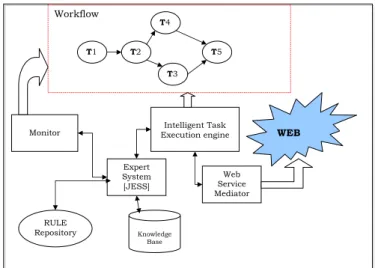
WebQ framework depicted in Figure 1 is comprised of gamut of collaborative components that allows for QoS oriented adaptive management of Web Service based workflows. We first illustrate various phases of workflow management in WebQ.
Phase 1: Workflow ModellingA workflow is defined, using DAML-S [8], as a collection of tasks accomplished using in-house services-components or through third party services.
Monitor RULE Repository Expert System [JESS] Web Service Mediator Knowledge Base Intelligent Task
Execution engine WEB T1 T2
T3 T5 T4
Workflow
Fig. 1.The WebQ Architecture
Phase 2: QoS Requirements Setting QoS parameters associated with the underlying workflow are specified. In this paper, three categories of QoS - task-specific QoS, Internet service task-specific QoS and general QoS parameters were introduced. Designer specifies QoS requirements in a multilevel rule hierarchy [26].
Phase 3: Initialization WebQ fetches set of Web Services for every task in the underlying workflow. Each Web Service is assigned a uniform fitness value
Ω. Fitness value Ωis defined as ”How fit a web Service is for executing a task for given QoS requirement.” Initially, we randomly select m services per task as every Web Service has a uniform fitness value. It could be noted here that absence of apriori knowledge about third party services calls for assignment of uniform fitness value.
Phase 4.a: Execution and MonitoringIn the execution phase load (number of requests) per task is divided across mselected Web Services associated with that task. Rationale behind selecting bestmWeb Services and load distribution methodology is discussed in Section 3.3. Task is accomplished on execution of selected Web Services. During execution associated QoS parameters are moni-tored, recorded and asserted as facts in Knowledge Base.
Phase 4.b: Dynamic and adaptive Web Service selection The process of continuous monitoring of workflow under execution updates related QoS pa-rameters which in turn updates associated fitness value. Deteriorating QoS of a selected Web Service triggers Rule that forces de-selection of that Web Service and re-selection of new set ofmbest services. The dynamic service selection
pro-cess accounts for the adaptability of the framework to an ad-hoc environment where quality of a Web Service changes stochastically.
In the following discussion we elicit role of each component in various phases.
Workflow,the process under execution, is a collection of tasks that can either be accomplished by in-house services or through third party services. DAML-S [8] specification is used to specify workflow. Web Service Mediator queries the web for services that would accomplish a particular task. Essentially it uses information stored in UDDIs across the web to retrieve listing of task specific Web Services.Monitoris responsible for monitoring, measuring and asserting facts about newly calculated-observed values of general, task-specific and Inter-net service specific QoS parameters. It calculates various values on the basis of mathematical underpinnings of our proposed QoS model.Intelligent Task Ex-ecution Engine manages and co-ordinates execution of tasks that are part of underlying workflow. The engine utilizes DAML-S [8] encoded information about the workflow to co-ordinate the execution of tasks, providing input to a task, binding and execution of a Web Service associated with the task, routing the re-quest to appropriate task depending upon the output obtained.Expert System
allows assertion of facts in the knowledge base depending upon the rules fired. WebQ uses JESS [27] based on Rete [28], a low complexity algorithm, reduces the overhead associated with dynamic selection and binding of Web Service to a task at runtime.Knowledge Baseis a repository of facts about Web Service related parameters - reliability, latency, execution time, performance and other QoS parameters. Rule Repositorycollects rules used to specify user specific QoS requirements, available workflow QoS and elicitation of steps to be taken for achieving specified QoS requirement. We use a multi-level approach wherein firing of a set of atomic rules leads to composite rule being executed [26].
3.2 QoS Based Service Selection and Execution
Our QoS model proposed in this paper dynamically selects the best among the available services and performs parallel execution of services. The goal of the adaptive selection and execution is to maximize the overall QoS. For the purpose, we carefully reviewed QoS parameters and classified them into the following three categories: General, Internet Service Specific and task specific QoS parameters. In order to design the Quality of Service for Web Service based workflow, multiple perspectives of the stakeholders of the system were considered. This task can be achieved by maintaining separate set of QoS management rules per user per task node, which would sum up to meet the overall desired QoS requirements.
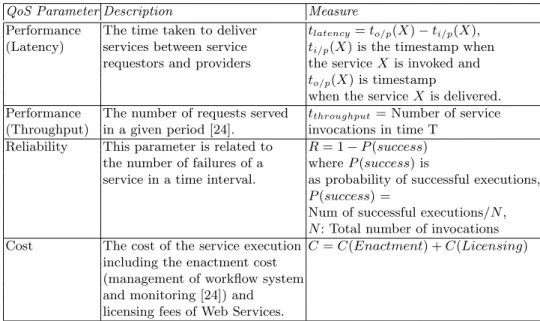
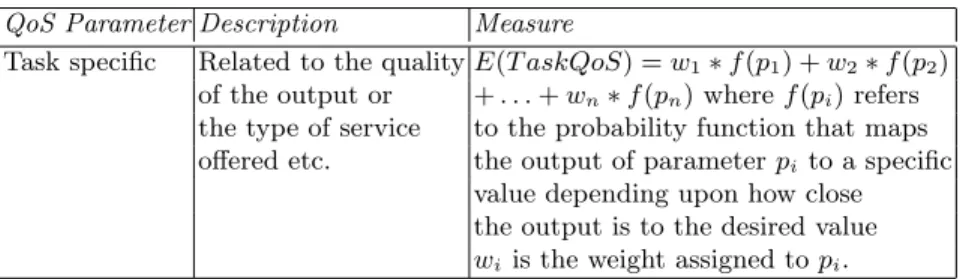
QoS model should be flexible and extensible enough to capture the fine gran-ularity of requirements that could arise in any given domain. [24] considers only generalized QoS features for traditional Workflow Management Systems, an In-ternet based Service Workflow requires a comprehensive QoS model that also incorporates task specific QoS requirements. Tables 1, 2 and 3 show a QoS model which captures all these essential features.
Table 1.General QoS parameters
QoS Parameter Description Measure
Performance The time taken to deliver tlatency=to/p(X)−ti/p(X), (Latency) services between service ti/p(X) is the timestamp when
requestors and providers the serviceX is invoked and
to/p(X) is timestamp
when the serviceX is delivered. Performance The number of requests served tthroughput = Number of service (Throughput) in a given period [24]. invocations in time T
Reliability This parameter is related to R= 1−P(success) the number of failures of a whereP(success) is
service in a time interval. as probability of successful executions,
P(success) =
Num of successful executions/N,
N: Total number of invocations Cost The cost of the service execution C=C(Enactment) +C(Licensing)
including the enactment cost (management of workflow system and monitoring [24]) and licensing fees of Web Services.
Table 2.Internet-Service Specific QoS
QoS Parameter Description Measure
Availability The probability that the Pavailability=C(X)/N,
service will be available at some C(X): Num of Successful executions period of time. An associated N: Total number of invocations parameter is time-to-repair, T T R=trestart(X)−tf ailed(X), the time taken to repair a service whereT T Rrepresents Time To Repair, [25]. tf ailed is timestamp when the service
X failed,trestart is timestamp when service was restarted. Security Confidentiality, non repudiation Values assigned by
message encryption and access the workflow designer
control [25]. depending upon the strength of the Encryption technology used, PKI, Kerberos etc [3].
Accessibility Instances when a particular servicePaccessibility =Pavailability is not accessible even if its at TimeT =t
available because of high volume of requests.
Regulatory A quality aspect which deals with Specific in-house ratings by
issues of conformance of service the workflow designer at design time. with the rules, the law, compliance
with standard, and the established Service Level Agreement [25].
Table 3.Task Specific QoS
QoS Parameter Description Measure
Task specific Related to the qualityE(T askQoS) =w1∗f(p1) +w2∗f(p2) of the output or +. . .+wn∗f(pn) wheref(pi) refers the type of service to the probability function that maps offered etc. the output of parameterpi to a specific
value depending upon how close the output is to the desired value
wi is the weight assigned topi.
3.3 Best One v/s Best m approach
The WebQ QoS model allows selecting best service that fits the QoS requirement. The approach of selecting a single third party service to accomplish a task is inherently unreliable. Consider a scenario where we havenavailable services for a given task. Our Best One QoS model approach would select one service for that task. Most of Web Services used in the workflow are third party services that cannot be trusted. It is quite possible that the execution of workflow is in jeopardy because of failure of best available service. The problem can be accounted for single point dependency between the workflow task and third party service. Our model accommodates for such problem, we advocate selection of best
m against single best service. The WebQ framework allows selection of bestm
services based on fitness value Ω. Selection ofmallows load distribution across these services. One of approach is to equally distribute load acrossm services. In this way better service can take more load than a average service hence a weighted average approach can distribute the load acrossmbest services.
The load distribution function (ldf) can be expressed as a function of fitness valueΩ associated with Web Service. Load per Web Service =ldf(Xi) =Li=
N∗wi; 1< i < m;Pwi= 1,Xiis theithservice from set ofmbest services.N
is the total number of inputs at a given timet.wiis weight associated with Web
ServiceXi. It is function of fitness valueΩi ofXi.wi = f (Ωi ) A Web Service Xi with a high fitness value Ω would have high weightwi as most of the load
can be handled by better services.wi=Ωi/PΩi. Consider an example where N
= 1000 (1000 users request weather information),n= 5 (5 Web Services provide weather information), m= 3(3 best Web Services were selected using our QoS model). Assume observed fitness values on scale of 100 as Ω1 = 95, Ω2 = 35,
Ω3= 85,Ω4 = 60,Ω5 = 50. Three best Web Services areX1,X3 andX4 when
top three services are selected among services arranged in descending order of fitness values. We assign weight to each Web Service w1 = 95/(95+85+60) =
0.395, w3 = 85/(95+85+60) = 0.355, w4 = 60/(95+85+60) = 0.25. Based on
this load distribution function, load per Web ServiceL1 =w1∗N = 395, L3=
w3∗N= 355, L4=w4∗N= 250.
The Bestm approach has a two fold advantage. First, it makes the work-flow fault-tolerant. Probability of failure of workwork-flow is now distributed acrossm
would not completely jeopardize the execution of underlying workflow. Second, distributing load acrossm services improves efficiency of overall system as sim-ilar tasks can be concurrently executed. We conclude that the concurrent, load distributed QoS model renders a workflow that is fault tolerant, efficient and reliable.
4
Implementation and Experimental Results
As a proof of concept we implemented and deployed a Java based prototype of the proposed model on Linux. Our major goal was to test the QoS management in a Web Service based workflow using JESS rule-based system. The intelligent task execution engine was constructed through Java implementation which reads the process specifications in DAML-S, selects, binds and executes Web Service from a service pool associated with each task. Monitor component asserts QoS measurements in the logDB, JESS Knowledge base. JESS Rules, measures of QoS requirements, are triggered by deteriorating Quality of Service. Dynamic service selection leads to the refinement of the workflow for maximizing the overall QoS. Java Web Services toolkit (JAX-RPC) was used for implementing the in-house Web Services and for interactions with third party Web Services.
We conducted relevant experiments to validate the proposed QoS oriented framework for adaptive management of Web Service based workflows. The tests were performed on existing services available on the Internet. We focussed on a single task in the underlying workflow. The weather information retrieval task was singled out as the basis of all our experiments. The choice of task was dictated by the amount of freely available third party services for that task. The main goal of the tests was to determine the performance gain by our approach of distributing load per task acrossmtask specific services and to illustrate how the dynamic service refinement process renders an efficient, high performance and a fault tolerant workflow. Following Web Services were selected to accomplish the task of retrieving weather information.
Table 4.Input for the Performance Gain Experiments ID Provider1 WSDL
WS1 www.xmethods.net http://www.xmethods.net/sd/2001/TemperatureService.wsdl WS2 www.ejse.com http://www.ejse.com/weatherservice/service.asmx?WSDL WS3 www.juice.com http://webservices.juice.com:4646/temperature.wsdl WS4 FastWeather http://ws2.serviceobjects.net/fw/FastWeather.asmx?WSDL
We tested each of the services individually, then incorporated them into our Workflow, and compared the difference in the performance. Performance gain,
G is ratio of total time taken for single Web Service (n inputs) to the time 1
The services were used for just experimental analysis, we do not intent to endorse or discriminate between providers.
taken when all services in setSare executed simultaneously with n inputs being divided between them.
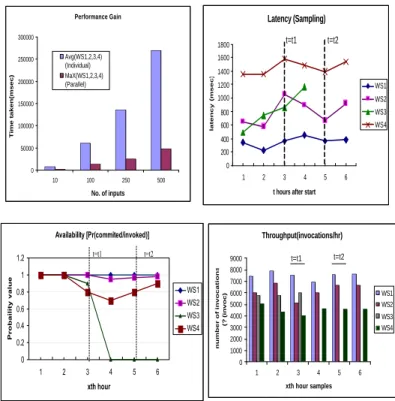
We conducted tests for 10, 100, 250 and 500 inputs, corresponding perfor-mance gain was calculated, G= 3.28, 4.31, 5.38, 5.62 respectively. Results in-dicate an average performance gain of 400% (G= 4). Higher values of (G > 4) can be attributed to the fact that WebQ uses weighted average load distribution function as against uniform load distribution. The results as depicted in Fig-ure 2a strengthens our hypotheses that the WebQ approach of load distribution renders a high performance and fault-tolerant workflow.
Secondly, we validate the proposed QoS based selection approach, a set of Web Services (depicted in Table 4) were tested rigorously across Internet and their QoS parameters were measured over a period of time. In these tests, we monitored a subset of QoS parameters - latency, throughput, and availability.
Performance Gain 0 50000 100000 150000 200000 250000 300000 10 100 250 500 No. of inputs Time taken(msec) Avg(WS1,2,3,4) (Individual) MaX(WS1,2,3,4) (Parallel) Latency (Sampling) 0 200 400 600 800 1000 1200 1400 1600 1800 1 2 3 4 5 6
t hours after start
latency (msec) WS1 WS2 WS3 WS4 t=t1 t=t2 Availability [Pr(commited/invoked)] 0 0.2 0.4 0.6 0.8 1 1.2 1 2 3 4 5 6 xth hour Probaility value WS1 WS2 WS3 WS4 t=t1 t=t2 Throughput(invocations/hr) 0 1000 2000 3000 4000 5000 6000 7000 8000 9000 1 2 3 4 5 6 xth hour samples number of invocations ( ? (invoc) WS1 WS2 WS3 WS4 t=t1 t=t2
Fig. 2.Experimental Results:(a) The Performance Gain (b) Latency (c) Availability (d) Throughput
QoS requirements on selecting the task node were services which are 1) highly available 2) handle large number of inputs and 3) provide maximum throughput. The experimental results (Figure 2b, 2c, 2d) at instances t = t1 and t = t2
show the associated QoS parameter values for Web Services W S1, W S2, W S3
and W S4 at time t1 and t2 respectively. The number of inputs(load) at time
t = t1 were 30 and t = t2 were 50. JESS Rules, measure of aforementioned
QoS requirements, were triggered to select servicesW S1,W S3 (m=2) att=t1
and W S1,W S2(m = 2) att=t2. It is important to note here that the failure
of service W S3 that was selected at time t = t1 doesn’t effect quality of the
underlying workflow. It is because our dynamic Web Service selection att=t2
leads to selection of the new set of bestm (=2) services,W S1 andW S2.
Moreover our research into existing Web Services revealed a highly impor-tant factor concerning the Availability parameter. Many Web Services listed on UDDIs were not available for most of time, hence we assert that Availability is an important QoS factor to take into consideration for selection of services.
Our results confirmed that Performance is also an important parameter for selection for the service. Tests revealed a large amount of variation in the per-formance of the Web Services. For Web ServicesW S2 (mean latency = 800ms)
and W S3(mean latency = 775 ms) we observed there are very high values of
variance, 110 ms and 132 ms respectively. Hence in such unpredictable Internet environment, creating a Internet based workflow demands strict performance monitoring and subsequent dynamic modification of the workflow execution.
5
Conclusions
We proposed a Web Service based framework for adaptive workflow management. A comprehensive QoS model can provide consistent interface of Web Services to workflow-based applications. Incorporated rules in the framework helped to establish a dynamic workflow by achieving a fine-grained control over service se-lection. The experimental results confirmed the effectiveness of the framework in enhancing the overall QoS of the system. As an ongoing work, we have extended the rule-base system to achieve automatic Web Service composition consisted of DAML-S semantics.
References
1. UDDI technical white paper, http://www.uddi.org/pubs/Iru UDDI Technical White Paper.pdf, 2000
2. D. Box and D. Ehnebuske and G. Kakivaya and A. Layman and N. Mendelsohn, H. F. Nielsen and S. Thatte and D. Winer, Simple object access protocol (SOAP), www.w3.org/TR/SOAP, 2000
3. Web Services Architecture, http://www.w3.org/TR/ws-arch/
4. V. Benjamins and E. Plaza and E. Motta and D. Fensel and R. Studer and B. Wielinga and G. Schreiber and Z. Zdrahal and S. Decker, Ibrow3: An intelligent bro-kering service for knowledge-component reuse on the world-wide web, In The 11th Banff Knowledge Acquisition for knowledge-Based System Workshop (KAW98), Banff, Canada, 1998.
5. F. Leymann, Web services flow language, TR WSFL 1.0”, IBM Software Group, May, 2001.
6. S. Thatte, XLANG Web Services for Business Process Design, 2001 http://www.gotdotnet.com/team/xml wsspecs/xlang-c/default.htm
7. P. Kammer, G. A. Bolcer, R. N. Taylor, M. Bergman, Techniques for Supporting Dy-namic and Adaptive Workflow, Vol 9, Journal of Computer Supported Cooperative Work (CSCW), 269-292.
8. DAML-S Specifications, http://www.daml.org/services/
9. D. McDermott and M. Burstein and D. Smith, Overcoming ontology mismatches in transactions with self-describing agents, Proceedings of the First International Semantic Web Working Symposium (SWWS), 285-302, 2001
10. J. Meng, S. Y.W. Su, H. Lam and A. Helal, Achieving Dynamic Inter-organizational Workflow Management by Integrating Business Processes, Events, and Rules, Pro-ceedings of the Thirty-Fifth Hawaii International Conference on System Sciences (HICSS-35), January 2002.
11. J. A. Miller, D. Palaniswami, A. P. Sheth, K. Kochut, and H. Singh. WebWork: METEOR 2 ’s web-based workflow management system. Journal of Intelligent In-formation Systems, 10(2):185-215, 1998
12. . J. Lee, G. Yost, and PIF Working Group. The pif process interchange format and framework. Technical Report 180, MIT Center for Coordination Science, 1995. 13. C. Schlenoff et al., The essence of the process specification language, Transactions
of the Society for Computer Simulation, 16(4), pp. 204-216, 1999.
14. K. Kosanke, CIMOSA - Open System Architecture for CIM; ESPRIT Consortium AMICE, Springer-Verlag 1993.
15. E. Christensen and F. Curbera and G. Meredith and S. Weerawarana, Web services description language (WSDL) 1.1, www.w3.org/TR/wsdl, 2001
16. M. Klein and A. Bernstein, Searching for services on the semantic web using process ontologies, Proceedings of the International Semantic Web Working Symposium (SWWS), July, 2001
17. Y. Hoffner, H. Ludwig, P. Grefen and K. Aberer, Crossflow : Integrating Workflow Management and Electronic Commerce, SIGeCOM ACM 2001
18. Biztalk http://www.microsoft.com/biztalk/
19. Business Process Execution Language for Web Services, Version 1.0, July 2002 http://www-106.ibm.com/developerworks/webservices/library/ws-bpel/
20. S. McIlraith and T. Son and H. Zeng, Semantic Web services, IEEE Intelligent Systems (Special Issue on the Semantic Web), 16(2), 46-53, 2001.
21. Web Services Transaction (WS-Transaction), August 2002,
http://www-106.ibm.com/developerworks/webservices/library/ws-transpec/?dwzone=webservices
22. Web Services Coordination (WS-Coordination), August 2002, http://www-106.ibm.com/developerworks/library/ws-coor/
23. J. Cardoso, A. Sheth, J. Miller, Workflow Quality Of Service (2002)
24. A. Sheth, J. Cardoso, J. Miller, K. Koch, QoS for Service-oriented Middleware (2002) ”Web Services and Grid Computing,” Proceedings of the Conference on Systemics, Cybernetics and Informatics, Orlando, FL, July 2002.
25. A. Mani, A. Nagarajan, Understanding quality of service for Web services, http://www-106.ibm.com/developerworks/library/ws-quality.html
26. C. Patel, K. Supekar, Y. Lee, Adaptive Workflow Management for Web Service using QoS Framework, Technical Report TR030103, University of Missouri - Kasas City, 2003.
27. Java Expert System Shell, http://herzberg.ca.sandia.gov/jess/ 28. Rete Algorithm, http://herzberg.ca.sandia.gov/jess/docs/52/rete.html