NeOn: Lifecycle Support for Networked Ontologies Integrated Project (IST-2005-027595)
Priority: IST-2004-2.4.7 — “Semantic-based knowledge and content systems”
D2.5.2 Pattern based ontology design: methodology and
software support
Deliverable Co-ordinator: Enrico Daga Deliverable Co-ordinating Institution: CNR
Other Authors: Eva Blomqvist (CNR); Aldo Gangemi (CNR); Elena Mon-tiel (UPM); Nadejda Nikitina (AIFB); Valentina Presutti (CNR); Boris Villazón-Terrazas (UPM);
Ontology design patterns (ODPs) is an emerging techinque based on the reuse of encoded good practices in the ontology development process. In this deliverable we present the latest results about the exploitation of ontology design patterns in ontology design, with particular focus on software support.
Document Identifier: NEON/2009/D2.5.2/v1.0 Date due: December 31st,2009
Class Deliverable: NEON EU-IST-2005-027595 Submission date: January 31st,2010
Project start date March 1, 2006 Version: v1.0
Project duration: 4 years State: Final
NeOn Consortium
This document is part of the NeOn research project funded by the IST Programme of the Commission of the European Communities by the grant number IST-2005-027595. The following partners are involved in the project:
Open University (OU) – Coordinator Universität Karlsruhe – TH (UKARL)
Knowledge Media Institute – KMi Institut für Angewandte Informatik und Formale Berrill Building, Walton Hall Beschreibungsverfahren – AIFB
Milton Keynes, MK7 6AA Englerstrasse 11
United Kingdom D-76128 Karlsruhe, Germany
Contact person: Martin Dzbor, Enrico Motta Contact person: Peter Haase
E-mail address: {m.dzbor, e.motta}@open.ac.uk E-mail address: [email protected] Universidad Politécnica de Madrid (UPM) Software AG (SAG)
Campus de Montegancedo Uhlandstrasse 12
28660 Boadilla del Monte 64297 Darmstadt
Spain Germany
Contact person: Asunción Gómez Pérez Contact person: Walter Waterfeld
E-mail address: [email protected] E-mail address: [email protected] Intelligent Software Components S.A. (ISOCO) Institut ‘Jožef Stefan’ (JSI)
Calle de Pedro de Valdivia 10 Jamova 39
28006 Madrid SL–1000 Ljubljana
Spain Slovenia
Contact person: Jesús Contreras Contact person: Marko Grobelnik E-mail address: [email protected] E-mail address: [email protected] Institut National de Recherche en Informatique University of Sheffield (USFD)
et en Automatique (INRIA) Dept. of Computer Science
ZIRST – 665 avenue de l’Europe Regent Court
Montbonnot Saint Martin 211 Portobello street
38334 Saint-Ismier, France S14DP Sheffield, United Kingdom Contact person: Jérôme Euzenat Contact person: Hamish Cunningham E-mail address: [email protected] E-mail address: [email protected] Universität Kolenz-Landau (UKO-LD) Consiglio Nazionale delle Ricerche (CNR) Universitätsstrasse 1 Institute of cognitive sciences and technologies
56070 Koblenz Via S. Marino della Battaglia
Germany 44 – 00185 Roma-Lazio Italy
Contact person: Steffen Staab Contact person: Aldo Gangemi
E-mail address: [email protected] E-mail address: [email protected]
Ontoprise GmbH. (ONTO) Food and Agriculture Organization
Amalienbadstr. 36 of the United Nations (FAO)
(Raumfabrik 29) Viale delle Terme di Caracalla
76227 Karlsruhe 00100 Rome
Germany Italy
Contact person: Jürgen Angele Contact person: Marta Iglesias
E-mail address: [email protected] E-mail address: [email protected]
Atos Origin S.A. (ATOS) Laboratorios KIN, S.A. (KIN)
Calle de Albarracín, 25 C/Ciudad de Granada, 123
28037 Madrid 08018 Barcelona
Spain Spain
Contact person: Tomás Pariente Lobo Contact person: Antonio López E-mail address: [email protected] E-mail address: [email protected]
Work package participants
The following partners have taken an active part in the work leading to the elaboration of this document, even if they might not have directly contributed to the writing of this document or its parts:
• CNR
• UPM
Change Log
Version Date Amended by Changes
0.1 17-11-2009 Enrico Daga Outline
0.2 27-11-2009 Enrico Daga Outline updated; Added sections “eX-treme Design, an introduction“ and “XD Tools for the NeOn Toolkit”;
0.3 3-12-2009 Boris Villazón-Terrazas Added section “The role of reengineering patterns“;
0.4 07-12-2009 Elena Montiel-Ponsoda Added sections “The role of Lexico-Syntactic Patterns” and “Lexico-Lexico-Syntactic Patterns: reusable JAPE code for NLP ap-plications”
0.5 7-12-2009 Boris Villazón-Terrazas Section “The role of reengineering pat-terns” updated
0.6 7-12-2009 Boris Villazón-Terrazas Section “Re-engineering patterns: a soft-ware library” updated;
0.7 10-12-2009 Eva Blomqvist Updated Sections “eXtreme Design (XD): an introduction", “The eXtreme design it-eration" and “The role of Content Ontol-ogy Design Patterns" . Added section heading “Pattern-based ontology evalua-tion".
0.8 13-12-2009 Nadejda Nikitina Added section "Pattern-Based Ontology Refinement", prelimenary version (con-tains additional images and references). 0.9 17-12-2009 Enrico Daga Updated section “XD Tools for the NeOn
Toolkit”; Outline updated.
1.0 18-12-2009 Enrico Daga Added section
“ontologydesignpat-terns.org”.
1.1 18-12-2009 Elena Montiel-Ponsoda Reviewed sections “The role of Lexico-Syntactic Patterns” and “Lexico-Lexico-Syntactic Patterns: reusable JAPE code for NLP ap-plications”
1.2 19-12-2009 Boris Villazón-Terrazas Reviewed sections “The role of Re-engineering Patterns” and “Re-engineering Patterns: a software library” 1.3 20-12-2009 Enrico Daga Added executive summary and Abstract. 1.4 20-12-2009 Nadejda Nikitina Updated section "Pattern-Based Ontology
Refinement".
1.5 05-01-2010 Eva Blomqvist Language editing of complete document. Adding explanations how the methods fit together (in introduction to 1.2 and 1.3). Aligning terminology of all sections. Intro-ducing appendix A and B that were pre-viously parts of section 1.3 and 2.4. Re-moved related work in 2.5, and clarified connection to XD.
1.6 07-01-2010 Enrico Daga Added Chapter Introduction. Moved 2.5 to the end of Chapter 1
Version Date Amended by Changes
1.7 13-01-2010 Eva Blomqvist In Chapter 1, eXtreme Design: revised according to QA advises
1.8 13-01-2010 Nadejda Nikitina Updated Section about Ontology Refine-ment: changed the figure according to the review comments; rewritten the section Matching criteria; fixed the broken table reference; corrected ’Section’ and ’Figure’ all over the Section
1.9 13-01-2010 Elena Montiel-Ponsoda Updated the sections “The role of Lexico-Syntactic Patterns” and “Lexico-Lexico-Syntactic Patterns: reusable JAPE code for NLP ap-plications” according to QA advises 2.0 13-01-2010 Boris Villazón-Terrazas Updated the sections “The role of
Re-engineering Patterns” and “Re-engineering ODPs: a software library” according to QA advises
2.1 14-01-2010 Enrico Daga Executive summary rewritten; Introduc-tion chapter updated; Added future work section for “XD Tools“ and “ODP Portal“; Conclusions added.
2.2 15-01-2010 Eva Blomqvist Language review of executive summary, introduction and conclusions. Minor lay-out improvements.
Executive Summary
In this deliverable we refer to the experiences regarding the role of patterns in ontology design that have matured within WP2 (with input also from experiments in WP5), with focus on how to concretely deal with patterns in ontology development, starting from methodological aspects in Chapter 2 and then presenting end-user tools and software components in Chapter 3. Section 2.1 presents a general methodology for pattern based design - i.e. eXtreme Design. Such a methodology has been designed to cover all kinds of patterns, but the actual realization presented here is mainly focused on Content Ontology Design Patterns (Content ODPs).
Since the work on eXtreme Design is continuously evolving, we present also two emerging methods for the reuse of Re-engineering ODPs and Lexico-Syntactic ODPs. Within the framework of the NeOn methodology, Re-engineering ODPs define methods for transforming non-ontological resources to ontological resources. This method is summarized in Section 2.2. The method based on Lexico-syntactic ODPs, described in Section 2.3, targets novice users. Exploiting Lexico-syntactic ODPs we can identify associated ODPs with the aim of allowing a semi-automatic reuse of other ODPs, where a formulation of the modelling problem in Natural Language (NL) is the starting point. Both Re-engineering ODPs and Lexico-syntactic ODPs are candidate methods to be incorporated into, and experimented on, within the XD methodology in the future. Chapter 2 is concluded by Section 2.4 that presents a method for ontology refinement by the means of highly axiomatized Content ODPs.
Chapter 3 is entirely dedicated to software, exploiting Ontology Design Patterns (ODPs). The XD Tools for the NeOn Toolkit - Section 3.1 - provides support for some of the main tasks of the eXtreme Design workflow, e.g. reusing ontology pattern registries, Content ODP specialization, annotation, pattern selection and ontology analysis with respect to good practices in pattern based ontology design. Section 3.2 presents the ODP portal1, a semantic web portal targeted to users interested in this topic, exposing registries of reusable patterns, with support for a discussion and evaluation process. Section 3.3 presents a software library that exploits the reuse of non-ontological resources by the means of Re-engineering ODPs. The library is implemented in a modular way and is easily extendable to support new patterns. Lexico-Syntactic ODPs have been implemented as a rule library to be used in NLP applications, in Section 3.4 we present their usage within the GATE framework.
Contents
1 Introduction 11
2 Developing ontologies using design patterns 13
2.1 eXtreme Design (XD): pattern based ontology design . . . 13
2.1.1 State-of-the-art and related work . . . 13
2.1.2 Background and principles . . . 14
2.1.3 The eXtreme design iteration . . . 16
2.1.4 The XD Workflow with Content Ontology Design Patterns . . . 17
2.2 The role of Re-engineering Ontology Design Patterns . . . 21
2.2.1 Method for re-engineering non-ontological resources . . . 22
2.2.2 Re-engineering ODPs . . . 22
2.3 The role of Lexico-syntactic Patterns . . . 25
2.3.1 Method for the reuse of ODPs starting from NL formulations . . . 26
2.3.2 Second version of the Lexico-syntactic ODP repository . . . 28
2.4 Pattern-Based Ontology Refinement . . . 31
2.4.1 Lexical element matching . . . 32
2.4.2 Matching criteria . . . 32
2.4.3 Matching algorithm . . . 33
2.4.4 Ontology Refinement Based on Partial Pattern Instantiations . . . 34
2.4.5 Feasibility Study . . . 35
2.4.6 Summary and Outlook . . . 35
3 Software support 37 3.1 XD Tools for the NeOn toolkit . . . 37
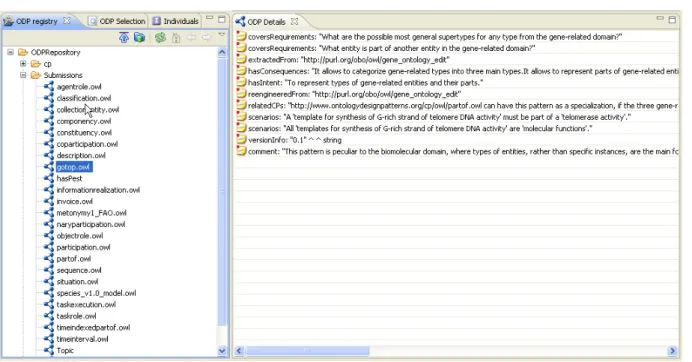
3.1.1 Pattern registry browsing . . . 37
3.1.2 Pattern selection . . . 38
3.1.3 Pattern specialization . . . 40
3.1.4 Pattern annotation . . . 43
3.1.5 Best practices analysis . . . 43
3.1.6 Help and support . . . 44
3.1.7 Software architecture (v1.0) and extendability . . . 46
3.1.8 Ongoing work . . . 49
3.2 ontologydesignpatterns.org - The ODP Portal . . . 49
3.2.1 ODP Portal organization . . . 51
3.2.2 User types . . . 53
3.2.4 Pattern EvaluationWikiFlow . . . 55
3.2.5 The ODP Portal pattern registry . . . 58
3.2.6 Outcome and future work . . . 58
3.3 Re-engineering ODPs: a software library . . . 59
3.3.1 NOR Connector . . . 59
3.3.2 Transformer . . . 61
3.3.3 Semantic Relation Disambiguator . . . 61
3.3.4 External Resource Service . . . 61
3.3.5 OR Connector . . . 62
3.3.6 Prospective further work . . . 62
3.4 Lexico-Syntactic Patterns: reusable JAPE code for NLP applications . . . 63
3.4.1 NL processing with GATE . . . 63
4 Conclusions 67
A Lexico-syntactic ODP repository 68
B JAPE rules 74
List of Tables
2.1 A requirement story card. It includes the story’s title, a list of other stories which the story
depends on, a natural language description, and a priority value. . . 19
2.2 Re-engineering ODP Template . . . 23
2.3 Recommendations for Task 1. . . 28
2.4 Lexico-syntactic ODP template. . . 29
2.5 Integration of Content ODP elements into an ontology . . . 35
2.6 Experiment results: matching of the after-before-pattern with ontologies indexed by the Watson Ontology Search Engine . . . 36
3.1 XD Analyzer rule examples. . . 45
A.1 LSPs corresponding tosubclass-of relationODP . . . 68
A.2 LSPs corresponding toequivalence relation between classesODP . . . 68
A.3 LSPs corresponding toobject property ODP . . . 69
A.4 LSPs corresponding todatatype propertyODP . . . 69
A.5 LSPs corresponding todisjoint classesODP . . . 69
A.6 LSPs corresponding toparticipationODP . . . 69
A.7 LSPs corresponding toco-participationODP . . . 70
A.8 LSPs corresponding tospecified valuesODP . . . 70
A.9 LSPs corresponding tomultiple inheritanceODP . . . 70
A.10 LSPs corresponding tolocationODP . . . 70
A.11 LSPs corresponding toobject-roleODP . . . 70
A.12 LSPs corresponding toobject property anduniversal restrictionODPs . . . 71
A.13 LSPs corresponding todefined classesandsubclass-of relationODPs . . . 71
A.14 LSPs corresponding tosubclass-of relation,disjoint classesandexhaustive classesODPs . . 71
A.15 LSPs corresponding tosubclass-of relation, orsimple part-whole relationODPs . . . 72
A.16 LSPs corresponding toobject property ordatatype propertyorsimple part-whole relationODPs 72 A.17 LSPs corresponding tosimple part-whole relationorconstituencyorcomponencyor collection-entity ODPs . . . 72
A.18 Lexico-syntactic ODPs corresponding tosubclassOf relationODP . . . 73
A.19 Lexico-syntactic ODPs corresponding tosubclassOf relation, disjoint classes and exhaustive classesODPs . . . 73
List of Figures
2.1 The general approach of eXtreme Design. ODPs represent the ontology project’s solution space, which is used as the main knowledge source for addressing ontology design problems,
e.g. reengineering, evaluation, design, etc. . . 14
2.2 Overview of the XD method, from D5.4.2 [SBD+09]. . . 17
2.3 XD workflow for Content ODP reuse. . . 18
2.4 Approach for the reuse of ODPs, aimed at novice users, by exploiting Lexico-syntactic ODPs. . 27
2.5 Symbols and Abbreviations used in the Formalization of Lexico-syntactic ODPs . . . 30
2.6 Integration of pattern elements into an ontology . . . 31
2.7 The Content ODP “precedence" containing the properties “precedes” and “follows” as well as axioms concerning these properties. . . 31
2.8 An alignment of an ontology part and a Content ODP. . . 33
2.9 ODP “before-after" . . . 35
3.1 ODP Registry browser . . . 38
3.2 XD Selector: The user can insert CQs into the quick search dialog. . . 39
3.3 The user has marked theSituation-pattern in the result-list. . . 39
3.4 The specialization wizard. . . 41
3.5 The new ontology module is annotated through the XD Annotation dialog . . . 44
3.6 XD Help . . . 46
3.7 XD Cheat Sheets . . . 47
3.8 XD componenets within the NeOn Toolkit . . . 47
3.9 ODP Portal organization - the navigation menu on the front page showing the different areas of the portal for contributing and navigating through the portal. . . 50
3.10 ODP Portal organization - the second part of the navigation menu on the front page showing the catalogues, and additional user support functionalities. . . 50
3.11 ODP Portal Use Case Diagram: main functionalities and user roles. . . 51
3.12 ThesituationContent ODP proposal as it appears on its page in the ODP Portal. . . 56
3.13 The WikiFlow evaluation tab on an ODP Portal page. . . 57
3.14 Evaluation example. . . 58
3.15 A certified pattern. . . 59
3.16 Modules of the Re-engineering ODP software library. . . 60
3.17 NOR Connector configuration file example. . . 60
3.18 PRNOR configuration file example. . . 61
Chapter 1
Introduction
The notion ofpatterns has proved useful in many areas of design, such as architecture and software en-gineering. Ontology Design Patterns (ODPs) have been presented and formally defined in the context of NeOn in D2.5.1 [PGD+08] (and in D5.1.1 [SFBG+07]), where catalogues of patterns have already been pre-sented . Within C-ODO, the model of collaborative ontology design prepre-sented in D2.1.2 [GP09a], ODPs play a crucial role, since they summarize the good practices to be applied within design solutions, and the design rationales that have motivated their adoption. Informally we can define an ODP as a modeling solution to solve a recurrent ontology design problem. Methodological aspects involving ODPs were the focus of D5.4.2 [SBD+09] and D3.8,1[VB08]. In this deliverable we refer to the experiences regarding the role of patterns in ontology design that have matured within WP2 (with input also from experiments in WP5), with particular focus on pattern-enabled software and tool support for end-users.
The eXtreme Design (XD) is probably the only methodology proposed so far that is entirely focused on ODPs. Section 2.1 presents background and related work concerning design patterns in ontology development, and gives an example of an ontology development workflow reusing Content ODPs. A software tool has been developed as a NeOn Toolkit plugin for supporting the XD methodology: XD Tools (see Section 3.1). We present here version 1.0 that provides support for some of the main tasks of the workflow.
Within this perspective the ODP portal1- presented in Section 3.2 - offers a space to the community where users, who are interested in best practices for ontology design and ontology engineering, can discuss and collect design solutions, provide resources for training and perform ODP evaluation (see Section 3.2.4). The portal has been recently extended for supporting additional pattern types, e.g. Re-engineering ODPs. Within the framework of the NeOn methodology, Re-engineering ODPs define methods for transforming non-ontological resources to ontological resources. This method, as summarized in Section 2.2, relies on a repository of patterns for re-engineering non-ontological resources (PR-NORs), also known as Re-engineering ODPs. In Section 3.3 we describe the Re-Re-engineering ODP software library, a Java library that implements the transformation process suggested by the Re-engineering ODPs.
The method based on Lexico-syntactic ODPs, described in Section 2.3, targets novice users. Exploiting Lexico-syntactic ODPs we can identify associated ODPs with the aim of allowing a semi-automatic reuse of other ODPs, where a formulation of the modelling problem in Natural Language (NL) is the starting point. In this deliverable we release a new version of the Lexico-syntactic ODP repository (a very preliminary version was included in D2.5.1 [PGD+08]), and also offer the JAPE code, that can be reused in NLP applications (see Section 3.4). Both Re-engineering ODPs and Lexico-syntactic ODPs are candidate methods to be incorporated into, and experimented on, within the XD methodology in the future.
Content ODPs are a resource that can also be exploited for ontology refinement. In Section 2.4 we present a pattern-based ontology refinement algorithm. The proposed approach searches for components within an ontology, that already partially instantiate a given ODP. In this way, potential missing ontology elements, present in the ODP, can be identified and reused to enrich the ontology.
Chapter 2 is dedicated to methodological aspects. Even though this deliverable is mainly focused on software support, this chapter gives an overview of methods involving ODPs and provides a background for Chapter 3, which is dedicated to software components and end-user tools.
Chapter 2
Developing ontologies using design
patterns
2.1
eXtreme Design (XD): pattern based ontology design
Ontology Design Patterns (ODPs) is an emerging technique for the reuse of encoded experience and best practices. In the context of the NeOn project catalogues of ODPs have already been presented in D5.1.1 [SFBG+07] and D2.5.1 [PGD+08], and an initial version of the XD methodology, focusing mainly on Content ODPs, was presented in D5.4.2 [SBD+09]. In this deliverable a new version of the methodology is described, since it has been extended and detailed based on experimental results from WP5 (see D5.6.2 [DSFGP+09]) and its application in WP7 use-cases (such as described in D7.6.2 [EBC+09]).
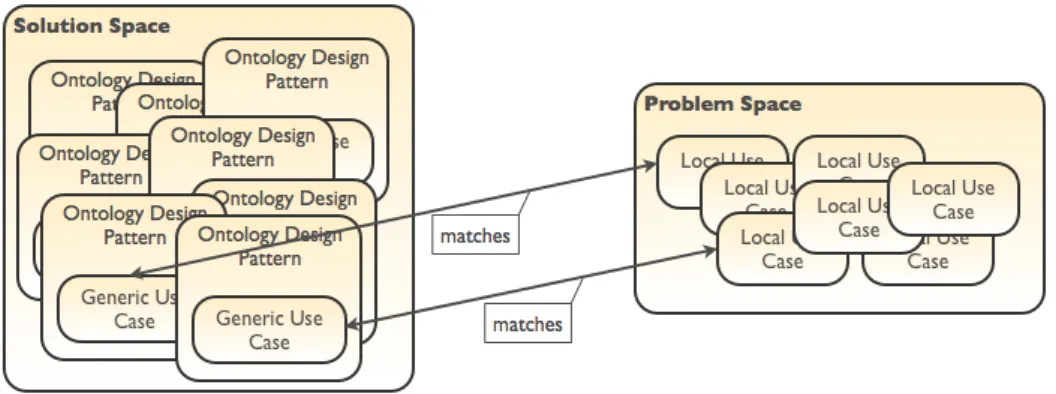
With the nameeXtreme Design (XD)we identify a family of methods based on the application, exploitation, and detection of ontology design patterns (ODPs) [PGD+08], for solving problems related to an ontology development project. The methods are in general characterized by exploiting two sets: theproblem space, which is composed of the actual problems that have to be addressed during an ontology development project, and thesolution space, which is made up of successful reusable solutions, e.g. ODPs. From the project’s
solution space, a number of ODPs are selected by matching the actual (local) problems (Local Use Case - LUC), from the ontology project’s problem space, typically expressed in terms of competency questions (CQs)[GF94], to the General Use Cases (GUC) associated with the ODPs in the solution space. The general approach is schematized in Figure 2.1. The selected ODPs are then used according to specific guidelines, such guidelines for Content ODP reuse were presented in D5.4.2[SBD+09].
Below, we first present a brief introduction to existing work in the area of pattern-based ontology design, or rather point at the lack of such existing work, then we describe the principles of the XD methodology and give an example of a workflow with Content Ontology Design Patterns (Content ODPs).
2.1.1 State-of-the-art and related work
The notion of pattern has proved useful in the context of design within many areas, such as architecture, software engineering, etc. Within C-ODO (the collaborative ontology design model presented in D2.1.2 [GP09a]) ODPs play a crucial role, since they summarize good practices to be applied within design solutions, and keep track of the design rationales that have motivated their adoption. In this context ODPs are the basis for ontology design, starting from ontology requirements and resulting in ODPs integrated into the ontology network to be built.
Even though the use of patterns is widespread in computer science in general, for instance in areas such as software engineering, there are very few methodologies that explicitly mention the use of patterns, and if mentioned they are usually proposed as a kind of additional support that may guide developers within any methodology. So far, very few purely pattern-based methodologies have been proposed, in ontology engineering or elsewhere. In ontology engineering pattern-based methods are present primarily at the logical
Figure 2.1: The general approach of eXtreme Design. ODPs represent the ontology project’ssolution space, which is used as the main knowledge source for addressing ontology design problems, e.g. reengineering, evaluation, design, etc.
level, where patterns support methods for ontology learning, enrichment and similar tasks. In these methods patterns are used more or less automatically, e.g. lexico-syntactic patterns to for example identify ontological elements in a natural language text or to extract relations between ontology concepts (see Section 2.3). Such methods have been proposed in several NeOn deliverables, e.g. [VB08], and in work such as [MFP09]. In the first chapter of this deliverable, on the other hand, the focus is on methodological support, rather than tool support.
As already mentioned, within this methodological focus, there is even less prior work within the ontology engineering field, whereas NeOn is at the forefront of this development. Some operations on ODPs were, however, already presented in D2.5.1 [PGD+08] and a first version of the XD method was introduced in D5.4.2 [SBD+09]. An existing methodology for pattern-based ontology design was presented by Clark and Porter in [CP97]. The difference between this method and XD is that the former do not consider collaboration, and that the patterns were assumed to be a non-evolving set, mostly defined with a top-down approach. One recent methodology that explicitly mentions the use of patterns is presented by Maas et al. in [MJ09], which is a methodology specifically tailored to ontologies for ambient intelligence. However, the methodology is quite general and resembles the XD in its outline, although there is no mention of general principles (see the XD principles later in this chapter). Additionally, this methodology is quite focused on the identification of user requirements and the matching of those requirements to the ODPs, e.g. introducing a notion of informal patterns (called prototypical ODPs) as a step between user requirements and formally described ODPs. For ontology evaluation and debugging, Content ODPs have been used during the evaluation of ontologies in the Fisheries use-case in WP7. Related work, such the one by Corcho et al. in [CRBP09], has also proposed the use of Logical ODPs, and even anti-patterns, for ontology debugging tasks.
2.1.2 Background and principles
XD is partly inspired by software engineering’s eXtreme Programming (XP) (see Shore et al. in [SW07]), and experience factory (von Wangenheim et al. in [vWAB99] and Basili et al. in [BCR94]). The former is an agile software development methodology aiming to minimize the impact of changes at any stage of the development, and producing incremental releases based on customer requirements and their prioritization. The latter is an organizational and process-oriented approach for improving life cycles and products based on the exploitation of past experience and know-how. The methodology of XP (also see Beck in [Bec99] for a comprehensible summary of the XP method and its practices) has evolved over the last decade, as part of the agile software development movement. As mentioned above, the main idea of agile software development is to be able to incorporate changes easily, at any stage of the development. Instead of using a waterfall-like method where you first do all the analysis, then the design, the implementation and finally the testing, the idea is to cut this process into small pieces, each containing all those elements but only for a very small subset of the problem. The solution will grow almost organically and there is no grand plan that can be
ruined by a big change request from the customer.
The XD methodology, especially the version for reusing Content ODPs, is a result of the observation and consequent description of the way we (in our research lab and in the NeOn project in general) have developed ontologies with Content ODPs. Since 2005, we have been developing Content ODPs, teaching pattern-based ontology design in conference tutorials and PhD courses, and for much longer we have been using and refining this approach for our professional work. In order to teach pattern-based design to PhD students and practitioners, we needed to provide trainees with guidelines to follow. This requirement provided us with a good occasion for defining the XD method, primarily for Content ODPs, and also with a context for running the method with different teams, and applying possible refinements and adjustments. During the development of the overall NeOn methodology in WP5 we have then formalized the guidelines and the methodology outline, as well as performed experiments (see D5.6.2 [DSFGP+09]), mainly on the specific methodology for Content ODP reuse. The analysis of those experiments in combination with our previous experience has led up to the current version of the methodology.
Principles
The XD method is inspired by XP in many ways, but its focus is different: where XP diminishes the value of careful design, this is exactly where XD has its main focus. Of course, designing software and designing ontologies is inherently different, but still there are many lessons to be learnt from programming. XD is test-driven, and applies the divide-and-conquer approach, similarly to XP. Also, XD adopts pair design, in analogy to pair programming. Although we did not yet perform a formal evaluation of the effectiveness of pair design, we have collected feedback of trainees and developers through informal discussions and questionnaires after the execution of XD with different teams. Most of them feel that they benefit from on-the-fly brainstorming, and perceive to improve the effect of learning-by-doing within the pair design setting. We have planned to conduct more rigorous evaluations which also involve the analysis of this aspect.
The intensive use of ODPs, modular design, and collaboration are the main principles of the methodology. The effectiveness of ODPs, in particular Content ODPs, in ontology design has been rigorously evaluated in D5.6.2 [DSFGP+09], where XD has been used as development guidelines. The main principles of the XD methodology can be summarized as follows:
• Customer involvement and feedback. The development of an ontology is part of a bigger picture, where typically a software project is under development. Ideally, the customer should be involved in the ontology development and the customer representation should be a team, whose members are aware of all parts and needs of the project. For example, the roles that should be represented include: domain experts, i.e. persons with deep knowledge of the domain to be described by the ontology, those who are in charge of maintaining the knowledge and data sets, i.e. persons who know the views over the data that are usually required by users, those who control and coordinate organizational processes, i.e. persons who have an overall view on the entire flow of data. Depending on the project characteristics, and on the complexity of the organization, the customer representative can be one person or a team. It is important that the team of designers is able to easily interact with the customer representative in order to minimize the possible number of assumptions that they have to make on the incomplete requirement descriptions, i.e. assumptions on the implicit knowledge without discussing and validating them first. Interaction with the customer representative is a key success factor for favoring the explicit expression of knowledge that is usually implicit in requirement documents, including competency questions (CQs). Furthermore, the customer representative should be able to describe what tasks the application involving the ontology is expected to solve.
• Customer stories, Competency Questions (CQs), and contextual statements. The ontology re-quirements and its tasks are described in terms of small stories by the customer representative. De-signers work on those small stories and, together with the customer, transform them into the form of CQs and contextual statements. Contextual statements are accompanying assertions that explicitly
state knowledge that is typically implicit in CQs, e.g. restrictions such as relational cardinality. CQs and contextual statements will be used throughout the whole development process, and their definition is a key phase as the designers have the challenge to help the customer in making explicit as much implicit knowledge as possible.
• ODP reuse and modular design. If there is a GUC of an ODP that matches a LUC it should be reused. Otherwise a new ODP, with its GUC defined based on the LUC in question, should be devel-oped and shared with the team (and ideally on the Web1). In the creation of ODPs certain principles apply (see Gangemi in [GP09b]) concerning the characteristics of the constructed ODP, e.g. level of generality, size, and cognitive comprehensiveness. For the specific case of Content ODPs the reuse of the ODPs as OWL building blocks introduce a natural way of modularizing the ontology, i.e. based on modelling issues. The solution for each CQ, or a group of related CQs, will become a module of the resulting ontology. Such modules, if general and reusable, could also be considered as Content ODP candidates.
• Collaboration and Integration. Integration is a key aspect of XD as the ontology is developed in a modular way, using a divide-and-conquer paradigm. Collaboration and constant sharing of knowledge is needed in an XD setting, in fact similar or even the same CQs and sentences can be defined for different stories. When this happens, it is for instance important that the same ODP is reused, or else the ontology might require some refactoring when the modules are integrated.
• Task-oriented design.The focus of the design is on a specific part of the domain of knowledge under investigation that is needed in order to address the user stories, and more generally, the tasks that the ontology is expected to address. This is opposed to the more philosophical approach of formal ontol-ogy design where the aim is to be comprehensive with respect to a certain domain. Similarly to XP, XD proposes to provide solutions to the exact requirements stated, nothing less but also nothing more; in the sense that unnecessary knowledge should be left out, and the concepts should be defined exactly according to the intended task of the ontology rather than in some common sense notion of their “true" nature.
• Test-driven design. Stories, CQs, and contextual statements are used in order to develop unit tests. A new story has been realized only when all unit tests associated with it have been passed. This aspect enforces the task-oriented approach of the method. It has to be noticed that in this context, unit tests have a completely different meaning with respect to software engineering unit tests. An ontology module developed for addressing a certain user story associated to a certain competency question, is tested e.g. (i) by encoding in the ontology a sample set of facts based on the user story, (ii) defining one or a set of SPARQL queries that formally encode the competency question, (iii) associating each SPARQL query with the expected result, and (iv) running the SPARQL queries against the ontology and comparing actual with expected results. Unit tests for ontologies have already been analyzed by Vrandecic et al. in [VG06], however, the focus was more on purely logical structures.
• Pair design. The team of designers is organized in pairs. This principle is analogous to the pair programming of XP, but while pair programming has proven efficient in software development it still remains to formally prove the efficiency for ontology engineering. Currently this has to be considered a hypothesis, based on experience and observations made so far. At least one pair is in charge of integrating ontology modules, and if necessary refactoring the resulting model.
2.1.3 The eXtreme design iteration
The XD ODP reuse method is illustrated in Figure 2.2. The process starts by identifying the set of require-ments to be addressed, possibly not the complete set of requirerequire-ments in the ontology requirerequire-ments
Figure 2.2: Overview of the XD method, from D5.4.2 [SBD+09].
cation document (ORSD) will be addressed using ODPs, and a set of patterns (catalogues of patterns) that are available for reuse. Throughout the process a divide-and-conquer paradigm is used.
For each sub-problem, it is matched to the patterns (a search of the solution space) and some appropriate patterns are selected and reused. Depending on the nature of the ODPs, e.g. if they are Content ODPs or Re-engineering ODPs, the matching uses different methods, e.g. for Content ODP reuse the specific requirement CQs are matched against the abstract CQs of the Content ODPS, while for Re-engineering ODPs the matching is done based on available non-ontological resource types, syntactical representation of those resources, and the desired output of the re-egnieering process. The pattern-based methodology is test-driven in the sense that each small solution is tested against the requirements before integrating it with the rest of the solution. More detailed guidelines for each step can be found in D5.4.2 [SBD+09].
2.1.4 The XD Workflow with Content Ontology Design Patterns
A previous version of this methodology, including detailed guidelines and examples, was presented in D5.4.2 [SBD+09]. The methodology presented here is an improved version, based on recent experiences and the
Figure 2.3: XD workflow for Content ODP reuse.
experiments performed in WP5 (reported in D5.6.2 [DSFGP+09]). Main improvements are that the initial and the final parts of the methodology have been detailed further (in the previous version the focus was mainly on the iterations by the design pairs), and the order of the steps slightly modified in order to better support the integration and collaboration of the design pairs.
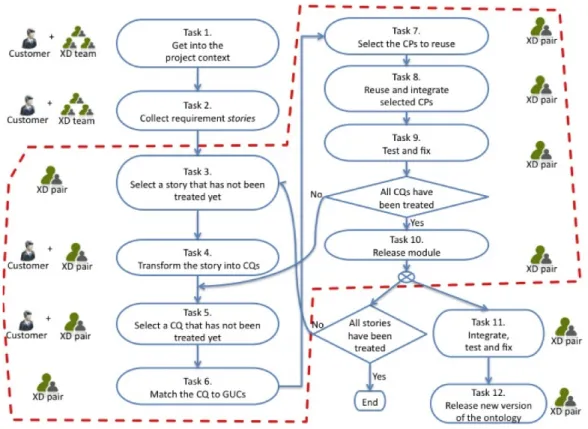
Figure 2.3 shows the workflow of XD with Content ODPs. In this section we will describe the single tasks with the help of a simplified scenario coming from a real case study in the Fishery domain. XD is an incremental, iterative method for pattern-based ontology development. So far detailed guidelines and partial tool support exist for the tasks within the dashed line in Figure 2.3. Guidelines for the initial steps, and the integration and release of new ontology versions, has so far not been properly established through experimental validation of our hypotheses. The guidelines presented here should be read with this in mind.
Before considering the details of each single task, it is worth noting a few assumptions. The team of designers is organized in pairs that work in parallel. At least one pair is in charge of integrating the modules produced by the other pairs, in order to obtain incremental releases of the ontology. A wiki for the project is set up with a basic structure able to collect customer stories and their associated modeling choices, testing documentation, and contextual statements. The wiki will be used in order to incrementally build the project documentation. During the development, and in particular for testing purposes, an ontology module containing instances according to the customer stories is created and shared. This module is used in order to run unit tests against the ontology.
Task 1. Get into the project context. The development is kicked-off by a group of ontology developers and a group of domain experts i.e. the customer representative. In principle they do not know much about each other; they do not have a precise idea of what will be the result of the project, they are used to different terminology, and have different backgrounds. This first task has a twofold objective: (i) make the customer representative aware of the methods and tools that will be applied during the development project, (ii) provide the ontology designer team with an overview of the problem from a domain expert perspective, its scope, and agree on initial terminology. The result of this task is the setup of a collaborative environment where
the customer representative and ontology designers will share documentation and collect arguments and motivations about modeling issues, including terminology, e.g. through deploying a wiki for the project. Task 2. Collect requirement stories. The customer representative is invited to write stories, possibly from real, documented scenarios, that sample the typical facts that should be stored in the resulting ontology. All stories are organized in terms of priority, and possible dependencies between them are identified and made explicit. Each story is described by means of a small card, like the one depicted in Table 2.1, which includes the story’s title, a list of other stories which it depends on, a description in natural language, and a priority value. It is important to notice that this task is not intended to be performed only once during the project. Stories can be added by the customer during the whole project life cycle. For example, if a new requirement emerges new stories can be written. In case the project already has an ontology requirements description document (c.f. D5.4.2 [SBD+09]) with clear CQs, these can instead be enriched by attaching them to such stories, otherwise this process can be seen as an alternative method for collecting CQs (see next steps below).
Task 3. Select a story that has not been treated yet.Each pair of designers selects a story that will be the focus of their work for the next iteration. The selection is based on the experience and competencies of the design pair, but also on the priority of the story, i.e. what the customer wants to be realized in this iteration. A new wiki page for the story is created: the name of the page is the title of the story, and its content is set up based on the information that is present on the card. By performing this task a pair enters a development iteration. To illustrate the process we assume that a pair has selected the story described by the card in Table 2.1.
Table 2.1: A requirement story card. It includes the story’s title, a list of other stories which the story depends on, a natural language description, and a priority value.
Title Tuna observation
Depends on Exploitation values, Tuna areas
Description In 2004 the resource of species ’Tuna’ in water area 24 was observed to be fully exploited in the tropical zone at pelagic depth.
Priority High
Task 4. Transform the story into CQs. The pair processes the story and derives a set of CQs from it. In order to do that, designers could involve the customer for having feedback and clarifications. In case CQs are already present (c.f. D5.4.2 [SBD+09]) this step will only involve to check the CQs for coverage, against the stories collected earlier. However, in case CQs need to be developed, first the story is split into simple sentences, meaning that complex example sentences may be broken up into shorter sentences to increase clarity. The sentences are abstracted so that they describe a class of facts instead of a specific one. The sentences are then transformed into CQs. For example, the story Tuna observationis transformed to the following CQs, which are added to the story’s wiki page:
• CQ1 : What are the exploitation state and vertical distance observed in a given climatic zone for a
certain resource?
• CQ2: What resources have been observed during a certain period in a certain water area?
Additionally, the following contextual statement is derived from the discussion with the customer representa-tive:
• A resource contains one or more species.
• Species are associated to vertical distances. As a consequence, the vertical distance of a resource is inferred through the vertical distance of the species.
Contextual statements are listed in a dedicated wiki page, and are mainly handled by the pair in charge of the integration task.
Task 5. Select a CQ that has not been treated yet. The iteration continues by selecting one of the CQs, or a small set that constitutes a coherent modelling task and should be treated together. In our example this could mean to selectCQ1. Sometimes it is more intuitive for the developers to select a set of coherent CQs,
treating the same concepts, rather than treating each CQ individually. However, the main idea is that the problem now should be broken down into its smallest components, i.e. the individual modelling issues. The termmodelling issue here denotes a primitive modelling problem, such as modelling an n-ary relation, e.g. the observation relation inCQ1.
Task 6. Match the CQ to GUCs. This task has the aim of identifying a set of candidate Content ODPs based on the CQ(s), which express part of the LUC, i.e. the output Content ODP set is the basis for the Content ODP selection performed in Task 7. The matching procedure can be done either with some tool support e.g., keyword based search, or manually e.g., if the designers have a good knowledge of available Content ODPs. We here assume that designers manually perform the matching against the ontologydesign-patterns.org repository of Content ODPs. In our example, candidate Content ODPs are (forCQ1andCQ2
above): situation, and time interval. All of which are available on http://ontologydesignpatterns.org (see Sec-tion 3.2). The competency quesSec-tion of situaSec-tion - “What entities are in the setting of a certain situaSec-tion?” - can be said to match the observation, the resource, and the parameters that are in the setting of that observation. Additionally, the time interval Content ODP may be seen as partially matching the question of what period a certain observation was made, although this could also be solved with just a simple datatype property in case, for example, a year is sufficient to denote the period. The Content ODP contains CQs such as: “What is the end time of this interval?”, “What is the starting time of this interval?”, “What is the date of this time interval?”. The result of this task is then two matching Content ODPs.
Task 7. Select the Content ODPs to reuse.The goal of this task is to select which of those patterns should be used for solving the modeling problem. We may decide that time interval adds too much extra effort, besides the needed year of observation (decided in cooperation with the customer representative), in which case we will only select situation.
Task 8. Reuse and integrate selected Content ODPs. The term ’reuse’ here refers to the application of typical operations that can be applied to Content ODPs, i.e. import, specialization, and composition (see D2.5.1 [PGD+08]). In our example, we specialize thesituationContent ODP in order to addressCQ1. The
particular situation is in our case the observation, and the thing observed is the resource. Additionally, the exploitation state, climatic zone, and vertical distance of the observation, are also involved in the setting. Thereby, we add a subclass of situation:Situation named AquaticResourceObservation, and add the other entities as subclasses of owl:Thing. In addition, we construct subproperties of the situation:isSettingFor and its inverse situation:hasSetting, for connecting the observations to the resources and the different parameters. In this case we have discussed a simplified example where only one Content ODP has been reused and specialized. In other cases, we might reuse more Content ODPs. Each of them would first be specialized then integrated with the others. The process that is typically performed during this task consists of the steps:
1. Select a Content ODP that has not been integrated yet. 2. Specialize the pattern.
3. Compose: identify elements and axioms of the specialized pattern that should be aligned with the current module being produced, and align them.
After iterating over all the selected Content ODPs, and integrating them into the current module, the module also has to be extended to cover the complete CQ(s). In our example, no pattern was selected to solve the time period issue inCQ2, hence a datatype property has to be added to the module in order to cover the
complete CQ.
Task 9. Test and fix. The goal of this task is to validate the resulting module with respect to the CQ(s) just modeled. To this aim, the task is executed through the following steps: (i) the CQ(s) are elaborated in order to
derive a unit test e.g., one or more SPARQL queries; (ii) the instance module is fed with sample facts based on the story; (iii) the unit test is ran against the ontology module (importing the instance module). If the result is not the expected one, i.e. the test is not passed, the module is revised in order to fix the problem, and the unit test ran again until the test is passed; (iv) run all other unit tests associated with the story so far until they all pass. Notice that all unit tests are described in dedicated wiki pages that are properly linked to the associated story. If all CQs associated to the story have been addressed, the process continues with Task 10, otherwise the pair goes back to Task 5. In our example, the unit test associated toCQ1is the following:
SELECT ?exp ?dist ?resource ?zone WHERE {
?obs a :AquaticResourceObservation . ?obs observedResource ?resource . ?obs inClimaticZone ?zone
?obs inState ?exp .
?obs atVerticalDistance ?dist }
Task 10. Release module. This task identifies the end of an iteration for a pair and the result is an ontology module. Once the whole story has been addressed, and the resulting module has been successfully tested, the new module can be released. The module is assigned a URI and published in order to be shared by the whole team. If the module can be publicly shared, it can be published in open Web registries such as ontologydesignpatterns.org. The module is then passed to the pair in charge of the integration. The pair of designers selects a new story if there are still some unaddressed (see Task 3).
Task 11. Integrate, test and fix. Once a new module is released, it has to be integrated with all the others that constitute the current version of the ontology. At least one pair is in charge of performing integration and related tests; new unit tests are defined for the integration, and all existing ones are again executed as regression tests before moving to next task. In this task, all contextual statements are taken into account and all necessary alignment axioms are defined. The module is now under the complete control and editing of the pair in charge of the integration, and refactoring of the ontology modules may be performed in case inconsistent modelling choices are discovered. The products of this task are new unit tests and alignment ax-ioms, and possibly a set of changes to the ontology modules (results of refactoring), all properly documented in the wiki.
Task 12. Release new version of the ontology. Once all unit tests have been passed, a new version of the ontology can be released. The ontology is given a new version number, and it is associated to its own version of the wiki documentation.
2.2
The role of Re-engineering Ontology Design Patterns
In [SFDMP+08, VTAGS+08], we already introduced a method for re-engineering non-ontological resources. We improved and refined the method in [ALVT09]. The method is included in the framework of the NeOn Methodology. It is related to the XD method family in the sense that it heavily makes use of ODPs, namely Re-engineering ODPs, however, it has so far not been properly aligned to the XD workflow presented previously in Section 2.1.3. It is included in this deliverable as a separate method, showing the role of Re-engineering ODPs in the overall NeOn methodology.
The method relies on a repository of Patterns for Re-engineering Non-Ontological Resources (PR-NORs). We can consider these patterns as Re-engineering Ontology Design Patterns, Re-engineering ODPs. In this research work, Re-engineering ODPs define a procedure that transforms the non-ontological resource components into ontology representational primitives. To this end, patterns take advantage of the non-ontological resource’s underlying data model. The data model defines how the different components of the non-ontological resource are represented [GSGPSFVT08].
We will present a summary of our method for re-engineering non-ontological resources into ontologies in Section 2.2.1 of this deliverable. Then we briefly sketch the Re-engineering Ontology Design Patterns in Section 2.2.2. Finally, in Section 3.3 we will present a software library that implements the transformation process suggested by the Re-engineering ODPs.
2.2.1 Method for re-engineering non-ontological resources
Non-ontological resources (NORs), which were defined in D5.4.1 [SFDMP+08], are knowledge-aware re-sources whose semantics have not been formalized yet by an ontology. There is a large amount of non-ontological resources that embody knowledge about some particular domains and that represent some de-gree of consensus for a user community. These resources are present the form of textual corpora, classifi-cations, thesauri, lexicons and folksonomies, among others. For example, Non-ontological resources have related semantics that allows interpreting the knowledge they contain. Regardless of whether the semantics is explicit or not, the main problem is that the semantics of non-ontological resources is not always formalized, and this lack of formalization prevents them from being used as ontologies. Using the non-ontological re-sources as ontologies can have several benefits, e.g. interoperability, browsing/searching, and reuse among others.
With the aim of speeding up the ontology development process, by re-engineering non-ontological resources, in [SFDMP+08, VTAGS+08, ALVT09] we proposed a method that consists of three activities:
1. Non-Ontological Resource Reverse Engineering. The goal of this activity is to analyze a
non-ontological resource to identify its underlying components and create representations of the resource at the different levels of abstraction (design, requirements and conceptual) [ALVT09].
2. Non-Ontological Resource Transformation. The goal of this activity is to generate a conceptual model from the non-ontological resource. We propose the use of Re-engineering ODPs to guide the transformation process. To this end, the ontology development team has to find out if there is any applicable Re-engineering ODP(s) to transform the non-ontological resource into a conceptual model. First, the non-ontological resource type has to be identified. Second, the internal data model of the non-ontological resource has to be identified as well. Third, the transformation approach has to be selected, e.g. from the ones described in [ALVT09].
3. Ontology Forward Engineering. The goal of this activity is to generate the ontology. We use the ontology levels of abstraction, described in [ALVT09], to depict this activity because they are directly related to the ontology development process.
In [ALVT09] we described a user based evaluation on using the method for re-engineering non-ontological resources into ontologies. The goal of this evaluation is to gain evidence on whether the usage of the method leads to users being able to design ontologies faster and/or better quality standards.
2.2.2 Re-engineering ODPs
In this Section we briefly present ourRe-engineering ODPs. The patterns are described in detail in NeOn deliverables D2.2.2 [VTAGS+08] and D2.2.4 [ALVT09]. These patterns come from the experience of ontology engineers in developing ontologies using non-ontological resources in several projects (e.g., SEEMP2, and Knowledge Web3 as well as the NeOn project itself). The patterns describe how to generate the ontologies at a conceptualization level, independent of the ontology implementation language.
The use of Re-engineering ODPs for transforming non-ontological resources into ontologies has several advantages, for instance, they:
2
http://www.seemp.org
3
• embody expertise about how to guide a re-engineering process,
• improve the efficiency of the re-engineering process,
• make the transformation process easier for both ontology engineers and domain experts,
• improve the reusability of non-ontological resources.
These patterns define a procedure that transforms the non-ontological resource components into ontology representational primitives. To this end, patterns take advantage of the non-ontological resource’s underlying data model. The data model defines how the different components of the non-ontological resource are represented.
According to the non-ontological resource categorization presented in D2.2.2 [VTAGS+08], the data model can be different even for the same type of non-ontological resource. For every data model we can define a process with a well-defined sequence of activities to extract the non-ontological resources’ components and then to map these components to a conceptual model of an ontology. Each of these processes can be expressed as a Re-engineering ODP.
The Re-engineering ODPs must disambiguate/discover the semantics of the relations among the non-ontological resource elements. To perform this disambiguation, patterns rely on external resources. In cases where the external resource gives an empty result, i.e. it does not provide any relation between two concepts, the patterns take advantage of the use of Logical or Content ODPs for asserting relations such as
partOf orsubClassOf.
Currently, as external resources, patterns are relying on (1) Scarlet4, which is a technique for discovering relations between two concepts by making use of ontologies available online, and (2) WordNet5, which is an electronic lexical database created at Princeton University. The relation disambiguation phase consists in
1. Take two related terms from the non-ontological resource. 2. Search for a relation between those terms by using Scarlet. 3. Assert the relation returned by Scarlet for the two terms. 4. If Scarlet gives an empty result
4.1. Search for a relation between the two terms by using WordNet. The patterns deal with the following WordNet relations:
• hyponym relation, interpreted assubClassOf.
• hypernym relation, interpreted assuperClassOf.
• member meronym relation, interpreted aspartOf.
• member holonym relation, interpreted ashasPart. 4.2. Assert the relation returned by WordNet for the two terms.
4.3. if WordNet gives an empty result, assert thepartOf orsubClassOf relation as appropriate. Next, we present the proposed template used to describe the Re-engineering ODPs. To present the patterns we have modified the tabular template used in [VTAGS+08]. The adapted template and the meaning of each field is shown in Table 2.2.
Table 2.2: Re-engineering ODP Template
Slot Value
General Information
4http://kmi.open.ac.uk/technologies/name/Scarlet
Table 2.2: Re-engineering ODP Template (Continued)
Slot Value
Name Name of the pattern
Identifier An acronym composed of component type + abbreviated name of the component + number Component Type Re-engineering ODP
Use Case
General Description in natural language of the re-engineering problem addressed by theRe-engineering ODP. Example Description in natural language of an example of the re-engineering problem.
Re-engineering ODP
INPUT: Resource to be Re-engineered
General Description in natural language of the non-ontological resource. Example Description in natural language of an example of the non-ontological resource.
Graphical Representation
General Graphical representation of the non-ontological resource. Example Graphical representation of the example of non-ontological resource.
OUTPUT: Designed Ontology
General Description in natural language of the ontology created after applying the pattern for
re-engineering the non-ontological resource.
Graphical Representation (UML) General Solution
Ontology
Graphical representation, using the UML profile [BH06], of the ontology created for the non-ontological resource being re-engineered.
(UML) Example Solution Ontology
Example showing a graphical representation, using the UML profile [BH06], of the ontology created for the non-ontological resource being used.
PROCESS: How to Re-engineer
General Description in natural language of the general re-engineering process, using a sequence ofactivities. Example Description in natural language of the re-engineering process applied to the non-ontologicalresource example, using the above sequence of activities.
Formal Transformation
General Formal description of the transformation by using the formal definitions of the resources. Relationships (Optional)
Relations to other
modelling components Description of any relation to other Re-engineering ODPs or other ontology design patterns.
So far, we have the following patterns:
• Patterns for Re-engineering Classification Schemes into Ontologies
– PR-NOR-CLTX-01. Pattern for re-engineering a classification scheme, which follows the path enumeration data model, into an ontology schema.
– PR-NOR-CLTX-02. Pattern for re-engineering a classification scheme, which follows the adja-cency list data model, into an ontology schema.
– PR-NOR-CLTX-03. Pattern for re-engineering a classification scheme, which follows the snowflake data model, into an ontology schema.
– PR-NOR-CLTX-04. Pattern for re-engineering a classification scheme, which follows the flattened data model, into an ontology schema.
– PR-NOR-CLLO-10. Pattern for re-engineering a classification scheme, which follows the path enumeration data model, into an ontology.
– PR-NOR-CLLO-11. Pattern for re-engineering a classification scheme, which follows the adja-cency list data model, into an ontology.
– PR-NOR-CLLO-12. Pattern for re-engineering a classification scheme, which follows the snowflake data model, into an ontology.
– PR-NOR-CLLO-13. Pattern for re-engineering a classification scheme, which follows the flattened data model, into an ontology.
• Patterns for Re-engineering Thesauri into Ontologies
– PR-NOR-TSLO-01. Pattern for re-engineering a term-based thesaurus, which follows the record-based data model, into an ontology schema.
– PR-NOR-TSLO-02. Pattern for re-engineering a term-based thesaurus, which follows the relation-based data model, into an ontology schema.
– PR-NOR-TSLO-11. Pattern for re-engineering a term-based thesaurus, which follows the record-based data model, into an ontology.
– PR-NOR-TSLO-12. Pattern for re-engineering a term-based thesaurus, which follows the relation-based data model, into an ontology.
Additionally, in the context of NeOn D2.4.4 An integrated model for linguistic/terminological resources and ontologies, we are proposing patterns for re-engineering lexica into ontologies. This set of patterns will soon be included at the Ontology Design Pattern Portal6, in the Re-engineering Catalogue7Section. The patterns already present were described in detail in NeOn deliverables D2.2.2 [VTAGS+08] and D2.2.4 [ALVT09]
2.3
The role of Lexico-syntactic Patterns
In [SFDMP+08], we already introduced a method for the reuse of Ontology Design Patterns (ODPs) aimed at newcomers to Ontology Engineering. This method is based on a repository of Lexico-syntactic patterns, Lexico-syntactic ODPs, associated to other ODPs with the aim of allowing a semi-automatic reuse of ODPs taking as a starting point the formulation of the modelling problem in Natural Language (NL). This method can be used to support for example the selection and reuse of Content ODPs, as was already described in D5.4.1 [SFDMP+08]. In this deliverable the Lexico-syntactic ODPs and the associated methods are described as separate methods, although they can be used to support tasks within the XD workflow (as described in 2.1.3) and hence describe the role of Lexico-syntactic ODPs in this context.
In this research work, Lexico-syntactic ODPs are understood asformalized linguistic schemas or construc-tions derived from regular expressions in NL that consist of certain linguistic and paralinguistic elements, following a specific syntactic order, and that permit to extract some conclusions about the meaning they ex-press[CGPMPSF08]. Our approach to derive Lexico-syntactic ODPs from NL expressions is based on the assumption that any language has a number of lexical and/or syntactical mechanisms to reliably convey a relation of interest, which in this case is the one represented by the ODP.
At this stage of the research we have only considered verb-oriented Lexico-syntactic ODPs that are mainly composed by tuples of the form subject-verb-object, although we also consider compound sentences, i.e., sentences in which more than one verb is involved. We assume that for expressing how concepts are related in ontologies, we make use of verbs in affirmative or declarative sentences in the simple present tense. In this kind of pattern, verbs are mostly the ones that carry the semantics of the relation. It is also worth men-tioning that Lexico-syntactic ODPs are language dependent, since each NL relies on different linguistic and morphosyntactical mechanisms to convey semantics. Our aim thus is to provide Lexico-syntactic ODPs for different NLs (currently English and Spanish), since the purpose of the approach is to assist novice users in their own languages.
6http://ontologydesignpatterns.org
The original method proposed in D5.4.1 [SFDMP+08] has undergone some minor modifications that are reported in Section 2.3.1 of this deliverable. Then, we briefly describe the approach within the wider frame-work of the NeOn Methodology. A very preliminary version of the repository of Lexico-syntactic ODPs was published in D2.5.1[PGD+08]. That first Lexico-syntactic ODP repository contained Lexico-syntactic ODPs in English associated to the other ODPs (e.g. Content ODPs) they corresponded to. A second version of the Lexico-syntactic ODP respository that contains Lexico-syntactic ODPs in English and Spanish is presented in appendix A. Note that the repository is in a more advanced stage for English and in a more initial one for Spanish. Finally, in Section 3.4, we describe how the set of English patterns contained in the Lexico-syntactic ODP repository have been implemented in the GATE Architecture8 [CMB+09] to enable a semi-automatic identification of corresponding ODPs.
2.3.1 Method for the reuse of ODPs starting from NL formulations
With the aim of helping untrained ontology designers to reuse ODPs, e.g. Content ODPs, in [SFDMP+08] we proposed a method that consisted of three tasks:
1. Task 1. ODP Formulation. The goal of this task is to formulate, in full NL, the domain aspect to be modeled: the user has difficulties in solving a particular modelling issue within a certain domain, and expresses that knowledge in NL.
2. Task 2. ODP Refinement. The goal of this task is to refine the input from Task 1. This task is only carried out when there is no direct correspondence to one ODP or a combination of ODPs. Different strategies may be adopted with this aim, such as, user interaction with the system, search in external ontologies or lexicons, etc. The reasons for refinement may be related to ontology enrichment needs or lexical ambiguities.
3. Task 3. ODP Validation. The goal of this task is to confirm that the resulting ODP, or ODPs, meet user expectations.
Since this is an approach involving NL, the method needs to rely on NLP tools, as explained below. Besides, this method has to be understood within the wider framework of the NeOn Methodology. In this sense, we assume that users have been following the NeOn Methodology for the development of their ontologies, and that they have already performed the Specification Activity (see [SBD+09]). As a result of this activity, users obtain the Ontology Requirements Specification Document (ORSD) in which the requirements to be satisfied by the ontology are expressed. Of particular interest are here the so-called Competency Questions (CQs). CQs are the starting point of this method, as also suggested by the method for Ontology Design Patterns Reuse aimed at Ontology Engineers in [SBD+09] (the initial version of the XD Content ODP methods de-scribed previously in this deliverable). Figure 2.4 illustrates the interaction of the main methodological and technological components of this approach.
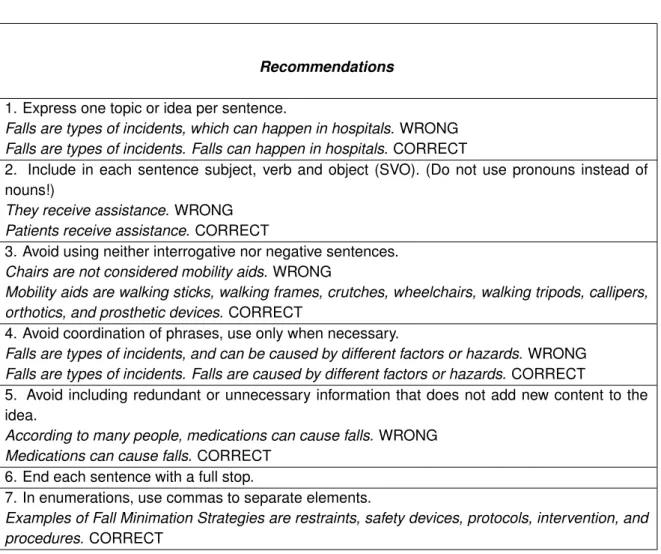
Relying on the set of CQs novice users are asked to formulate in NL the domain aspect (Step 1), i.e. the modelling issue in terms of domain knowledge, they aim at modelling in the ontology (as proposed in Task 1 of the method). Initially, the idea behind this method was to allow users to freely introduce sentences in NL without restrictions, with the aim of palliating the difficulties imposed by controlled languages (for more on this see [CGPMPSF08, dCMPSF09]). However, after some initial tests with real users, we realized that some advice or recommendations were needed to guide users in the formulation task. Note that the user is assumed to introduce correct information from the content viewpoint, moreover taking into account that CQs have been previously validated. Therefore, with the aim of helping or guiding users in the formulation of sentences in NL, we have provided some recommendations accompanied with examples in NL. See table 2.3.
Figure 2.4: Approach for the reuse of ODPs, aimed at novice users, by exploiting Lexico-syntactic ODPs.
The following step (step 2 in Figure 2.3) consists of processing the input sentences with NLP tools. This is performed with GATE, the General Architecture for Text Engineering developed by our colleagues from the University of Sheffield. With this aim, the Lexico-syntactic ODPs identified so far for the English language have been implemented in the JAPE language, as detailed in Section 3.4. Once the input sentence has been annotated with GATE, the result is compared against the repository of Lexico-syntactic ODPs to find corre-spondences (step 3 in Figure 2.3). As can be seen in appendix A, correcorre-spondences between Lexico-syntactic ODPs and other ODPs are not always direct or 1:1 correspondences. Sometimes a Lexico-syntactic ODP corresponds to a combination of other ODPs, because the same linguistic structure conveys the information encoded in various other ontological structures. There is still a third possibility, namely, the correspondence of one Lexico-syntactic ODP to pairwise disjoint ODPs. This means that the information conveyed by the same linguistic structure can have various modelling alternatives, which are not necessarily compatible. This can be summarized as follows:
• 1:1 correspondence: 1 Lexico-syntactic ODP - 1 ODP
• 1:N correspondence: 1 Lexico-syntactic ODP - combination of 2 or more ODPs
• 1:1/2 correspondence: 1 Lexico-syntactic ODP - pairwise disjoint ODPs
When the matching between the annotated sentence and the Lexico-syntactic ODP repository is 1:1 or 1:N, the system will identify the appropriate ODP, or ODPs, that solve the user’s modelling issue and show the results, which is either a UML diagram instantiated with the information from the input sentece or the corresponding OWL code (step 5 in Figure 2.3). If, on the other hand, the third correspondence modality occurs, or no match at all is found, then a disambiguation or refinement task has to be performed (step 4 in Figure 2.3), concerning Task 2 of the proposed method. This situation may be due to an ambiguous or polysemic linguistic structure, or to the fact that different modelling decisions can be made to solve a certain modelling issue. In any case, a process of refinement is needed in order to obtain the ODP, or ODPs, that correspond to the input sentence. For this purpose different refinement strategies have been investigated (see [CGPMPSF08, MPdCGPSF08]).
![Figure 2.2: Overview of the XD method, from D5.4.2 [SBD + 09].](https://thumb-us.123doks.com/thumbv2/123dok_us/10245179.2929340/17.892.189.692.87.756/figure-overview-xd-method-d-sbd.webp)