Termination of Context-Sensitive Rewriting
?Ra´ul Guti´errez and Salvador Lucas DSIC, Universitat Polit`ecnica de Val`encia, Camino de Vera S/N, 46022 Valencia, Spain
{rgutierrez,slucas}@dsic.upv.es
Abstract. Context-sensitive rewriting (CSR) is a variant of rewriting where only selected arguments of function symbols can be rewritten. Consequently, the subterm positions of a term are classified as either active, i.e., positions of subterms thatcan be rewritten; orfrozen, i.e., positions that cannot. Frozen positions can be used to denote subexpres-sions whose evaluation isdelayed or justforbidden. A typical example is the if-then-else operator whose second and third arguments are not evaluated until the evaluation of the first argument yields either true orfalse. Imposing replacement restrictions canimprove the termination behavior of rewriting-based computational systems. Termination ofCSR
has been investigated by several authors and a number of automatic tools are able to prove it. In this paper, we analyze how frozen subterms affect termination ofCSR. This analysis helps us to improve our Context-Sensitive Dependency Pair (CS-DP) framework for automatically prov-ing termination ofCSR. We have implemented these improvements in our toolmu-term. The experiments show the power of the improvements in practice.
Keywords: context-sensitive rewriting, termination, dependency pairs
1
Introduction
During the4th International Workshop on Rewriting Logic and its Applications, WRLA 2002, a tutorial by the second author entitledContext-Sensitive Rewrit-ing Techniques for Programs With Strategy Annotations was the starting point of a friendly cooperation with Jos´e Meseguer leading to multiple exchanges of students and people from the UIUC and the UPV, and to the development of fruitful joint work on Rewriting Logic, Maude, and, in general, the analysis, verification, and optimization of declarative programming languages.
?
Partially supported by the EU (FEDER), MINECO project TIN 2013-45732-C4-1-P, and GV project PROMETEO/2011/052. Salvador Lucas’ research was developed during a sabbatical year at the CS Dept. of the UIUC and was also partially sup-ported by NSF grant CNS 13-19109. Ra´ul Guti´errez is also partially supported by a Juan de la Cierva Fellowship from the Spanish MINECO, ref. JCI-2012-13528.
Actually, the idea ofstrategy annotation (where the list of arguments whose evaluation isallowed is explicitly given for each function symbol) originally intro-duced by Jos´e and other colleagues as part of the design ofOBJ2[11] anticipated the main ideas underlying the development ofContext-Sensitive Rewriting for a rather different purpose1. On the basis of previous work in [23, 24], in the afore-mentioned tutorialContext-Sensitive Rewriting (CSR, [22]) was shown useful to model rewriting-based programming languages likeCafeOBJ[12],ELAN[8],OBJ
[15], and Maude[9] that are able to use such kind of strategies.
In CSR, we start with a pair (R, µ) (often called a CS-TRS) consisting of a Term Rewriting System (TRS)R and a replacement mapµ, i.e., a mapping from a signatureF into natural numbers that satisfiesµ(f)⊆ {1, . . . ,ar(f)}for each function symbolf in the signatureF, wherear(f) is the arity off. Here, µis used todiscriminatethe argument positions on which the rewrite steps are allowed. In this way, we can avoid undesired computations and (in many cases) obtain a terminating behavior for the TRS (with respect to the context-sensitive rewrite relation). Strategy annotations are still used in CafeOBJandMaude. In
Maude, actually, frozen arguments have been recently introduced as a powerful mechanism to avoid undesired reductions. Frozen arguments are even closer to
CSR, as they are just the complement of thereplacing arguments specified by a replacement mapµ: thei-th argument off is frozen iffi /∈µ(f).
Using CSR, we can easily model the evaluation of expressions which avoid
ordelay the evaluation of some of their arguments. Paramount examples are if-then-else expressions, some boolean operators (and/or) andlazy cons operators for list construction.
Example 1. The following TRSR[28] provides a definition of factorial
0+x→x (1) zero(0)→true (6)
s(x)+y→s(x+y) (2) zero(s(x))→false (7)
p(s(x))→x (3) fact(x)→if(zero(x),s(0), x∗fact(p(x))) (8)
if(true, x, y)→x (4) 0∗x→0 (9)
if(false, x, y)→y (5) s(x)∗y→y+(x∗y) (10) Withµ(if) ={1} andµ(f) ={1, . . . , k} for any otherk-ary symbolf (i.e., the onlyfunction symbol which is restricted by µisif), we can advantageously use
CSR for handling the if-then-else operator: the second and third arguments of an expressionif(b, s, t)are not evaluated until the guardbis evaluated totrueor
false. Without the replacement map,Ris nonterminating because fact(x) calls
fact(p(x)), which then calls fact(p(p(x)))and so on. Thanks to the replacement restrictions, though, we can evaluatefact(sn(0))to obtain the factorialsn!(0)of a numbern(encoded assn(0)) by usingCSRas follows:
fact(sn(0)),→(8),µif(zero(sn(0)),s(0),sn(0)∗fact(p(sn(0)))),→(7),µ· · ·
1
The notion context-sensitive rewriting was developed as part of Lucas’ Master Thesis (1994) to implement concurrent programming languages that, like the π-calculus, forbid reductions on some arguments of its operations.
This can be formally proved (see [22, 26] and also [19] for an account of the algebraic semantics of context-sensitive specifications). Note thatzero(sn(0))is forced to be reduced first to either true or false before evaluating the ‘then’ or ‘else’ expression, thus avoiding undesired reductions until the guard is fully evaluated.
Direct techniques and frameworks for proving termination of CSR have been developed [1, 3, 17]. But, in practice, proving termination of some CS-TRSs with certain lazy structures as the if-then-else in the example can be difficult. In fact, finding an automatic proof of Example 1, and other examples like [13, Example 1] or [10, Example 3.2.14] are open problems since 1997, 2003 or 2008, respectively. The reason why these problems cannot be proved terminating by existing termination tools lies in the lack of sufficiently precise models of how the evaluation of expressions is delayed in context-sensitive computations. In this paper, we revisit this problem to obtain easier and mechanizable proofs of termination.
After some preliminaries in Section 2, Section 3 analyzes the role of frozen subterms in infiniteµ-rewrite sequences, Section 4 models the activation of de-layed subexpressions. Section 5 revises the characterization of the termination ofCSR. Sections 6 proposes a new notion of CS usable rules, the extended basic CS usables, that allows us to simplify termination proofs if the application con-ditions are satisfied, Section 7 shows the experimental evaluation and Section 8 concludes.
2
Preliminaries
See [7] and [22] for basics on term rewriting andCSR, respectively. Throughout the paper,X denotes a countable set of variables andF denotes a signature, i.e., a set of function symbols each having a fixed arity given by a mappingar:F → N. The set of terms built fromF andX isT(F,X). Terms are viewed as labeled
trees in the usual way. The symbol labeling the root of the termsis denoted as
root(s). Positionsp, q, . . .are represented by chains of positive natural numbers used to address subterms ofs. Given positionsp, q, we denote their concatenation as p.q. We denote the empty chain byΛ. Positions are ordered by the standard prefix ordering: p≤q if∃q0 such thatq =p.q0. The set of positions of a term s isPos(s). Ifpis a position, and Qis a set of positions, p.Q={p.q |q∈Q}. For a replacement mapµ, the set ofactive positions Posµ(s) ofs∈ T(F,X) is:
Posµ(s) ={Λ}, ifs∈ X andPosµ(s) ={Λ} ∪Si∈µ(root(s))i.Posµ(s|i), ifs6∈ X. We write sDt, tis a subterm of s, if there isp∈ Pos(s) such that t=s|p and sBt, t is a proper subterm of s, ifsDt and s6=t. Given a replacement map µ, we writesDµt,t is aµ-replacing subterm ofs, if there isp∈ Posµ(s) such that t = s|p and sBµt, t is a proper µ-replacing subterm of s, if sDµt and s6=t. Moreover, we writesB
µt,tis a non-µ-replacing subterm ofs, if there is a
frozen positionp, i.e.p∈ Posµ(s) wherePosµ(s) =Pos(s)− Posµ(s), such that t=s|p. Let Var(s) ={x∈ X | ∃p∈ Pos(s), s|p=x}, Varµ(s) ={x∈ Var(s)|
∃p∈ Posµ(s), s|p=x}andVarµ(s) ={x∈ Var(s)|sB
µx}. Acontextis a term C ∈ T(F ∪ {},X) with zero or more ‘holes’(a fresh constant symbol). We write C[ ]p to denote that there is a (usually single) hole at positionpofC. Generally, we writeC[ ] to denote an arbitrary context (where the number and location of the holes is clarified ‘in situ’) and C[t1, . . . , tn] to denote the term obtained by filling the holes of a contextC[ ] with termst1, . . . , tn.C[ ] =is called theemptycontext.
A rewrite rule is an ordered pair (`, r), written`→r, with`, r∈ T(F,X), ` /∈ X and Var(r) ⊆ Var(`). A TRS is a pair R = (F, R) whereR is a set of rewrite rules. GivenR= (F, R), we considerFas the disjoint unionF =C ]Dof symbolsc∈ C, calledconstructors and symbolsf ∈ D, calleddefined functions, where D={root(`)|`→r∈R} and C=F − D. Given a CS-TRS (R, µ), we have s ,→R,µt (alternativelys
p
,→R,µtif we want to make the position explicit) if there are ` →r ∈ R, p ∈ Posµ(s) and a substitutionσ with s|p =`σ and t=s[rσ]p. A CS-TRS (R, µ) isterminating if,→R,µ is well-founded.
3
Minimal Non-
µ
-Terminating Terms at Frozen Positions
In this section we investigate how frozen subterms affect termination of CSR. Our analysis is used in Section 4 to obtain a more precise model of termination of CSRusing Context-Sensitive Dependency Pairs (CS-DPs, [3]). If a TRS R
is nonterminating, then terms are either terminating or nonterminating. The subset T∞ of minimal nonterminating terms consists of nonterminating terms whose proper subterms are all terminating. And the following observations are in order [20, 21]: (1) every nonterminating term s contains a subterm t ∈ T∞, (2)root(t) is a defined symbol ofR, and (3) minimality is preserved under inner rewritings:
Lemma 1. Let R be a TRS. For every term s ∈ T∞, if s >Λ
−→R t and t is
nonterminating then t∈ T∞.
InCSR, if a CS-TRS (R, µ) is nonterminating, among non-µ-terminating terms we distinguish the subset T∞,µ of strongly minimal non-µ-terminating terms, whose proper subterms areall µ-terminating. But unlike minimality for rewrit-ing, strong minimality is not preserved under innerµ-rewritings.
Example 2. Consider the following TRS R[3, Example 3]:
a→c(f(a)) (11) f(c(x))→x(12)
together withµ(c) =∅ andµ(f) ={1}, and the term f(a)∈ T∞,µ. If we apply (11) to the proper subterm a, we obtain f(c(f(a))) ∈ T/ ∞,µ because f(a) is a subterm off(c(f(a))).
Unfortunately, strong minimality doesnotdistinguish active and frozen positions and a result as Lemma 1 is not possible for strongly minimal terms. The set of
whose proper subterms at active positions are all µ-terminating. Minimal non-µ-terminating terms are preserved under inner µ-rewritings, as we show in the following lemma.
Lemma 2. [3, Lemma 4]Let(R, µ)be a CS-TRS. For alls∈ M∞,µ, ifs >Λ ,→R,µt
andt is non-µ-terminating, thent∈ M∞,µ.
Furthermore, T∞,µ ⊆ M∞,µ. And now, f(c(f(a))) in Example 2 is minimal:
f(c(f(a)))∈ M∞,µ. The following result establishes that, given a minimal non-µ-terminating term, there are only two ways for an infinite µ-rewrite sequence to proceed.
Proposition 1. [3, Proposition 5]Let (R, µ)be a CS-TRS. For all s∈ M∞,µ,
there exist a rewrite rule`→r∈ R, a substitutionσand a termu∈ M∞,µsuch
thats,−→>Λ∗ R,µ`σ
Λ
,→`→r,µrσDµtand either(1)there is a nonvariable subtermu
at an active position ofrsuch thatt=uσ, or(2)there isx∈ Varµ(r)− Varµ(`)
such that xσDµt.
What Proposition 1 says is that minimal non-µ-terminating terms at frozen positions (asf(a) inf(c(f(a)))) show up at active positions by means of migrating variables (a variablexis migrating in a rule`→rifx∈ Varµ(r)− Varµ(`), asx in rule (12)). If (1) happens, information about the shape oftis provided because it is partially introduced by an active subterm of r. This information is crucial to efficiently mechanize proofs of termination. But if (2) happens, information about the shape of tishidden below a bindingxσ of the matching substitution σ. The frozen occurrence ofxin the left-hand side`of the rule is responsible for this information showing up later in the sequence. In the following, we analyze how minimal non-µ-terminating terms appear at frozen positions in infiniteµ -rewrite sequences and how they evolve until getting activated by a migrating variable. Without loss of generality, in the following all the considered infinite µ-rewrite sequences start from strongly minimal non-µ-terminating terms.
Example 3. Consider the following non-µ-terminating TRSR[1, modified (I)]:
a→f(g(b)) (13)
f(x)→h(c(x)) (14)
h(x)→x (15)
b→a (16) with µ(g) = µ(c) = {1} and µ(f) =∅ for all f ∈ F − {g,c}. Subexpressions at frozen positions are identified using the overbar. And consider the following infiniteµ-rewrite sequence (Figure 1 shows it graphically, where shaded triangles are minimal non-µ-terminating terms2):
a,→(13),µf(g(b)),→(14),µh(c(g(b))),→(15),µc(g(b)),→(16),µc(g(a)),→(13),µ· · ·
2
Note that minimal non-µ-terminating terms may contain minimal non-µ-terminating terms (at frozen positions, though). We use darker shades for such nested minimal non-µ-terminating terms.
As we can see in the sequence,a∈ T∞,µ, and the firstµ-rewriting step introduces the minimal non-µ-terminating term b at a frozen position by using rule (13) which introduces the context g() wherebis located. Afterwards, the context
c() is insertedabove termg(b) which is “pushed down” by the right-hand side of rule (14). Finally, the migrating variablexin rule (15) isinstantiated (in the third step) to c(g(b)). The application of rule (15) finallyactivates b, which is nowactive inside c(g(b)).
a ,→ (13),µ g() b ,→ (14),µ c(g()) b ,→ (15),µ c(g()) b ,→ (16),µ· · ·
Fig. 1.Infiniteµ-rewrite sequence in Example 3
Example 3 shows how minimal non-µ-terminating terms are partially “intro-duced” in an infiniteµ-rewrite sequence: there is a rule`→r(in this case (13)), a subterm uofr at a frozen position (b) and a possible context with a hole at an active position (g()).
As discussed above, the context surrounding those “hidden” minimal non-µ-terminating terms t can be “increased”, i.e., t can be “pushed down” into a bigger context. Furthermore, the context can be “decreased” as well, as we can see in the following example.
Example 4. Consider the following TRS R[1, modified (II)]:
a→f(g(c(g(b)))) (17)
f(g(x))→h(x) (18)
h(c(x))→x (19)
b→a (20) withµ(g) =µ(c) ={1}andµ(f) =∅for allf ∈ F − {g,c}, and:
a,→(17),µf(g(c(g(b)))),→(18),µh(c(g(b))),→(19),µg(b),→(20),µg(a),→(17),µ· · · Figure 2 shows it graphically. Once again, the first µ-rewriting step introduces the minimal non-µ-terminating term b at a frozen position by using rule (17) which introduces the context g(c(g())). But, in the second µ-rewriting step, part of the active context g(c(g())) which is frozen ats2 =f(g(c(g(b)))), i.e.
g(), isremoved froms2due topattern matching with the left-hand side of rule (18). Finally, in the same way, part of the active contextc(g()) which is frozen at s3 = h(c(g(b))), i.e. c(), is removed from s3 in the third µ-rewriting step by pattern matching with rule (19) and, furthermore, the migrating variablex is instantiated tog(b).
a ,→ (17),µ g(c(g())) b ,→ (18),µ c(g()) b ,→ (19),µ g() b ,→ (20),µ· · ·
Fig. 2.Infiniteµ-rewrite sequence in Example 4
We describe these “incoming” and “outcoming” contexts surrounding frozen subterms. First, we notice that, when examining the rules (14), (18) and (19) (which are responsible for the introduction and removal of contexts discussed in Example 3 and Example 4) they all share the following features:
– if a rule ` → r adds a context Ci, then there is a term s = Ci[x]p such thatr=D[s]q, beingq a frozen position ofrandpan active position ofs. Furthermore, if`→r is applied in a minimal non-µ-terminating sequence, the variablexcannot occur at active positions, i.e.,x∈(Varµ(`)∩Var
µ(r))− (Varµ(`)∪ Varµ(r)) (if not, minimality is violated); and,
– if a rule`→r removes a contextCo, then there is a terms=Co[x]p such that`=D[s]q, beingq a frozen position of`and pan active position ofs. Furthermore, if`→r is applied in a minimal non-µ-terminating sequence, the variablexcannot occur at active positions, i.e.,x∈(Varµ(`)∩Var
µ(r))− (Varµ(`)∪ Varµ(r)) or`|q.p is migrating (in this case, we are in the second case of Proposition 1, where the minimal non-µ-terminating term shows up and is the responsible of continuing the sequence).
Rules involving these incoming and outcoming contexts can be applied several times and in different orders.
Example 5. Consider the following TRS R[1, modified (III)]:
a→f(g(b)) (21)
f(x)→h(g(c(c(x)))) (22)
h(g(x))→h(x) (23)
h(c(x))→x (24)
b→a (25)
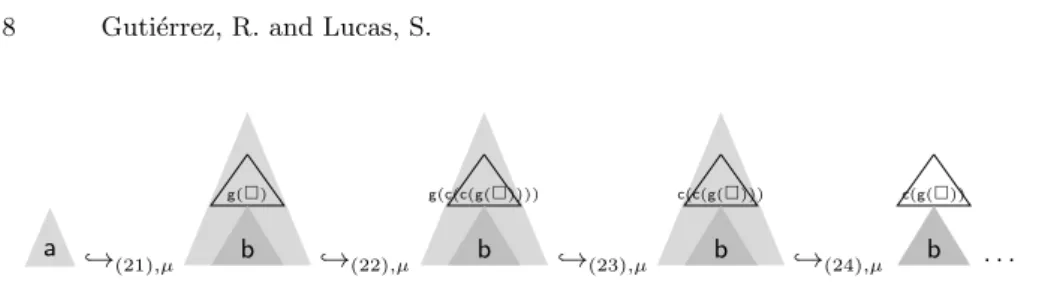
with µ(g) = µ(c) = {1} andµ(f) = ∅ for allf ∈ F − {g,c}. And consider the following infiniteµ-rewrite sequence (graphically in Figure 3):
a,→(21),µf(g(b)),→(22),µh(g(c(c(g(b))))),→(23),µh(c(c(g(b)))),→(24),µc(g(b))· · ·
Note that the migrating variable xis instantiated to term xσ=C[u] =c(g(b)) whereu=bis minimal non-µ-terminating and the contextC[] =c(g()) with a hole at an active position is a combination offragments of contexts added at frozen positions by rewrite rules.
a ,→ (21),µ g() b ,→ (22),µ g(c(c(g()))) b ,→ (23),µ c(c(g())) b ,→ (24),µ c(g()) b · · ·
Fig. 3.Infiniteµ-rewrite sequence in Example 5
4
Modeling the Unhiding Process using Rules
Recapitulating Section 3, if we consider an infinite sequence starting from s1∈ T∞,µ, following Proposition 1 we extract an infinite sequence of the form:
s1,−→>Λ∗R,µ`1σ Λ ,→`1→r1,µr1σDµs2 >Λ ,−→∗R,µ`2σ Λ ,→`2→r2,µr2σDµ· · ·
where si∈ M∞,µ, for alli >0. If Proposition 1(2) is applied on stepj,j >0, we know that: (a) previously in the chain there is a rule (like (13), (17) and (21)) that introduces the minimal non-µ-terminating term in the sequence together with an active context, (b) there are rules that modify this active context (like (14), (18), (22) and (23)) and, finally, (c) rule`j→rj (like (15), (19) and (24)) shows up the minimal non-µ-terminating by means of a migrating variable x together with part of its active context, xσ =C[u]. In this section, we use the knowledge of the previous section to define a TRS that can be used to extract u from C[u] by using a minimum set of rules. Furthermore, we introduce the new notion of unhidable. All this prepares the introduction of a new notion of minimality which is the basis of our new characterization of termination ofCSR. Following the observations in the previous section, we can get the patterns which introduce the minimal non-µ-terminating term at a frozen position in a µ-rewrite sequence together with its active context, as g(b) in rule (13) in Example 3 and in rule (21) in Example 5 andg(c(b)) in rule (17) in Example 4. Definition 1. Let R = (F, R) = (C ] D, R) be a TRS, ` → r ∈ R and µ a replacement map onF. We say thats=C[t]p is a raw hidden termof `→r if r=D[C[t]p]q,q∈ Posµ(r),p∈ Posµ(C[t]p),root(t)∈ Dandq.pis minimal inr
(i.e., there is noq0.p0 such thatr=D0[C0[t]p0]q0,q0∈ Pos
µ(r),p0 ∈ Posµ(C0[t]p0)
and p0 < p). Let Hraw(R, µ) be the set of all raw hidden terms from rules in
(R, µ).
Example 6. In Example 1, we haveHraw(R, µ) ={x∗fact(p(x))}; in Example 3,
we haveHraw(R, µ) ={g(b)}; in Example 4, we haveHraw(R, µ) ={g(c(g(b)))};
and, in Example 5, we haveHraw(R, µ) ={g(b))}.
We identify the shape of the patterns that increase or decrease the active context attached to delayed subexpressions.
Definition 2. Letu∈ T(F,X)andµa replacement map onF. We say thats= C[]p is a maximal active hiding contextin uif u=D[C[x]p]q,q∈ Posµ(u),
p∈ Posµ(C[x]p)andq.p is minimal inu.
Example 7. In rule (14),c() is a maximal active hiding contex of the right-hand side, in rule (18),g() is an maximal active hiding context of the left-hand side and in rule (19),c() is a maximal active hiding context of the left-hand side. And we clasify the different maximal active hiding contexts existing in a CS-TRS.
Definition 3. Let R= (F, R) be a TRS, `→r∈R,µ a replacement map on F, D[]q a context with a hole at a frozen position q, C[]p a context with a
hole at an active position andx∈ X. We say thats=C[]p is either:
1. An incoming contextof `→r if sis a maximal active hiding contex of r,
r=D[C[x]p]q, andx∈(Varµ(`)∩ Varµ(r))−(Varµ(`)∪ Varµ(r)).
2. An outcoming context of `→rif s is a maximal active hiding contex of`,
`=D[C[x]p]q, andx∈(Var
µ(`)∩ Var
µ(r))−(Varµ(`)∪ Varµ(r)).
3. A terminal outcoming context of ` → r if s is a maximal active hiding context of`,`=D[C[x]p]q, andx∈ Varµ(r)− Varµ(`).
LetCi(R, µ)/Co(R, µ)/Ct(R, µ)be the set of all incoming / outcoming / terminal
outcoming contexts from rules in(R, µ).
Example 8. In rule (14), c() is an incoming contex of the right-hand side, in rule (18), g() is an outcoming context of the left-hand side and in rule (19),
c() is a terminal outcoming context of the left-hand side.
In Example 1, we haveCi(R, µ) =Co(R, µ) =Ct(R, µ) =∅; in Example 3,
we haveCi(R, µ) ={c()}, andCo(R, µ) =Ct(R, µ) =∅; in Example 4, we have
Ci(R, µ) =∅,Co(R, µ) ={g()}, andCt(R, µ) ={c()}; and, in Example 5, we
have Ci(R, µ) ={g(c(c()))},Co(R, µ) ={g()}, andCt(R, µ) ={c()}.
Outcoming contexts represent the fragments of active contexts which can be
removed by a rule. Incoming contexts represent the active contexts that can be
added. The following fixed-point definition obtains any combination of added/re-moved contexts (this will allow us to model the contexts that appear in the infiniteµ-rewrite sequence in Example 5).
Definition 4. Let R= (F, R) be a TRS and µ∈MF. The set XCi(R, µ)and
XCo(R, µ)are the least sets satisfying:
1. Ci(R, µ)⊆XCi(R, µ),Co(R, µ)⊆XCo(R, µ)andCt(R, µ)⊆XCt(R, µ).
2. If Ci[] ∈ XCi(R, µ), Co[] ∈ XCo(R, µ), and there exist θ = mgu(Ci[x],
Co[y]) (rename variables if necessary) where x and y are fresh variables, such thatyθ /∈ X andyθ=Ci0[x], thenCi0[]∈XCi(R, µ).
3. If Co[] ∈ XCo(R, µ), Ci[] ∈ XCi(R, µ), and there exist θ =mgu(Co[x],
Ci[y])(rename variables if necessary) wherexandyare fresh variables, such thatyθ /∈ X andyθ=Co0[x], thenCo0[]∈XCo(R, µ).
4. If Ct[] ∈ XCt(R, µ), Ci[] ∈ XCi(R, µ), and there exist θ = mgu(Ct[x],
Ci[y]) (rename variables if necessary) where x and y are fresh variables, such thatyθ /∈ X andyθ=Ct0[x], thenCt0[]∈XCt(R, µ).
Note that, when the most general unifier (mgu) is computed, terms do not share variables, so a variable renaming is applied if necessary. The computation of XCi(R, µ), XCo(R, µ) and XCt(R, µ) terminates (in each step, the resulting
context is a instantiated fragment of one of the contexts that are unified).
Example 9. In Examples 1, 3 and 4, we haveXCi(R, µ) =Ci(R, µ),XCo(R, µ) =
XCo(R, µ) andXCt(R, µ) =Ct(R, µ). In Example 5, we haveCo(R, µ) =XCo(R, µ),
Ct(R, µ) =XCt(R, µ), butXCi(R, µ) ={g(c(c())),c(c())}. The contextc(c())
represents a fragment of the active incoming context that remains after applying rule (22) and rule (23).
Terminal outcoming contexts can only be applied just before the minimal non-µ -terminating term shows up at an active position. Therefore,FXCi(R, µ) extends
XCi(R, µ) obtaining the fragments of contexts obtained after removing the the
terminal outcoming context.
Definition 5. Let R = (F, R) be a TRS and µ ∈ MF. The set FXCi(R, µ)
satisfies:
1. XCi(R, µ)⊆FXCi(R, µ).
2. If Ci[] ∈ XCi(R, µ), Ct[] ∈ XCt(R, µ), and there exist θ = mgu(Ci[x],
Ct[y]) (rename variables if necessary) where x and y are fresh variables, such thatyθ /∈ X andyθ=C[x], thenC[]∈FXCi(R, µ).
Example 10. In Examples 1, 3 and 4, we haveFXCi(R, µ) =XCi(R, µ) =Ci(R, µ).
In Example 5,FXCi(R, µ) ={g(c(c())),c(c()),c()}. The contextc()
repre-sents a final fragment of the active incoming context that remains after applying rule (24) (when the minimal non-µ-terminating term shows up at an active po-sition).
In the same way, we apply the outcoming contexts to the raw hidden terms to obtain the possible shape of those terms when they show up by means of migrating variables.
Definition 6. The set XHraw is the least set satisfying (1) Hraw ⊆ XHraw, and
(2) if Ci[t] ∈ XHraw, Co[] ∈ XCo(R, µ) and there exist θ = mgu(Ci[t], Co[x])
wherexis a fresh variable, such thatxθ=C[tθ], thenC[tθ]∈XHraw.
The set FXHraw satisfies (1) XHraw ⊆ FXHraw, and (1) if Ci[t] ∈ XHraw,
Ct[] ∈ XCt(R, µ) and there exist θ = mgu(Ci[t], Ct[x]) where x is a fresh
variable, such thatxθ=C[tθ], thenC[tθ]∈FXHraw.
Example 11. In Examples 1 and 3,FXHraw(R, µ) =XHraw(R, µ) =XHraw(R, µ);
in Example 4, we haveXHraw(R, µ) ={g(c(g(b))),c(g(b))} andFXHraw(R, µ) =
{g(c(g(b))),c(g(b)),g(b)}; and, in Example 5, XHraw(R, µ) = FXHraw(R, µ) =
{g(b),b}.
Previous definitions will be helpful in the next section to obtain a notion of minimality that gives us more information about non-µ-terminating terms at frozen positions.
4.1 A new notion of minimal non-µ-terminating term
The following notion ofunhidable prepares a notion ofminimality that provides more information about minimal non-µ-terminating terms at frozen positions. Definition 7. Let R = (F, R) and S = (F, S0]S1) be TRSs, and µ ∈MF.
Let s, t∈ T(F,X). We say that sunhides t using S if s→Λ∗S 0 ◦
Λ
→S1 t. We say that a term u is unhidable using S if for every subterm v ∈ M∞,µ such that u = D[C[v]p]q, q ∈ Posµ(u), p ∈ Posµ(C[v]p), q.p minimal, C[v]p unhides v
usingS andv is unhidable usingS.
Setting S0 =FXCRi(R, µ) and S1 = FXHRraw(R, µ) in Definition 7, where we
define FXCRi(R, µ) ={Ci[x]→ x| Ci[] ∈FXCi(R, µ)} and FXHRraw(R, µ) =
{Ci[s]p → s | Ci[s]p ∈ FXHraw(R, µ), p ∈ Posµ(Ci[s]p), s ∈ D}, we obtain the following properties.
Proposition 2. Let R= (F, R) be a TRS,µ∈MF,S0 =FXCRi(R, µ), S1=
FXHRraw(R, µ),S = (F, S0]S1),σbe a substitution andu, vbe terms such that uunhides v usingS. Then,
1. S0∩S1=∅.
2. If Co[] ∈XCo(R, µ)∪XCt(R, µ), and u=Coσ[C[v]] then C[v] unhides v
usingS.
3. IfCi[]∈XCi(R, µ), thenCiσ[u] unhidesv using S.
Proof. Item 1 is true by construction, since for alls→t∈S0,t∈ X and for all s→t∈S1,t /∈ X. Sinceuunhidesv usingS, we can writeu→Λ∗S0 ◦
Λ
→S1 v. We
prove Item 2 by induction on the length iof→Λ
i
S0, we have:
1. If i= 0, we haveu→Λs→tv, where s→t∈S1. If u=Coσ[C[v]], there exist θ =mgu(s, Co[x]), xθDµtθ and v =tθσ0. By Definition 6,xθ → tθ ∈ S1 andC[v]→Λxθ→tθ v, i.e. C[v] unhidesv usingS.
2. Ifi >0, we haveu→Λs→tw Λ
→iS−10 ◦→ΛS1 v, wheres→t∈S0ands=Ci[x].
Ifu=Coσ[C[v]], there existθ=mgu(Ci[x], Co[y]). We consider two cases: (a) Ifxθ=Co0[y], then by Definition 4, if Co[]∈XCo(R, µ) then Co0[]∈
XCo(R, µ) and if Co[] ∈ XCt(R, µ) then Co0[] ∈ XCt(R, µ), w =
Co0σ[C[v]] and, by the induction hypothesis,C[v] unhidesv usingS. (b) Ifyθ=Ci0[x], then by Definition 4, Ci0[]∈XCi(R, µ),Ci0[x]→x∈S0,
C[v] =Ci0σ0[w], andCi0σ0[w]→ΛCi[x]→xw Λ
→iS−10 ◦→ΛS1 v, i.e.C[v] unhides
v usingS. Item 3 is trivial.
The following lemma is an auxiliary result to prove Proposition 3.
Lemma 3. Let R = (F, R) be a TRS, µ ∈ MF, S0 = FXCRi(R, µ), S1 =
FXHRraw(R, µ),S= (F, S0]S1),σbe a substitution andsisµ-terminating. If
s is unhidable usingS ands ,→R,µt andt isµ-terminating thent is unhidable
Proof. First of all, note that ifthas no subtermusuch thattB
µuandu∈ M∞,µ then the proposition is vacuously true. By induction on the position ofs,→p`→r,µ t. Ifp=Λthen s=`σand t=rσ andrσ isµ-terminating. Ifrσ=D[C[u]p]q, q ∈ Posµ(rσ), p ∈ Posµ
(C[u]p), q.p is minimal and u ∈ M∞,µ we have two possibilities:
– if there is no variablex ∈ Var(r) such that xσDu then r = D0[C0[u0]p]q and C[u]p = C0σ[u0σ]p. Therefore, C0[u0] ∈ Hraw(R, µ), C0[u0] → u0 ∈
FXHRraw(R, µ) andC[u] unhidesuusingS (C0[u0]→u0 ∈S1);
– if there is a variable x ∈ Var(r) such that xσDu, we have `σB
µu. Let `σ=D0[C0[u]p0]q0, q∈ Pos µ(`σ),p∈ Posµ(C0[u]p0) andq0.p0 minimal. • If q0 ∈ P/ osµ(`) then we have ` = D00[x]q00, q00 < q0, q0 = q00.q000, xσ = D000[C0[u]p0]q000, q000 ∈ Pos
µ(xσ) and, by definition, C0[u]p0 un-hidesuusingS. Therefore,r=D0000[x]q0000,rσ=D0000[D000[C0[u]p0]q000]q0000, q0000.q000=q,p0=p,C0[] =C[] andC[u] unhidesuusingS.
• If q0 ∈ Posµ(`) then we have ` = D00[C00[x]p00]q0, D00σ[]q0 = D0[]q0, C00[]p00 ∈XCo(R, µ) andC0[u]p0 =C00σ[C000[u]p000]p00. Applying Proposi-tion 2(2),C000[u]p000 unhidesuusingS. Therefore,r=D000[C0000[x]p0000]q000, q000=q,D000σ[]q000=D[]q,C0000[]p0000 ∈XCi(R, µ) and, hence,C[u]p= C0000σ[C000[u]
p000]p0000. By Proposition 2(3), C0000σ[C000[u]p000]p0000 unhides u usingS.
Ifp6=Λthen s=f(s1, . . . , si, . . . , sn),t=f(s1, . . . , ti, . . . , tn and si ,→`→r,µ ti where 1 ≤i≤n. By definition, sj is unhidable usingS for all 1≤j ≤n and applying the induction hypothesisti andt are unhidable usingS. ut We are ready now to introduce our new notion of minimality.
Definition 8 (Unhidable minimal term). Let R= (F, R) be a TRS, µ ∈
MF,S0 =FXCRi(R, µ),S1=FXHRraw(R, µ)and S = (F, S0]S1). We define
the set of unhidable minimal non-µ-terminating terms M∗
∞,µ as follows: s ∈
M∗
∞,µ iffs∈ M∞,µ andsis unhidable using S.
The following result improves Proposition 1 by using then new notion of minimal non-µ-terminating term.
Proposition 3. Let R = (F, R) = (C ] D, R) be a TRS, µ ∈ MF, S0 =
FXCRi(R, µ),S1=FXHRraw(R, µ)andS= (F, S0]S1). Then for allt∈ M∗∞,µ,
there exist ` → r ∈ R, a substitution σ and a term u ∈ M∗
∞,µ such that t ,−→>Λ∗
R,µ `σ Λ
,→ rσ Dµ uand either:
1. There is a nonvariable active subterms of r,rDµs, such thatroot(s)∈ D
andu=sσ, or
2. There is x∈ Varµ(r)− Varµ(`) such that xσ =C[u] for a possibly empty
Proof. Consider an infiniteµ-rewrite sequence starting fromt. By definition of
M∗
∞,µ, all proper active subterms oft are µ-terminating, and for all maximal terms s such that tB
µs, sDµ u and u ∈ M∗∞,µ then s unhides u using S. Therefore, t has an inner reduction to an instance `σ of the left-hand side of a rule l → r of R: t ,−→>Λ∗
R,µ `σ Λ
,→ rσ and rσ is not µ-terminating. Thus, we can write t = f(t1, . . . , tk) and `σ = f(`1, . . . , `k) for some k-ary defined symbol f, and ti ,→∗ `iσ for all i, 1 ≤ i ≤ k. Since t is unhidable using S allti, wherei∈µ(f), are unhidable usingS. Since allti areµ-terminating for i∈µ(f), by [3, Lemma 1] and Lemma 3,`iσand all its active subterms are also µ-terminating, and`iσis unhidable usingS. In particular,yσ isµ-terminating for all active variablesy in`:y∈ Varµ(`). Sincerσis non-µ-terminating, by [3, Proposition 5], it contains an active subtermu∈ M∞,µ:rσDµu, i.e., there is a positionp∈ Posµ(rσ) such thatrσ|p=u. We consider two cases:
1. Ifp∈ Pos(r) is a nonvariable position ofr, then there is an active nonvariable subtermsofr(i.e.,p∈ Posµ(r) ands=r|p∈ X/ ), such thatu=sσ. If there existv∈ M∞,µ such thatuB
µv, reasoning in an analogous way to Lemma 3, we obtain thatuis unhidable usingS, i.e.,u∈ M∗
∞,µ.
2. If p /∈∈ Pos(r), then there is a variable at an active position q ∈ Posµ(r) such thatq≤p. Letx∈ Varµ(r) be such thatr|q =x. Then,xσ =C[u]p, and xσ is not µ-terminating: since u ∈ M∞,µ is not µ-terminating, by [3, Lemma 1], xσ is not µ-terminating. Since yσ is µ-terminating for all y∈ Varµ(`), we get thatx∈ Varµ(r)− Varµ(`). Let`σ=D0[C0[u]p0]q0,q0∈
Posµ(`σ),p0 ∈ Posµ(C0[u]
p0) andq0.p0minimal. We have`=D00[C00[x]p00]q0, D00σ[]q0 =D0[]q0,C00[]p00∈XCt(R, µ) andC0[u]p0 =C00σ[C[u]p]p00. Ap-plying Proposition 2(2),C[u]p unhidesuusing S. If there existv ∈ M∞,µ such thatuB
µv, reasoning in an analogous way to Lemma 3, we obtain that uis unhidable usingS, i.e., u∈ M∗
∞,µ.
u t
5
From Minimal Terms to the CS-DP Framework
Dependency pairs [6] describe the propagation of minimal non-µ-terminating terms in non-terminating rewrite sequences. The notion of CS-DP is a con-sequence of Proposition 1. The notation f] for a given symbol f means that f is marked. For s = f(s1, . . . , sn), we write s] to denote the marked term f](s1, . . . , sn). We often capitalizef and useF instead off] in our examples. Definition 9 (Context-Sensitive Dependency Pairs [3]). Given a CS-TRS (R, µ), let DP(R, µ) =DPF(R, µ)∪DPX(R, µ)the set of CS-DPs where
DPF(R, µ) = {`] → s] | ` → r ∈ R, r Dµ s,root(s) ∈ D, ` 7µ s}, and
DPX(R, µ) = {`] → x | ` → r ∈ R, x ∈ Varµ(r)− Varµ(`)}. We extend µ
Example 12. For(R, µ)in Example 1, we obtain the following CS-DPs:
s(x)+]y→x+]y (26) FACT(x)→ZERO(x) (30)
s(x)∗]y→y+](x∗y) (27) IF(true, x, y)→x (31)
s(x)∗]y→x∗]y (28) IF(false, x, y)→y (32)
FACT(x)→IF(zero(x),s(0), x∗fact(p(x))) (29)
DPs (26)-(30) capture the direct function calls and collapsing DPs (31)-(32) capture the activation of delayed function calls.
As usual when dealing with DPs, we abstract the notion of chain using generic TRSsP, RandS. Termination of CS-TRSs is characterized by the absence of infinite chains of CS-DPs [2, 3].
Definition 10 (Chain of Pairs [17]). Let P, R and S be TRSs and µ a replacement map whereS =SBµ] S],SBµ are rules of the forms→t∈ S such
thatsBµtandS]=S − SBµ. A(P,R,S, µ)-chain is a finite or infinite sequence
of pairsui→vi∈ P, together with a substitutionσsatisfying that, for alli≥1,
1. Ifvi ∈ V/ ar(ui)− Varµ(ui), thenviσ=wi,→∗R,µui+1σ, and 2. Ifvi ∈ Var(ui)− Varµ(ui), thenviσ Λ →∗S Bµ ◦ Λ →S] wi,→ ∗ R,µui+1σ.
An infinite (P,R,S, µ)-chain is called minimal if for all i ≥ 1, wi is (R, µ)
-terminating.
In Definition 10,Pplays the role ofDP(R, µ) andShas two componentsSBµ and
S]which are useful to model the connection between a collapsing pair to another pair. The connection between the results obtained in the previous section and the notion of chain is straightforward, we only have to introduce the marking in our unhiding rules.
Definition 11 (Unhiding TRS). Let Rbe a TRS and µ ∈MR. We define
unh(R, µ) = unhBµ(R, µ)]unh](R, µ), where unhBµ(R, µ) = FXCRi(R, µ) and
unh](R, µ) ={s→t]|s→t∈FXHRraw(R, µ)}.
Example 13. The unhiding TRSunh(R, µ)in Example 1 consists of the following rules:
x∗fact(p(x))→x∗]fact(p(x)) (33) x∗fact(p(x))→FACT(p(x)) (34) x∗fact(p(x))→P(x) (35)
where FXCi(R, µ) = ∅. In [17], the definition of the unhiding TRS is different.
We would have the following biggerset of rules:
x∗fact(p(x))→x∗]fact(p(x)) x∗y→y
fact(p(x))→FACT(p(x)) fact(x)→x
p(x)→P(x)
Theorem 1. Let R be a TRS andµ∈MR.R isµ-terminating if and only if
there is no infinite minimal(DP(R, µ),R,unh(R, µ), µ])-chain. Proof. Soundness.
By contradiction. If R is not µ-terminating, then there is t ∈ T∞,µ. By Theorem [17, Theorem 1] and Proposition 3, there are rules `i → ri ∈ R, matching substitutionsσi, and termsti∈ M∗∞,µ, fori≥1 such that
t=t0 ,−→>Λ∗R,µ σ1(`1),→Λ σ1(r1)Dµt1 >Λ
,−→∗R,µ σ2(`2),→Λ σ2(r2)Dµt2 >Λ ,−→∗R,µ· · ·
where either (D1) ti =siσi for somesi such that riDµsi or (D2)xiσi=Ci[ti] for some xi ∈ Varµ(ri)− Varµ(`i) and Ci[ti] unhides ti using FXCRi(R, µ)]
FXHRraw(R, µ), root(t0i) ∈ D. Furthermore, since ti−1 ,−→>Λ∗R,µ `iσi and ti−1 ∈
M∗
∞,µ (in particular, t0 = t ∈ T∞,µ ⊆ M∗∞,µ), `iσi ∈ M∗∞,µ for all i ≥ 1. Note that, since ti ∈ M∗∞,µ, we have that t
]
i is µ-terminating (with respect to
R), because all active subterms ofti (hence oft ]
i as well) areµ-terminating and
root(t]) is not a defined symbol ofR.
First, note thatDP(R, µ) is a TRSP over the signatureG=F ∪ D]andµ]∈ MF ∪G as required by Definition 10. Furthermore,PG =DPF(R, µ) and PX =
DPX(R, µ). We define an infinite strongly minimal (DP(R, µ),R,unh(R, µ), µ] )-chain using CS-DPs ui →vi for i≥1 (note that if t1∈ T∞,µ, thent]1 satisfies the conditions of the first element in an infinite strongly minimal (DP(R, µ),R,
unh(R, µ), µ])-chain), where ui =`]i and 1. vi=s
]
i if (D1) holds. Sinceti∈ M∗∞,µ, we have that root(si)∈ D. Further-more, if we assume thatsi is an active subterm of`i (i.e., `iBµsi), then `iσiBµsiσi which (since siσi =ti ∈ M∗∞,µ) contradicts that `iσi∈ M∗∞,µ. Thus, `i 6Bµsi. Hence, ui → vi ∈ DPF(R, µ). Furthermore, t]i = viσi is µ-terminating. Finally, sinceti=siσi,−→>Λ∗R,µ`i+1σi+1 andµ] extends µto
F ∪ D]byµ](f]) =µ(f) for allf ∈ D, we also have thatv
iσi=s]iσi,→∗R,µ] ui+1σi+1.
2. vi=xi if (D2) holds. Clearly,ui →vi∈DPX(R, µ). As discussed above,t]i isµ-terminating. Sincexiσi=Ci[ti], we have thatviσi=Ci[ti] andCi[ti] un-hidestiusingunh(R, µ). By Proposition 3, we know thatθi(Ci0)[ti]
Λ
→∗unh(R,µ) Bµ
◦→Λunh(R,µ)] t ]
i. Finally, sinceti,−→>ΛR∗,µ`i+1σi+1, again we have thatt ] i ,→∗R,µ] ui+1σi+1.
Regardingσ, w.l.o.g. we can assume thatVar(`i)∩ Var(`j) =∅for alli6=j, and thereforeVar(ui)∩ Var(uj) =∅as well. Then,σis given byxσ=xσiwhenever x ∈ Var(ui) for i ≥ 1. From the discussion in points (1) and (2) above, we conclude that the CS-DPs ui → vi for i≥1 together withσ define an infinite strongly minimal (DP(R, µ),R,unh(R, µ), µ])-chain which contradicts our initial assumption.
By contradiction. If there is an infinite strongly minimal (DP(R, µ),R,
unh(R, µ), µ])-chain, then there is a substitution σand dependency pairsui → vi ∈DP(R, µ) such that 1. viσ ,→∗R,µ] ui+1σ, ifui→vi ∈DPF(R, µ), and 2. if ui → vi = ui → xi ∈ DPX(R, µ), then viσ Λ →∗unh(R,µ)Bµ ◦ Λ →unh(R,µ)] si,→∗R,µui+1σ.
fori≥1. Now, consider the first dependency pairu1→v1in the sequence: 1. If u1 → v1 ∈ DPF(R, µ), then v\1 is an active subterm of the
right-hand-side r1 of a rule l1 → r1 in R. Therefore, r1 = C1[v1\]p1 for some p1 ∈ Posµ(r1) and we can perform the µ-rewriting stept1 =u1σ ,→R,µ r1σ = C1σ[v1\σ]p1 =s1, where (v1\σ)]=v1σ ,→∗
R,µ] u2σandu2σinitiates an infinite (DP(R, µ),R,unh(R, µ), µ])-chain. Note thatp1∈ Posµ(s1).
2. Ifu1→x∈DPX(R, µ), then there is a rule`1→r1inRsuch thatu1=`]1, and x ∈ Varµ(r1)− Varµ(`1), i.e., r1 = C1[x]q 1 for some q1 ∈ Pos µ (r1). Furthermore, ifviσ Λ →∗unh(R,µ) Bµ ◦ Λ
→unh(R,µ)] si, this means thatviσunhides s\i using unh(R, µ). Hence, viσDµs\1, s1 ,→∗R,µ] u2σ and u2σ initiates an infinite (DP(R, µ),R,unh(R, µ), µ])-chain. Note thatp
1=q1.p01∈ Pos µ(s
1) wherep01 is the position of the hole inC1[]p0
1.
Since µ](f]) =µ(f), andp1 ∈ Posµ
(s1), we have thats1 ,→∗
R,µt2[u2σ]p1 =t2
and p1 ∈ Posµ(t2). Therefore, we can build in that way an infinite µ-rewrite sequence
t1,→R,µs1,→∗R,µt2,→R,µ· · ·
which contradicts the µ-termination ofR. ut
Example 14. For(R, µ)in Example 3, we obtain the following CS-DPs:
A→F(g(b)) (36)
F(x)→F(c(x)) (37)
F(x)→x (38)
B→A (39) The infinite sequence in Example 3 is captured by the following (P,R,S, µ]) -chain, whereP =DP(R, µ)andS=unh(R, µ):
A→(36)F(g(b))→(37)F(c(g(b)))→(38)c(g(b))
Λ
→SBµ g(b)
Λ
→S] B→(39)A→(36)· · ·
5.1 Context-Sensitive Dependency Pair Framework
In the DP framework [14], the focus is on the so-called termination problems
involving two TRSsP andRinstead of just the ‘target’ TRSR. In our setting we start with the following definition (see also [1, 3]).
Definition 12 (CS problem and processor). A CS problem τ is a tuple
τ = (P,R,S, µ), where P, RandS are TRSs, andµ is a replacement map on the signatures of R,P andS. The CS problem (P,R,S, µ)is finite if there is no infinite minimal (P,R,S, µ)-chain.
ACS processorProcis a mapping from CS problems into sets of CS problems. A CS-processor Proc is sound if for all CS problems τ, τ is finite whenever ∀τ0∈Proc(τ),τ0 is finite3.
In order to prove the µ-termination of a TRSR, we adapt the result from [14] toCSR.
Theorem 2 (CS-DP Framework [3]). LetRbe a TRS andµa replacement map on the signature ofR. We construct a tree whose nodes are labeled with CS problems or “yes”, and whose root is labeled with (DP(R, µ),R,unh(R, µ), µ]).
For every inner node labeled with τ, there is a sound processor Proc satisfying one of the following conditions:
1. Proc(τ) =∅and the node has just one child, labeled with “yes”.
2. Proc(τ)6=no,Proc(τ)6=∅, and the children of the node are labeled with the CS problems inProc(τ).
If all leaves of the tree are labeled with “yes”, then Risµ-terminating.
6
Usable Rules in the CS-DP Framework
One of the most powerful CS processors to deal with CS problems is the µ -reduction pair processor, a processor that discards pairs that can be strictly oriented using orderings. A µ-reduction pair (&,A) consists of a stable and µ -monotonic4 quasi-ordering
&, and a well-founded stable relationAon terms in
T(F,X) which are compatible, i.e., &◦ A⊆Aor A◦ &⊆A [2]. Given a CS problemτ= (P,R,S, µ), if there is aµ-reduction pair such thatP ∪ S ⊆&∪A
and R ⊆&then (P,R,S, µ) is finite if (P − PA,R,S − SA, µ) is finite, where
PA and SA represent the set of rules fromP and S oriented using A. The µ -reduction pair processor can be improved using the notion of usable rule [5]. Usable rules, initially connected to innermost termination, allow us to discard those rules from Rthat are not directly involved in (possible) infinite minimal (P,R,S, µ)-chains. In rewriting (and also in CSR), the notion of usable rule is connected with Cε-termination [16, 27]. A TRSR= (F, R) is Cε-terminating if
R ] Cε is terminating, where Cε = {c(x, y) → x, c(x, y) → y} (with c ∈ F/ ). The idea behind the usable rules is that for every infinite minimal (P,R,S, µ )-chain we can construct an infinite sequence where rewrite steps using Rcan be simulated by rewrite steps usingUτ(R) andCε, whereUτ(R) is the set of usable rules ofτ. So, instead ofR ⊆&, we only need to satisfyUτ(R)] Cε⊆&.
3 In order to keep our presentation simple, we do not introduce here the notions related
with completeness of processors, needed fornontermination proofs.
4 A binary relationRon terms isµ-monotonic if for all termss, t, t1, . . . , tm, andm-ary
In [18], the notion of CS usable rule was given for chains of pairs. This notion is different from the one given in unrestricted rewriting. For example, if we consider the following CS problemτ1= ({(29),(31),(32)},R,{(33),(34)}, µ]) obtained from Example 13, the set of CS usable rules inτ1 isR. This is caused by the presence of migrating variables. In the presence of migrating variables, every rule headed by a symbol appeared at a frozen positions in the right-hand side of a rule inRmust be considered usable (in this case∗,factandp, and by transitivity +,if andzero).
But, if we look closely at the µ-rewrite sequence from Example 1 and its translation into a (DP(R, µ),R,unh(R, µ), µ])-chain:
FACT(sn(x))→(29)IF(zero(sn(x)),s(0),sn(x)∗fact(p(sn(x)))),→(7),µ
IF(false,s(0),sn(x)∗fact(p(sn(x))))→
(32) sn(x)∗fact(p(sn(x))) Λ
→(34)
FACT(p(sn(x))),→(3),µ· · ·
we notice thatxin FACT(p(sn(x))) appears at anactive position, butxcomes from the initial term FACT(sn(x)) where it was also at an active position, i.e., x does not behave as a migrating variable in the (DP(R, µ),R,unh(R, µ), µ] )-chain. Intuitively, this is equivalent to consider a pair FACT(x) →FACT(p(x)) and remove the intermediate steps. This “conservative” behavior allows us to ensure that only the rules defining zeroand p are usable and, hence, obtain a smaller set of usable rules. Therefore, we have to find the general conditions that allow us to use this suitable set of usable rules in theµ-reduction pair processor.
6.1 Strongly Minimal Terms
The first stumbling rock in our goal comes when we try to control the shape of infinite terms (minimal non-µ-terminating terms in infiniteµ-rewrite sequences) that appear at frozen positions. In the analysis of infinite µ-rewrite sequences, we obtain this control by imposing strong minimality on the initial term of the sequence, but this notion is lost in the notion of chain. Therefore, our first step is to introduce the notion of strongly minimal (P,R,S, µ)-chain. This notion ensures that the initial term of an infinite (P,R,S, µ)-chain does not contain any subterm that can generate an infinite (P,R,S, µ)-chain.
Definition 13. An infinite(P,R,S, µ)-chain u1→v1, u2→v2, . . . is strongly minimal if it is minimal and there is no rule s→t∈ S] and substitutions σ, θ
such that u1σBsθ andtθ starts an infinite minimal(P,R,S, µ)-chain.
But the absence of infinite strongly minimal (P,R,S, µ)-chain do not character-ize the finiteness of CS problems. For example, ifS]={a→F(a)},P ={F(x)→ x},R=∅ andµ(f) =∅for allf in the signature, we have the infinite minimal (P,R,S, µ)-chain F(a) →P a
Λ
→S F(a) →P · · · which is not strongly minimal. Furthermore, there is no infinite strongly minimal (P,R,S, µ)-chain. The fol-lowing result allows us to use strongly minimal chains in the CS-DP framework
by imposing an structural condition on rules in S]. Rules inunh](R, µ) always satisfy the condition imposed onS]in Theorem 3.
Theorem 3. Let τ = (P,R,S, µ) be a CS problem such that for every s →
t∈ S],s=f(s1, . . . , sm)and t=g(s1, . . . , sm). Then, τ is finite if there is no
infinite strongly minimal(P,R,S, µ)-chain.
Proof. If τ is not finite, then there is an infinite minimal (P,R,S, µ)-chain of pairsu1→v1, u2→v2, . . .together with a substitutionσ. By structural induc-tion on u1σ:
1. If there is nou01, rules→t∈ S] and substitutionθsuch thatu1σBu01 and u01=sθ, then the infinite minimal (P,R,S, µ)-chain is strongly minimal. 2. If there is u01, rule s → t ∈ S] and substitution θ such that u1σBu01 and
u01=sθ, then without loss of generality we can chooseu01to be minimal (i.e., u01has no subterm satisfying the previous conditions) and there is an infinite minimal (P,R,S, µ)-chain starting fromtθ, by Definition 13. The obtained infinite minimal (P,R,S, µ)-chain is strongly minimal, if not there isu001such thattθBu001. But, by hypothesis,sθBu001 contradicting the minimality ofu01.
6.2 Left-Linearity and µ-Conservativity
The second stumbling rock in our goal comes when we want to ensure that any term occurring at a frozen position does not show up at an active position by means of a variable instantiation after pair or rule applications. We will make use of left-linearity and conservativity conditions. Left-linearity allow us to discard rules which left-hand side variables are at the same time at frozen and active positions, because we impose its unicity. A rule`→risµ-conservative if
Varµ(r)⊆ Varµ(`), i.e., there is no migrating variable. Collapsing pairs are not conservative, but if we ensure that when we introduce a possible infinite term at a frozen position in the chain (as fact(p(x)) in rule (7) or pair rule (29)) it remains unaltered until it shows up by means of a S] rule application (in this case, rule (34)), we only need to pay attention to the rule or pair ` → r that introduce the possible infinite term uin the chain at a frozen position,rB
µu, (i.e., rule (7) or pair rule (29)) and check that`→u(i.e. fact(x)→fact(p(x)) andFACT(x)→fact(p(x))) is conservative. If so, we say that the CS problem is
conservative with respect to S.
Definition 14 (Conditions forS).Letτ = (P,R,S, µ)be a CS problem. We say thatτ is conservative with respect toS ifS is conservative and the following conditions hold:
– for alls→t∈ S],s=f(s1, . . . , sm)andt=g(s1, . . . , sm); and,
– for eachs→t∈ S] and for each u→v ∈ P ∪ R, if there is a nonvariable
subtermv0 ofv at a frozen position such thatθ=mgu(v0, s), thenv0=sup to renaming of variables andu→v0 must be conservative.
6.3 Extended Basic CS Usable Rules
We define our set of usable rule in the usual way. Let Funµ(s) be the set of symbols at active positions in a term s ∈ T(F,X), Funµ(s) = {f | ∃p ∈
Posµ(s), f =root(s|p)}. andFunµ(s) the set of symbols at frozen positions in a terms∈ T(F,X),Funµ(s) ={f | ∃p∈ Pos(s)− Posµ(s), f =root(s|p)}. Let RlsR(f) ={`→r∈ R |root(`) =f}.
Definition 15 (Extended Basic µ-Dependency).Given a TRS(F, R)and a replacement map µ, we say thatf ∈ F has an extended basic µ-dependency
onh∈ F, writtenf .R,µh, iff =hor there is a function symbolg withg .R,µh
and a rule `→r∈RlsR(f) withg∈ Fun
µ(`)∪ Funµ(r).
Definition 16 (Extended Basic CS Usable Rules).Letτ= (P,R,S, µ)be a CS problem. The set U.
τ(R) of extended basic context-sensitive usable rules
of τ is Uτ.(R) = [ u→v∈P∪S,f∈Fun µ(u)∪Funµ(v),f .R,µg RlsR(g)
We obtain the processor ProcUR. The pairs P in a CS problem (P,R,S, µ),
where P is a TRS over the signatureG, are partitioned as follows:PX ={u→ v∈ P |v∈ Var(u)− Varµ(u)}andPG=P − PX.
Theorem 4. Let τ= (P,R,S, µ)be a CS problem such that (a)PG∪ Uτ.(R)∪
SBµ is left-linear and conservative, and (b) wheneverPX 6=∅ we have that PX
is left-linear andτ is conservative with respect toS. Let(&,A)be aµ-reduction pair such that(1) P ⊆&∪A, U.
τ(R)] Cε ⊆&,(2) wheneverPX 6=∅ we have
that S ⊆&∪A. Let PA={u→v∈ P |uAv} andSA ={s→t∈ S |sAt}. Then, the processorProcUR given by
ProcUR(τ) =
{(P − PA,R,S − SA, µ)}if (1) and (2) hold
{(P,R,S, µ)} otherwise
is sound.
The proof is at the end of the section, we introduce now the partial results needed to obtain it. We use the interpretation given in [18, Definition 11] to define the new interpretation.
Definition 17 (Basic µ-Interpretation [18]). Let (R, µ) be a CS-TRS over the signature F and ∆ ⊆ F. Let > be an arbitrary total ordering on terms in T(F ∪ {⊥,c},X)where ⊥is a fresh constant symbol and cis a fresh binary symbol. The basicµ-interpretationI0,∆,µis a mapping fromµ-terminating terms
inT(F,X)to terms inT(F ∪ {⊥,c},X)defined as follows:
I0,∆,µ(t) = t if t∈ X f(I0,∆,µ,f,1(t1), . . . ,I0,∆,µ,f,n(tk)) if t=f(t1, . . . , tk) andf∈∆ c(f(I0,∆,µ,f,1(t1), . . . ,I0,∆,µ,f,n(tk)), t0) if t=f(t1, . . . , tk) andf /∈∆
where I0,∆,µ,f,i(t) = ( I0,∆,µ(t) ifi∈µ(f) t ifi /∈µ(f) t0=order({I0,∆,µ(u)|t ,→R,µu}) order(T) = ( ⊥, ifT =∅ c(t, order(T− {t})) iftis minimal inT w.r.t.>
Lemma 4. [18]Let(R, µ)be a CS-TRS over the signatureF andtinT(F,X). If t isµ-terminating thenI0,∆,µ is well-defined.
But, in order to deal with collapsing pairs, we allow that at frozen positions we can have terms that are interpreted (or partially interpreted). Then, to have a unique interpretation for each term we have to parametrize it with respect to an infinite strongly minimal (P,R,S, µ)-chain.
Definition 18 (Extended Basicµ-Interpretation).Let(P,R,S, µ)be a CS problem whereRis a TRS over the signatureF and∆⊆ F. LetAbe an infinite strongly minimal(P,R,S, µ)-chain of the formu1→v1, u2→v2,· · ·LetI∆,µ,A
be an interpretation that satisfies:
– I∆,µ,A(u1σ) =I0,∆,µ(u1σ), and
– if there is a pair ui → vi ∈ P and a variable x ∈ V ar(ui)∩ Var(vi),
I∆,µ,A(xσ)has the same interpretation in ui andvi.
– if there is a rule `i → ri ∈ R and a variable x ∈ V ar(`i)∩ Var(ri),
I∆,µ,A(xσ)has the same interpretation in `i andri.
Definition 19. Let (P,R,S, µ) be a CS problem where R is a TRS over the signatureFand∆⊆ F. LetAbe an infinite strongly minimal(P,R,S, µ)-chain. We denote by σI∆,µ,A a substitution that replaces occurrences ofx∈ Var(t) by
I∆,µ,A(xσ).
Lemma 5. Let (P,R,S, µ) be a CS problem where R is a TRS over the sig-nature F and∆⊆ F. Let Abe an infinite strongly minimal (P,R,S, µ)-chain. Let t be a linear term and σ be a substitution. If all subterms t0 of t at frozen positions are fromT(∆,X)andtσis(R, µ)-terminating, thenI∆,µ,A(tσ),→∗Cε,µ
σI∆,µ,A(t). If t only contain ∆-symbols at active positions, then we have
I∆,µ,A(tσ) =σI∆,µ,A(t).
Proof. By structural induction ont:
– Ift is a variable thenI∆,µ,A(tσ) =σI∆,µ,A(t). – Ift=f(t01, . . . , t0k) then
• Iff ∈∆thenI∆,µ,A(tσ) =f(t001, . . . , t00k). Termst0iσareµ-terminating for i∈µ(f). By induction hypothesis, for all termst0
i s.t.i∈µ(f), we have
t00i =I∆,µ,A(t0iσ),→∗Cε,µσI∆,µ,A(t
0
i). And for allt0i s.t.i /∈µ(f), we have that t0i only contains ∆ symbols, then t00i = I∆,µ,A(t0iσ) = σI∆,µ,A(t
0 i). This impliesf(t001, . . . , t00k),→∗
Cε,µσI∆,µ,A(t).
• If f /∈ ∆, I∆,µ,A(tσ) = c(f(t001, . . . , t00k), t0) for some t0. Applying a Cε step to this term, we obtain again the termf(t001, . . . , t00k), and using the previous item result, we getf(t001, . . . , t00k),→∗Cε,µσI∆,µ,A(t).
Then we conclude I∆,µ,A(tσ),→∗Cε,µσI∆,µ,A(t).
The second part of the lemma is proved similarly. If t is a variable then
I∆,µ,A(tσ) = σI∆,µ,A(t). Now let t = f(t1, . . . , tk). Since f ∈∆, I∆,µ,A(tσ) =
I∆,µ,A(f(t01σ, . . . , t0kσ)) = f(t001, . . . , t00k). For i ∈ µ(f), we have I∆,µ,A(t0iσ) =
σI∆,µ,A(t
0
i) by the induction hypothesis. For i /∈ µ(f), we have I∆,µ,A(t0iσ) =
σI∆,µ,A(t
0
i). This implies thatf(t001, . . . , t00k) =σI∆,µ,A(t).
Lemma 6. Letτ= (P,R,S, µ)be a CS problem whereP andRare TRSs over the signaturesGandFrespectively and∆⊆ F. LetAbe an infinite strongly min-imal(P,R,S, µ)-chain. Let PG∪ Uτ.(R)be conservative and left-linear,PX
left-linear and conservative with respect to S, and ∆={root(`)|`→r∈ U. τ(R)}.
If s and t are (R, µ)-terminating and s ,→R,µ t then I∆,µ,A(s) ,→+U.
τ(R)]Cε,µ
I∆,µ,A(t).
Proof. We proceed by induction on the positionpof the redex ins ,→{`→r},µt. First assume thatroot(s)∈∆andp=Λ(and therefore`→r∈ Uτ.(R)). So we haves=`σ→Λ{`→r},µrσ=tfor some substitutionσ. Moreover, for all subterms r0 at active positions ofr,root(r0)∈∆and for all subterms`0at frozen positions of `, root(`0)∈ ∆ by definition of∆. We know that` →r is conservative and left-linear. We have:
I∆,µ,A(s) = I∆,µ,A(`σ) ,→∗
Cε,µ σI∆,µ,A(`) by Lemma 5
→{`→r}σI∆,µ,A(r) =I∆,µ,A(rσ) =I∆,µ,A(t)
Note that, by conservativity, every variable at an active position in r is at an active position in`. Now consider the case whereroot(s)∈∆andp6=Λ. Hence, s=f(s0
1, . . . , s0i, . . . , s0n),t=f(s01, . . . , t0i, . . . , s0n),i∈µ(f), and s0i ,→{`→r},µt0i. The induction hypothesis impliesI∆,µ,A(s0i),→
+
{`→r}]Cε,µI∆,µ,A(t 0
i) and hence,
I∆,µ,A(s) ,→+{`→r}]Cε,µ I∆,µ,A(t). Finally, we consider the case root(s) ∈/ ∆. In this case, I∆,µ,A(s)∈order({I∆,µ,A(u)|s ,→R,µu}) becauses ,→R,µt. By applyingCεrules, we getI∆,µ,A(s),→+Cε,µI∆,µ,A(t).
Proof (Theorem 4).Regarding soundness, we proceed by contradiction. By The-orem 3, assume that there is an infinite strongly minimal (P,R,S, µ)-chain A, but there is no infinite strongly minimal (P − PA,R,S − SA, µ)-chain. Due to the finiteness of P and S, we can assume that there are subsets Q ⊆ P and
T ⊆ S such thatAhas a tailB
u1σ →QG →QX ◦→Λ ∗ TBµ ◦ Λ →T] t01,→∗R,µu2σ →QG →QX ◦→Λ ∗ TBµ ◦ Λ →T] · · ·
for some substitution σ, where all pairs in Q and all rules in T are infinitely often used (note that, if T 6=∅, then T] 6=∅ andQX 6=∅), and, for all i≥1, (1) if ui →vi ∈ QG, then t0i =viσ and (2) ifui → vi = ui →xi ∈ QX, then xiσ Λ →∗T Bµ ◦ Λ →T] t 0
We know thatP∪U.
τ(R)∪SBµ is conservative and left-linear. We applyI∆,µ,A in Definition 18 to the initial term. To ease readability, we letI=I∆,µ,A. By def-inition, we know thatI(u1σ) =I0,∆,µ(u1σ). Let∆={root(`)|`→r∈ Uτ.(R)}. Note that the application ofI0,∆,µ is always possible since active subterms are (R, µ)-terminating due to the minimality of the chain. Using Lemma 6, we ob-tain I(viσ),→∗U.
τ(R)]Cε,µ I(ui+1σ) for all i ≥1. Moreover, by the definition of
U.
τ(R), for all nonvariable active subterms v0i of vi, we have root(vi0) ∈ ∆. By Lemma 6, we haveviσI =I(viσ) andI(ui+1σ),→∗Cε,µui+1σI. Sinceui(&∪A)vi for allui→vi ∈ Q ⊆ P, by stability of&andA, we haveuiσI(&∪A)viσI for alli≥1.
No pairu→v ∈ Q satisfies that uAv. Otherwise, we get a contradiction by considering the following two cases:
1. If ui → vi ∈ QF, then viσI ,→∗U.
τ(R)]Cε,µ ui+1σ and (by compatibility of &with the rules in U.
τ(R)] Cε) viσI &ui+1σI. For all active subterms v0i of r, root(v0i) ∈ ∆. Then I(ui) ,→∗Cε,µ uiσI and viσI = I(vi) (we use the fact that P is conservative and left-linear). Since uiσI (& ∪ A)viσI, by using transitivity of & and compatibility between & and A, we conclude thatuiσI(&∪A)ui+1σI.
2. If ui→vi=ui→xi∈ QX (which is not empty wheneverT is not empty), then viσI =xiσI ,→∗TBµ]Cε,µ I(si), as in Lemma 6. Let `i → ri ∈ T]. For all subterms r0
i at active positions of ri, root(r0i) ∈ ∆. If `i is not linear, we know that u1 7 `iσ and there is a rule u → v ∈ P ∪ R such that uσ7`iσ andvσB
µ`iσand we know that uis left-linear andv =`i up to renaming of variables, soσI is unique. Since`(&∪A)rfor all`→r∈ T, we have viσI = xiσI(& ∪ A)I(si)(& ∪A)riσI =I(ti). Hence, by transitivity of&(and compatibility of &and A), we haveviσ=xiσ(&∪A)ti. Since I(ti),→∗
R,µui+1σI, we also have that, for alli≥1,I(ti)&ui+1σI. Therefore, again by transitivity of&and compatibility of &and A, we conclude that uiσI(&∪A)I(ti)&ui+1σI and henceuiσI(&∪A)ui+1σI.
Since u → v occurs infinitely often in B, there is an infinite set I ⊆ N of
pairs such that uiσI A ui+1σI for all i∈ I. Thus, by using the compatibility conditions of theµ-reduction pair, we obtain an infinite decreasingA-sequence which contradicts well-foundedness of A. Therefore, B is an infinite minimal (P − PA,R,S − SA, µ)-chain, thus leading to a contradiction.
Example 15. In Example 1, we start with the CS problem τ0 = (DP(R, µ),R,
unh(R, µ), µ]). Applying the well-known SCC processor [17] toτ0,Proc
SCC(τ0),
we get the new set of CS problems ProcSCC(τ0) = {τ1, τ2, τ3} using the
com-puted CS dependency graph from Figure 4, where τ1 = ({(26)},R,∅, µ), τ2 = ({(28)},R,∅, µ) and τ3 = ({(29),(31),(32)},R,{(34)}, µ). Applying the well-knownµ-subterm processor [17] to CS problemsτ1andτ2we getProcsub(τ1) =τ4
and Procsub(τ2) =τ4, where τ4 = (∅,R,∅, µ)and, hence, we can conclude that
τ1andτ2 are finite.
But, until now, CS problemτ3 could not be handled by any automatic tool. By Definition 16, the set of extended basic CS usable rulesU.
(26)LL oo (27)oo (31) uu --'' (29) mm uu (28) (( RR (32) ee oo 55 //(30) Fig. 4.CS Dependency Graph for Example 1
zero(0)→true zero(s(x))→false p(s(x))→x
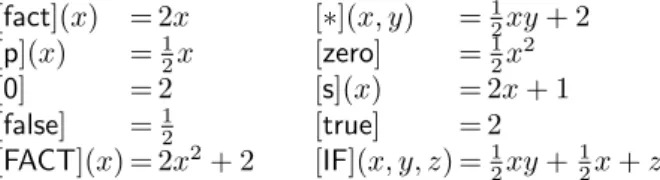
when in the previous approach all the rules are usable. We can use the extended basic CS usable rules instead ofRbecause the CS problem satisfies the restric-tions in Theorem 4 and the following polynomial interpretation [25] allows us to remove pair(32): [fact](x) = 2x [∗](x, y) =12xy+ 2 [p](x) =12x [zero] =12x2 [0] = 2 [s](x) = 2x+ 1 [false] =12 [true] = 2 [FACT](x) = 2x2+ 2 [IF](x, y, z) =1 2xy+ 1 2x+z
The new CS problemτ5= ({(29),(31)},R,{(34)}, µ)can be handled again using Theorem 4. The following polynomial interpretation removes pair(31):
[fact](x) = 1 [∗](x, y) = 2x+ 2 [0] = 0 [s](x) = 2x [p](x) = 2x+ 1 [zero] = 2x+ 1 [false] = 1 [true] = 1 [FACT](x) = 2 [IF](x, y, z) =y+ 1
and we obtain a finite CS problem by applying ProcSCC to the resulting CS
problem.
7
Experimental Evaluation
We have performed an experimental evaluation of the new improvements intro-duced by these new results presented in the paper in our tool for proving termina-tion properties,mu-term[4]. We compared our new version, we call itmu-term 5.1, with respect to the previous version,mu-term 5.08 [17]. The experiments have been performed on an Intel Core 2 Duo at 2.4GHz with 8GB of RAM, run-ning OS X 10.9.1 using a 120 seconds timeout. We used the last version of the ter-mination problem database, TPDB 8.0.75, context-sensitive category. Results are inhttp://zenon.dsic.upv.es/muterm/benchmarks/lrc15-csr/benchmarks. htmland summarized in Table 1.mu-term5.1 also participated in theCSR cat-egory in the 2014 termination competition (http://termination-portal.org/ wiki/Termination_Competition_2014) and the same results were confirmed.
5
Tool Version Proved Total time (Av. time) mu-term5.1 102/109 1.62s
mu-term5.08 99/109 2.23s
Table 1.mu-term5.1 vs.mu-term5.08 comparison
The practical improvements revealed by the experimental evaluation are twofold. First, we can prove (now) termination of 102 of the 109 examples, 3 more examples than our previous version, including [28, Example 1], [13, Ex-ample 1] and [10, ExEx-ample 3.2.14], whose automatic proofs were open problems since 1997, 2003 and 2008. To our knowledge, there is no other tool that can prove more than those 99 examples from this collection of problems. Second, the new definitions yield a faster implementation; this is witnessed by a speed-up of 1.37 with respect to our previous version.
8
Conclusions
In this paper, we revisit infinite µ-rewrite sequences to obtain a new notion of minimal non-µ-terminating term and a new set of unhiding rules. Since the introduction of the CS-DPs in 2006, the constraints introduced by the unhid-ing process have been a headache for constraint solvers. For example, in the original approach for each symbol f in the signature and replacing argument i∈µ(f), aprojection constraint f(x1, . . . , xn)≥xi should be satisfied in order to find a proof. Subsequent works [1, 17] reduced these projection constraints to a subset of those for the hidden symbols. Now, in many cases, as in the leading example of the paper, we can avoid these projection/embedding constraints and the unhiding rules are a very small set of rules. In the context of the CS-DP framework, we propose a new notion of chain, the notion of strongly minimal (P,R,S, µ)-chain and a new set of CS usable rules, the extended basic CS us-able rules, that allows us to simplify termination proofs on CS problems with respect to the set of unhiding rules. The new processor leads us to a faster and more powerful CS-DP framework. We show an example where the technique is successfully applied [28, Example 1] (included in the TPDB), whose automatic proof was an open problem since 1997. An implementation and an experimen-tal evaluation was performed in our tool for proving termination properties,
mu-term[4]. With these improvements,mu-termwon theCSRcategory in the 2014 termination competition.
References
1. Alarc´on, B., Emmes, F., Fuhs, C., Giesl, J., Guti´errez, R., Lucas, S., Schneider-Kamp, P., Thiemann, R.: Improving Context-Sensitive Dependency Pairs. In: Cervesato, I., Veith, H., Voronkov, A. (eds.) Proc. of the 15th International Con-ference on Logic for Programming, Artificial Intelligence and Reasoning, LPAR’08. LNCS, vol. 5330, pp. 636–651. Springer (2008)
2. Alarc´on, B., Guti´errez, R., Lucas, S.: Context-Sensitive Dependency Pairs. In: Arun-Kumar, S., Garg, N. (eds.) Proc. of the 26th Conference on Foundations of Software Technology and Theoretical Computer Science, FST&TCS’06. LNCS, vol. 4337, pp. 297–308. Springer (2006)