A Hierarchical Phrase-Based Model for Statistical Machine Translation
David Chiang
Institute for Advanced Computer Studies (UMIACS) University of Maryland, College Park, MD 20742, USA
Abstract
We present a statistical phrase-based transla-tion model that uses hierarchical phrases— phrases that contain subphrases. The model is formally a synchronous context-free gram-mar but is learned from a bitext without any syntactic information. Thus it can be seen as a shift to the formal machinery of syntax-based translation systems without any lin-guistic commitment. In our experiments us-ing BLEU as a metric, the hierarchical phrase-based model achieves a relative improve-ment of 7.5% over Pharaoh, a state-of-the-art phrase-based system.
1 Introduction
The alignment template translation model (Och and Ney, 2004) and related phrase-based models ad-vanced the previous state of the art by moving from words to phrases as the basic unit of transla-tion. Phrases, which can be any substring and not necessarily phrases in any syntactic theory, allow these models to learn local reorderings, translation of short idioms, or insertions and deletions that are sensitive to local context. They are thus a simple and powerful mechanism for machine translation.
The basic phrase-based model is an instance of
the noisy-channel approach (Brown et al., 1993),1in
which the translation of a French sentence f into an
1Throughout this paper, we follow the convention of Brown
et al. of designating the source and target languages as “French” and “English,” respectively. The variables f and e stand for source and target sentences; fij stands for the substring of f from position i to position j inclusive, and similarly for eij.
English sentence e is modeled as:
arg max
e
P(e| f )=arg max
e
P(e,f )
(1)
=arg max
e
(P(e)×P( f |e))
(2)
The translation model P( f |e) “encodes” e into f by
the following steps:
1. segment e into phrases ¯e1· · ·¯eI, typically with
a uniform distribution over segmentations;
2. reorder the ¯ei according to some distortion
model;
3. translate each of the ¯ei into French phrases
ac-cording to a model P( ¯f | ¯e) estimated from the training data.
Other phrase-based models model the joint
distribu-tion P(e, f ) (Marcu and Wong, 2002) or made P(e)
and P( f |e) into features of a log-linear model (Och
and Ney, 2002). But the basic architecture of phrase segmentation (or generation), phrase reordering, and phrase translation remains the same.
Phrase-based models can robustly perform trans-lations that are localized to substrings that are com-mon enough to have been observed in training. But Koehn et al. (2003) find that phrases longer than three words improve performance little, suggesting that data sparseness takes over for longer phrases. Above the phrase level, these models typically have a simple distortion model that reorders phrases in-dependently of their content (Och and Ney, 2004; Koehn et al., 2003), or not at all (Zens and Ney, 2004; Kumar et al., 2005).
Consider the following Mandarin example and its English translation:
(3) ³2
Aozhou Australia
/
shi is
yu with
Bei North
é
Han Korea
you have
¦¤
bangjiao dipl. rels.
„
de that
p
shaoshu few
ý
guojia countries
K zhiyi one of
‘Australia is one of the few countries that have diplomatic relations with North Korea’
If we count zhiyi, lit. ‘of-one,’ as a single token, then translating this sentence correctly into English re-quires reversing a sequence of five elements. When we run a phrase-based system, Pharaoh (Koehn et al., 2003; Koehn, 2004a), on this sentence (using the experimental setup described below), we get the fol-lowing phrases with translations:
(4) [Aozhou] [shi] [yu] [Bei Han] [you]
[bangjiao]1[de shaoshu guojia zhiyi]
[Australia] [is] [dipl. rels.]1 [with] [North
Korea] [is] [one of the few countries]
where we have used subscripts to indicate the re-ordering of phrases. The phrase-based model is
able to order “diplomatic. . .Korea” correctly (using
phrase reordering) and “one. . .countries” correctly
(using a phrase translation), but does not accom-plish the necessary inversion of those two groups. A lexicalized phrase-reordering model like that in use in ISI’s system (Och et al., 2004) might be able to learn a better reordering, but simpler distortion models will probably not.
We propose a solution to these problems that does not interfere with the strengths of the phrase-based approach, but rather capitalizes on them: since phrases are good for learning reorderings of words, we can use them to learn reorderings of phrases as well. In order to do this we need hierarchical
phrases that consist of both words and subphrases.
For example, a hierarchical phrase pair that might help with the above example is:
(5) hyu 1 you 2,have 2 with 1i
where 1 and 2 are placeholders for subphrases. This
would capture the fact that Chinese PPs almost al-ways modify VP on the left, whereas English PPs
usually modify VP on the right. Because it gener-alizes over possible prepositional objects and direct objects, it acts both as a discontinuous phrase pair and as a phrase-reordering rule. Thus it is consider-ably more powerful than a conventional phrase pair.
Similarly,
(6) h1 de 2,the 2 that 1i
would capture the fact that Chinese relative clauses modify NPs on the left, whereas English relative clauses modify on the right; and
(7) h1 zhiyi,one of 1i
would render the construction zhiyi in English word order. These three rules, along with some conven-tional phrase pairs, suffice to translate the sentence correctly:
(8) [Aozhou] [shi] [[[yu [Bei Han]1 you
[bangjiao]2] de [shaoshu guojia]3] zhiyi]
[Australia] [is] [one of [the [few countries]3
that [have [dipl. rels.]2with [North Korea]1]]]
The system we describe below uses rules like this, and in fact is able to learn them automatically from a bitext without syntactic annotation. It translates the above example almost exactly as we have shown, the only error being that it omits the word ‘that’ from (6) and therefore (8).
bilingual bracketer (Wu, 1997), but ours uses a dif-ferent extraction method that allows more than one lexical item in a rule, in keeping with the phrase-based philosophy. Our extraction method is basi-cally the same as that of Block (2000), except we allow more than one nonterminal symbol in a rule, and use a more sophisticated probability model.
In this paper we describe the design and imple-mentation of our hierarchical phrase-based model, and report on experiments that demonstrate that hi-erarchical phrases indeed improve translation.
2 The model
Our model is based on a weighted synchronous CFG (Aho and Ullman, 1969). In a synchronous CFG the elementary structures are rewrite rules with aligned pairs of right-hand sides:
(9) X → hγ, α,∼i
where X is a nonterminal,γ andαare both strings
of terminals and nonterminals, and∼is a one-to-one
correspondence between nonterminal occurrences
in γ and nonterminal occurrences in α. Rewriting
begins with a pair of linked start symbols. At each step, two coindexed nonterminals are rewritten us-ing the two components of a sus-ingle rule, such that none of the newly introduced symbols is linked to any symbols already present.
Thus the hierarchical phrase pairs from our above example could be formalized in a synchronous CFG as:
X→ hyu X1 you X2,have X2 with X1i
(10)
X→ hX1 de X2,the X2 that X1i
(11)
X→ hX1 zhiyi,one of X1i
(12)
where we have used boxed indices to indicate which
occurrences of X are linked by∼.
Note that we have used only a single nonterminal symbol X instead of assigning syntactic categories to phrases. In the grammar we extract from a bitext (described below), all of our rules use only X, ex-cept for two special “glue” rules, which combine a sequence of Xs to form an S:
S→ hS1X2,S1X2i
(13)
S→ hX1,X1i
(14)
These give the model the option to build only par-tial translations using hierarchical phrases, and then combine them serially as in a standard phrase-based model. For a partial example of a synchronous CFG derivation, see Figure 1.
Following Och and Ney (2002), we depart from the traditional noisy-channel approach and use a more general log-linear model. The weight of each rule is:
(15) w(X→ hγ, αi)=Y
i
φi(X→ hγ, αi)λi
where theφi are features defined on rules. For our
experiments we used the following features, analo-gous to Pharaoh’s default feature set:
• P(γ |α) and P(α| γ), the latter of which is not found in the noisy-channel model, but has been previously found to be a helpful feature (Och and Ney, 2002);
• the lexical weights Pw(γ | α) and Pw(α | γ)
(Koehn et al., 2003), which estimate how well the words inαtranslate the words inγ;2
• a phrase penalty exp(1), which allows the
model to learn a preference for longer or shorter derivations, analogous to Koehn’s phrase penalty (Koehn, 2003).
The exceptions to the above are the two glue rules, (13), which has weight one, and (14), which has weight
(16) w(S→ hS1X2,S1X2i)=exp(−λg)
the idea being that λg controls the model’s
prefer-ence for hierarchical phrases over serial combination of phrases.
Let D be a derivation of the grammar, and let f (D) and e(D) be the French and English strings gener-ated by D. Let us represent D as a set of triples
hr,i,ji, each of which stands for an application of a grammar rule r to rewrite a nonterminal that spans
f (D)ij on the French side.3 Then the weight of D
2This feature uses word alignment information, which is
dis-carded in the final grammar. If a rule occurs in training with more than one possible word alignment, Koehn et al. take the maximum lexical weight; we take a weighted average.
3This representation is not completely unambiguous, but is
hS1,S1i ⇒ hS2X3,S2X3i
⇒ hS4X5X3,S4X5X3i
⇒ hX6X5X3,X6X5X3i
⇒ hAozhou X5X3,Australia X5X3i
⇒ hAozhou shi X3,Australia is X3i
⇒ hAozhou shi X7 zhiyi,Australia is one of X7i
⇒ hAozhou shi X8 de X9 zhiyi,Australia is one of the X9 that X8i
⇒ hAozhou shi yu X1 you X2 de X9 zhiyi,Australia is one of the X9 that have X2 with X1i
Figure 1: Example partial derivation of a synchronous CFG.
is the product of the weights of the rules used in the translation, multiplied by the following extra factors:
(17) w(D)= Y
hr,i,ji∈D
w(r)×plm(e)λlm×exp(−λwp|e|)
where plm is the language model, and exp(−λwp|e|),
the word penalty, gives some control over the length of the English output.
We have separated these factors out from the rule weights for notational convenience, but it is concep-tually cleaner (and necessary for polynomial-time decoding) to integrate them into the rule weights, so that the whole model is a weighted synchronous CFG. The word penalty is easy; the language model is integrated by intersecting the English-side CFG with the language model, which is a weighted finite-state automaton.
3 Training
The training process begins with a word-aligned cor-pus: a set of triples hf,e,∼i, where f is a French
sentence, e is an English sentence, and∼is a
(many-to-many) binary relation between positions of f and positions of e. We obtain the word alignments using the method of Koehn et al. (2003), which is based on that of Och and Ney (2004). This involves
run-ning GIZA++(Och and Ney, 2000) on the corpus in
both directions, and applying refinement rules (the variant they designate “final-and”) to obtain a single many-to-many word alignment for each sentence.
Then, following Och and others, we use heuris-tics to hypothesize a distribution of possible deriva-tions of each training example, and then estimate
the phrase translation parameters from the hypoth-esized distribution. To do this, we first identify
ini-tial phrase pairs using the same criterion as previous
systems (Och and Ney, 2004; Koehn et al., 2003):
Definition 1. Given a word-aligned sentence pair
hf,e,∼i, a rule hfij,ej 0
i0i is an initial phrase pair of
hf,e,∼iiff:
1. fk∼ek0 for some k∈[i,j] and k0∈[i0, j0];
2. fk/ek0 for all k∈[i,j] and k0 <[i0,j0];
3. fk/ek0 for all k<[i,j] and k0 ∈[i0,j0].
Next, we form all possible differences of phrase
pairs:
Definition 2. The set of rules of hf,e,∼i is the smallest set satisfying the following:
1. Ifhfij,eij00iis an initial phrase pair, then
X→ hfij,ej 0 i0i
is a rule.
2. If r = X → hγ, αiis a rule and hfij,eij00iis an
initial phrase pair such thatγ=γ1fijγ2andα=
α1ej
0
i0α2, then
X→ hγ1Xkγ2, α1Xkα2i
is a rule, where k is an index not used in r.
because it creates spurious ambiguity—a situation where the decoder produces many derivations that are distinct yet have the same model feature vectors and give the same translation. This can result in n-best lists with very few different translations or fea-ture vectors, which is problematic for the algorithm we use to tune the feature weights. Therefore we filter our grammar according to the following prin-ciples, chosen to balance grammar size and perfor-mance on our development set:
1. If there are multiple initial phrase pairs contain-ing the same set of alignment points, we keep only the smallest.
2. Initial phrases are limited to a length of 10 on the French side, and rule to five (nonterminals plus terminals) on the French right-hand side.
3. In the subtraction step, fij must have length
greater than one. The rationale is that little would be gained by creating a new rule that is no shorter than the original.
4. Rules can have at most two nonterminals, which simplifies the decoder implementation. Moreover, we prohibit nonterminals that are adjacent on the French side, a major cause of spurious ambiguity.
5. A rule must have at least one pair of aligned words, making translation decisions always based on some lexical evidence.
Now we must hypothesize weights for all the deriva-tions. Och’s method gives equal weight to all the extracted phrase occurences. However, our method may extract many rules from a single initial phrase pair; therefore we distribute weight equally among initial phrase pairs, but distribute that weight equally among the rules extracted from each. Treating this distribution as our observed data, we use relative-frequency estimation to obtain P(γ|α) and P(α|γ).
4 Decoding
Our decoder is a CKY parser with beam search together with a postprocessor for mapping French derivations to English derivations. Given a French sentence f , it finds the best derivation (or n best derivations, with little overhead) that generateshf,ei
for some e. Note that we find the English yield of the highest-probability single derivation
(18) e
arg max
D s.t. f (D)=f w(D)
and not necessarily the highest-probability e, which would require a more expensive summation over derivations.
We prune the search space in several ways. First,
an item that has a score worse thanβtimes the best
score in the same cell is discarded; second, an item that is worse than the bth best item in the same cell is discarded. Each cell contains all the items standing
for X spanning fij. We choose b and β to balance
speed and performance on our development set. For our experiments, we set b=40, β=10−1for X cells, and b=15, β=10−1for S cells. We also prune rules
that have the same French side (b=100).
The parser only operates on the French-side
gram-mar; the English-side grammar affects parsing only
by increasing the effective grammar size, because
there may be multiple rules with the same French side but different English sides, and also because in-tersecting the language model with the English-side grammar introduces many states into the nontermi-nal alphabet, which are projected over to the French side. Thus, our decoder’s search space is many times larger than a monolingual parser’s would be. To
re-duce this effect, we apply the following heuristic
when filling a cell: if an item falls outside the beam, then any item that would be generated using a lower-scoring rule or a lower-lower-scoring antecedent item is also assumed to fall outside the beam. This heuristic greatly increases decoding speed, at the cost of some search errors.
Finally, the decoder has a constraint that pro-hibits any X from spanning a substring longer than 10 on the French side, corresponding to the maxi-mum length constraint on initial rules during train-ing. This makes the decoding algorithm asymptoti-cally linear-time.
The decoder is implemented in Python, an
inter-preted language, with C++code from the SRI
Python implementation of a standard phrase-based decoder, so we expect that a future optimized imple-mentation of the hierarchical decoder will run at a speed competitive with other phrase-based systems.
5 Experiments
Our experiments were on Mandarin-to-English translation. We compared a baseline system, the state-of-the-art phrase-based system Pharaoh (Koehn et al., 2003; Koehn, 2004a), against our sys-tem. For all three systems we trained the
transla-tion model on the FBIS corpus (7.2M+9.2M words);
for the language model, we used the SRI Language Modeling Toolkit to train a trigram model with mod-ified Kneser-Ney smoothing (Chen and Goodman, 1998) on 155M words of English newswire text, mostly from the Xinhua portion of the Gigaword corpus. We used the 2002 NIST MT evaluation test set as our development set, and the 2003 test set as our test set. Our evaluation metric was BLEU (Pap-ineni et al., 2002), as calculated by the NIST script (version 11a) with its default settings, which is to perform case-insensitive matching of n-grams up to
n=4, and to use the shortest (as opposed to nearest)
reference sentence for the brevity penalty. The re-sults of the experiments are summarized in Table 1.
5.1 Baseline
The baseline system we used for comparison was Pharaoh (Koehn et al., 2003; Koehn, 2004a), as pub-licly distributed. We used the default feature set: lan-guage model (same as above), p( ¯f | ¯e), p(¯e| f ), lex-¯
ical weighting (both directions), distortion model, word penalty, and phrase penalty. We ran the trainer with its default settings (maximum phrase length 7), and then used Koehn’s implementation of minimum-error-rate training (Och, 2003) to tune the feature weights to maximize the system’s BLEU score on our development set, yielding the values shown in Table 2. Finally, we ran the decoder on the test set,
pruning the phrase table with b = 100, pruning the
chart with b = 100, β = 10−5, and limiting
distor-tions to 4. These are the default settings, except for the phrase table’s b, which was raised from 20, and the distortion limit. Both of these changes, made by Koehn’s minimum-error-rate trainer by default, im-prove performance on the development set.
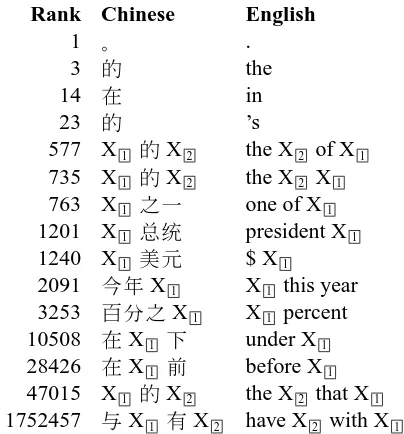
Rank Chinese English
1 .
3 „ the
14 ( in
23 „ ’s
577 X1 „X2 the X2 of X1
735 X1 „X2 the X2 X1
763 X1 K one of X1
1201 X1 ;ß president X1
1240 X1 ŽC $ X1
2091 ÊtX1 X1 this year
3253 ~ KX1 X1 percent
10508 (X1 under X1
28426 (X1 M before X1
47015 X1 „X2 the X2 that X1
[image:6.612.324.526.69.286.2]1752457 X1 X2 have X2 with X1
Figure 2: A selection of extracted rules, with ranks after filtering for the development set. All have X for their left-hand sides.
5.2 Hierarchical model
We ran the training process of Section 3 on the same data, obtaining a grammar of 24M rules. When fil-tered for the development set, the grammar has 2.2M rules (see Figure 2 for examples). We then ran the minimum-error rate trainer with our decoder to tune the feature weights, yielding the values shown in
Ta-ble 2. Note thatλgpenalizes the glue rule much less
thanλppdoes ordinary rules. This suggests that the
model will prefer serial combination of phrases, un-less some other factor supports the use of hierarchi-cal phrases (e.g., a better language model score).
We then tested our system, using the settings
de-scribed above.4Our system achieves an absolute
im-provement of 0.02 over the baseline (7.5% relative), without using any additional training data. This dif-ference is statistically significant (p < 0.01).5 See Table 1, which also shows that the relative gain is higher for higher n-grams.
4Note that we gave Pharaoh wider beam settings than we
used on our own decoder; on the other hand, since our decoder’s chart has more cells, its b limits do not need to be as high.
5We used Zhang’s significance tester (Zhang et al., 2004),
BLEU-n n-gram precisions
System 4 1 2 3 4 5 6 7 8
Pharaoh 0.2676 0.72 0.37 0.19 0.10 0.052 0.027 0.014 0.0075
hierarchical 0.2877 0.74 0.39 0.21 0.11 0.060 0.032 0.017 0.0084
[image:7.612.111.511.55.123.2]+constituent 0.2881 0.73 0.39 0.21 0.11 0.062 0.032 0.017 0.0088
Table 1: Results on baseline system and hierarchical system, with and without constituent feature.
Features
System Plm(e) P(γ|α) P(α|γ) Pw(γ|α) Pw(α|γ) Word Phr λd λg λc
Pharaoh 0.19 0.095 0.030 0.14 0.029 −0.20 0.22 0.11 — —
hierarchical 0.15 0.036 0.074 0.037 0.076 −0.32 0.22 — 0.09 —
+constituent 0.11 0.026 0.062 0.025 0.029 −0.23 0.21 — 0.11 0.20
Table 2: Feature weights obtained by minimum-error-rate training (normalized so that absolute values sum
to one). Word = word penalty; Phr = phrase penalty. Note that we have inverted the sense of Pharaoh’s
phrase penalty so that a positive weight indicates a penalty.
5.3 Adding a constituent feature
The use of hierarchical structures opens the pos-sibility of making the model sensitive to syntac-tic structure. Koehn et al. (2003) mention German
hes gibt,there isi as an example of a good phrase
pair which is not a syntactic phrase pair, and report that favoring syntactic phrases does not improve ac-curacy. But in our model, the rule
(19) X→ hes gibt X1,there is X1i
would indeed respect syntactic phrases, because it builds a pair of Ss out of a pair of NPs. Thus, favor-ing subtrees in our model that are syntactic phrases might provide a fairer way of testing the hypothesis that syntactic phrases are better phrases.
This feature adds a factor to (17),
(20) c(i,j)=
1 if fij is a constituent
0 otherwise
as determined by a statistical tree-substitution-grammar parser (Bikel and Chiang, 2000), trained on the Penn Chinese Treebank, version 3 (250k words). Note that the parser was run only on the test data and not the (much larger) training data. Re-running the minimum-error-rate trainer with the new feature yielded the feature weights shown in Table 2. Although the feature improved accuracy on the de-velopment set (from 0.314 to 0.322), it gave no sta-tistically significant improvement on the test set.
6 Conclusion
Hierarchical phrase pairs, which can be learned without any syntactically-annotated training data, improve translation accuracy significantly compared with a state-of-the-art phrase-based system. They also facilitate the incorporation of syntactic informa-tion, which, however, did not provide a statistically significant gain.
Our primary goal for the future is to move towards a more syntactically-motivated grammar, whether by automatic methods to induce syntactic categories, or by better integration of parsers trained on an-notated data. This would potentially improve both
accuracy and efficiency. Moreover, reducing the
grammar size would allow more ambitious train-ing setttrain-ings. The maximum initial phrase length is currently 10; preliminary experiments show that increasing this limit to as high as 15 does im-prove accuracy, but requires more memory. On the other hand, we have successfully trained on almost
30M+30M words by tightening the initial phrase
length limit for part of the data. Streamlining the grammar would allow further experimentation in these directions.
[image:7.612.94.523.168.230.2]Acknowledgements
I would like to thank Philipp Koehn for the use of the Pharaoh software; and Adam Lopez, Michael Sub-otin, Nitin Madnani, Christof Monz, Liang Huang, and Philip Resnik. This work was partially sup-ported by ONR MURI contract FCPO.810548265 and Department of Defense contract RD-02-5700.
S. D. G.
References
A. V. Aho and J. D. Ullman. 1969. Syntax directed trans-lations and the pushdown assembler. Journal of Com-puter and System Sciences, 3:37–56.
Daniel M. Bikel and David Chiang. 2000. Two statis-tical parsing models applied to the Chinese Treebank. In Proceedings of the Second Chinese Language Pro-cessing Workshop, pages 1–6.
Hans Ulrich Block. 2000. Example-based incremen-tal synchronous interpretation. In Wolfgang Wahlster, editor, Verbmobil: Foundations of Speech-to-Speech Translation, pages 411–417. Springer-Verlag, Berlin.
Peter F. Brown, Stephen A. Della Pietra, Vincent J. Della Pietra, and Robert L. Mercer. 1993. The mathemat-ics of statistical machine translation: Parameter esti-mation. Computational Linguistics, 19:263–311.
Stanley F. Chen and Joshua Goodman. 1998. An empir-ical study of smoothing techniques for language mod-eling. Technical Report TR-10-98, Harvard University Center for Research in Computing Technology.
Philipp Koehn, Franz Josef Och, and Daniel Marcu. 2003. Statistical phrase-based translation. In Proceed-ings of HLT-NAACL 2003, pages 127–133.
Philipp Koehn. 2003. Noun Phrase Translation. Ph.D. thesis, University of Southern California.
Philipp Koehn. 2004a. Pharaoh: a beam search decoder for phrase-based statistical machine translation mod-els. In Proceedings of the Sixth Conference of the Association for Machine Translation in the Americas, pages 115–124.
Philipp Koehn. 2004b. Statistical significance tests for machine translation evaluation. In Proceedings of the 2004 Conference on Empirical Methods in Natural Language Processing (EMNLP), pages 388–395.
Shankar Kumar, Yonggang Deng, and William Byrne. 2005. A weighted finite state transducer transla-tion template model for statistical machine translatransla-tion. Natural Language Engineering. To appear.
Daniel Marcu and William Wong. 2002. A phrase-based, joint probability model for statistical machine translation. In Proceedings of the 2002 Conference on Empirical Methods in Natural Language Processing (EMNLP), pages 133–139.
Franz Josef Och and Hermann Ney. 2000. Improved sta-tistical alignment models. In Proceedings of the 38th Annual Meeting of the ACL, pages 440–447.
Franz Josef Och and Hermann Ney. 2002. Discrimina-tive training and maximum entropy models for statis-tical machine translation. In Proceedings of the 40th Annual Meeting of the ACL, pages 295–302.
Franz Josef Och and Hermann Ney. 2004. The align-ment template approach to statistical machine transla-tion. Computational Linguistics, 30:417–449.
Franz Josef Och, Ignacio Thayer, Daniel Marcu, Kevin Knight, Dragos Stefan Munteanu, Quamrul Tipu, Michel Galley, and Mark Hopkins. 2004. Arabic and Chinese MT at USC/ISI. Presentation given at NIST Machine Translation Evaluation Workshop.
Franz Josef Och. 2003. Minimum error rate training in statistical machine translation. In Proceedings of the 41st Annual Meeting of the ACL, pages 160–167.
Kishore Papineni, Salim Roukos, Todd Ward, and Wei-Jing Zhu. 2002. B: a method for automatic evalua-tion of machine translaevalua-tion. In Proceedings of the 40th Annual Meeting of the ACL, pages 311–318.
Andreas Stolcke. 2002. SRILM – an extensible lan-guage modeling toolkit. In Proceedings of the Inter-national Conference on Spoken Language Processing, volume 2, pages 901–904.
Dekai Wu. 1997. Stochastic inversion transduction grammars and bilingual parsing of parallel corpora. Computational Linguistics, 23:377–404.
Kenji Yamada and Kevin Knight. 2001. A syntax-based statistical translation model. In Proceedings of the 39th Annual Meeting of the ACL, pages 523–530.
Richard Zens and Hermann Ney. 2004. Improvements in phrase-based statistical machine translation. In Pro-ceedings of HLT-NAACL 2004, pages 257–264.