Accepted Manuscript
Title: A Multi-Fidelity Surrogate-Model-Assisted
Evolutionary Algorithm for Computationally Expensive
Optimization Problems
Author: Bo Liu Slawomir Koziel Qingfu Zhang
PII:
S1877-7503(15)30038-7
DOI:
http://dx.doi.org/doi:10.1016/j.jocs.2015.11.004
Reference:
JOCS 431
To appear in:
Received date:
11-6-2015
Revised date:
31-10-2015
Accepted date:
15-11-2015
Please cite this article as: Bo Liu, Slawomir Koziel, Qingfu Zhang, A
Multi-Fidelity Surrogate-Model-Assisted Evolutionary Algorithm for Computationally
Expensive Optimization Problems,
Journal of Computational Science
(2015),
http://dx.doi.org/10.1016/j.jocs.2015.11.004
This is a PDF file of an unedited manuscript that has been accepted for publication.
As a service to our customers we are providing this early version of the manuscript.
The manuscript will undergo copyediting, typesetting, and review of the resulting proof
before it is published in its final form. Please note that during the production process
errors may be discovered which could affect the content, and all legal disclaimers that
apply to the journal pertain.
Accepted Manuscript
Bo Liu received the B.S. degree from Tsinghua University, China, in 2008 and the Ph.D. degree from
the Katholieke Universiteit Leuven, Belgium, in 2012. From October 2012, he was a Humboldt
research fellow, working with Technical University of Dortmund, Germany. Since April 2013, he is a
Lecturer in Computing at Glyndwr University, Wales, U.K.. His research interests lie in evolutionary
computation, machine learning and design automation methodologies of electronic circuits and
systems (e.g., analog / RF integrated circuits, antennas).
Slawomir Koziel received the M.Sc. and Ph.D. degrees in electronic engineering from Gdansk
University of Technology, Poland, in 1995 and 2000, respectively, and the M.Sc. degrees in
theoretical physics and in mathematics, in 2000 and 2002, and the Ph.D. in mathematics in 2003,
from the University of Gdansk, Poland. He is currently a Professor with the School of Science and
Engineering, Reykjavik University, Iceland. His research interests include CAD and modeling of
microwave circuits, simulation-driven design, surrogate-based optimization, space mapping, circuit
theory, analog signal processing, evolutionary computation and numerical analysis.
Qingfu Zhang received the BSc in mathematics from Shanxi University, China in 1984, the MSc in
applied mathematics and the PhD in information engineering from Xidian University, China, in 1991
and 1994, respectively. He is currently a Professor with the School of Computer Science and
Electronic Engineering, University of Essex, UK. From 1994 to 2000, he was with the National
Laboratory of Parallel Processing and Computing, National University of Defence Science and
Technology, China, Hong Kong Polytechnic University, Hong Kong, the German National Research
Centre for Information Technology (now Fraunhofer-Gesellschaft, Germany), and the University of
Manchester Institute of Science and Technology, Manchester, U.K. His main research interests
include evolutionary computation, optimization, neural networks, data analysis, and their
applications.
Accepted Manuscript
Accepted Manuscript
Highlights
A new multi-fidelity surrogate-model-based optimization framework is proposed to improve
reliability and efficiency of existing frameworks.
A data mining method is proposed to address discrepancies between simulation models of
different fidelities in the context of global optimization.
A new multi-fidelity surrogate-model-based optimization method is proposed for
engineering optimization problems with quite long simulation time per candidate design,
whose advantages are verified by mathematical benchmark and real-world problems.
Accepted Manuscript
A Multi-Fidelity Surrogate-Model-Assisted Evolutionary
Algorithm for Computationally Expensive Optimization
Problems
Bo Liua, Slawomir Kozielb,c, Qingfu Zhangd
aDepartment of Computing, Glyndwr University, UK
bEngineering Optimization & Modeling Center, Reykjavik University, Iceland cFaculty of Electronics, Telecommunications and Informatics, Gdansk University of
Technology, Poland.
dSchool of Computer Science & Electronic Engineering, University of Essex, UK
Abstract
Integrating data-driven surrogate models and simulation models of dierent ac-curacies (or delities) in a single algorithm to address computationally expen-sive global optimization problems has recently attracted considerable attention. However, handling discrepancies between simulation models with multiple deli-ties in global optimization is a major challenge. To address it, the two major contributions of this paper include: (1) development of a new multi-delity surrogate-model-based optimization framework, which substantially improves reliability and eciency of optimization compared to many existing methods, and (2) development of a data mining method to address the discrepancy be-tween the low- and high-delity simulation models. A new ecient global opti-mization method is then proposed, referred to as multi-delity Gaussian process and radial basis function-model-assisted memetic dierential evolution. Its ad-vantages are veried by mathematical benchmark problems and a real-world antenna design automation problem.
Keywords: multi-delity, multilevel, variable delity,
surrogate-model-assisted evolutionary algorithm, expensive optimization
Email addresses: [email protected] (Bo Liu), [email protected] (Slawomir Koziel), [email protected] (Qingfu Zhang)
Accepted Manuscript
1. Introduction
Solving many real-world engineering design problems requires both global optimization and expensive computer simulation for evaluating their candidate solutions. For example, computational models utilized in photonics and micro-electromechanical system optimization require well over 1 hour simulation time
5
per design [1],[2],[3]. For these problems, successful surrogate-model-assisted local search methods have been developed [2], but in terms of global optimiza-tion, many state-of-the-art surrogate-based optimization techniques are still pro-hibitively expensive. In the context of global optimization, these tasks are con-sidered as very expensive. Addressing such problems is the objective of this
10
paper.
High cost of evaluating real-world simulation models often results from the necessity of solving complex systems of partial dierential equations using nu-merical techniques or Monte-Carlo analysis. Direct handling of such models is often computationally prohibitive and utilization of cheaper representations
15
(surrogates) of the system at hand might be necessary. Two classes of such replacement models are normally considered. The rst type is function approx-imation model (usually, data-driven surrogates constructed by approximating sampled simulation model data, e.g., radial basis function). Optimization meth-ods making use of such models are often referred to as surrogate /
metamodel-20
based optimization (SBO) methods [4]. The other type is low-delity simulation model (e.g., coarse-mesh model in nite element analysis), which exhibits re-laxed accuracy but shorter evaluation time. Low-delity model is typically used with occasional reference to the high-delity model. The methods using such models are often referred to as multi-delity / multilevel / variable-delity
op-25
timization (MFO) methods [5]. For simplicity, two-level modeling is considered in this paper: the coarse model is referred to as the low-delity model, whereas the ne model is referred to as the high-delity model.
Recently, a trend to combine SBO and MFO in a single algorithm for further speed improvement has been observed; successful examples include [6, 7, 8, 9].
Accepted Manuscript
References [6, 9] demonstrated an approach which iteratively updates a co-kriging surrogate model [10] using samples from coarse and ne model evalua-tions accumulated over the entire optimization process. These techniques are mathematically sound and often feature good reliability. However, the success of these methods relies on a high-quality co-kriging surrogate model constructed
35
by the initial one-shot sampling, which determines the eectiveness of the con-secutive adaptive sampling. For higher-dimensional design spaces or complex function landscapes, the computational cost of building the initial high-quality co-kriging model may be prohibitive, as the necessary number of training sam-ples grows exponentially with linear increase of the number of design variables
40
[11].
In order to alleviate these diculties, a new hierarchical algorithm structure has been proposed in [7, 8]: It can be considered as an MFO, but SBOs are used for some optimization stages with certain delities to replace standard optimization methods without data-driven surrogate models. For example, a
45
coarse model is used for a surrogate model-assisted evolutionary algorithm to explore the space and accurate but expensive ne model evaluations are only used for local search starting from the most promising solutions obtained from space exploration [7, 12]. These methods are scalable if proper SBOs are used, but the reliability of the MFO structure becomes a challenge, which is detailed
50
as follows.
Because both the coarse and the ne model describe the same function (or a physical system), it is reasonable to use the cheaper coarse model for ltering out some non-optimal subregions. However, considering discrepancy between the models of various delities, there is a lot of uncertainty regarding the promising
55
solutions found using the coarse model. Fig. 1 illustrates this issue using an example of a microwave lter. The problem is to minimize the maximum value of the reection coecient, i.e.,max(|S11|)for a given frequency range of interest.
It can be observed by sweeping one of the nine design variables of the device, that although many non-optimal regions for the coarse model are also non-optimal
60
Accepted Manuscript
• wasting precious ne model evaluations because some promising locations of the coarse model-based landscape (such as A and its projection A', which may correspond to multiple design variables) may have substantial distance to the desired optimal regions of the ne model-based landscape
65
(like B');
• making the MFO framework unreliable because the desired optimum such as the point B' is dicult to be reached from points such as A' by exploita-tion. Note that only one variable is changed in Fig. 1. When considering multiple design variables, the point B may have a low probability to be
70
selected for exploitation because there may be quite a few points with better tness values according to the coarse model.
Clearly, the lower the delity of the coarse model, the higher the eciency of the space exploration stage of an MFO, but the higher the risk induced by model discrepancy. Reference [8] investigates the discrepancy problem using
75
practical antenna design cases and indicates that, in many cases, a large number of ne model evaluations may be needed which may result in the same or even higher overall design optimization cost than that of direct optimization of the ne model; also, the MFO may simply fail to nd a satisfactory design. There are some methods that do not directly use the promising points from the coarse
80
model optimization, include equalization of the computational eort for models of each delity [5], space mapping and model correction, where a correction function is applied to reduce misalignment between the coarse and the ne model [8, 13]. However, the above two critical challenges still remain.
To address the above two challenges, a new MFO framework is proposed
85
in this paper. Its goal is to make full use of available expensive ne model evaluations and substantially improve the reliability compared to existing MFO frameworks, and thus, addressing the targeted very expensive design optimiza-tion problems. Based on this framework, a data mining method is proposed to address the discrepancy between the coarse and the ne model. A new method,
90
function-model-Accepted Manuscript
s
W L x y z xp d yeFigure 1: Curves of coarse and ne models
assisted memetic dierential evolution (MGPMDE), is subsequently proposed. Empirical studies on mathematical benchmark problems with dierent charac-teristics as well as a real-world antenna design automation problem verify the advantages of MGPMDE.
95
The remainder of this paper is organized as follows. Section 2 formulates the optimization problem and introduces the basic techniques. Section 3 de-scribes the new MFO framework, the data mining method and the MGPMDE algorithm. Section 4 presents the experimental results of MGPMDE on test problems. Concluding remarks are provided in Section 5.
100
2. Problem Formulation and Basic Techniques 2.1. Problem Formulation
We consider the following problem:
min ff(x)
x∈[¯a,¯b]d (1)
whereff(x)is the ne model function, which is expensive but accurate. There
is a coarse model function, fc(x), which is much cheaper than ff(x), but less
accurate thanff(x), and, consequently, with a distorted landscape. Reference 105
Accepted Manuscript
[5] provides an eective method to construct mathematical benchmark problems for MFO, which is as follows.
ff(x) =fc(sf×(x−ss)) (2)
where fc(x) (also ff(x)) is a periodic function, and there exist minimal and
maximal values in each period. sf is called a frequency shift, which mimics
the loss of peaks of fc(x). For example, when fc(x) = cos(x), ff(x) can be 110
cos(sf×(x)). Whensf is set to 1.3, about 30% of the peaks are not accounted
for byfc(x). ssis called a spatial shift, which shifts the positions of the optimal
points. The frequency shifts and the spatial shifts often happen for expensive evaluations obtained by solving suitable systems of partial dierential equations, where the coarse model is a coarse-mesh model and / or with reduced number of
115
solver iterations. This kind of expensive optimization problem is very (if not the most) popular in computationally expensive engineering design optimization, because most physics simulations (e.g., electromagnetic simulation) are based on solving partial dierential equations.
It is worth to determine the focused extent of discrepancy before proposing
120
methods to address it. From the point of view of practical industrial problems [2, 5, 14, 15], we focus on reasonably large discrepancy between computational models of various delities in this work. Reasonably large discrepancy refers to the fact that the optimal designs in terms of the ne model cannot be obtained by local exploitation based on the optimal points in terms of the coarse model,
125
but the landscape(s) of the coarse model maintains the general shape of that of the ne model. Otherwise, a better coarse model (by increasing the delity) should be used. Also based on [2, 5, 14, 15], the focused optimization problems have unimodal or multimodal landscapes and with 5-20 variables.
2.2. Blind Gaussian Process Modeling and Prescreening
130
In MGPMDE, Gaussian process (GP) regression [16] is used. To model an unknown functiony = f(x), x ∈ Rd, GP modeling assumes that f(x) at any
Accepted Manuscript
independent ofx. For anyx,f(x)is a sample ofµ+(x), where(x)∼N(0, σ2).
By maximizing the likelihood function to ensure that f(x) = yi at x = xi (i = 1, . . . , K)(where x1, . . . , xK ∈ Rd and theirf-function values y1, . . . , yK
areKtraining data points) and the best linear unbiased prediction: ˆ
f(x) = ˆµ+rTC−1(y−1µ)ˆ (3)
the mean squared error is:
s2(x) = ˆσ2[1−rTC−1r+(1−1
TC−1r)2
1TC−1r ] (4)
wherer= (c(x, x1), . . . , c(x, xK))T. Cis aK×Kmatrix whose(i, j)-element is
c(xi, xj). c(xi, xj)is the correlation function betweenxi andxj, whose
hyper-parameters are estimated by maximization of the likelihood function [16]. y = (y1, . . . , yK)T and1is a K-dimensional column vector of ones.
The above surrogate modeling mechanism is called the ordinary GP
mod-135
eling. In the blind GP modeling [17, 18], the linear combination of some basis functionsPm
i=1βibi(x)is used to replaceµˆso as to capture a portion of the
vari-ations which is desirable to represent the general trend off(x), so as to alleviate
the complexity of the ordinary GP modeling, which handles the residuals. The blind GP modeling consists of the following steps: (1) based on the
140
available training data points, an ordinary GP model is rstly constructed by identifying the hyper-parameter values; (2) given the hyper-parameters and the candidate features, thebi(x)are ranked based on the estimatedβi(i= 1, . . . , m).
The ranking follows a Bayes variable ranking method [17, 18]. For simplicity and eciency, only linear, quadratic items and two-factor interactions are considered
145
as the candidate features (bi(x)) in this implementation; (3) the most promising
features amongbi(x)(i= 1, . . . , m)are selected and an intermediate GP model
with the original hyper-parameters is constructed. Its accuracy is subsequently evaluated by a leave-one-out cross-validation method [17]. This step is repeated until no accuracy improvement can be achieved; (4) given the selected features
150
and the corresponding coecients, the likelihood function is re-optimized and the nal GP model is obtained. The details can be found in [18].
Accepted Manuscript
For a minimization problem, given the predictive distributionN( ˆf(x), s2(x))
forf(x), a lower condence bound (LCB) prescreening off(x)is used: flcb(x) = ˆf(x)−ωs(x)
ω∈[0,3] (5)
whereω is a constant. More details can be found in [19].
2.3. Dierential Evolution
The dierential evolution (DE) algorithm [20] is used as the global
optimiza-155
tion search engine in the MGPMDE method. There are quite a few DE mutation strategies available which lead to various trade-os between the convergence rate and the population diversity. The properties of dierent DE strategies in SBO, and more specically, under the selected SBO framework for global optimization in this work, have been investigated in [21]. Based on [21] and our pilot
exper-160
iments, DE/current-to-best/1 (6) and DE/best/2 (7) are used in MGPMDE. Suppose that P is a population and the best individual in P is xbest. Let
x = (x1, . . . , xd) ∈ Rd be an individual solution in P. To generate a child
solutionu= (u1, . . . , ud)for x, DE/current-to-best/1 and DE/best/2 work as
follows:
165
A donor vector is rst produced by mutation: (1)DE/current-to-best/1
vi=xi+F·(xbest−xi) +F·(xr1−xr2) (6)
where xi is the ith individual in P. xr1 and xr2 are two dierent solutions randomly selected from P; they are also dierent from xbest and xi. v
i is the
ith mutant vector in the population after mutation. F ∈ (0,2] is a control
parameter, often referred to as the scaling factor [20]. (2)DE/best/2
vi =xbest+F·(xr1−xr2) +F·(xr3−xr4) (7)
where xr3 and xr4 are two dierent solutions randomly selected from P, and dierent fromxbest,xr1 andxr2.
Having the donor vector, a binomial crossover is applied to produce the child solution with the crossover rateCR∈[0,1]. More details can be found in [20].
Accepted Manuscript
2.4. The ORBIT Algorithm
170
In MGPMDE, the ORBIT algorithm [22] is utilized to perform local search using expensive ne model evaluations. ORBIT is a mathematically sound and successful radial basis function (RBF)-assisted trust-region method and excel-lent results have been reported in [22]. The main advantage of ORBIT is that it tries to build a unique RBF model based on the sampled points for accurate
175
predictions. Given a set of evaluated data, ORBIT realizes the following proce-dures (more details about ORBIT and fully linear RBF model can be found in [22]).
Step 1: Select points to build (if possible) an RBF model which is fully linear within a neighbourhood of the current trust-region.
180
Step 2: Include additional points if necessary to ensure that the model pa-rameters remain bounded.
Step 3: Fit the RBF parameters (a cubic RBF is used in this implementation). Step 4: If the model gradient is not too small, obtain a fully linear RBF
model within a small neighbourhood.
185
Step 5: Determine a search step based on the RBF model. Step 6: Update trust-region parameters.
Step 7: Perform exact evaluation at an additional point if the model is not fully linear within the neighbourhood.
3. The MGPMDE Algorithm
190
3.1. The New MFO Framework
The proposed MFO framework is as follows:
Stage 1: Coarse Model-based SBO: Construct the pool of representative candidate solutions based on an ecient and scalable SBO (should have global search ability) using coarse model-based evaluations (CEs).
Accepted Manuscript
Stage 2: Data Mining: Generate the initial population for ne model-based optimization by clustering of the representative solution pool and self-development using ne model-based evaluations (FEs).
Stage 3: Fine Model-based Memetic SBO: Carry out memetic SBO from the initial population in Stage 2 using FEs with an appropriate strategy
200
balancing the surrogate-model-assisted global and local search.
Compared to most MFO frameworks, two distinct dierences of the new MFO framework are: (1) The initial candidate solutions for FE-based search are generated based on a data mining process, instead of a set of selected promising candidates based on CEs (starting FE-based optimization from the latter would
205
lead to wasting FEs and degraded performance of the optimization process). (2) Both global and local search are conducted in FE-based search, instead of only using local exploitation.
The goal of Stage 1 and Stage 2 is to construct an expected good initial population for FE-based optimization in Stage 3, using as few expensive
eval-210
uations as possible. Two clarications are: (1) Despite discrepancies between the models of dierent delities, it is reasonable to assume that the points vis-ited by the CE-based SBO represent the positions of the decision space which are worth to be studied. Many unpromising subregions are naturally ltered out in this process with the support of SBO. (2) Because the qualities of the
215
representative candidates are not known in terms of FE, and the number of FEs should be as few as possible for selecting truly good candidates, clustering techniques are to be used. Because of the model discrepancy and the limited number of FEs in this process, the candidates extracted at this stage may not be of sucient number and of suciently good quality when directly serving as
220
the initial population of Stage 3. Hence, self-development using FEs based on extracted good candidates (seed population) is necessary.
Although the number of FEs used in Stage 2 is small in the above framework, more CEs have to be used than in most MFOs, since a complete global optimiza-tion using the coarse model is necessary, instead of just selecting promising
Accepted Manuscript
candidates in the middle of the process. Nevertheless, the cost of CEs can still be reasonable if the following three conditions are satised: (1) CE is much cheaper than FE, (2) the SBO used for CE-based optimization is ecient enough (i.e., require fewer exact evaluations), and (3) the stopping criterion is appropriate. More details are in Section 3.2.
230
Only FEs are used in Stage 3. The eciency improvement comes from an expected initial population with good optimality and diversity from Stage 2 and the memetic SBO. The prerequisites for the memetic SBO are: (1) to have a global optimization ability instead of only performing local exploitation, (2) to exhibit improved eciency compared to the selected SBO without
sacric-235
ing the solution quality, (3) to have sucient exibility to nd a reasonable trade-o between global exploration and local exploitation for problems with prohibitively expensive FEs where global optimization is not possible.
In the following, an algorithm is proposed according to the above framework and requirements of each stage, called MGPMDE. The surrogate model-aware
240
evolutionary search (SMAS) framework [23] with blind GP surrogate modeling is selected as the SBO for global optimization and the ORBIT algorithm with RBF surrogate modeling is selected as the SBO for local optimization. Empirical studies in Section 4 show that the use of SMAS and ORBIT is an appropriate choice for the targeted very expensive problems, but note that it is not the only
245
choice, and other successful SBO frameworks (e.g., [4]) can also be applied when satisfying the requirements of each stage of the above framework.
3.2. Construction of the Representative Candidate Solution Pool
This subsection describes operation of Stage 1 of MGPMDE, which works as follows:
250
Step 1: Use Latin Hypercube Sampling [24] to allocateαsolutions within the
decision space[¯a,¯b]d, evaluate all these solutions using CEs and form the
initial database.
Accepted Manuscript
consecutive iterations, output the database; otherwise go to Step 3.
255
Step 3: Select theλ best solutions from the database to form a population P.
Step 4: Apply DE/current-to-best/1 (6) and binomial crossover onP to
gen-erateλchild solutions.
Step 5: Selectτnearest evaluated points (based on Euclidean distance) around
260
the centroid of theλchild solutions as training data points [21]. Construct
a surrogate model using blind GP with the selected training data points. Prescreen theλchild solutions generated in Step 4.
Step 6: Evaluate fc(x)(the value of the estimated best child solution from
Step 5) using CE. Add this evaluated solution and its function value to the
265
database (i.e., representative candidate solution pool). Go back to Step 2. The population diversity is calculated as [25]:
PD= λ1P λ i=1minj∈{1,2,...,λ},j6=idn(Pi, Pj) dn(Pi, Pj) = q 1 d Pd k=1( Pi,k−Pj,k ¯b k−¯ak ) 2 (8)
At this stage, an SMAS-based SBO is used to construct the representative candidate solution pool, consisting of all the solutions which undergo CE. The selection of SMAS is because of its eciency considering the expensiveness of the targeted problem. The GPEME algorithm [23] based on SMAS and GP
270
modeling ensures comparable results but uses considerably fewer number of ex-act evaluations compared to SBOs with several popular frameworks, as veried using more than ten benchmark test problems. In an improved SMAS [21], the eciency is further enhanced along with the exploration ability of the algorithm. For example, the local optimum in the narrow valley of the 20/30-dimensional
275
Rosenbrock function can be escaped by the improved SMAS, which is dicult for many global optimization-focused SBOs. Having in mind the prerequisites for the SBO process formulated in Section 3.1, the following two clarications on eciency of SMAS and the stopping criterion are provided below.
Accepted Manuscript
The eciency of SMAS comes from high-quality surrogate modeling and the
280
balance between exploration and exploitation. In each iteration, theλcurrent
best candidate solutions form the parent population (it is reasonable to assume that the search focuses on the promising subregion) and the best candidate based on prescreening in the child population is selected to replace the worst one in the parent population. This way, only at most one candidate is altered
285
in the parent population in each iteration; consequently, the best candidate among the child solutions in several consecutive iterations may not be far away with each other (they will then be evaluated and are used as the training data points). Therefore, the training data points describing the current promising region can be much denser than those generated by a standard EA population
290
updating mechanism (in which the solutions may spread in dierent subregions of the decision space while there may not be sucient number of the training data points around the candidate solutions to be prescreened). For this reason SMAS-based SBO is very ecient.
To maintain the exploration ability, an appropriate strategy for generating
295
the child population should be used so that a reasonably high diversity in or around the promising subregions is introduced. Experimental results in [21] show that by combing the promising subregion-emphasised search mechanism and the DE/current-to-best/1 strategy, a good balance of exploration and ex-ploitation is obtained and a good performance in terms of solution quality for
300
10 to 30-dimensional multimodal benchmark problems is shown. More details of SMAS are in [23, 21].
Similarly as in most SBOs, an intensive search (i.e., ne tuning) may be carried out around the nally obtained optimum when using SMAS. However, considering the discrepancy between the coarse and the ne model, costing CEs
305
in this intensive search process may not be necessary. Therefore, terminating the search based on the population diversityPD seems to be a more reasonable
approach. WhenPD is within a very small range for a number of consecutive
iterations, a ne tuning is expected to be applied toP, which is the appropriate
time to terminate. Note that the population diversity estimation method
Accepted Manuscript
lized here takes into account the dimensionality and the search ranges in order to obtain a good generality.
3.3. Population Initialization
This subsection describes Stage 2 (data mining) of MGPMDE, which works as follows:
315
Step 1: Divide the representative candidate solution pool intoGgroups based
on the fc(x) values. The ith(i = 1,2, . . . , G) group has fc(x) values of
[min(fc(x))+i−G1(max(fc(x))−min(fc(x))), min(fc(x))+Gi(max(fc(x))−
min(fc(x)))].
Step 2: Divide each group of solutions inton0 clusters (based on Euclidean
320
distance) using the intelligent Kmeans method [26] and obtain n0×G
centroids.
Step 3: Find the nearest point to each obtained centroid from the representa-tive candidate solution pool and evaluate them using FEs to obtainff(x).
Step 4: Cluster the group with the best ff(x) into λ0 clusters using the
325
intelligent Kmeans method to form the seed populationPs.
Step 5: If||Ps||=λ, outputPs. Otherwise; go to Step 6.
Step 6: Apply DE/best/2 (7) and the binomial crossover onPs to generate
||Ps|| child solutions.
Step 7: Use all the solutions inPs as the training data points to construct a 330
blind GP model. Prescreen the child solutions generated in Step 6. Step 8: Evaluate the ff(x) value of the estimated best child solution from
Step 7. Add this evaluated solution and its function value toPs. Go back
to Step 5.
Some clarications are as follows.
Accepted Manuscript
The representative candidate solution pool should not be directly clustered. When preparing the representative solution pool (Section 3.2), the search grad-ually transforms from global exploration to local exploitation. Hence, the earlier visited solutions have much larger distances between each other than the later visited ones. When directly clustering the representative solution pool (based
340
on their distances), the earlier visited solutions will dominate the clustering. Considering the overall similarity of the landscapes of the coarse and ne mod-els, we do not expect that many promising subregions in terms of FE are located in the vicinity of the candidates visited in the space exploration phase. There-fore, we approximately divide the representative solution pool into groups with
345
comparable (or similar level) distances between each other and then perform clustering in each group. fc(x)is selected as a reference to approximately
re-ect dierent phases of the search, in which the distances between solutions are approximately on the same level. For clustering, the iKmeans clustering [26] is used to prevent the uncertainty of the standard Kmeans clustering.
350
Because the number of FEs in the data mining process should be as few as possible, only a small number of samples (n0) can be used to represent each
group. Some optimal solutions in terms of FE may thus be missing. However, nding all the optimal candidates is not our goal at this stage. Instead, we aim at constructing an initial population with good optimality and good diversity for
355
the next stage (FE-based optimization). Therefore, a seed population derived from the best group is rstly constructed with expected reasonably good quality and diversity. DE/best/2 is then used to promote both the optimality and the diversity. The population size is continuously increasing until it reachesλ, and
in each iteration, all the evaluated solutions are used to generate and prescreen
360
the child population. 3.4. Memetic SMAS
This subsection outlines implementation of Stage 3 of MGPMDE. SMAS is selected as the basic SBO of this stage due to its eciency and global optimiza-tion capability. According to the requirements listed in Secoptimiza-tion 3.1, introducing
Accepted Manuscript
surrogate-model-assisted local search to SMAS is necessary. The ORBIT algo-rithm, which is a rigourous and successful method, is selected for this purpose. It has been introduced briey in Section 2 and more details of ORBIT are in [22]. A key issue is the method to control the use of SMAS and ORBIT.
When the population of SMAS enters the ne tuning phase (within a small
370
subregion of the search space) and the landscape in this local area is not very rugged, we can reasonably assume that a surrogate-model-assisted local search with less exploration ability can also obtain an optimal or satisfactory solution using fewer exact evaluations. Due to this, ORBIT is used to replace SMAS when the population diversity becomes small. Note that this is dierent from
375
many memetic SBOs, where global and local search are iteratively applied in the entire optimization process. Because eciency is the top priority of MGPMDE considering the targeted problem, local tuning of an intermediate and potentially good solution cannot be aorded. Hence, in MGPMDE, SMAS and ORBIT are separated and ORBIT is applied only once. In addition, a
surrogate-model-380
assisted local search method has ability (to some extent) to avoid getting stuck in local optima because surrogate modeling itself smoothens the landscape. To enhance this ability, a reasonably large initial trust-region radius is used.
In MGPMDE, The memetic SMAS works as follows:
Step 1: Starting from the initial population of Stage 2, iteratively carry out
385
Step 3 to Step 6 in Stage 1 (Section 3.2) but with FEs untilPD≤δ2 or
according to the predetermined computational budget setting.
Step 2: Calculate the Euclidean distances between each individual in the child population and the centroid of the child population. Set the average and the largest distance values as the initial radius and the maximum radius
390
of the trust-region, respectively.
Step 3: Carry out ORBIT until the stopping criterion is met, which can be a certain number of FEs according to the computational budget and / or if the RBF gradient is smaller than a given tolerance.
Accepted Manuscript
3.5. Parameter Settings
395
Each stage of the MGPMDE algorithm has its own parameters. The SMAS parameters and the ORBIT parameters have been well studied and the algo-rithm performance is not sensitive to their values when following the setup rules [23, 11, 22]. The new parameters that need to be studied areδ1,δ2,G,n0, λ0.
Their settings and our considerations are as follows:
400
• δ1andδ2are normalized population diversity values calculated by (8). For
a given method, they are not dicult to be obtained by empirical tests. We assume that the search range is[−1,1]d (or we can easily adaptδ
1and
δ2). We suggest δ1 = 0.03. δ2 is tuneable to nd a reasonable trade-o
between exploration and exploitation. If global optimization is expected,
405
δ2is suggested to be set to 0.06. For larger values, the local search is more
emphasized. Note that in some cases, δ2 may be replaced by a certain
number of FEs according to available computational budget.
• G is the number of groups the pool is divided into based on fc(x). Its
value should not be too small (otherwise the distances in each group are
410
still not at the same level) nor too large (otherwise FEs will be wasted on later steps). We suggest to set it between 4 and 6.
• n0is the number of samples to represent each group. As mentioned above,
n0 should be small (Section 3.3). We suggestn0= 2 or 3.
• λ0is the size of the seed population. For the sake of reducing the number
415
of FEs and considering the self-development process,λ0is suggested to be
set around 10.
Although there are 5 parameters, the clear setup rules provided above and their small suggested ranges, prevent parameter setting from being a problem. To verify the robustness, we use the same parameters for various test problems.
420
We useδ1= 0.03,δ2= 0.06,G= 5,n0= 2andλ0= 10. For SMAS parameters
and ORBIT parameters, we follow [11] and [22]. For simplicity,αandλare set
Accepted Manuscript
4. Experimental Studies
In this section, MGPMDE is tested using mathematical benchmark problems
425
and a real-world antenna array design optimization problem. Six benchmark functions of dimensionality 5 to 20 of increasing diculty and with landscapes of dierent characteristics are rst selected. Based on the method of Section 2.1 [5] , six multi-delity test problems are subsequently constructed. The real-world problem uses a cheap analytical model as the low-delity model and a
430
computationally expensive electromagnetic (EM) simulation model as the high-delity model, which is widely applied for antenna array design optimization [2]. Comparisons with standard DE and existing multi-delity SBOs are provided. 4.1. Mathematical Benchmark Problem Tests
4.1.1. Test problems construction
435
Six mathematical benchmark problems [27] with dierent characteristics are selected as the basic functions, as shown in Table 1. The specic challenges of some of the problems are as follows: (1) The optimal point of the Dixon & Price function is located in a narrow valley. (2) For the Styblinski-Tang function, the local optima are far away from each other. (3) The Levy function has numerous
440
local optima and the global optimum is located on a plate. (4) The Ackley function has numerous local optima. It has a nearly at outer region and with a narrow peak at the centre.
These basic functions serve as eitherfc(x) or ff(x)when constructing the
test problems as in [5] (Section 2.1). For test problems that contain
trigono-445
metric functions, both spatial shiftsss and frequency shiftssf are added with
increasing complexity. For all the functions, spatial shiftsss are added, which
are randomly generated with up to around 10% of the search ranges. The above discrepancy setting is similar to [5], making sure that the optimal solutions of the FE function are dicult to be obtained by directly exploiting the optimal
450
solutions of the CE function except F1, which is a unimodal problem. More details are provided in the Appendix.
Accepted Manuscript
Table 1: Basic Functions Used in the Experimental StudiesProblem Objective function Search range Global optimum Property
F1 Ellipsoid [−30,30]20 0 unimodal,separable
F2 Dixon & Price [−30,30]20 0 unimodal,non-separable
F3 Styblinski-Tang [−5,5]5 -195.83 multimodal, non-separable
F4 Levy [−30,30]10 0 multimodal,non-separable
F5 Ackley [−30,30]10 0 multimodal,non-separable
F6 Ackley [−30,30]20 0 multimodal,non-separable
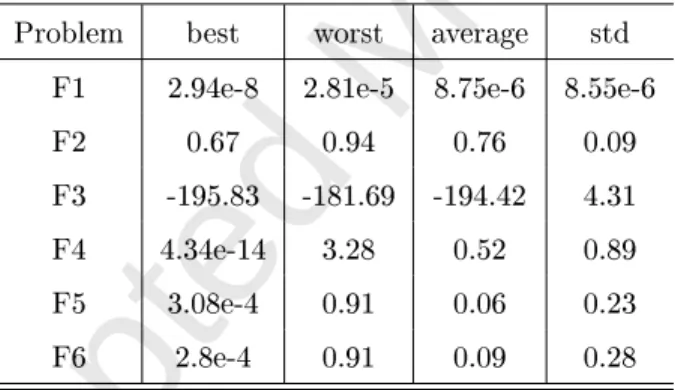
Table 2: Statistics of the best function values obtained by MGPMDE for F1-F6
Problem best worst average std
F1 2.94e-8 2.81e-5 8.75e-6 8.55e-6
F2 0.67 0.94 0.76 0.09
F3 -195.83 -181.69 -194.42 4.31
F4 4.34e-14 3.28 0.52 0.89
F5 3.08e-4 0.91 0.06 0.23
F6 2.8e-4 0.91 0.09 0.28
4.1.2. MGPMDE performance study
The statistics of the best function values obtained by MGPMDE based on 30 independent runs are reported in Table 2. The number of CEs is determined
455
byδ1 and the number of FEs is determined by δ2 and RBF gradient tolerance
(1e-4).
It can be inferred from Table 2 that MGPMDE consistently exhibits good global optimization capability and robustness when using the same algorithm setup. This is despite of various types and levels of discrepancies between the
460
complex-Accepted Manuscript
ity. The average values of 30 runs are close to the global optimum.
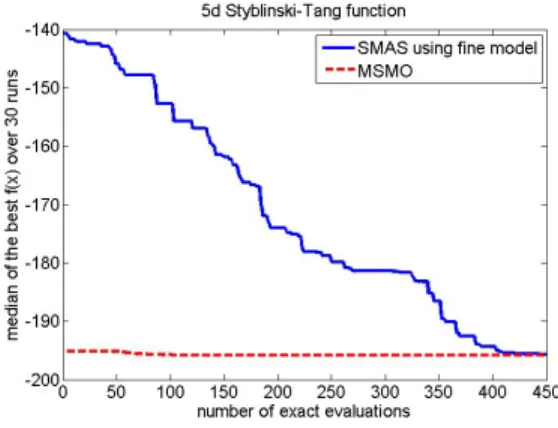
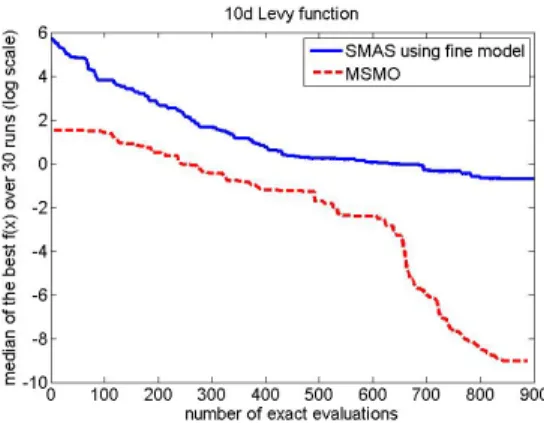
In terms of reliability and eciency, Fig. 2 to Fig. 7 show the comparison of MGPMDE and the latest SMAS-based SBO [21], which is an improved version of [23]. The reference method only uses FEs. For comparison purposes, we assume
465
that the coarse model is 10 times faster than the ne model, which is common in industry [2]. The number of CEs used in MGPMDE is thus transformed to equivalent FEs for comparisons.
The following conclusions can be drawn: (1) Considering model discrep-ancy, good reliability of MGPMDE is shown, because the median performance
470
of MGPMDE is not worse than the reference method (based on only FE and SMAS) in terms of solution quality. (2) The initial population constructed from the rst two stages of MGPMDE exhibits good optimality. According to Figs. 2 to 7, the initial tness values for F1-F6 are much better than those obtained by means of the reference method using the same number of FEs. To verify this,
475
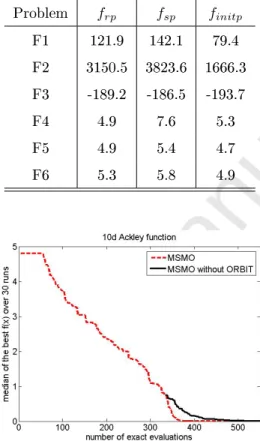
Table 3 lists the best tness values of the representative solution pool (where CE is used) in terms of FE (frp), of the seed population (fsp), and of the initial
population for Stage 3 (finitp). It can be observed that most fsp are similar
tofrp, which veries the method to generate the seed population (Steps 1-4 in
Stage 2). finitp shows clear improvement compared to fsp, which veries the 480
self-development process in Stage 2 (Steps 5-8) in terms of optimality. (3) Good overall quality (including both optimality and diversity) of the initial population can be observed, because the convergence rate of MGPMDE is similar to the reference method starting from the corresponding tness values, except for F1 which is a little lower but still similar. Otherwise; the convergence rate should
485
be much lower than that of the reference method or stuck at a local optimum although starting from a population with good optimality. Conclusions (2) and (3) indicate that the goals of the new MFO framework, specically, obtaining high quality initial population based on CE, data mining and a small num-ber of FEs are met. Conclusion (3) also veries the overall good eciency of
490
MGPMDE.
com-Accepted Manuscript
Figure 2: Convergence curve of the objective function for F1
Figure 3: Convergence curve of the objective function for F2
Figure 4: Convergence curve of the objective function for F3
Page 25 of 34
Accepted Manuscript
Figure 5: Convergence curve of the objective function for F4
Figure 6: Convergence curve of the objective function for F5
Figure 7: Convergence curve of the objective function for F6
Accepted Manuscript
Table 3: Best tness values for the representative solution pool, seed population and initialpopulation (average over 30 runs)
Problem frp fsp finitp F1 121.9 142.1 79.4 F2 3150.5 3823.6 1666.3 F3 -189.2 -186.5 -193.7 F4 4.9 7.6 5.3 F5 4.9 5.4 4.7 F6 5.3 5.8 4.9
Figure 8: Comparison of MGPMDE with / without ORBIT
putational eciency of SMAS and provides further improvements by applying ORBIT at suitably selected step of the optimization procedure as explained be-fore. A clear example is shown in Fig. 5, where ORBIT starts at around 680
495
iterations. To further demonstrate the benets of memetic SMAS, a represen-tative example using F5 is shown in Fig. 8. MGPMDE is compared with a method using the same rst two stages but with only SMAS (without ORBIT) used at the third stage. It can be seen that about 20% FEs are saved.
Accepted Manuscript
4.2. Real-world Problem Tests
500
MGPMDE is applied to a real-world antenna design automation problem [28]. It is a 10 GHz 16-element microstrip patch antenna implemented on a nite 1.575-mm-thick Rogers RT5880 dielectric substrate, which is shown in Fig. 9. The objective is minimization of the side lobes assuming ±8-degree
main beam. The design variables are excitation amplitudesak, k= 1,2, . . . ,16
with a range of[0,1]16. The objective function is as follows:
min SLL(ak), k= 1,2, . . . ,16 (9)
where SLL is the sidelobe level, i.e., the maximum relative power for the angles 0 to 82 degrees and 98 to 180 degrees.
The coarse model is an analytical array factor model assuming ideal isotropic radiators [28], for which each calculation costs about5×10−3s. The ne model
is an electromagnetic (EM) simulation model (no explicit analytical formula
505
is available), for which each simulation costs about 30 minutes. In order to make multiple runs and comparisons possible, the simulation-based superposi-tion model has been created that ensures virtually the same accuracy as the ne EM simulation model but at the fraction of the cost of the latter. The simulation-based superposition model is obtained as superposition of
individu-510
ally simulated far elds of all array elements. Each element is simulated within the array in order to take into account EM couplings with all other elements.
30 runs of MGPMDE, SMAS and standard DE with the same parameters of Section 4.1 are carried out. From practical standpoint, accomplishing the an-tenna design process within 3 days can be considered as satisfactory. According
515
to the computational budget, 100 ne model simulations are used for Stage 2 and SMAS in Stage 3, and 50 ne model simulations are used for ORBIT.
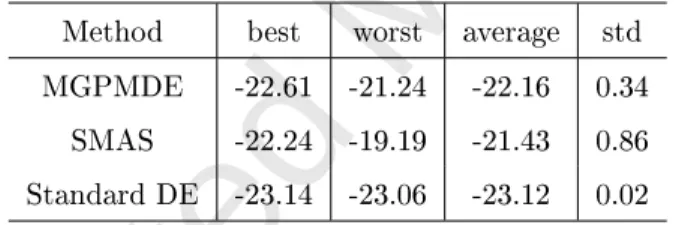
The results are shown in Table 4. The convergence trends of MGPMDE and SMAS are indicated in Fig. 10. The time expenditure is calculated by multiplying the average cost of each simulation by the number of simulations.
520
The time spent on surrogate model training is less than half an hour (less than 1 FE), and it can be neglected. The following observations can be made: (1) The
Accepted Manuscript
s
Figure 9: Layout of 16-element microstrip patch array antenna
Table 4: Statistics of the best function values obtained by MGPMDE (150 ne simulations), SMAS (550 ne simulations), standard DE (30,000 ne simulations)
Method best worst average std
MGPMDE -22.61 -21.24 -22.16 0.34 SMAS -22.24 -19.19 -21.43 0.86 Standard DE -23.14 -23.06 -23.12 0.02
Figure 10: Convergence curve of the objective function for the real-world antenna design example
Accepted Manuscript
result of MGPMDE using 150 ne model simulations is of high quality either using antenna theory or the standard DE result as a reference. (2) A large speed improvement of MGPMDE can be observed compared to SMAS with ne model
525
simulations.
The dierence between the best candidate design of Stage 1 (coarse model-based SBO) and the nal best design of Stage 3 are compared for 30 runs of the algorithm. Among 16 design variables, the average dierence spans from 7.2% to 42.2% of the search range, and 8 out of 16 are larger than 20% of the search
530
range. This indicates that the true optimum is dicult to be found if following the existing method of performing local exploitation around the CE-based op-timal design. Furthermore, the average results of MGPMDE and standard DE over 30 runs are compared. To obtain the average result of MGPMDE using 150 ne model simulations, standard DE needs 3800 ne model simulations. This
535
indicates the substantial speed improvement oered by MGPMDE. 5. Conclusions
In this paper, the MGPMDE method has been proposed. The targeted prob-lems are engineering design optimization tasks with very long simulation time of the relevant computational models, for which even state-of-the-art global SBOs
540
or MFOs may be too expensive. The main contributions of the work are: (1) the development of the new MFO framework which substantially improves reli-ability of the optimization process and makes comprehensive use of high-delity evaluations, (2) the development of the data mining method which provides a good initial population for ne model-based optimization in terms of both
opti-545
mality and population diversity, and (3) the development of MGPMDE, showing the combined advantages of high eciency, high reliability and high optimiza-tion quality, as demonstrated by benchmark and antenna design automaoptimiza-tion problems. The methodology developed under this research also considerably decreases the risk related to usage of lower-delity simulation models, as well
550
Accepted Manuscript
focus on constrained and multi-objective MGPMDE. Acknowledgement
The authors thank CST AG for making CST Microwave Studio available. The authors would like to thank Dr. Renato Cordeiro de Amorim, Glyndwr
555
University, UK, for valuable discussions. A. F1: Ellipsoid Problem fc(x) =P d i=1i×x 2 i ff(x) =P d i=1i×shi×(xi−ssi)2 i= 1, . . . , d sh= [0.3,0.4,0.2,0.6,1,0.9,0.2,0.8,0.5,0.7, 0.4,0.3,0.7,1,0.9,0.6,0.2,0.8,0.2,0.5] ss= [1.8,0.4,2,1.2,1.4,0.6,1.6,0.2,0.8,1, 1.3,1.1,2,1.4,0.5,0.3,1.6,0.7,0.3,1.9] (.1)
B. F2: Dixon & Price Problem
fc(x) = (x1−1)2+P n i=2i(2x 2 i −xi−1)2 ff(x) =fc(x−ss) i= 1, . . . , d ss= [1.8,0.5,2,1.2,0.4,0.2,1.4,0.3,1.6,0.6, 0.8,1,1.3,1.9,0.7,1.6,0.3,1.1,2,1.4] (.2) C. F3: Styblinski-Tang Problem fc(x) = 0.5×P d i=1(x4i −16x2i + 5xi) ff(x) =fc(x−ss) i= 1, . . . , d ss= [0.28,0.59,0.47,0.16,0.32] (.3)
Accepted Manuscript
D. F4: Levy Problem fc(x) =sin2(sf×πwi) +Pid−=11[1 + 10sin2(sf ×πwi+ 1)] +(wd−1)2[1 +sin2(2sf×πwd)], wi= 1 + 0.25(xi−ssi−1) ff(x) =sin2(πwi) +Pd− 1 i=1[1 + 10sin 2(πw i+ 1)] +(wd−1)2[1 +sin2(2πwd)], wi= 1 + 0.25(xi−1) i= 1, . . . , d sf = 0.8, ss= [1.2,0.3,1,0.3,1.6,0.8,1.4,0.7,2,1.5] (.4) E. F5,F6: Ackley Problem fc(x) =−20e−0.2 √ 1 d Pd i=1x2i −e1d Pd i=1cos(2πxi) ff(x) =−20e−0.2 √ 1 d Pd i=1(xi−ssi)2 −e1d Pd i=1cos(2×sf×πxi−ssi) i= 1, . . . , d F5 :sf = 1.3, ss= [1.3,0.1,1.4,0.8,1.7,1,1.5,0.6,2,0.4] F6 :sf = 1.3, ss= [1.2,0.2,1.4,0.8,1.8,1,1.6,0.6,2,0.4, 1.3,0.3,1.5,0.9,1.9,1.1,1.7,0.7,2.1,0.5] (.5) References[1] J. W. Bandler, Q. S. Cheng, S. A. Dakroury, A. S. Mohamed, M. H. Bakr, K. Madsen, J. Sondergaard, Space mapping: the state of the art, IEEE Transactions on Microwave Theory and Techniques 52 (1) (2004) 337361.
560
[2] S. Koziel, L. Leifsson, X.-S. Yang, Solving computationally expensive engi-neering problems: Methods and applications, Springer.
[3] COMSOL, Comsol multiphysics 4.3 user's guide (2012).
[4] J. Müller, C. A. Shoemaker, R. Piché, SO-MI: A surrogate model algorithm for computationally expensive nonlinear mixed-integer black-box global
565
optimization problems, Computers & Operations Research 40 (5) (2013) 13831400.
Accepted Manuscript
[5] M. A. El-Beltagy, A. Keane, A comparison of various optimization algo-rithms on a multilevel problem, Engineering Applications of Articial In-telligence 12 (5) (1999) 639654.
570
[6] A. I. Forrester, A. Sóbester, A. J. Keane, Multi-delity optimization via surrogate modelling, in: Proceedings of the Royal Society of London A: Mathematical, Physical and Engineering Sciences, Vol. 463, The Royal So-ciety, 2007, pp. 32513269.
[7] I. C. Kampolis, A. Zymaris, V. Asouti, K. C. Giannakoglou, Multilevel
op-575
timization strategies based on metamodel-assisted evolutionary algorithms, for computationally expensive problems, in: IEEE Congress on Evolution-ary Computation, IEEE, 2007, pp. 41164123.
[8] S. Koziel, S. Ogurtsov, Model management for cost-ecient surrogate-based optimisation of antennas using variable-delity electromagnetic
simu-580
lations, IET Microwaves, Antennas & Propagation 6 (15) (2012) 16431650. [9] L. Huang, Z. Gao, D. Zhang, Research on multi-delity aerodynamic opti-mization methods, Chinese Journal of Aeronautics 26 (2) (2013) 279286. [10] M. C. Kennedy, A. O'Hagan, Predicting the output from a complex
com-puter code when fast approximations are available, Biometrika 87 (1) (2000)
585
113.
[11] B. Liu, D. Zhao, P. Reynaert, G. G. Gielen, GASPAD: A general and ecient mm-wave integrated circuit synthesis method based on surrogate model assisted evolutionary algorithm, IEEE Transactions on Computer-Aided Design of Integrated Circuits and Systems 33 (2) (2014) 169182.
590
[12] E. Huang, J. Xu, S. Zhang, C.-H. Chen, Multi-delity model integration for engineering design, Procedia Computer Science 44 (2015) 336344. [13] L. Leifsson, S. Koziel, Multi-delity design optimization of transonic
air-foils using physics-based surrogate modeling and shape-preserving response prediction, Journal of Computational Science 1 (2) (2010) 98106.
Accepted Manuscript
[14] P. Rocca, G. Oliveri, A. Massa, Dierential evolution as applied to electro-magnetics, IEEE Antennas and Propagation Magazine 53 (1) (2011) 3849. [15] B. Liu, G. Gielen, F. Fernández, Automated design of analog and
high-frequency circuits, Springer.
[16] T. J. Santner, B. J. Williams, W. I. Notz, The design and analysis of
600
computer experiments, Springer, 2003.
[17] V. R. Joseph, Y. Hung, A. Sudjianto, Blind kriging: A new method for developing metamodels, Journal of mechanical design 130 (2008) 031102. [18] I. Couckuyt, A. Forrester, D. Gorissen, F. De Turck, T. Dhaene, Blind
kriging: Implementation and performance analysis, Advances in
Engineer-605
ing Software 49 (2012) 113.
[19] J. Dennis, V. Torczon, Managing approximation models in optimization, in: Multidisciplinary design optimization: State-of-the-art, Philadelphia, PA: SIAM, 1997, pp. 330347.
[20] K. Price, R. Storn, J. Lampinen, Dierential evolution: a practical
ap-610
proach to global optimization, Springer-Verlag, 2005.
[21] B. Liu, Q. Chen, Q. Zhang, G. Gielen, V. Grout, Behavioral study of the surrogate model-aware evolutionary search framework, in: IEEE Congress on Evolutionary Computation, IEEE, 2014, pp. 715722.
[22] S. M. Wild, R. G. Regis, C. A. Shoemaker, ORBIT: Optimization by radial
615
basis function interpolation in trust-regions, SIAM Journal on Scientic Computing 30 (6) (2008) 31973219.
[23] B. Liu, Q. Zhang, G. Gielen, A gaussian process surrogate model assisted evolutionary algorithm for medium scale expensive optimization problems, IEEE Transactions on Evolutionary Computation 18 (2) (2014) 180192.
620
[24] M. Stein, Large sample properties of simulations using latin hypercube sampling, Technometrics 29 (2) (1987) 143151.
Accepted Manuscript
[25] M. Lozano, F. Herrera, J. R. Cano, Replacement strategies to preserve useful diversity in steady-state genetic algorithms, Information Sciences 178 (23) (2008) 44214433.
625
[26] L. Rutkowski, Clustering for data mining: A data recovery approach, Psy-chometrika 72 (1) (2007) 109110.
[27] M. Jamil, X.-S. Yang, A literature survey of benchmark functions for global optimisation problems, International Journal of Mathematical Modelling and Numerical Optimisation 4 (2) (2013) 150194.
630
[28] S. Koziel, S. Ogurtsov, Simulation-based design of microstrip linear an-tenna arrays using fast radiation response surrogates, IEEE Anan-tennas and Wireless Propagation Letters (2015) 759762.