University of Colorado, Boulder
CU Scholar
Electrical, Computer & Energy Engineering
Graduate Theses & Dissertations
Electrical, Computer & Energy Engineering
Spring 1-1-2012
Optimizing Jython using invokedynamic and
Gradual Typing
Shashank Bharadwaj
University of Colorado at Boulder, [email protected]
Follow this and additional works at:
http://scholar.colorado.edu/ecen_gradetds
Part of the
Computer Engineering Commons, and the
Computer Sciences Commons
This Thesis is brought to you for free and open access by Electrical, Computer & Energy Engineering at CU Scholar. It has been accepted for inclusion in Electrical, Computer & Energy Engineering Graduate Theses & Dissertations by an authorized administrator of CU Scholar. For more information, please [email protected].
Recommended Citation
Bharadwaj, Shashank, "Optimizing Jython using invokedynamic and Gradual Typing" (2012).Electrical, Computer & Energy
Optimizing Jython using and Gradual Typing
by
Shashank Bharadwaj
B.E., Visvesvaraya Technological University, 2008
A thesis submitted to the Faculty of the Graduate School of the University of Colorado in partial fulfillment
of the requirements for the degree of Master of Science
Department of Electrical, Energy and Computer Engineering 2012
Optimizing Jython using invokedynamicand Gradual Typing written by Shashank Bharadwaj
has been approved for the Department of Electrical, Energy and Computer Engineering
Jeremy Siek
Bor-Yuh Evan Chang
Sriram Sankaranarayanan
Date
The final copy of this thesis has been examined by the signatories, and we find that both the content and the form meet acceptable presentation standards of scholarly work in the above
Bharadwaj, Shashank (M.S.)
Optimizing Jython using invokedynamicand Gradual Typing Thesis directed by Assistant Professor Jeremy Siek
Compilers for statically typed languages such as C/C++ and Java use the types from the program to generate high performance code. Although the runtimes of dynamically typed languages such as Python, Ruby and Javascript have evolved significantly over the past few years; they have not yet reached the performance of their statically typed counterparts. A new type system called gradual typing has been proposed in which the program can optionally be annotated with type information. In this thesis, I implement gradual typing in Jython (an implementation of Python language for the Java virtual machine) and generate type-specialized code. Also, I use invokedynamic, a new byte code introduced in Java 7, to implement optimizations in Jython; both in an effort to close the gap between Java and Jython in particular and statically type and dynamically typed language in general.
Acknowledgements
I thank my advisor, Jeremy Siek for his guidance, constant encouragement and support. Under his guidance I have learnt everything I know about compilers and programming languages; I could not have completed this thesis without him. I am grateful to my mentor Jim Baker, who was always there to catch glitches in my thinking and who has always been a constant source of encouragement. I thank my committee: Bor-Yuh Evan Chang and Sriram Sankaranarayanan for their for their helpful advice and encouragement. I thank Michael Vituosek, my fellow graduate student, for interesting discussions around the design choices and begin a superb work partner. I thank Christopher Poulton for helping with the implementation. I thank Carl Friedrich Bolz for reviewing and helping me improve this thesis. A big thank you to Kaushik, Karthik, Srinivas, Deepak and especially Arul and Bharath for all their support and motivation. Last, but by no means the least, I thank my parents and my sister for being a constant source of support, inspiration and motivation.
Contents
1 Introduction 1
2 Background 3
2.1 Introduction to Gradual Typing. . . 3
2.1.1 Static semantics . . . 4
2.1.2 Dynamic semantics . . . 7
2.2 Introduction toinvokedynamic. . . 9
3 Jython Optimizations 15 3.1 A framework for AST transformations . . . 16
3.1.1 Optimizing loops in Jython . . . 17
3.1.2 Optimizing global name lookups . . . 20
3.2 Changing the dispatch mechanism . . . 27
3.2.1 Current dispatch mechanism in Jython. . . 27
3.2.2 Dispatch mechanism in Jython withinvokedynamic . . . 32
3.2.3 Performance evaluation . . . 39
3.3 Reducing frame overhead . . . 39
3.4 Performance evaluation . . . 43
4 Gradual Typing for Jython 52 4.1 Design Choices . . . 52
4.2 Parsing and type checking . . . 54
4.3 Cast Insertion and type specialization . . . 56
4.4 Code generation . . . 57
4.4.1 Standard Gradual Jython types. . . 58
4.4.2 Functions . . . 60
4.4.3 Evaluation . . . 62
5 Conclusions and Future Work 64
Figures
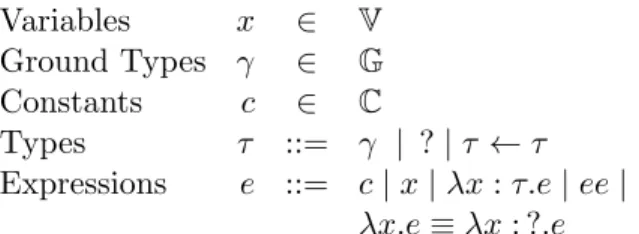
2.1 Syntax for gradually-typed lambda calculus. . . 4
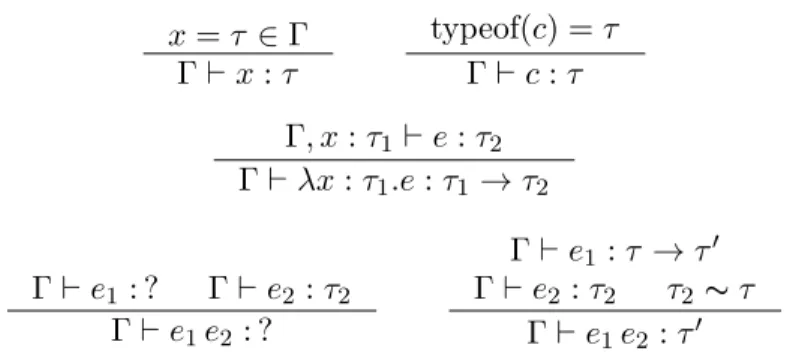
2.2 Type system for the gradually-typed lambda calculus. . . 5
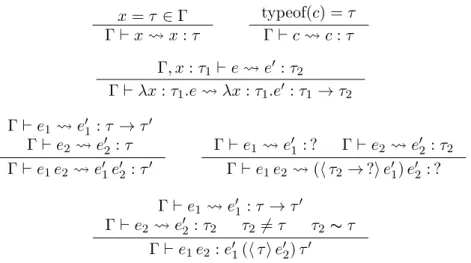
2.3 Cast insertion for the gradually-typed lambda calculus. . . 6
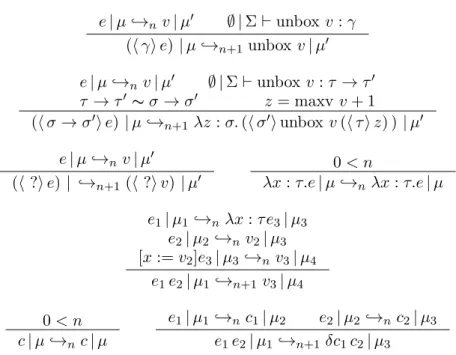
2.4 Evaluation rules going to values for the gradual typing intermediate language. . . 8
2.5 Evaluation rules going to errors for the gradual typing intermediate language. . . 8
3.1 The current Jython framework. . . 16
3.2 Overview of the AST transformation framework. . . 17
3.3 Comparing the performance of the loop optimization. . . 22
3.4 Comparing the relative performance the getGlobal stress test from Listing 3.7. . . 28
3.5 Comparing the relative performance running the fibonacci function from Listing 3.22. 40 3.6 Comparing the performance running a frameless version from Listing 3.24.. . . 44
3.7 Comparing the performance of the for loop optimization implemented in Subsec-tion 3.1.1. The geometric mean of the benchmarks is -0.42%. . . 47
3.8 Comparing the performance of the getGlobal optimization implemented in Sub-section 3.1.2. The geometric mean of the benchmarks is 4.04% . . . 48
3.9 Comparing the performance of the change in dispatch mechanism implemented in Section 3.2. The geometric mean of the benchmarks is -2.46% . . . 49
3.10 Comparing the performance of the dispatch mechanism change (from Section 3.2) and the getGlobal optimization (from Subsection 3.1.2) together. The geometric mean of the benchmarks is 3.2% . . . 50
3.11 Comparing the performance of the optimizations implemented in this chapter using a few (macro) application benchmarks. The geometric mean of the benchmarks is 5.7% . . . 51
Chapter 1
Introduction
Based on the type system they use, modern programming languages can broadly be classified as either being dynamically-typed or statically-typed. Both systems have well known advantages and disadvantages. Statically-typed languages (such as C, C++, or Java) perform type-checking at compile-time and require the program to have type information on all the variables. This not only ensures that the compiler generates meaningful type errors, but also facilitates high performance code generation, because the compiler has to generate code for only one type. This approach makes a program rigid, making it harder handle situations where the type of a value depends on runtime information and also to adapt to changing requirements.
Dynamically-typed languages (such as Perl, Python, or Javascript) are popular for their ease of use and rapid development cycles [13]. These languages do not perform type checking during compilation so that the programmer does not have to provide any type information on the program. Although this feature can be helpful when developing a prototype, in this type system the compiler generates inefficient code since the compiler must assume the most generic case for all the expressions.
There has been a wealth of research into improving performance of dynamic languages. Cham-bers and Ungar used static profiling techniques to bring some of the traditional optimizations using data-flow analysis, such as sub-expression elimination, dead code elimination, constant folding and copy propagation, into dynamic languages [3]. H¨olzle and Ungar usedtype feedback(where they extract type information from runtime and feed that back into the compiler), to decide which calls
should be inlined [5]. Brunthaler cached the calls so as to avoid multiple lookup for calls [2]. Even with all these optimizations, dynamically-typed languages have not reached the speed of statically-typed languages. A new approach to improving the performance of dynamically-statically-typed languages is necessary.
In this thesis, I explore two main ways to improve the performance of Jython, an imple-mentation of the Python programming language that runs on the Java virtual machine (JVM). First, I use the invokedynamic byte-code introduced along with Java 7 to implement various optimizations. Second, I implementgradual typing [11] in Jython and enable type-specialized code generation. I show that these approaches help close the gap between Jython and Java in particu-lar and the techniques can be used to close the performance gap between dynamically-typed and statically-typed languages in general.
The paper is organized as follows: Chapter 2provides an introduction togradual typing and invokedynamic;Chapter 3 presents the various optimizations implemented in Jython by using invokedynamic; in Chapter 4 I present the details of an implementation of gradual typing in Jython; I end the thesis with some concluding remarks inChapter 5.
Chapter 2
Background
In this chapter I present background reading material required for the thesis. In Sec-tion 2.1 I present a brief overview of gradual typing and in Section 2.2 I present an overview on invokedynamicframework in Java 7.
2.1 Introduction to Gradual Typing
Traditionally statically typed programming languages (such as Java, C and C++) have dom-inated industry usage for decades [14], their popularity is largely attributed to earlier detection of programming mistakes, better documentation in the form of type signatures, more opportunities for compiler optimizations and increased runtime efficiency. Dynamic languages (such as Python, Ruby and Javascript) are heavily used for prototyping since the code is much more compact. These languages allow programmers to get results quickly since these languages are generally not as ver-bose as their statically typed counterparts and are more flexible which helps reduce overheads and increase productivity [7].
In 2007, Siek and Taha introducedgradual typingto bridge the gap between the dynamically-typed languages and statically-dynamically-typed languages by developing a framework that allowed a language to have some parts to be completely dynamically-typed and other parts to be statically typed [11] [9]. In this section I will provide a brief introduction to gradual typing.
The essence of gradual typing is that it allows input program to have optional types, where some parts of the program can have type annotations and other parts type annotations can be left
Variables x ∈ V Ground Types γ ∈ G Constants c ∈ C Types τ ::= γ | ?|τ ←τ Expressions e ::= c|x|λx:τ.e|ee| λx.e≡λx: ?.e
Figure 2.1: Syntax for gradually-typed lambda calculus.
out. Parts of the program without type annotations are assumed to be dynamic by default. The gradual typing system then converts this input program to an intermediate language with explicit casts, inserting casts where the program transitions from dynamic typed part into a statically typed part. These casts are enforced at runtime so that, if the value flowing in from the dynamically typed part of the program does not match the static types, an exception is raised. An important property of gradual typing systems is that if a program is completely annotated, then the type-checker would catch all the type errors at compile time. In the remainder of this section I will explain the type-checking and the cast insertion phase of a gradual typing system on a slight variation on the simply-typed lambda calculus language.
2.1.1 Static semantics
The syntax for the language gradually-typed lambda calculus is shown in Figure 2.1; where the simply-typed lambda calculus is extended with the type ? used to represent dynamic types. The lambda function without annotation on the parameter implies that the parameterxis dynamic and is a short-hand for writingλx: ?.e. With the language defined, let us look at the type-checking rules to understand the type system of this language.
Figure 2.2shows the type checking rules for this language. The rules look very similar to the rules for the simply-typed lambda calculus except for the function application case (Γ`e1e2). Here,
instead of requiring that the types of the argument to the function and the type of the function’s parameter to be equal, the authors require that the types be consistent instead. Consistency
Γ`e:τ x=τ ∈Γ Γ`x:τ typeof(c) =τ Γ`c:τ Γ, x:τ1 `e:τ2 Γ`λx:τ1.e:τ1 →τ2 Γ`e1: ? Γ`e2:τ2 Γ`e1e2: ? Γ`e1:τ →τ0 Γ`e2:τ2 τ2 ∼τ Γ`e1e2:τ0
Figure 2.2: Type system for the gradually-typed lambda calculus.
other type and vice versa. Rules for consistency are defined below:
τ ∼τ ?∼τ τ ∼?
τ1∼τ3 τ2 ∼τ4
τ1 →τ2 ∼τ3 →τ4
Note that the consistency relation is reflexive and symmetric but not transitive. The consis-tency relation places a less restrictive constraint on the types, than type equality. Since all types are consistent with the type ?, the static type checker would allow an argument of any type to be passed into a parameter of type ?, making the function far more flexible. To ensure that the gradual type system does not produce type errors in statically typed parts at runtime, runtime checks are performed at appropriate places. These checks throw runtime exceptions if the checks fail. The checks can be thought of as guards making sure that the potentially malformed programs that were allowed at compile time, actually adhere to the typing rules. For example, if at compile time a expression of type dynamic was applied, then the cast makes sure that at runtime the value at that point is a function. We shall now look at the pass which inserts these checks, neatly called cast insertion phase.
The Figure 2.3 shows the rules for cast insertion phase. Cast insertion takes as input the expression and produces back a casted expression and is similar in many rules to the type-checker with the addition of an output term. The rules for function application (e1e2) are the most
Γ`e e0 :τ x=τ ∈Γ Γ`x x:τ typeof(c) =τ Γ`c c:τ Γ, x:τ1 `e e0 :τ2 Γ`λx:τ1.e λx:τ1.e0 :τ1 →τ2 Γ`e1 e01:τ →τ0 Γ`e2 e02 :τ Γ`e1e2 e01e02 :τ0 Γ`e1 e01 : ? Γ`e2 e02:τ2 Γ`e1e2 (hτ2 →?ie01)e02 : ? Γ`e1 e01 :τ →τ0 Γ`e2 e02 :τ2 τ2 6=τ τ2∼τ Γ`e1e2:e01(hτie02)τ0
Figure 2.3: Cast insertion for the gradually-typed lambda calculus.
interesting ones. In the first rule for application, the functione1 goes through cast-insertion and is
converted toe01 and expects typeτ for the argument and the argument e02 indeed has typeτ, and no casts are needed in this case as the application can never fail at runtime. In the second rule for application, the functione01 has type dynamic ?, and the argument e02 has typeτ2. Here we insert
a cast (hτ2 →?ie01) on the function to make sure that the term e01 is indeed a function that can
take a term of type τ2 as input. In the third case of function application, the functione01 has type
τ →τ0 but the argument has type τ2. This will not be a type error only if τ ∼τ2, and at runtime
we need to make sure to cast the terme02 toτ and therefore this cast is inserted before the function is applied.
After the cast insertion phase, we are left with a program very similar to the original input program but with the addition of casts. Therefore we can extend the original language by with casts:
Expressions e ::= ...|(hτie) And the additional typing rule for casts would be:
Γ`e:τ0 τ0 ∼τ
2.1.2 Dynamic semantics
This new intermediate language can then either be compiled to run or interpreted. In this subsection we will review the runtime semantics of the new language. Before diving into the details, we first define a grammar to describe the different parts of the evaluation.
Simple values s∈S ::= x|c|λx:τ.e
Values v∈V ::= s|(h ?is)
Errors ε ::= CastError|TypeError|KillError
Results r ::= v|ε
The type resultris a super set of errorseand valuesv, where values can either be one of the simple valuessor a simple value with a cast. Of the three types of errors defined, KillError was added by the original authors to prove type safety. The CastError symbolizes errors that the runtime system is able to catch and thus raise exceptions. The TypeError represents the class of errors which if uncaught would cause undefined behavior such as segmentation faults.
The evaluation rules are defined using big-step style with substitution, in the form e ,→n r,
where e evaluates to the result r with a derivation depth of n. The evaluation rules for terms resulting in values are presented in Figure 2.4 and the rules resulting in errors are presented in Figure 2.5.
It is interesting to look at the rules of evaluation of casted expressions. Here, unbox is a helper function which will get the underlying value by removing the cast around it. The rule for function casts (2ndrule inFigure 2.4) handles the case of casting to a function type. If the run-time type τ → τ0 is consistent with the target type σ → σ0, then the cast is removed. Then, a new function is created which wraps the inner value v and a cast is inserted to produce a well-typed value of the appropriate type.
If the runtime type does not match the expected type, then a CastError is raised as shown in the first rule in Figure 2.5. If a simple value is applied (function call) then the cast raises a TypeError. The authors prove that this approach is type-safe [11]. Building on their initial
e|µ ,→nv|µ0 ∅ |Σ`unbox v:γ (hγie) |µ ,→n+1unboxv|µ0 e|µ ,→nv|µ0 ∅ |Σ`unboxv :τ →τ0 τ →τ0 ∼σ →σ0 z= maxv v+ 1 (hσ→σ0ie) |µ ,→n+1 λz:σ.(hσ0iunboxv(hτiz) )|µ0 e|µ ,→nv|µ0 (h ?ie)| ,→n+1 (h ?iv) |µ0 0< n λx:τ.e|µ ,→nλx:τ.e|µ e1|µ1 ,→nλx:τ e3|µ3 e2|µ2 ,→nv2|µ3 [x:=v2]e3|µ3,→nv3|µ4 e1e2|µ1 ,→n+1 v3|µ4 0< n c|µ ,→nc|µ e1|µ1 ,→nc1|µ2 e2|µ2 ,→nc2|µ3 e1e2|µ1,→n+1 δc1c2|µ3
Figure 2.4: Evaluation rules going to values for the gradual typing intermediate language.
e|µ ,→nv|µ0 ∅ |Σ`unboxv:σ σ τ (hτie) |µ ,→n+1CastError|µ0 e|µ ,→0 KillError|µ 0< n x|µ ,→nTypeError|µ e1|µ ,→nv1|µ0 v1 ∈/ FunVal e1e2|µ1,→n+1 TypeError|µ0 e|µ ,→nε|µ0 (hτie) |µ ,→n+1 ε|µ0 e1|µ ,→nε|µ0 e1e2|µ ,→n+1ε|µ0 e1|µ1,→nv1|µ2 v1 ∈FunVal e2|µ2 ,→nε|µ3 e1e2|µ1 ,→n+1ε|µ3 e1|µ1,→nv1|µ2 e2|µ2,→nv2|µ3 [x:=v2]e3|µ3 ,→nε|µ4 e1e2|µ1 ,→n+1 ε|µ4
work, Siek et. al. extend gradual type system to handle object oriented languages [9]. They also introduced an efficient way of storing the runtime cast information [12] [10].
2.2 Introduction to invokedynamic
In 2010, Java-7 introducedinvokedynamic [8], a new byte-code in the Java virtual machine (JVM) to give more control to developers of dynamic languages on method dispatch. Specifically invokedynamic provides user-defined call site semantics, so that a language runtime can link (and re-link) the call site based on runtime information. In this section I present an introduction on this new bytecode.
The JVM was initially designed to support only the Java programming language, but it quickly outgrew it’s initial purpose. Today many languages are implemented on top of the JVM owing to the JVM’s type-safe byte code, optimizing just in compilers (JIT), scalable concurrency, wide distribution, and the rich ecosystem of libraries and debugging tools surrounding it. Not only do existing languages such as Python, Javascript, and Ruby have JVM implementations; but there are also plenty of languages developed solely on the JVM such as Scala, Fortress, and Groovy. The total number of languages with JVM implementations is more than 200 [15].
A large number of these languages have dramatic semantic differences when compared to Java, making the translation from a non-Java language into JVM byte code difficult. For example the language may support strong updates to an object, where the programmer can change a bound method; or support mutable classes; or support arithmetic operations on dynamically typed objects or multiple return values. Compiling such features require the implementation to keep additional Java data structures, and possibly use of Java core reflection API which increase the execution overhead and complexity. To address this issue the Da Vinci Machine project was set up and they introduced theinvokedynamicframework in Java 7.
Traditionally, before Java 7, the Java virtual machine only supported 4 instructions to invoke a method:
• invokevirtual invokes the method on an instance of an object, dispatching on the virtual type of the object.
• invokestatic invokes a static method on a named class.
• invokeinterface invokes a method on an interface; the virtual machine searches the methods implemented by the runtime object and dispatches to the appropriate method. • invokespecial invokes a method on an instance requiring special handling such as the
constructor method.
With Java 7, a new byte code for method invocation was added calledinvokedynamic[6]. invokedynamic invokes the method which is the target of the call site object bound to the invokedynamicinstruction. At the first execution of theinvokedynamicinstruction, the Java virtual machine calls a bootstrap method which returns the call site object, and this is bound to the specific invokedynamicinstruction. Unlike other invoke methods mentioned above, each invokedynamicinstruction in the byte code has a unique linkage state. A key point to emphasize here is thatinvokedynamicis only a new instruction at in the JVM bytecode and does not have an equivalent Java representation. It is unique because this is the first time that the JVM has added a feature which does not have a direct equivalent in Java.
During the first call of an invokedynamicinstruction, a bootstrap method is called. The bootstrap method is provided by the custom language implementer, such as the sample bootstrap method shown below:
public CallSite bootstrap(Lookup l, String name, MethodType type) { return new CallSite(...);
}
Listing 2.1:
• The JVM passes the Lookupobject (explained in the next paragraph), the method name and the method type as parameters to the bootstrap method.
• The bootstrap method has to return an object of class java.invoke.CallSite (or it’s subclass), where the language runtime is free to point this CallSiteto any method satisfying the received method type.
When the bootstrap method call returns, the CallSite object is bound to the specificinvokedynamic instruction by the JVM and the association is unchanged unless changed explicitly by the language runtime. After theCallSiteobject is bound, the JVM extracts the target method reference from the CallSite object (stored in the private field CallSite.target) and dispatches a call to that method. Every other invocation of this particular invokedynamic instruction will use the boundCallSiteobject to dispatch.
To be able to point to arbitrary methods, Java 7 introduces the concept of method handles. Every method handle has a specific type (an object of MethodType) and behaves as a typed function pointer. The CallSite object stores the target of the call site in a MethodHandle object. Method handles are created by looking up the method or field on a Lookupobject. The Lookup object is a factory for creating method handles. Method handles do not perform access checks when they are called, but rather when they are created. Therefore, method handle access restrictions are enforced when a method handle is created.
The simplest form of method handle is a direct method handle,Listing 2.2shows an example which creates a method handle to System.out.println and calls it. Direct method handles can emulate all the invoke bytecode instructions (other thaninvokedynamic) via corresponding Lookup methods, such as, invokevirtual via Lookup.findVirtual; invokestatic via Lookup.findStaticand so on.
Method handles are not limited to just direct method handles, there are other kinds of method handles such as adapter method handles, bound method handles and control flow method handles.
1 MethodHandle println = MethodHandles.lookup().findVirtual( 2 PrintStream.class, "println",
3 MethodHandles.methodType(void.class, String.class)); 4 println.invokeExact(System.out, "hello, world");
Listing 2.2: Example of creating a direct method handle and invoking it.
first calls the wrapper method which then delegates to the original target. These adapter method handles provide functionality that is frequently desired such asconvertArguments : which can be used to cast an argument to a different type, dropArguments: which can be used to ignore one or more parameters and permuteArguments: which can re-order the parameters before calling the underlying function.
Bound method handles provide a way to bind arbitrary parameters to an object (provided that the types match) and this returns a wrapped method handle which has the same type as the previous method handle with the bound parameter dropped.
Control flow method handles were introduced so that language runtimes can encode complex logic into the method dispatch mechanism. The MethodHandles.guardWithTest pro-vides the following semantics:
∀S λ(test, target, f allback). λa :S. if (test a) then target a else f allback a This can be used to implement inline caches or guarded calls. Another control flow mecha-nism isSwitchPoint.guardWithTestwhere one can register manytargetandf allback
method handles to an instance of SwitchPoint but there is no test method handle. All the calls are always dispatched to the target method handle, until SwitchPoint. invalidateAllmethod is called, at which point all the method handles are switched to use the f allback method handle.
Constant method handles always return a (constant) value bound to the method handle with-out dispatching to any method.
1 public static CallSite bootstrap(Lookup lookup, String name, 2 MethodType type, String base64Array) {
3 BASE64Decoder decoder = new BASE64Decoder(); 4 byte[] bytes = decoder.decodeBuffer(base64Array); 5
6 Class<?> returnType = type.returnType();
7 Object value = convertAsArray(bytes, returnType);
8 return new ConstantCallSite(MethodHandles.constant(returnType,
9 value));
10 }
Listing 2.3: Lazy decoding of a string into bytes.
After looking at the different types of method handles, we can now look at a couple more examples of bootstrap methods to better understand the possibilities enabled byinvokedynamic. Listing 2.3 shows how the bootstrap argument can be used to create a string to byte decoder. Here, the string in base64Array is only decoded on the firstinvokedynamic call, which calls the bootstrap method. Also, here we use a constant method handle to cache the value of the byte array, therefore everyinvokedynamiccall would just return this cached value [4].
The Listing 2.4 shows an example which install a generic target method install in the bootstrap method. Theinstallmethod takes all the runtime arguments and can re-bind the call site if as appropriate.
Although invokedynamic is not exposed to the Java language itself, it is being used to implement upcoming language features in the language such as lambda expressions and virtual extension methods. It is also used in various other projects such as: Nashorn project which is an implementation of JavaScript on the JVM; JRuby which is an implementation of Ruby on the JVM and has proved useful in efficiently compiling complex language features.
1 public static CallSite bootstrap(Lookup lookup, String name, MethodType type) {
2 MyCallSite callSite = new MyCallSite(lookup, name, type); 3 MethodHandle install = INSTALL.bindTo(callSite);
4 callSite.setTarget(install); 5 return callSite;
6 } 7
8 public static Object install(MyCallSite callSite, Object[] args) { 9 MethodType type = callSite.type();
10 Class<?> receiverClass = args[0].getClass();
11 MethodHandle target = callSite.lookup.findVirtual(receiverClass, 12 callSite.name, type.dropParameterTypes(0, 1));
13 target = target.asType(type); 14 callSite.setTarget(target);
15 return target.invokeWithArguments(args); 16 }
Chapter 3
Jython Optimizations
Compiling a dynamic language with powerful features such as Python [16] to Java byte code is nontrivial, and generating high performance Java bytecode is challenging. There are a few challenges in the efficient compilation of Python to Java byte code. Firstly, the JVM is tuned to optimize na¨ıve Java code, but code generated by Jython is usually complex and does not equate to na¨ıve Java code. Secondly, Python has a number of dynamic features limiting the ability to apply any optimizations at compile-time. Since Python has late-binding of names, it prevents Jython from loading built-in functions or names directly; they can only be loaded at runtime. Python provides the ability to change an object’s method resolution order (MRO) which implies that method dispatch would require heavy use of runtime data structures and creating nested call graphs for even simple method calls, limiting the JVM’s ability to inline them.
In this chapter I tackle some of these challenges and show how optimizations can be imple-mented with the use of invokedynamic. InSection 3.1I describe the general framework used for some of the optimizations and then use this framework to for two different optimizations described in Subsection 3.1.1 and Subsection 3.1.2. In Section 3.2 I present a way to optimize the function dispatch mechanism in Jython. Section 3.3presents a way of utilizing programmer input to improve the runtime performance. Finally, in Section 3.4I evalute the optimizations implemented.
Parser Scopes Compiler Code Compiler
Figure 3.1: The current Jython framework.
3.1 A framework for AST transformations
Jython currently does not perform any optimization passes, therefore before diving into performing optimizations it was important to first develop an extendable framework that would support optimization transformations. In this section I will discuss the framework I developed in Jython.
A simplified overview of current Jython compiler framework is shown inFigure 3.1. Although this representation an oversimplification, it suffices for our discussion here. As with most compilers, the parser produces an abstract syntax tree (AST) – a tree containing nodes where each node corresponds to a Python statement or expression. In Jython this AST is then passed to the Scopes Compiler which creates another data-structure containing information regarding scopes. Then the AST and the scopes data-structures are passed to the Code Compiler which compiles each node to Java byte code creating a Java class. The AST nodes are tightly coupled with the language and traditionally new nodes were only added when the language changed. This limits the number of optimizations possible with the current framework.
To make the framework more extensible, I extended the AST by adding custom nodes that were not part of the language definition. These nodes represent the optimized nodes and could be compiled differently. The AST from the parser would still generate the same nodes as be-fore, but then one or more optimization passes would then operate over the AST adding cus-tom nodes as required. An overview of this approach is shown in Figure 3.2. The AST trans-formation passes would generate a new AST as output which would include the custom added nodes representing parts of the program for which optimized code can be generated. This AST
AST Transforms Scopes Compiler Code Compiler Parser Optimized AST AST Modified
Figure 3.2: Overview of the AST transformation framework.
would then pass through the Scopes Compiler which remains unchanged for the most part. A new class called OptimizedCodeCompiler is created and this extends the previously existing CodeCompiler, thus all the old nodes would still be handled by the CodeCompiler class and the OptimizedCodeCompiler would only handle the newly added custom nodes that require optimized byte code generation. The output from this stage is Java byte code which is potentially optimized for performance.
In the remainder of this section I will dive into how for loops in Python can be optimized in Jython (Subsection 3.1.1) and how global name lookups for built-in functions can be optimized (Subsection 3.1.2).
3.1.1 Optimizing loops in Jython
Consider the Python program shown in Listing 3.1, it iterates over the variable i ranging from 1 to 10,000,000 and performs some mathematical operations in each iteration. Jython uses a generic compilation strategy for all loops, and the output, de-compiled to Java, is presented in Listing 3.2.
In the generic loop compilation strategy presented in Listing 3.2, we see that in lines 1-4 initializes PyObjects corresponding to 1, 10M, xrange and the first item from the xrange object. Lines 5-13 show the actual loop and the arithmetic operations take place in lines 8-10.
1 for i in xrange(1, 10000000): 2 sum += (sum ˆ i) / i
1 PyObject _2 = Py.newInteger(1);
2 PyObject _3 = Py.newInteger(10000000);
3 xrangeObj = frame.getglobal("xrange").__call__(ts, _2, _3).__iter__(); 4 iterTmp = ((PyObject) xrangeObj).__iternext__();
5 while (iterTmp != null) {
6 frame.setlocal(2, iterTmp);
7 PyObject sumPyObj = frame.getlocal(1);
8 localPyObj = sumPyObj._iadd(frame.getlocal(1)
9 ._xor(frame.getlocal(2))
10 ._div(frame.getlocal(2)));
11 frame.setlocal(1, localPyObj);
12 iterTmp = ((PyObject) xrangeObj).__iternext__(); 13 }
Listing 3.2: The de-compiled output of current compilation strategy for the Python program in Listing 3.1in Jython.
In line 6 the current iteration item is stored onto the frame (variable i), line 7 loads the variable sum); line 11 stores the result of the operation back into the variablesumand line 12 loads the next object of the iteration. From the generated output we observe that the Jython compilation strategy is to use a generic solution by using iterators and a while loop iterating over them. Although this maintains all Python semantics; the generated code is not highly optimized since it provides very little opportunity for optimization by the JVM. Since the JVM was primarily designed for the Java language, most just in time (JIT) compilers developed for the JVM such as HotSpot (from Oracle), J9 (from IBM) or Zing (from Azul Systems) are primarily tuned to recognize Java code and then optimize them. Therefore generating idiomatic Java byte code would help the JVM optimize code, improving the performance of Jython. If we could generate code that resembles a Java for loop, such as the code presented inListing 3.3then the JVM could use readily recognize it which would enable JIT optimizations.
1 for(int i = 0; i < 10000000; i++) { 2 sum += (sum ˆ i)/ i;
3 }
Listing 3.3: Ideal compilation.
We could potentially use the information that the built-in functions such as range and xrange always iterate over integers, and then implement a compilation strategy that would gen-erate a Javafor loop for such Python loops iterating over these built-in functions, but we have to be careful to not break Python semantics. At runtime the name "xrange"can be bound to any arbitrary method, for example it maybe bound to an iterator that returns floating point numbers instead of integers; or possibly a function that returns None. So the compilation strategy must first check if the name "xrange"is indeed bound to the Python’s built-inxrange.
Our approach to handle such situations, is to use aninvokedynamiccheck as a guard and generated optimized byte code, in the fallback case we could fallback to Jython’s interpreter or to a generated generic loop. Such an approach with fallback to Jython’s interpreter is shown in Listing 3.4. The main point here is that we make an invokedynamic call and pass the object
bound to "xrange". This call would return normally if the object is indeed bound to Python’s built-in xrange function, else it throws an IndyOptimizerException. If the call returns normally, then we proceed to line 3 where we declare integers as loop iterators and in lines 5-8 we perform the loop operation. If the call throws an exception then we fallback to using Jython interpreter to execute that part of the code instead.
To implement this optimization, I created a new (custom) AST node calledOptimizedFor which extends the already existing node For. In the AST transform phase, instances of For loop using "xrange" or "range" to iterate over the loop were replaced with this new node OptimizedFor. Then in the OptimizedCodeCompiler class, this new node was compiled to generate code corresponding to the one presented inListing 3.4.
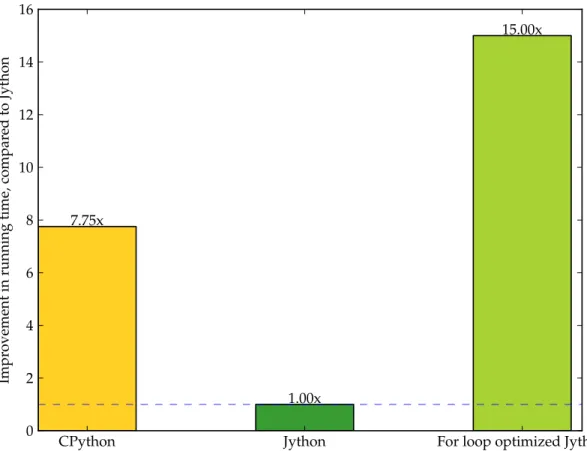
I compared the running times of the Python program inListing 3.1under 3 Python platforms: CPython (version 2.7.3); Jython (version 2.7.0a2) and the custom Jython version with this loop optimization enabled. The result is presented inFigure 3.3. The figure shows a bar graph, where the height of the bar determines how much faster the program ran when compared to Jython 2.7.0a2. We see that CPython runs the program about 7.75 times faster than Jython; and we see that our optimization has enabled this program to run 15 times faster than stock Jython. Therefore, by generating idiomatic Java code and using the knowledge of the return types of key builtin functions, we have enabled the JVM to optimize the loop and improve the performance by a factor of 15x in simple cases.
3.1.2 Optimizing global name lookups
Global names in Python are resolved dynamically, at runtime and the Jython compiler cannot rely on the names of the variables at compile-time but has to always perform a lookup on the variable string at runtime. Functions and classes are often defined in the global scope of a module and in most Python code they are rarely re-bound to other objects. With this insight, we can implement an optimization which will cache the global objects such that the overhead of lookup is reduced. This cache has to be invalidated when the global object is rebound. This would make the
1 try {
2 indyDispatch();
3 int start = 0, stop, step = 1, downCountFlag = 0;
4 if(pyObjStart) 5 start = pyObjStart.asInt(); 6 if(pyObjStop) 7 stop = pyObjStop.asInt(); 8 if(pyObjStep){ 9 step = pyObjStep.asInt(); 10 if(step == 0)
11 Py.ValueError("step argument must not be zero");
12 else if(step < 0):
13 downCountFlag = 1;
14 }
15
16 PyObject iterTmp = null;
17 for(int i = start; (downCountFlag == 0) ? i < stop : i > stop; i += step){
18 iterTmp = Py.newInteger(i); 19 // Do the loop stuff here
20 }
21 } catch (IndyOptimizerException e) {
22 // fallback to Python byte code virtual machine 23 }
Listing 3.4: The de-compiled output of a fast implementation of the Python program inListing 3.1 using invokedynamic.
CPython Jython For loop optimized Jython 0 2 4 6 8 10 12 14 16 Impr ovement in running time, compar ed to Jython 7.75x 1.00x 15.00x
1 s = "hello world" 2
3 def foo():
4 print s
Listing 3.5: Example Python program to show a global call.
global accesses fast (since the lookup is avoided), while making the re-binding of global variables slower than it currently is. I use the SwitchPoint mechanism provided with invokedynamic to implement this optimization.
Consider the example presented inListing 3.5, here the stringsis defined in the global scope of a module and is used in the functionfoo. Listing 3.6shows the Java equivalent of the Java byte code produced when compiling this example with current version of Jython. At compile-time the compiler knows that the variables does not exist in the local scope of the functionfoo since the variable s does not appear as the parameters of the function nor in the body of the function. So the compiler can infer that the variable swas defined in the global scope. As seen in line 2 of the Java code, that Jython generates agetGlobal call on the frame.
Even though this seems harmless, each load of a global variable results in a frame lookup which can be costly when trying to optimize hot loops. Consider for example a simple variation on the previous example show inListing 3.7, here the variablesaandbare both global variables and are accessed 5,000,000 times in the loop in line 6. Here we can see that loading global variables from the frame would be costly.
Each getGlobal call on the frame is internally dispatched to a lookup on a PyDict ob-ject called globals in the frame object. PyDict contains a HashMap mapping PyStrings to
1 public PyObject foo$3(ThreadState ts, PyFrame f) { 2 PyObject local = f.getGlobal("s");
3 Py.Println(local); 4 return Py.None; 5 }
1 a = 1 2 b = 2 3 4 def foo(): 5 result = 0 6 for _ in xrange(5000000):
7 result += a + b # 2 global accesses
8 print(result)
9
10 foo()
Listing 3.7: Another Python program stressing the global lookup.
PyObjects where a given string such as "s" will be looked up. Going back to the first example inListing 3.5, let us look at how to improve the performance. The goal here is to cache the value of the PyObjectbound to the string "s" in line 2. The cache has to be invalidated if the global variable "s" changed. SwitchPoint and invokedynamic provide the right tools to for this op-timization. We can make the getGlobal call an invokedynamic(in line 2 in Listing 3.6) call which first performs a lookup to get the global object and caches it at the call-site. The object is actually cached in the MethodHandleassociated with the call-site and the method handle has a switch point guard around it. The global switch point is turned off whenever a global variable is updated. This ensures that allgetGlobal call-sites would re-load the value of the cached object maintaining Python semantics.
To implement this optimization, we first need to move the globals out of the frame and asso-ciate it with the module instead. Associating the globalsPyDictwould mean all thesetGlobal andgetGlobaloperations would happen on this dictionary and it would make sure that we inval-idate the switch points consistently. Each module in Python is implemented as a class extending PyFunctionTable in Jython. I created a new field of in the base class PyFunctionTable to hold a reference to the globals and all the getGlobal and setGlobal are now redirected from operations on the frame to operations on this new field. Listing 3.8shows the optimized code with invokedynamiccall dispatch for getGlobal. The only difference in the generated byte code is in line 2 where thegetGloballookup on the frame is replaced by an invokedynamicbytecode,
1 public PyObject foo$3(ThreadState ts, PyFrame f) {
2 PyObject local = invokedynamic<getGlobalBSM>(this, "s"); 3 Py.Println(local);
4 return Py.None; 5 }
Listing 3.8: Java equivalent of the invokedynamic optimized getGlobal call for the Python example inListing 3.5.
bound to thegetGlobalBSM bootstrap method. The invokedynamiccall is given the current object (this) and the string of the variable ("s") as arguments.
The bootstrap method is shown in Listing 3.9, and this method create a new CallSite bound to the method handle point to the methodinitGetGlobalin theInvokeDynamicSupport
class. The methodinitGetGlobalis shown inListing 3.10. In this method, in line 3, we first get the value associated with the string from thePyFunctionTablewhich is module object. In lines 4-6 we create a new constant method handle. A constant method handle is a method handles which always returns the value it is bound to, irrespective of the inputs. We wrap the constant method handle with dropArguments to make sure the type of thetarget method handle matches the type of the call-site. In lines 7-9 we wrap the method handle with a switch point, and in line 10 we add this switch point to the HashMap global_sps against the name of the global variable (index). Then in line 11, the call site is updated with this new constant method handle. Lines 12-16 implement a re-linking logic, which triggers the re-caching mechanism.
With this logic implemented, we can look back at the stress-test example inListing 3.7. Each of the global variable reads of variables a and b in line 7 will be a invokedynamic instruction which would cache the value of the global variable in a constant method handle. Since the global variables are not modified, the switch point would never be invalidated; thus making global lookups considerably faster.
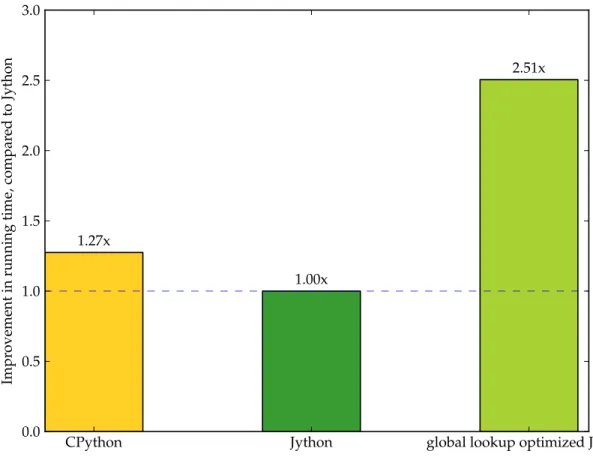
The Figure 3.4 shows a bar graph of the performance improvement of running the program in Listing 3.7 on Jython versus running the same program on CPython and the custom build of Jython with the global lookup mechanism via method handles enabled. We see that caching the
1 public static CallSite getGlobalBootstrap(Lookup lookup, String name,
2 MethodType type) {
3 GetGlobalCallSite site = new GetGlobalCallSite(type); 4 MethodHandle init = lookup.findStatic(
5 InvokeDynamicSupport.class, "initGetGlobal",
6 methodType(PyObject.class, GetGlobalCallSite.class, 7 PyFunctionTable.class, String.class)); 8 init = insertArguments(init, 0, site);
9 site.setTarget(init); 10 return site;
11 }
Listing 3.9: The init method called by the bootstrap method on the first call (or a switch point invalidate) of the getGlobal invokedynamic call.
1 public static PyObject initGetGlobal(GetGlobalCallSite site, 2 PyFunctionTable self, String index) throws Throwable { 3 PyObject value = self.getglobal(index);
4 MethodHandle target = dropArguments(
5 constant(PyObject.class, value), 0, GetGlobalCallSite.class, 6 PyFunctionTable.class, String.class);
7 SwitchPoint sp = new SwitchPoint();
8 target = sp.guardWithTest(target, MH_GET_GLOBAL); 9 target = insertArguments(target, 0, site);
10 self.global_sps.put(index, sp); 11 site.setTarget(target); 12 if(site.changedCount == GetGlobalCallSite.MAX_CHANGE_COUNT) { 13 self.global_sps.remove(index); 14 site.setTarget(MH_GET_GLOBAL_FALLBACK); 15 } 16 return value; 17 }
Listing 3.10: The init method called by the bootstrap method on the first call (or a switch point invalidate) of the getGlobal invokedynamic call.
global value in a method handle increases the performance by a factor of 2.5x. We can also see that this performance is about 2 times better than CPython.
3.2 Changing the dispatch mechanism
Chapter 2 explains the invokedynamic instruction. This section will mainly deal with using the instruction to change the dispatch mechanism of Jython. Subsection 3.2.1 shows how the call dispatch mechanism work before invokedynamic andSubsection 3.2.2 presents the current implementation using invokedynamic.
3.2.1 Current dispatch mechanism in Jython
In this section I describe how how function dispatch currently works in Jython, with an example. Consider the example Python code presented inListing 3.11. The functionfoocalls the functionbar with an argument 10.
Jython compiles this Python program into Java byte code and Listing 3.12 shows the Java equivalent of the generated Java byte code. lines 3-5 show the equivalent of the functionbar. All Jython generated Java methods have the same signature, which is: PyObjectas the return type and ThreadState, PyFrame as arguments. TheThreadState stores the state of the current thread and a reference to previous frames and the PyFrameobject stores references to parameters and local variables among other things.
Having a uniform signature for all generated methods makes the compiler design a little bit easier, all the arguments passed into a function is stored in the frame; but, this also means that the generated code cannot be optimized nearly as well if we had used the internal stack of the JVM for passing arguments.
InListing 3.11, at line 5, there is a call to the function bar; but in general when the compiler encounters a call, it does not know the function, method or class being called. Therefore the compiler must first get the object bound to the name and then call it. Lines 8-9 of Listing 3.12 show this exact procedure, where, in order to respect Python semantics, first the object bound to
CPython Jython global lookup optimized Jython 0.0 0.5 1.0 1.5 2.0 2.5 3.0 Impr ovement in running time, compar ed to Jython 1.27x 1.00x 2.51x
Figure 3.4: Comparing the relative performance thegetGlobal stress test fromListing 3.7.
1 def bar(n):
2 pass
3
4 def foo(): 5 bar(10)
1 PyInteger _10 = new PyInteger(10); 2
3 public PyObject bar$2(ThreadState ts, PyFrame f) { 4 return Py.None;
5 } 6
7 public PyObject foo$3(ThreadState ts, PyFrame f) { 8 PyObject local = f.getName("bar");
9 local.__call__(ts, _10); 10 return Py.None;
11 } 12
13 public PyObject call_function(int func_id, PyFrame f, ThreadState ts) { 14 switch(func_id) {
15 case 2: return bar$2(ts, f); 16 case 3: return foo$3(ts, f);
17 ...
18 }
19 }
1 public class PyFunction extends PyObject { 2
3 public PyCode func_code; 4
5 @Override
6 public PyObject __call__(ThreadState ts, PyObject arg0) { 7 return func_code.call(ts, arg0, ...);
8 }
9 10 }
Listing 3.13: Showing the relevant portions of PyFunction.
the name "bar" is loaded (line 8) and then the __call__ method is called on this object with the current ThreadState object (ts) and the argument _10 (line 9). The dispatch mechanism then depends on the type of object loaded.
In this case the object bound to the name"bar"is aPyFunction,Listing 3.13shows the rel-evant parts ofPyFunction. All run-time objects in Jython extend PyObjectand PyFunction is no different. The__call__method call on line 9 inListing 3.12calls into line 6 ofListing 3.13. Each PyFunction object is associated with onePyCode object which is the actual implementa-tion of the funcimplementa-tion definiimplementa-tion. This extra level of indirecimplementa-tion is added to support mutable funcimplementa-tion objects.
Line 7 calls thecallmethod on thefunc_codeobject with the arguments and a few other parameters (omitted here since they are not important to this discussion). This call re-directs to PyBaseCodewhich creates a newPyFrameobject using the passed arguments and then redirects to line 7 in Listing 3.14. At this point the arguments passed in at the call-site have been put on the newly created PyFrame object. PyTableCode extends PyBaseCode which in-turn extends PyCodeand contains a referencefuncsto the object in which the methodbar$2is defined in. It also has thefunc_id(2 for functionbar) of the method. This method calls thecall_function method on thefuncsobject which then takes us back toListing 3.12line 13. Thecall_function defines a switch-case on func_id and calls the methods with their corresponding ids and since the functionbar hasid2, we call bar$2in line 15.
1 public class PyTableCode extends PyBaseCode { 2 3 PyFunctionTable funcs; 4 int func_id; 5 6 @Override
7 public PyObject call(ThreadState ts, PyFrame frame, PyObject 8 closure) {
9 PyObject ret;
10 ...
11 ret = funcs.call_function(func_id, frame, ts);
12 ...
13 return ret;
14 }
15 }
So, we see that for even a simple method call, there is a lot of back-and-forth between the generated Java byte code and the Jython runtime. In the next sub-section we will device a way of avoiding this by using invokedynamic.
3.2.2 Dispatch mechanism in Jython with invokedynamic
In this sub-section we will see how to useinvokedynamicmachinery to dispatch to functions so that the JVM can readily optimize these calls. We would like to perform two optimizations, first we want useinvokedynamiccalls to dispatch function calls instead of the__call__mechanism seen earlier. Next, we want to make use of parameter passing in the JVM instead of using frames so that accessing parameters in a function is easier.
3.2.2.1 Dispatching to a method using invokedynamic
Since the function resolution happens at runtime in Python, we do not know which function will be called at compile time or even at link time. Since the bootstrap method of ainvokedynamic call is called at link-time, at this time we still do not have all the information we need to dispatch the call. So at bootstrap time we bind the call-site to a generic dispatch method. We make sure to pass the CallSiteobject to this generic dispatch method which will be called at runtime on the first call to the invokedynamicbytecode. At this point we can find out the target method of a given function call and re-bind the call site appropriately. This would ensure that future calls to the same function at that call-site would be directly dispatched to the actual target method.
In order for this optimization to work, every runtime function should be associated with a method handled. The runtime function object in Jython is PyFunction, but the actual code object is stored in the func_codeattribute of PyFunction which is of type PyCode. So a new field is added to PyCode called mHandle which stores the method handle associated with that code object, and this function can then be called via this method handle.
Listing 3.15 shows the de-compiled Java byte code generated by Jython for the example in Listing 3.11 using the invokedynamic machinery. We see that line 9 is now replaced by an
1 PyInteger _10 = new PyInteger(10); 2
3 public PyObject bar$2(ThreadState ts, PyFrame f) { 4 return Py.None;
5 } 6
7 public PyObject foo$3(ThreadState ts, PyFrame f) { 8 PyObject local = f.getName("bar");
9 invokedynamic<bootstrap>(ts, local, _10); 10 return Py.None;
11 }
Listing 3.15: Dispatch usinginvokedynamicfor code shown in Listing 3.11.
invokedynamiccall instead of the previous __call__method call. We have already seen that at compile time we do not know what method we are dispatching to, therefore we must wait till runtime to make the decision of where to dispatch a call. The invokedynamic byte code is provided with the thread state, the localvariable corresponding to the function object and _10 as arguments. We also see that this invokedynamic byte code is bound to bootstrap as the bootstrap method.
Listing 3.16 shows the bootstrap method, that the invokedynamiccall is bound to. This method this returns a generic JythonCallSite object (a sub-class of CallSite) which binds the call-site to a the installCS method. After calling the bootstrap method on the first call of invokedynamic, the JVM proceeds to call the installCS method. This method is shown in Listing 3.17.
The installCS is given the call site object from before and the rest of the arguments passed in from the actual invokedynamiccall-site is received in the args Object array. Since we are dealing with specializing function dispatch, we check to see if the 1st argument is actually
1 public CallSite BSM(Lookup lookup, String name, MethodType type) { 2 return new JythonCallSite(lookup, name, type);
3 }
1 public static Object installCS(JythonCallsite callSite,
2 Object[] args) throws Throwable {
3 if (args[1] instanceof PyFunction) {
4 PyFunction pyFunc = (PyFunction) args[1]; 5 int noOfArgs = args.length - 2;
6 if (pyFunc.func_code.mHandle != null) {
7 if (pyFunc.func_code instanceof PyBaseCode) {
8 PyBaseCode fcode = (PyBaseCode) pyFunc.func_code; 9 if (!fcode.varkwargs && fcode.varargs &&
10 noOfArgs == fcode.co_argcount) {
11 MethodHandle target = getCachedMH(callSite,pyFunc); 12 target = target.bindTo(callSite); 13 target = target.asType(callSite.type()); 14 callSite.setTarget(target); 15 return target.invokeWithArguments(args); 16 } 17 } 18 } 19 }
20 return fallback(callSite, args); 21 }
1 public static Object fallback(JythonCallsite callSite, Object[] args) { 2 MethodType fallbackType = callSite.type().dropParameterTypes(1, 2); 3 MethodHandle fb = callSite.lookup.findVirtual(
4 PyObject.class, "__call__", fallbackType); 5 MethodType desiredType = fb.type().
6 changeParameterType(0, ThreadState.class). 7 changeParameterType(1, PyObject.class);
8 MethodHandle fbWithPermute = MethodHandles.permuteArguments( 9 fb, desiredType,
10 getPermuteArray(desiredType.parameterCount())); 11 callSite.setTarget(fbWithPermute);
12 return fbWithPermute.invokeWithArguments(args); 13 }
Listing 3.18: Fallback code for function dispatch.
a PyFunction (numbering starts from 0 and the 0th element is the thread state object) in line
3 of Listing 3.17. Then in line 6 we make sure that a method handle exists in the code object of the current PyFunction, and in lines 10-11 we make sure that the current call does not contain star arguments and double star arguments, and that the number of arguments passed in matches the expected number of arguments. In line 11, we fetch the method handle target (the caching mechanism is explained a bit later) associated with the current function object and in lines 12-14 re-bind the call site to point to the target method handle. In line 15 we invoke the target method handle with the appropriate arguments. Subsequent invokedynamic calls at this call-site will be directly dispatched to the method pointed by the method handletarget, removing a lot of overhead.
If any of the conditions in checks from lines 3-10 fail inListing 3.17, thefallbackmethod is invoked. This method looks up the__call__method inPyObjectand then calls it, mimicking the behavior of the previous approach. Listing 3.18 shows the outline for this method, in lines 3-5 we lookup the __call__ method of the appropriate type in PyObject. The arguments are ordered so that thread state object is the 0thparameter and the function object is the 1st parameter, but we wish to dispatch this method handle with the function object in the receiver position (in the 0th position). Lines 5-10 accomplish exactly this goal by permuting the arguments on the method
1 public static MethodHandle setupMHForCall(MethodHandle target) { 2 MethodType targetType = target.type();
3 MethodHandle before = MH_CALL_BEFORE.asCollector(PyObject[].class, 4 targetType.parameterCount() - LEADING_NON_ARGS);
5 MethodHandle targetWithBefore = foldArguments(target, before); 6 MethodHandle targetWithBandA = setupAfter(
7 targetWithBefore, MH_CALL_AFTER);
8 MethodHandle gwt = setupGuardWithTest(targetWithBandA, 9 target.type().parameterCount() - LEADING_NON_ARGS); 10 return gwt;
11 }
Listing 3.19: Code for setting up the method handle for call.
handle. This new method handlefbWithPermuteis updated as the call-site’s target and in line 12 this method handle is invoked with the appropriate arguments.
The method handle stored on a the code object points to the Java method which contains the implementation of the code. When the method handle is created, the setupMHForCall method is called to install these wrappers around the target method handle. The Listing 3.19 shows the outline of this method. In lines 3-4 the target method handle is wrapped to first call the before method handle using the foldArguments method. The before method handle points to a method that first creates a new frame object (of type PyFrame) and adds all the arguments to the frame. Line 6 creates a wrapper around the targetWithBefore method handle setting up a method handle to call a method to call after the previous method handle has been executed. This after method is responsible for updating the frame in case an exception was raised in the previous method. Finally, in line 8, thesetupMHForCallcreates a wrapper around the previous targetWithBandA guarding the call with a test method. The test method checks to see if the PyFunctionobject that was bound at the particular call site has changed. If it has changed, the fallback method is called which will re-bind the call site to the correct target. If the test returns true, then the target bound call site is invoked.
3.2.2.2 Changing the calling convention
Now, we will look at changing the calling convention so that instead of passing the arguments via the frame object, the arguments are also passed using the JVM operand stack. Jython main-tained a uniform calling convention since the previous dispatch mechanism required it. Since we are now using method handles, which are typed and more powerful, it would be straight-forward to implement this change.
The Listing 3.21 shows the Java equivalent of the byte code generated by Jython after im-plementing this change. We see that the functionbar$2 now accepts a new parameter n of type PyObject. The code compiler is updated to generate Java methods with the first three arguments always beingThreadState,PyFrameandPyObject. The third argument is the function object itself. The return type remains same atPyObject. After the 3 standard parameters, the number of parameters equal to the argument count of the function (in Python) is added to the generated method. In our example the function bar had 1 argument (n), which is added to the method signature as seen in line 4 inListing 3.21.
Recall that from Listing 3.14, previouslyPyTableCodewas used to dispatch a given call to thecall_functionmethod, which invoked the appropriate method. We cannot use this approach directly anymore, since the expected function would have a different signature. Instead we make use of method handles to invoke the target directly instead of delegating to thecall_function method. To do this, I created a new code object called PyMethodCode, the relevant parts of this class are shown inListing 3.20.
The method handle mHandle is created along with the code object creation. The switch case in lines 8-18 dispatch to the target method handle depending on the number of arguments passed in. The third argument is always set to null, since the function object is not needed for this dispatch to work. Line 14 shows an example where if the number of arguments was one, as in the case in our example (Listing 3.11), the target is invoked using the method handle passing the appropriate parameters. The rest of the function dispatch stack remains largely unchanged.
1 public class PyMethodCode extends PyBaseCode { 2
3 @Override
4 public PyObject call(ThreadState ts, PyFrame frame, PyObject 5 closure, PyObject[] args) {
6 PyObject ret;
7 ...
8 switch(args.length) {
9 case 0:
10 ret = (PyObject) mHandle.invokeExact(frame, ts,
11 (PyObject) null);
12 break;
13 case 1:
14 ret = (PyObject) mHandle.invokeExact(frame, ts,
15 (PyObject) null, args[0]);
16 break; 17 ... 18 } 19 ... 20 return ret; 21 } 22 }
1 PyInteger _10 = new PyInteger(10); 2
3 public PyObject bar$2(ThreadState ts, PyFrame f, PyObject func,
4 PyObject n) {
5 return Py.None; 6 }
7
8 public PyObject foo$3(ThreadState ts, PyFrame f, PyObject func) { 9 PyObject local = f.getName("bar");
10 invokedynamic<bootstrap>(ts, local, _10); 11 return Py.None;
12 }
Listing 3.21: Using the new dispatch mechanism coupled with the calling convention change for the example inListing 3.11.
The bootstrap method the call to a generic install call site, which then binds the correct target loaded from the code object. The fallback method is also unchanged, but the fallback will invoke the__call__on PyMethodCodeinstead of the previous PyTableCode.
3.2.3 Performance evaluation
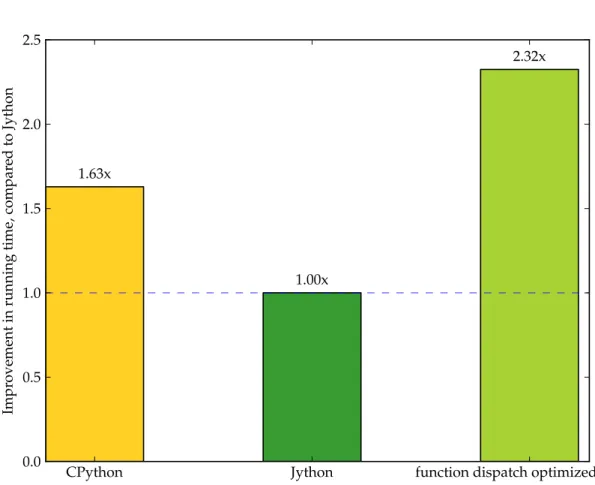
To evaluate the performance gains by this approach, we will use the classical fibonacci cal-culated as implemented inListing 3.22. Figure 3.5shows a bar chart where the performance of the fibonacci function from Listing 3.22 is compared by measuring the running time on three Python platforms: Python, Jython and a custom build of Jython with the dispatch mechanism imple-mented. The running time of Jython is used as the baseline, and we see that both stock Jython and CPython have similar running times. The new dispatch mechanism which usesinvokedynamic enables the JIT in the JVM to better optimize the code at runtime giving a 2.32x performance improvement.
3.3 Reducing frame overhead
Even though we see that in the previous performance experiment, the fibonacci function used invokedynamic to dispatch to the target call, the method handle was wrapped to call another
1 def fibonacci(n): 2 if n < 2:
3 return n
4 return fibonacci(n - 1) + fibonacci(n - 2)
Listing 3.22: An implementation of calculating thenth number in the fibonacci series.
CPython Jython function dispatch optimized Jython
0.0 0.5 1.0 1.5 2.0 2.5 Impr ovement in running time, compar ed to Jython 1.63x 1.00x 2.32x
1 >>> import sys 2 >>> def print_locals(a, b): 3 ... pi = 3.14 4 ... print(sys._getframe().f_locals) 5 ... 6 >>> print_locals(4, 6) 7 {’a’: 4, ’pi’: 3.14, ’b’: 6}
Listing 3.23: Accessing the local variables from the frame.
method created a frame and added all the arguments into the frame. The Python frame is essential for debugging purposes and allows for easy introspection of Python execution. A Python program can easily get to the current Python frame, as shown in Listing 3.23.
Creating a new Python frame object before each call hampers performance on the JVM. We have seen that, since we have changed the calling convention, we can use JVM’s operand stack to pass arguments to functions instead of passing them via the Python frame. The globals are also moved out of the frame, therefore reducing its dependence on the frame. We can further reduce our dependency on the frame by using JVM’s locals array to store local variables, instead of doing the same on a Python frame object. Although this is possible, we would still have to support Python introspection abilities such as the program inListing 3.23 as we cannot break Python semantics.
To get around this issue, we have introduced a new function decorator @frameless to indicate that frames are not required for that particular function. This way the programmer is explicitly telling the compiler to not create frames since they know that, in the current scope, the frame need not be exposed to Python code.
To be able to mark a given function as frameless, the following are required: • The function cannot rely on using the frame for introspection.
• The function cannot have inner (nested) functions, since the nested function would require us to construct a frame for accessing variables in the bounded scope.
If a Python function is annotated with @frameless, and if the scope analysis determines the function is a closure, it cannot be frameless, regardless of the decorator; a compilation error
is raised in such a situation. The programmer should either remove the annotation or move the nested function.
We have already seen how we move global variables and parameters out of the frame. Now, we look into the details of the implementation of the not relying on Python frames local variables, by using JVM’s locals array instead. We have All AST nodes are updated to now have a new boolean fieldframeless. Once a function is annotated with@frameless, the AST node for the corresponding function definition is updated settingframeless totrue.
The scope analysis is updated to ensure that a frameless function definition node, does not contain another function (or class) definition in it’s body. If it finds a nested definition, a compilation error is raised. The OptimizedCodeCompiler is updated to not use frames for loading and storing variables if the current scope is marked frameless. Variables are accessed via theName AST node. If the current scope is frameless, and the variable is local, then the variable is either loaded form or stored in the JVM’s array.
A new boolean field frameless is also created in the class PyMethodCode, the runtime code object. This boolean object is set to true if the function corresponding to code object is marked frameless. During the call to a function, if thePyMethodCodeobject is marked frameless, then the method handle wrapper is updated to bind anullobject to the frame, instead of call the additional method which constructs the frame. This removes the overhead of an additional method call when dispatching to a frameless function.
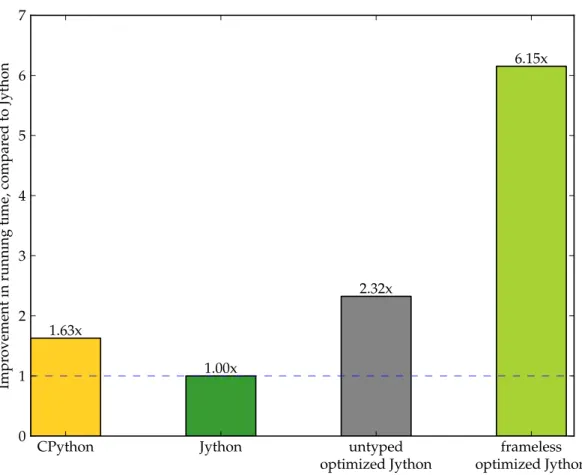
Consider the fibonacci function annotated with the @framelessdecorator on the function inListing 3.24. In this case, there is only one parameter,n, and because of the frameless annotation, Jython does not use the Python frame object to load this parameter, instead uses the JVM operand stack, by which the argument was passed. Like the previous case, I performed a performance evaluation, comparing the running times for the fibonacci function in CPython, stock Jython and the frameless-supported Jython. In the first two cases I used the original function fromListing 3.22 where as in the third case, I used the function in Listing 3.24. Figure 3.6 charts the performance across the three implementations. We see that using frameless (and the previousinvokedynamic