Student Learning Preferences and SMS Text Messaging: A Web 2.0 Large
Classroom Engagement System
1
C. Matt Graham,
2Scott Anchors,
3Brian E. Doore
1,2
Maine Business School, University of Maine Orono, ME. 04469, USA
3
College of Education and Human Development University of Maine
Orono, ME. 04469, USA
ABSTRACT
This paper investigated the analysis of student learning preferences and the use of SMS text messaging system in the classroom to engage students in the subject matter being taught. Myers-Briggs Personality type indicator was used as a measure of learning preferences. This study specifically examined whether or not the learning preferences of students influenced their decision to use the SMS text messaging system. The results of the study found that students’ learning preferences were not related to the student’s general engagement to use the SMS text messaging system.
Keywords: student learning preferences, personality types, SMS text messaging, texting, Web 2.0, student engagement, computer-mediated communication, classroom technology
1.
INTRODUCTION
Increasingly, both faculty and students bring technology into the classroom. This study explored use of texting to level the playing field for students with different learning preferences. Texting may be one way to encourage the participation of students who are not inclined to speak out in a classroom environment. Text messaging, a ubiquitous element of our society, holds potential as an enhancement to teaching pedagogy. This study examines the relationship between learning preferences and the use of text messaging to encourage dialogue between student and instructor. The results of this study have implications for instructors and students alike.
2.
PROBLEM STATEMENT
Encouraging students to engage in classroom discussions, ask for clarification, or pose questions can be challenging for faculty in all types of classes; however, the dynamics of large classes often work to discourage meaningful communication during the traditional lecture (Friedman, Rodriguez, & McComb, 2001; Markett, Sánchez, Weber, & Tangney, 2006). Students in large lecture classes may be less inclined to participate in class discussions for fear of asking a “dumb” question. Additionally, students may be disinterested in the subject matter or may feel that the lecture format results in one-way communication in which students are not expected to participate. Adding to the challenges associated with large classes is the task of accommodating multiple student learning preferences (Lawrence, 1993;
Henson, 2003). While synchronous networked
communication is rapidly becoming more accessible through the development of Web 2.0 technologies and services such
as social media, blogs, smartphones, and other personal devices, these opportunities are thus far underutilized in the higher education classroom.
Specifically, this study examined: 1) Student decisions to use a blog page that received short-message-service (SMS) text messages during classroom lectures; and, 2) The influence of students’ learning preferences on the level and nature of their participation in texting (Graham & Miaoulis, 2010). Simply, our research question asks; does SMS text messaging contribute positively to enhanced communication, and do differences exist for students with specific learning preferences?
3.
REVIEW OF THE LITERATURE
Learning Preferences
There is a substantial body of literature on learning preferences of learning (e.g. Myers, 1998; Paivio, 1971; Kolb, 1976; Messick, 1976; Provost and Anchors, 2003 and Lawrence, 2009) that has informed both practitioners and academics. The learning preferences constructs applied in this study are based on the theory of Carl Jung. Jung posited a Theory of Psychological Types (Jung, 1923). His original theory was later operationalized by Isabelle Myers and Katherine Myers who created the Myers Briggs Type Indicator (MBTI®; Myers, McCaulley, Quenk and Hammer, 1998). The MBTI® categorizes patterns of self-reported behaviors into a series of learning preferences. Jung hypothesized that humans have underlying, innate personality preferences that endure throughout life, and are shaped by life experiences and the environment (Jung, 1923). Although
individual preferences may be influenced by environmental factors, "the essence of the theory is that much seemingly random variation in behaviors is actually quite orderly and consistent" (Myers, McCaulley, Quenk, & Hammer, 1999, p. 3). The MBTI® dichotomizes four distinct personality traits:
Extraversion-Introversion. This trait is defined by Myers et al. (1998) as how an individual is energized either from interactions with people and objects in the outer world (extroversion) or by reflecting on people and objects in his or her own mind (introversion).
Sensing-iNtuiting. This trait is defined by Myers et al. (1998) as representing two ways in which individuals perceive information. Specifically, individuals favoring the Sensing function use the reality of touch, sight, taste, smell, and hearing to gather information while individuals preferring the iNtuition function unconsciously identify relationships and possibilities when gathering information.
Thinking-Feeling. Myers et al. (1998) define "judging or deciding functions" as how a person judges a situation or makes a decision. Individuals preferring the thinking function employ rational use of logic and objective truth when making a decision. Individuals preferring the feeling function typically employ a rational use of empathy and subjective values when making a decision.
Judging-Perceiving. Myers et al. define their final dimension as an individual’s orientation toward the outer world is that is evidenced by either structure and organization with a focus on closure and decision-making (judging) or flexibility and organization with a focus on continual search for additional information (perceiving).
Buch and Bartley (2002) college students may have specific learning preferences that are associated with each MBTI dimension. .Thus, each of the MBTI dimentions may suggest a set of instructional conditions in which students are able to maximize their learning. Others have taken Jung’s theory of learning preferences further and specifically suggest that each of the 4 personality dimensions dictate strategies that will help student learn (Bargar, Bargar, & Cano, 1994). For example, a student with an introverted profile on the MBTI® may learn more through independent work, whereas a student with an extraverted orientation may benefit more from group projects and in-class engagement. Bargar et al., along with Buch and Bartley suggest that students may have difficulty learning in an environment that is not consistent with their learning preferences.
The purpose of this study is to determine if there is a relationship between the MBTI® personality dimensions presented above and the use of “texting” technology to enhance classroom engagement and learning. Extending Jung’s theory (1923) and Lawrence’s later (1993) work on personality types and learning preferences researchers might expect a relationship between students MBTI type and their level of education benefit from texting. For example,
students who prefer an introverted learning preference might benefit more from texting as a means of communicating in a large lecture class because permits more reflection than may be possible in traditional oral communication. In contrast, students who prefer an extraverted learning preference may enjoy greater levels of engagement through direct verbal communication with the instructor.
4.
COMPUTER-
MEDIATED
COMMUNICATION
According to Di Blasio and Milani (2008) computer-mediated communication (CMC) involves using a computer as a communication device. The term computer now represents a broad range of devices such as smart phones, laptops, and netbooks. Di Blasio and Milani also suggested CMC may facilitate many-to-many communication. That is, many people can communicate with many other people over the same CMC channel.
Baym (2006) stated that CMC technologies evolve so quickly that its form and use changes almost continuously. Both hardware and software have evolved at an accelerated rate, with advances in hardware permitting ever more complex software solutions. For example recent advances in laptops, cell phones, smart phones, netbooks, tablets, and other mobile devices have made possible improvements to CMC software solutions such as instant messaging, short-messaging-services (SMS) texting, social network services such as Facebook, and myriad other communication portals. While much research has been done in the area of CMC, little research to date has specifically addressed student learning preferences and their decision to use web 2.0 technologies such as texting as a CMC learning tool.
5.
WEB
2.0
AND
CLASSROOM
ENGAGEMENT
The term Web 2.0 has been used to describe several social and technological trends (Shamel, 2008). The first perspective takes a decided capitalistic flavor and describes these technologies as a vehicle for business to expand their reach into mobile devices as a new platform for sales and marketing. A second perspective on Web 2.0 technologies is that they facilitate a knowledge-oriented environment where individuals interact to create content and ideas that are stored, categorized, and transmitted by a flexible network architecture. A third definition of Web 2.0 was offered by O’Reilly (2007) who stated that Web 2.0 is “the Web as a platform.” O’Reilly further suggested it differed from traditional technologies because it has no hard boundaries but instead a “gravitational core”.
Graham and Miaoulis, Jr. (2010) helped to clarify that the importance of these technologies lies not with their technical configuration, but rather with their capabilities to bring individuals together that were previously separated by time and space: “Web 2.0 is the Internet’s next generation of
Web technologies, which has radically transformed how internet content is developed, accessed, and used by individuals and groups today.”
Web 2.0 technologies are making the Internet both more interactive and more accessible. Directly supporting this growing interactivity are What-You-See-Is-What-You-Get
(WYSIWYG) technologies. WYSIWYG technologies make web content development easier for people who are not web designers and information technology professionals. As a result, many teachers and instructors are now able to utilize various Web 2.0 technologies to increase student engagement
and interactivity in the classroom. For example,
Cheung (2008) used SMS text messaging as a medium for students in large classes to participate in experiments. Wains and Mahmood (2008) discussed the use of SMS text
messaging to administer quizzes to students, and
Reimers and Stewart (2009), used SMS text messaging in a classroom for teaching and data collection. In the present study,, a blog page and SMS text receiver were combined to create an additional interface for students to send questions, make comments, and sometimes, answer other student’s questions.
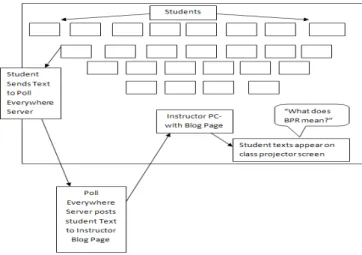
In this study, several Web 2.0 technologies were used. These included a Google Blogspot blog page, SlideShare, a free open-source technology that converts presentations into a HTML format, and Poll Everywhere, an open-source technology that allows a SMS text receiver to be embedded into blog pages so that text messages sent from students appear automatically in the blog. Combined, these technologies allowed students to ask questions and make comments anonymouslyby sending a SMS text message from their cell phones.
6.
SOFTWARE BEING EVALUATED: SMS
TEXTING WEBSITE
Graham and Miaoulis, Jr. (2010) stated that there are several social networking sites such as FaceBook, MySpace, and Twitter that have made creating a personalized social networking site easy for even the most technologically challenged person. Additionally several open-source technologies have emerged that embed easily into a variety of social networking development tool like Facebook, MySpace, and Google blogger. To determine whether large classes would benefit from including social networking technologies in the classroom a blog page was developed for use in this study that combines: 1) a Google blog page, 2) Slide Share, which is a free open-source technology that converts PowerPoint presentations into a HTML format that can be
embedded into blog pages, and 3) Poll Everywhere, which is another open-source technology that allows a SMS text receiver to be embedded into blog pages as well. These three social networking technologies were combined to create the “SMS texting system”. A diagram of the messaging system used in this experiment is presented below.
SMS Texting System
SMS Texting System
7.
PURPOSE OF THE STUDY
The purpose of this study is to determine if any relationship exists between students’ MBTI® Learning preferences and their use of or preference for SMS texting as a means of class participation. Students from two sophomore classes at the University of Maine’s business school were encouraged to use a SMS text message receiver embedded in an instructor designed blog page. This Blog page and SMS text receiver was projected on a white screen during the length of class discussions for a period of two weeks. At the end of the two-week period students that participated in these classes were asked then to complete a web-based 10 question survey. The survey asked respondents to rate three major elements of the blog: ease of use, comprehension and interest level, and participation. These three dimensions are defined in Table 1.
Table 1: Web 2.0 Technology Dimensions
Ease of Use The degree to which students felt the class blog page was easy to use and send messages to. Ease of Use also included students’ perceptions of how easy it was to read SMS text messages received by the blog page
Comprehension and Interest level
The degree to which students found the information stored in the blog page (including SMS text messages) increased their understanding of class material
or make the class discussions more interesting and more engaging
Participation The degree to which students felt that the class blog page that received SMS text messages accomplished its intended goal of increasing student
participation in class discussions (including individual participation) and improved class discussions
8.
PARTICIPANT RECRUITMENT
The participants in this study were students enrolled in either a sophomore introduction to management information systems class or a sophomore management class, at the University of Maine’s Maine School of Business. Participants were apprised of their rights as human subjects and were invited to participate in the study. All 175 students enrolled in these courses signed the consent form and completed the 10 item online survey.
Context for the study
The lecture halls used in this study were equipped with an LCD projector system. Wireless internet access allowed students with compatible devices to access the blog page at any time during class sessions. In addition, the blog page was projected onto a highly visible white screen located at the front of the lecture hall.
9.
PROCEDURES
Students were initially briefed about the expectations for participants in the study. During the two week period of time that the SMS system was used in class, they were asked to: a) ask questions or make comments in class or via the SMS system; b) read comments posted via the SMS system to the blog page; and, c) respond either verbally or through the SMS system about comments posted to the system. At the end of this two-week period students were asked to complete a 10 question web-based survey that measured the ease of use, comprehension and interest level, and participation of the class blog page that received SMS text messages.
10. MEASURES
The scale was comprised of 10 attribution questions that used a 5 point Likert scale where 1 = strongly agree and 5 = strongly disagree. The questions were roughly evenly divided across the three domains and addressed the respondent’s experiences with the system. The 10 items included:
Ease of Use
1. I thought that the SMS texting website was easy to use. 2. Sending a SMS text to the Webpage was easy.
3. SMS texts posted to the SMS texting website from other students was easy to read.
Comprehension and Level of Interest
4. The SMS texting website provided me with Comp. & Level of Interest information
5. The SMS texting website was interesting and engaging.
6. Using the SMS texting website improved my
understanding of course material
7. I think that I would use this SMS texting website frequently in class
Participation
8. I found that the SMS texting website motivated me to participate more in class
9. I felt that SMS texting questions sent by students improved classroom discussions
I felt that more students participated in class because of the SMS texting website.
11.
MBTI Personality Types / Learning Preferences
SMS survey data were then matched with the respondents’ MBTI personality types and then de-identified in subsequent analyses. Responses for students who completed both the personality type indicator test and the SMS text enabled blog page survey were analyzed todetermine whether any relationship exists between
respondents’ personality type and their decision to use the SMS text enabled blog page. Simply put, do students differ in their preference for, or use of, SMS text messaging
depending upon their MBTI learning preferences? Table 2
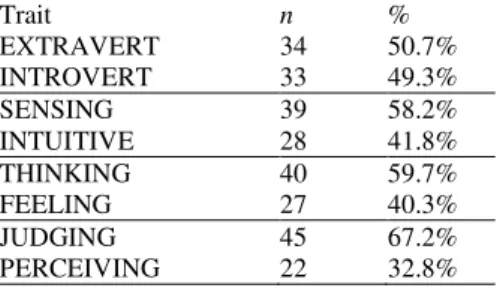
below identifies how the population broke down by MBTI personality types.
Table 2: MBTI Personality types / Learning
Preferences
Trait n % EXTRAVERT 34 50.7% INTROVERT 33 49.3% SENSING 39 58.2% INTUITIVE 28 41.8% THINKING 40 59.7% FEELING 27 40.3% JUDGING 45 67.2% PERCEIVING 22 32.8%12. RESULTS
Descriptive Statistics
Of the 175 students who participated in the study, matched data were available for 67 students, who had taken the MBTI®. A total of 29 females (43.3%) and 38 males (56.7%) responded to the survey. There was no significant difference in the proportion of male or females, introverts/extraverts, sensing/intuitive, or thinking/feeling individuals. The proportion of judging individuals was, however, significantly greater (߯2 = 7.90, p = .005).
Factor Analysis
Next, the 10 items in the student questionnaire were examined to determine whether the three hypothesized factors (Ease of Use, Comprehension and Level of Interest, Participation) were evident in student response patterns. To determine the factorability of the correlations observed between these items, we performed several widely accepted tests. All items correlated with one another at least 0.30, suggesting reasonable factorability. Next, the
Kaiser-Meyer-Olkin measure of sampling adequacy was 0.89, exceeding the minimum recommended value of 0.60. Additionally, Bartlett’s test of sphericity was significant (߯2 (45) = 464.90,
p < .05) as was the Measures of Sampling Adequacy in the anti-image correlation matrix which all exceeded .5, thus supporting the inclusion of each item into the correlation matrix. Finally, the communalities were all above 0.50, demonstrating that all items shared some common variance with other items in the questionnaire. Based on these results, a factor analysis was conducted with all 10 items.
Principal Components Analysis (PCA) was
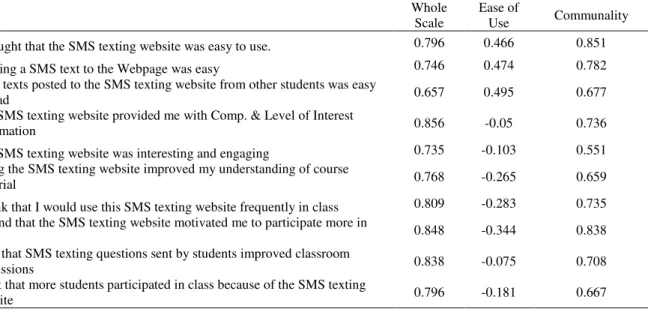
employed to examine factor loadings for each of the 10 items in the questionnaire and resulted in a two-factor solution. The initial eigen value of 6.20 indicated that 62.0% of the variance across items was explained by the first factor, while the second eigen value of 1.00 explained an additional 10.1% of the variance across items. Additional components all had eigenvalues of less than one. The PCA results were explored further using both varimax and oblimin solutions. The oblimin rotation produced the best defined factor structure and was used for all subsequent factor analyses. The resulting factor structure is shown in Table 3.
Table 3: Factor loadings and communalities based on PCA using oblimin rotation for 10 items (n =67)
WholeScale
Ease of
Use Communality I thought that the SMS texting website was easy to use. 0.796 0.466 0.851 Sending a SMS text to the Webpage was easy 0.746 0.474 0.782 SMS texts posted to the SMS texting website from other students was easy
to read 0.657 0.495 0.677
The SMS texting website provided me with Comp. & Level of Interest
information 0.856 -0.05 0.736
The SMS texting website was interesting and engaging 0.735 -0.103 0.551 Using the SMS texting website improved my understanding of course
material 0.768 -0.265 0.659
I think that I would use this SMS texting website frequently in class 0.809 -0.283 0.735 I found that the SMS texting website motivated me to participate more in
class 0.848 -0.344 0.838
I felt that SMS texting questions sent by students improved classroom
discussions 0.838 -0.075 0.708
I felt that more students participated in class because of the SMS texting
website 0.796 -0.181 0.667
Extraction Method: Principal Component Analysis. The results of the PCA suggest that of the three originally hypothesized factors, only ease of use emerged as a distinctly unique construct in participants’ responses. Given this pattern, subsequent analyses use this two-factor solution to consider differences in response patterns by personality type. Specifically, respondents’ answers to questions 1 – 3 were aggregated to represent ease of use, while their response to questions 4 – 10 were combined to represent experience with the intervention.
We measured the internal consistency for each of the sets of questions represented by the two factors. The three ease of use items yielded a Cronbach’s alpha of 0.85 and the 7 items related to a student’s experience with the intervention produced a reliability estimate of 0.92. Composite scores were then created for each factor. Specifically, the mean of items 1 – 3 was calculated to yield a composite ease of use score, while the mean of items 4 – 10 determined the experience with the intervention score.
To determine whether there were differences in the response patterns of Introverted vs. Extraverted (EI), Sensing vs. Intuitive (SN), Thinking vs. Feeling (TF), or Judging vs. Perceiving (JP) individuals, a series of independent samples test were conducted. Specifically, independent samples t-tests were conducted to compare responses of the EI, SN, TF, and JP pairs for the two factors found in this scale (ease of use, experience with the intervention).
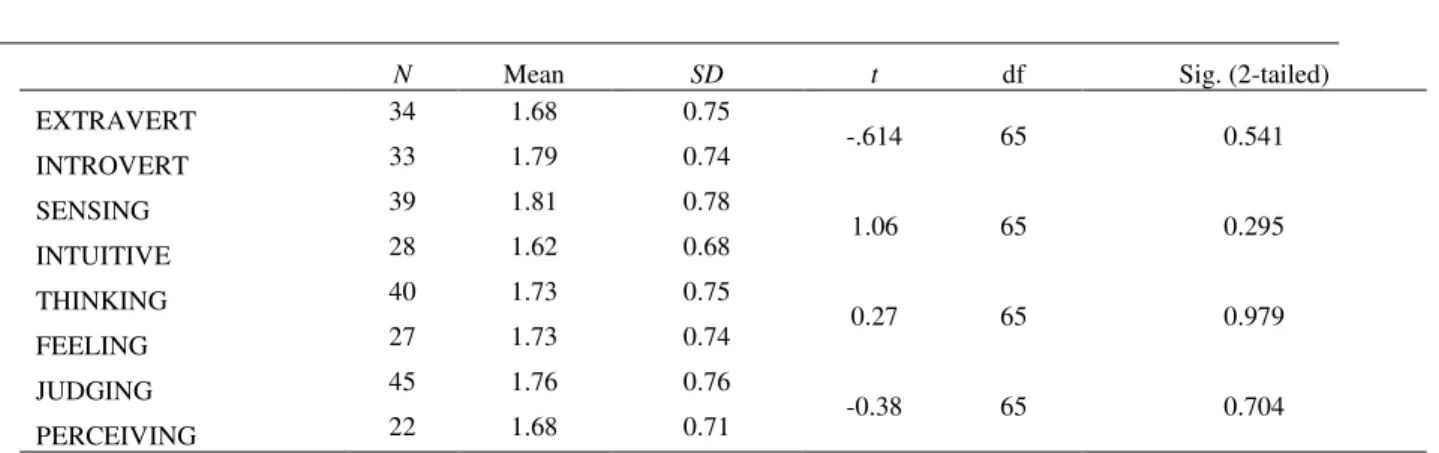
Results indicated no significant differences in mean ratings for either factor as related to any of the four personality dimensions measured by the MBTI®). Table 4 displays the mean ratings for each of the four personality dimensions for ease of use, while Table 5reflects the same comparisons for the seven experiences with the intervention questions.
Table 4: Mean Ease of Use Ratings by Personality Type
Table 5: Mean Engagement Ratings by Personality Type
N Mean SD t df Sig. (2-tailed)
EXTRAVERT 34 2.27 0.78 -1.16 65 0.268 INTROVERT 33 2.50 0.91 SENSING 39 2.38 0.81 -0.94 65 0.925 INTUITIVE 28 2.40 0.90 THINKING 40 2.49 0.94 1.23 65 0.223 FEELING 27 2.23 0.66 JUDGING 45 2.31 0.77 -0.989 65 0.326 PERCEIVING 22 2.53 0.98
13. DISCUSSION
These findings indicate that no significant differences exist between the four MBTI®) learning preferences and students’ use of texting to communicate with the instructor in class. This is surprising in light of Carl Jung’s theory of Psychological Type (1923), since students with an introverted learning preference might be expected to prefer texting classroom communication to their professor. According to Pearman, Lombardo and Eichieger (2005), students with introverted personality types often provide delayed responses to interactions, are succinct when communicating, and are more reflective. This argument was reinforced by Jensen (YEAR, page 127) who described introverts if asked a question, they would think about an
answer, reflect on it, rehearse it, and only then share it. Additionally, Pearman, et. al stated that students with a perceiving learning preference might be expected to prefer texting since they often approach learning with spontaneity and openness to new ways of doing things. Thus, our findings are in direct contrast to the accepted theory that introverted students would have a stronger orientation towards the use of texting as a method of communication. Our results suggest personality type – at least as measured by the MBTI – should not create an inequitable learning environment in large lecture classes. The use of SMS text receivers may in fact promote increased levels of engagement and communication for students who otherwise might rarely participate in class interaction. Perhaps texting is a cultural phenomenon that appeals to a wide range of college age students.
N Mean SD t df Sig. (2-tailed)
EXTRAVERT 34 1.68 0.75 -.614 65 0.541 INTROVERT 33 1.79 0.74 SENSING 39 1.81 0.78 1.06 65 0.295 INTUITIVE 28 1.62 0.68 THINKING 40 1.73 0.75 0.27 65 0.979 FEELING 27 1.73 0.74 JUDGING 45 1.76 0.76 -0.38 65 0.704 PERCEIVING 22 1.68 0.71
14. LIMITATIONS
AND
FUTURE
RESEARCH
One limitation was the size and demographic characteristics of our sample. Future research should include larger and more diverse samples to ensure a greater degree of generalizability. Specifically, future research should attempt to determine whether differences exist by gender or ethnicity. Another limitation of the present study was alignment between the hypothesized and observed constructs for the 10 item perception measure. The results of the PCA suggested that of the three originally hypothesized factors, only ease of use emerged as a distinctly unique construct in participants’ responses.
Future research should expand on the findings in this study. Specifically, future studies should further examine the relationship between MBTI® type and personal preferences for computer mediated instruction with larger groups of students from more geographically and culturally diverse backgrounds than was possible in the present study. Additional research in this area should also examine the extent to whether computer mediated approaches (e.g., real-time texting response) has a differential effect on student achievement. That is, does the presence of computer-mediated approaches lead to more positive outcomes for certain personality types?
15. CONCLUSION
Specifically, we found that students used SMS text messaging equally irrespective of individual learning preferences. Careful structuring of students’ use of text messaging may result in increased opportunities for communication in the classroom. Students’ wholesale adoption of this technology provides educators with an alternate means of engaging students.
Texting provides an effective and efficient method of communication. It allows students to interact in a way that is familiar to them and to do so at a time that best matches their desire to provide feedback. In a large classroom, many students may want to ask a question, seek clarification, or make a salient point about the topic being discussed; however, they choose not to due to class size, time limitations, and the public nature of directly engaging the instructor. As a result, student voice may be lost without the provision of alternate pathways to communicate. Message boards in a Learning Management System (LMS) attempt to extend classroom-based discussion, but they fail to adequately capture the complex and unpredictable nature of classroom discourse.
The LMS has been a staple for instructors to store and categorize information. However, the LMS is typically used only to capture static information such as web pages, documents, and other forms of multi-media. What is lost in this “dead” archive is the interactive teaching and learning that occurs during classroom discussion. The traditional use of the LMS can be enhanced through the addition of an SMS
text messaging module. Texting offers a practical way to capture the real-time interactions of classroom discussions and allows it to “live” beyond that moment.
Texting may evolve in the future, and as new capabilities emerge, new opportunities for additional research emerge as well. One stream of research should explore texting as a disruptive instructional technology. That is, future research should examine the extent to which SMS text messaging displaces traditional forms of classroom communication. Future research should also examine how SMS text messaging may enhance the effectiveness of traditional classroom discussion.
In sum, verbal and written language represents our externalized thoughts (Vygotsky, 1986). We believe text messaging represents the latest way for individuals to share their thoughts with others. Our research provides a building block in the evolution of the use of SMS texting in the classroom.
REFERENCES
[1] Bargar, J.R., Bargar, R.R, & Cano, J.M.
(1994).iscovering learning preferences and learning
differences in the classroom. Ohio Agricultural
Curriculum Materials Center. The Ohio State University, Columbus, OH
[2] Baym, N. (2006). Language in Computer-Mediated
Communication, Encyclopedia of Language &
Linguistics, Elsevier, Oxford, P. 523-529
[3] Buch, K., & Bartley, S. (2002). Learning style and training delivery mode preference. Journal of Workplace Learning, 14(1), 5-5-10.
[4] Cheung, S. (2008). Using Mobile Phone Messaging as a Response Medium in Classroom Experiments. Journal of
Economic Education, 39(1), 51-67.
[5] Di Blasio,P & Milani,L.,(2008). Computer-mediated communication and persuasion: Peripheral vs. central route to opinion shift, Computers in Human Behavior,
Instructional Support for Enhancing Students'
Information Problem Solving Ability, 24(3), 798-815
[6] Friedman, P., Rodriguez, F., & McComb, J. (2001). Why students do and do not attend classes: myths and realities.
College Teaching, 49(4), 124-33.
[7] Graham, C. M. & Miaoulis, G. (2010). Web 2.0 Social Networking Technologies & Student Engagement: An Evaluation of an In-Class Question-Answer SMS Text Messaging System. Journal of Innovative Education Strategies. 1(1):23-37
[8] Hensen, G. (2003) Learning preferences in Provost, Judith and Anchors, S. Using the MBTI®) Instrument in
colleges and universities. Consulting Psychologist Press, Palo Alto, CA
[9] Jensen, G., H. (2003), Learning Preferences in Using the MBTI®) instrument in colleges and universities, Provost, Judith and Anchors, Scott. Center for Applications of Psychological Type, Gainesville, Florida (on page 127) [10]Jung, C.G. (1923). Psychological types: or the
psychology of individuation. Oxford, England: Harcourt, Brace
[11]Kolb, D. (1976). Learning Preferences Inventory. Boston: McBer & Company Lawrence, G. (1993) People
Types and Tiger Stripes, Center for Applications of
Psychological Type, Gainesville, FL.
[12]Markett, C., Sánchez, I., A., Weber, S., and Tangney, B. (2006). "Using short message service to encourage interactivity in the classroom." Computers & Education
46(3): 280-293.
[13]MBTI® Manual: A Guide to the Development and Use of the Myers-Briggs Type Indicator® Isabel Briggs Myers, Mary H. McCaulley, Naomi L. Quenk, Allen L. Hammer Third edition. 1998, Consulting Psychologist Press, Calo Alto, CA
[14]Messick, S., (1976). Individuality and learning. Jossey-Bass. San Francisco
[15]O’Reilly, T. (2007). What is Web 2.0: Design patterns and business models for the next generation of software.
Communications and Strategies. Vol. 65, pp 17-37
[16]Paivio, A. (1971) “Preferences and strategies of learning,” British Journal of Educational Psychology. Vol. 46, pp 128-148
[17]Pearman, R., Lombardo, M., & Eichinger, R., W. (2005). YOU: Being more effective in your MBTI®) Type. Lominger International, Minneapolis, Minnesota
[18]Psychological Types (Collected Works of C.G. Jung Vol.6)(1923) by C. G. Jung, Gerhard Adler, and R. F.C. Hull Princeton Press, Princeton, NJ
[19]Reimers, S., & Stewart, N. (2009). Using SMS text messaging for teaching and data collection in the
behavioral sciences. Behavior Research
Methods, 41(3), 675-681
[20]Shamel, C. (2008).Online information 2007 and the WEB 2.0 Mandate. Searcher, 16(4), 27-29, 60-62 [21]Ygotsky, L.S. (1986). Thought and language. (A.
Kozulin, trans.) Cambridge, MA: MIT Press. (Original work published 1934).
[22]Wains, S,.I. and Mahmood, W.(2008). Integrating m-learning with e-m-learning. Proceedings of the 9th ACM SIGITE conference on Information technology education. Cincinnati, OH, USA, ACM.