Students’ perceptions on their use of an EHR:
pilot questionnaire study
Ellis, Beverley S, Quayle, Susan, Bailey, Ian, Tishkovskaya,
Svetlana, Spencer, Joseph and Richardson, Robin
Available at http://clok.uclan.ac.uk/35463/
Ellis, Beverley S, Quayle, Susan, Bailey, Ian, Tishkovskaya, Svetlana ORCID:
0000-0003-3087-6380, Spencer, Joseph and Richardson, Robin (2020) Students’ perceptions
on their use of an EHR: pilot questionnaire study. BMJ Health & Care Informatics, 27 (3).
e100163.
It is advisable to refer to the publisher’s version if you intend to cite from the work.
http://dx.doi.org/10.1136/bmjhci-2020-100163For more information about UCLan’s research in this area go to
http://www.uclan.ac.uk/researchgroups/
and search for <name of research Group>.
For information about Research generally at UCLan please go to
http://www.uclan.ac.uk/research/
All outputs in CLoK are protected by Intellectual Property Rights law, including
Copyright law. Copyright, IPR and Moral Rights for the works on this site are retained
by the individual authors and/or other copyright owners. Terms and conditions for use
of this material are defined in the
http://clok.uclan.ac.uk/policies/
CLoK
Central Lancashire online Knowledge
Open access
Students’ perceptions on their use of an
EHR: pilot questionnaire study
Beverley S Ellis ,1 Susan Quayle,2 Ian Bailey,3 Svetlana Tishkovskaya,4
Joseph Spencer,4 Robin Richardson1
To cite: Ellis BS, Quayle S, Bailey I, et al. Students’ perceptions on their use of an EHR: pilot questionnaire study. BMJ Health Care Inform 2020;27:e100163. doi:10.1136/ bmjhci-2020-100163 Received 21 April 2020 Revised 13 August 2020 Accepted 17 August 2020
1Faculty of Health and Social
Care, University of Central Lancashire, Preston, UK
2School of Nursing, University of
Central Lancashire, Preston, UK
3Emis Health, Leeds, UK 4Academic Research Support
Team, University of Central Lancashire, Preston, UK
Correspondence to
Susan Quayle; SQuayle2@ uclan. ac. uk
Original research
© Author(s) (or their employer(s)) 2020. Re- use permitted under CC BY- NC. No commercial re- use. See rights and permissions. Published by BMJ.
ABSTRACT
Introduction Many clinical education programmes have not incorporated the use of the electronic health record (EHR) into their curriculum. It is important to incorporate technologies that will be used in real- world settings to better prepare students for clinical practice.
Objectives To undertake a review of literature to identify a training evaluation framework; to conduct a self- completion survey, pretraining and post- training, to determine students’ perceptions on the benefit of using EHR training system.
Setting Nursing School, University, North West England, UK; University Ethic Committee Approval Received.
Participants Registered nurses undertaking a validated return to practice course; 24 participants for the first cohort who completed pretraining questionnaire and 23 for the second post- training cohort.
Results The statistical results show that the students perceived that the training improved their capability in employing digital systems with statistically significant difference in the assessed preproficiency and post proficiency in the use of digital clinical systems (premedians and post medians are 2 and 5 on 10- point Likert scale, p=0.041). There was also an indication of an improvement in the knowledge of EHR systems although not statistically significant. Most students perceived it increased their knowledge on digital systems.
Conclusion Students perceived an increase in proficiency with the EHR. There was evidence of improvement in confidence in the use of the EHR, but this confidence would be enhanced by additional use of the system. Some desire to increase confidence further and to develop knowledge of digital systems was expressed.
INTRODUCTION
Since 2017, the University of Central Lancashire, a University in the North West (NW) of England, UK and a National Health Service (NHS) clinical systems and solution supplier, Egton Medical Information Systems Limited (EMIS) Health, have collaborated to introduce healthcare students to an elec-tronic healthcare record (EHR), to build proficiency in using digital technology in a safe and controlled environment, prior to work placement and practice.1–3
Informatics, the use of information and technology to support quality care, is an essential part of the modern clinicians’ job.4
In the UK, this is supported by a range of strategy and policy documents, starting with Information for Health in 1998.5 Learning
to Manage Health Information (LtMHI) was first developed in 1999 to establish a common framework in health informatics for clinical professionals at preregistration and postregis-tration level6; Learning to Manage Health
Infor-mation: Moving Ahead was published in 2002, providing an updated edition with additional guidance and interpretation to take account of important developments since the orig-inal publication (in information, its manage-ment and educational approaches).7 Digital
literacy is a key strand of the English National Information Board’s Building a Digital Ready Workforce.8 Higher Education England,
working with professional bodies that include the UK Royal College of Nursing (RCN), tasked with delivering this work stream. RCN aims include ‘every nurse to be an e- nurse’.9
Current English policy includes the Topol review, which states (p81)10 ‘Educational
providers must ensure that students gain an appropriate level of digital literacy at the
Summary
What is already known?
► During the last decade, the use of electronic health records (EHRs) in clinical settings has risen. Many clinical education programmes have not incorpo-rated the use of electronic documentation into their curriculum. It is important to incorporate technol-ogies that will be used in real- world settings into educational clinical simulations to better prepare students for clinical practice and promote patient safety.
What does this paper add?
► As first of type, this research differs from earlier studies presenting new empirical data on students’ perceptions on their use of an EHR within a desig-nated nursing educational programme.
► The statistical results show that the students per-ceived an increase in proficiency in the use of EHRs, within clinical skills session.
copyright.
on November 10, 2020 by guest. Protected by
outset of their study for their prospective career pathway’. UK government drivers, supported by professional organ-isations, suggest the imperative for clinical education providers to ensure that students acquire informatic knowledge and skills.
The research question that this paper sets out to answer: ‘Do nurses perceive benefit from the introduction of digital technology (use of EHR system) into the Return to Practice Programme?’
To achieve this aim, study objectives include:
► To undertake a review of literature to identify what is known about:
a. nurses’ attitudes toward use of digital record systems;
b. incorporating informatic knowledge and skills into educational programmes: Is there an issue?
c. Published study research strategies to establish a theoretical base to the study;
► To identify a training evaluation framework;
► To conduct a self- completion survey to determine students’ perceptions, pre- EHR and post- EHR training session with registered nursing students on designated programme of study;
The relationship of this pilot study to previous research in this field is considered next.
LITERATURE REVIEW
The Preferred Reporting Items for Systematic Review and Meta- Analyses statement,11 and Statement on Reporting
of Evaluation Studies in Health Informatics,12 framed
literature search protocol used in this study, shown in
table 1.
A review of literature, using literature search protocol shown in table 1, was undertaken to determine what is known about (1) nurses’ attitudes towards use of digital record systems; (2) incorporating informatics into clin-ical education programmes: is there an issue? The overall
Table 1 Literature search protocol
Planning
Clearly stated set of objectives; Explicit, reproducible methodology; Search criteria;
Data collection process
Systematic presentation and synthesis of the characteristics of included studies
Inclusion criteria
The review of literature focused on the aims and objectives of this study: what is known about: (1) nurses’ attitudes towards use of digital record systems? (2) incorporating informatic knowledge and skills into educational programmes? (3) known study research strategies? Identification of a training evaluation framework.
Identify articles using e- databases; Articles published in English;
Publish date range for the articles was between January 1950 and August 2019 to ensure established models, and the most current, were captured and reviewed; 1950s being the earliest mention of training evaluation in the literature;
Literature to be full text, where possible;
Search
Attempt to identify papers and publications that meet eligibility criteria identified by keywords
Articles were searched via e- databases including PubMed; Web of Science; CINAHL Complete; Emerald Insight; Science Direct; using a list of key words: training, training evaluation, nursing education, electronic health record, health informatics, nursing informatics, pilot study, higher education, with “AND” and “OR” as a search strategy.
Tracing origins of thinking and key authoritative text relevant to this study.
Manual searches based on the reference lists and bibliographies of articles, reports and books considered relevant to this study were also performed.
Mapping
Presentation and synthesis of the key characteristics of the included papers.
Evaluation of authoritative texts by the criteria of scholarship, comprehensiveness and contribution to subsequent work
Appraisal
An assessment of the validity of the findings, assessment of risk of bias;
Evaluation of each study for its design, validity, rigour and relevance to this study’s research aim and objectives.
Synthesis
Systematic presentation and synthesis of the characteristics of included studies
Identification of the key characteristics of studies and contexts
Recommendations Evidenced summarisation of the overall messages from the research findings; justification and methodological approach to study design
copyright.
on November 10, 2020 by guest. Protected by
Open access
aim of the review to identify a gap, if any, to justify study; to identify training evaluation model and inform choice of research strategy, relevant to the aims and objectives of this study. Published date range for the articles was between January 1950 and August 2019 to ensure estab-lished models and studies, and the most current, were captured and reviewed. The articles were published in English.
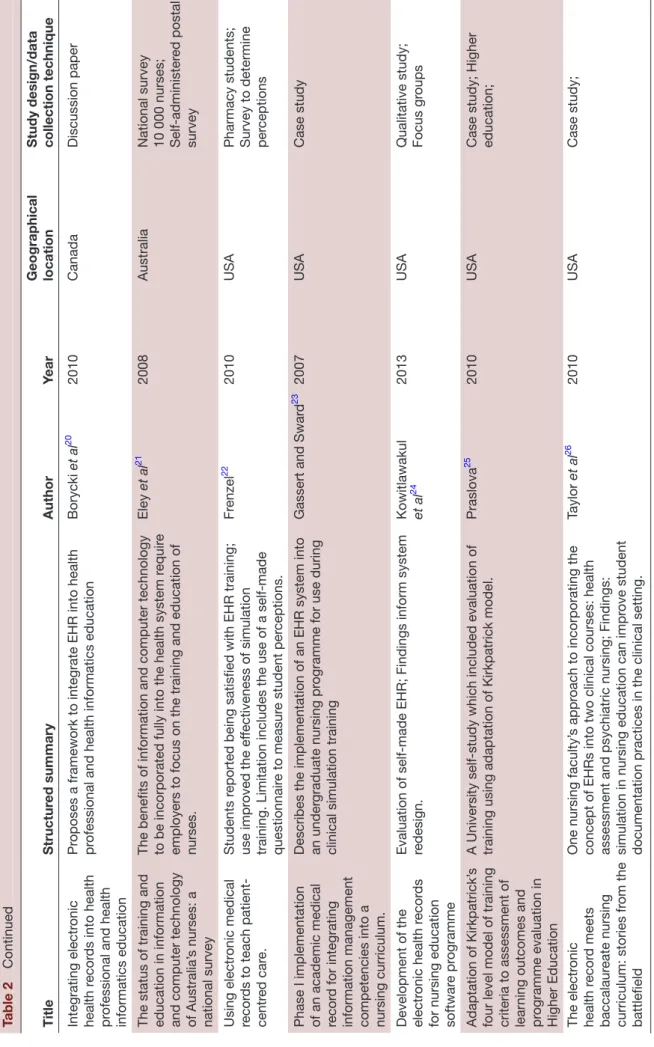
Articles were searched via e- databases including PubMed; Web of Science; CINAHL (Cummulated Index to Nursing and Allied Health Literature) Complete; Emerald Insight; Science Direct; using a list of key words: training evaluation, nursing education, electronic health record, health informatics, nursing informatics, pilot study, higher education, with ‘AND’ and ‘OR’ as a search strategy. Manual searches based on the reference lists and bibliographies of articles, reports and books consid-ered relevant to this study were also performed. With the search filters applied, 12 397 articles were identified. Arti-cles were screened across all results to remove duplicates. Following a review of the titles and abstracts removed further articles. The exclusion criteria were papers that did not mention a training evaluation model and papers with insufficient information about methods, resulting in the inclusion of 36 articles for the purposes of the review. Selected papers revealed various study designs that included case studies (n12), descriptive, qualita-tive, quasi- experimental strategies and details about data collection techniques including survey, interviews and focus groups. Geographical locations—USA; UK; Canada; Iran; Australia; Korea and rest of the World. An extract of selected literature review analysis is shown in table 2.
Issue
Digital literacy of nurses has been identified as a signifi-cant factor influencing positive attitudes towards the use of electronic record systems in practice. Some studies identified a strong correlation between nurses’ previous computer use and positive attitudes towards the use of electronic record systems.13 14 Yet, the Research into
Health Informatics Education study15 concluded that
health informatics learning objectives had not been fully incorporated into formal educational programmes. In a study that built on this work, it was reported that students recognised that they would “…value more access to, and training on, digital clinical information systems” (p558)16; Academic staff reported limitations in their
levels of expertise in the informatics topic area and gener-ally assumed that student training occurred within clin-ical practice due to the wide variety of electronic record systems available. The findings highlighted that clinical systems training was not necessarily available for students in placement; where training was provided in practice, students were not prioritised; 61% of students asked for further training.
Several studies identified a problem with the provi-sion of informatics within educational programmes.17–19
Many authors suggested a gap in nurses informatic
knowledge and skills,20–24 need for assessment of learning
outcomes,25–27 and assert the need for training to be eval-uated. The aim to ensure that each iteration produces an evidence base, to identify what went well and what could be improved or changed; to look at whether an educational activity accomplished what it was supposed to; and to explore results of the participants’ learning, or to set goals for the future. Furthermore, evaluation should be planned from the start using a robust model. It is suggested that the findings from review of selected liter-ature in this section show an issue with nurses informatic training, which justifies study.
Selection of training evaluation model
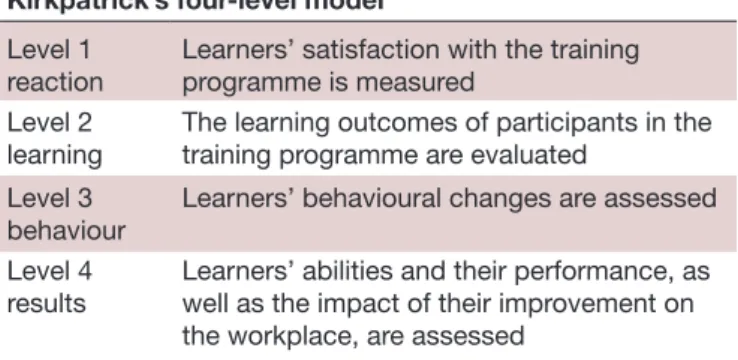
Some of the key influential models of training evalua-tion devised since the 1950s, the earliest menevalua-tion in the literature, will be reviewed next to inform selection of training evaluation model. Kirkpatrick defined evalua-tion in 1959 as determining the effectiveness of a training programme.28 The Kirkpatrick model identified four
levels at which trainings can be evaluated, summarised in
table 3.
Vizeshfar et al,27 in the context of a pilot study conducted
within healthcare context, argue that Kirkpatrick’s model: is one of the best- known models for evaluating the effectiveness of training courses, provides a compre-hensive, simple and practical approach for use in many training situations and is known as a bench-mark in the field.
Several authors highlight the importance of the Kirk-patrick model, which has been critiqued, refined and adapted for various purposes, including evaluations of workplace training, and nursing programmes delivered in higher education institutions.25 27 29–32
The selected literature shows a lack of consistency in the ways in which evaluation theory has been conceptual-ised. Several authors29 33 34 present the notion of an issue
between positivist and phenomenological approaches to evaluation, and articulate the dichotomies apparent in the field, to clarify basic beliefs, and associated methodolog-ical approaches. Basic beliefs associated with a positivist approach include: the world is external and objective; suggesting that researchers should focus on facts; look for causality and reduce phenomena to simplest elements. It is suggested that Kirkpatrick’s four level model reflects a positivist world view. A phenomenological approach views the world as socially constructed and subjective; suggesting that researchers need to focus on meanings, to understand what is happening. Some authors suggest that rather than view these models as competing alternatives, advantage can be achieved from viewing them as comple-mentary and amalgamating the strengths of each.29 34
In 2016, Kirkpatrick30 and Kirkpat rick41 revised the four- level model in which the complexity of the behavioural change increases as evaluation strategies ascend to each higher level, adding five principles described in table 4,
copyright.
on November 10, 2020 by guest. Protected by
Table 2 Extract of literatur e r eview r esults Title Structur ed summary Author Year Geographical location Study design/data collection technique
A comparative study of the attitudes of users and
users towar
ds
computerised car
e
planning.
The aim of this study was to compar
e the attitudes
of nurses who had little or no experience of computerised car
e planning (non‐users) with those
who had at least 2 years’ experience (users). The study assessed levels of computer literacy among both cohorts and the training methods consider
ed
most appr
opriate to meet their needs.
Getty et al 13 1999 Norther n Ir eland, UK
Comparative study The appr
oach was
quantitative, using a questionnair
e to collect
data fr
om 15 non‐ users
and 14 users.
Assessment of nurses’ attitudes towar
d
computerisation.
The overall r
esults of the study suggest that both
non-users (n15) and non-users (n14) had favourable attitudes towar
ds computerised car
e planning. The pr
eferr
ed
teaching method identified by both gr
oups was
training by technical staf
f in the clinical ar ea Str onge and Br odt 14 1999 USA Questionnair e using
Likert type scale, survey tool designed to elicit attitude statements
Health Informatics Education for Healthcar
e
pr
ofessionals. Final r
eport
to Department of Health
Students views, as key stakeholders wer
e taken
into consideration. The study concluded that health informatics lear
ning objectives had not been fully
incorporated into formal educational pr
ogrammes;
Recommendation to incorporate health informatics into national curriculum and pr
omote health
informatics training for clinical educators.
Murphy
et al
15
2001
UK
Survey; 292 health science pr
ogrammes
(nursing and medical) from the UK wer
e
included in the sampling frame.
Is HE r
eady for the
informatics r
evolution?
The findings suggest limitations in the pr
ovision of
informatics education; within HE healthcar
e curricula and of fers r ecommendations to impr ove practice. Bartholomew 16 2011 UK
Mixed method using online questionnair
e and
interviews
A survey of student nurses’ and midwives’ experiences of lear
ning to use electr
onic
health r
ecor
d systems in
practice.
Need for guidance that pr
omotes opportunities for
students to develop competence in using EHRs in practice, training on EHR systems in use, and clear processes for authorised access. Following the survey
,
the University and practice partners collaboratively established formalised EHR training for students with clear gover
nance pr
ocedur
es for access and use.
Baillie
et al
17
2013
UK
A survey of nursing and midwifery students (n 215) and thr
ee focus
gr
oups:
Nurses, computers and prer
egistration education.
Paper pr
esents the r
esults of a longitudinal study
carried out with a cohort of nursing students. Findings: although the students lacked computer skills and knowledge at the start of their pr
ogramme, they
wer
e willing to engage with this agenda.
Bond
18
2009
UK
Longitudinal study (PhD); 386 year one nursing students; Survey and focus groups
Pr escription for nursing informatics in prer egistration nurse education Nurses ar e not curr ently adequately pr epar ed to
work with information and technology thr
ough their pr er egistration education. it is r ecommended that all pr er egistration nursing pr
ogrammes should have
access to a nursing informatics.
Bond and Pr octor 19 2007 UK Discussion paper Continued copyright.
on November 10, 2020 by guest. Protected by
Open access Title Structur ed summary Author Year Geographical location Study design/data collection technique
Integrating electr onic health r ecor ds into health pr
ofessional and health
informatics education
Pr
oposes a framework to integrate EHR into health
pr
ofessional and health informatics education
Borycki et al 20 2010 Canada Discussion paper
The status of training and education in information and computer technology of Australia’
s nurses: a
national survey
The benefits of information and computer technology to be incorporated fully into the health system r
equir
e
employers to focus on the training and education of nurses.
Eley
et al
21
2008
Australia
National survey 10 000 nurses;
administer ed postal survey Using electr onic medical recor ds to teach patient-centr ed car e. Students r
eported being satisfied with EHR training;
use impr
oved the ef
fectiveness of simulation
training. Limitation includes the use of a
made questionnair e to measur e student per ceptions. Fr enzel 22 2010 USA
Pharmacy students; Survey to determine per
ceptions
Phase I implementation of an academic medical recor
d for integrating
information management competencies into a nursing curriculum. Describes the implementation of an EHR system into an under
graduate nursing pr
ogramme for use during
clinical simulation training
Gassert and Swar
d
23
2007
USA
Case study
Development of the electr
onic health r
ecor
ds
for nursing education softwar
e pr
ogramme
Evaluation of
made EHR; Findings inform system
redesign.
Kowitlawakul et al
24
2013
USA
Qualitative study; Focus gr
oups
Adaptation of Kirkpatrick’
s
four level model of training criteria to assessment of lear
ning outcomes and
pr
ogramme evaluation in
Higher Education
A University
study which included evaluation of
training using adaptation of Kirkpatrick model.
Praslova
25
2010
USA
Case study; Higher education;
The electr onic health r ecor d meets baccalaur eate nursing curriculum: stories fr om the battlefield
One nursing faculty’
s appr
oach to incorporating the
concept of EHRs into two clinical courses: health assessment and psychiatric nursing; Findings: simulation in nursing education can impr
ove student
documentation practices in the clinical setting.
Taylor et al 26 2010 USA Case study; Table 2 Continued Continued copyright.
on November 10, 2020 by guest. Protected by
which incorporates both positivist and phenomenolog-ical approaches.
Shinners review, focused on principles above, suggests the value of Kirkpatrick and Kirk patrick’s evaluation model in continu ing nursing education.34
This pilot study is part of an overall University strategy to embed Health Informatics across educational programmes, underpinned by a collaborative relationship with a commercial EHR company. The Kirkpatrick and Kirkpatrick revised model was selected because the liter-ature supports that it provides a comprehensive, simple and practical approach to training evaluation, within an overall purpose orientated approach that supports the principle of beneficence (do no harm), applicable to both nursing, and maintenance of collaborative commer-cial relationship, contextual environment that this study was conducted within. Moreover, the selected model provides scope to continue evaluation should the pilot be rolled out to include other preregistration and postregis-tration programmes delivered by the University.
Choice of research strategy
The research strategy selected for this pilot study is summarised next, followed by the argument for the choices made. The aim to ensure rigour in all aspects of this study to achieve trustworthy findings and conclu-sions. In this context, it is argued that the choice of an appropriate research strategy provides an approach to the collection and analysis of data in a way that ensures validity.
Informed by the research strategies used in several studies shown in table 2, an overall case study strategy was selected, being appropriate to the integration of data from different sources, limitations in one method coun-terbalanced by strength from an alternative data collec-tion technique.35 For example, a strength associated with
review of literature is that it is a relatively straightforward; and an efficient method to determine what is already known about a subject, allowing identification of issues, authoritative text, key characteristics and known models. A strength of using survey technique is to obtain a limited amount of information, at a given point in time; surveys allow anonymity. Limitations associated with survey tech-niques include limited information, low response rates;
Title Structur ed summary Author Year Geographical location Study design/data collection technique
Evaluation of the effectiveness of a first aid health volunteers’ training pr
ogramme using
Kirkpatrick’
s model: A pilot
study
.
An evaluation based on Kirkpatrick’
s model showed
that the training pr
ogramme was able to incr
ease the
knowledge and skills of participants; Using model, wer
e able to assess the ef
fectiveness of each of the
components of the pr
ogramme separately
, together
with the overall ef
fectiveness of the pr ogramme. Vizeshfar et al 27 2017 Iran
Evaluation using Kirkpatrick model
EHR, electr onic health r ecor d. Table 2 Continued
Table 3 Kirkpatrick’s four- level model
Kirkpatrick’s four- level model
Level 1 reaction
Learners’ satisfaction with the training programme is measured
Level 2
learning The learning outcomes of participants in the training programme are evaluated Level 3
behaviour Learners’ behavioural changes are assessed Level 4
results Learners’ abilities and their performance, as well as the impact of their improvement on the workplace, are assessed
copyright.
on November 10, 2020 by guest. Protected by
Open access
and do not allow detection of misunderstandings arising from questions. Data collection through survey is appro-priate in seeking attribute data, that is relating to attitudes, perceptions and opinions of participants. For example, the use of Likert scales allows survey respondents to select from categories indicating their strength of agreement, or disagreement with statements.36 Open questions allow
respondents to respond in their own terms, allowing unusual responses to be derived.
METHODS Setting
Faculty of Health and Well- being, Nursing School, Univer-sity, NW England, UK.
Participants
All students registered on the Return to Practice (RTP) course as at 1 September 2018 were eligible for this pilot study. Participation was voluntary. One student declined to participate. Twenty- four participants for the first questionnaire (pretraining) and 23 for the second (post- training).
Ethics
This pilot study was designed and conducted applying principles of professional research practice; University Ethics Committee Approval received.37
Reasonable attempt to minimise any bias was made. All RTP registered students were invited to participate in self- completion online questionnaire, issuing a letter to each. All questionnaires were anonymous to protect the
student’s identity. Statistical analysis of survey findings was supported by University Research Support Team to minimise any bias.
Data collection
A student survey was conducted using self- completion questionnaire. The survey tool was developed, piloted with University Staff. The first questionnaire was given to the students at the start of the course, prior to teaching sessions, to determine students’ perceptions about their existing knowledge and experience of EHRs, if any. Following completion, teaching sessions were delivered that included a theoretical session incorporating the concepts of the EHR, students’ personal and professional responsibilities. A further practical session was delivered during which students were given the opportunity to access and interrogate the EHR training system to answer specific clinical questions. The second questionnaire was conducted to determine how useful students perceived the benefit of using EHR training system. The first ques-tionnaire had seven questions (three free text and four Likert Scale). The second questionnaire had 18 questions (5 free text and 13 Likert Scale). Both surveys consisted of a Likert style questionnaire from 1 to 10 with 1 being strongly disagree and 10 being strongly agree with an open- ended comments section for students wishing to add more information. The second questionnaire consisted of four main questions to be compared with the questions from the first questionnaire: about previous knowledge of and proficiency in digital clinical systems, about pretraining personal use of social media and its
Table 4 Kirkpatrick and Kirkpatrick’s (2016) five principles
Kirkpatrick and Kirkpat rick’s five principles
Principle 1 To effectively use the model, desired results serve as the first step in the planning process. Those working in professional development are familiar with a planning process that begins with identification of a professional practice gap.
Principle 2 Return on expectations involves understanding what stakeholders’ expectations are.
This helps to identify the value of the activity and allows for the statement of measurable results. Not all professional continuing education activities involve business partnerships, but when they do, planners need to partner with managers and supervisors to prepare participants for the activity in advance.
These stakeholders will also have key roles to play in reinforcing the application of the newly acquired knowledge and skills.
Principle 3 Kirkpatrick30 and Kirkpatrick (2016, p34)41 reported that the learning ac tivity will typically result in just
15% of on- the- job application. Partnerships with stakehold ers, such as managers and supervisors, will be important in preparing partic ipants for the education, as well as in reinforcing the new skills or knowl edge. The degree to which these af filiations occur relates directly to the achievement of positive outcomes. Principle 4 Often the major portion of a plan ner’s efforts and resources are spent on the development and delivery
of the learning activity, whereas typically little time is spent on undertakings before and after the training that sup port behaviour change, the results that stakeholders want. In many instances, providers should redefine their roles to focus more on the achievement of behaviour change. This may be a challenge for many, but it is an important area to consider for future development.
Principle 5 By using the Kirkpatrick model and the foundational principles, a chain of evidence can be created that demon strates the worth of the learning experi ence. The bottom- line value of the ac tivity, either qualitative or quantitative, can be measured and shared with stake holders and the organisation. This is an important way for educators to demon strate their value to the organisation.
copyright.
on November 10, 2020 by guest. Protected by
link with the professional use. The rest of the questions asked students how useful they perceived the teaching. Students were asked to complete the second question-naire at the end of the Course. Questionquestion-naire 1 took 10–15 min. Questionnaire 2 took between 10 and 20 min to complete.
Data analysis
Pilot Student survey: SPSS package (V.25) was used to perform the statistical analysis of the data from the survey and thematic analysis to report the findings from open- ended questions.38 Significance level used in statistical
analysis was 0.05.
The questionnaires were completed entirely anony-mously; no case- by- case comparison could be conducted. Answers to four questions related to participant’s pretraining and post- training experience were considered for comparison. The Likert Scale data were summarised using medians and IQRs of response to each question. The research suggests that Likert Scale with number of items close to 10 can be considered as an interval scale continuous measurement.38 However, the Shapiro- Wilkes
test did not support the normality assumption for the samples, so the Mann- Whitney U test, a non- parametric test, was used for comparison.
RESULTS
The statistical results show that the students perceived that the training improved their capability in employing digital systems with statistically significant difference in
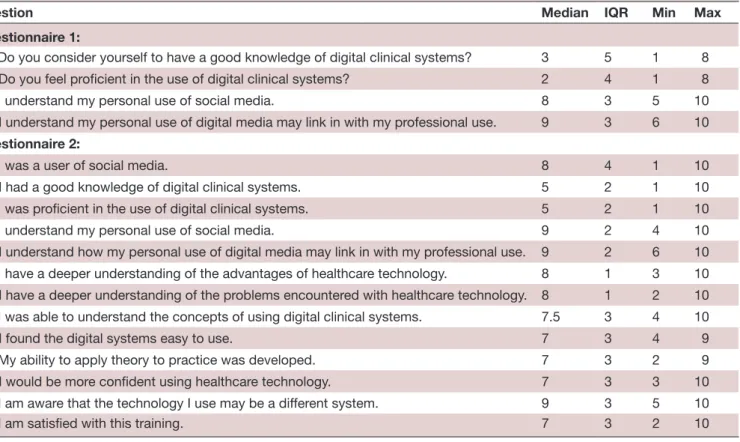
the assessed preproficiency and postproficiency in the use of digital clinical systems (premedians and postmedians are 2 and 5 on 10- point Likert Scale, p=0.041). There was also an indication of an improvement in the knowledge of EHR systems although not statistically significant. Most students perceived it increased their knowledge on digital systems. Descriptive statistics of Likert type scores for all questions used in the survey are presented in table 5.
Braun and Clarke’s39 thematic analysis was used to
analyse the data from open- ended question responses, which consisted of familiarisation of the data; genera-tion of codes; searching for themes; reviewing of themes; defining and naming themes and producing the report. Analysis of free text/open- ended questions revealed four themes: low self- belief in knowledge, the desire to know more about digital systems, the desire to increase capa-bility using digital systems and an existing awareness of responsibilities of using social media. The results of the comparative analysis of the presurvey and postsurvey are shown in table 6.
The median on the questions requesting survey respon-dents to rate their own knowledge and proficiency in using digital systems in a clinical setting in the pretest questionnaire were lower than the median for other questions (Mdn=3 and Mdn=2 pretraining; Mdn 5 post- training), suggesting that nurses did not rate their knowl-edge or capabilities in the use of digital systems in a clinical setting highly. Respondents perceived capabilities in the use of digital clinical systems did show a statisti-cally significant improvement in the Mann- Whitney U test
Table 5 Descriptive statistics (median and IQR) for pretraining and post- training questionnaires
Question Median IQR Min Max
Questionnaire 1:
1a: Do you consider yourself to have a good knowledge of digital clinical systems? 3 5 1 8
1b: Do you feel proficient in the use of digital clinical systems? 2 4 1 8
2a: I understand my personal use of social media. 8 3 5 10
2b: I understand my personal use of digital media may link in with my professional use. 9 3 6 10
Questionnaire 2:
1a: I was a user of social media. 8 4 1 10
1b: I had a good knowledge of digital clinical systems. 5 2 1 10
1c: I was proficient in the use of digital clinical systems. 5 2 1 10
2a: I understand my personal use of social media. 9 2 4 10
2b: I understand how my personal use of digital media may link in with my professional use. 9 2 6 10 2c: I have a deeper understanding of the advantages of healthcare technology. 8 1 3 10 2d: I have a deeper understanding of the problems encountered with healthcare technology. 8 1 2 10 3a: I was able to understand the concepts of using digital clinical systems. 7.5 3 4 10
3b: I found the digital systems easy to use. 7 3 4 9
3c: My ability to apply theory to practice was developed. 7 3 2 9
3d: I would be more confident using healthcare technology. 7 3 3 10
3e: I am aware that the technology I use may be a different system. 9 3 5 10
4a: I am satisfied with this training. 7 3 2 10
copyright.
on November 10, 2020 by guest. Protected by
Open access
between pre and post training results (p=0.041, U=182.0). The respondent’s perceived knowledge of digital clinical systems after training indicated an increase, it was not statistically significant, though the p value was just above the significance level (p=0.052, U=186.0).
Theme: lack of confidence in the use of the technology
Open ended questions in the pretraining questionnaires revealed many students reported the need to become more confident in digital technology. Survey respondents expanded their notion of confidence in the post- training questionnaire that showed students strongly agreeing that they perceived more confidence using digital health systems (Q3d Mdn (IQR)=7 (3)). Open ended comments included: ‘Confidence will come after use of the systems in practice, although the initial session was very helpful’. ‘One to one training to increase confidence’.
Theme: the desire to increase knowledge and capability using digital systems
Those students who already had some awareness of the systems, in the open- ended questions reported the wish to reinforce or expand their existing knowledge. Open- ended survey responses included: ‘The desire to gain more knowledge and become more proficient’. ‘Digital is the future of healthcare so it is vital to become familiar and competent in its use and access’.
The post- training questionnaires revealed an expan-sion of what students perceived as knowledge and profi-ciency. Participants agreed with deeper understanding of the advantages of and the problems encountered with healthcare technology, Q2c and Q2d Mdn (IQR)=8 (1) and the need to use the system in practice with their ability to apply theory to practice being developed (Q3c Mdn (IQR)=7 (3)). Many reported that although being taught the system was useful and relevant it was limited as the system was not necessarily the EHR they would use in practice. The majority strongly agreed that the tech-nology they will use in practice may be a different system (Mdn (IQR)=9 (3)). Open- ended question responses included: ‘It increased my understanding and I know that if I used the same system in a hospital it would be beneficial’.
Theme: an existing awareness of responsibilities of using social media
The students understanding of personal use of social media increased although this was not statistically signif-icant (U=204.5, p=0.12). The understanding of how personal use of digital media links to professional use also increased post training but was not statistically significant (U=216.0, p=0.27). All students reported using digital technology socially although some stated this was only on the use of sending emails while others used a large variety of social media. Majority strongly agreed that they under-stand how personal use of digital media may link in with professional use (Q2b Mdn (IQR)=9 (2)).
DISCUSSION
The application of the Kirkpatrick and Kirkpatrick evaluation model to this pilot study underpinned the foundation, and development, of a unique educational programme, to provide students with an opportunity to use an EHR in a safe and controlled environment. The programme was designed in partnership with stake-holders, which included an NHS clinical system solu-tion supplier; Faculty Executive Dean, Heads of School and Course Leaders. The five principles associated with selected evaluation model (see table 4) were applied throughout the 12- month duration of the study; for example, the initial planning stage involved identifica-tion of a professional skill gap, and issue with embed-ding informatics in educational programmes, informed by review of literature. Stakeholder support for agreed programme objectives, evaluation and research study design was obtained. It is suggested that partnership working with stakeholders helped to prepare participants for the training on EHR systems, which impacted posi-tively on survey response rates, which aligns to principle 3. Nursing student feedback, regarding perceptions to the EHR training, align to selected evaluation model Level 1, Reaction level, discussed next.
It is expected that students would have lower median scores on the pretest questionnaire on their knowledge of digital systems in clinical setting as the students were on a course to refresh their skills in healthcare. Despite the median scores being low, there was an increase in
Table 6 Results of the comparative analysis of the presurvey and postsurvey
Comparator Pretraining Questionnaire Median (IQR) Posttraining Questionnaire
Median (IQR) P value
Q1.1a - Q2.1b: Knowledge of digital clinical systems. 3.0 (20.25) 5.0 (27.91) 0.052 Q1.1b - Q2.1c: Proficiency in the use of digital clinical systems. 2.0 (20.08) 5.0 (28.09) 0.041 Q1.2a - Q2.2a: Understanding of personal use of social media. 8.0 (21.02) 9.0 (27.11) 0.120 Q1.2b - Q2.2b: Understanding how personal use of digital
media links to professional use. 9.0 (21.50) 9.0 (25.68) 0.271
copyright.
on November 10, 2020 by guest. Protected by
perceived knowledge of digital clinical systems post- training. Students perceived an increase in proficiency in the use of the EHR. There was evidence of improvement in confidence in the use of the EHR; this confidence would be enhanced by additional use of the system. Some desire to increase confidence further and to develop knowledge of digital systems was expressed. This may be attributable to the students developing a deeper awareness of, and confidence in, their own skill base and learning needs that requires further investigation.
The findings show that some students reported that it would be useful to gain experience on the system they would be using in practice. EHR systems currently vary between NHS Trusts. The justification for providing access to selected EHR in this pilot being that all NHS providers across the UK County geographical context of this study “have plans in place to improve their digital maturity through the implementation of EHR. Whilst each acute provider has a different solution, the provi-sion of primary care and community systems is less complex, with EMIS Health Solutions in use across all GP practices, half of the county’s community services and its planned use as the county- wide child health information system (CHIS). Medicines management and e- prescribing are also largely delivered through EMIS solution” (p15).40
This small pilot study demonstrates measurable, and in some instances, statistically significant benefit of the EHR training/learning experience, which establishes a chain of evidence aligned to evaluation model, principle 5. Results may help to inform future developments, and instance of embedding use of EHR systems, across prereg-istration and postregprereg-istration clinical courses.
Limitations
This 12- month pilot study has limitations that include the questionnaire being short and not comprehensive, as well as the reported findings based on use of EHR in clinical skills session limited to registered RTP nurses in a University based Nursing School, NW England, which may not represent the general population of pre and post- registration healthcare professionals.
Recommendations
I. Expedite development of relevant clinical scenarios: educational modules, chosen by the university, to be reviewed by a multiprofessional team from system supplier; aligning all components of a module(s) to system functionality and Health Informatics theory; II. EHR system to be used on PCs due to laptop screen
resolution issues;
III. Roll- out access to Medical School that plan to use EHR system with year 5 students; potential to devel-op multidisciplinary approach to clinical scenarios; IV. Potential to increase student
placements—univer-sity students familiar with EHR prior to placements should prove an advantage;
V. Continue to evaluate first of type, build evidence— what works, what could be improved, identify be-haviour changes, impact and publish results.
CONCLUSION
As first of type, this EHR system deployment proved chal-lenging due to university requiring a non- NHS network solution. The university’s instance of EHR system was on a separate environment and new processes had to be developed in system suppliers Hosted, Deployment and Support departments.
The statistical results reported in this paper show that the students felt they were more proficient in the use of the digital EHR systems and the difference in pretraining and post- training level was statistically significant. There was also an improvement in the knowledge of clinical systems although not statistically significant. Emergent themes from the comments in the questionnaires were that most students perceived it increased their knowledge on digital systems although some would have preferred more 1:1 time with it, and some stated they would have liked training on the system they were going to use in practice. Some stated it increased their confidence in using digital technology.
Acknowledgements The authors wish to thank Editorial Board and reviewers for their constructive feedback.
Contributors JS and ST, Research Support Team, analysed the data. All authors discussed the results and contributed to the final manuscript.
Funding The University Faculty of Health and Wellbeing provided the funding for the pilot study, and Research Support Team to analyse survey findings.
Competing interests None declared.
Patient consent for publication Not required.
Ethics approval University of Central Lancashire Ethics Committee, granted approval 1 October 2018 of proposal application ‘Do nurses benefit from the introduction of digital technology into the Return to Practice Programme?’. Application Unique Reference Number STEMH 935, Preston: UCLan, 2018.
Provenance and peer review Not commissioned; externally peer reviewed.
Data availability statement All data relevant to the study are included in the article or uploaded as supplementary information. Further information available upon reasonable request.
Open access This is an open access article distributed in accordance with the Creative Commons Attribution Non Commercial (CC BY- NC 4.0) license, which permits others to distribute, remix, adapt, build upon this work non- commercially, and license their derivative works on different terms, provided the original work is properly cited, appropriate credit is given, any changes made indicated, and the use is non- commercial. See: http:// creativecommons. org/ licenses/ by- nc/ 4. 0/.
ORCID iD
Beverley S Ellis http:// orcid. org/ 0000- 0003- 0938- 1172
REFERENCES
1 Emis Health. Higher education EMIS proposal for University of central Lancashire. Leeds: Emis Health, 2017.
2 Department of Health. Making information count: a human resources strategy for health informatics. London: Department of Health, 2002. 3 University of Central Lancashire. “One Health,” University of Central Lancashire, June 2018. [Online]. Available: https:// www5. uclan. ac. uk/ sites/ ImageBank/ Marketing_ Image_ Library/ 5281_ One_ Health_ June2018_ FINAL_ WEB. pdf [Accessed Sep 2018].
copyright.
on November 10, 2020 by guest. Protected by
Open access 4 Bond CS. Nurses' requirements for information technology: a
challenge for educators. Int J Nurs Stud 2007;44:1075–8.
5 Department of Health. Information for health. London: NHS, HMSO, 1998.
6 NHS Information Authority. Learning to manage health information. London: HMSO, 1999.
7 NHS Information Authority,. Learning to manage health information: moving ahead. London: HMSO, 2002.
8 National Information Board UK. National information board paperless 2020,” 2016. [Online]. Available: https:// digital. nhs. uk/ news- and- events/ news- archive/ 2016- news- archive/ national- information- board- paperless- 2020 [Accessed 4th Feb 2020].
9 Royal College of nursing. Available: https://www. rcn. org. uk/ clinical- topics/ ehealth/ every- nurse- an- e- nurse [Accessed 4th Feb 2020]. 10 Topol E. The Topol review preparing the healthcare workforce to
deliver the digital future. London: Health Education England NHS, 2019.
11 Liberati A, Altman DG, Tetzlaff J, et al. The PRISMA statement for reporting systematic reviews and meta- analyses of studies that evaluate health care interventions: explanation and elaboration. J Clin Epidemiol 2009;62:e1–34.
12 Brender J, Talmon J, Keizer Nde, et al. STARE- HI – statement on reporting of evaluation studies in health informatics. Appl Clin Inform 2013;04:331–58.
13 Getty M, Ryan AA, Ekins ML. A comparative study of the attitudes of users and non- users towards computerized care planning. J Clin Nurs 1999;8:431–9.
14 Stronge JH, Brodt A. Assessment of nurses' attitudes toward Computerization. Comput Nurs 1985;3:154–8.
15 Murphy J, Stramer K, Clamp S, et al. Health informatics education for healthcare professionals. final report to department of health (ICT research initiative, Ref ICT/136) 2001.
16 Bartholomew N. Is He ready for the informatics revolution? International Journal of Therapy and Rehabilitation 2011;18:558–66.
17 Baillie L, Chadwick S, Mann R, et al. A survey of student nurses' and midwives' experiences of learning to use electronic health record systems in practice. Nurse Educ Pract 2013;13:437–41.
18 Bond CS. Nurses, computers and PRE- REGISTRATION education. Nurse Educ Today 2009;29:731–4.
19 Bond CS, Procter PM. Prescription for nursing informatics in PRE- REGISTRATION nurse education. Health Informatics J 2009;15:55–64.
20 Borycki E, Kushniruk A, Armstrong B, et al. Integrating electronic health records into health professional and health informatics education. Acta Informatica Medica 2010;18:20–4.
21 Eley R, Fallon T, Soar J, et al. The status of training and education in information and computer technology of Australian nurses: a national survey. J Clin Nurs 2008;17:2758–67.
22 Frenzel JE. Using electronic medical records to teach patient- centered care. Am J Pharm Educ 2010;74:71.
23 Gassert CA, Sward KA. Phase I implementation of an academic medical record for integrating information management
competencies into a nursing curriculum. Stud Health Technol Inform 2007;129:1392–5.
24 Kowitlawakul Y, Wang L, Chan SW- C. Development of the electronic health records for nursing education (EHRNE) software program. Nurse Educ Today 2013;33:1529–35.
25 Praslova L. Adaptation of Kirkpatrick’s four level model of training criteria to assessment of learning outcomes and program evaluation in Higher Education. Educ Asse Eval Acc 2010;22:215–25.
26 Taylor LA, Hudson K, Vazzano J, et al. The electronic health record meets baccalaureate nursing curriculum: stories from the battlefield. Nurse Lead 2010;8:40–4.
27 F V, Momennasab M, Yektatalab S. Evaluation of the effectiveness of a first aid health volunteers’ training programme using Kirkpatrick’s model: A pilot study. Health Education Journal 2018;77:190–7. 28 Kirkpatrick DL. Techniques for evaluating training programs. ASTD
1959;11:1–13.
29 DeSilets LD, Shinners J. An update on Kirkpatrick's model of evaluation: part two. J Contin Educ Nurs 2018;49:292–3. 30 Kirkpatrick DL. Evaluating training programs: the four levels. San
Francisco: Berrett- Koehler, 1994.
31 Geber B. Does your training make a difference? Prove it! Training 1995:27–34.
32 Bates R. A critical analysis of evaluation practice: the Kirkpatrick model and the principle of beneficence. Eval Program Plann 2004;27:341–7.
33 Desilets LD. Connecting the dots of evaluation. J Contin Educ Nurs 2009;40:532–3.
34 Greenhalgh T, Russell J. Why do evaluations of eHealth programs fail? an alternative set of guiding principles. PLoS Med 2010;7:e1000360.
35 Yin R. Case study research: design and methods. 5th Edition. SAGE, 2014.
36 Likert R. A technique for the measurement of attitudes. Archives of Psychology 1932;140:256.
37 University Ethics Committee,. granted approval 1st October 2018 of proposal application ‘Do nurses benefit from the introduction of digital technology into the Return to Practice Programme?’. Application Unique Reference Number STEMH 935. Preston: UCLan, 2018.
38 Wu H, Leung S- O. Can Likert Scales be Treated as Interval Scales?—A Simulation Study. J Soc Serv Res 2017;43:527–32. 39 Braun V, Clarke V. Using thematic analysis in psychology. Qual Res
Psychol 2006;3:77–101.
40 Lancashire Digital Roadmap 2016-2021. Lancashire Local Digital Roadmap,” 2016-2021. [Online]. Available: https://www. bfwh. nhs. uk/ wp- content/ uploads/ participants- database/ item__ 4b_-_ lancashire_ local_ digital_ roadmap_ 2016- 2021. pdf [Accessed 5th Feb 2020]. 41 Kirkpatrick JD, Kirkpatrick WK. Kirkpatrick’s four levels of training
evaluation. Alexandria, VA: ATD Press, 2016.
copyright.
on November 10, 2020 by guest. Protected by