Real Life. Real Learning.
N O R T H C E N T R A L T E C H N I C A L C O L L E G E
Academic Quality Improvement Program
2010 Systems Portfolio
_
___
___
___
___
___
___
___
___
___
___
___
___
___
___
___
___
___
___
___
___
___
___
___
___
___
___
___
___
___
___
___
___
___
___
___
___
___
___
___
___
___
___
___
___
___
___
___
___
___
___
___
___
___
___
___
___
___
___
___
___
___
___
___
___
___
___
___
___
___
__
Submitted To:
AQIP and The Higher Learning Commission
June 1, 2010
Submitted By:
Northcentral Technical College
1000 West Campus Drive
Wausau, WI 54401-1899
NTC Official Contact:
Beth Ellie, AQIP Liaison
Accreditation and Evaluation Coordinator
715.803.1197 • [email protected]
© Northcentral Technical College 1000 West Campus Drive
Wausau, WI 54401-1899 715.675.3331 • ntc.edu
Table of Contents
_
___
___
___
___
___
___
___
___
___
___
___
___
___
___
___
___
___
___
___
___
___
___
___
___
___
___
___
___
___
___
___
___
___
___
___
___
___
___
___
___
___
___
___
___
___
___
___
___
___
___
___
___
___
___
___
___
___
___
___
___
___
___
___
___
___
___
___
___
___
__
Front Matter
Table of Contents...i List of Figures……...iiiInstitutional Overview
Overview………. ... 1Category 1 Helping Students Learn
Processes (Questions 1P1-1P18) ... 11 Results (Questions 1R1-1R6)... 22 Improvement (Questions 1I1-1I2) ... 28
Category 2 Accomplishing Other Distinctive Objectives:
K-16 Programs and Partnerships
Processes (Questions 2P1-2P6)... 31 Results (Questions 2R1-2R4)... 32 Improvement (Questions 2I1-2I2) ... 34
Category 3 Understanding Students’ and Other Stakeholders’ Needs
Processes (Questions 3P1-3P6)... 35 Results (Questions 3R1-3R6)... 39 Improvement (Questions 3I1-3I2) ... 43
Category 4 Valuing People
Processes (Questions 4P1-4P13) ... 45 Results (Questions 4R1-4R4)... 49 Improvement (Questions 4I1-4I2) ... 53
Category 5 Leading and Communicating
Processes (Questions 5P1-5P10) ... 54 Results (Questions 5R1-5R3)... 56
Category 6 Supporting Institutional Operations
Processes (Questions 6P1-6P5)... 61 Results (Questions 6R1-6R5)... 66 Improvement (Questions 6I1-6I2) ... 70
Category 7 Measuring Effectiveness
Processes (Questions 7P1-7P7)... 73 Results (Questions 7R1-7R3)... 78 Improvement (Questions 7I1-7I2) ... 79
Category 8 Planning Continuous Improvement
Processes (Questions 8P1-8P8)... 81 Results (Questions 8R1-8R5)... 83 Improvement (Questions 8I1-8I2) ... 87
Category 9 Building Collaborative Relationships
Processes (Questions 9P1-9P7)... 89 Results (Questions 9R1-9R3)... 93 Improvement (Questions 9I1-9I2) ... 96
Appendix
List of Abbreviations... 98 Higher Learning Commission Criteria for Accreditation... 100
List of Figures
_
___
___
___
___
___
___
___
___
___
___
___
___
___
___
___
___
___
___
___
___
___
___
___
___
___
___
___
___
___
___
___
___
___
___
___
___
___
___
___
___
___
___
___
___
___
___
___
___
___
___
___
___
___
___
___
___
___
___
___
___
___
___
___
___
___
___
___
___
___
__
Institutional Overview
Figure OV1-1 NTC Vision, Mission, Core Beliefs, Community Benefits Statement, Strategic Directions... 1
Figure OV1-2 NTCs Associate Degrees and Technical Diplomas ... 3
Figure OV2-1 NTCs Key K-16 Partnership Activities ... 4
Figure OV3-1 NTCs Student and Stakeholder Needs and Expectations ... 5
Figure OV9-1 NTCs Key Partnerships... 10
Category 1 Helping Students Learn
Figure 1P1-1 NTCs Core Abilities... 11Figure 1P2-1 NTCs Performance-Based Learning Model... 11
Figure 1P3-1 NTCs Product Development Plan Process... 12
Figure 1P11-1 NTCs Curriculum Development Process ... 16
Figure 1P13-1 First Year of Academic Quality Review Process ... 17
Figure 1P16-1 Student Organizations at NTC... 20
Figure 1R2-1 NTC Academic Course Completion... 22
Figure 1R2-2 NTCs 2005 and 2008 Employer Satisfaction Survey Results ... 23
Figure 1R3-1 NTC Technical Course Completion Rates... 23
Figure 1R3-2 NTC Graduation Rates ... 24
Figure 1R3-3 NTC Graduate Satisfaction... 24
Figure 1R3-4 NTC Five-Year Follow-Up Placement Results ... 24
Figure 1R4-1 NTCs External Assessment Pass Rate ... 25
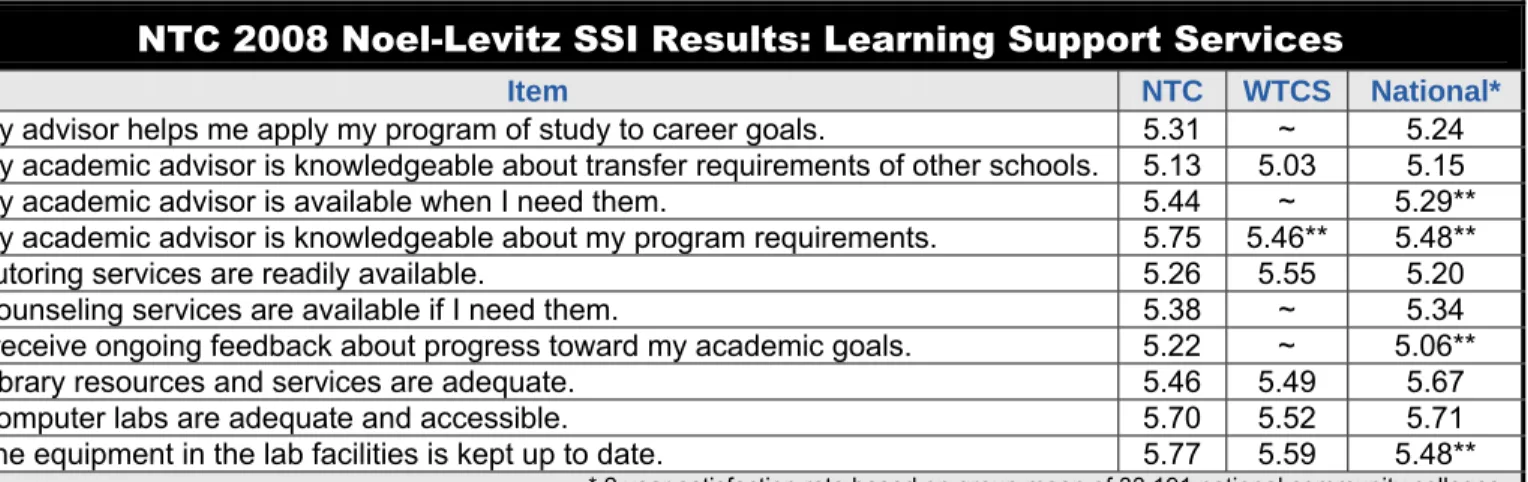
Figure 1R5-1 NTC Noel-Levitz SSI Results: Learning Support Services... 25
Figure 1R5-2 NTC TRiO Annual Performance Report ... 26
Figure 1R5-3 NTC Course Completion of Courses Targeted by Nursing Tutor Program... 26
Figure 1R5-4 NTC Library Database and Index Usage... 26
Figure 1R5-5 NTC Graduate Employment Placement ... 27
Figure 1R5-6 NTC AEFL Scorecard Comparisons... 27
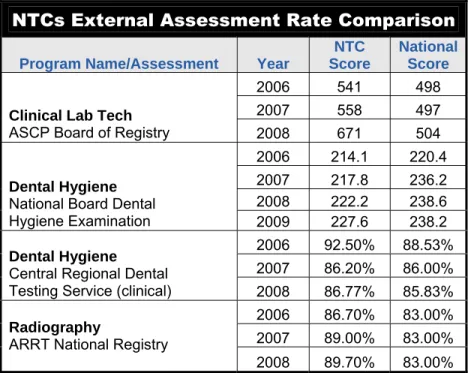
Figure 1R6-1 NTCs External Assessment Rate Comparison... 28
Figure 1R6-2 NTC Noel-Levitz SSI: Instructional Effectiveness... 28
Category 2 Accomplishing Other Distinctive Objectives:
K-16 Programs and Partnerships
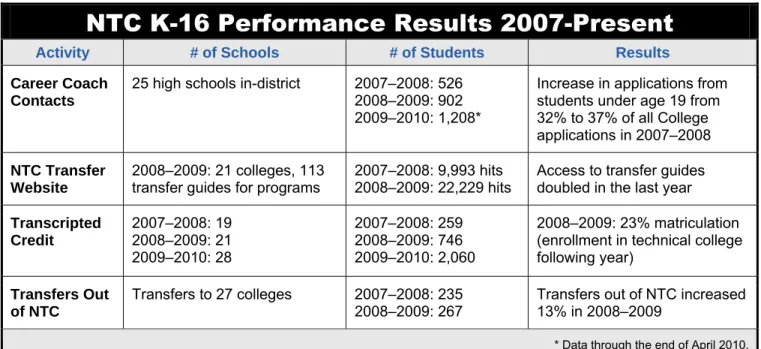
Figure 2R2-1 K-16 Performance Results... 33Category 3 Understanding Students’ and Other Stakeholders’ Needs
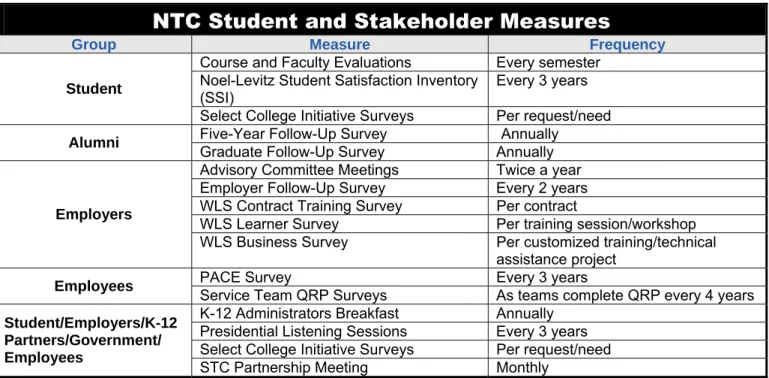
Figure 3R1-1 NTC Student and Stakeholder Measures... 39
Figure 3R2-1 2008 Noel-Levitz SSI Overall Results ... 39
Figure 3R3-1 2008 Noel-Levitz SSI Results: Building Student Relationships... 40
Figure 3R4-1 NTCs Employer Surveys and WLS Post-Contract Training Surveys ... 40
Figure 3R5-1 NTCs College Partners and Guides Representing Transfer Agreements... 41
Figure 3R5-2 WLS Businesses Served ... 42
Figure 3R5-3 WLS Short-Term Continuing Education Enrollments ... 42
Figure 3R5-4 WLS Customized Training Contract Enrollments ... 42
Figure 3R5-5 NTC Regional FTE and Enrollment Growth ... 42
Figure 3R5-6 NTC Collaboration with Governmental Bodies and Business Communities ... 43
Category 4 Valuing People
Figure 4R2-1 NTC Employee Turnover Rate ... 50Figure 4R2-2 Ergonomic Reviews ... 50
Figure 4R2-3 NTC Worker’s Compensation... 50
Figure 4R2-4 Gender Diversity in the NTC Workforce ... 50
Figure 4R2-5 Ethnic Diversity in the Workforce... 50
Figure 4R2-6 Criminal Offenses on the NTC Campus ... 51
Figure 4R4-1 Percentage Increase in Family Plan Health Insurance for Faculty... 52
Figure 4R4-2 Worker’s Compensation Mod NTC vs. WTCS... 52
Category 5 Leading and Communicating
Figure 5P5-1 NTC Organizational Chart... 55Figure 5R2-1 Top Five Average PACE Scores at NTC Compared to National Average ... 57
Figure 5R2-2 Comparative Analysis of College Climate with PACE Norm Base... 57
Figure 5R3-1 Sixteen Statistically Significant Questions Comparing NTC with the PACE Norm Base Mean ... 58
Figure 5I1-1 Comparative Mean Responses to Five Questions Regarding Communication within Climate/PACE Surveys 2000–2002 to 2007–2008 ... 59
Category 6 Supporting Institutional Operations
Figure 6P1-1 NTCs Support Services-Enrollment, Student, IT, Business and Campus... 62-64 Figure 6R2-1 FTE Growth Over Five Years ... 66Figure 6R2-2 Five-Year Financial Aid Application and Award Results... 67
Figure 6R2-3 NTCs Perkins IV Report Card... 67
Figure 6R3-1 NTC Employee Giving ... 68
Figure 6R5-1 2008 Noel-Levitz SSI Comparison Results for Supporting Institutional Operations... 69
Category 7 Measuring Effectiveness
Figure 7P1-1 Performance Information Supporting Planning and Improvement... 73Figure 7P1-2 Sample 2009 Quality Review Process Scorecard for Nursing ... 74
Figure 7P4-1 NTC Board of Trustees 2008-2009 Year-End Dashboard... 76
Figure 7P7-1 Data & Information Integrity Factors ... 77
Figure 7R2-1 PACE Results for Measuring Effectiveness ... 78
Figure 7R2-2 Quality Review Process Evaluation Results... 79
Figure 7R3-1 Cost per FTE Results ... 79
Category 8 Planning Continuous Improvement
Figure 8R1-1 Annual, Biennial and Triennial Board Reports... 84Figure 8R4-1 NTCs Rank Among the 16 Wisconsin Technical Colleges... 85
Figure 8R4-2 NTCs 2008 Noel-Levitz SSI Overall Student Satisfaction Results... 86
Category 9 Building Collaborative Relationships
Figure 9P6-1 Coordination Efforts with NTCs Key Partners... 92Figure 9R2-1 NTC Foundation Scholarships... 94
Figure 9R3-1 2008 WTCS Foundation Net Assets Comparison ... 95
Figure OV1-1
Vision, Mission & Core Beliefs
Overview of Northcentral Technical College
_
___
___
___
___
___
___
___
___
___
___
___
___
___
___
___
___
___
___
___
___
___
___
___
___
___
___
___
___
___
___
___
___
___
___
___
___
___
___
___
___
___
___
___
___
___
___
___
___
___
___
___
___
___
___
___
___
___
___
___
___
___
___
___
___
___
___
___
___
___
__
OV College Overview. Northcentral Technical College (NTC) enriches the
communities of north central Wisconsin by offering educational opportunities that allow students to attain or enhance marketable job skills, obtain degrees and certificates, or prepare for transfer to four-year baccalaureate colleges under the guidance of industry savvy faculty and the support of a caring campus community.
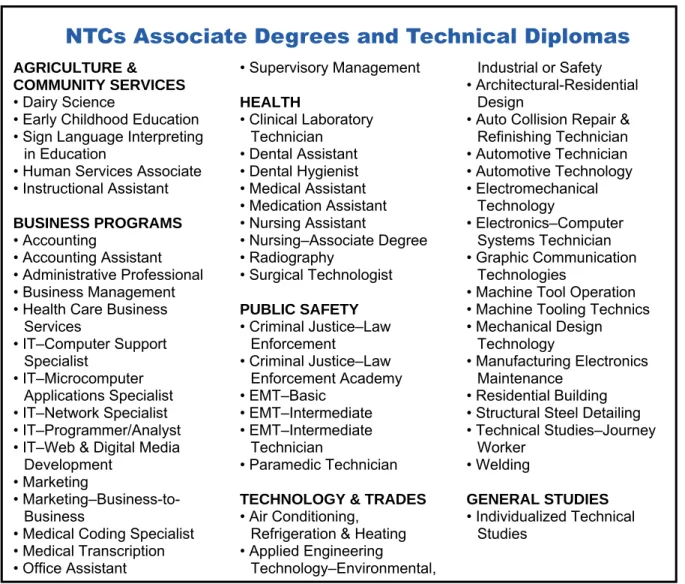
NTC fills a critical and growing need for a skilled Wisconsin workforce by providing quality education and training for the residents of its 10-county service District in north central Wisconsin. Established in 1912, NTC is a public educational unit of government. NTC is 1 of 16 two-year post-secondary colleges in the Wisconsin Technical College System (WTCS). NTC serves 22,100 students, offering 33 associate degrees, 24 technical diplomas, 114 certificates and 9 apprenticeship programs. Figure OV1-2 lists NTCs associate degree and technical diploma programs.
One opportunity and challenge for NTC is the size of the 5,900-square mile District (comparable to Connecticut). The primarily rural District has a total population of 235,667. NTCs District is comprised of all or parts of Clark, Langlade, Lincoln, Marathon, Menominee, Portage, Price, Shawano, Taylor and Waupaca Counties. NTCs main campus is located in Wausau. Six regional sites are strategically located in Antigo, Medford, Merrill, Phillips, Spencer and Wittenberg, providing most students a 20-minute or less drive to one of NTCs campuses. In FY 2009 NTC ranked 8th in headcount served of the 16 WTCS colleges. The College serves 7% of the District population, ranking second in the WTCS.
NTCs vision and mission statements (Figure OV1-1) fulfill the statutory requirements of the WTCS. Core beliefs define the manner in which the College pursues its goals. Community Benefits Statements (CBS) further clarify what communities realize through the College’s existence today and in the future. To achieve the College's vision, mission, CBS and core beliefs, the College identified seven strategic directions: Growth, Innovation, Strategic Partnerships, Organizational Development, Continuous Quality Improvement, Fiscal Strength and Sustainability. NTC reconfigured its strategic directions in spring 2010. In fall 2009, a single-focus performance goal of 4,000 full-time equivalent (FTE) by 2014 was set.
To enable the College to grow in excellence, NTCs Board sought to reaccredit the College as an Academic Quality Improvement Program (AQIP) institution in 2000. The College joined AQIP in 2001 and today NTC benefits from nearly a decade of positive improvements directed through action projects such as Listening Sessions Capturing Stakeholder Needs for Setting Strategic Directions, Increase Online Course Completion and Retention and Enhancing Flexibility and Accessibility of Learning.
In 2006, Dr. Lori Weyers became NTCs president. Since NTCs last portfolio, a significant cultural shift occurred resulting in re-focused mission and vision statements, a change from operating principles to core beliefs and new strategic directions based on Presidential Listening Sessions. A restructuring of the College aligned with these goals. The College’s information-gathering focus changed as well, replacing Key Quality Indicators with focused measurements of quality. As evidenced in Categories 1, 5 and 8 these changes were well-received as indicated by the higher student and employee Vision
Northcentral Technical College: Building futures one community, one work-place, one learner at a time.
Mission
Northcentral Technical College is the customer-focused, accessible provider of innovative life-long
learning that builds a globally competitive workforce. Core Beliefs Learner Focus Continuous Learning Ingenuity Access Service to Community Diversity Culture of Professionalism Community Benefits Statement 1. Communities have the capability to foster economic growth. 2. Workplaces have an
available and skilled workforce.
3. Learners have the knowledge and skills necessary to explore, maintain or advance in employment or higher education. Strategic Directions Growth Innovation Strategic Partnerships Organizational Development Continuous Quality Improvement Fiscal Strength
OV1 Goals for Student Learning, Key Credit and Non-Credit Instructional Programs, Educational Support Services. In support of NTCs mission to build a competitive workforce, the goals for student learning are
occupational skill attainment and student mastery of core abilities. NTC faculty measure student attainment of knowledge, skills and abilities to provide insights for course and program improvements. At NTC, assessment is used as a conceptual framework to measure evidence of learning and to meet the changing needs of the stakeholders including learners, employers and the community at large.
NTC continues on a journey to build a culture of evidence related to student learning by ensuring that faculty use both direct and indirect assessment tools to document learning. This culture includes early and frequent feedback (formative) to students as well as evaluation of levels of mastery (summative). NTC believes students shall take responsibility for their learning. Learning is measured by a student’s demonstration of course competencies and core abilities at the end of each course and the attainment of program outcomes at the conclusion of their program. The process by which program outcomes are established and reviewed for workforce relevance is crucial to building and supporting a competitive workforce. The use of industry experts, via advisory committees, in the determination of learning outcomes assures that occupational duties and tasks required for workforce proficiency are embedded within each of the College’s programs.
NTCs instructional offerings include programs determined as essential to the District’s workforce and those required or recommended in order to serve the communities’ greater needs. Diploma and degree programs resulting from workforce needs are approved through a rigorous process including both the NTC Board of Trustees and the WTCS Board. The process requires clear evidence of training needs in the occupational area and support for local employment of graduates. Short-term certificates are created at the discretion of the institution and allow for rapid response to workforce needs. Figure OV1-2 contains a list of NTCs degree and diploma offerings.
Non-credit offerings are approved by the WTCS and include state-mandated programs such as Fire Service Training and continuing education offerings for professionals and the general public. NTC also provides offerings in partnership with entities such as the Department of Transportation’s Traffic Safety and the Wisconsin Motorcycle Safety programs. Adult Basic Education is also offered by the College supported mostly by Adult Education and Family Literacy Funds.
Within the College’s Learning Division, there are six academic divisions that encompass NTCs credit programs. These divisions include Agriculture and Community Services, Business and International Studies, General and Adult Basic Education, Health, Public Safety and Technology and Trades. Additionally, the College has a Workforce Learning Solutions Division dedicated to serving the needs of employers through on-site contract training and continuing education in support of workforce development. Due to NTCs geographic size, outreach areas are served by regional campuses which function as educational systems within the larger organization. Educational Support Services (ESS) serves a foundational role within the College’s Learning Division by providing support for learning through the oversight and management of curriculum, assessment, online course development, instructional innovation and flexible delivery including Weekend College. The ESS team supports the day-to-day function of teaching and learning within the College while helping to introduce new instructional tools and technologies that increase the effectiveness of instruction at NTC. ESS provides leadership in the applicability of new ideas and technologies and their utility with the instructional process. An Innovation Team was created to bring people from across the College community together in order to examine practices that support innovative ideas and processes. NTC aligns key resources to provide infrastructure and support services to the Learning Division. Student Services provides support through the enrollment process via a one-stop concept. The department coordinates services for students with disabilities, transfer and placement, K-16 partnerships, testing, counseling, advising, financial aid, student activities and student government.
While NTC continues to grow in the use of technology and innovative delivery methods, the primary instruction within the College continues to take place within the walls of physical campuses including a central campus and six regional sites. The Facilities Team supports the delivery of instruction by overseeing building projects, renovations and maintaining the campus resources including classrooms and other space that supports the work of students and staff. Given the geographical size of the NTC District, instructional technologies are integral to the delivery of instruction to the residents and communities in outlying areas. Technology necessary for instruction is supported from a hardware and software perspective by the Information Systems and Instructional Technology (ISIT) Team
who oversee Interactive Television (ITV), web-conferencing, electronic delivery, all networking services and information and communication technologies.
Another key service within the College relates to the management of institutional communication with students and stakeholders through marketing and public relations functions. The Marketing and Public Relations Team provides analysis of market segments served by the College and leads the evolution of NTCs marketing campaigns in written and electronic formats as well as within television, newspaper and radio media markets.
Human Resources provides crucial support to the delivery of learning by coordinating the hiring of all instructional and support staff within the College. In addition, Human Resources encompasses the NTC Foundation, Grants, Organizational Development and Continuous Improvement activities including accreditation, state reporting and campus security. NTC learners have access to financial support for their education beyond typical financial aid resources. The NTC Foundation manages student scholarship opportunities funded by individuals and businesses primarily within the NTC District. The NTC Foundation annually distributes scholarship funds to students in excess of $250,000.
Figure OV1-2 NTCs Associate Degrees and Technical Diplomas
NTCs Associate Degrees and Technical Diplomas
AGRICULTURE & COMMUNITY SERVICES
• Dairy Science
• Early Childhood Education • Sign Language Interpreting
in Education
• Human Services Associate • Instructional Assistant BUSINESS PROGRAMS • Accounting • Accounting Assistant • Administrative Professional • Business Management • Health Care Business
Services • IT–Computer Support Specialist • IT–Microcomputer Applications Specialist • IT–Network Specialist • IT–Programmer/Analyst • IT–Web & Digital Media
Development • Marketing
• Marketing–Business-to-Business
• Medical Coding Specialist • Medical Transcription • Office Assistant • Supervisory Management HEALTH • Clinical Laboratory Technician • Dental Assistant • Dental Hygienist • Medical Assistant • Medication Assistant • Nursing Assistant • Nursing–Associate Degree • Radiography • Surgical Technologist PUBLIC SAFETY • Criminal Justice–Law Enforcement • Criminal Justice–Law Enforcement Academy • EMT–Basic • EMT–Intermediate • EMT–Intermediate Technician • Paramedic Technician
TECHNOLOGY & TRADES
• Air Conditioning, Refrigeration & Heating • Applied Engineering
Technology–Environmental,
Industrial or Safety • Architectural-Residential
Design
• Auto Collision Repair & Refinishing Technician • Automotive Technician • Automotive Technology • Electromechanical Technology • Electronics–Computer Systems Technician • Graphic Communication Technologies
• Machine Tool Operation • Machine Tooling Technics • Mechanical Design
Technology
• Manufacturing Electronics Maintenance
• Residential Building • Structural Steel Detailing • Technical Studies–Journey Worker • Welding GENERAL STUDIES • Individualized Technical Studies
OV2 Key Organizational Services-K-16 Programs and Partnerships. NTC is committed to establishing and
maintaining strong collaborative relationships with K-16 educational institutions. The commitment is demonstrated by ‘Strategic Partnerships’ being one of the College’s strategic directions, with a goal of “Developing relationships with institutions of higher education for new transfer agreements.” NTCs Executive Leadership Team (ELT) also has three goals on their Team Action Plan related to establishing strategic educational partnerships. Figure OV2-1 lists NTCs key K-16 partnership activities.
Figure OV2-1 NTCs Key K-16 Partnership Activities
Educational partnerships are critically important to the College for a number of reasons including recruitment and learner preparedness of prospective students, opportunities for students to continue their education after completion of an NTC program and overall public image of the technical college. Opportunities for graduates to continue their education after NTC allows NTC to be viewed as a first step in higher education rather than a second choice for students. NTC becomes a start to a bachelor’s degree, which enhances public perception of what can be achieved by attending a technical college.
NTC operates a number of unique programs and activities with District high schools. High schools are NTCs suppliers of future students. The partnerships NTC develops can strengthen the high schools—as well as NTC—as preparedness for college and knowledge of opportunities for NTCs graduates is critical to the success of NTC as a college of choice. NTC is committed to providing services and resources to keep District K-12s strong. NTC offers learning options allowing students to explore opportunities that support the technical college. The Career Coach concept, which allows NTC staff
NTCs Key K-16 Partnership Activities
K-12 Activities with
District Schools Activity Description NTC Staff Responsible
Advanced Standing
Agreements Student earns college credit for approved course upon entrance to a technical college. Associate Dean, Administrative Assistant Alternative High
School High school completion program for at-risk students age 16 and older. Associate Dean Career Coach Individual student meetings at high schools for career/program exploration. Classroom presentations. 2 Career Coaches Distance Education –
Contracted Coursework
College courses taught by college instructors to high school students via distance education networks
delivered in the high schools. Associate Dean
Educational
Equipment Donation Educational equipment no longer used by NTC is donated to local high schools. Vice President of Student Services High School
Academies College courses and work-based learning experiences for high school students in specific content areas. K-12 Programs Coordinator, Associate Dean International Student
Activities NTC International students provide presentations and participate in cultural events with K-12 students. Associate Dean, Business & International Programs NTC Campus Events
Campus visit days/Career Days; College Career Camp (middle school students); Pre-College Experience (minority students); Science, Technology, Engineering and Math (STEM) workshops for middle school students.
K-12 Programs
Coordinator, Marketing Administrative Assistant Pathways Newsletter Monthly communication to K-12 partners regarding programs and activities. Parent information for high
school newsletter distributed monthly. K-12 Programs Coordinator Pre-College
Experience Summer program for middle and high school disadvant-aged youth, focusing on basic skills and career exploration. Minority Recruitment & Retention Advisor Special Needs
Transition Services Assistance for students with disabilities to transition from high school to the College. 2 Career Coaches Staff Professional
Development
Organizational and program planning meetings for administrators, counselors, and instructors; Tech Prep Summer Institute–3-day workshop; Externship
Program–educators experiences in business settings.
Associate Dean, K-12 Programs Coordinator, Administrative Assistant Transcripted Credit College classes taught by high school instructors for dual credit. Associate Dean, Administrative Assistant TRiO–Educational
Talent Search College exploration activities for alternative high school and correctional facility students. Director, Educational Talent Search Youth Apprenticeship
Program High school junior & senior paid work experience program with related coursework. K-12 Programs Coordinator Youth Options High school junior & seniors enroll in college in courses for dual credit. Associate Dean
Figure OV3-1 NTCs Student and Stakeholder Needs and Expectations
to work with all students in high schools on career exploration and post-secondary planning, does not specifically focus on just recruiting students into NTC programs. As a service, the College is committed to working with all students needing assistance to support the limited resources of the high schools in the area of career exploration. As NTC updates its equipment, the College has started a program of Educational Equipment Donation to the K-12s. During the current school year, 17 schools have received equipment and/or office supplies through the school donation program. During the 2009– 2010 school year Transcripted Credit allowed more than 2,000 students to earn college credit tuition-free while in high school. College courses are offered in the high school and taught by certified high school instructors. Working collaboratively, students are enrolled in a college course and given a final grade on a college transcript. The credit can be transferred to most colleges the student may choose to attend following high school graduation, not just NTC.
Expanded transfer agreements with NTCs post-secondary partners allow students and the public to appreciate that a degree from NTC does not have to be a stopping point; rather, students can easily be life-long learners and transfer their NTC credits into a bachelor’s degree program. The College’s commitment to expanding transfer opportunities is demonstrated in the creation of the Transfer and Placement Office in the summer 2008. The office helps students as they are transitioning out of the College, either to enter employment or continue their education. A full-time transfer advisor is available to assist students with their transfer options. College resources have been dedicated to updating NTCs transfer agreements with existing educational partners as well as developing additional agreements with new and existing partners. Currently, NTC has agreements with 23 four-year colleges, and has developed unique strategic partnerships that bring four-year college instruction to the NTC campus which allows students to earn their bachelor’s degree in Wausau. Information regarding transfer is on the comprehensive, student-friendly website. It contains transfer guides that show how NTC credits transfer to another college, lists location of the college program, tuition and scholarship information and process information to help students maximize their transferability. A number of activities have been developed to help students get additional transfer information including an annual Transfer Fair with college partners, college partner program area meetings and transfer workshops.
OV3Short- and Long-Term Requirements and Expectations of Current Students and Other Key Stakeholder Groups. Current students at NTC have individual educational and career goals with a wide variety of requirements
and expectations for NTC to assist them in meeting their goals. NTC acknowledges and strives to meet its responsibility to be receptive and responsive to the various stakeholders it serves. Figure OV3-1 highlights NTC student and stakeholder needs and expectations.
NTC Student and Stakeholder Needs & Expectations
Group Short- and Long-Term Requirements and Expectations
Alumni Value of degree; lifelong learning opportunities; positive image of the College; career and placement services. Board of Trustees Fiscal responsibility; attainment of strategic goals.
Donors Resource stewardship; positive College image; worthy purpose; donation outcomes/ tangible results. Employers Well-trained workforce reflective of local needs; partnership opportunities; access to training/ retraining for existing employees; access to recruit students; advisory committee participation. Institutions of
Higher Learning Quality of instruction; transfer agreements and transferability; space allocations; internship opportunities. K-16 Educational partnerships; Career Coaching; Transcripted Credit; equipment donation. Government Fiscal responsibility; workforce development; information and data sharing with state, county and local government entities.
Students
Approved curriculum; accessible technology and facilities; degree offerings reflective of workforce need; affordability; transferability; state-of-the-art technology and facilities; diversity of program offerings; safety; counseling and advising; lifelong learning opportunities; career placement; opportunities for development outside of the classroom; active Student Life program; positive image of College; degree completion and graduation.
Primary Competitors NTC has many competitors, challenging the College to remain focused on its mission.
However, the College also recognizes that it is mutually beneficial to collaborate with these entities to benefit NTCs students. NTCs willingness to do this enhances what the College is able to offer students, thus increasing its effectiveness.
Competition comes from public and private colleges and universities offering degree programs that operate within the NTC District, particularly UW-Marathon County (UWMC), UW-Wood County and UW-Stevens Point. Rasmussen College opened a campus in Wausau in January 2010 and Globe University opened a campus in Wausau in April 2010. Competition also comes from an increase in popularity of online colleges and universities marketing themselves to learners with barriers preventing them from pursuing their degrees in a more traditional setting. These institutions appeal to many of the same students NTC recruits. Examples of online institutions serving the area include University of Phoenix, Capella University and Kaplan University.
NTC also collaborates with institutions providing life-long educational opportunities operating within the NTC District, particularly, UWMC and the College of the Menominee Nation. NTCs strategic partners that offer courses on campus are UW-Stout, Upper Iowa University, Silver Lake College and Lakeland College.
NTC recognizes the competition facing NTCs Workforce Learning Solutions (WLS) Division from educational and non-educational entities offering training and continuing education to District businesses. Local Chambers of Commerce, UWMC, UW-Stevens Point and private firms all offer ongoing educational opportunities.
OV4 Administrative, Faculty and Staff Human Resources. NTC operates under a shared governance between
the WTCS Board and the NTC Board of Trustees (NTC Board). The strategic directions of the College are set by the NTC Board. The President reports to the NTC Board, and the College’s ELT reports directly to the President. The ELT is responsible for the strategic actions that fulfill the mission, vision and strategic directions. Members include the President, Vice President for Learning, Vice President of Human Resources and College Advancement, Vice President of Student Services, Vice President of Finance, Chief Information Officer, Director of Facilities and Director of Marketing and Public Relations. This team meets weekly to set direction and provide communication. NTC is comprised of structured teams supporting the learners of the College. Teams are comprised of many different employee groups such as administration, faculty and support staff. All teams are charged with supporting the vision, mission, community benefit statements and strategic directions of the College. The core beliefs indicate how a team will function to support the College.
Strategic directions are reviewed on a continuous basis to ensure progress and alignment. The ELT and individual teams complete a Team Action Plan which includes specific goals in support of the current strategic directions. Team Action Plans are developed for a two-year period and are an important piece of NTCs commitment to continuous improvement and provide a mechanism to react to changing needs.
The support teams provide services to students and academic teams. The teams within the support function include Student Services, Human Resources, Finance, Information Systems, Marketing and Public Relations and Facilities. Vice presidents and directors serve as leaders for these support areas and serve on the ELT. Several academic teams support the learner in the classroom. Specific functions include instruction, curriculum, flexible delivery, international education and workplace learning. Faculty, deans, associate deans, learning coordinators and support staff comprise the Learning Division. The Vice President for Learning serves as the leader of the Learning Division and is a member of the ELT.
The Human Resource office works in conjunction with College leaders and teams to identify the skills necessary to successfully perform work. Technical skills and soft skills are equally important for employee success. All faculty and instructional supervisors meet the certification requirements of the WTCS Board. The majority of employees are represented by one of four bargaining units. Bi-monthly union/administration meetings are held to foster cooperative relationships and identify potential problems before issues become grievances.
To promote collegewide communication, the College has also implemented several groups which comprise a cross-section of teams. For example, the Learning Team is comprised of deans, associate deans, learning coordinators and directors from service teams such as Human Resources, Finance, Grants, Marketing and Public Relations and Student Services. This team primarily focuses on communication and improvement of processes that cross multiple areas of the College. A second example of this effective model is the team of learning coordinators. This team
represents the learning coordinators from various academic divisions. The group develops processes and procedures that extend across multiple areas for purposes of efficiency, consistency and continuous improvement.
OV5 Leadership, Decision-Making and Communication Processes. At the heart of NTCs institutional alignment
is the focus on student learning and NTCs close connection to the community it serves. This focus begins with the mission of the WTCS that was developed by the state legislature who originally formed WTCS colleges. Wisconsin State Statutes Chapter 38 directs NTC to be responsible and accountable to the communities it serves and to be respectful stewards of taxpayer funds and the public trust. NTC operates under a unique blend of shared governance between the Wisconsin Technical College System Board and the NTC Board of Trustees. NTC aligns with the WTCS (oversight entity) through participation in WTCS associations and state-called meetings.
The College is a locally governed higher education institution with a nine-member appointed Board of Trustees whose composition is legislated to be representative of the geographic communities it serves. The primary goal of the NTC Board is in the management of the College’s societal responsibilities to comply with all of the state, federal and accreditation requirements placed upon it. This in turn safeguards the long-term viability and value of the institution for stakeholders. The WTCS Board and the NTC Board approves all new academic programs. The representative nature of the NTC Board ensures an ongoing close connection with all of the local communities being served. Under policy governance practice for governmental boards, the NTC Board delegates the overall leadership of the College to the President. The College President, in turn, delegates leadership for instruction and operations to various vice-presidents (Learning, Human Resources, Finance and Student Services) and other ELT members. The President also acts as the predominant communication liaison between the stakeholders of the College and the NTC Board.
The organizational chart (Figure 5P5-1) illustrates NTCs formal leadership and communication structure. NTCs ELT serves as the main coordinating and communicating group for the College. This leadership group creates an environment grounded in NTCs core beliefs. These values foster both legal and ethical behavior on the part of College employees. ELT members model these values, provide leadership to teams, act as communication liaisons and facilitate interaction within the various employee teams for strategic as well as day-to-day operations. The communication and feedback loop is completed when information from various committees, charter groups and employee work teams is conveyed to the ELT via its members.
The mission statements of the WTCS and NTC define why the College exists as an institution and the WTCS Board and NTC Board put forward a structure to ensure that the College adheres to the policy requirements of its oversight entities and its social, ethical and legal responsibilities to the community it serves. The strategic planning process of the institution provides the overall structure for aligning the work of the College. The strategic directions are developed using feedback from triennial Presidential Listening Sessions held with groups of community business and industry leaders, K-12, employees and students. These forums provide valuable feedback as to what information stakeholders believe to be most important to consider as the NTC Board and ELT develop the strategic directions of the College. Once the strategic directions are developed and approved, the ELT then develops a Team Action Plan that incorporates action items for each of these strategic directions. These goals are then shared with all teams at the College which in turn develop their own Team Action Plans consistent with these goals and strategic directions.
OV6 Identifying Student Support Services. Student support and administrative support service needs are
identified, considered and prioritized through student feedback, requests for service and enrollment trends and finalized via the College’s annual planning and budget development process by the NTC Board of Trustees, the ELT, and through Team Action Plan developed by divisions within the organization. This process links directly to NTCs mission and values through the strategic directions identified by the College.
Overall, support services can be organized into five major categories (Figure 6P1-1). The College has identified two major categories of student support: Enrollment Services and Student Support Services. Three major categories of administrative support are Business Services, Campus Services and IT Support Services. Components within these categories fulfill a specific purpose within the organizational divisions. Enrollment Services includes essential activities that support students throughout their educational journey at NTC. Whether a student is taking only one continuing education course or enrolling in an associate degree program, services within this category support knowledge of, and access to, NTC offerings. Student Services includes activities that focus on supporting the success of NTCs learners toward their educational goals. Students may access these services on an as-needed basis on their own or may be referred by College faculty/staff. Business Support Services aid administrative activities that help maintain NTC as a stable, fiscally sound and responsive institution. Campus Support Services includes services that are visible and
accessible collegewide and support students, staff and visitors to the College. IT Support Services provide technical support and integrate the use of technology to facilitate teaching and learning.
Facilities: NTC is a commuter college with no residence halls, although the College maintains a partnership with
UW-Marathon County to provide students with residence rooms. The highly functional, well-maintained grounds, classrooms and labs, and online learning infrastructure reflect NTCs approach to learning and workforce development. The College encompasses 549,533 square feet of space in seven sites in the District: Antigo 45,357 sq. ft.; Medford 18,470 sq. ft.; Merrill 9,488 sq. ft.; Phillips 17,500 sq. ft.; Spencer 5,589 sq. ft.; Wausau 455,723 sq. ft. and Wittenberg 9,600 sq. ft. There have also been recent additions to College facilities. NTC and Langlade County are establishing a Wood Technology Center of Excellence (approximately 21,000 sq. ft.) on the Antigo campus that will include a welcome center, classrooms, office space, research testing and workshop space. To establish the Agriculture Center of Excellence, in summer 2010 the College will be gifted a 110-acre farm in Marathon County that will include a shop/classroom, a cow barn, a milking parlor and a calf and heifer barn. Finally, in spring 2010 NTC added a 5,000 sq. ft. one-story building at the Phillips campus to triple classroom and lab facilities for additional program offerings. The College is also expanding offerings at the College of the Menominee Nation. The District also rents additional space in public school buildings and other facilities throughout the District to provide instruction.
Equipment: NTC purchased and implemented PeopleSoft, USA (PST) Enterprise Resource Planning software in
2000, with a major web-based upgrade in 2004–2005. In October 2008, the PST platform underwent a second major upgrade which incorporated a new version with many improvements. Examples include enhancements to the self-service functionality of the student and faculty portals, a new staff view of the student self-service center which provides quick access to all of the student’s information, enrollment features such as a shopping cart and a validation function, an interactive degree progress report, the ability to provide student 1098-T forms online, enhancements to load scholarships and student financials to the financial aid screens, a new communication generation function, a new report writer feature and improved time and labor efforts for HR/payroll processing. The College has established standardized technology throughout using a Five-Year Technology Plan that replaces all PCs on a three-year cycle in labs and a four-year cycle for all employees. NTC uses a variety of electronic methods to provide and increase access to data and information. NTC has made a major investment in a sophisticated ITV system to maintain NTCs close connection to the learners in the regional campuses. To support ITV and other instructional technology, 96 rooms were converted to smart classrooms over the last four years. An updated comprehensive ISIT plan for innovation and infrastructure was developed and presented to the NTC Board of Trustees in fall 2008. This plan outlines the following parameters:
1. Provide customers with access to information worldwide. 2. Support systems for effective utilization of resources.
3. Provide training and support for existing and emerging technologies. 4. Maintain compliance with local, state and federal mandates and standards.
5. Provide services that are responsive, reliable and available to anyone from anywhere. 6. Cultivate an environment that develops partnerships with other organizations.
7. Nurture continuous process improvement to anticipate and meet customer requirements. 8. Organize and protect knowledge assets.
Dynamic Campus Solutions (DCS) was chosen as a technology partner and the 2009–2010 capital equipment budget includes funding for DCS consultants to collaborate with staff on projects supporting ISIT parameters to customize PST. Many of the projects fall under ISIT parameters of providing services that are responsive, reliable and available to anyone from anywhere and supporting systems for effective utilization of resources. Examples include streamlining NTCs online registration process, integrating PST and Blackboard systems and the automation of request for instructional pay process.
OV7 Determining Data and Information Collected and Distributed and the Information Resources and Technologies Managing and Using Data. The data and information collected at NTC are determined by the
mission, vision and strategic directions of the College, state (WTCS) and federal requirements, accreditation guidelines and individual Team Action Plans and goals. As a college in the WTCS, state reporting requirements are at the core of the College’s data collection and reporting requirements. In addition to standard systemwide reporting requirements expected of all WTCS colleges, the WTCS also awards grants that require performance measurement and accountability. The College is a recipient of significant grants provided through the Carl D. Perkins Career and Technical Education Act (Perkins IV) and the Adult Education and Family Literacy (AEFL) Act that evaluate College performance levels based on a Perkins report card and an AEFL report card collected through state
reporting. These reports are part of the analysis used to develop specific strategies for collegewide performance improvement.
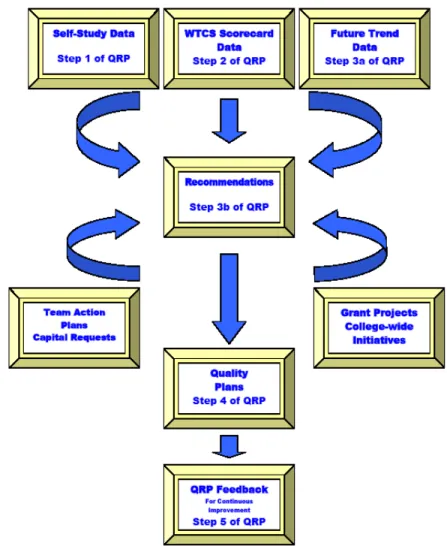
Program level data is collected and distributed as part of the Quality Review Process, a collaborative effort between the WTCS and its colleges to evaluate the quality of the College’s educational programs, apprenticeships and basic and general education teams. As part of this evaluation process, Quality Review Process scorecards are distributed annually using data collected through state reporting. The Quality Review Process scorecards include indicators based on priorities of the College as well as WTCS and strategic directions related to grant requirements.
The College’s mission, vision and strategic directions, which are set by the NTC Board, determine other specific data and information needed by the College. In support of the strategic directions, Team Action Plans are developed at the ELT level and at each individual team level identifying specific team goals. The review and measured progress of these goals lead to specific reports needed by the College and by individual teams. In addition to the WTCS data requirements, the College complies with federal and state requirements through the Integrated Post-Secondary Education Data System (IPEDS) reporting and affirmative action. Data collection and reporting needs are also driven by accreditation guidelines, most importantly The Higher Learning Commission’s (HLC) Annual Institutional Update and the College’s current Key Action Projects.
The College’s ability to govern the management and use of data through information resources and technology is mainly retained by the College itself. However, WTCS state reporting does operate under nine aligned data systems. NTC complies with the WTCS reporting guidelines and processing procedures by designing its data management system (PeopleSoft) to electronically submit student, staff, financial and survey information through each of the nine data systems and different performance edits.
OV8 NTCs Key Commitments, Constraints, Challenges and Opportunities. The economic, political and
logistical environment NTC operates in helps the College to identify its key commitments, constraints, challenges and opportunities with which it must operate. A comprehensive three-year strategic planning cycle provides the framework for identifying and analyzing the College’s key commitments, constraints, challenges and opportunities. The College’s key commitments are expressed in its newly adopted strategic directions:
Growth—The College achieves growth through innovation, flexibility, access and the strategic analysis and
marketing of competitive and environmental information.
Innovation—The College implements new products or services to meet current and future stakeholder needs. Strategic Partnerships—The College becomes the preferred strategic partner of K-12 districts, local communities,
area businesses and industries, entrepreneurs and other institutions of higher education to support learning and economic development, establishing NTC as an educational leader.
Organizational Development—The College encourages and supports professional growth throughout the organization. Continuous Quality Improvement—The College develops innovative ways to continually improve learning and
support systems, processes and resources that enhance organizational effectiveness.
Fiscal Strength—The College prudently manages and strengthens its financial resources in order to thrive in a
complex and changing environment.
Sustainability—The College demonstrates a responsible use of natural resources within College operations and
learning.
NTCs self-identified constraints:
• Accounting for reduced funding from stagnating property values • Adhering to WTCS statutory requirements
• Increasing competition from for-profit educational facilities • Managing unpredictable levels of state aid from year-to-year • Meeting unfunded/underfunded government mandates • Overcoming the image of a technical college education • Providing an equal level of service across the District • Providing services in a largely rural 10-county District • Rising health insurance costs for employees
Figure OV9-1 NTCs Key Partnerships
These constraints have cross-cutting effects throughout the College. Given these constraints, the College is challenged to:
• Account for the limited Internet bandwidth or lack of access to high speed Internet in rural portions of the District • Balance the expectations of four bargaining units while functioning as a flexible and accessible institution • Budget with decreased funding while maintaining the same level of service, especially with no additional
financial support to serve a significant influx of dislocated workers • Maximize finite financial resources with ever-increasing cost demands
• Meet the differing expectations/attitudes/skills of a multi-generational student body
• Meet the increased demand for services due to the influx of dislocated workers, underprepared learners and people seeking a more economical education
• Provide a balance of high and low cost program offerings while meeting the job market demand • Provide appropriate course delivery technology to reach students due to the size of the District
• Understand and respond to the economic struggles affecting students in an era of high unemployment, wage stagnation and economic recession
These commitments, constraints and challenges have presented NTC with many opportunities. • To develop and implement varied and innovative course delivery offerings
• To empower an engaged staff at all levels to achieve shared goals
• To expand partnerships with government, K-12 and other higher education institutions, business and industry • To identify and cultivate alternative resources to support educational offerings, enhance or expand facilities
and increase services for growth
• To nurture the change of the College’s image as a key player in regional economic development efforts, providing additional opportunities for the College in the future
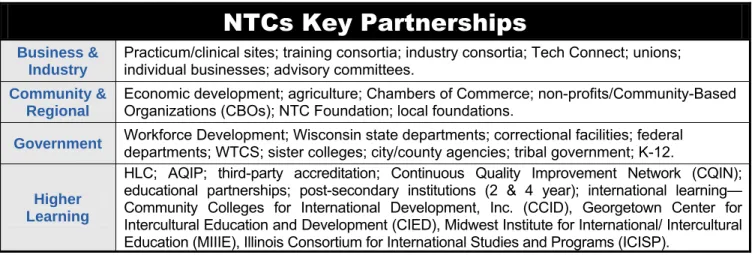
OV9 NTCs Key Partnerships and Collaborations. NTC places a high value on building and maintaining strong
partnerships within its 10-county region as well as within the walls of each of its seven campuses. As President Weyers states, “Without collaboration, none of us can be successful.” The partnerships listed in Figure OV9-1 are key in providing excellent, pertinent and cost-effective educational services to the communities served by NTC. Through these partnerships, NTC is able to leverage additional resources, expand services, support economic development and grow its educational programs and services. Figure OV9-1 showcases the dynamic collaborative partnerships that NTC has recently fostered. These entities have shown commitment to the vision and mission of NTC as they each have played a vital role in enhancing learning to provide successful experiences for students. NTCs K-16 partnerships are listed in Category 2.
NTCs Key Partnerships
Business & Industry
Practicum/clinical sites; training consortia; industry consortia; Tech Connect; unions; individual businesses; advisory committees.
Community & Regional
Economic development; agriculture; Chambers of Commerce; non-profits/Community-Based Organizations (CBOs); NTC Foundation; local foundations.
Government Workforce Development; Wisconsin state departments; correctional facilities; federal departments; WTCS; sister colleges; city/county agencies; tribal government; K-12.
Higher Learning
HLC; AQIP; third-party accreditation; Continuous Quality Improvement Network (CQIN); educational partnerships; post-secondary institutions (2 & 4 year); international learning— Community Colleges for International Development, Inc. (CCID), Georgetown Center for Intercultural Education and Development (CIED), Midwest Institute for International/ Intercultural Education (MIIIE), Illinois Consortium for International Studies and Programs (ICISP).
Figure 1P2-1 NTCs PBL Model
DACUM
Occupational Analysis
Industry Standards
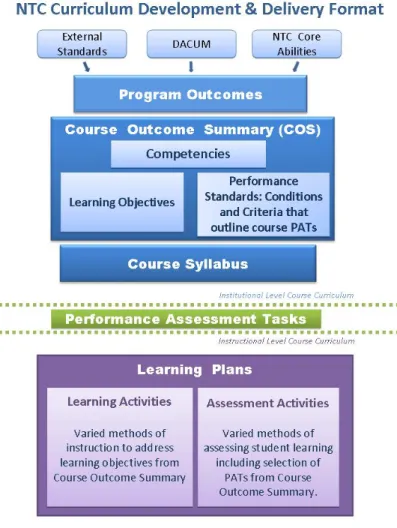
Exit Learning Outcomes
Core Abilities Learning or Assessment Wha t w ill I te ac h? Learning Objective Learning
Objective Objective Learning
Criterion Criterion Criterion Condition
Learning Activity
Learning
Activity Learning Activity Performance Assessment Task Ho w w ill th e stud en t learn th e conte nt t o pe rfor m th e s kill ? How wi ll the s tu de nt pro ve th ei r l earni ng ? How wi ll I k no w if th e stu de nt learn ed?
Link Competencies & Performance Criteria/Conditions
Performance Standards
+
=
Category 1 Helping Students Learn
_
___
___
___
___
___
___
___
___
___
___
___
___
___
___
___
___
___
___
___
___
___
___
___
___
___
___
___
___
___
___
___
___
___
___
___
___
___
___
___
___
___
___
___
___
___
___
___
___
___
___
___
___
___
___
___
___
___
___
___
___
___
___
___
___
___
___
___
___
___
__
1P1 NTCs Common Learning Objectives. Common learning objectives represent overall employability skills and
knowledge graduates need to be successful in the workplace. Common learning objectives, called core abilities at NTC, were established in 1998 and follow the core ability model adopted by the
Wisconsin Technical College System (WTCS). NTCs core abilities were re-evaluated in 2002 resulting in a more focused list of learning objectives created and validated by internal and external stakeholders. In 2003, 75 key stakeholders (consisting of business leaders, community, student panels, faculty members and curriculum support staff) assisted in the creation of core ability indicators that may be used to measure student attainment of these common learning objectives. Core abilities, listed in Figure 1P1-1, are embedded in curricula in general education, associate degrees, technical diplomas, certificates and stand alone courses. They are annually reviewed at a program and course level through the Curriculum
Modification Process. Figure 1P1-1 Core Abilities 1P2 Program Learning Objectives. College programs have specific learning objectives called “program
outcomes” and courses have learning objectives called “course competencies” that represent occupation-specific abilities graduates need for occupational success. Programs that have an external credentialing body that has direct or indirect oversight of educational outcomes (for credentialing or certification purposes) have established learning outcomes that align with the
credentialing authorities’ requirements. These credentialing authorities include, but are not limited to, the Wisconsin Department of Health and Family Services, National League for Nursing Accreditation Commission, National Accrediting Agency for Clinical Laboratory Sciences and the American Dental Association Commission on Dental Accreditation.
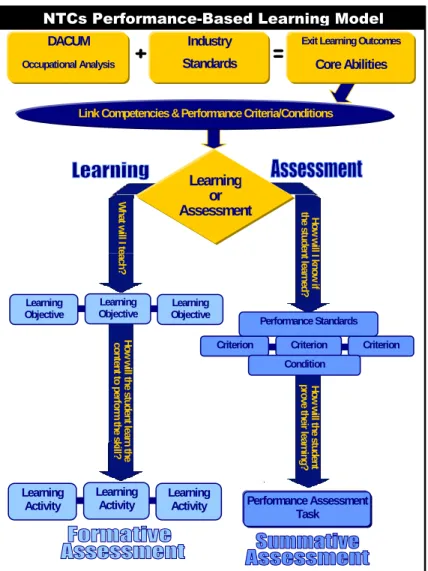
Programs offered in response to local workforce and industry needs are established using the DACUM (Designing a Curriculum) process. A DACUM team includes employers and practitioners in the occupational field along with educators. The process begins with the end in mind, as DACUM team members work to identify duties and tasks required for the profession. Faculty use DACUM results to design program and course outcomes, which are endorsed by program advisory committees. Programs that are offered at most of the 16 WTCS schools often have a statewide curriculum development and modification process for the purpose of aligning curriculum across the system. The alignment process, facilitated by a WTCS curriculum specialist, assists the technical colleges to align program outcomes and course competencies. Program outcomes are reviewed on an annual basis by program advisory committees to ensure outcomes remain relevant to workforce needs. Figure 1P2-1 shows how NTCs performance-based learning (PBL) model determines program learning objectives.
NTCs Core Abilities Act responsibly
Communicate clearly Demonstrate integrity Develop global awareness Think critically and creatively Work cooperatively
Work productively
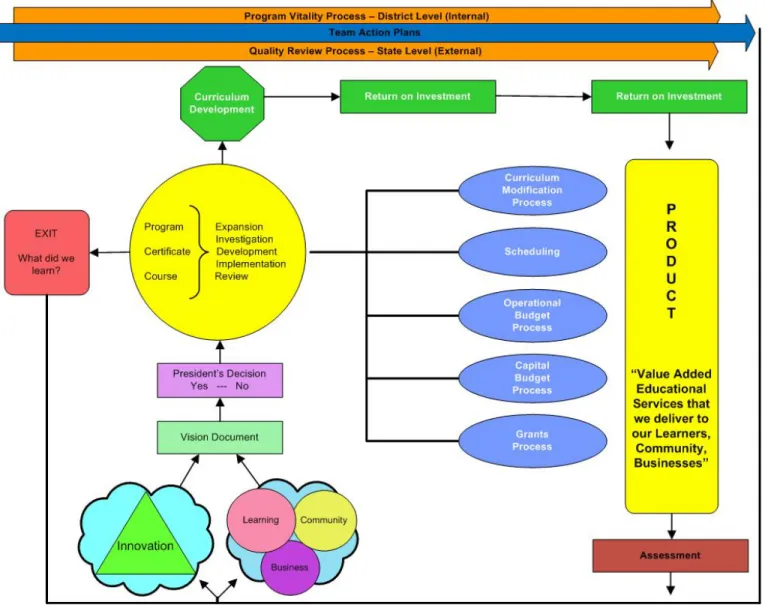
1P3 New Program and Course Design. NTC has a sequential Product Development Plan process. Development
phases include: Expansion, Investigation, Development, Implementation and Review. Figure 1P3-1 illustrates this process. New learning opportunities identified by the Learning Team based on workforce and community demands are preliminarily investigated through secondary research methods (DACUMs). Once the investigation is completed, a decision is made to advance the product to the next phase, development or end the process. After development the product goes to the implementation phase. The implementation phase begins with offering courses or programs. Each dean is able to review and update the Product Development Plan on a monthly basis through the Product Development Database.
New programs are subject to the program implementation process set forth by the WTCS Office. This process includes extensive research into the employability and wage potential of graduates, uniqueness of the offering within the system and program cost to taxpayers. Both the NTC and WTCS Board of Trustees are involved in approving new opportunities. To ensure workforce readiness and the competitive advantage of program graduates, NTC involves local workforce representatives on New Program Implementation Teams. These participants represent the unique needs of the District’s employers for a given sector and assist with aspects of implementation including program content and outcomes, integration of core abilities, structure, format and delivery method. In addition, local business and industry assist the College in identifying the global economic needs of new programs to ensure graduates are prepared for their integration into the ever-evolving global market.
1P4Designing Responsive Academic Programming. NTC recognizes that each learner and every industry are
unique. Students come to the College with specific learning and career goals, which may or may not change during their learning journey. Similarly, industry needs for skilled workers continue to progress and transform as their business evolves. Offerings range from courses, certificates, short-term technical diplomas, one- and two-year technical diplomas to associate degrees designed for completion in two years. Recognizing that one size does not fit all, NTC provides learning in different formats, modes and timeframes. The College works to ensure that each offering provides as many academic and career laddering opportunities as possible to meet the dynamic goals of NTCs students. These laddering opportunities are accessible via the transfer section located on the NTC website. The design and implementation of most courses and certificates are at the discretion of the NTC District. These offerings allow the College to rapidly respond to employee and employer needs within the communities it serves. The short-term nature of these offerings allow for swift design and implementation of curriculum that can provide entry-level or continued training. For example, coursework may include ways to enhance technology skills, such as competence in the use of new software or introduce the use of a new technique or skill within the profession. NTC continues to grow its offerings in the area of short-term certificates as the demand for post associate and bachelor’s degree skills rise. These offerings allow students to enhance and update their knowledge and skills to meet the dynamic requirements of the workplace and help them demonstrate their unique skill set and capacity to positively impact the workplace.
Short-term, one- and two-year technical diploma and associate degree programs are designed to assist in the development of workforce skills that require hands-on acquisition of skills. In partnership with industry, the College strives to deliver academic content in a format that encourages the greatest achievement of competence in a short period of time. This recognizes not only the need of employers, but the goals of students who wish to gain experience in a skilled trade that will quickly allow them to enter the workforce and also keep the investment in education relative to the earning potential of their career.
1P5 Preparation Required of Students. Although testing of the preparation requirements of students for specific
courses and programs is administered by Student Services, these requirements are determined by the Learning Team in conjunction with program teams. To determine required student preparedness, academic deans meet with teams to review and recommend entry-level program admission requirements using a variety of external criteria and internal information including success rates of current and past students, state and federal statutes, peer institution admissions criteria, advisory committee input and statewide curriculum project team recommendations. Criteria are established during the program development process and annually reviewed to avoid turning away potential students or ensure enrolling prepared students.
In addition to successful completion of their high school degree or GED/HSED, potential students complete admissions testing to assess their preparation for program courses. Students not meeting the required scores do self-paced remediation in the Learning Center as described in 1P8. Utilizing the general education courses common to all programs, the College is determining the appropriate general education entrance criteria for programs. Program teams are asked to use the admissions score recommendations set forth by the general education faculty related to the courses they have selected for their program requirements. To further ensure successful retention of students, NTC program teams carefully evaluate course sequencing and course pre-requisite and co-pre-requisite requirements within the curriculum. Keeping flexibility in mind at all times, program teams layout the progression of courses ideal for student attainment of competence and ultimately student success.
1P6 Communicate Expectations to Students. NTC utilizes a variety of methods to share information about the
College with current and prospective students including print media, face-to-face communication strategies and electronic marketing incorporating radio, television, web and social-networking components. This communication focuses on general College information along with preparation needed to enroll at NTC, support services available to assist in that preparation, learning objectives and outcomes for programs and pathways for education beyond NTC. The Student Services team provides integral connections with prospective students including those who are leaving the K-12 systems in our communities and returning adults wishing to retool their career or expand their knowledge related to a current position. Career Coaches work within the K-12 schools to provide students and parents with information on the array of courses, certificates and programs available. In addition, they assist students in gaining the appropriate academic preparation required for their career path while still in high school. While often focusing more broadly on supporting student’s pathways to higher education, the Career Coaches utilize the College’s website and print media to attract future learners and provide clear communication about program requirements and objectives. Enrollment advisors work with all other prospective NTC students to assist in the enrollment needs