Calhoun: The NPS Institutional Archive
Reports and Technical Reports All Technical Reports Collection
2010-08-02
Joint Effects-based Contracting and
"Phase - "0" Operations
Yoder, E. Cory
=
^Åèìáëáíáçå=oÉëÉ~êÅÜ=mêçÖê~ã=
do^ar^qb=p`elli=lc=_rpfkbpp=C=mr_if`=mlif`v= k^s^i=mlpqdo^ar^qb=p`elli=
Approved for public release, distribution is unlimited.
Prepared for: Naval Postgraduate School, Monterey, California 93943
NPS-CM-10-160
^`nrfpfqflk=obpb^o`e=
pmlkploba=obmloq=pbofbp=
=
Phase Zero Operations for Contingency and Expeditionary Contracting–Keys to Fully Integrating Contracting Into
Operational Planning and Execution 2 August 2010
by
E. Cory Yoder, Senior Lecturer Graduate School of Business & Public Policy
=
^Åèìáëáíáçå=oÉëÉ~êÅÜ=mêçÖê~ã=
do^ar^qb=p`elli=lc=_rpfkbpp=C=mr_if`=mlif`v= k^s^i=mlpqdo^ar^qb=p`elli=
The research presented in this report was supported by the Acquisition Chair of the Graduate School of Business & Public Policy at the Naval Postgraduate School.
To request Defense Acquisition Research or to become a research sponsor, please contact:
NPS Acquisition Research Program
Attn: James B. Greene, RADM, USN, (Ret) Acquisition Chair
Graduate School of Business and Public Policy Naval Postgraduate School
555 Dyer Road, Room 332 Monterey, CA 93943-5103 Tel: (831) 656-2092
Fax: (831) 656-2253
e-mail: [email protected]
Copies of the Acquisition Sponsored Research Reports may be printed from our website www.acquisitionresearch.org
= = ^Åèìáëáíáçå=oÉëÉ~êÅÜ=mêçÖê~ã= do^ar^qb=p`elli=lc=_rpfkbpp=C=mr_if`=mlif`v - i - k^s^i=mlpqdo^ar^qb=p`elli=
Abstract
The Naval Postgraduate School (NPS) has published several works that highlight significant progress in the planning and execution of Operational Contract Support. For example, The Yoder Three-tier Model for Optimal Planning and
Execution of Contingency Contracting (YTTM) research project (NPS-AM-05-002),
the Joint Effects-based Contracting project (NPS-AM-08-127), and many others are recent published works that may be instrumental in shaping public and military policy related to the structure, planning, and execution of Operational Contract Support.
Of particular note is the NPS Joint Effects-based Contracting project (NPS-AM-08-127), which created a new concept of Operational Contract Support and developed and exercised simulation modeling to demonstrate the efficacy of the concepts. A key element of the work was the identification and creation of a Phase “0” operational model. The results are that with the Phase “0” concept in operation, significant efficiencies and greater effectiveness can be achieved in planning and executing any operation requiring Operational Contract Support.
This sponsored research report proposes and formulates the concept of contract integration into joint doctrine and planning documents as a key element of meeting potential gains in efficiency and effectiveness of operations, and in meeting elements of the revised title 10 U.S.C. section 2333, directly shaping public policy. Of particular concern to the author is that despite significant movement and progress in developing the Operational Contract Support construct, joint planners and
practitioners in supported and supporting roles are still suboptimized due to the lack of an integrated structure and construct at the joint strategic level.
The early planning phase parleyed terminology utilized by the warfighter and planning communities, aptly titled Phase Zero operations, that is, all planning and exercising that can and should occur prior to an actual real-world event or before a contingency crisis is manifest. The clear purpose and intent of this research is to
= =
^Åèìáëáíáçå=oÉëÉ~êÅÜ=mêçÖê~ã=
do^ar^qb=p`elli=lc=_rpfkbpp=C=mr_if`=mlif`v - ii -
k^s^i=mlpqdo^ar^qb=p`elli=
provide a concept model that can guide planners and resource holders to create and utilize the recommended mix of personnel, platforms, and protocols to achieve better contracted effects, create efficiencies and effectiveness, and improve business operations across the full spectrum of war and peacetime operations.
The research incorporates a thorough examination and review of key literature germane to the background and development of the work. The author creates a framework of integration into Phase Zero – shaping phase- doctrine and provides the construct for operation reality.
This work will formulate and further develop operational construct concepts into executable concepts for incorporation into joint doctrine, planning documents, and business operations, and will explore implications for war-fighters, logisticians, and contracting offices. Specific conclusions and recommendations are provided in the final chapter, along with areas recommended for further research.
The concepts developed and presented in this research report will meet the warfighter and legislative requirements for improved integrative planning, and will be optimized to complement and best support the Unified Combatant Commander’s desired effects as iterated in the Operation Plans and Operation Orders - OPLAN and OPORD - by incorporating a holistic approach of the right mix of credentialed personnel; refinement and utilization of existing platforms utilized in the joint planning environment; and implementing, exercising, and fully employing forward-leaning protocols necessary for the creation of a sound business effect.
Keywords: Contracting, Contingency Contracting, Expeditionary Contracting, Joint Planning, Joint Contract and Logistics Planning, Contracting workforce, Joint Doctrine, Joint Publication JP 4-10, Operational Phasing, Effects-based Contracting, Yoder Three-tier Model, Joint Operations Planning, Operational Contract Support, Operational Contracting Support, OCS.
= = ^Åèìáëáíáçå=oÉëÉ~êÅÜ=mêçÖê~ã= do^ar^qb=p`elli=lc=_rpfkbpp=C=mr_if`=mlif`v - i - k^s^i=mlpqdo^ar^qb=p`elli=
Acknowledgments
I would like to thank the Acquisition Research Program team, RADM Jim Greene, Karey Shaffer, and Tera Yoder, and the editors, for their dedication and continuous support and assistance. What a great team!
I also extend thanks and appreciation to my wife and daughters, Nicoline, Olivia, and Katie, for their encouragement, support, and dedication to my efforts at the Naval Postgraduate School, and for their sound advice both personally and professionally. They are the loves of my life, and what a great team we make!
Lastly, I thank my mother, Dixie Yoder, for her continued mentorship, encouragement and excitement for my work at the Naval Postgraduate School.
= =
^Åèìáëáíáçå=oÉëÉ~êÅÜ=mêçÖê~ã=
do^ar^qb=p`elli=lc=_rpfkbpp=C=mr_if`=mlif`v - ii -
k^s^i=mlpqdo^ar^qb=p`elli=
= =
^Åèìáëáíáçå=oÉëÉ~êÅÜ=mêçÖê~ã=
do^ar^qb=p`elli=lc=_rpfkbpp=C=mr_if`=mlif`v - iii -
k^s^i=mlpqdo^ar^qb=p`elli=
About the Author
CDR (Ret) Cory Yoder is a faculty member of the Naval Postgraduate School’s Graduate School of Business and Public Policy (GSBPP). Yoder was originally assigned to NPS in July 2000 while on active duty commission with the Navy. He was then appointed to a civilian lecturer position in June 2004 and promoted to senior lecturer in May 2008. He has performed duties as academic associate (program manager)for the 815 (MBA) (three-year appointment ending July 2005), and he currently serves as academic associate for the 835 (MSCM— Master of Science in Contract Management program—with an indefinite
appointment). Yoder has strong acquisition and contracting experience combined with several challenging acquisition, logistics, industrial, headquarter, and combat support operations assignments.
In addition to holding the positions of senior lecturer and academic associate at NPS, he has performed in numerous assignments, including, but not limited to the following:
Director and Chief of Logistics, Headquarters, Allied Forces Southern Command (AFSOUTH), Naples, Italy (logistics, contracting, finance within NATO);
Post Commander and Support Group Commander, Kosovo Verification Coordination Center (KVCC), Kumanovo (Skopje), Macedonia;
Officer-in-Charge, Fleet and Industrial Supply Detachment, Long Beach, California;
Stock Control Officer, USS TARAWA (LHA-1);
Aviation and Surface Stores Officer, USS TARAWA (LHA-1);
Naval Acquisition and Contracting Officer (NACO) internship, Naval Regional Contracting Center (NRCC), Washington, DC; and
Supply Officer, USS FANNING (FF-1076). CDR (Ret) Yoder holds the following degrees:
= =
^Åèìáëáíáçå=oÉëÉ~êÅÜ=mêçÖê~ã=
do^ar^qb=p`elli=lc=_rpfkbpp=C=mr_if`=mlif`v - iv -
k^s^i=mlpqdo^ar^qb=p`elli=
Master of Arts in National Security and Strategic Studies, Naval War College (NWC), Newport, Rhode Island;
Master of Science in Management, Naval Postgraduate School, Monterey, CA; and
BS in Business Management, Indiana University, “Kelly” School of Business.
CDR (Ret) Yoder is a Schiefflen award “Top Five Percent” nominee for academic years 2006, 2007, and 2008, and is the course owner and/or primary instructor for the following courses:
MN3304 Cost and Price Analysis & Negotiations (5-2)—DAU CON 217 & CON 218 Certified;
MN3318 Contingency Contracting (3-0)—DAU CON 234 Certified; and
MN3315 Advanced Contract Management (4-0)—DAU CON 214 & CON 215 Certified.
CDR (Ret) Yoder has recently been published or cited in the following works, among others:
Contingency Contracting—A Joint Handbook for the 21st Century;
AFMLA, December 2008. Endorsed by Mr. Shay Assad, OSD, Director of Defense Procurement and Acquisition Policy, and Major General Darryl A. Scott, Deputy Director, Defense Business Transformation Agency, and is certified as the primary guide for all DAU CON 234 course deliveries.
Contracting Out Government Procurement Functions: An Analysis
(NPS-CM-07-105), E. Cory Yoder and Dr. David V. Lamm (presented at the Acquisition Symposium in May 2008).
Capitalizing on Commercial Item Designation Provisions of FAR 13.5;
Getting the Most from Limited Resources (NPS-AM-06-049), E. Cory
Yoder.
Engagement versus Disengagement: How Structural & Commercially
Based Regulatory Changes Have Increased Government Risks in
= =
^Åèìáëáíáçå=oÉëÉ~êÅÜ=mêçÖê~ã=
do^ar^qb=p`elli=lc=_rpfkbpp=C=mr_if`=mlif`v - v -
k^s^i=mlpqdo^ar^qb=p`elli=
Publications resulting from CDR (Ret) Yoder’s Engagement versus
Disengagement NPS working paper include the following:
o Published in the peer-reviewed Journal of Public Procurement
(JOPP) December 2007, Volume 7, Issue 2.
o The Project on Government Oversight (POGO) has published this work as a “white paper,” retaining its NPS branding. POGO is a nationally recognized leader in Government acquisition oversight and policy analysis, and provides testimony on key topics to Congress.
o Referenced and cited in the Report of the Commission on Army Acquisition and Program Management in Expeditionary
Operations, Dr. Jacques Gansler, Chairman, former Deputy
Under Secretary of Defense (Acquisition, Technology & Logistics), October 31, 2007.
o Referenced and cited in the Report of the Defense Science Board Task Force on Management and Oversight in Acquisition
Organizations, USD (AT&L), Washington, DC, March 2005.
Yoder Three-Tier Model for Optimal Planning and Execution of
Contingency Contracting (NPS-AM-05-002).
Publications resulting from CDR (Ret) Yoder’s Three-Tier ModelNPS working paper include the following:
o Referenced and cited in the Report of the Commission on Army Acquisition and Program Management in Expeditionary
Operations, Dr. Jacques Gansler, Chairman, former Deputy
Under Secretary of Defense (Acquisition, Technology & Logistics), October 31, 2007.
o Referenced and cited in the July 2006 Special Inspector
General Report for Iraq Reconstruction: Lessons in Contracting
and Procurement, Office of the Special InspectorGeneral for
Iraq Reconstruction, 2006.
o Presented at the 2005 Acquisition Research Symposium in Monterey, California, and included in the proceedings of the Second Annual Acquisition Research Symposium, Acquisition
= =
^Åèìáëáíáçå=oÉëÉ~êÅÜ=mêçÖê~ã=
do^ar^qb=p`elli=lc=_rpfkbpp=C=mr_if`=mlif`v - vi -
k^s^i=mlpqdo^ar^qb=p`elli=
o Published as “Contingency Contracting Operations—Achieving Better Results,” an excerpt in the Army AL&T Magazine,
January-February 2004 edition.
CDR Yoder is a Beta Gamma Sigma honor society member with a lifetime appointment; he is certified DAWIA Contract Level III; he is an active member of the Institute for Supply Management (ISM); and he holds an active Top Secret security clearance.
= = = ^Åèìáëáíáçå=oÉëÉ~êÅÜ=mêçÖê~ã= do^ar^qb=p`elli=lc=_rpfkbpp=C=mr_if`=mlif`v - vii - k^s^i=mlpqdo^ar^qb=p`elli= = NPS-CM-10-160
^`nrfpfqflk=obpb^o`e=
pmlkploba=obmloq=pbofbp=
=
Phase Zero Operations for Contingency and Expeditionary Contracting – Keys to Fully Integrating Contracting Into
Operational Planning and Execution 2 August 2010
by
E. Cory Yoder, Senior Lecturer Graduate School of Business & Public Policy
Naval Postgraduate School
Disclaimer: The views represented in this report are those of the author and do not reflect the official policy position of the Navy, the Department of Defense, or the Federal Government.
= = = ^Åèìáëáíáçå=oÉëÉ~êÅÜ=mêçÖê~ã= do^ar^qb=p`elli=lc=_rpfkbpp=C=mr_if`=mlif`v - viii - k^s^i=mlpqdo^ar^qb=p`elli= =
= = ^Åèìáëáíáçå=oÉëÉ~êÅÜ=mêçÖê~ã= do^ar^qb=p`elli=lc=_rpfkbpp=C=mr_if`=mlif`v - ix - k^s^i=mlpqdo^ar^qb=p`elli=
Table of Contents
I. Introduction and Objectives ... 1
A. Background ... 1
B. Objective and Purpose of the Research—Key Planning Elements . 3 C. Research Questions ... 5
D. Methodology and Scope ... 5
E. Terminology ... 7
F. Research Limitations ... 7
G. Chapter Summary—Report Content ... 8
II. Joint Planning Environment—Calls for Integrative Planning ... 11
A. Mandates for Joint and Integrative Planning ... 12
B. Joint Operation Planning Framework and Joint Doctrine ... 14
C. Joint Strategic Planning System (JSPS) and the Joint Operation Planning and Execution System (JOPES)—Platform & Protocol Framework ... 16
D. Joint Publication 4-10, Operational Contract Support ... 19
E. DoD Directive 3020.49, Orchestrating, Synchronizing, and Integrating Program Management of Contingency Acquisition Planning and Its Operational Execution ... 23
III. Premise of the Yoder Three-Tier Model and Joint Effects-Based Contracting Execution System (JEBCES) and Phase Zero ... 25
A. Yoder Three-Tier Model (YTTM) ... 25
B. The YTTM Conclusions and Recommendations ... 30
C. The Yoder Three-Tier Model Gains Traction in the Broader Community ... 32
= =
^Åèìáëáíáçå=oÉëÉ~êÅÜ=mêçÖê~ã=
do^ar^qb=p`elli=lc=_rpfkbpp=C=mr_if`=mlif`v - x -
k^s^i=mlpqdo^ar^qb=p`elli=
E. Yoder Three-Tier Model as a Building Block for Additional Research and the Joint Effects-Based Contracting and Execution System
(JEBCES) ... 33
F. The Joint Effects-Based Contracting Execution System (JEBCES): A Proposed Enabling Concept for Future Joint Expeditionary Contracting Execution ... 33
G. Chapter Summary ... 40
IV. Integrating YTTM & JEBCES in Phase Zero ... 41
A. Introduction ... 41
B. Key Pillars for Integrative Success: Personnel, Platforms, Protocols42 C. Addressing Universal Questions of Integration ... 43
D. Time-Phase Integrated Product—The Contracting Support Integration Plan (CSIP) ... 63
E. Process Mapping—Laying Out the Integrated Concept ... 65
F. Chapter Summary and Conclusion ... 65
V. Conclusions, Recommendations, and Implications for Policy Makers: Phase Zero Contracting Operations ... 67
A. Introduction ... 67
B. Conclusions and Implications ... 69
C. Recommendations... 73
D. Areas for Additional Research ... 74
E. Final Summary ... 75
= =
^Åèìáëáíáçå=oÉëÉ~êÅÜ=mêçÖê~ã=
do^ar^qb=p`elli=lc=_rpfkbpp=C=mr_if`=mlif`v= = - 1 -
k^s^i=mlpqdo^ar^qb=p`elli=
I.
Introduction and Objectives
A. Background
The Department of Defense’s (DoD) use ofcontractors has increased dramatically in the past decade. In Iraq alone, the number of contractor
personnel now exceeds the number of uniformed military personnel. Congress has recently increased scrutiny and expressed concern over the significant challenges that the DoD faces in planning, executing, and managing Operational Contract Support. Among the many challenges are, for example, failure to
adequately integrate contracting into operation planning, exercising and employment in actual crisis events. To address these concerns, Congress enacted an amendment to title 10 U.S.C. adding section 2333 directing the Secretary of Defense in consultation with the Joint Chiefs of Staff to develop joint policy for contingency and Operational Contract Support requirements definition, contingency program management, and contingencyoperations during combat and post-conflict operations. This mandate, in addition to concepts presented in this paper, create the framework for a better structure for planning and executing joint planning. The research proposes concepts for integrating contract support into comprehensive plans for effective and efficient utilization of contractors in supporting roles across the full spectrum of war, peacetime, and other operations in which contractors will be integral to mission success.
To date, Government Accountability Office (GAO) reports indicate that some progress has been made in Operational Contract Support. However, it is essential that additional progress be made to ensure effective and efficient integration of contracted support into operations plans (OPLANs) and operations orders (OPORDs) in order to meet the increasing demands of the warfighter, the congressional overseers, and for the increased and continued confidence of the American taxpayers.
= =
^Åèìáëáíáçå=oÉëÉ~êÅÜ=mêçÖê~ã=
do^ar^qb=p`elli=lc=_rpfkbpp=C=mr_if`=mlif`v= = - 2 -
k^s^i=mlpqdo^ar^qb=p`elli=
The Naval Postgraduate School has published several works that highlight significant progress in the planning and execution of Operational Contract
Support. For example, The Yoder Three-tier Model (YTTM) (NPS-AM-05-002), the Joint Effects-based Contracting project (NPS-AM-08-127), and many others, are recent published works that may be instrumental in shaping public and military policy related to the structure, planning, and execution of Operational Contract Support.
Of particular note is the NPS Joint Effects-based Contracting project (NPS-AM-08-127), which created a new concept of operational contract support and developed and exercised simulation modeling to demonstrate the efficacy of the concepts. Among key elements of the work was the identification and
creation of a Phase Zero operational model. The results are that with the Phase Zero concept in operation, significant efficiencies and greater effectiveness can be achieved in planning and executing any operation requiring Operational Contract Support.
This sponsored research report proposes the concept of integration into joint doctrine and planning documents as a key element in meeting potential gains in efficiency and effectiveness of operations, and in meeting essential elements directly shaping public policy. Of particular concern to the author is that despite significant movement and progress in developing the Operational
Contract Support (OCS) construct, joint planners and practitioners in supported and supporting roles are still suboptimizing due to lack of an integrated structure and construct at the joint strategic level.
This work will construct and further develop operational construct
concepts into executable concepts for incorporation into joint doctrine, planning documents, business operations, and it will explore implications for warfighters, logisticians, and contracting offices. Specific conclusions and recommendations are provided in the final chapter, along with areas recommended for further research.
= =
^Åèìáëáíáçå=oÉëÉ~êÅÜ=mêçÖê~ã=
do^ar^qb=p`elli=lc=_rpfkbpp=C=mr_if`=mlif`v= = - 3 -
k^s^i=mlpqdo^ar^qb=p`elli=
This research incorporates a thorough examination and review of key literature germane to the background and development of this work. It creates a concept of integration to show the structure and conduct of integrating Phase Zero into doctrine and provides the construct for sound operation reality.
B. Objective and Purpose of the Research—Key Planning
Elements
Planning and exercising is essential for warfighters and business
practitioners alike.In the Unified Combatant Commanders’ arena, a significant amount of time, energy, and resources are devoted to the integrative planning and exercising of war plans. However, the same level of time, energy, and resources have been woefully omitted in integrating a key complementary support element for traditional logistics plans in even the most critical of Operations Plans (OPLANs)—including the plan for Operation Iraqi Freedom (Anderson & Flaherty, 2003). Integrated planning, wherein contract support design is fully integrated into operation plans and is fully exercised, is an essential and imperative element of sound doctrine and business practice. To highlight the need for integrative planning and the significant lack of an integrated planning structure, which failed to incorporate contracting into major war plans, joint applied project authors Flaherty and Anderson (2003) examined the
Operation Iraqi Freedom OPLAN/OPORD Contingency Contracting Support Plan (CCSP) and found that it was regrettably deficient, and that it lacked sufficient structure and necessary detail.
The planning of military operations should take into account all of the critical and essential elements to create the desired effect in concert and harmony with the Unified Combatant Commander’s intent. The researcher published a working paper titled The Yoder Three-Tier Model for Optimal
Planning and Execution of Contingency Contracting (2003) that created the
construct for a tiered structure, capitalizing on specific credential, experiential, and educational criteria for assignment of personnel for strategic and operational
= =
^Åèìáëáíáçå=oÉëÉ~êÅÜ=mêçÖê~ã=
do^ar^qb=p`elli=lc=_rpfkbpp=C=mr_if`=mlif`v= = - 4 -
k^s^i=mlpqdo^ar^qb=p`elli=
planning and operational and tactical execution of contracting functions (Yoder, 2004).
Subsequently, student researchers, and joint applied project and
Acquisition Research Program sponsored research authors Kelly Poree, Karina Curtis, Jeremy Morrill, and Steven Sherwood (2008a, 2008b), further developed the Yoder Three-tier Model through incorporation of key planning elements and methodologies, such as strategic purchasing analysis, in the joint planning construct. These researchers created a modeling and simulation that used sensitivity analysis, with varying degrees of utilization of proposed concepts, to demonstrate the efficacy of higher integrative planning concepts. The results were striking in that prior contract planning and integration utilizing specific concepts such as, spend analysis and creation of “ready” contracts, created a huge return in capability “effects” and reduction of cycle time response to the warfighter.
The early planning phase parlayed terminology utilized by the warfighter and planning communities, aptly titled Phase Zero operations, that is, all planning and exercising that can and should occur before an actual real-world event or contingency crisis is manifest. The clear purpose and intent of this research is to provide a concept model that can guide planners and resource holders to create and utilize the recommended mix of personnel, platforms, and protocols to achieve better contracted effects, create efficiencies and effectiveness, and improve business operations across the full spectrum of war and peacetime operations.
The concept development presented in this research report will meet the warfighters’ and the legislative requirements for improved integrative planning, and will be optimized to complement and best support the Unified Combatant Commander’s desired effects as iterated in the OPLANs and OPORDs. This is accomplished by incorporating a holistic approach including the right mix of credentialed personnel; the refinement and utilization of existing platforms used
= =
^Åèìáëáíáçå=oÉëÉ~êÅÜ=mêçÖê~ã=
do^ar^qb=p`elli=lc=_rpfkbpp=C=mr_if`=mlif`v= = - 5 -
k^s^i=mlpqdo^ar^qb=p`elli=
in the joint planning environment; and, the implementing, exercising, and full employment of forward-leaning protocols necessary for the creation of a sound business effect.
C. Research Questions
The primary research question is: How can the Yoder Three-tier Model and Joint Effects-based Contracting Execution Systems improve DoD and joint contingency contracting support planning processes?
In order to answer the primary question, five subsidiary questions are posed, addressed, and answered:
1. What current initiatives are targeted at improving joint contingency contract planning?
2. What are the key elements of the Yoder Three-tier Model and the Joint Effects-based Contracting Execution System, and do they complement current initiatives?
3. What primary pillars, or elements, are required for optimizing joint contingency contract planning?
4. How can the Yoder Three-tier Model and the Joint Effects-based Contracting Execution System be integrated at the strategic planning level to optimize results?
5. What policy implications are inherent if the research conclusions and recommendations are followed?
D. Methodology and Scope
I conducted a thorough and extensive literature review, utilized graduate student teams (i.e., working groups) to analyze doctrine and written policies, and capitalized on personal experience and imagination to develop this body of work and its concepts. A more detailed explanation of the methodology follows.
I conducted a thorough and extensive examination and review of existing published works, including, but not limited to, Joint Doctrine, Commission
= =
^Åèìáëáíáçå=oÉëÉ~êÅÜ=mêçÖê~ã=
do^ar^qb=p`elli=lc=_rpfkbpp=C=mr_if`=mlif`v= = - 6 -
k^s^i=mlpqdo^ar^qb=p`elli=
Reports (Gansler, 2007; –CWCIA, 2009, Department of Defense directives and instructions, student theses and joint applied projects, sponsored research and working papers, Congressional Research Service reports, Government
Accountability Office reports and testimony, and published documentation, slides, and reports from Joint and Service community planners, contracting experts, and practitioners.
Additionally, two teams of graduate students were utilized to examine and provide critical assessment of “Phase Zero” operations (planning in advance of a real event) in respect to contingency contracting, including, but not limited to: (1) the Yoder Three-tier Model (Yoder, 2004); (2) the Joint Effects-based Contracting Execution System (Poree, et al., 2008a, 2008b); (3) Joint Publication 4-10
(CJCS, 2008b); and (4) other pertinent referenced documents. Team 1 consisted of 19 uniformed officers from the Army and the Navy and international students enrolled in the Naval Postgraduate School’s MBA program. Team 1 was in their fifth program quarter (out of six total quarters) and enrolled in the MN3318
Contingency Contracting course. The mix of Team 1 students ranked on average at the 0-3 to 0-4 level and about half of them had at least one prior tour in a contingency or expeditionary operational billet. Team 2 consisted of 15 students enrolled in the Master’s of Science in Contract Management (MSCM) curriculum in their sixth quarter of an eight-quarter program. This group predominantly consisted of Department of the Army civilian 1102 series contract specialists. A majority of these students were DAWIA Con Level II or III, with an average of seven years of experience in contracting positions.
When either subject-matter experts or student teams were utilized, the DoD and NPS mandated that Institutional Review Board (IRB) protocols be followed to ensure full notification of the intent to use information gathered for research purposes and related compliance. All information gathered via contact with individuals and/or groups was subject to a prior verbal “consent to use” provision.
= =
^Åèìáëáíáçå=oÉëÉ~êÅÜ=mêçÖê~ã=
do^ar^qb=p`elli=lc=_rpfkbpp=C=mr_if`=mlif`v= = - 7 -
k^s^i=mlpqdo^ar^qb=p`elli=
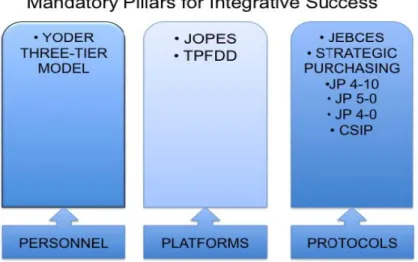
Based on the literature review, consultations, and student team analyses, the author created the framework and concept structure for Joint Effects-based Contracting and Phase Zero Operations, incorporating key pillars that the author considers essential for effective implementation: (1) personnel, (2) platforms, and (3) protocols for integrated planning and execution of contracting functions in OPLANs and OPORDs in harmony with the Unified Combatant Commander’s intent and effect.
E. Terminology
The author recognizes that many in the contracting community may not be well versed in the terminology associated with the joint warfighter community and vice versa. In that regard, every effort has been made to ensure that definitions are provided or that concepts are fully explained. The intent is to ensure that the research product is useful to planners, contracting experts, and warfighters, thereby increasing the potential utility of the work in shaping public policy and practices.
F. Research Limitations
The structure and presentation of this research is designed to provide information on the Joint planning process framework, on the background and premise of the Joint Effects-based Contracting (JEBC), and on Phase Zero operations as appropriate in order for the sponsor and readers to have a useful and meaningful concept for real-world integration and implementation into
existing doctrine and practice. Utilization of existing platforms and processes are paramount because the intent is not to re-invent or change elements of the Joint Planning Process that are currently in place and working. The author developed concepts that rely on existing planning platforms and protocols while adding the critical capability analysis function that is currently lacking at the strategic level.
= =
^Åèìáëáíáçå=oÉëÉ~êÅÜ=mêçÖê~ã=
do^ar^qb=p`elli=lc=_rpfkbpp=C=mr_if`=mlif`v= = - 8 -
k^s^i=mlpqdo^ar^qb=p`elli=
Limitations include those associated with concept development. Specifically, while the concepts were tested through simulation, they will still require actual implementation and refinement, a process that will naturally require additional commitment, dedication, time, and resources. Specific recommendations at the conclusion of this report will address these issues.
G. Chapter Summary—Report Content
This introduction and objectives chapter provided the background, purpose, methodology, and limitations of this sponsored research report.
The following chapter, Chapter II, provides an overview of the Joint Planning environment with particular emphasis on recently introduced doctrine and policy, including Joint Publication 4-10 Operational Contracting Support,
DoD Directive 3020.49 Orchestrating, Synchronizing, and Integrating Program
Contract Support, and recent mandates to integrate contracting into the Joint
Planning system, including title 10 U.S.C. section 2333 of the FY2008 Defense Authorization Act and its implications for contingency and expeditionary contract support planning and execution.
Chapter III, Background and Premise of JEBC and Phase Zero, provides an overview of the Yoder Three-tier Model (YTTM) (Yoder, 2004), its
incorporation in subsequent reports and recommendations, and its use as a building block for the next step in contract planning integration. Chapter III also includes key elements of the Joint Effects-based Contracting student MBA Acquisition Research Program project to demonstrate the potential gains from fully integrated planning and execution.
Chapter IV, Integrating YTTM and Phase Zero, presents the required concept for integrating the personnel, platforms, and protocols effectively.
Chapter V, Conclusions and Recommendations, provides the specific conclusions and related recommendations, including areas for further research
= =
^Åèìáëáíáçå=oÉëÉ~êÅÜ=mêçÖê~ã=
do^ar^qb=p`elli=lc=_rpfkbpp=C=mr_if`=mlif`v= = - 9 -
k^s^i=mlpqdo^ar^qb=p`elli=
and recommendations for an implementation strategy, imperative for policy makers, senior planners within joint and service planning, Unified Combatant Commanders (COCOMs), agencies and service components, and service communities including the logistics and contracting functional area groups.
= =
^Åèìáëáíáçå=oÉëÉ~êÅÜ=mêçÖê~ã=
do^ar^qb=p`elli=lc=_rpfkbpp=C=mr_if`=mlif`v - 10 -
k^s^i=mlpqdo^ar^qb=p`elli=
= =
^Åèìáëáíáçå=oÉëÉ~êÅÜ=mêçÖê~ã=
do^ar^qb=p`elli=lc=_rpfkbpp=C=mr_if`=mlif`v - 11 -
k^s^i=mlpqdo^ar^qb=p`elli=
II.
Joint Planning Environment—Calls for
Integrative Planning
This chapter provides a construct of the Joint Planning Environment and a review of key documents germane to this study. This information is important for those interested in placing the researcher’s model into the broader context of joint planning and execution.
An extensive review of historical and recent literature was conducted with the objective of determining (1) historical backdrop; (2) recent and pertinent legislative, doctrinal, and operational references; and (3) current academic works related to integrative planning and exercising of phase zero operations.
The primary sources of literature include, but are not limited to, (1) Joint Publications (doctrine), including Joint Publication 4-10 and Joint Publication 4-0; (2) Government Accountability Office (GAO) reports that highlight current
initiatives and legislation and provide critical analysis; (3) Department of Defense (DoD) reports, directives, and instructions; (4) NPS joint applied projects; (5) NPS Acquisition Research Program sponsored research reports and working papers; (6) current website publications and postings from the Office of the Secretary of Defense (OSD) and the Joint Staff, including J-4 (Joint Logistics), Army Contracting Command (ACC), the Naval Expeditionary Contracting
Command (NECC), and other key Service-affiliated websites; and, (7) other key documents as referenced herein.1
1
The author reviewed hundreds of relevant documents for this research, totaling over 4,000 pages. Those with particular importance are referenced and/or cited herein and used for establishing the continuity and harmony of the research model against existing Federal mandates, doctrines, and policies.
= =
^Åèìáëáíáçå=oÉëÉ~êÅÜ=mêçÖê~ã=
do^ar^qb=p`elli=lc=_rpfkbpp=C=mr_if`=mlif`v - 12 -
k^s^i=mlpqdo^ar^qb=p`elli=
A. Mandates for Joint and Integrative Planning
The formal requirement for joint planning is not new. In fact, it dates back to the inception of the statutory mandate for Joint structure and command under the Goldwater-Nichols Act of 1986. The Goldwater-Nichols Department of
Defense Reorganization Act of 1986, Public Law 99-433, reworked the command structure of the United States military. It increased the powers of the Chairman of the Joint Chiefs of Staff, implementing some of the suggestions from the Packard Commission formed by President Ronald Reagan in 1985. The statutory
provision created joint billet coding, wherein Joint Professional Military Education (JPME) billets in key functional areas required personnel with joint credentials that had been attained through education and experience. The joint requirement, along with the structural changes that Goldwater-Nichols created via the Joint Command structure, revolutionized the way forces are structured, trained and exercised. However, the author contends that this requirement, in and of itself, did not guarantee that joint and integrative planning in the contracting arena occurred.
Problems encountered in creating and executing comprehensive plans in contracting were manifest despite the Goldwater-Nichols Act.
Operation Iraqi Freedom and the huge theater contracting effect that ensued had little, if any, joint and integrated contract planning in the early phases of the operation.2
2
The author recommends the NPS joint applied project by Anderson and Flaherty (2003) for the examination of the Operation Iraqi Freedom Operation Plans (OPLANs) and other referenced works from the Government Accountability Office (2004, 2008, 2009a, 2009b, 2009c, 2009d, 2009e, 2009f, 2009g, 2010a, 2010b), Special Inspector General for Iraq Reconstruction (SIGIR) (?), the Commission on Wartime Contracting in Iraq and Afghanistan (CWCIA-I/A) (2009), the “Gansler” Report (2007), etc., for a comprehensive examination of the negative effects of the lack of coordinated and integrative planning on military and business operations.
= =
^Åèìáëáíáçå=oÉëÉ~êÅÜ=mêçÖê~ã=
do^ar^qb=p`elli=lc=_rpfkbpp=C=mr_if`=mlif`v - 13 -
k^s^i=mlpqdo^ar^qb=p`elli=
Congress, the GAO, and others have frequently reported on, or expressed concerns about, the long-standing challenges that the DoD faces when
managing operational contract support. These challenges include a failure to adequately plan for the use of contractors, poorly defined or changing
requirements, a lack of deployable contracting personnel with contingency contracting experience, and difficulties in coordinating contracts and contractor management across military Services in joint contingency environments.
Furthermore, as previously stated, the DoD has not provided a sufficient number of trained contract oversight and management personnel in contingency
operations, and visibility of contracting activities and contractors has been limited. As we have testified, problems associated with the DoD's inability to overcome these challenges have resulted in higher costs, schedule delays, unmet goals, and negative operational impacts. To respond to these concerns, Congress enacted an amendment to title 10 of the U.S. Code adding section 2333, which directed the Secretary of Defense in consultation with the Chairman of the Joint Chiefs of Staff to develop joint policies by April 2008 for requirements definition, contingency program management, and contingency contracting during combat and post-conflict operations. In January 2008, the National Defense Authorization Act for Fiscal Year 2008, hereafter referred to as the NDAA FY08, amended section 2333 to add a new subparagraph directing that these joint policies provide for the training of military personnel outside of the acquisition workforce who are expected to have acquisition responsibilities such as oversight of contracts or contractors during combat operations, post-conflict operations, and contingency operations. Additionally, NDAA FY08 directed the GAO to review the DoD's joint policies and determine the extent to which those policies and the implementation of such policies complied with the requirements of section 2333 of title 10 of the U.S. Code3 (GAO, 2008).
3
= =
^Åèìáëáíáçå=oÉëÉ~êÅÜ=mêçÖê~ã=
do^ar^qb=p`elli=lc=_rpfkbpp=C=mr_if`=mlif`v - 14 -
k^s^i=mlpqdo^ar^qb=p`elli=
B. Joint Operation Planning Framework and Joint
Doctrine
Joint doctrine publications and DoD directives and guidance have
recently incorporated many changes to address contracting process integration, to include, but not limited to: Joint Publication 4-10, Operational Contract Support
(CJCS, 2008b); DoD Directive 3020.49, Orchestrating, Synchronizing, and Integrating Program Management of Contingency Acquisition Planning and Its
Operational Execution (USD[AT&L],2009), and GAO references highlighting title
10 U.S.C. section 2333 of the FY2008 Defense Authorization Act, Overview and Implications for Contingency Operations. These documents, along with all other referenced materials, working groups, and the researcher’s professional and academic experiences, provide the analytical framework for placing the Yoder Three-tier Model and the Joint Effects-based Contracting System into a cohesive model for implementation across the Services and in the Joint Unified Combatant Command structure.
Understanding the Joint Operation Planning and Execution System (JOPES) is essential for any practitioner, planner, contracting officer, or senior leader with a role in the design, planning, construct, exercise, and, ultimately, utilization of contracting for any joint operation. And, quite frankly, most, if not all, modern operations have a joint requirement. According to Richard W. Goodale, Jr., in “Planning for War: A System,” “planning must be visionary, quick, flexible, and adaptive. To achieve that end, we must understand the architecture of the planning system and on-going initiatives to improve” (1994).
strategic doctrinal framework, service policies, and operational organization policies in place and
in practice in order to address and overcome the identified deficiencies. A review of key elements is presented in this chapter. However, I contend that doctrinal and operational personnel,
platform, and protocol shortfalls still exist that will sub-optimize and hinder the effective and efficient integrative planning for joint contracting operations, and propose in Chapters IV and V a concept model designed to address those shortfalls.
= =
^Åèìáëáíáçå=oÉëÉ~êÅÜ=mêçÖê~ã=
do^ar^qb=p`elli=lc=_rpfkbpp=C=mr_if`=mlif`v - 15 -
k^s^i=mlpqdo^ar^qb=p`elli=
Joint Publication 5-0 (CJCS, 2006) entitled, Joint Operational Planning, is
the overarching doctrine mandated for utilization by all Services and the Joint community. Joint Publication 5-0 , along with the other Joint doctrine
publications, including Joint Publication 4-0, Joint Logistics Planning (CJCS, 2008a), and Joint Publication 4-10, Operational Contract Support (CJCS, 2008b) discussed subsequently, must be utilized in concert to achieve an integrated logistics and contracting support plan. These joint publications have all undergone recent revisions to reflect the need for more comprehensive examination and integration of doctrinal concepts aimed at providing a better support capability for operations. The recent rewriting of the Joint Publications, “reflects the current doctrine for conducting joint, interagency, and multinational planning activities across the full range of military operations. This vital keystone publication forms the core of joint warfighting doctrine and establishes the
framework for our forces’ ability to fight as a joint team” (CJCS, 2006).
All doctrine must be utilized as the overarching strategic framework for planning, force structuring, and process protocol. Joint doctrine, according to the Joint Chiefs’ and iterate,
[Joint doctrine] applies to the Joint Staff; to commanders of Unified Combatant Commands, sub-unified commands, joint task forces, subordinate components of these commands, and combat support agencies; and to the Services. The guidance in this publication is authoritative; as such, this doctrine will be followed except when, in the judgment of the commander, exceptional circumstances dictate otherwise. If conflicts arise between the contents of this publication and the contents of Service publications, this publication will take precedence unless the Chairman of the Joint Chiefs of Staff, normally in coordination with the other members of the Joint Chiefs of Staff, has provided more current and specific guidance. Commanders of forces operating as part of a
multinational (alliance or coalition) military command should follow multinational doctrine and procedures ratified by the United States. For doctrine and procedures not ratified by the United States, commanders should evaluate and follow the multinational command’s doctrine and procedures, where applicable and consistent with US law, regulations, and doctrine. (CJCS, 2006)
= =
^Åèìáëáíáçå=oÉëÉ~êÅÜ=mêçÖê~ã=
do^ar^qb=p`elli=lc=_rpfkbpp=C=mr_if`=mlif`v - 16 -
k^s^i=mlpqdo^ar^qb=p`elli=
Given the aforementioned mandate to follow joint doctrine for any doctrinal and/or procedural protocol, the researcher thoroughly examined current doctrine to ensure that the model constructs of the Yoder Three-tier Model, the Joint Effects-based Contracting and Execution System, and the main purpose of this research, creating the Phase Zero model, is harmonious with, and
complementary to, established doctrine. For more in-depth information about the contextual framework, examine the referenced documents.
C. Joint Strategic Planning System (JSPS) and the Joint
Operation Planning and Execution System (JOPES)— Platform & Protocol Framework
According to Joint Publication 5-0, “Joint operation planning includes all activities that must be accomplished to plan for an anticipated operation—the mobilization, deployment, employment, and sustainment of forces. Planners recommend and commanders define criteria for the termination of joint
operations and establish criteria for attainment and achievement of the end state. Joint operation planning is an inherent command responsibility established by law and directive” (CJCS, 2006). This publication provides the doctrinal
framework for all other activities related to joint operational planning. Within this construct, Joint Publication 5-0 states:
The Joint Operation Planning and Execution System (JOPES) and the Joint Operation Planning Process (JOPP) share the same basic approach and problem-solving elements, such as mission analysis and course of action development. The combination of JOPES and JOPP promotes coherent planning across all levels of war and command echelons, whether the requirement is for a limited, single-phase operation such as noncombatant evacuation or for a multiphase campaign involving high-intensity combat operations. JOPES formally integrates the planning activities of the entire JPEC during the initial planning and plan refinement that occurs both in peacetime and when faced with an imminent crisis. While JOPES activities span many organizational levels, the focus is on the interaction which ultimately helps the President and Sec Def decide when, where, and how to commit US military capabilities in response to a foreseen contingency or an unforeseen crisis. JOPP is a less formal but
= =
^Åèìáëáíáçå=oÉëÉ~êÅÜ=mêçÖê~ã=
do^ar^qb=p`elli=lc=_rpfkbpp=C=mr_if`=mlif`v - 17 -
k^s^i=mlpqdo^ar^qb=p`elli=
proven analytical process, which provides a methodical approach to planning at any organizational level and at any point before and during joint operations. The focus of JOPP is on the interaction between an organization’s commander, staff, the commanders and staffs of the next higher and lower commands, and supporting commanders and their staffs to develop a joint operation plan (OPLAN) or operation order (OPORD) for a specific mission. (CJCS, 2006)
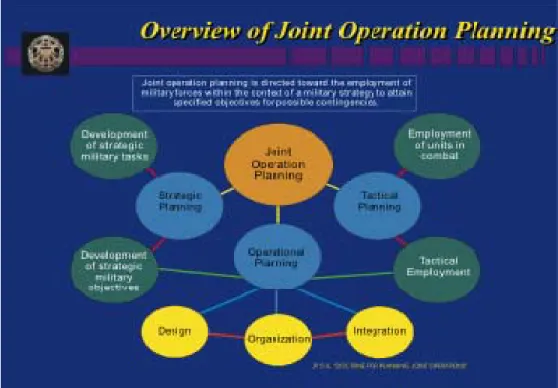
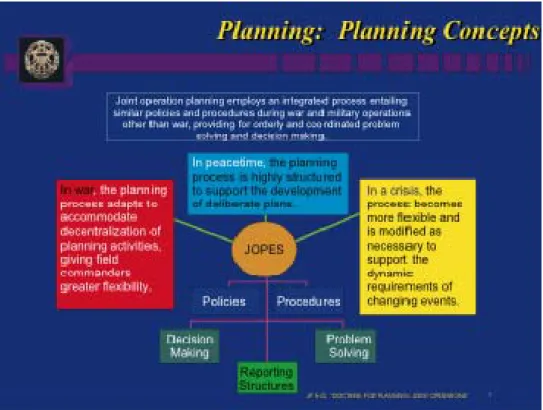
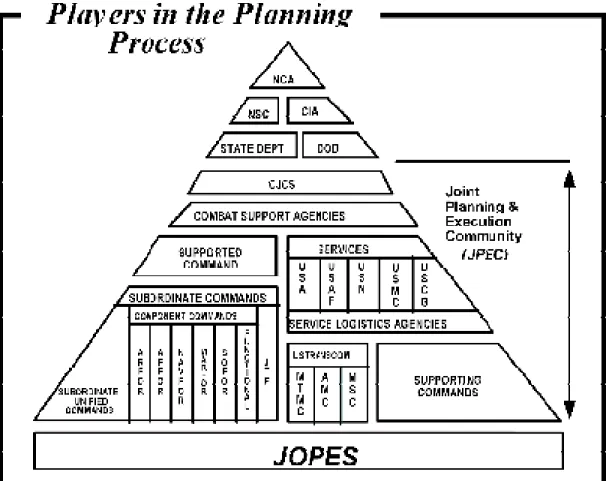
Figure 1. Overview of Joint Operation Planning (CJCS, 2006) JOPES, in essence, provides the platform and associated protocols required for its employment and for the integration of strategic, operational, and tactical elements in the planning, exercising, and execution of complex military operations. It is also the network of systems and people required to coordinate all the efforts in peacetime and wartime environments. JOPES can be viewed as the heart of the “system” utilized in the joint planning community, as evidenced in Figures 1 and 2.
= =
^Åèìáëáíáçå=oÉëÉ~êÅÜ=mêçÖê~ã=
do^ar^qb=p`elli=lc=_rpfkbpp=C=mr_if`=mlif`v - 18 -
k^s^i=mlpqdo^ar^qb=p`elli=
= =
^Åèìáëáíáçå=oÉëÉ~êÅÜ=mêçÖê~ã=
do^ar^qb=p`elli=lc=_rpfkbpp=C=mr_if`=mlif`v - 19 -
k^s^i=mlpqdo^ar^qb=p`elli=
D. Joint Publication 4-10, Operational Contract Support
Joint Publication 4-10 entitled Operational Contract Support (CJCS, 2008)
created doctrine designed to address many of the shortcomings associated with a lack of comprehensive strategic-level contracting doctrine prior to its
publication. Additionally, it fulfilled an essential statutory mandate under title 10 U.S.C. section 2333, as was discussed earlier. Joint Publication 4-10 established doctrine for planning, conducting, and assessing operational contract support integration and contractor management functions in support of joint operations, and it provides standard guidance and information related to integrating
operational contract support and contractor management (CJCS, 2008b).
Joint Publication 4-10 created the doctrinal, strategic-level concept, and
promotes Operational Contract Support (OCS),which is “the process of planning for and obtaining supplies, services, and construction from commercial sources in support of joint operations along with the associated contractor management functions. Successful operational contract support is the ability to orchestrate and synchronize the provision of integrated contract support and management of contractor personnel providing that support” (CJCS, 2008b). Like much of U.S. doctrine, OCS under Joint Publication 4-10 calls for centralized planning with decentralized control.
The doctrine created under Joint Publication 4-10 emphasizes a key role for Unified Combatant Commanders (CCDRs) in relation to integrated planning and assigns unique functional roles and responsibilities to the joint staff codes under joint authority. Figure 3 provides an excerpt from Joint Publication 4-10
that gives specific guidance on this subject.4
4
Joint Publication 4-10 creates flow-down doctrinal responsibilities in addition to the CCDRs listed in Figure 4. However, for the purposes of my model creation and presentation, the CCDR, or COCOM, level and that of the specific Service components is most germane for the
= =
^Åèìáëáíáçå=oÉëÉ~êÅÜ=mêçÖê~ã=
do^ar^qb=p`elli=lc=_rpfkbpp=C=mr_if`=mlif`v - 20 -
k^s^i=mlpqdo^ar^qb=p`elli=
Figure 3. Excerpt from Joint Publication 4-10 (CJCS, 2008b, pp. II-8–II-9)
discussion. Readers are encouraged to examine Joint Publication 4-10 in detail for a greater
= =
^Åèìáëáíáçå=oÉëÉ~êÅÜ=mêçÖê~ã=
do^ar^qb=p`elli=lc=_rpfkbpp=C=mr_if`=mlif`v - 21 -
k^s^i=mlpqdo^ar^qb=p`elli=
The doctrine also creates uniquely identified service component functions that must be examined in concert with the roles of the CCDRs. Figure 4 is an excerpt from Joint Publication 4-10 that outlines these roles.
= =
^Åèìáëáíáçå=oÉëÉ~êÅÜ=mêçÖê~ã=
do^ar^qb=p`elli=lc=_rpfkbpp=C=mr_if`=mlif`v - 22 -
k^s^i=mlpqdo^ar^qb=p`elli=
Figure 4. Excerpt from Joint Publication 4-10 (CJCS, 2008b, pp. II-10, II-11)
Joint Publication 4-10 integrated two key and instrumental agencies into
the doctrine: the Defense Contract Management Agency and the Defense Contract Audit Agency. This integration, in addition to creating the strategic framework for creation of the Contracting Support Integration Plan (discussed in Chapter IV), was monumental at creating the strategic framework required to fully integrate contracting into operation plans and in the conduct of business across the spectrum of war.
= =
^Åèìáëáíáçå=oÉëÉ~êÅÜ=mêçÖê~ã=
do^ar^qb=p`elli=lc=_rpfkbpp=C=mr_if`=mlif`v - 23 -
k^s^i=mlpqdo^ar^qb=p`elli=
E. DoD Directive 3020.49, Orchestrating, Synchronizing,
and Integrating Program Management of Contingency Acquisition Planning and Its Operational Execution
In a monumental step towards better contract planning integration, DoD published DoD Directive 3020.49 (USD[AT&L], 2009), establishing the policy and assigned the responsibilities for program management for the preparation and execution of acquisitions for contingency operations. This directive further stipulates that all DoD service components be in full compliance with statutory and doctrinal requirements under the aforementioned statutes. As the directive title clearly states, the service components must perform the orchestration, synchronization, and integration of programmatic and systems contractual support within operations plans (USD[AT&L], 2009, para. 4[d]). In other words, all weapons systems that will be deployed for military operations must have an integrated contract support plan,5
fully integrated and synchronized with the operations’ plan time phasing.6
5
The OCS integrated support plan is now required as Annex W to all OPLANs and OPORDs.
6
The author notes that throughout 2009 and 2010, program offices contacted for this research effort had been engaged in developing the comprehensive contract requirements specifically driven by this requirement. Additionally, Operational Contract Support (OCS) has gained concurrent momentum, including staging two OCS conferences in the national capital region.
= =
^Åèìáëáíáçå=oÉëÉ~êÅÜ=mêçÖê~ã=
do^ar^qb=p`elli=lc=_rpfkbpp=C=mr_if`=mlif`v - 24 -
k^s^i=mlpqdo^ar^qb=p`elli=
= =
^Åèìáëáíáçå=oÉëÉ~êÅÜ=mêçÖê~ã=
do^ar^qb=p`elli=lc=_rpfkbpp=C=mr_if`=mlif`v= = - 25 -
k^s^i=mlpqdo^ar^qb=p`elli=
III.
Premise of the Yoder Three-Tier Model and
Joint Effects-Based Contracting Execution
System (JEBCES) and Phase Zero
This chapter provides the background and premise of the Joint Effects-based Contracting concept and Phase Zero operations. The primary objective of this research is to integrate the Yoder Three-tier Model (Yoder, 2004) and the Joint Effects-based Contracting concepts originally proposed by NPS students and published as an MBA joint applied project and an NPS Acquisition Research sponsored research report (Poree et al., 2008a, 2008b) in a sound strategic and operational construct model for senior executives, planners, practitioners, and policy makers. Therefore, a review of the aforementioned research works is necessary. Those desiring a more comprehensive look at those products are encouraged to review them.7
A. Yoder Three-Tier Model (YTTM)
The Yoder Three-tier Model (YTTM) was originally published as a Naval Postgraduate School (NPS) Acquisition Research Program (ARP) working paper (Yoder, 2004) and is still available from the Acquisition Research Program’s website (www.acquisitionresearch.org). This working paper was created following the
author’s publication in the Army AL&T magazine, which called for a better structure for planning and executing contingency contracting operations (AL&T Magazine, 2004). In order to satisfy calls from senior leadership, operational managers, and practitioners for a more comprehensive development of the concept presented in
the Army AL&T magazine article, the author published the YTTM as part of the NPS
working paper series. The working paper has two sections. Section one is the basic
7
It should be noted that under this current research effort, and based on the significant amount of analysis conducted in the preparation of this report, some changes to those original works are recommended by the author and are presented herein. Specific changes are clearly stated within this and subsequent chapters, where applicable.
= =
^Åèìáëáíáçå=oÉëÉ~êÅÜ=mêçÖê~ã=
do^ar^qb=p`elli=lc=_rpfkbpp=C=mr_if`=mlif`v= = - 26 -
k^s^i=mlpqdo^ar^qb=p`elli=
premise of contingency contracting and its unique contextual elements. Section two is the presentation of the YTTM itself. The layout of the document is as follows:
Section One: The Unique Contingency Contracting Requirement I. Contract Definition
II. Functions of a Contract
III. Contingency Contract Definition
IV. Real-world Examples (taken from up to and including the 2004 publication date)
Section Two: The Contingency Contracting Officer Yoder Three-tier Model I. Calls for Better Planning and Coordination
II. The Yoder Three-tier Model for Contingency Contracting: A. Ordering Officer Model
B. Leveraging Contracting Officer Model C. Integrated Planner and Executor Model
III. Moving from Theory to Practice—The “Who Cares” Test
In the working paper, the author proposed three models of employment for contingency contracting officers. Each tier performs unique functions and requires specific education, developed skill sets, and unique personnel and manpower characteristics. Each tier is co-dependent, or integrated in a hierarchal manner, on the other tiers. The Yoder Three-tier Model maximizes the effectiveness and the efficiency of theater contingency contracting operations and directly links operations to the Unified Combatant Commander (COCOM) broad objectives through
integrative planning and execution (Yoder, 2004).
1. Tier One: Ordering Officer Model. The most basic and simplistic model is the “ordering officer” model. This model is the most rudimentary of contracting support, which includes functions such as placing orders against existing theater
= =
^Åèìáëáíáçå=oÉëÉ~êÅÜ=mêçÖê~ã=
do^ar^qb=p`elli=lc=_rpfkbpp=C=mr_if`=mlif`v= = - 27 -
k^s^i=mlpqdo^ar^qb=p`elli=
contracts. By nature, this model requires little interactive engagement with the
environment and is best suited for warranted junior officers and enlisted personnel. 2. Tier Two: Leveraging Contracting Officer (LCO) Model. The next level in the model is the “leveraging contracting officer” model. This level includes the basic ordering functions of the ordering officer model, but it includes leveraging the capacities and capabilities of the local and regional economies in the contingent theater. As a result, there may be a reduced need for organic service and material support. The practitioner in the leveraging model clearly will be engaged in
interfacing with local and regional businesses, in creating business processes, and in potentially coordinating with higher military personnel, non-governmental
organizations (NGOs), and private volunteer organizations (PVOs) and with political organizations. With this in mind, only more qualified and capable practitioners should perform in the leverage model. A shortfall of this model is that the contingency
contracting officer (CCO) operation may or may not be integrated with the broader goals of national and theater objectives. In the worst case, some of the tactical execution may actually be counter productive to those higher level goals.
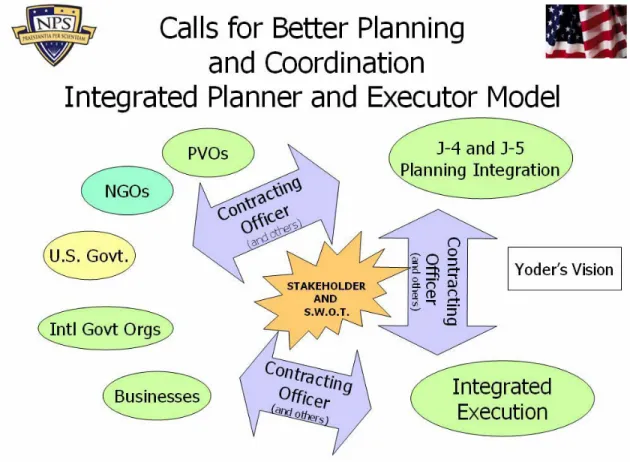
3. Tier Three: The Integrated Planner and Executor (IPE) Model. The highest-level model is the “Integrated Planner and Executor” (IPE) contingency contracting officer. This model takes the leveraging contracting officer function one giant step forward. In this model, well-educated and qualified CCOs are integrated into the operational-planning phases of contingencies, often before actual troop deployment; they then make the transition to operations. The hallmark of the IPE CCO is that contingency contracting operations may be planned and subsequently executed to meet national strategic and theater objectives. Additionally, the myriad NGOs and PVOs—which, in many if not most cases, are essential to the overall efficiency, effectiveness, and, ultimately, the success of operations—can be integrated into the planning and execution of contingency operations. While this integration requirement may seem painfully obvious, the integrated planning and execution among warfighters, contingency contracting officers, and the NGOs and
= =
^Åèìáëáíáçå=oÉëÉ~êÅÜ=mêçÖê~ã=
do^ar^qb=p`elli=lc=_rpfkbpp=C=mr_if`=mlif`v= = - 28 -
k^s^i=mlpqdo^ar^qb=p`elli=
PVOs is not, and it does not occur on a regular and recurring basis. The author proposes that the IPE CCO be utilized in a broader planning-and-execution environment. The CCO with higher level certification, education, and experience, should be integrated within the J-4 and J-5 Logistics and Planning/Operations and Exercise organization structure. Integration is essential to achieving the desired synergies between the myriad organizations involved in and participating in contingency environments. Concurrently, operational planners can leverage
integration of all theater players (military, NGOs/PVOs, and contractors) to achieve harmony between National Security Strategy (NSS), Unified Combatant Commander (COCOM), and NGOs’ and PVOs’ objectives through integrated planning,
exercising, and, ultimately, execution. This integrative planning, exercising, and execution may (1) help eliminate the competing (and often conflicting) demands of the participants, (2) closely marry acquisition support with stated objectives, (3) allow for the creation of robust Contingency Contract Support Plans, and (4) integrate such plans into broader operational plans in support of theater operations.
= =
^Åèìáëáíáçå=oÉëÉ~êÅÜ=mêçÖê~ã=
do^ar^qb=p`elli=lc=_rpfkbpp=C=mr_if`=mlif`v= = - 29 -
k^s^i=mlpqdo^ar^qb=p`elli=
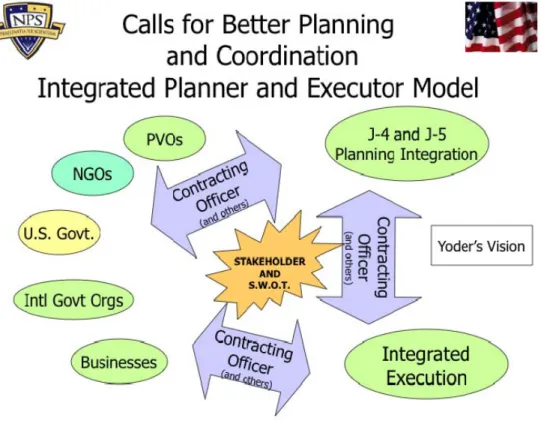
Figure 5. Calls for Better Planning and Coordination – Integrated Planner and Executor (IPE) Model
(Yoder, 2004)
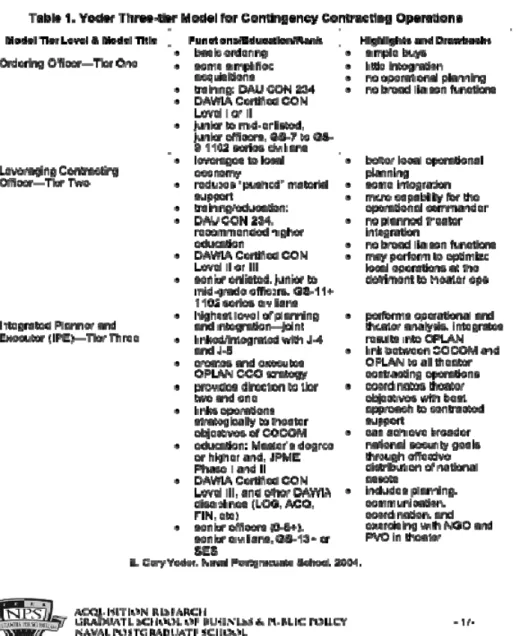
The true heart of the model in Figure 5 is portrayed in Table 1 as it originally appeared in the YTTM working paper.
= =
^Åèìáëáíáçå=oÉëÉ~êÅÜ=mêçÖê~ã=
do^ar^qb=p`elli=lc=_rpfkbpp=C=mr_if`=mlif`v= = - 30 -
k^s^i=mlpqdo^ar^qb=p`elli=
Table 1. Yoder Three-Tier Model for Contingency Contracting Operations
B. The YTTM Conclusions and Recommendations
The Yoder Three-tier Model addresses a significant shortfall in current
contingency contracting operation support: integrative planning and execution. As is demonstrated in the Anderson and Flaherty (2003) project, comprehensive planning in the joint environs of the Unified Combatant Commander’s J-4 (logistics) and J-5 (planning and exercising) is currently not being accomplished in any significant
= =
^Åèìáëáíáçå=oÉëÉ~êÅÜ=mêçÖê~ã=
do^ar^qb=p`elli=lc=_rpfkbpp=C=mr_if`=mlif`v= = - 31 -
k^s^i=mlpqdo^ar^qb=p`elli=
degree. Instead, what the acquisition and contracting community is providing the COCOM is sub-optimized.
The Yoder Three-tier Model calls for the cultivation and utilization of senior officers and civilians with sufficient education, joint qualification, multi-discipline Defense Acquisition Workforce Improvement Act (DAWIA) certifications, and other professional qualifications to perform at the highest integrative-planning and
execution levels. At the highest level, the Integrative Planner and Executor (IPE) is the essential and critical linchpin, allowing for the development of a comprehensive Contingency Contracting Support Plan (CCSP) that integrates contracting with the broader theater objectives in the Operation Plan (OPLAN).
The IPE, being integrated at the J-4 level, will plan, exercise, and call for adequate theater contingency contracting personnel provisioning (which may vary depending on the phases of the contingency operation) to effectively and efficiently meet theater objectives.
The primary recommendation is that the Yoder Three-tier Model be reviewed and implemented across all Services. In order to effectively accomplish this
implementation, the author recommends that senior leadership, including the
secretariat level, take pro-active measures to implement the model. Such review and implementation considerations include the following:
Mandate that the Services implement the Yoder Three-tier Model;
Fully fund educational and career-development programs, which are the hallmark of the Integrated Planner and Executor (IPE) and the Leveraging Contracting Officer (LCO);
Ensure that the Services create career incentives for personnel choosing to take positions in support of the Yoder Three-tier Model;
Mandate that the J-4 structure include the IPE, top-level integrative planner and executor; and
Mandate that personnel at the IPE and LCO model levels achieve Joint Professional Military Education (JPME) Phases I and II.
= =
^Åèìáëáíáçå=oÉëÉ~êÅÜ=mêçÖê~ã=
do^ar^qb=p`elli=lc=_rpfkbpp=C=mr_if`=mlif`v= = - 32 -
k^s^i=mlpqdo^ar^qb=p`elli=
C. The Yoder Three-Tier Model Gains Traction in the Broader
Community
The Yoder Three-tier Model, subsequent to its original publication, was cited and/or referenced in several studies and commission reports. The author attributes the success in large part, to the efforts of the staff at the Acquisition Research Program at the Naval Postgraduate School who championed the work. Among the works that reference or cite the model are the Report of the Commission on Army
Acquisition and Program Management in Expeditionary Operations (Gansler, 2007),
andthe July 2006 Special Inspector General Report for Iraq Reconstruction:
Lessons in Contracting and Procurement (SIGIR, 2006). The model was also
presented at the 2005 Acquisition Research Symposium sponsored by the Naval Postgraduate School in Monterey, California.
Of particular significance is the Gansler Report. The tier structure
recommended in the YTTM was adopted by the Gansler Report in late 2007, and subsequently has become the tier structure authorized by Congress for the Army Contracting Command commissioned in early 2008. The YTTM structure, embedded in the overarching recommendations in the Gansler Report, became the foundation that authorized and created a position equivalent to two stars and its associated lower tiers for the Army Contracting Command.
D. YTTM Summary and Implications for this Phase Zero
Research
The YTTM tackled a most critical issue in the broader context of integrative planning—lack of credentialed personnel and lack of actual defined positions within the existing joint planning environment. This is the personnelaspect of the key elements defined in this research work: personnel, platforms, and protocols. Additionally, the YTTM, shown in the body of Table 1, provided the basic elements of protocols, or what should be done, and, in a very basic sense and to a lesser degree, how it should be done in the context of the hierarchy.