Roma Kriaučiūnienė
Vilnius UniversityInstitute of Foreign Languages
Universiteto g. 5, LT-01513 Vilnius, Lietuva Tel. : +370 5 268 72 68
E-mail: [email protected]
Research interests: foreign language didactics, development of future foreign language teachers’ moral attitudes, teachers’ competencies (professional, pedagogical, linguistic, inter- cultural, general)
VIEWPOINTS OF INTERCULTURAL COMPETENCE
DEVELOPMENT IN ENGLISH LANGUAGE TEACHING/
LEARNING CLASSROOM
The article presents an analysis of viewpoints on the development of intercultural competence in the English language teaching/learning classroom. Intercultural competence, acknowledged as the key component of foreign language studies, increases the need to adapt teaching methods and materials to raise learners’ cultural awareness. The following research problem is formulated: how schoolchildren’s intercultural competence is developed at schools during English language classes and what the precon-ditions of its improvement are. Based on the survey carried out at secondary schools and gymnasiums, the article presents the findings on the ninth and tenth formers’ viewpoints regarding the extent to which cultural activities are incorporated into their English language classroom. The respondents’ answers indicated that the present practices for the development of intercultural competence in the English language classroom are not sufficient. A conclusion is made that the English language teach-ing/ learning process should be more purposefully aimed at developing all the dimensions of learners’ intercultural competence.
KEY WORDS: intercultural competence, English language teaching/learning classroom, communica-tion, language, intercultural awareness.
Auksė Šiugždinienė
Marijampolės Rygiškių Jono Gymnasium Kauno g. 7, LT-68175 Marijampolė, Lietuva Tel.: +370 685 302 72
E-mail: [email protected] Research interests: foreign language didac-tics, development of intercultural competence in the English language teaching/learning process
The relevance of the topic. Global changes taking place in the 21st century open the boarders for free movement of people in Europe and in the rest of the world making contemporary working and educational environment more culturally diverse. There� fore, the need not only for learning foreign languages but also for developing our learn�
ers’ intercultural competence appears to be of great importance.
The idea that foreign languages can open access to other people and countries, promote mutual understanding is stated in Lithuanian and European documents on education (Commission of the European Communities, Brussels, 2008; General Con�
cept of Education in Lithuania, 199�; �rovi�ept of Education in Lithuania, 199�; �rovi� sions of the National Education Strategy 2003–2012). The view that foreign language teaching provides favorable conditions for the development of learners’ intercultural competence is held by scientists of education (Fenner 2006; �opovici 2006). It is consid� ered that intercultural awareness, being the main feature of language and an integral part of language learning, is important at all levels (from beginners to advanced learners) (Tomalin, Stempleski 1993). It is also pointed out that intercultural competence is not an automatic result of learning and gaining knowledge about a foreign language culture but requires an attempted effort to direct the foreign language teaching/learning process accordingly (Fenner 2006).
Although the thought of integrating cul� ture into language learning is not new, it is getting enormously popular nowadays and intercultural competence is being discussed not only in terms of foreign language learning but in a great variety of other contexts (Ris� ager 2000). According to the thematic map of the 1�thCongress of Nordic Network for Intercultural Communication (Matkevičienė 2008), the most common research areas in the field of intercultural communication are: analysis of the definition and traditional aspects of cul ture, cultural identity and dif� ferences, the significance of the context; communica tion competence accompanied by the culture learning process and teaching intercultural communica tion (Meyer 2008); relation of media and the Internet with the studies of intercultural communica tion.
Theoretical and practical aspects of intercultural education have been ana� lyzed by many scientists of education in
Lithuania as well.The main areas of their research are: theoretical perspectives of intercultural education (Duoblienė 2006); civic and intercultural education, civic atti� tudes and national identity, methodology for multicultural education (Zaleskienė 2006; Ranonytė 2006; Tamošiūnas 2000); cultural identity and competencies necessary to live in multicultural societies (Balčiūnienė2007); political tolerance of high school children (Sprindžiūnas 2006); the development of students’ intercultural competence at uni� versities (Barzelis, Barcytė 2009). A research into tolerance and multicultural develop� ment in basic education schools carried out by J. Reingardė, N. Vasiliauskaitė and R. Erentaitė (2010) showed that Lithuanian schools are deviated from the reality in terms of multicultural education. However, an analysis of theoretical literature on educa� tion in Lithuania reveals that research into foreign language teaching/learning and a possibility of developing foreign language learners’ intercultural competence has been lacking adequate attention and some insights into the area should be made. Therefore, the following scientific research problem could be formulated: how schoolchildren’s intercultural competence is developed at schools during English language learning process and what the preconditions of its improvement are.
The object of the research: ninth–tenth formers’ intercultural competence develop� ment in foreign language teaching/ learning classroom.
The aim of the research: to reveal how intercultural competence could be devel� oped in foreign language teaching/learning classroom and how it can be improved.
The aim of this article:to find out the ninth–tenth formers’ viewpoints of the de� velopment of intercultural awareness in the English teaching/learning classroom.
The aim of the research could be specified by the following research tasks:
1. To define intercultural competence. 2. To reveal the respondents’ viewpoints
of the development of intercultural competence in English teaching/ learn� ing classroom.
The methods of the research:
I. Theoretical:analysis of scientific edu� cational literature.
II. Empirical: survey – a closed/open� ended questionnaire was used to reveal the respondents’ viewpoints of intercultural competence development in the English language classrooms based on L. Sercu, E. Bandura (2005) questionnaire “Language teachers as teachers of intercultural commu� nicative competence” and “Teachers’ Com� petence Description” (2007) (“Mokytojo profesijos kompetencijos aprašas” 2007). The questionnaire consisted of three sections – ‘the knowledge dimension,’ i. e., the acquisi� tion of culture; ‘the attitudinal dimension,’ i. e., adoption of intercultural attitudes; and ‘the skills dimension,’ i. e., acquisition of behaviour in intercultural situations – com� ponents of intercultural competence based on M. Byram’s (2000) five types of knowledge defined by L. Sercu, E. Bandura (2005). The respondents were given questions related to classroom activities considering culture learning and were asked to indicate to what extent they were taking part in them on 5�point scale (5= very often, �= often, 3= sometimes, 2= seldom, 1= never).
III. Statistical: descriptive statistics (fre� quency counts), Chi�Square Tests, Cronbach
Alpha coefficient, using software package S�SS version 17.0.
The research sample consisted of 236 learners of the ninth and tenth forms from secondary schools and gymnasiums. The research was carried out in 2009–2010.
Intercultural competence
Scientists (Fenner 2006, Fantini 2006, Lundgren 2005, Byram 2000) indicate that contacts with other languages and cultures provide an excellent opportunity to foster the development of intercultural com� municative competence (or intercultural competence, for short).Intercultural com� petenceis generally defined as the ability of successful communication with people of other cultures (Zaleskienė 2006) involving the following: the ability to establish and maintain relationships, communicate with minimal loss or distortion, collaborate in order to accomplish something of mutual interest or need (Fantini 2006). This ability can exist in someone at a young age, or may be developed and improved, occasionally with periods of regression or stagnation, but more commonly with positive results and no end point. According to J. W. Neuliep (2006), intercultural competence enables a person to predict beliefs, attitudes, values and behav� iour of others and interact with people from other cultures more effectively.
Intercultural competence is mostly viewed as having three basic dimensions: knowl� edge, attitudes, and skills, with a variation of the forth one. According to J. W. Neuliep (2006), intercultural competence consists of four dimensions: knowledge component (how much one knows about the culture of others), affective (one’s motivation to in�
teract with others from different cultures), psychomotor (the actual enactment of the knowledge and affective components), and including a fourth contextual component (situational features in which intercultural communication takes place). The classifica� tion of intercultural competence presented by A. E. Fantini (2006) is very similar to the description of thecomponents of intercul� tural competence based on M. Byram’s five savoirs (components of knowledge) and defined by L. Sercu, E. Bandura (2005):
1. Attitudes (savoir ếtre): curiosity and openness, readiness to suspend dis� belief about other cultures and belief about one’s own;
2. Knowledge (savoir): of social groups and their products and practices in one’s own and interlocutors’ country, and of the general processes of societal and individual interaction;
3. Skills of interpreting and relating (savoir-comprendre): ability to inter� pret a document or an event from an� other culture, to explain it and to relate it to documents from one’s own; �. Skills of discovery and interaction
(savoir-faire): ability to acquire new knowledge of a culture and cultural practices and the ability to operate knowledge, attitudes and skills under the constraints of real time communi� cation and interaction;
5. Critical cultural awareness/political education (savoir-s’engager): an abil� ity to evaluate critically (on the basis of explicit criteria) the perspectives, practices and products in one’s own and other cultures and countries (By� ram 2000, p. 9).
Thus a language learner moving between cultures is an intercultural learner involved in a dynamic, developmental, ongoing process of intercultural competence de� velopment which engages him/her cogni� tively, behaviourally, and affectively (�aige, Stringer 1997). As a result of such learning, the intercultural competence gained by the learner enables him/her to be more open to new information, help to become a more emphatic listener, be able to accept differ� ences, reduce communication uncertainty and increase predictability in his/her own and the other person’s behaviour and in this way build much more effective intercultural relationships.
Learners’ viewpoints of the
develo-pment of intercultural competence
in English language teaching
/lear-ning classroom
As it has been mentioned, the research aimed at finding out learners’ viewpoints of the development of cultural awareness in the English teaching/learning classroom. The learners were asked to indicate to what extent cultural activities were incorporated into their foreign language learning classroom (Figure 1).
The data of the learners’ questionnaire indicate that most favourable classroom practices related with the teaching of culture are those from attitudinal and knowledge dimensions. Nearly a fifth of the respondents (18.58%) indicated ‘very often’ and ‘often’ about taking part in the classroom activities aimed at developing intercultural attitudes, 17.95% of the learners stated ‘very often’ and ‘often’ about taking part in the classroom activities aimed at increasing cultural knowl� edge. Development of intercultural skills
received less attention – 15.72% of the learn� ers indicated ‘very often’ and ‘often’ about developing intercultural skills in the foreign language teaching/learning classroom. More than a quarter (38.71%) acknowledged to have received cultural information, 36.17% stated that they sometimes developed in� tercultural attitudes in foreign language lessons and less than a quarter said that they sometimes were developing intercultural skills. However, about a half of the learners marked ‘seldom’ or ‘never at all’ about taking part in classroom activities aimed at develop� ing intercultural competence. �3.32% of the learners indicated ‘seldom’ or ‘never’ about getting cultural knowledge, �5.22% ‘seldom’ or ‘never’ about taking part in the activities for developing intercultural attitudes, and even more than a half (5�.71%) stated that they seldom or never developed intercultural skills in the foreign language teaching/learn� ing classroom. The research data reflected the unfavourable situation for the develop� ment of learners’ intercultural competence. Cronbach Alpha coefficient of the learners’ questionnaire was found ,925.
Learners were asked to answer eight questions aimed at discovering to what
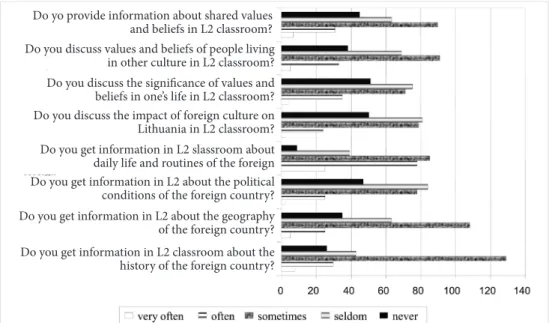
extent classroom practices regarding knowl� edge dimension of intercultural competence were carried out in foreign language teach� ing/learning classroom (Figure 2).
The learners’ answers showed that the most frequent classroom activity in the knowledge dimension was ‘getting infor-mation <…>about daily life and routines of the foreign culture’. It seems apparent that discussions about moral values (‘the significance of values and beliefs in one’s life’ (very often and often – 16.5%)‚ ‘values and beliefs of people living in other culture’(very often and often – 16.1%), ‘information about shared values and beliefs’(very often and often – 16.1%) are slightly more frequent in L2 classroom than presentations of factual knowledge about foreign country’s geogra� phy (very often and often – 12.7%) or politi� cal situation (very often and often – 12.7%). The low scores reflected a lack of classroom practices aimed at developing intercultural competence.
The impact of the foreign culture on Lithuania is discussed the least in the L2 classroom, only 11% of the learners indi� cated taking part in such discussions often and very often and more than a half of the Figure 1. Learners’ viewpoint of the dimensions of intercultural competence development
knowledge dimension attitudinal dimension skills dimension per cent �0 35 30 25 20 15 10 5 0 vert often often sometimes seldom never
respondents (55.5%) very seldom or never participated in such activities. The same percentage of the learners indicated ‘very seldom’ or ‘never’ about discussing politi� cal conditions of the target country or the significance of values and beliefs in one’s life in L2 classroom. Almost half of the respon� dents very seldom or never ‘discuss values and beliefs of people living in other culture’ (�5.3%), ‘get information about shared values and beliefs’ (�5.8%), ‘getinformation about the geography of the foreign culture’ (�1.5%). Having analysed the research data, it could be stated that the learners do not get suffi� cient cultural information and take part in few discussions on cultural topics.
A comparison of the research data by form revealed no significant differences in providing cultural knowledge in the ninth and tenth forms, however, there were some statistically relevant differences in ‘getting information <…> about the political condi-tions of the foreign culture’ (x2 ≈ 12,02, p <
,017) and ‘getting information <…> about daily life and routines of the foreign culture’ (x2 ≈ 16,95, p < ,002). In both cases, more at� tention to those classroom practices was paid in the ninth form. A presumption could be made that in the tenth form, foreign language teachers concentrate more on the develop� ment of linguistic competence. Cronbach Alpha coefficient was found ,81�.
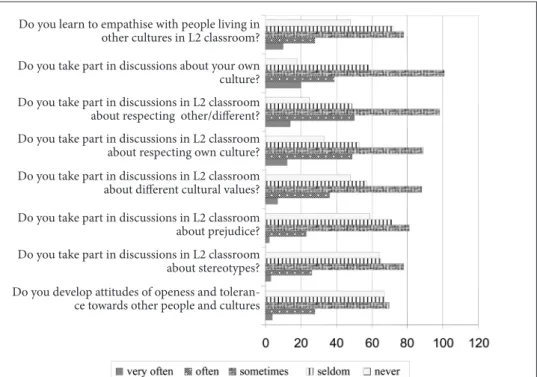
The analysis of the research data revealed the learners’ viewpoints of attitudinal dimen� sion (Figure 3).
As the most favourable classroom activi� ties related with teaching culture in the atti� tudinal dimension, the learners indicated (as ‘most often’ and ‘often’) ‘discussions about re-specting others/different’ (27.1%), ‘discussions about respecting their own culture’ (25.9%) and ‘discussions about their own culture’ (25%). As the second favourite classroom practices, ‘discussions about different cultural values’ (18.3%) and ‘empathising with people living in other cultures’ (16.1%) were chosen. Figure 2. Learners’ viewpoint of knowledge dimension of intercultural competence
Do yo provide information about shared values and beliefs in L2 classroom? Do you discuss values and beliefs of people living
in other culture in L2 classroom? Do you discuss the significance of values and beliefs in one’s life in L2 classroom? Do you discuss the impact of foreign culture on
Lithuania in L2 classroom? Do you get information in L2 slassroom about
daily life and routines of the foreign Do you get information in L2 about the political
conditions of the foreign country? Do you get information in L2 about the geography
of the foreign country? Do you get information in L2 classroom about the
Figure 3. Learners’ viewpoint of attitudinal dimension of intercultural competence develo-pment
According to the respondents’ opinion, least attention during English language classes was paid to ‘discussions about prejudice’ (10.5%). A quarter of the students stated never hav� ing discussed prejudice at all. According to the research data, it seems obvious that the possibilities of developing intercultural competence are not fully exploited in for� eign language teaching/learning classroom. A comparison of the research data by form showed no statistically relevant differences in the development of attitudinal dimension in the ninth and tenth forms. Cronbach Alpha coefficient was determined ,871.
The research data analysis also revealed some important insights into the develop� ment of learners’ skills dimension of inter� cultural competence (Figure �).
The respondents’ answers showed that classroom practices in the skills dimension
carried out in the foreign language teaching/ learning classroom are as follows: ‘speaking about the etiquette of other cultures’ (25.�%), ‘learning to handle intercultural contact situations’ (20.7%), ‘performing reflection on cultural differences orally’ (17.7%), ‘learning to handle intercultural conflict situations’ (16.1%), ‘getting new information about your own culture’ (15.2%), ‘learning to reflect on cultural differences’ (12.7%), ‘looking for solutions of intercultural conflict situations’ (9.�%), ‘performing reflection on cultural differences in writing’ (8.5%). Such research data show which activities should receive more attention from teachers in order to strengthen the learners’ abilities to manage intercultural situations better.
Having compared the research data by form, it became evident that ninth formers learn how to handle intercultural contact sit�t�
Do you learn to empathise with people living in other cultures in L2 classroom? Do you take part in discussions about your own
culture? Do you take part in discussions in L2 classroom
about respecting other/different? Do you take part in discussions in L2 classroom
about respecting own culture? Do you take part in discussions in L2 classroom
about different cultural values? Do you take part in discussions in L2 classroom
about prejudice? Do you take part in discussions in L2 classroom
about stereotypes? Do you develop attitudes of openess and toleran� ce towards other people and cultures
uations more often than tenth form learners (x2 ≈ 9.53, p < ,0�9). A presumption could be made that in the tenth form (and higher), the content of the foreign language teaching and learning is devoted to the preparation for the final exam. As there are no culture�based tasks in the final exam, teachers and learners pay less attention to intercultural competence development in higher secondary schools and gymnasiums. Cronbach Alpha coef� ficient was found to be ,823.
It seems obvious that learners find the present practices for the development of in� tercultural competence in the L2 classroom to be insufficient. The respondents’ answers indicate a significant lack of attention devot� ed to intercultural competence development in the foreign language teaching process.
Thus, the research data make it possible to draw the following conclusions:
A need to integrate culture into foreign •
language curricula in order to develop
learners’ intercultural competence is accentuated both by scholars and the European Union and Lithuanian docu� ments on education. A development of linguistic knowledge and skills is not enough for successful intercultural communication. Therefore, lingua�cul� tural teaching must be emphasized in the whole process of foreign language teaching/learning.
Intercultural competence, having the •
dimensions of knowledge, attitudes and skills, is generally defined as the ability of successful communication with people of other cultures. Language learners need to possess intercultural competence in order to be able to cope with different intercultural experience. As an integral part of foreign language learning, intercultural competence de� velopment helps to enrich the learners as intercultural personalities who are Figure �. Learners’ viewpoints of skills dimension of intercultural competence development
Do you look for solutions of intercultural conflict situations in L2 classroom? Do you learn to handle intercultural conflict
situations in L2 classroom? Do you speak about the etiquette of other cultu� res in L2 classroom? Do you learn to handle intercultural contact
situations in L2 classroom? Do you get new information about your own
culture in L2 classroom? Do you perform reflection on cultural differences
orally in L2 classroom? Do you perform reflection on cultural differences
in writing in L2 classroom? Do you learn to reflect on cultural differences in L2 classroom?
able to build and maintain intercultural relationships more effectively.
The research data reflected the unfa� •
vourable situation for the development of learners’ intercultural competence in the English language teaching/ learning process. The low scores of the respondents’ answers reveal a lack of classroom practices aimed at de� veloping the dimensions of learners’ intercultural competence. The research findings show that learners do not get sufficient cultural information and very
seldom or never take part in discus� sions about values, beliefs, attitudes, and behaviour of people living in other cultures. Obviously, the possibilities of developing intercultural competence are not yet fully exploited in foreign language teaching/learning classroom. Therefore, a considerably stronger fo� cus in the English language teaching/ learning process should be given to the increase of learners’ cultural awareness in accordance with the present day requirements and goals of education.
Literature
BALČIŪNIENĖ, I., 2007. Religinio ir pili� etinio ugdymo suderinamumas ir papildomu�ugdymo suderinamumas ir papildomu� mas. Daktaro disertacija Socialiniai mokslai, edukologija (07 S), Šiauliai. �rieiega: http:// vddb.library.lt/fedora/get/LT�eLABa�0001� :E.02~2007~D_20081121_1612���0689�/ DS.005.0.01.ETD (Žiūr. 2010–10–12)
BARZELIS A.; BARCYTĖ. A., 2009. Studentų tarpkultūrinės kompetencijos ugdymas taikant kooperuotų studijų metodą. Jaunųjų mokslininkų darbai, Nr. 2, 23.�rieiga:http://www.minfolit.lt/ arch/20501/20980.pdf (Žiūr. 2010–08–20)
BYRAM, M., 2000. Assessing intercultural competence. Sprogforum, No. 18, Vol. 6, 8–13. Available from: http://inet.dpb.dpu.dk/infodok/ sprogforum,Espr_nr18.html (accesed on August 27, 2009)
BYRAM, M.; RISAGER. K., 1999. Language teachers, politics and cultures. Multilingual Mat-ters. Available from: www.multilingual�matters. com (accesed on August 25, 2009)
DUOBLIENĖ, L., 2006. Šiuolaikinė ugdymo filo-sofija: refleksijos ir dialogo link. Vilnius: Tyto Alba.
European Commision. 2010. Education and training. Available from: http://ec.europa.eu/ education/erasmus/doc892_en.htm (accesed on March 31, 2010)
FANTINI, A. E., 2006. About Intercultural Communicative Competence: A Construct. Fede-ration of the Experiment in International Living
Research Project. Available from: www.sit.edu/ Sitoccasional�apers/feil_appendix_e.pdf (acce� sed on March 31, 2010)
FENNER, A., 2006. Intercultural awareness as an integral part of foreign language learning. In: Coherence of principles, cohesion of competences.
European Centre for Modern Languages: Council of Europe �ublishing, �0–59.
MATKEVIČIENĖ, R., 2008.Identities and intercultural communication: Thematic map of the 14thCongress of Nordic Network for Intercultural
Communication. �rieiga: http://www.leidykla. vu.lt/fileadmin/Informacijos_mokslai/�5/60�69. pdf (Žiūr. 2010–03–21)
MEYER, U., 2008. In the name of identity: Teaching cultural awareness in the intercultural classroom. Informacijos mokslai, �5. www.lei� dykla.eu/mokslo�darbai/informacijos mokslai/ (accesed on March 29, 2010)
Mokytojo profesijos kompetencijos aprašas.
Lietuvos respublikos švietimo ir mokslo minis� terija. 2007 m. sausio 15d. Nr. ISAK�5�.
NEULIE�, J. W., 2006. Intercultural Communi-cation. A contextual approach. 3rd ed. California:
Sage �ublications, Inc.
�AIGE, R. M.; STRINGER, D., 1997. Trai-ning design for international and multicultural programs. �ortland, Oregon: Intercultural com� munication institute.
hip, human rights and Language Education. In: Coherence of Principles, Cohesion of Competences. Exploring theories and designing materials for tea-cher education.European Centre for Modern Lan� guages: Council of Europe �ublishing, 59–69.
Provisions of the National Education Strategy 2003–2012. Available from: http://www.smm.lt (accesed on December 12, 2009)
RANONYTE, A., 2006. Lietuvos moksleiviш pilietiškumo ir tautinio tapatumo formavimosi prielaidos. Acta paedagogica vilnensia, Nr. 16. �rieiga: http://www.leidykla.vu.lt/fileadmin/ Acta_�aedagogica_Vilnensia/Asta_Ranonyte.pdf (Žiūr. 2010–10–1�)
REINGARDĖ, J.; VASILIAUSKAITĖ, N.; ERENTAITĖ, R.; 2010. Tolerancija ir multikult-tūrinis ugdymas bendrojo lavinimo mokyklose. Tolerantiško jaunimo asociacija. Lygių galimybių kontrolieriaus tarnyba. �rieiga: http://www.lygybe. lt/assets/visas%20leidinys.pdf (Žiūr. 2010–5–8)
RISAGER, K., 2000. The teacher’s intercul� tural competence. Sprogforum, No. 18, Vol. 6, 1�–20. Available from: http://inet.dpb.dpu.dk/
infodok/sprogforum,Espr_nr18.html (accessed on August 27, 2009)
SERCU, L., BANDURA, E., 2005. Foreign lan� guage teachers and intercultural competence – an international investigation. Multilingual matters. Available from: www.multilingual�matters.com (accesed on August, 2�, 2009).
S�RINDŽIŪNAS, A., 2000. X–XII klasių mo-kinių tolerancijos ugdymas. Daktaro disertacijos santrauka. Vilnius: V�U.
Standards for Foreign Language Learning: �reparing for the 21st Century. National Standards
in Foreign Language Education Project, 1996. TAMOŠIŪNAS, T., 2000. Mokykla įvairiatau� tėje aplinkoje. In:Konferencija „Tautinės mažu-mos demokratinėje valstybėje”. Vilnius: Tautinių mažumų ir išeivijos departamentas prie Lietuvos Respublikos vyriausybės, 1�0–161.
TOMALIN, B.; STEM�LESKI, S., 1993. Cultu-ral awareness. Oxford: Oxford University �ress. ZALESKIENĖ, I., 2006. �ilietinė komunika� cija ir tarpkultūrinis ugdymas. Acta paedagogica Vilnensia, t. 16, 56–62.
Roma Kriaučiūnienė
Vilnius University, Lithuania
Research interests: foreign language didactics, development of future foreign language teachers’ moral attitudes, teachers’ competencies (profession-al, pedagogic(profession-al, linguistic, intercultur(profession-al, general) Auksė Šiugždinienė
Marijampolės Rygiškių Jono Gymnasium, Lithu� ania
Research interests: foreign language didactics, development of intercultural competence in the English language teaching/learning process VIEWPOINTS OF INTERCULTURAL COMPETENCE DEVELOPMENT IN ENG-LISH LANGUAGE TEACHING/ LEARN-ING CLASSROOM
Summary
The article presents an analysis of viewpoints on the development of intercultural competence in the English language teaching/learning classroom.
Roma Kriaučiūnienė
Vilniaus universitetas, Lietuva
Moksliniai interesai: užsienio kalbų didaktika, būsimųjų užsienio kalbų mokytojų dorinių nuos-tatų ugdymas, mokytojų profesijos kompetencijų (profesinės, pedagoginės, lingvistinės, tarpkultū-rinės, bendrosios) plėtojimas
Auksė Šiugždinienė
Marijampolės Rygiškių Jono Gimnazija, Lie� tuva
Moksliniai interesai: užsienio kalbų didaktika, tarpkultūrinės kompetencijos ugdymas anglų kalbos mokymo(si) proceso metu
POŽIŪRIS Į TARPKULTŪRINĖS KOM-PETENCIJOS PLĖTOTĘ ANGLŲ KALBOS PAMOKŲ METU
Santrauka
Straipsnyje pristatomas devintų�dešimtų klasių mokinių požiūris į tarpkultūrinės kompetencijos ugdymą anglų kalbos pamokų metu. Šios kompe�
The need to develop learners’ intercultural compe� tence is accentuated in European and Lithuanian laws on education and acknowledged as a key component of foreign language studies. Therefore, foreign language teaching methods and materials should serve the purpose of raising learners’ cul� tural awareness. An analysis of theoretical litera� ture on education in Lithuania has revealed that research into the possibility of the development of foreign language learners’ intercultural com� petence is lacking adequate attention, therefore the following research problem wasformulated:
how schoolchildren’s intercultural competence is developed at schools during English language learning process and what the preconditions of its improvement are. The aim of this article is to find out the ninth–tenth formers’ viewpoints of the development of intercultural awareness in the English teaching/learning classroom.
Intercultural competence is mostly viewed by scientists as having three basic dimensions:knowl� edge, attitudes and skills, with the variation of the forth one. The research presented in the article is based on M. Byram’s model of intercultural com� petence embracing the dimensions of knowledge, attitudes, and skills. The original questionnaire developed by L. Sercu ‘Language teachers as teach� ers of intercultural communicative competence’, which was adapted according to the Lithuanian Teachers’ Competence Description, was used as a research instrument. The questionnaire consisted of three sections – the knowledge dimension, i. e. the acquisition of culture; the attitudinal dimen� sion, i. e. adoption of intercultural attitudes; and the skills dimension, i. e. acquisition of behaviour in intercultural situations.
The findings of the research carried out at secondary schools and gymnasiums in 2009 and 2010 revealed the respondents’ view that the ex� tent to which cultural activities are incorporated into the ninth and tenth formers’ English language classroom is not sufficient. The conclusion is made that the English language teaching/learning process should be more purposefully aimed at developing all the dimensions (knowledge, attitudinal, and skills) of learners’ intercultural competence.
KEY WORDS: intercultural competence, Eng� lish language teaching/learning classroom, com� munication, language, intercultural awareness.
tencijos ugdymo poreikis pabrėžiamas Europos ir Lietuvos švietimo dokumentuose ir pripažįstamas vienu iš pagrindinių užsienio kalbos studijų kompo� nentų. Todėl užsienio kalbų mokymo/si metodai bei mokymo/si medžiaga turėtų būti kreipiama besimo� kančiųjų tarpkultūriniam suvokimui gilinti. Eduko� loginės literatūros analizė atskleidė, kad Lietuvoje stokojama dėmesio šios kompetencijos ugdymo užsienio kalbų pamokų metu klausimams aptarti. Atsižvelgiant į tai, buvo formuluojama mokslinio tyrimo problema: kaip ugdoma mokinių tarpkul� tūrinė kompetencija anglų kalbos pamokų metu ir kokios galimos tokio ugdymo tobulinimo prielaidos. Šio straipsnio tikslas – atskleisti devintų – dešimtų klasių mokinių požiūrį į tarpkultūrinės kompeten� cijos plėtotę anglų kalbos pamokų metu.
Daugelio mokslininkų požiūriu tarpkultūrinė kompetencija apibrėžiama kaip apimanti tris pagrin� dinius žinių, nuostatų ir įgūdžių bei įvairių autorių skirtingai interpretuojamą ketvirtą (situacijos, kon� teksto) komponentą. Šiame straipsnyje aptariamas tyrimas yra grindžiamas M. Byram’o tarpkultūrinės kompetencijos modeliu, susidedančiu iš minėtųjų trijų komponentų. Tyrimo instrumentą sudarė originalus L. Sercu klausimynas „Kalbų mokytojai kaip tarpkultūri� nės komunikacinės kompetencijos mokytojai“, kuris buvo modifikuotas, atsižvelgiant į „Lietuvos mokytojų kompetencijos aprašą“. Tyrimo klausimyną sudarė trys skyriai: žinių (kultūrinių skirtumų žinojimas ir suvo� kimas), nuostatų (tarpkultūrinių nuostatų pažinimas ir pripažinimas) ir įgūdžių (elgesio tarpkultūrinėse situacijose suvokimas ir įsisavinimas).
Tyrimas buvo atliktas vidurinėse bendrojo la� vinimo mokyklose ir gimnazijose 2009–2010 me� tais.Tyrimo rezultatai atskleidė, kad respondentų požiūriu tarpkultūrinės kompetencijos ugdymui anglų kalbos pamokų metu skiriama per mažai dėmesio. Straipsnyje daroma išvada, kad anglų kalbos mokymo/si procesas turėtų būti tikslingiau orientuojamas į besimokančiųjų tarpkultūrinį ugdymą ir sudaryti palankias sąlygas mokinių tarpkultūrinės kompetencijos plėtotei visais (žinių, nuostatų ir įgųdžių) lygmenimis.
REIKŠMINIAI ŽODŽIAI: tarpkultūrinė kom� petencija, anglų kalbos pamokos, komunikacija, kalba, tarpkultūrinės žinios ir suvokimas.