Suzanne Jago and Julie Radford
Final author copy, published in Child Language Teaching & Therapy 2016
Exploring newly qualified speech & language therapists’ perceptions of the application and teaching of collaborative practice.
Abstract
Effective collaborative practice is expected of newly qualified speech and language therapists (SLTs) in order to achieve the best outcomes for clients. Research into collaborative practice has identified a number of barriers to and facilitators of collaborative practice, but there has been limited research into the perceptions of these by newly qualified
practitioners or how well prepared they feel to carry out collaborative practice. There is emerging research into the teaching of collaborative practice in higher education institutions; however studies have typically focused on medical professions, with limited research into the teaching of collaborative practice for allied health professionals.
This study set out to elicit newly qualified SLTs’ beliefs about collaborative practice in paediatric work settings, the effectiveness of the teaching of
collaborative practice on their pre-registration higher education course, and how the teaching of collaborative practice on SLT university courses could be improved. The aim was to review whether current teaching practices are appropriate or whether changes could be implemented to better facilitate the development of the necessary skills and knowledge involved in working effectively with others.
Semi-structured telephone interviews were carried out with ten newly qualified speech and language therapists. Responses were analysed qualitatively using thematic analysis.
Results indicated that participants value collaborative practice and continue to experience barriers to and facilitators of collaborative practice previously identified in the literature. Participants emphasised the need for better links between theory and practice in the teaching of collaborative practice, which they suggested could be achieved through practical experiences on
placement and opportunities to engage with other trainee professionals at university.
This study adds to the literature on barriers to and facilitators of collaborative practice. It also serves as a preliminary study into the perspectives of newly qualified SLTs regarding the current teaching of collaborative practice and how university courses could be improved. Key words
Teaching • collaborative practice • collaboration • speech and language therapist • SLT • universities • perspectives
Introduction
For speech and language therapists (SLTs), working with others is a key aspect of their role, and supported by the standards of proficiency set out by their registering body, the Health and Care Professions Council. Additionally, the introduction of the new SEND Code of Practice (DfE and DoH, 2014) places further emphasis on the need for SLTs working in paediatric settings to work with other professionals in education and social care. It is, however, well recognised that there are many challenges to working effectively with others (Baxter et al., 2009; Dunsmuir et al., 2006; Hartas, 2004).
Although SLTs work with other professionals and with service users, for the purposes of this study the focus will be limited to working with other
professionals.
Leathard (1994) reported 52 different terms used to label the practice of working together, and identified that differing terms were also accompanied by varying definitions. Lacey (2001) describes these terms by considering the interaction hierarchically from liaison, to co-operation, to co-ordination and finally collaboration. Lacey and Lomas (1993) acknowledge that where professionals are working with others in teams, the nature of the team work also appears hierarchical, from multi-disciplinary to inter-disciplinary and finally trans-disciplinary working. Trans-disciplinary is considered true collaboration as it involves the sharing of information and skills across disciplines. They argue that this model is most effective for meeting the needs of the child with special educational needs.
However, for many the concept and process of collaboration remains a multi-dimensional construct whose ‘‘active ingredients relating directly to quality of care and patient outcomes are poorly understood” (Suter et al., 2009:41) and therefore the lack of a common set of competencies and conceptual clarity makes collaborative practice difficult to teach and carry
out (Suter et al., 2009). Nevertheless, working together, or collaborative practice, is an area which has been gathering momentum for some time, and despite the lack of consistency in arriving at a definition, it is an expected professional skill for many health care professionals.
Drivers for collaborative practice
The SEND code of practice (2014) sets out requirements for local
authorities and clinical commissioning groups to make joint commissioning arrangements for education, health and care provision for children and young people with special educational needs or disabilities. It assumes that collaborative practice is taking place at strategic and operational levels, and particularly between professionals involved in developing joint Education, Health and Care Plans. Gascoigne (2006) reported that professionals in education and health still tended to work individually with a child and then share relevant information with another professional. Although research has indicated the benefits of joint working (Wright and Kersner, 2004), there is less clarity regarding how staff should work together most effectively and overcome barriers for effective collaboration.
Hartas (2004) explored teacher and SLT perceptions of collaboration in a special school setting through the use of questionnaires and group
discussions and identified clarification of roles and expectations as an important enabler of collaboration. This was also found by Dunsmuir et al. (2006) who used questionnaires to explore SLTs’ and Educational
Psychologists’ perceptions of roles and found conflicting opinions on how and why a child’s non-verbal skills should be assessed. Teachers and SLTs in Hartas’ (2004) study expressed the importance of a mutual
understanding of the difference in educational and health care philosophies. Furthermore Stringer and Lozano (2007) argue that teachers’ reduced understanding of speech, language and communication needs and the role and responsibilities of the SLT impacts effective collaborative practice. SLTs, who tend to adhere to a prioritisation model, may also not fully appreciate that teachers must manage the needs of all the children in the school (Baxter et al., 2009). Differing philosophies often lead to differing terminologies, and poor communication has also been identified as a barrier to collaboration due to poor mechanisms for the exchange of information between health and education (Dunsmuir et al., 2006) and differing approaches to consent (McConnellogue, 2011).
Baxter et al. (2009) sought to explore the perceptions of school staff regarding the SLT service to mainstream schools and identified some challenges relating to power struggles between SLTs and school staff, and conflict over the implementation of intervention. Hartas’ (2004) suggests that SLTs are likely to be seen as visitors within a school, potentially creating a social barrier between the professionals. Roux’s (1996) small scale survey of the retrospective perceptions of newly qualified SLTs working consultatively in a mainstream school highlights a number of barriers and enablers to working with educational staff. In light of the drive for more integrated working over the past decade, it will be interesting to compare the participants’ responses to those from this study taking place nearly twenty years later.
The effectiveness of collaborative practice in supporting children with speech, language and communication needs.
As the nature of collaborative practice continues to be explored in the research, it is important to consider whether collaborative practice creates better outcomes for children at an equal or lower cost than individuals working independently with the child. Certainly research indicates positive outcomes for strategic planning of integrated services (Gross, 2011) in
terms of ensuring population needs are identified and adequate services commissioned. There is, however, a dearth of research demonstrating the effectiveness of collaboration in terms of actual delivery of intervention targeting specific speech and language skills. This is in part due to relatively limited effectiveness studies within the field of speech and
language intervention overall (Lindsay at al., 2012), and also due to limited literature indicating the effectiveness of speech and language interventions carried out by non SLT professionals (Law et al., 2001; Broomfield and Dodd, 2011). With many SLT teams now operating a consultative service, it is important to explore further whether professionals at this grass roots level perceive collaboration to be effective in the delivery of intervention, what it looks like in practice, and whether children do, in fact, show
measurable progress in their speech and language skills. The initial part of this study aims specifically to address this first point by exploring newly qualified SLTs’ views of collaborative practice.
Teaching collaborative practice
The Department of Health has, in recent years, emphasised the role that higher education institutions play in developing skills in team work, integration and workforce flexibility. The most recent Cochrane Review
(Reeves et al., 2013) indicates an increase in studies relating to inter-professional education and its positive impact on collaborative practice. Gilligan et al., (2014: 2) state that “inter-professional education occurs when two or more professions learn with, from and about each other to improve collaboration and the quality of care.” The literature does not detail a specific environment in which this learning should take place and incorporates both university and practice based learning. A thematic analysis of focus group interviews with 68 newly qualified medics, nurses and pharmacists from a range of Australian universities by Giligan et al. (2014) showed that the inter-professional learning experiences valued most highly were those that involved genuine engagement and opportunities to interact with students in other professions working on a relevant problem. They reported that placements were a missed opportunity with few
structured meaningful inter-professional learning experiences. There has, however, been very little research into student SLTs’ experiences of inter- professional learning. SLT training typically encompasses a combination of medical and educational approaches, and therefore SLTs’ experience of inter-professional learning could differ significantly.
As the Commission on Education of Health Professionals for the 21st Century (Frenk, et al., 2010) published an analysis of the disjunctions between traditional health professions’ education and global health and health workforce, the World Health Organization (2010) issued the call for a ‘‘collaborative practice-ready’’ health work force. As a consequence, the Inter-professional Education Collaborative Expert Panel (2011) was asked to recommend a common core set of collaboration competencies relevant for all professions, along with appropriate learning methods. Reeves et al. (2013) report that the use of competency frameworks is helpful to define professional competence, set consistent standards of practice and identify performance indicators. There has, however, been criticism of the proposed competency frameworks in respect of their ability to meet the needs of all the necessary trainee health care professionals, and therefore how their effectiveness can be measured. In order to develop SLTs’ knowledge and application of collaborative practice, it is important to explore what it could or should look like in practice in order to provide a clear definition for teaching and assessment purposes.
With the development in the teaching of inter-professional practice, in conjunction with the introduction of Education, Health and Care Plans placing collaboration at their core, it is important to explore SLTs’ current perceptions of how prepared they are to work collaboratively, and consider how universities can develop their roles in supporting the development of this competency. This study seeks to take preliminary steps to address this by answering the following research questions:
how do newly qualified SLTs perceive collaborative practice in paediatric work settings?
how do newly qualified SLTs perceive the effectiveness of the teaching of collaborative practice on their pre-registration university course?
how do newly qualified SLTs think that the teaching of collaborative practice on SLT university courses could be improved?
Method
Design
In keeping with the existing literature, an experiential qualitative approach was taken to obtain participants’ views about their own experience of collaborative practice and university learning experiences. Sofaer (1999)
argues that qualitative research is effective in health care research as it can give voice to those whose views are rarely heard and is useful for
conducting initial explorations into new areas of research.
Participants
Ten qualified SLTs were recruited to take part in the study through
purposive, non probability self selection sampling and snowball sampling. Participants were initially recruited through contact with the London Speech & Language Therapy Managers’ Network. All participants had to have graduated from a UK speech and language therapy course within the past two years, and all had to have been working in paediatric posts for at least five months. SLTs who participated in the study also passed on details to colleagues and friends outside the London area. All of the ten participants were female, four had attended City University, two had attended University College London, two were Manchester University graduates, one a
University of East Anglia graduate and one had attended Cardiff
Metropolitan University. Six participants held clinical positions in London, one in Berkshire, one in Hertfordshire, one in Bath and one in the North West of England. Due to the small sample size, in order to preserve
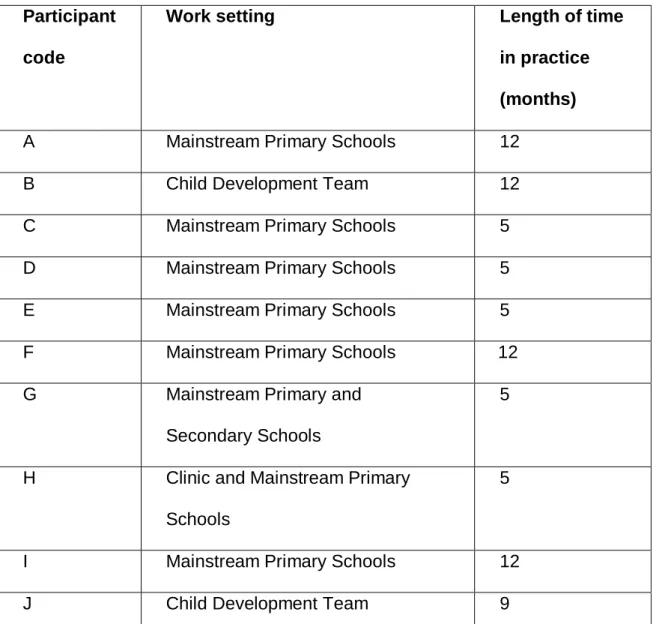
confidentiality the following table only states the participant code, work setting and length of time in practice.
Table 1.Table to show participants’ work setting and length of time in practice.
Participant code
Work setting Length of time
in practice (months)
A Mainstream Primary Schools 12
B Child Development Team 12
C Mainstream Primary Schools 5
D Mainstream Primary Schools 5
E Mainstream Primary Schools 5
F Mainstream Primary Schools 12
G Mainstream Primary and Secondary Schools
5
H Clinic and Mainstream Primary Schools
5
I Mainstream Primary Schools 12
Tools for data collection
Semi structured interviews were used to explore participants’ views in order to answer the research questions. The use of semi structured interviews was chosen to ensure that key areas for discussion were introduced, and also to give the freedom for both interviewer and interviewee to explore and provide additional information as necessary. Bernard (1988) states that semi structured interviewing is beneficial when a researcher is unable to interview a participant on more than one occasion, as was the case in this study, and can provide reliably comparable qualitative data. Phone
interviews were chosen rather than face to face interviews as they were deemed a more economical method of obtaining the necessary data in terms of both cost and time. All participants were qualified speech and language therapists, and it was therefore assumed that they would have the necessary communication skills to participate successfully in a phone
interview.
Interview questions and rationale
Following a pilot study, six questions for the interview schedule were refined to reflect the findings of the literature review and are detailed below
with supporting rationale. Prompt questions were used, where appropriate, to encourage the participant to provide as much detail as possible.
1. Could you please explain in your own words what you understand the term collaborative practice to mean?
In light of the many terms identified in the literature, this question sought to establish whether SLTs had a shared understanding of the term
collaborative practice.
2. How important do you consider collaborative practice to be in your role as a speech and language therapist?
It is clear that policies are driving collaborative practice, but it is pertinent to explore whether those expected to carry it out actually perceive it to be effective, and for what purpose.
3. Have you encountered barriers to collaboration whilst you have been working?
This question sought to determine whether newly integrated working practices might have overcome some of barriers identified in the literature, and/or whether SLTs faced new challenges.
4. Was collaborative practice taught on your university course, and if so, how?
With the drive to introduce inter-professional learning on many health care courses, it was important to determine whether SLT courses were already providing approaches to support the learning of collaborative practice.
5. Do you feel that your course adequately prepared you for collaborative working?
This question hoped to determine the perceived effectiveness of any collaborative practice learning opportunities at university.
6. How do you think university courses can support the learning of collaborative practice for future students?
Here participants were given opportunities to make suggestions as to how collaborative practice could be better taught.
Data analysis
The audio recorded phone interviews were transcribed orthographically immediately after each interview. This study explored participants’ experiences, and therefore thematic analysis was chosen to reflect and unpick their realities in order to interpret their needs and those of future speech and language therapy students.
A theoretical rather than inductive approach to data analysis was carried out. Participants’ responses were read with reference to existing literature to confirm existing themes and identify new ones. Each transcript was read through by the researcher and open coded. This involved generating codes to represent specific ideas or themes associated with specific phrases or words (data extract). Each data extract was recorded in a table along with its definition. All transcripts were re-read and codes were added in a recursive process. Once initial coding had taken place, codes were collated into themes and data extracts were sorted to reflect the themes. Themes were then organised into mind maps to search for relationships
and establish overarching themes and sub themes. Both prevalence in the data and the researcher’s perceptions of the importance of the data extract influenced the coding. Themes were then reviewed, expanded or collapsed as necessary, and again the data extracts were reviewed to ensure that they matched the theme. Following this, themes were defined in relation to the data set and research questions.
Findings
The main themes arising from the three topics investigated, together with a number of illustrative quotes, are detailed below. Quotes were selected to be representative and were taken from a range of participants.
Collaborative practice in paediatric work settings
From the data, three main themes became apparent with regard to newly qualified SLTs’ beliefs about collaborative practice in paediatric work settings; the value of collaborative practice; service delivery as a barrier to or enabler of collaborative practice; variation in beliefs about parents as collaborative partners. Most participants placed significant value on collaborative practice in order to work effectively:
‘with joint working I can really find out functional impact that you want to
work on for a child...I couldn’t do my job without it.’ (Participant F)
And some considered its value in promoting the service:
‘Schools can choose to buy in speech therapy, so schools will obviously decide to buy in or not depending on the relationships they’ve had with
therapists’ (Participant G)
Participants reported barriers to collaboration already identified in the literature on this topic, including time constraints; understanding of roles and responsibilities; communication; and organisational goals. Additionally, participants identified the relationship between SLTs and schools as a barrier or enabler to collaboration depending on the school’s role in the commissioning process:
‘In my current job I work in a mainstream school that is buying in speech and language provision and as such they’re engaged with the speech therapy process. In my previous job the collaborative working was very different and the school staff were really not engaged or aware of the role of
This study limited itself to collaboration between professionals, and all participants considered other health, education and social care
professionals as potential collaborative partners. However, it was considered relevant to note that there was some variability in the participants’ answers as to whether parents were considered as collaborative partners and if so, for what purpose.
The effectiveness of the teaching of collaborative practice on their pre-registration university course
Three themes arose from newly qualified SLTs’ beliefs about their university learning experiences; variable placement opportunities;
collaboration not formally taught or assessed; and relevance to practice. The majority of participants commented on the fact that opportunities to experience collaborative practice were different for each student according to their placement experience. Many considered this to be due to the individual practice educator’s opinion of collaborative practice and their priorities for learning opportunities:
‘I think it’s about luck. If your placement educator cares about collaborative working then they will ensure that over your time they will send you off with
‘as a student I felt quite sheltered from actually being able to be part of a multi-disciplinary team. They’re happy to leave you with a child and run a session, but for them to let go and say ‘you can go and speak to these
professionals about what you’re planning,’ I think that’s difficult.’ (Participant
B)
There was also a belief that few paediatric services were set up to promote collaborative practice and so students’ experience of collaborative practice mostly related to adult settings. At university most participants agreed that they had been exposed to the concept of collaborative practice, even if this was under a different name, however felt that it was alluded to but not formally taught:
‘I don’t think we were taught about it, we had quite a lot of exposure to other roles but it was kind of indirect ‘this might be useful in your practice.’
(Participant H)
Some participants suggested that it was not given the gravitas that it deserved and that it needed to be an assessed clinical skill:
‘I don’t think you really think about it as a clinical skill, I think probably it’s quite important that it is and there’s something more explicit about it. Whether there’s something that says ‘It’s not just about being able to be
flexible and nice, you need to think about this as an important part of your
clinical learning.’ (Participant B)
For many, it was felt that if and when collaborative practice was covered at university, the links to practice were not made clear:
‘It’s a very different thing isn’t it hearing about it and then knowing how you
should actually do it.’ (Participant J)
How the teaching of collaborative practice on university courses could be improved
The main theme emerging from this area of investigation linked strongly with the participants’ learning experiences and emphasised the need for better links between theory and practice. Within this main theme fell the following sub themes; practical experience on placement; and opportunities to engage with other trainee professionals at university. Most participants felt that university teaching of collaborative practice might have been satisfactory had they been guaranteed opportunities to experience it on placement:
‘I feel that it [knowledge of collaborative practice] was in the back of my mind, but I think that unless you really saw it in practice, well it’s a very
All participants agreed that opportunities to engage with other trainee professionals at university would be beneficial in learning about collaborative practice, particularly with regard to learning about other professionals’ roles:
‘I think joint study or lectures would be really good so everyone knows a little bit more about each other [...] I think if people could be included in a
focus day it actually brings it to life.’(Participant E)
‘I think it would be really useful if people talked to each other properly about what they really do [...] and stopped pretending that we knew what
everybody did and how they worked.’ (Participant B)
And some felt that the timing of this learning experience needed to be carefully considered:
‘I remember being in MDT training and thinking this is a complete waste of time because really I need to learn about speech therapy. So I think it should be in your final year when you have the knowledge on your role.’
(Participant H)
Collaborative practice in paediatric work settings
Overall newly qualified SLTs continue to encounter the majority of barriers to collaboration already identified in the research. The fact that two
participants consider the direct commissioning of speech and language therapy by schools as an enabler of collaboration goes some way to demonstrate that joint commissioning arrangements are having a positive impact on the practical application of collaborative practice, and reinforces the recommendations of the Bercow Review (2008) to encourage better outcomes for children with speech, language and communication needs. One could make the assumption that schools that choose to buy in additional speech and language therapy value the work of SLTs and understand, or are at least prepared to develop their understanding of the role of the SLT and how education and health can work together effectively. Interestingly though, the role of parents in the collaboration process
appears contentious, and although, as previously stated, this study focuses on collaborative practice between professionals, the fact that practising SLTs continue to understand the term ‘collaborative practice’ differently, highlights the ongoing tension identified in the literature regarding a clear definition of the concept. This ongoing ambiguity has implications for the teaching and assessment of collaborative practice and it would be
interesting to investigate further how collaboration with other professionals and with parents differs.
Despite the differing views on potential collaboration partners, all
participants in this study view collaborative practice positively, with most indicating that it is an invaluable part of their job. They argue that without collaborative practice the needs of the child cannot be fully met, suggesting that they do perceive collaboration to be effective for the delivery of
intervention, which is in keeping with current research demonstrating positive healthcare outcomes resulting from inter-professional collaboration (Zwarenstein et al., 2009). It is encouraging that grass roots level
practitioners perceive positive outcomes for children through effective collaborative practice, and it would be beneficial to explore this further through research measuring the effectiveness of collaborative practice on children’s speech and language outcomes.
The effectiveness of the teaching of collaborative practice on their pre-registration university course
Many of the participants in this study report that at university collaborative practice was alluded to but not specifically taught as a concept. This is
perhaps because collaborative practice is so difficult to define, as is reflected in the multiple definitions found in the literature. Likewise,
although an important skill in the work of SLTs, due to its undefined nature it is difficult to conceptualise it as a clinical skill which must be
demonstrated in order to qualify. This is in line with criticisms of the competency model devised by the Inter-professional Education
Collaborative Expert Panel (2011) and supports Hepp et al. (2015) who suggest that competencies should be tailored to reflect the different
practices of individual professional groups. It appears that even within SLT practice, collaborative practice varies between adult and paediatric settings and it would be beneficial to explore further how and why collaborative practice differs across these two client groups. Participants in this study typically held more favourable views regarding opportunities to experience collaborative practice in adult settings. This could be because the adult settings described were typically acute settings in which collaboration is more likely to take place between health care professionals rather than outside agencies such as education and social care, thus reducing the barrier of opposing organisational goals. Leaving aside the adult paediatric divide, for participants in this study opportunities to experience collaborative practice on placement varied greatly, and opportunities for students to
engage in collaboration were ignored in favour of opportunities to develop more traditional clinical skills. It is possible that that practice educators focus on traditional clinical skills on placement, believing that collaborative practice develops when in post. However, with the developments in
statutory assessment, it is clear that having the skills to work effectively with others from a range of professional backgrounds and attempt to overcome barriers is increasingly paramount. Including collaborative practice as a clinical skill to be achieved on placement could encourage practice
educators to find opportunities for it to be experienced by students, and in turn raise the value of collaborative practice in paediatric settings.
How the teaching of collaborative practice on university courses could be improved
The participants offer a means of qualifying collaborative practice in the context of speech and language therapy; to inform information gathering and to provide intervention. These purposes are not cross professional, however they do provide some conceptual clarity. In considering the code of practice (2014), joint target setting could be included as a third purpose, and universities could teach collaborative practice for the purpose of information gathering, joint target setting and delivering intervention. Lack
of a collaborative purpose could underlie the difficulties that universities face in linking theory to practice, a criticism of current teaching that a number of the participants in this study make and a criticism of the current literature, which Hepp et al. (2015) argue has focused on knowledge of and attitudes towards collaborative practice, rather than the applied component of how inter-professional working is enacted in a practice setting. Using a clearer definition of collaborative practice as a competency for achievement on placement could be one way to encourage more practice based
experiences, however it cannot guarantee that students will have opportunities to experience and participate in this practice.
Another suggestion is for universities to embed collaborative practice in the curriculum through inter-professional learning opportunities. A number of participants recommend the use of complex case studies to facilitate inter-professional discussions, and to appreciate each others’ roles and
viewpoints. Some participants feel that they do not have a thorough understanding of the roles of other professionals, and this lack of
understanding of roles and responsibilities has been shown in the literature to be a barrier to collaborative practice (Dunsmuir et al., 2006).
As with all qualitative research projects, obtaining demographic
representativeness was not the aim of this project, but rather to obtain the in-depth views of a cohort of SLTs regarding the aforementioned topics, which might lead to explanatory theories for the experiences of other individuals who are in comparable situations (Horsburgh, 2003).
Convenience sampling, as used in this study, is considered to be the least rigorous sampling method (Sandelowski, 1995) and it would have been preferable to obtain the views of participants from a broader range of universities across the United Kingdom. Opportunities to cross check the analysis of the data with a co-researcher could have limited bias, but this was not possible due to the small scale nature of this study.
Summary and recommendations
Newly qualified SLTs value collaborative practice highly, and consider it to be key for information gathering and delivering intervention. There are differences in their perceptions of parents as collaborative partners, and this could be in some way explained by an unclear definition of
collaborative practice in the literature and therefore in university teaching. This lack of clarity may be leading universities to have difficulties teaching the links between the theory of collaboration to practice. This is further
exacerbated by variable experiences of collaborative practice on
placement. Although work is in place to develop competencies to support the learning of collaborative practice, there are criticisms that a common set of competencies may not be appropriate to all professions.
A suggestion from this study is to consider including collaborative practice for a purpose in the marking criteria for SLTs’ clinical placements. It is anticipated that this would encourage practice educators to find
opportunities for collaborative practice and provide a more defined expectation of what collaborative practice looks like. Additionally, joint professional learning opportunities at university could ensure that all students gain some experience of collaborative practice. According to the participants in this study these would need to take place towards the end of the speech and language therapy training course when students have a sound understanding of their own roles.
Funding
This research received no specific grant from any funding agency in the public, commercial, or not-for-profit sectors.
Conflict of Interest Statement
The authors declare there is no conflict of interest.
References
Baxter, S., Brookes, C., Bianchi, K., Rashid, K., & Hay, F. (2009). Speech and language therapists and teachers working together: Exploring the issues. Child Language Teaching and Therapy, 25( 2) 215–234.
Bercow, J. (2008). The Bercow Report: A review of services for children
and young people (0-19) with speech, language and communication needs.
Nottingham: DCSF.
Bernard, H.R. (1988). Research methods in cultural anthropology. Newbury Park CA: Sage Publications.
Broomfield, J. & Dodd, B. (2011). Is speech and language therapy effective for children with primary speech and language impairment? Report of a randomized control trial. International Journal of Language and
Department for Education & Deparment of Health (2014). Special educational needs and disability code of practice: 0 to 25 years. London: The Stationery Office.
Dunsmuir, S., Clifford, V., & Took, S. (2006). Collaboration between educational psychologists and speech and language therapists.
Educational Psychology in Practice, 22(2), 125–140.
Frenk, J., Chen, L., Zulfiqar, A. Bhutta. Cohen, J., Crisp, N., (...) Zurayk, H. (2010). Health professionals for a new century: transforming education to strengthen health systems in an interdependent world. The Lancet, 376 (9756), 1923-1958.
Gascoigne, M. (2006). Supporting children with speech, language and communication needs within integrated children’s services. Position paper.
London: Royal College of Speech and Language Therapists.
Gilligan, C., Outram, S., & Levett-Jones, T. (2014). Recommendations from recent graduates in medicine, nursing and pharmacy on improving
inter-professional education in university programs: a qualitative study. BMC
Medical Education, 14, 52.
Gross, J. (2011). Two years on: Final report of the Communication Champion for children. Retrieved from
https://www.thecommunicationtrust.org.uk/media/9683/nwm_final_jean_gro ss_two_years_on_report.pdf
Hartas, D. (2004). Teacher and speech–language therapist collaboration: being equal and achieving a common goal? Child Language Teaching and
Therapy, 20, 33–53.
Hepp, S., Suter, E., Jackson, K., Deutschlander, S., Makwarimba, E., Jenning. J. & Birmingham, L. (2015). Using an inter-professional
competency framework to examine collaborative practice. Journal of
Inter-professional Care, 29(2) 131-137.
Horsburgh, D. (2003). Evaluation of qualitative research. Journal of Clinical
Inter-professional Education Collaborative Expert Panel. (2011). Core competencies for inter-professional collaborative practice: Report of an
expert panel. Washington, D.C.: Inter-professional Education Collaborative.
Lacey, P. (2001). Support Partnerships: Collaboration in action. London: David Fulton.
Lacey, P. & Lomas, J. (1993). Support Services and the Curriculum: A
Practical guide to collaboration. London: David Fulton. Cited in Lacey, P.
(2001). Support Partnerships: Collaboration in action. London: David Fulton.
Law, J., Lindsay, G., Peacey, N., Gascoigne, M., Soloff, N., Radford, J., & Band, S. (2001). Facilitating communication between education and health services: The provision for children with speech and language needs.
Leathard, A (ed.) (1994). Going inter-professional: Working together for
health and welfare. London: Routledge. Cited in Lacey, P. (2001). Support
Partnerships: Collaboration in action. London: David Fulton.
Lindsay, G., Dockrell, J., Law, J., & Roulstone, S. (2012). Better communication
research programme: Improving provision for children and young people with
speech, language and communication needs. London: DfE.
McConnellogue, S. (2011). Professional roles and responsibilities in meeting the needs of children with speech, language and communication needs: joint working between educational psychologists and speech and language therapists. In Educational Psychology in Practice, 27(1), 53-64.
Reeves, S., Perrier, L., Goldman, J., Freeth, D. & Zwarenstein, M. (2013). Inter-professional education: effects on professional practice and
healthcare outcomes. Cochrane Database of Systematic Reviews, 3. Chichester: Wiley.
Roux, J. (1996). Working collaboratively with teachers: supporting the newly qualified speech and language therapist in a mainstream school.
Child Language Teaching & Therapy, 12, 3-14.
Sandelowski, M. (1995). Sample size in qualitative research. Research in
Nursery and Health, 18, 179-183. Cited in Braun, V., & Clarke, V. (2013).
Successful qualitative research: a practical guide for beginners. London:
Sage.
Sofaer, S. (1999). Qualitative Methods: What Are They and Why Use Them? Health Services Research, 34 (5).
Stringer, H., & Lozano, S. (2007). Under identification of speech and
language impairment in children attending a special school for children with emotional and behavioural disorders. Educational and Child Psychology, 24(4), 9–19.
Suter, E., Arndt, J., Arthur, N., Parboosingh, J., Taylor, E., & Deutschlander, Siegrid. (2009). Role understanding and effective
communication as core competencies for collaborative practice. Journal of
Inter-professional Care, 23(1), 41–51.
World Health Organisation (2010).Framework for Action on
Inter-professional Education & Collaborative Practice. Geneva: WHO
Wright, J. and Kersner, M. (2004). Short-term projects: the Standards Fund and collaboration between speech and language therapists and teachers.
Support for Learning 19, 19–23.
Zwarenstein, M., Goldman, J., & Reeves, S. (2009). Inter-professional Collaboration: effects of practice based interventions on professional