© 2019. Naveen Ghorpade & Dr. Vijayakaryhik. P. This is a research/review paper, distributed under the terms of the Creative Commons Attribution-Noncommercial 3.0 Unported License http://creativecommons.org/licenses/by-nc/3.0/), permitting all
Global Journal of Computer Science and Technology:
ENetwork, Web & Security
Volume 19 Issue 2 Version 1.0 Year 2019
Type: Double Blind Peer Reviewed International Research Journal
Publisher: Global Journals
Online ISSN:
0975-4172
& Print ISSN:
0975-4350
Energy Efficient Mobile Sink based Routing Model for
Maximizing Lifetime of Wireless Sensor Network
By Naveen Ghorpade & Dr. Vijayakaryhik. P
Abstract-
Recently, wide adoption of wireless sensor networks (WSNs) has been seen for provision real-time
and non-real-time application services. Provisioning these application service requires energy efficient routing
design for WSN. Clustering technique is an efficient mechanism that plays a major role in minimizing energy
dissipation of WSN. However, the existing model are designed considering minimizing energy consumption of
sensor device considering homogenous. However, it incurs energy overhead among cluster head. Further,
maximizing coverage time is not considered by exiting clustering approach considering heterogeneous
network affecting lifetime performance. For overcoming issues of routing data packets in WSN, mobile sink
has been used. Here, the sensor device will transmit packet in multihop fashion to the rendezvous and the
mobile sink will move towards rendezvous points (RPs) to collect data, as opposed to all nodes. However, the
exiting model designed so far incurs packet delay (latency) and energy (storage) overhead among sensor
device. For overcoming research challenges, this work present energy efficient mobile sink based routing
model for maximizing lifetime of wireless sensor network. Experiment are conducted to evaluate the
performance of proposed model shows significant performance in terms of communication, routing overhead
and lifetime of sensor network.
Keywords:
clustering, energy efficiency, mobile sink, rendezvous point, routing, WSNs.
GJCST-E Classification:
C.2.1
EnergyEfficientMobileSinkbasedRoutingModelforMaximizingLifetimeofWirelessSensorNetwork
Strictly as per the compliance and regulations of:
Energy Efficient Mobile Sink based Routing
Model for Maximizing Lifetime of Wireless
Sensor Network
Naveen Ghorpade
α& Dr. Vijayakaryhik. P
σAbstract- Recently, wide adoption of wireless sensor networks (WSNs) has been seen for provision real-time and non-real-time application services. Provisioning these application service requires energy efficient routing design for WSN. Clustering technique is an efficient mechanism that plays a major role in minimizing energy dissipation of WSN. However, the existing model are designed considering minimizing energy consumption of sensor device considering homogenous. However, it incurs energy overhead among cluster head. Further, maximizing coverage time is not considered by exiting clustering approach considering heterogeneous network affecting lifetime performance. For overcoming issues of routing data packets in WSN, mobile sink has been used. Here, the sensor device will transmit packet in multihop fashion to the rendezvous and the mobile sink will move towards rendezvous points (RPs) to collect data, as opposed to all nodes. However, the exiting model designed so far incurs packet delay (latency) and energy (storage) overhead among sensor device. For overcoming research challenges, this work present energy efficient mobile sink based routing model for maximizing lifetime of wireless sensor network. Experiment are conducted to evaluate the performance of proposed model shows significant performance in terms of communication, routing overhead and lifetime of sensor network.
Keywords: clustering, energy efficiency, mobile sink, rendezvous point, routing, WSNs.
I.
I
NTRODUCTIONhe increased growth of sensor technologies has led to increased adoption of wireless sensor network (WSN) across various organization for provisioning both non-real-time and real-time application requirement of future wireless sensor network based services [1], [2], [3], and [4].A primary operation of wireless sensor network is to perform accurate sensing and collect resourceful information such as temperature, humidity, etc. for further examination [5]. Further, cloud computing based model, such as Fog-RAN (Fog-Radio area network) [6] and Cloud-RAN [7] enable wireless sensor network with capability of massive storage [8] and processing capability [9]. The senor device are placed in hazardous location where physical monitoring is near impossible such as in oil refinery, space etc. Thus, Authorα: Assistant Professor, CSE Dept., SKIT, Bengaluru, Karnataka, India. e-mail: [email protected]
Authorσ: Professor & HOD, ISE Dept., Sir MVIT, Bengaluru, Karnataka, India. e-mail: [email protected]
replacing and recharging of battery of the sensor device [SD) are difficult/impossible. The sensor device sensing operation can either be time driven or event driven where energy loss exponential in nature. The sensory information are generally transmitted directly through base station or through intermediate/neighbouring device. In some case, same sensory information is transmitted toward base station. As a result, affect network energy performance. For addressing data redundancy issues, [10] presented a data aggregation method. Further, [11] showed accurate gathering and routing [12] is needed for provisioning real-time requirement of industrial and commercial application. Performing data aggregation possess several energy efficiency challenges [13]. In [14] presented energy conservation (efficient) model for performing efficient data aggregation. Further, [15] presented hierarchical cluster based routing model namely Hybrid Energy-Efficient Distributed (HEED) and Low Energy Adaptive Clustering Hierarchy (LEACH) for preserving energy of sensor network. However, both LEACH and HEED are not efficient under large density network as they induces energy overhead among cluster head (CH) [16]. Along with, routing data from CH to the base station (BS) is not a feasible solution for such environment [16]. Thus, to minimize overhead among CH and enhance lifetime of sensor network, [17] presented a hop based routing model under clustered network. However, adopting hop based transmission induces communication among CH device and hop device due to channel contention. Further, optimizing channel contention is NP-deterministic.
Number of energy efficient clustering based
method for large wireless sensor network is been presented in recent times. In [18] presented fuzzy based clustering model for large network. However, energy of CH closer to BS drains very rapidly. Thus, affecting lifetime performance of WSN. For addressing, [19] presented type-2 fuzzy logic (T2FL) based clustering model. The T2FL distributes packet load among sensor nodes (SN) aiding lifetime performance improvement of WSN’s. However, T2FL cluster model are not designed heterogeneity real-time application requirement of WSN’s [20], [21], [22], and [23]. For meeting real-time application requirement [24] presented a data collection method, [25] proposed an energy efficient clustering
T
Global Journal of Computer Science and Technology Volume XIX Issue II Version I
1 Year 2019
(
)
E
based routing model, [26] proposed data prediction model, and [27], [28] proposed a energy efficient clustering routing design using cross layer design. Recently, many approach has been presented to minimize energy dissipation of sensor device [24], [25], [26], [27], and [28]. However, these model suffers from network coverage issues. Further, [29] presented cluster formation considering coverage problem using evolutionary computing model. However, extensive survey presented in [30] shows using evolutionary computing model under heterogeneous network incurs computation overhead among wireless sensor nodes. in [31], proposed an energy efficient routing model considering packet loss rate and link quality under clustered based heterogeneous sensor network. However, they did not considered improving coverage time. Thus, affecting lifetime performance of WSN’s.
For improving network coverage for large
heterogeneous network, mobile sink (MS) based routing (data collection) have attained much attention in recent times [34], [35], [36], and [37]. Here, MS will move through the WSN area to gather sensory information from SN. As it is practically impossible (i.e., not efficient) for MS to visit all SN. Recently, number of methods using rendezvous point (RP) selection method is presented. The RP collect the sensory information from sensor node which later send it to MS when the MS visit near them. In [34], [35] presented a fixed rendezvous point. As a result, mobile sink path is very restricted. In [36], [37] presented an unconstrained method where MS can move freely within region of WSN’s. In [4], mapped SN to region on a Halin graph (HG) for choosing rendezvous point considering given to the residual energy availability status of the SNs. Similarly, [37] presented a rendezvous point section scheme using weighted rendezvous planning (WRP). The WRP aid in selecting appropriate rendezvous point devices (RPD) while assuring the delay requirement by limiting the travelling distance of the MS. To establish the rendezvous point device, a weight is assigned to each SN. The SN with maximum weight is selected as RPD only if the TD of the MS is smaller than a predetermined threshold. However, throughout the RPD selection process of the state-of-art method [4] and [5], computation of the weight parameter of SN is done using data of preliminary routing paths, whose directions are headed towards a solitary starting point of a MS. Thus, the state-of-art routing model induces higher routing length and affect overall performance of WSN. For overcoming research challenges, this work first present energy efficient mobile sink based routing model for maximizing lifetime of wireless sensor network.
The contribution of research work are as follow.
Presenting an optimal rendezvous point selection model for minimizing energy dissipation of sensor nodes and maximizing lifetime of WSN. The proposed model attain significant performance improvement over state-of-art
model in terms of communication, routing overhead and lifetime of sensor network.
The manuscript is organized as follows. In
section II the proposed energy efficient mobile sink based routing model for maximizing lifetime of wireless sensor network model is presented. The penultimate section presents an experimental study of proposed model over exiting method. The conclusion and future work is discussed in the last section of the manuscript.
II.
E
NERGYE
FFICIENTM
OBILES
INK BASEDR
OUTINGM
ODELF
ORMAXIMIZINGL
IFETIME OF WSNThis section present an energy efficient routing
model using mobile sink for minimizing energy consumption sensor device, and maximize lifetime of sensor network. Firstly, we describe the system and channel model of heterogeneous wireless sensor network architecture. Then, we describe the optimal rendezvous point selection and routing model to enhance lifetime of wireless sensor network.
Global Journal of Computer Science and Technology Volume XIX Issue II Version I
2 Year 2019
(
)
E
Fig. 1:The Architecture of proposed energy efficient
a) System architecture, channel and transmission
optimization model
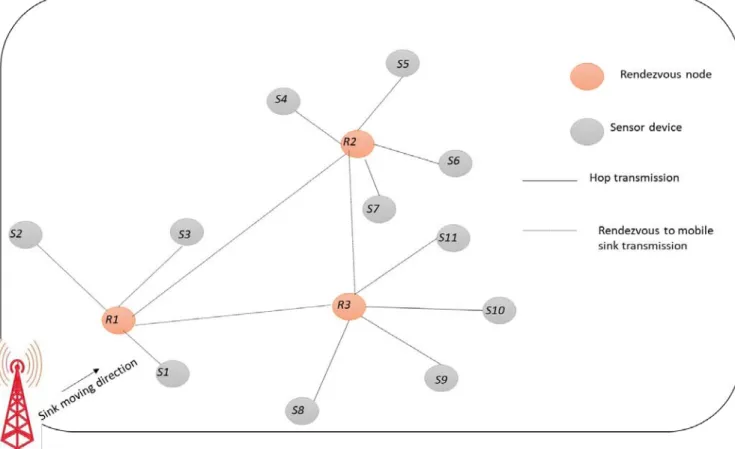
The architecture of proposed model is show in
Fig. 1. From Fig. 1 it can be seen that the rendezvous point closer to base station is composed of less number of rendezvous member we call this as level 1 and rendezvous point little far away from rendezvous node has more number of rendezvous member we call this has level 2. This way the far rendezvous point nodes will have large density of rendezvous member. This deployment method aid in minimizing energy consumption of rendezvous node. Especially, the rendezvous node closer to sink. Thus enhancing coverage time and lifetime of sensor network.
This work considers heterogeneous WSN i.e.,
let’s consider classes of sensor device such class A, class B. Class A are represented as sensor device that performs operation such as sensing. These device are low cost and tiny devices which are deployed across sensing region. The sensor are grouped together to form a rendezvous points. Class B sensor device is more powerful and has higher computing capability than Class A device which depicted as rendezvous node. The class B device collects and aggregates sensory data from its member and transmit toward sink/base station through set of hop/intermedia rendezvous node device.
Let consider there are 𝑁𝑁 and 𝑂𝑂 nodes that are
randomly deployed in a network and their position are known. Each sensor device are connected/associated
with one rendezvous node device and generates mean packet load of 𝛼𝛼 bits/sec and transmit to the rendezvous node, which further routes to the mobile sink nodes
(which in this work we considers as the (𝑀𝑀+ 1)𝑡𝑡ℎ
rendezvous node directly or through intermediated rendezvous node devices. Further, this work considers the rendezvous node consumes much higher energy than its sensor devices. Since, rendezvous node is active all the time and at the same time the member device are in sleep state. As a result, this work aimed to minimize energy consumption of rendezvous node device. As it aid in enhancing network coverage resulting in better lifetime of wireless sensor networks.
This work considers Rayleigh fading model to
characterize the channel among rendezvous node and also among rendezvous node and the base station. Therefore the channel gain 𝑦𝑦 among sender and receiver for communication is obtatined as follows
𝑖𝑖(𝑦𝑦) =𝑀𝑀(𝑒𝑒0)�𝑒𝑒𝑦𝑦 0�
−𝑜𝑜
𝛽𝛽 (1)
where 𝑀𝑀(𝑒𝑒0) is the path loss component of 𝑒𝑒0 which can
be computed as follows 𝑀𝑀(𝑒𝑒0) =𝐻𝐻𝑢𝑢𝐻𝐻𝑠𝑠𝑚𝑚 2 16𝜋𝜋2𝑒𝑒 02 (2) where 𝐻𝐻𝑢𝑢 is the antenna gain of the sender, 𝐻𝐻𝑠𝑠 is the antenna gain of the receiver, 𝛽𝛽 is a normalized arbitrary
Global Journal of Computer Science and Technology Volume XIX Issue II Version I
3 Year 2019
(
)
E
parameter that depicts the variation in the fading process, 𝑚𝑚 is the wavelength of the frequency carrier, 𝑜𝑜
is the path loss exponent. The 𝛽𝛽 is arbitrary and is
considered to be exponentially distributed, and the received signal is also arbitrary. Therefore, perfect reception of a signal is assured through probabilistic manner. Hence we needed that 𝑃𝑃{𝑓𝑓𝑠𝑠≥ 𝛿𝛿}≥ 𝛾𝛾𝑚𝑚 for ideal
reception, where 𝑓𝑓𝑠𝑠 is the energy of obtained signal, 𝛿𝛿 is
predetermined energy threshold, and 𝛾𝛾𝑚𝑚 is the expected
link ideal parameter.
Let consider 𝑑𝑑𝑗𝑗 as the cumulated hop routing
load attained by the 𝑗𝑗𝑡𝑡ℎ rendezvous node (bit/seconds)
for 𝑗𝑗= 1, … ,𝑂𝑂. The rendezvous pointing optimization
vector is expressed as follows
𝑑𝑑= (𝑑𝑑1, … ,𝑑𝑑𝑂𝑂). (3)
An important to be seen here is that the number
of sensor device associated with rendezvous node 𝑗𝑗i.e., the size of rendezvous point 𝑗𝑗, is expressed as follows
𝑑𝑑𝑗𝑗
𝛼𝛼. (4)
For 𝑗𝑗 ∈{1,2,3, … ,𝑂𝑂} and 𝑘𝑘 ∈{1,2,3, … ,𝑂𝑂+ 1}, with 𝑗𝑗 ≠ 𝑘𝑘, let 𝑤𝑤𝑗𝑗𝑘𝑘be the rendezvous routing load that is
transmitted from rendezvous node 𝑗𝑗 to rendezvous
node 𝑘𝑘. The routing optimization matrix 𝑺𝑺is the 𝑂𝑂 ∗ (𝑂𝑂+ 1) matrix of element𝑤𝑤𝑗𝑗𝑘𝑘, 𝑗𝑗= 1, … ,𝑂𝑂 and 𝑘𝑘= 1, … ,𝑂𝑂+ 1. This work considers𝑤𝑤𝑗𝑗𝑗𝑗 = 0. The objective of
this work is to maximize coverage time by establishing
an optimized routing matrix 𝑺𝑺′ and rendezvous point
vector𝑑𝑑′. Let consider 𝑄𝑄
𝑗𝑗 as the mean energy
consumption of the 𝑗𝑗𝑡𝑡ℎ rendezvous node. Then, the 𝑄𝑄 𝑗𝑗is expressed as follows 𝑄𝑄𝑗𝑗 = 𝑓𝑓𝑟𝑟𝑒𝑒𝑟𝑟𝑟𝑟�𝑑𝑑𝑗𝑗+ � 𝑤𝑤𝑘𝑘𝑗𝑗 1≤𝑘𝑘≤0,𝑘𝑘≠𝑗𝑗 � + 𝑓𝑓𝑡𝑡𝑟𝑟𝑡𝑡𝑠𝑠� � 𝑤𝑤𝑗𝑗𝑘𝑘 1≤𝑘𝑘≤0+1,𝑘𝑘≠𝑗𝑗 � + � 𝑤𝑤𝑗𝑗𝑘𝑘 1≤𝑘𝑘≤𝑂𝑂+1,𝑘𝑘≠𝑗𝑗 𝑓𝑓𝑢𝑢𝑗𝑗𝑘𝑘, 𝑗𝑗 = 1, … ,𝑂𝑂 (5)
where 𝑓𝑓𝑡𝑡𝑟𝑟𝑡𝑡𝑠𝑠 are the circuit energy per bit dissipated in
transmitting data, 𝑓𝑓𝑟𝑟𝑒𝑒𝑟𝑟𝑟𝑟 are the circuit energy per bit
dissipated in receiving data, and 𝑓𝑓𝑢𝑢𝑗𝑗𝑘𝑘 is the energy
dissipated from rendezvous node 𝑗𝑗 to rendezvous node
𝑘𝑘. Let us assume that 𝑒𝑒𝑗𝑗𝑘𝑘 as the distance among
rendezvous node 𝑗𝑗 and 𝑘𝑘, therefore using Eq. (1) the received energy per bit can be expressed as follows
𝑓𝑓𝑟𝑟𝑒𝑒𝑟𝑟𝑟𝑟𝑗𝑗𝑘𝑘 = 𝑓𝑓𝑡𝑡𝑟𝑟𝑡𝑡𝑠𝑠𝑗𝑗𝑘𝑘 𝑀𝑀(𝑒𝑒0)�𝑒𝑒𝑒𝑒𝑗𝑗𝑘𝑘 0�
−𝑜𝑜
𝛽𝛽. (6)
By using Rayleigh channel model, the link ideal
parameter can be described as follows 𝛾𝛾𝑚𝑚 =𝒫𝒫�𝑓𝑓𝑟𝑟𝑒𝑒𝑟𝑟𝑟𝑟𝑗𝑗𝑘𝑘 ≥ 𝛿𝛿� =𝒫𝒫 �𝛽𝛽 ≥ 𝑓𝑓 𝛿𝛿 𝑡𝑡𝑟𝑟𝑡𝑡𝑠𝑠𝑗𝑗𝑘𝑘 𝑀𝑀(𝑒𝑒0)� 𝑒𝑒𝑗𝑗𝑘𝑘 𝑒𝑒0� 𝑜𝑜 � =𝑓𝑓− 𝛿𝛿𝑒𝑒𝑗𝑗𝑘𝑘𝑜𝑜 𝑓𝑓𝑡𝑡𝑟𝑟𝑡𝑡𝑠𝑠𝑗𝑗𝑘𝑘 𝑀𝑀(𝑒𝑒0)𝑒𝑒0𝑜𝑜 (7)
From Eq. (7), we can describe 𝑓𝑓𝑡𝑡𝑟𝑟𝑡𝑡𝑠𝑠𝑗𝑗𝑘𝑘 as follows
𝑓𝑓𝑡𝑡𝑟𝑟𝑡𝑡𝑠𝑠𝑗𝑗𝑘𝑘 =𝜑𝜑𝑒𝑒𝑗𝑗𝑘𝑘𝑜𝑜, 𝑗𝑗 ≠ 𝑘𝑘 (8)
where 𝜑𝜑 is a constant that can be expressed as definition as follows
𝜑𝜑=𝑀𝑀(𝑒𝑒 −𝛿𝛿
0)𝑒𝑒0𝑜𝑜log𝛾𝛾𝑚𝑚
(9)
The Eq. (5) can be written considering for 𝑗𝑗=
1, … ,𝑂𝑂, as follows 𝑄𝑄𝑗𝑗 = 𝑓𝑓𝑟𝑟𝑒𝑒𝑟𝑟𝑟𝑟�𝑑𝑑𝑗𝑗+ � 𝑤𝑤𝑘𝑘𝑗𝑗 1≤𝑘𝑘≤𝑂𝑂,𝑘𝑘≠𝑗𝑗 � + � 𝑤𝑤𝑗𝑗𝑘𝑘�𝑓𝑓𝑡𝑡𝑟𝑟𝑡𝑡𝑠𝑠 1≤𝑘𝑘≤𝑂𝑂+1,𝑘𝑘≠𝑖𝑖 + 𝜑𝜑𝑒𝑒𝑗𝑗𝑘𝑘𝑜𝑜) (10)
Let 𝐹𝐹𝑗𝑗depicts the initial energy of the 𝑗𝑗𝑡𝑡ℎ
rendezvous node, 𝑗𝑗= 1, … ,𝑂𝑂. This work consider an
optimization problem to maximize coverage time as follows 𝑚𝑚𝑚𝑚𝑚𝑚{𝑑𝑑,𝑺𝑺}𝑚𝑚𝑖𝑖𝑡𝑡 �𝑄𝑄𝐹𝐹1 1, 𝐹𝐹2 𝑄𝑄2, … , 𝐹𝐹𝑂𝑂 𝑄𝑄𝑂𝑂�. (11)
When rendezvous nodes are deployed with
equal energy, that is,
𝑃𝑃𝑗𝑗 =𝑃𝑃 ∀ 𝑗𝑗, (12)
The optimization problem of Eq. (11) can be
rewritten as follows
𝑚𝑚𝑖𝑖𝑡𝑡{𝑑𝑑,𝑺𝑺}𝑚𝑚𝑚𝑚𝑚𝑚{𝑄𝑄1, … ,𝑄𝑄𝑂𝑂} (13)
For solving optimization problem of Eq. (13),
packet load composed by all the rendezvous node considering certain instance period of time must be identical to load produced by all the sensor devices in the same instance period of time.
b) Optimal rendezvous point selection and routing model
This section present rendezvous point
optimization technique for wireless sensor network. Let 𝑑𝑑′= (𝑑𝑑
1′, … ,𝑑𝑑𝑂𝑂′) be the optimal rendezvous pointing
vector outcome. For 𝑗𝑗= 1, … ,𝑂𝑂, rendezvous node 𝑗𝑗 is given 𝑁𝑁𝑗𝑗′ =𝑑𝑑𝑗𝑗′⁄𝛼𝛼 sensor devices. The sensor device
allocation is carried out in sequential manner, i.e., one at
Energy Efficient Mobile Sink Based Routing Model for Maximizing Lifetime of Wireless Sensor Network
Global Journal of Computer Science and Technology Volume XIX Issue II Version I
4 Year 2019
(
)
E
a time. A corresponding sensor device is allocated to the
nearest rendezvous node𝑗𝑗, provided that number of SD
to rendezvous node 𝑗𝑗 is not greater than𝑁𝑁𝑗𝑗′. If it exceed
then next nearest rendezvous node is considered and so on. The algorithm for obtaining optimal rendezvous pointing is presented in algorithm 1.
Algorithm 1: Optimal rendezvous pointing selection algorithm Input:𝑑𝑑;=𝑑𝑑′= (𝑑𝑑
1
′, … ,𝑑𝑑 𝑂𝑂′)
Expected outcome:𝑉𝑉1, … ,𝑉𝑉𝑂𝑂
Initialize:𝑉𝑉1=⋯=𝑉𝑉𝑂𝑂=∅ (rendezvous point sets)
Start: For𝑗𝑗= 1 to 𝑁𝑁
For𝑘𝑘= 1 to 𝑂𝑂
Set𝑦𝑦𝑗𝑗𝑘𝑘 to distance among sensor device 𝑗𝑗 and rendezvous node 𝑘𝑘
End for Iteration:𝑙𝑙=𝑚𝑚𝑟𝑟𝑎𝑎{𝑘𝑘}min�𝑦𝑦𝑗𝑗𝑘𝑘,𝑘𝑘= 1, … ,𝑂𝑂� If𝑑𝑑𝑙𝑙′> 0 𝑑𝑑𝑙𝑙′=𝑑𝑑𝑙𝑙′− 𝛼𝛼 𝑉𝑉𝑙𝑙=𝑉𝑉𝑙𝑙+ {𝑙𝑙} Else 𝑦𝑦𝑗𝑗𝑙𝑙 =∞ go to iteration End if End for End:
This work consider routing considering shortest
path root towards rendezvous node device to mobile sink through number of hop devices. For minimizing hop count which varies for different transmission. As a result, this work considers quality of communication using parameter 𝛾𝛾𝑞𝑞 for computing probability of positive
end-to-end reception. Fordifferent roots of 𝐿𝐿 paths experience different fading, the root reliability 𝛾𝛾𝓊𝓊 must be at least 𝛾𝛾𝑞𝑞
1
𝐿𝐿 .
Considering the shortest hop case, the packets are routed through nearest rendezvous node closer to the next level 𝑗𝑗 towards the base station. This work considers energy balanced rendezvous point based routing design that balance energy of different rendezvous nodes. The communication radius of rendezvous point can be obtained as follows
1
2(𝑠𝑠1− 𝑠𝑠0), … , 1
2(𝑠𝑠𝐿𝐿− 𝑠𝑠𝐿𝐿−1), (14) is the important to energy dissipation at different level rendezvous nodes. Thus, by purposely regulating the size of rendezvous point in different levels, a more balanced energy dissipation at different rendezvous nodes is attained, which aided in enhancing coverage time of WSN. Thus improving lifetime of WSNs which is experimentally proven below.
III.
S
IMULATIONR
ESULT ANDA
NNALYSIS
This section present performance evaluation of proposed model over exiting method considering lifetime, communication overhead and routing overhead. The experiment is conducted using windows 8 operating
system, I-7 Intel Pentium processor, 64-bit, 8 GB RAM. Experiment evaluation is done using SENSORIA simulator [32] for proposed and existing model. Here we compared our result with base LEACH protocol [11]. The LEACH and proposed model is modelled using Dot Net framework 4.5 and C# programming language. The LEACH has been widely used comparison protocol across various exiting approaches [11]. As a result, this work consider LEACH protocol as a case study for comparison. The simulation parameter used for experimental analysis is described as follows, the network size is set to 100m × 100m, the sensor device is varied from 500, 1000, 1500 and 2000, one base station is consider which is placed at the edge of the network, initial energy of sensor device is set between (heterogeneity) 0.1 to 0.2 Joules (j), Idle Energy Consumption (Eelec) is set to50 nj/bit, and Amplification Energy (Emp) is set to100 pJ/bit/m2. The range of transmission is set to 5 m and sensing range is set to 3 m, Data Packets Length is set to 5000 bits, Transmission Speed is set to 100 bit/s, Bandwidth is set to 10000 bit/s, Data processing delay is set to 0.1 s.
a) Lifetime performance analysis considering total
sensor node death
This section describes performance attained by
proposed model over existing model considering total sensor device death. Here the sensor device is varied from 500, 1000, 1500, and 2000 and experiment are conducted to evaluate lifetime performance and the result is graphically represented in Fig. 2. The result shows proposed model improves lifetime performance by 69.09%, 76.22%, 82.96%, and 83.83% over existing
Global Journal of Computer Science and Technology Volume XIX Issue II Version I
5 Year 2019
(
)
E
protocol considering 500, 1000, 1500, and 2000, sensor device respectively. An average lifetime performance improvement of 78.02% is attained by proposed model
over existing considering total sensor device death. The overall result attained shows scalable lifetime performance considering varied network density.
Fig. 2: Lifetime performance considering total sensor node death
b) Communication overhead and Routing/transmission
overhead performance evaluation considering varied sensor device
This section studies communication overhead
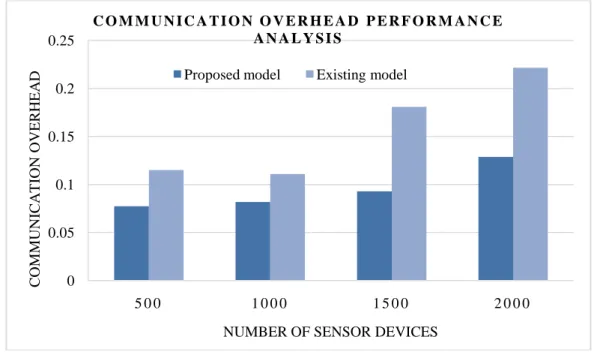
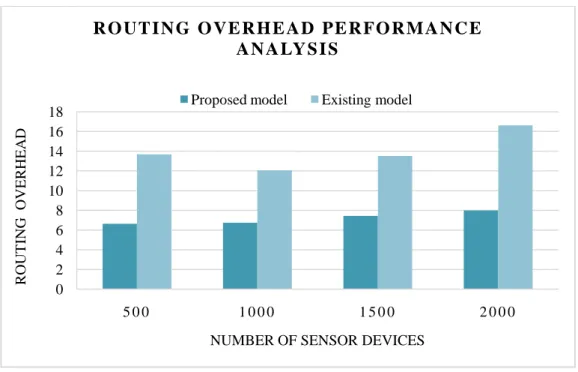
and routing overhead performance attained by proposed model over existing model [11]. For experiment analysis, the sensor device is varied from 500, 100, 1500, and 2000 and experiment are conducted and the result is graphically shown in Fig. 3. The outcome shows, proposed model reduces computation overhead by 32.74%, 26.25%, 48.644%, and 41.88% over existing model considering 500, 1000, 1500, and 2000 sensor
device, respectively. An average communication overhead reduction of 37.37% is attained by proposed model over existing model. Similarly, experiment are conducted to evaluate routing overhead performance by varying sensor device from 500, 100, 1500, and 2000 and result is graphically shown in Fig. 4. The outcome shows, proposed model reduces routing overhead by 51.62%, 44.06, 45.08%, and 51.93% over exisitng considering 500, 1000, 1500, and 2000 sensor device, respectively. An average routing overhead reduction of 48.17% is attained by proposed model over existing model.
Fig. 3: Communication overhead performance evaluation for varied wireless sensor nodes
0 200 400 600 800 1000 1200 1400 1600 1800 5 0 0 1 0 0 0 1 5 0 0 2 0 0 0 NUM B E R OF R OUND ( S )
NUMBER OF SENSOR NODES
L I F E T I M E P E R F O R M A N C E C O N S I D E R I N G T O T A L S E N S O R N O D E D E A T H
Proposed model Existing model
0 0.05 0.1 0.15 0.2 0.25 5 0 0 1 0 0 0 1 5 0 0 2 0 0 0 C OM M UNI C A T ION OVE R HE A D
NUMBER OF SENSOR DEVICES
C O M M U N I C A T I O N O V E R H E A D P E R F O R M A N C E A N A L Y S I S
Proposed model Existing model
Energy Efficient Mobile Sink Based Routing Model for Maximizing Lifetime of Wireless Sensor Network
Global Journal of Computer Science and Technology Volume XIX Issue II Version I
6 Year 2019
(
)
E
Fig. 4: Routing overhead performance analysis for varied wireless sensor nodes
c) Result and discussion over state-of-art technique
This paper conducted experiment evaluation
considering various performance parameter such as communication overhead, routing overhead, and network lifetime considering total sensor device death. This section particularly evaluate lifetime performance attained by proposed and various state-of-art technique over LEACH protocol [11].The model presented in [18] attain a lifetime performance improvement of 25.0%, [19] by 50.0%, [29] by 55.0%, [31] by 44.0%, [33] by 15.0%, and proposed model by 78.02% over LEACH [11]. From overall result attained shows proposed model attain significant lifetime performance enhancement over various existing model [18], [19], [29], [31], and [33]. Our model brings minimize energy consumption of rendezvous node, enhancing coverage time aiding in lifetime performance improvement of WSNs. Thus will aid in provisioning real-time application service that requires energy efficient design.
IV.
C
ONCLUSIONBuilding energy efficient design for provisioning
real-time and non-real-time application services in WSN is challenging. Extensive survey carried out shows number of approaches has been presented lately to enhance energy efficiency of sensor network. Among them mobile sink based routing design play an important role in enhancing performance of sensor network. However, design mobile sink based routing model with minimal latency and higher energy efficiency is challenging. To overcome research challenges, this manuscript presented an Energy Efficient Routing Optimization model using mobile sink. Further, routing optimization is carried out and shortest path based
routing is considered for attaining good trade-off between minimizing energy and maximizing lifetime of sensor network. Experiment are conducted to evaluate performance of proposed model over exiting model. The result shows proposed model improves lifetime performance of 78.02% considering total sensor device death. Further, the proposed model reduces communication overhead and routing overhead over exiting model by 37.37%, and 48.17% respectively. The overall result attained shows scalable lifetime, communication overhead and routing overhead performance considering varied network density.
1. M. R. Palattella et al., ``Internet of Things in the 5G era: Enablers, architecture, and business models,'' IEEE J. Sel. Areas Commun., vol. 34, no. 3, pp. 510-527, Mar. 2016.
2. S. Cirani and M. Picone, ``Wearable computing for
the Internet of Things,'' IT Prof., vol. 17, no. 5, pp. 35-41, Sep. 2015.
3. A. Zanella, N. Bui, A. Castellani, L. Vangelista, and
M. Zorzi, ``Internet of Things for smart cities,'' IEEE Internet Things J., vol. 1, no. 1, pp. 22-32, Feb. 2014.
4. M. Simsek, A. Aijaz, M. Dohler, and J. Sachs,
``5G-enabled tactile Internet,'' IEEE J. Sel. Areas Commun., vol. 34, no. 3, pp. 460-473, Mar. 2016.
5. J. Fan, F. Han, and H. Liu, ``Challenges of big data
analysis,'' Nat. Sci. Rev., vol. 1, no. 2, pp. 293-314, 2014.
6. M. Peng, S. Yan, K. Zhang, and C. Wang,
``Fog-computing-based radio access networks: Issues
0 2 4 6 8 10 12 14 16 18 5 0 0 1 0 0 0 1 5 0 0 2 0 0 0 R OUT ING OVE R HE A D
NUMBER OF SENSOR DEVICES
R O U T I N G O V E R H E A D PE R FO R M A N C E
A N A LY S I S
Proposed model Existing model
Global Journal of Computer Science and Technology Volume XIX Issue II Version I
7 Year 2019
(
)
E
and challenges,'' IEEE Netw., vol. 30, no. 4, pp. 46-53, Jul./Aug. 2016.
7. Y. Shi, J. Zhang, and K. B. Letaief, ``Group sparse
beamforming for green cloud-RAN,'' IEEE Trans. Wireless Commun., vol. 13, no. 5, pp. 2809-2823, May 2014.
8. Y. Shi, J. Zhang, K. B. Letaief, and W. Chen,
``Large-scale convex optimization for ultra-dense cloud-RAN,'' IEEE Wireless Commun., vol. 22, no. 3, pp. 84-91, Jun. 2015.
9. M. Chiang and T. Zhang, ``Fog and IoT: An
overview of research opportunities,'' IEEE Internet Things J., vol. 3, no. 6, pp. 854-864, Dec. 2016.
10. G. Anastasi, M. Conti, M. Di Francesco, and A.
Passarella, “Energy conservation in wireless sensor networks: A survey,” Ad Hoc Netw., vol. 7, no. 3, pp. 537–568, May 2009.
11. I. F. Akyildiz, W. Su, Y. Sankarasubramaniam, and
E. Cayirci, “Wireless sensor networks: A survey,” Comput. Netw., vol. 38, no. 4, pp. 393–422, Mar. 2002.
12. A. Nayak and I. Stojmenovic, Wireless Sensor and
Actuator Networks: Algorithms and Protocols for Scalable Coordination and Data Communication. Hoboken, NJ, USA: Wiley, 2010.
13. W. Dargie, “Dynamic power management in
wireless sensor networks: State-of-the-art,” IEEE Sensors J., vol. 12, no. 5, pp. 1518–1528, May 2012.
14. M. Saleem, G. A. Di Caro, and M. Farooq, “Swarm
intelligence based routing protocol for wireless sensor networks: Survey and future directions,” Inf. Sci., vol. 181, no. 20, pp. 4597–4624, Oct. 2011.
15. J. Yick, B. Mukherjee, and D. Ghosal, “Wireless
sensor network survey,” Comput. Netw., vol. 52, no. 12, pp. 2292–2330, Aug. 2008.
16. D. V. Puspalata and P. Nayak, “A clustering
algorithm for WSN to optimize the network lifetime using type-2 fuzzy logic model,” in Proc. 3rd Int. Conf. Artif. Intell., Modeling Simulations (AIMS), Kota Kinabalu, Malaysia, Dec. 2015, pp. 53–58.
17. S. Bandyopadhyay and E. J. Coyle, “An energy
efficient hierarchical clustering algorithm for wireless sensor networks,” in IEEE INFOCOM, vol. 3, 2003. 18. P. Nayak and A. Devulapalli, "A Fuzzy Logic-Based
Clustering Algorithm for WSN to Extend the Network Lifetime," in IEEE Sensors Journal, vol. 16, no. 1, pp. 137-144, Jan.1, 2016.
19. P. Nayak and B. Vathasavai, "Energy Efficient
Clustering Algorithm for Multi-Hop Wireless Sensor Network Using Type-2 Fuzzy Logic," in IEEE Sensors Journal, vol. 17, no. 14, pp. 4492-4499, July15, 15 2017.
20. U. Srinivasan and B. Arunasalam, “Leveraging big
data analytics to reduce healthcare costs,” IT Prof., vol. 15, no. 6, pp. 21–28, Nov./Dec. 2013.
21. N. Sun, J. G. Morris, J. Xu, X. Zhu, and M. Xie,
“iCARE: A framework for big data-based banking customer analytics,” IBM J. Res. Develop., vol. 58, nos. 5/6, pp. 4:1–4:9, 2014.
22. C. Sun, R. Gao, and H. Xi, “Big data based retail
recommender system ofnon E-commerce,” in Proc. Int. Conf. Comput., Commun. Netw. Technol.,2014, pp. 1–7.
23. [Online]. Available:
http://www.ibm.com/big-data/au/en/big-data-andanalytics/ operations-management.html
24. K. L. M. Ang; J. K. P. Seng; A. M. Zungeru,
"Optimizing Energy Consumption for Big Data Collection in Large-Scale Wireless Sensor Networks With Mobile Collectors," in IEEE Systems Journal , vol.PP, no.99, pp.1-11.
25. S. Rani, S. H. Ahmed, R. Talwar and J. Malhotra,
"Can Sensors Collect Big Data? An Energy-Efficient Big Data Gathering Algorithm for a WSN," in IEEE Transactions on Industrial Informatics, vol. 13, no. 4, pp. 1961-1968, Aug. 2017.
26. X. Liu, J. Li, Z. Dong and F. Xiong, "Joint Design of Energy-Efficient Clustering and Data Recovery for Wireless Sensor Networks," in IEEE Access, vol. 5, no. , pp. 3646-3656, 2017.
27. Chandramouli H, Dr. Somashekhar C Desai, K S
Jagadeesh, Kashyap D Dhruve. “Enhancing Network Lifetime in Wireless Sensor Networks Adopting Elephant Swarm Optimization”, Global Journal of Computer Science and Technology, NETWORK, WEB & SECURITY, Volume 13, Issue 4, Version 1.0, pp 09-17, Mar 2013.
28. Chandramouli H, Dr. Somashekhar C Desai, K S
Jagadeesh, Kashyap D Dhruve. “Elephant Swarm Optimization for Wireless Sensor Networks – A Cross Layer Mechanism”, International Journal of Computer Science & Technology (IJCET), Volume 4, Issue 2, pp 45-60, March – April 2013.
29. W. Twayej, M. Khan and H. S. Al-Raweshidy,
"Network Performance Evaluation of M2M With Self Organizing Cluster Head to Sink Mapping," in IEEE Sensors Journal, vol. 17, no. 15, pp. 4962-4974, Aug.1, 1 2017.
30. C. W. Tsai, T. P. Hong and G. N. Shiu,
"Metaheuristics for the Lifetime of WSN: A Review," in IEEE Sensors Journal, vol. 16, no. 9, pp. 2812-2831, May1, 2016.
31. Z. Hong, R. Wang and X. Li, "A clustering-tree
topology control based on the energy forecast for heterogeneous wireless sensor networks," in IEEE/CAA Journal of Automatica Sinica, vol. 3, no. 1, pp. 68-77, January 10 2016.
32. J. N. Al-Karaki and G. A. Al-Mashaqbeh,
"SENSORIA: A New Simulation Platform for Wireless Sensor Networks," 2007 International Conference on Sensor Technologies and Applications
Energy Efficient Mobile Sink Based Routing Model for Maximizing Lifetime of Wireless Sensor Network
Global Journal of Computer Science and Technology Volume XIX Issue II Version I
8 Year 2019
(
)
E
(SENSORCOMM 2007), Valencia, 2007, pp. 424-429.
33. H. K. Deva Sarma, R. Mall and A. Kar, "E2R2:
Energy-Efficient and Reliable Routing for Mobile Wireless Sensor Networks," in IEEE Systems Journal, vol. 10, no. 2, pp. 604-616, June 2016.
34. Konstantopoulos, C., Pantziou, G., Gavalas, D.,
Mpitziopoulos, A., and Mamalis, B.: ‘A rendezvous-based approach enabling energy-efficientsensory data collection with mobile sinks’, IEEE Trans. Parallel Distrib. Syst., 23, (5), pp. 809–817, 2012.
35. Gao, S., Zhang, H., and Das, S.: ‘Efficient data
collection in wireless sensor networks with path-constrained mobile sinks’, IEEE Trans.Mob. Comput., 2011, 10, (4), pp. 592–608, 2011.
36. Chang, R.-S., Wang, S.-H., Tsai, S.-L., and Yang,
W.-P.: ‘Planning rendezvous using the Halin graph in wireless sensor networks’, IET WirelSens. Syst., 2, (3), pp. 222–229, 2012
37. Salarian, H., Chin, K.-W., and Naghdy, F.: ‘An
energy-efficient mobilesink path selection strategy for wireless sensor networks’, IEEE Trans. Veh. Technol., 63, (5), pp. 2407–2419, 2014.