Page 1
DV SW Preliminary Report Introduction
INTRODUCTION
Background:
This is a preliminary descriptive report of the grant-funded pilot program
Public
Defender Social Workers and
Connecticut Domestic Violence Dockets: Managing Collateral Consequences
which began in April 2011. The grant is managed by
the Office of Policy and Management (OPM) through the Justice Assistance Grant (JAG) program of the Bureau of Justice
Assistance (BJA). The grant is scheduled to end in May 2013.
The purpose of the grant is to increase social work services for public defender clients on domestic violence dockets and
to provide services to more clients who would benefit. Domestic violence defendants are the focus of many initiatives and
collaborations within the criminal justice system, yet there have been no studies looking at the ways to improve individualized
assessment, wrap-around services and increased contact within the scope of public defender services. Public defender agencies
work with those defendants who are most likely to have economic, educational, employment and substance abuse issues. Public
defender social workers are in a key position to act as a primary care physician would in assessing, coordinating and supporting
all collateral needs and services including those that impact the court sanctioned diversionary domestic violence education
programs. Despite this natural collaboration, relationships of this kind are not commonplace in Connecticut and there is
virtually no research base on forensic social work or case management in public defender offices. Because the contracted
domestic violence education programs are pretrial programs, the defendant’s attorney and public defender social worker, due to
privilege, are in the best position to provide wrap-around services for the defendant. Wrap-around or collateral services are
important to the success of treatment.
DPDS social workers, because of their forensic assessment and case management skills as well as their privileged
communication status with those charged with domestic violence offenses, are in the best position to provide the vital
wrap-around services for domestic violence defendants. Because domestic violence education programs are accessed during the
pretrial phase of a case, there is no parole or probation officer assigned to assist and monitor the person’s collateral issues. The
DPDS social worker is more likely than not to have a advanced degree in social work, and has the training and experience
working within a forensic setting with defendants. For these reasons, the DPDS social worker has the best training and
information for acting as the primary source of case management among all community, treatment and judicial agencies for the
domestic violence defendant who has been remanded to pretrial domestic violence education programming.
February 2013
Connecticut Division of Public Defender Services
Page 2
DV SW Preliminary Report Introduction continued
Goals:
With six (6) primary goals in mind for the grant (see sidebar below), pilot sites in New Haven and Bridgeport were arranged.
One (1) new social worker was hired in each office on a contractual basis to carry the Domestic Violence Docket caseload. The
grant marks the first time the Division of Public Defender Services has collected this extent of demographic data over an
extended period of time. As a result, this report contains the first evidence-based portrait of any population of indigent
defendants this agency has reported. It acts as a template for future
analysis and data collection. Increasing the DV client’s chances of
getting DVSW services has been greatly increased by the addition of the
third social worker in each pilot site. Not only has the amount of
clients assigned increased, the dedication of one social worker to a
particularly complex docket has anecdotally resulted in better
communication with programs, defense attorneys assigned to DV cases
and DVSWers’ familiarity with programs and services tailored to DV
cases.
Data Collection:
Domestic Violence Social Workers (DVSW) fill out an intake and
discharge sheet for each client and provide caseload figures on a
quarterly basis for report to OPM. Caseload figures are collected
through the intake and discharge processes of DV clients with the
DVSW and additional data is collected by the clerical staff in each of
the two Public Defender pilot sites. The staff identifies every
domestic violence client and case appointed to the Bridgeport and
New Haven Public Defender’s offices thus giving us the ability to
calculate the percentage of overall DV clients (and cases) assigned to
DVSWers.
Preliminary Analysis from April 2012:
By April, 2012, at the year mark, the New Haven site had been
appointed to the cases of 1,245 clients and in Bridgeport 583 clients.
Of those, the DVSW was assigned 292 and 298 clients respectively.
This represents 23.5% of all DV clients in the New Haven Public Defender office and 51% of those in Bridgeport. Initial analyses
of clients who successfully completed the domestic violence protocol required by the court was 81% of New Haven and 57% in
Bridgeport.
Current Analysis:
This report covers the time periods of April 2011-August 2012 for the New Haven site and April 2011-December 2012 for the
Bridgeport site. Because some information is gathered by the DVSW at the close of a case, certain analyses could only be
conducted on closed cases (arrests during pendency of case, number of days incarcerated pretrial, total number of court
appearances, months pending, number of contacts). For those analyses the number of clients with cases included in the analyses
is smaller as the grant is still ongoing and there are a number of pending cases in each site (the N for each analyses will be
provided where applicable). A final analysis encompassing all cases for the life of the grant will be conducted once all clients
have been discharged.
February 2013
Goals of the JAG Public Defender Social
Workers and Connecticut Domestic Violence
Dockets: Managing Collateral Consequences
● Goal 1:fostering collaborative relationships be-tween DPDS and other criminal justice and con-tracted providers associated with the dedicated domestic violence dockets.
● Goal 2: Apply evidence-based practice (EBP) princi-ples to developing the DPDS social worker’s domes-tic violence model.
● Goal 3: Provide indigent domestic violence defen-dants with comprehensive assessment and social work case management services.
● Goal 4: Ensure adherence of social worker case management program to program goals.
● Goal 5: Have a greater understanding of the im-pact of Public Defender Social Workers’ interven-tions on client success in court sanctioned diver-sionary domestic violence education programs.
● Goal 6: Share and implement the results of the pro-gram.
DV SW Assignments and Caseload
The New Haven Site:
Domestic Violence Social Work (DVSW) Assignments:
Caseload: Attorneys were instructed to assign only new clients, however some existing cases were referred. Omitting the already existing clients, one-hundred seventy six (176) clients with two-hundred sixty five (265) cases (original docket numbers) were referred to the DVSW between April 2011 and October 2012 resulting in an average of approximately eleven (11) new cases per month. One-hundred fifty-seven clients (89.2%) began with 1-2 dockets.
Timeliness of Assignments: In the first seven (7) days, approximately 6% of clients were referred for DVSW services and just over 11% within the first fourteen (14) days. Fifty-nine percent (59%) were referred within the first eight (8) weeks. An aim of the DVSW program was to initiate early contact with clients whenever possible in order to help clients better manage collateral consequences of arrest.
The Bridgeport Site:
Domestic Violence Social Work (DVSW) _Assignments:
Caseload: Five hundred seventy-seven (577) new clients with seven hundred twenty-one (721) cases were assigned to the Bridgeport
DVSW between April 2011 and December 2012 resulting in an average of approximately twenty nine (29) new clients per month. The overwhelming majority of clients (95.7%) began with 1-2 cases.
Timeliness of Assignments: In the first seven (7) days, just over 9% of clients were referred for DVSW services and just over 12% within the first fourteen (14) days. Nearly forty-seven percent (46.8%) were referred within the first eight (8) weeks.
Analysis: According to the data between 46.8% and 59% of clients were referred to DV Social Workers within the first eight weeks. While both sites demonstrated adherence to the aim of early referrals to DV Social Workers, further research is needed to determine the benefits of referral at arraignment in comparison to subsequent dates. Anecdotally, staff of the New Haven site noted that having a social worker in Court to work with the client and assess strengths and weaknesses at time of arraignment may increase compliance with protective orders and other conditions of release.
February 2013
Chart 1: Dockets per Client NH
Chart 3: Dockets per Client Bpt
Chart 4: Referrals by Week in Bpt Site
Graphic 2: Educational Level Bridgeport
Page 4
DV SW Client Demographics and Descriptives
The New Haven Site:
This pilot program had an additional impact on the statistical reporting for the Division of Public Defender Services as it marked the first time variables including gender, age, race/ethnicity and education were collected from any client population.
Gender: Of the 176 clients, 72.7% were Male and 27.3% were female.
Age: Clients in New Haven ranged from age 18 to age 71 with a mean age of 33.5 years old. This wide range in age presents unique challenges to the social worker assisting these clients as the educational, employment, family and health concerns across the caseload can widely vary.
Race/Ethnicity: As self-reported by the 176 new clients in New Haven during that time period, the highest percentage of clients were African American (56.8%) with Hispanic second (25.6%) (figure 3).
The Bridgeport Site:
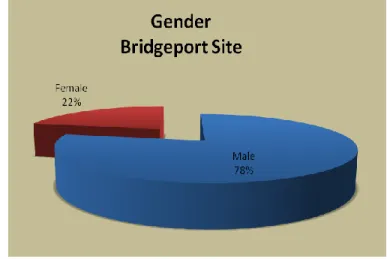
Gender: Of the 577 clients, 78.3% were male and 21.7% female.
Age: Clients served by the DV social worker in the Bridgeport Public Defender’s Office ranged in age from 17 to 78 with a mean age of 33 years old; nearly identical to the mean age of the New Haven DV clients in the pilot.
Race/Ethnicity: As self-reported by the 176 new clients in New Haven during that time period, the highest percentage of clients were African American (39.7%) with Hispanic second (33.3%) (Figure 4).
February 2013
Chart 5: Gender New Haven
Chart 6: Race/Ethnicity New Haven
Chart 8: Race/Ethnicity Bridgeport Chart 7: Gender Bridgeport
Graphic 2: Educational Level Bridgeport
Page 5
DV SW Client Demographics and Descriptives continued
The New Haven Site:
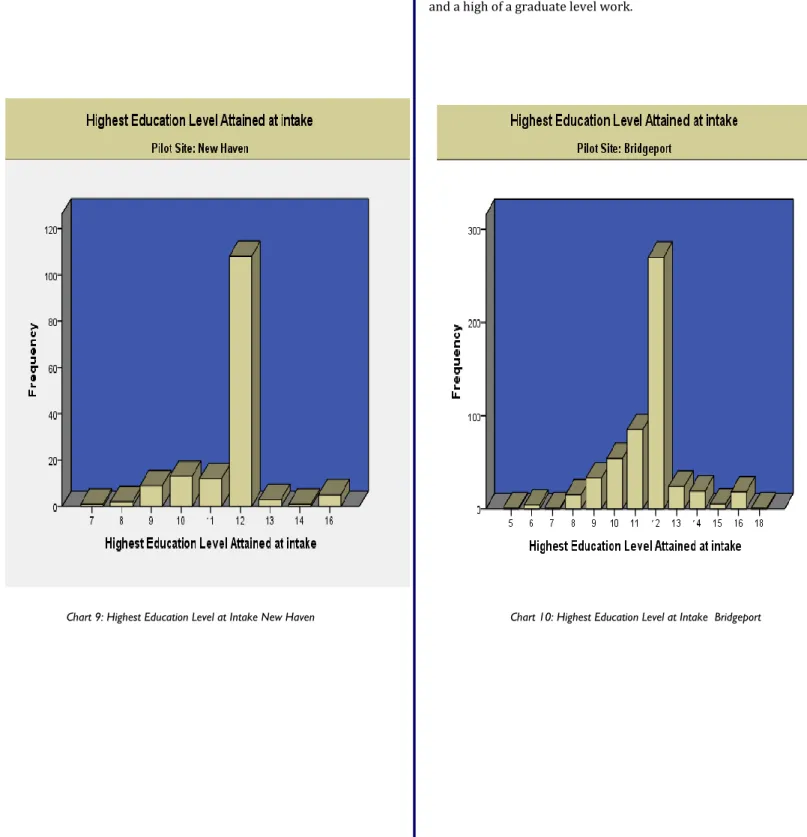
Education: In New Haven, the mean educational grade level (self-reported) attained at the time of intake with the DV Social Worker was 11.66. The overwhelming majority (92%) had attainted a 12th grade level (includes High School Diploma and GED) and an additional nearly 6% had some college. The range of levels attained ran from a low of 7th Grade to a high of a four year college degree.
The Bridgeport Site:
Education: In Bridgeport, the mean educational grade level (self-reported) attained at the time of intake with the DV Social Worker was 11.56 and within close proximately to New Haven’s group. Although lower than New Haven, 76.6% of the Bridgeport clients listed reportedly attained a 12th grade level (see chart 4 below). The range of educational levels attained included a low of the 5th grade and a high of a graduate level work.
February 2013
Chart 10: Highest Education Level at Intake Bridgeport Chart 9: Highest Education Level at Intake New Haven
Graphic 2: Educational Level Bridgeport
Page 6
DV SW Client Demographics and Descriptives continued
The New Haven Site:
Months Pending: Of the 95 cases that were both opened and closed between April 2011 and August 2012, 55.8% were resolved in between less than a month and three months. Another 30.5% were resolved in between four and six months and 13.7% between months seven and nine. The average length of a client’s experience with resolution of his or her cases was 3.55 months.
Incarceration Status : At arraignment in New Haven, over 28.4% of DVSW clients were incarcerated. Of the 88 cases closed during the timeframe outlined in this report, 36.95% were incarcerated at some point during the pendency of his/her cases. Those New Haven clients had a mean number of days incarcerated of 16.81 and 26% of those with days incarcerated served between 1 and 60 days. Incarceration at any point during the pretrial phase may to additional concerns regarding the collateral consequences of losing employment, inability to pay for housing and other serious considerations.
The Bridgeport Site:
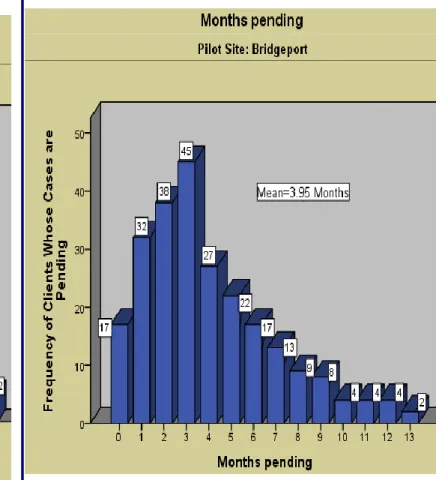
Months Pending: Two-hundred and forty two DV Social Work cases were opened and closed in Bridgeport between April 2011 and December 2012. The average length of time for a client’s cases to be resolved was only slightly longer than in New Haven at 3.95 months. While 81.5% were resolved within six months, it is worth noting that over half at 54.5% resolved within the first three months.
Incarceration Status at Arraignment: Twenty five percent of Bridgeport clients were incarcerated at time of arraignment and of the 233 discharged cases 40% were incarcerated at some point during pretrial. An additional consideration when analyzing incarceration rates of pretrial DV defendants is indigence. All of the defendants in both pilot sites were deemed financially eligible for the services of the Public Defender office in their jurisdiction; therefore inability to post bond is an additional concern for these clients.
February 2013
Graphic 2: Educational Level Bridgeport
CT Division of Public Defender Services
DV SW Client Demographics and Descriptives continued
The New Haven Site:
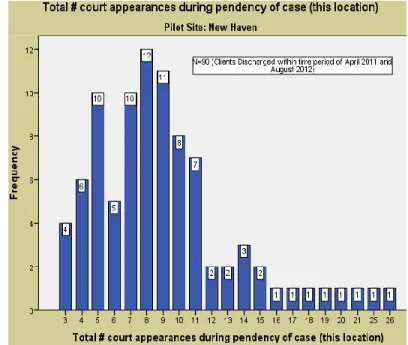
Court Appearances: Of the 90 discharged clients, the average number of court appearances was 9.13. Over one third (38.9%) of those clients completed his or her cases within 7 court appearances and 4.4% within 3 pretrial appearances. While number of continuances and length of case may be impacted by pretrial program
completion, additional research should be conducted on the critical time between the first and second pretrial court dates. If the DV social worker is not included during that time, the defendant may have little to no other guidance or case management from DV or Court personnel.
Arrests During Pendency of Case(s): Within the approximately 90 discharged cases in New Haven during the time period covered in this report, 88.3% of clients completed their case(s) without any additional arrests during the pendency of the case(s). Few or no arrests during the pendency of the case is a positive step for clients who and DV Social Workers who are working towards successful resolution of the case(s).
The Bridgeport Site:
Court Appearances: Of the 230 discharged clients at the time of this report, the average number of court appearances was 8.37. Over half (52.2%) of those clients had completed cases within 7 court appearances and 9.6% within 3 pretrial appearances. The longest length of time for a client’s cases to be resolved was twenty-nine weeks. There are many factors that can impact the pendency of a case including the pretrial program(s), any changes to programming
during the pretrial stage, personal factors and others.
Arrests During Pendency of Case(s): Of the approximately 230 clients discharged, 200 (84%) completed their case(s) without any additional arrests during the pendency of the case(s).
February 2013
Chart 13: Court Appearances During Pendency of Case in New Haven
Chart 14: Arrest(s) During Pendency of Case(s) in New Haven
Chart 15: Court Appearances During Pendency of Case in New Haven
Graphic 2: Educational Level Bridgeport
CT Division of Public Defender Services
DV SW Client Demographics and Descriptives continued
The New Haven Site:
Collateral Needs at Referral to DVSW New Haven:
Training: Public Defender Social Workers are trained to conduct bio-psychosocial assessments and provide alternative plans and referrals based on not only the client’s history, records and collateral sources but to place that within the context of the current legal circumstances. Because of attorney/client privilege and the statewide public defender system, DVSW are uniquely equipped to fully understand the legal ramifications and disposition possibilities of clients who may have other pending charges in other jurisdictions.
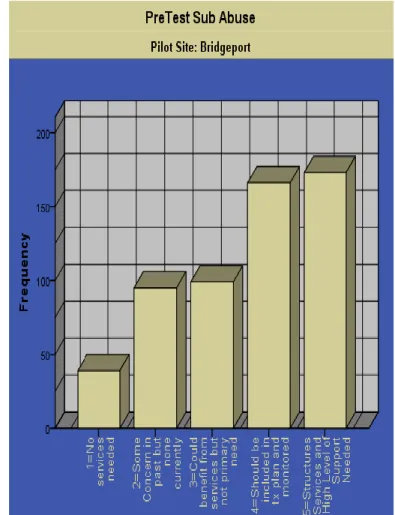
Assessment: At the time of DVSW intake, social workers assessed each client for six collateral needs (Educational, Substance Abuse Treatment, Employment, Mental Health, Community Support and Housing) and recorded a score between 1 and 6 on a pretest. According to the assessments by the New Haven DVSW, the majority of clients presented with few services needs in Education, Employment, Community Support and Housing. The majority of clients were assessed as a “4” needing substance abuse treatment within the treatment plan (41.8%). While 54% of the clients were assessed as having the lowest level of need for mental health, nearly 36% were assessed at the two highest levels of need.
The New Haven pilot clients’ mean scores on each of the six assessed areas of need ranged from scores of 1.27—2.89 with an overall score mean of 10.89. Similar to the Bridgeport site, Substance Abuse (mean score=2.89) and Mental Health (mean score=2.43) topped the needs.
The Bridgeport Site:
Collateral Needs at Referral to DVSW Bridgeport:
Of the 577 cases assessed for collateral needs at the beginning of the case at Bridgeport site, Total pretest scores for 574 clients yielded a mean score of 19.85 (compared to the New Haven pretrial mean score of 10.89) within the range of possible scores from a low of 6 through a high of 30. 86.9% of clients scores over the mid-range score of 15 meaning the DV Social Worker assessed the overwhelming majority of clients as having collateral needs that should be included in the treatment plan.
Overall, Bridgeport had higher mean scores of all six areas assessed than the New Haven pilot clients. Bridgeport DV clients generally presented as needing the most assistance with Substance Abuse (mean score=3.59) and Mental Health (mean score=3.58) followed by community support (mean score=3.51). The lowest scores were in housing needs (mean=2.73). All are areas that can be addressed by the DV Social Workers, but identifying the most critical needs may make a difference in the allocation of time and resources for the social workers.
Analysis: Because DV social workers were augmenting their clinical skills with the collateral needs assessment, a non-validated tool, care was taken to report each site separately to account for any inter-rater reliability issues. More research is needed to identify or develop validated tools that would give DV Social Workers data that can not only be compared across sites, but with DV SW programs in other agencies and Public Defender organizations across the country.
February 2013
Chart 18: Pretest Substance Abuse Needs Bridgeport
Graphic 2: Educational Level Bridgeport
Page 9
DV SW Client and Collateral Contacts
The New Haven Site:
DVSW Contacts: One of the most prominent aims of the pilot site project was to increase (or in the case of victims, track contact made to the DVSW) Public Defender Social Worker contact with:
For this endeavor, types of contact included: e-contact (email, text, other); face to face contact and written contact. A number of factors can impact the type of contact DVSW make with stakeholders in a DV case. For example, clients may not have a mailing address but may have texting capability therefore e-contact may be more feasible than written contact.
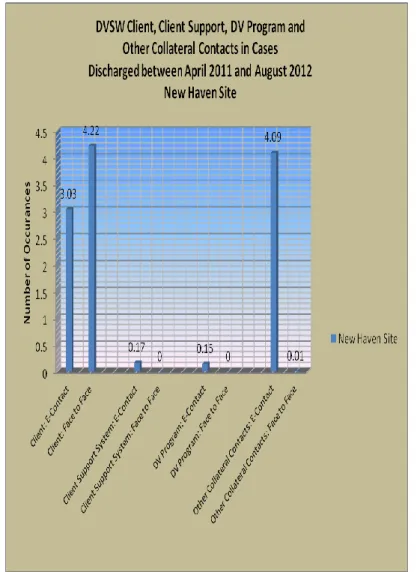
In New Haven, overall the DVSW had the most e-contact (mean=3.03 events during a case with client; 4.09 with collateral contacts) and face to face contact (mean=4.22 events during a case with client) with the clients.
The Bridgeport Site:
DVSW Contacts: In the Bridgeport site, the DVSW similarly recorded the most contact with both clients and other collateral contacts such as employers. E-contact such as emails and texts were the most common with a mean of 3.03 for clients and a mean of 4.09 for other collateral contacts. Face to face contact with clients had a mean of 2.19. This indicates that most of the contact occurred face to face with clients and through e-contact with other collateral contacts as well as clients.
Analysis: More research is needed to understand the correlations between frequency and types of contact with client case outcomes and other factors. It is important to identify ways clients can communicate with the DVSW to avoid crisis situations stemming from logistical or other factors that impact compliance with conditions of release . An example is the DVSW providing assistance to the client by helping him/her identify the correct bus route to take in order to reach DV groups on time.
In addition, qualitative feedback from DVSW who made concerted efforts to increase awareness of their role within the larger DV community within the courthouses would also be valuable.
February 2013
Clients
Client support system (ex. Family) Domestic Violence Programs
Other Collateral Contacts (ex. Employer) Victim(s)
Graphic 2: Educational Level Bridgeport
Page 10
DV SW Client and Collateral Contacts
The New Haven Site:
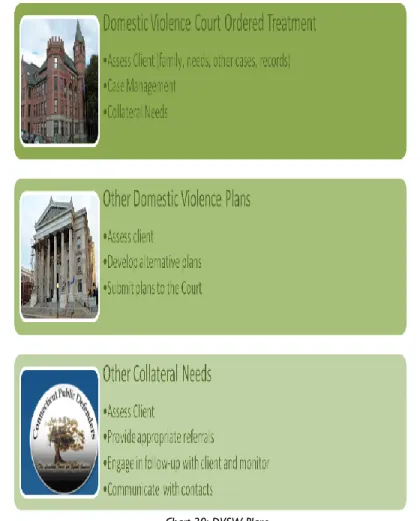
Treatment Planning:Part of the DV caseload for both sites included assisting clients who were participating in Court ordered DV programs (Evolve, Family Violence Education Program and Explore). Many clients needed additional or alternative services because of special circumstances or collateral needs. DVSWers developed and monitored plans that included domestic violence counseling, mental health, substance abuse, education, housing and other collateral needs that were assessed at the beginning of each case.
In New Haven there were ninety-four (N=94) clients who had been discharged at the time of this report (N=94) and nine (9) of those were involved in Court ordered DV programs. In addition, the DVSW had presented alternative domestic violence treatment plans for 38.3% of discharged clients. Of those plans, 33% were partially (1.1%) or fully (31.9%) accepted by the Court.
Alternative plans or referrals included mental health outpatient (37.2%), housing (1.1%), substance abuse inpatient (7.4%), substance abuse outpatient (46.8%) and other community needs (8.5%). These percentages are commensurate with the average initial needs assessment reported on page 7 of this report.
The Bridgeport Site:
Treatment Planning:The Bridgeport DVSW treatment plan figures are based on the two-hundred forty-two (N=242) clients who had been discharged at the time of this report. The Bridgeport DVSW had thirty (30) clients involved in Court ordered DV programs such as Evolve, Family Violence Education Program and Explore).
The DVSW also presented alternative DV programming to the Court in 46% of all discharged clients with 45.1% of those being accepted by the Court either partially (2.5%) or fully (42.6%).
Another 65 other alternative plans (out of the 242 discharged clients) were developed in the areas of mental health inpatient (3.3%), mental health outpatient (41.1%), housing (.4%), substance abuse inpatient (8.7%), substance abuse outpatient (43.8%) and other community needs (2.1%).
Analysis: DVSW in both locations applied training and expertise to assess and provide plans and treatment referrals to clients on their caseloads that were designed to support the Court ordered DV treatment, provide alternative DV treatment where necessary and to address the myriad of collateral issues that may inhibit DV defendants from successfully completing treatment, making lasting changes and successfully disentangling themselves from the criminal justice system.
The presence of DVSWers in both offices provides a more targeted, higher level of coverage for DV clients particularly during the critical first few months of a DV case when defendants are expected to maintain treatment, comply with full or partial protective orders and address any collateral issues. Having DVSWers in two of the busiest public defender offices in the state has made this level of intervention possible not only for DV clients, but has had an additional impact of allowing the other two social workers in each office to provide more in depth services to more of their clients.
February 2013
Graphic 2: Educational Level Bridgeport
CT Division of Public Defender Services
DV SW Client and Collateral Contacts
1. Domestic Violence SW Flyer
2. Domestic Violence Social Worker Intake Form
3. Domestic Violence Social Worker Discharge Form
4. Monthly Measurement Worksheet for Grant Reporting
February 2013
Attachments
Beginning in April, 2011 the Division of Public Defender
Services will pilot a Domestic Violence Social Worker
program in the New Haven and Bridgeport Geographical
Area Courts.
In addition to the aims of the pilot program that are
listed in the sidebar (
left
), the Division of Public
De-fender Services and the two new Domestic Violence
So-cial Workers look forward to collaborating with other
agencies and personnel who have long dedicated their
services to the vital needs of victims and the community
at large to address the growing need for
defendant-initiated change in the cycle of violence.
We look forward to this collaboration and welcome any
questions or comments you may have about this or any
of the other programs of the Division of Public Defender
Services.
Sincerely,
Susan O. Storey, Esq.
Chief Public Defender
Connecticut Division of
Public Defender Services
Domestic Violence Social
Worker Pilot Program
Phone: 860-509-6400 Fax: 860-509-6495 30 Trinity Street, 4th Floor Hartford, Connecticut 06106
Connecticut Division of
Public Defender Services
A
ims of this Pilot Program:
● Provide Support for Clinical Intervention:
Provide wrap-around services to indigent defendants who are involved in domestic violence treatment programs.
● Support a defendant-initiated change in the cycle of violence: Through attorney-client privileged services with a professional social worker, clients will engage in skill-building, enhance communication and inter-personal skills and build appropriate com-munity supports.
● Enhance Inter-Agency Collaboration:
Enhance collaboration between the Division of Public Defender Services and other crimi-nal justice agencies who share common goals of decreased recidivism, increased treatment completion and increased public safety.
● Improve Evidence-BasedPractice with Domestic Violence Defendants: Finally, this pilot aims to measure the impact of having a trained social worker in the Public Defender’s Office on the outcomes of indi-vidual clients and the overall success rates of those receiving the services.
Section One: Demographics
Name
Date of Birth
Zip Code at end of services
Education level at end of services
Section Two: Contacts Made During the Pendency of the Case
Phone
Calls/Texts/Emails
In-Person
Written
Correspondence
With Client
With Client’s Support System
With DV Program or others
With other collateral Supports
Section Three: Progress Report
1.
Additional Arrests? (Provide New
Docket Number[s])
Yes
No
2.
Number of Court Appearances
3.
Final Charges (Provide Statute
Numbers)
4.
Alternative Plan Presented by
PDSW?
Yes
No
5.
Alternative Plan Presented by anyone
other than PDSW?
Yes
No
Alternative PDSW Plan Accepted by Court?
Fully
Yes
No
Partially
Yes
No
Not at all
Yes
No
DIRECTIONS:
For questions 7 and 8, please indicate successful or not successful for only the programs that were utilized.
Otherwise leave blank.
Program
Was Program Successfully
Completed?
Which of these DV programs were used?
a.
FVEP
Yes
No
b.
Explore
c.
Evolve
Yes
No
d.
Other
Name:_________________
Yes
No
Program
Was Program Successfully
Completed?
Which alternative programs/plans were
used? Successful completion?
a.
Mental Health
Inpatient?
Yes
No
b.
Mental Health
Outpatient?
Yes
No
c.
Substance Abuse
Inpatient?
Yes
No
d.
Substance Abuse
Outpatient?
Yes
No
e.
Housing Assistance
Yes
No
f.
Educational
Resources
Yes
No
g.
Other Community
Resources Accessed
(list)
Yes
No
How was case removed from caseload?
Post-Test Assessment of Collateral Needs: Mark “X” in Appropriate Score Box for Questions 1 through 5
1
No Services
Needed at this
time
2
Some Concern
in the past but
not currently
3
Could benefit
from Services,
but Not Primary
Need
4
Should be
included in
Treatment Plan
and Monitored
5
Requires
Structured
Services and
High level of
Support
1.
Educational
1
2
3
4
5
2.
Substance Abuse
1
2
3
4
5
3.
Employment
1
2
3
4
5
4.
Mental Health
1
2
3
4
5
5.
Community Support
1
2
3
4
5
6.
Housing
1
2
3
4
5
Name
Date of Birth
Gender
Race/Ethnicity
Docket Number (s)
Zip Code
Education level
Date of First Court Appearance
Date of First PD Social Work Services
Initial Charges (Statute Numbers)
Pre-Test Assessment of Collateral Needs: Circle Appropriate Score for Questions 1 through 5
1
No Services
Needed at this
time
2
Some Concern
in the past but
not currently
3
Could benefit
from Services,
but Not Primary
Need
4
Should be
included in
Treatment Plan
and Monitored
5
Requires
Structured
Services and
High level of
Support
1.
Educational
1
2
3
4
5
2.
Substance Abuse
1
2
3
4
5
3.
Employment
1
2
3
4
5
4.
Mental Health
1
2
3
4
5
5.
Community Support
1
2
3
4
5
6.
Housing
1
2
3
4
5
Public Defender Domestic Violence Social Worker
Performance Measures Worksheet
2011
Reporting Month/Year:
Reporting Office:
Performance Measure
Clients
Cases
(Docket Numbers)
P
er
fo
rm
an
ce M
easu
re:
R
ec
ei
v
in
g
S
er
v
ices
a.
Number of
domestic violence
clients (and cases)
carried over from
last month:
b.
Number of clients
(and cases)
receiving services
that were added
during this
reporting month
c.
Number of clients
(and cases)
receiving services
(a+b = c)
P
er
fo
rm
an
ce M
easu
re:
P
er
cen
tag
e
C
om
pl
et
ing S
er
vi
ce
s
a.
Number of dv
clients (and cases)
who successfully
completed
1services during
this reporting
month
b.
Total Number of
clients (and cases)
that exited
2services during
reporting month
(complete or not
complete)
c.
Percent (a/b=c)
1Completion refers to the number of clients that completed their domestic violence
programming.
2