Multi-Agent Behavior-Based Policy Transfer
Sabre Didi and Geoff Nitschke
Department of Computer Science, University of Cape Town, 7700 Rondebosch, Cape Town, South Africa [email protected],[email protected]
Abstract. A key objective of transfer learning is to improve and speed-up learning on a target task after training on a different, but related, source task. This study presents a neuro-evolution method that transfers evolved policies within multi-agent tasks of varying degrees of complex-ity. The method incorporates behavioral diversity (novelty) search as a means to boost the task performance of transferred policies (multi-agent behaviors). Results indicate that transferred evolved multi-agent behav-iors are significantly improved in more complex tasks when adapted using behavioral diversity. Comparatively, behaviors that do not use behav-ioral diversity to further adapt transferred behaviors, perform relatively poorly in terms of adaptation times and quality of solutions in target tasks. Also, in support of previous work, both policy transfer methods (with and without behavioral diversity adaptation), out-perform behav-iors evolved in target tasks without transfer learning.
Keywords: Multi-agent Learning, Evolutionary Algorithms, Transfer Learning, Behavioural diversity adaptation
1
Introduction
Transfer learning1 is a technique that attempts to improve learning a task by leveraging knowledge from learning a related but simpler task [1]. Specifically, transfer learning is the process of reusing learned information across tasks, where information is shared between a source and target task. Transferring knowledge that is learned on a source task accelerates learning and increases solution quality in target tasks by exploiting relevant prior knowledge.
Transfer learning has been widely studied in the context of Reinforcement Learning (RL) [2], for various single-agent tasks including pole-balancing [3], game-playing [4], robot navigation as well as multi-agent tasks including predator-prey [5]. For such single and multi-agent tasks, policy (behavior) transfer is typically done within the same task domain for varying task complexity [2]. To facilitate the learning of generalized problem solving behavior various agent (controller) representations have been used including Decision Trees [4], Ar-tificial Neural Networks (ANNs), Cerebellar Model Arithmetic Computer, and Radial Basis Functions [6]. Such representations are typically selected as they are amenable to decomposition for transfer of partial policies between source
1
and target tasks as well as further adaptation in target tasks [4]. In multi-agent transfer learning, policies learned in source tasks are often shared between agents and used as a starting point for learning new policies in target tasks [5]. A pop-ular multi-agent test-bed isRoboCup Keep-Away Soccer [7], which has received significant attention in multi-agent transfer learning research [6].
Recently, in addition to RL, there has been an increasing amount of work on transfer learning using evolutionary algorithms to adapt policies with various representations. For example, Doncieux [8] usedneuro-evolution[9] to search for effective ANN controllers in a simulated robot ball collecting task, and inves-tigated methods for extracting behavioral features shared between versions of the task. These extracted features were then used as stepping stones to shape rewards in the evolution of controllers transferred to more complex versions of the ball collecting task.
In related research, Moshaiov et al. [10] used Multi-Objective Evolutionary Algorithms [11] to devise a Family Bootstrapping method that evolved groups of complementary ANN controllers to robot navigation tasks. These controllers were then used as an evolutionary starting point for controller evolution in robot navigation tasks with different objectives. Taylor et al. [12] used the NEAT neuro-evolution method [13] to further evolve a population of ANN controllers already evolved for a source keep-away soccer task. The authors demonstrated that biasing and further evolving a fittest population of controllers for more complex versions of keep-away significantly decreased evolution time.
Verbancsics et al. [14] used an indirect encoding neuro-evolution method (HyperNEAT [15]) to facilitate evolved solutions encoding the geometry of the keep-away soccer task. HyperNEAT facilitated the transfer of evolved multi-agent behaviors between source and target tasks with varying numbers of multi-agents and soccer field sizes, without the need for any further adaptation. The authors also used HyperNEAT to demonstrate successful transfer of multi-agent behav-iors between the Knight’s Joust (a multi-agent predator-prey task variant) [6] and keep-away soccer tasks. The efficacy of this approach was further supported by improved task performance on target tasks after further neuro-evolution and evolved behaviors that were comparable to RL derived policies [16], [17]. In support of this approach, related work [18], [14] has also highlighted the ef-fectiveness of indirectly coded representations for facilitating transfer learning between multi-agent task variants as well as between different multi-agent tasks. A key challenge in transfer learning is to ensure that a policy, learned in a source task can be meaningfully transferred to a policy in a target task, with a typically more complex representation [6]. Hence a mapping function is required in order that learned policies are transferable between tasks with different num-bers of state and action variables. For example, tasks of increasing complexity or different but related tasks such as keep-away soccer [7] and Knight’s Joust [6]. To address this, Taylor et al. [6], devised a inter-task mappings for policy search method to transfer a population of control policies (ANN controllers) between keep-away soccer, knight’s joust and Server Job Scheduling tasks [17]. This method was successfully applied with full (hand-coded) inter-task mapping
functions, where inter-task mapping functions were only partially available or where inter-task mapping functions had to be learned prior to policy transfer.
This study combines and extends previous work oninter-task mappings for policy search [6] and facilitating transfer learning with HyperNEAT [14]. Specif-ically, we investigate the adaptation of multi-agent behaviors in the keep-away soccer task domain with theNovelty Search[19] behavioral diversity mechanism. Whilst many studies support the efficacy of objective-based (fitness function) search approaches in transfer learning [17], [6], [18], [14], the impact of behav-ioral diversity maintenance on transfer learning remains unexplored. This study also investigates the benefits of behavioral diversity and objective based search with policy transfer using direct (NEAT) and indirect encoding (HyperNEAT) methods to evolve behaviors in target keep-away tasks.
First, we hypothesize that if behavioral diversity maintenance is used in multi-agent behavior evolution, this will yield a higher task performance than objective-based evolution in all tasks tested. Second, we hypothesize that NEAT and HyperNEAT are appropriate policy (multi-agent behavior) search methods for enabling policy transfer where transferred behaviors yield ahigher task per-formance and efficiency compared to those without policy transfer. Efficiency refers to the average number of generations until theaverage maximum fitness (for the given method) was attained.
These hypotheses were devised given related research results [20], [21], [22], and were tested by a comparison of keep-away behaviors evolved with NEAT and HyperNEAT (using either objective-based search or behavioral diversity maintenance) in keep-away target tasks with and without policy transfer.
2
Methods
2.1 NEAT: Neuro-Evolution of Augmenting Topologies
This research uses Neuro-Evolution of Augmenting Topologies (NEAT) [13] as the direct encoding policy search method. NEAT evolves both connection weights and ANN topologies, and applies three key techniques to maintain a balance be-tween performance and diversity of solutions. First, it assigns a unique historical marking to every new gene so as crossover can only be performed between pairs of matching genes. Second, NEAT speciates the population so as ANNs (genotypes) compete primarily within their own niches (identified by historical markings) in-stead of competing with the population at large. Third, NEAT begins evolution with a population of simple ANNs with no hidden nodes but gradually adds new topological structure (nodes and connections) using two special mutation operators calledadd hidden node andadd link.
NEAT was selected as this study’s direct encoding method as it has been successfully used for a broad range of multi-agent control tasks [12], [2], [23], [24], [10]. However, there has been relatively little research as to efficacy of NEAT as a policy search method for multi-agent transfer learning [12].
2.2 HyperNEAT: Hypercube-based NEAT
Hypercube-based NEAT (HyperNEAT) [15] is an indirect (generative) encoding neuro-evolution method that extends NEAT and uses two networks, aComposite
Pattern Producing Network (CPPN) [25] and a substrate (ANN). The CPPN is the generative encoding mechanism that indirectly maps evolved genotypes to ANNs and encodes pattern regularities, symmetries and smoothness of the geometry of a given task in the form of the substrate. This mapping functions via having coordinates of each pair of nodes connected in the substrate fed to the CPPN as inputs. The CPPN outputs a value assigned as the synaptic weight of that connection and a value indicating whether that connection can be expressed or not. HyperNEAT uses the evolutionary process of NEAT to evolve the CPPN and determine ANN fitness values. The main benefit of HyperNEAT is scalability as it exploits task geometry and thus effectively represents complex solutions with minimal genotype structure [15]. This makes HyperNEAT an appropriate choice for evolving complex multi-agent solutions [14], [26].
HyperNEAT was selected as this study’s indirect encoding neuro-evolution method since previous research indicated that transferring theconnectivity pat-terns[27] of evolved behaviors is an effective way for facilitating transfer learning in multi-agent tasks [18], [14]. HyperNEAT’s capability to evolve controllers that account for task geometry also makes HyperNEAT appropriate for deriving con-trollers that elicit behaviors robust to variations in state and action spaces [28] as well as noisy, partially observable environments of multi-agent tasks. Also, it has been demonstrated that HyperNEAT evolved multi-agent policies can be effectively transferred to increasingly complex versions of keep-away soccer [7] without further adaptation [14] and that transferred behaviors often yield comparable task performance to specially designed learning algorithms [16]. 2.3 Behavioral Diversity
Encouraging behavioral diversity is a well studied concept in neuro-evolution and has been used to discover novel solutions, increase solution performance in a wide range of tasks as well as out-perform controller evolution approaches that encourage genotypic diversity [20], [29], [30], [31],
One such approach isNovelty search (NS) [19], that is not driven by a fitness (objective) function but rather rewards evolved phenotypes (behaviors) based on their novelty. Thus, a genotype is more likely to be selected for reproduction if its encoded behavior is sufficiently different from all other behaviors produced thus far in an evolutionary run. Recent results indicate that controllers evolved with a NS metric attained some degree of generality. For example, in a maze solving task, controllers evolved to solve one maze were successfully transferred to solve different mazes [32]. Also, NS has been demonstrated as yielding solutions that out-perform objective based search in various tasks [20], [22] including complex multi-agent tasks with large numbers of agents [21]. Hence, NS was selected as the behavioral diversity mechanism to be applied to our selected policy search methods (NEAT and HyperNEAT).
In this study, the function of NS is to consistently generate novel team (keep-away) behaviors. Hence, we define team behavior in terms of properties that potentially influence team behavior but are not directly used for task perfor-mance evaluation. For the keep-away task, the behavioral properties we use are
theaverage number of passes,average dispersion of team members, andaverage distance of the ball to the center of the field.
In line with previous research on hybrid NS and fitness metrics supporting performance gains in various tasks [33], including multi-agent tasks [34], we use a behavioral diversity metric that linearly combines NS with objective-based search (NEAT and HyperNEAT), in order to improve keep-away policy search.
Several hybrid metrics have been proposed including fitness sharing and lin-ear combination [21], restarting converged evolutionary runs using NS [33], a minimal criteria NS (for genotype survival and reproduction) [35], and a pro-gressive minimal criteria (incrementing reproduction requirements throughout evolution) [34]. Here we use a linear combination [21] (Equation 1):
scorei=ρ·fiti+ (1−ρ)·novi (1)
Where, f iti and novi are normalized fitness and novelty of ith genotype
respectively. Thenρ∈[0,1] is a parameter selected by the experimenter (ρ= 0.4, in this study) to control the relative contribution of each metric to the selection pressure. To measure novelty we use normalized task specific behavioral vectors: Average number of passes, Mean team mates dispersion, and Average distance of ball to the center of the field.
This team level behavioral characterization has been used previously [21] and out-performs individual behavioral characterizations and fitness based search. Behavioral distance is computed as a Euclidean distance (Equation 2):
δ(x, y) =kxi−yik (2)
Where,xi andyi are normalized behavioral characterization vectors of
geno-typexandy. The novelty is then quantified by equation 3:
novx= 1 3k k X i=1 3 X j=1 δ(xj, yij) (3)
Where,xj is thejthbehavioral property of genotypex,yij is thejth
behav-ioral property of theithnearest neighbour of genotypexandδis the behavioral distance between two genotypesxandy computed in equation 2 which is based on the behavioral characterization vector. The novx is then derived from the
mean of behavioral distance of an individual with knearest neighbors. The pa-rameter k is specified by the experimenter to represent the number of nearest neighbors, where k = 15 has been widely used in NS experiments [22]. A few researchers have used k= 20 [36], [22] and kin the range of [3,10] though it is unclear if suchkvalues were derived experimentally. Gomes et al. [22] discovered that the choice ofkvalue heavily depended on the type of novelty archive used and that k = 15 yielded relatively good performance across all tested archive types. Hence in this study we usek= 15.
2.4 Policy Transfer Method
For both NEAT and HyperNEAT, and their non-objective (novelty) and objec-tive based search variants, we tested three policy transfer approaches. First, the entire evolved population was transferred from the source task (at the final gen-eration of neuro-evolution) and set as the initial population for neuro-evolution in the target task. Second, target population was seeded with the fittest genotype in the source task and used as a bias for initialising the remainder of the target population. Third, the fittest 50% of the population evolved for the source task was selected to seed and bias initialization of the rest of the starting population in the target task. The first approach was found to be the most effective for all methods and tasks tested in this case study and was thus used in company with the selected mapping function for policy transfer (Algorithm 1). Algorithm 1 is a transfer mapping function that is an extension of that proposed by Taylor et al. [6] and used is used in this study’s keep-away policy transfer experiments.
Algorithm 1: Transfer Mapping Function
Generate a network with same number of inputs and outputs as in theΠsource
Add the same number of hidden nodes toΠtargetas in Πsource
Repeat
Foreach pair of nodes (ni,nj) inΠtargetdo
If ∃linkLi,j ∈Πsource then
add linkLi,j toΠtarget withwti,j=wsi,j inΠsource
Else
If 6 ∃nodes(ni,nj)∈Πsource
add linkLi,j toΠtargetwithwti,j = random weights
Untilall pairs of nodes are visited
3
Experiments
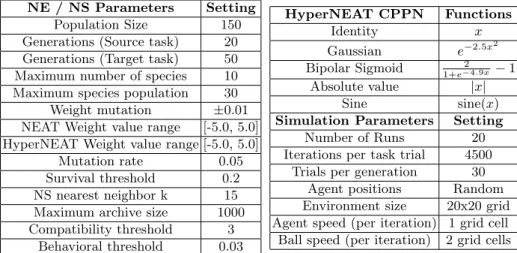
Experiments test this study’s research objectives (Section 1). First, to test the impact of using a non-objective (behavioral diversity) versus objective (fitness) based search approach for two given policy search methods (NEAT and Hyper-NEAT). Second, to test the efficacy of NEAT and HyperNEAT as appropriate methods for yielding task performance and efficiency boosts after policy transfer. Experiments are run in a source keep-away task (using NEAT or Hyper-NEAT to evolve multi-agent keep-away behavior), where populations evolved after 20 generations, are transferred to a target task, and evolved for a further 50 generations (Table 2). Results are compared to those where no policy transfer takes place, that is where NEAT and HyperNEAT are used to evolve keep-away behaviors from scratch in the target tasks. For both NEAT and HyperNEAT experiments, each genotype (agent team) is evaluated over 30 task trials per generation, where each task trial tests different (random) agent positions. The ball always starts in the possession of a (randomly selected) keeper. Average fit-ness (task performance) per genotype is computed over these 30 task trials. Table 2 specifies the neuro-evolution and simulation parameters for these experiments.
Sensory Inputs Description
dist(Kb, C), dist(Kt1, C), dist(Kt2, C) Distance of each keeper to field center
dist(T1, C), dist(T2, C) Distance of each taker to field center dist(Kb, Kt1), dist(Kb, Kt2) Distance of each taker to keeper 1
dist(Kb, T1), dist(Kb, T2) Distance of each taker to keeper 1
minj∈1,2dist(Kt1, Tj),minj∈1,2dist(Kt2, Tj) Distance of closest taker to keeper 1
minj∈1,2angle(Kt1, Tj),minj∈1,2angle(Kt1, Tj) Angle of closest keeper, taker, keeper 1
Motor Outputs
Hold Do not pass ball
Pass toKt1, Pass toKt2 Pass to keeper 2, keeper 3
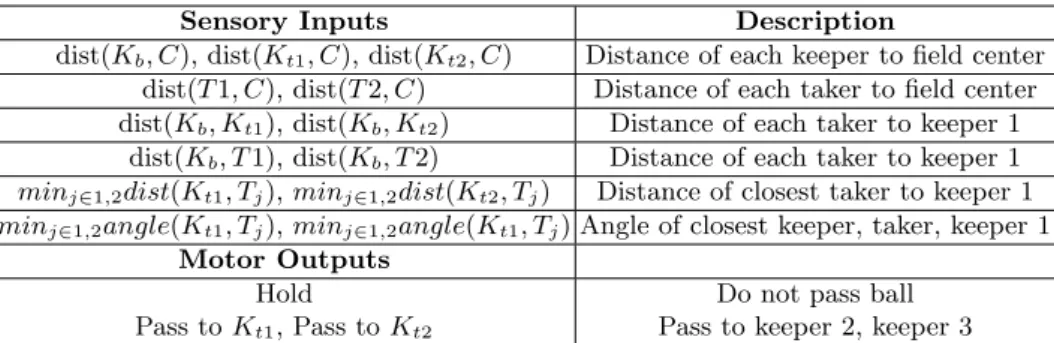
Table 1. Sensory inputs (13 input nodes) and motor outputs (three outputs) for a team’s ANN controller in the3vs2 keep-away task. Keeper 1 is the agent with the ball.
The efficacy of policy transfer was evaluated in terms of time (genotype eval-uations) taken to attain a policy transfer threshold, with and without policy transfer. The threshold was theaverage maximum fitness attained after apply-ing NEAT and HyperNEAT to evolve behaviorsfrom scratchin each target task. Policy transfer occurs between source and incrementally complex target tasks. That is, first we evolve keep-away behavior for three keepers versus two tak-ers (denoted as 3vs2) in a 20 x 20 virtual field2 (Table 2). Evolved behaviors (policies) are then transferred (and neuro-evolution continued) in one of three keep-away target tasks, four keepers versus three takers (4vs3), five keepers ver-sus three takers (5vs3) or six keepers versus four takers (6vs4).
3.1 NEAT Experiments
Table 1 describes the 13 sensory input nodes in a team’s ANN controller for the 3vs2 keep-away task. The output nodes represent an agent’s decision toholdthe ball, pass to keeper 2 or pass to keeper 3, wherekeeper 1 has the ball. At any task trial iteration, the output with the highest activation is the action selected. NEAT is direct encoding method, so the genotype representation (encoding sensory-motor elements of a keep-away team’s controller) needs to change as task complexity and the number of agents changes. For example, as task com-plexity increases, from3vs2 to4vs3 keep-away, an ANN topology with 19 input nodes and 4 output nodes is required. The additional output node represents the decision ofkeeper 1 topass to keeper 4. The extra six input nodes represent: 1) distance of keeper 4 from the field’s center, 2) distance of taker 3 from the field’s center, 3) distance ofkeeper 1 fromtaker 3, 4) distance betweenkeeper 4 and the closest taker, 5) angle formed between keeper 1 and the closest keeper and taker, and 6) distance of keeper 1 to keeper 4. Similarly, for the 5vs3 task an ANN with 27 inputs and six outputs is needed.
However, for all keep-away tasks tested (3vs2, 4vs3, and 5vs4) the ANN sensory-motor layer topology was kept static (13 sensory inputs and three motor
2 All experiments were run in RoboCup Keep-Away version 6 [6]. Source code and
NE / NS Parameters Setting Population Size 150 Generations (Source task) 20 Generations (Target task) 50 Maximum number of species 10 Maximum species population 30 Weight mutation ±0.01 NEAT Weight value range [-5.0, 5.0] HyperNEAT Weight value range [-5.0, 5.0]
Mutation rate 0.05 Survival threshold 0.2 NS nearest neighbor k 15 Maximum archive size 1000 Compatibility threshold 3 Behavioral threshold 0.03 HyperNEAT CPPN Functions Identity x Gaussian e−2.5x2 Bipolar Sigmoid 2 1+e−4.9x−1 Absolute value |x| Sine sine(x)
Simulation Parameters Setting Number of Runs 20 Iterations per task trial 4500
Trials per generation 30 Agent positions Random Environment size 20x20 grid Agent speed (per iteration) 1 grid cell Ball speed (per iteration) 2 grid cells Table 2. Left: Neuro-Evolution (NE), Novelty Search (NS) parameters (final three rows).Right:CPPN (HyperNEAT) activation Functions and simulation parameters.
Fig. 1. Left:Substrate encoding the virtual field (20 x 20 grid of inputs and outputs). Connection values ([-1.0, 1.0]) between these input-output nodes represent positions of agents relative to the keeper with the ball.Right:Connections from pairs of nodes in the substrate are sampled and the coordinates passed as inputs to the CPPN, which then outputs the synaptic weight of each sampled connection.
outputs) in order to facilitate transfer across tasks of increasing complexity. Thus, as the number of agents increased with task complexity, a heuristic selected which agents in the environment would be processed by the ANN’s 13 sensory input nodes. At each sensory-motor cycle (task trial iteration), the heuristic selected the closest two keeper and taker agents to be processed by the ANN, but had the potential to process any agent as sensory input. In keep-away task simulation this was tantamount to noise preventing the keeper with the ball from processing agents too far away and thus accounting for them in action selection.
Experiment 4vs3 5vs3 6vs4 Keep-Away Keep-Away Keep-Away No Policy Transfer
NEAT 0.438 (0.037) 0.473 (0.052) 0.419 (0.057) HyperNEAT 0.587 (0.059) 0.765 (0.050) 0.533 (0.044) Fitness-Based Policy Transfer
NEAT 0.482 (0.059) 0.580 (0.069) 0.464 (0.033) HyperNEAT 0.729 (0.089) 0.873 (0.089) 0.632 (0.038) Fitness + NS Policy Transfer
NEAT 0.545 (0.047) 0.638 (0.0048) 0.520 (0.036) HyperNEAT 0.752 (0.054) 0.943 (0.029) 0.697 (0.032) Table 3.Average normalized maximum fitness (over 20 runs) for the three experimen-tal setups. Values are portions of the maximum possible hold time (possession of the ball) for the team of keepers. Standard deviations are shown in parentheses.
3.2 HyperNEAT Experiments
HyperNEAT uses indirect encoding and can thus represent changes in task com-plexity without changing genotype representation [14]. In this experimentBird’s Eye View (BEV) representation [14] is used to encode keep-away’s physical state (layout of the field and locality of agents) and actions onto a substrate network. The virtual keep-away soccer field is divided into a 20 x 20 grid world, where each agent can occupy one grid cell per task trial iteration. The input and out-put layers of the substrate network are two dimensional, with coordinates in the x, y plane in the range of [−1.0,1.0]. Each grid cell in the virtual space is represented by a node in the substrate network layer, so the 20 x 20 grid world is represented by 400 nodes in the substrate network. Hence, the layout of nodes in the substrate network (network geometry) directly maps to the tasks geom-etry and this enables HyperNEAT to exploit the task’s geometric regularities and relationships. The position of each agent is marked on the substrate input layer, where each position of the keeper is marked by a value 1.0, and takers by
−1.0. Physical paths between agents are drawn. Each direct path from a keeper with a ball to another keeper is marked by a value 0.3 and to a taker by a value
−0.3. The region to pass the ball to is highlighted on the substrate output by activating the node with the highest output.
The CPPN queries each connection between input and output layers of the two dimensional substrate network taking coordinates (x1, y1) and (x2, y2) as input. The CPPN output represents the weight of that connection and the con-nection expression value. The concon-nection weights are then produced as a function of their endpoints. The functions used are listed in Table 2 (right).
4
Results and Discussion
Policy transfer was applied between the source3vs2 keep-away task and incre-mentally complex 4vs3, 5vs3 and 6vs4 keep-away tasks (section 3). Keep-away behaviors were evolved for 20 generations with NEAT or HyperNEAT (using
either the novelty-objective hybrid or objective-based search) in the source task, transferred to the target task and then further evolved for 50 generations. For policy transfer, three population initialization methods in the target task were tested (Section 2.4). However, the transfer of theentire population(from gener-ation 20 in the source task) to target tasks best facilitated policy transfer. Hence only results for this population initialization method are presented here.
Table 3 presents the average normalized maximum fitness (attained during each run and averaged over 20 runs) for the three experimental setups. Experi-ment 1 (No Policy Transfer) presents results from evolving keep-away behaviors in each of the target tasks from scratch (without policy transfer). Experiment 2 (Fitness-Based Policy Transfer) presents results from evolving keep-away be-haviors using objective (fitness) based NEAT and HyperNEAT in the source and then in target tasks (after policy transfer). Experiment 3 (Fitness + NS Policy Transfer) presents results from evolving keep-away behaviors with NEAT and HyperNEAT using the novelty-objective hybrid based search. In experiments 2 and 3, NEAT or HyperNEAT is applied in the source task for 20 generations and thereafter for 50 generations in the target task.
Results data was found to be non-parametric using theKolmogorov-Smirnov normality test with Lilliefors correction [37]. The Mann-Whitney U test [38] was then applied in a series of pair-wise comparisons to gauge if there was a statistically significant difference between corresponding result sets of the three experiments (Table 3). Pair-wise comparisons were conducted between average results data for NEAT or HyperNEAT (for a given experiment). The null hy-pothesis stated that two comparative data sets were not significantly different, andα= 0.05 was selected as the significance threshold.
4.1 Policy versus No-Policy Transfer: Performance Comparisons First, statistical tests indicated that for all policy transfers (from 3vs2 to4vs3, 5vs3 and6vs4), there was a statistically significant difference (p-value<0.05) between thenovelty-objective hybrid andobjective-based NEAT. That is, NEAT with behavioral diversity maintenance yielded a significantly higher average max-imum task performance for all policy transfer cases (Table 3).
Second, statistical tests indicated that for all policy transfers transfer cases, both NEAT and HyperNEAT using behavioral diversity maintenance yielded a higher average maximum task performance compared to objective-based NEAT and HyperNEAT (Table 3).
This result supports this study’s first hypothesis (Section 1), that encourag-ing behavioral diversity facilitates the evolution of higher performance keep-away behaviors in all tasks tested, compared to keep-away behavior adaptation with-out behavioral diversity maintenance.
Statistical tests also indicated that NEAT (using either the novelty-objective or objective-based search) yielded a higher average task performance (with sta-tistical significance) for all policy transfers, compared to objective-based NEAT without policy transfer. That is, where NEAT was applied to evolve keep-away behavior (from scratch) in each of the target tasks (4vs3,5vs3 and6vs4). Simi-larly, statistical tests indicated that HyperNEAT (with and without behavioral
diversity maintenance), yielded significantly higher task performances in all tar-get tasks compared to HyperNEAT without policy transfer (Table 3).
These results partially support this study’s second hypothesis, that NEAT and HyperNEAT are appropriate as policy search methods where policy transfer enables the evolution of significantly higher performance keep-away behaviors in all target tasks tested (compared to keep-away behaviors evolvedfrom scratch). These results are further supported by previous work demonstrating that transfer learning enables multi-agent behavior adaptation with significantly higher task performances compared to adaptation without transfer learning [12], [14], [5]. 4.2 Policy versus No-Policy Transfer: Efficiency Comparisons To further support this study’s second hypothesis, the efficiency of NEAT and HyperNEAT (with and without behavioral diversity maintenance) is compared in the target tasks where policy transfer was applied versus where keep-away behaviors were evolved in the target tasksfrom scratch.
Results (performance threshold) of applying NEAT and HyperNEAT to adapt keep-away behaviors from scratch (without policy transfer) in the target tasks (4vs3,5vs3 and6vs4) were used as a benchmark for comparisons with the same methods applied with policy transfer. This threshold was theaverage maximum task performance of NEAT and HyperNEAT in the target tasks, where keep-away behavior was evolved without policy transfer (Table 3).
First, for objective-based NEAT without policy transfer, an average maxi-mum task performance of 0.443 (as a portion of maximaxi-mum task performance) for all three target tasks was attained after approximately 40 generations3. After 40 generations negligible task performance increases were observed. Additional experiments that used relatively few runs, but 100 generations of evolution indi-cated that objective-based NEAT, without policy transfer, gets stuck in a local optima. However, this is not the case when policy transfer is used (for both objective and hybrid objective-novelty based variants of NEAT).
Comparatively, results from objective-based NEAT with policy transfer in-dicated efficiency gains for all target tasks. Objective-based NEAT with policy transfer yielded an average maximum task performance of 0.482, 0.580 and 0.464 for the 4vs3, 5vs3 and 6vs4 keep-away tasks, respectively. These tasks perfor-mances were attained after approximately 48 generations. However, additional experiments using relatively few runs but 100 generations indicated that the task performances yielded by objective-based NEAT with policy transfer continued to increase. Also, all task performances yielded by objective-based NEAT with policy transfer were significantly higher (Mann-Whitney test, p-value < 0.05) compared to those yielded by NEAT without policy transfer in the same tasks. Objective-based HyperNEAT with policy transfer also yielded greater effi-ciency for all target tasks. That is, objective-based HyperNEAT with policy transfer resulted in an an average maximum task performance of 0.632 for 6vs4 keep-away after 38 generations, with policy transfer. This was compared to the
3 NEAT and HyperNEAT average maximum task performance progression graphs can
significantly lower 0.533 (Mann-Whitney test, p-value < 0.05) average maxi-mum performance after 49 generations,without policy transfer in the same5vs3 keep-away task.
Task performance in5vs3 keep-away steadily reached an average maximum of 0.873 after 50 generations, with policy transfer. This was compared to the significantly lower 0.765 (Mann-Whitney test, p-value<0.05) average maximum performance after 48 generations,without policy transfer in the same task.
Task performance in4vs3 keep-away steadily reached an average maximum of 0.729 after 47 generations, with policy transfer. This was compared to the significantly lower 0.587 (Mann-Whitney test, p-value<0.05) average maximum performance after 45 generations,without policy transfer in the same task. Also, additional experiments using relatively few runs but 100 generations indicated that the task performances yielded by objective-based HyperNEAT with policy transfer continued to increase.
Second, fornovelty-objective based NEAT with policy transfer, average max-imum task performances of 0.545, 0.638 and 0.520 were attained for tasks4vs3, 5vs3 and6vs4, after 48, 49 and 48 generations, respectively. This compared to the significantly lower task performances (Mann-Whitney test, p-value<0.05) ofnovelty-objective based NEAT without policy transfer for the same tasks. That is, 0.443, 0.473, and 0.473 for the4vs3,5vs3 and6vs4 tasks, attained after 40, 37 and 43 generations respectively.
Also,novelty-objective based HyperNEAT with policy transfer yielded aver-age maximum task performances of 0.752, 0.943 and 0.697 for tasks 4vs3, 5vs3 and 6vs4, after 45, 49 and 48 generations, respectively. This compared to the significantly lower task performances (Mann-Whitney test, p-value < 0.05) of objective based HyperNEAT without policy transfer for the same tasks (Table 3), yielded in a comparable number of generations (45, 48 and 49 generations, for the4vs3,5vs3 and6vs4 tasks, respectively).
Hence, these results further support this study’s second hypothesis, that NEAT and HyperNEAT are appropriate policy search methods, where policy transfer enables a higher efficiency in the target tasks tested. Thus, NEAT and HyperNEAT with policy transfer (using objective-based search or behavioral di-versity maintenance) converge to a higher task performance faster compared to the same methods without policy transfer.
4.3 Behavioral Diversity Maintenance and Policy Transfer
The results of this study have important implications for current policy transfer research, specifically multi-agent policy transfer where neuro-evolution is used for policy search (agent behavior adaptation).
First, the results indicated significanttask performanceandefficiency (speed-up of evolution) benefits of policy transfer in a multi-agent task (Keep-away RoboCup Soccer) where team behavior was evolved with NEAT or HyperNEAT in a source task and then further evolved in more complex target tasks. This was compared to the same methods for evolving keep-away behaviorfrom scratch in the target tasks. These results are also supported by related policy transfer research that used neuro-evolution for policy search [12], [14], [8], [10].
Second, results indicated that HyperNEAT with behavioral diversity main-tenance yielded the greatest benefits for policy transfer overall. These trans-ferred behaviors leveraged the most benefits of behaviors evolved in the source task such that further evolution in target tasks yielded the highest overall task performances. This was compared to NEAT with behavioral diversity mainte-nance, objective-based NEAT and HyperNEAT and the same methods without policy transfer. Such benefits of behavioral diversity maintenance coupled with objective-based search is supported by related work [35], [33], [34]. Also, advan-tages of indirect encoding neuro-evolution methods such as HyperNEAT have been highlighted in a broad range of task domains[15], [14], [26], [28].
However, a key contribution of this study is that this is the first time (to the authors’ knowledge), the benefits of behavioral diversity maintenance coupled with neuro-evolution, have been demonstrated in multi-agent policy transfer.
The significantly higher performance of HyperNEAT with behavioral diver-sity maintenance across all tasks is theorized to be a result of beneficial interac-tions between a more effective search for high performance behaviors (aided by behavioral diversity maintenance) and HyperNEAT’s indirect encoding of agent behaviors. Consider that in the source task the novelty-objective hybrid based search employed by HyperNEAT facilitated an effective exploration versus ex-ploitation trade-off in the search for high-performance keep-away behaviors. This is supported by results from previous work [35], [34], [33], [21] that similarly re-port the benefits of hybrid novelty-objective based search approaches (including task performance advantages over objective based search approaches).
Also, when effective high-performance behaviors are discovered as solutions to the source task (3vs2 keep-away), HyperNEAT’s indirect encoding of such behaviors and the spatial geometry of the keep-away task facilitates more ef-fective policy transfer to incrementally complex target tasks. That is, Hyper-NEAT evolves CPPNs that are able to represent complex ANN controllers with their own symmetries and regularities and exploit the sensory-motor geometry of multi-agent tasks [15], [26]. This controller representation significantly impacted the efficacy of evolved keep-away behavior across all tested target tasks.
Thus, we hypothesize that adapting controllers with HyperNEAT in company with the aid of behavioral diversity maintenance allows first, for the discovery of novel robust and effective multi-agent behaviors (that might not have oth-erwise been discovered with pure objective-based search). Second, HyperNEAT encodes team behaviors that do not rely upon specific sensory-motor mappings in the agent team controller and thus set task environment configurations (such as specific agent and ball positions and numbers of agents). That is, HyperNEAT evolves connectivity patterns [27] that are broadly applicable to tasks of vary-ing complexity (in keep-away, numbers of agents). This is supported by related research that similarly demonstrates the robustness of HyperNEAT evolved con-trollers in tasks of varying complexity [28].
The performance of HyperNEAT evolved teams was contrasted to the signif-icantly lower task performance of NEAT (with and without behavioral diversity maintenance). In NEAT, team behaviors were directly encoded with an ANN
with fixed sensory-motor layers (13 sensory inputs and three motor outputs), where the number of hidden nodes and connections were evolved. This static sensory-motor layer ANN topology prevented a smooth and effective transfer from the source task to the more complex target tasks. However, behavioral diversity maintenance did boost the task performance and efficiency of NEAT evolved behaviors in all target tasks after policy transfer (Table 3).
The lower performance of both NEAT and HyperNEAT (with and without behavioral diversity maintenance) in the6vs4 target task (Table 3) remains the subject of current research. Though this is hypothesized to be a result of the increased complexity of four takers on the same sized virtual field, making taker interception of ball passes more likely. Also this increases the required complexity of evolved keep-away behaviors, meaning evolved behaviors must effectively scale to coordinate larger numbers of keepers while accounting for more takers, but with the same spatial constraints on the virtual field as the4vs3 and5vs3 tasks.
5
Conclusion
This study investigated methods for improving the current state of the art in multi-agent transfer learning. That is, improving task performance and efficiency (speed of adaptation) of Keep-away RoboCup Soccer behaviors evolved in a source task but then further evolved on more complex versions of the same task. Experiments compared two neuro-evolution methods, NEAT and HyperNEAT, applying them to evolve keep-away behaviors. This study’s main contribution was elucidating that behavioral diversity maintenance coupled with these meth-ods yielded increased task performance in increasingly complex keep-away tasks. Results indicated that behavioral diversity maintenance used in company with NEAT and HyperNEAT is an appropriate approach for increasing task performance and efficiency in keep-away tasks of increasing complexity. Using be-havioral diversity maintenance enabled NEAT and HyperNEAT to out-perform objective-based NEAT and HyperNEAT with and without policy transfer in all tested target keep-away tasks. Also, results indicated that HyperNEAT using behavioral diversity maintenance yielded the highest overall task performance and efficiency. This was theorized to be a result of HyperNEAT’s indirect en-coding of keep-away behaviors, facilitating effective transfer of evolved behaviors between tasks of varying complexity.
Future work will further investigate the efficacy of indirect encoding methods for facilitating effective policy transfer between similar but related multi-agent tasks (for example, keep-away to multi-agent predator-prey [26]), thus address-ing the larger goal of devisaddress-ing controller design methods capable of producaddress-ing generalized problem solving behaviors.
References
1. Pan, S., Yang, Q.: A survey on transfer learning. IEEE Transactions on Knowledge and Data Engineering22(10)(2010) 1345–1359
2. Torrey, L., Shavlik, J.: Transfer learning. In: Handbook of Research on Machine Learning Applications. IGI Global, Hershey, USA (2009) 17–23
3. Ammar, H., Tuyls, K., Taylor, M., Driessens, K., Weiss, G.: Reinforcement learning transfer via sparse coding. In: Proceedings of the eleventh international conference on autonomous agents and multiagent systems, Valencia, Spain, AAAI (2012) 4–8 4. Ramon, J., Driessens, K., Croonenborghs, T.: Transfer learning in reinforcement learning problems through partial recycling. In: Proceedings of the 18th European Conference on Machine Learning, Warsaw, Poland, Springer (2007) 699–707 5. Boutsioukis, G., Partalas, I., Vlahavas, I.: Transfer learning in multi-agent
re-inforcement learning domains. In: Recent Advances in Rere-inforcement Learning. Springer, Berlin, Germany (2012) 249–260
6. Taylor, M., Stone, P., Liu, Y.: Transfer learning via inter-task mappings for tem-poral difference learning. Journal of Machine Learning8(1)(2010) 2125–2167 7. Stone, P., Kuhlmann, G., Taylor, M., Liu, Y.: Keepaway soccer: From machine
learning testbed to benchmark. In: Proceedings of RoboCup-2005: Robot Soccer World Cup IX, Berlin, Germany, Springer (2006) 93–105
8. Doncleux, S.: Knowledge extraction from learning traces in continuous domains. In: AAAI 2014 fall Symposium on Knowledge, Skill, and Behavior Transfer in Autonomous Robots, Arlington, USA, AAAI Press (2014) 1–8
9. Floreano, D., D¨urr, P., Mattiussi, C.: Neuroevolution: from architectures to learn-ing. Evolutionary Intelligence1(1) (2008) 47–62
10. Moshaiov, A., Tal, A.: Family bootstrapping: A genetic transfer learning approach for onsetting the evolution for a set of realated robotic tasks. In: Proceedings of the Congress on Evolutionary Computation, IEEE Press (2014) 2801–2808 11. Deb, K.: Pareto based Multi-objectives optimization using evolutionary algorithms.
John Wiley and Sons, New York, USA (2001)
12. Taylor, M., Whiteson, S., Stone, P.: Transfer learning for policy search methods. In: ICML 2006: Proceedings of the Twenty-Third International Conference on Machine Learning Transfer Learning Workshop, Pittsburgh, USA, ACM (2006) 1–4 13. Stanley, K., Miikkulainen, R.: Evolving neural networks through augmenting
topologies. Evolutionary Computation.10(2) (2002) 99–127
14. Verbancsics, P., Stanley, K.: Evolving static representations for task transfer. Jour-nal of Machine Learning Research11(1) (2010) 1737–1763
15. Stanley, K., D’Ambrosio, D., Gauci, J.: A hypercube-based indirect encoding for evolving large-scale neural networks. Artificial Life15(2) (2009) 185–212
16. Stone, P., Sutton, R., Kuhlmann, G.: Reinforcement learning for robocup-soccer keepaway. Adaptive Behavior13(3)(2006) 165–188
17. Whiteson, S., Stone, P.: Evolutionary function approximation for reinforcement learning. Journal of Machine Learning Research7(1)(2006) 877–917
18. Bahceci, E., Miikkulainen, R.: Transfer of evolved pattern-based heuristics in games. In: Proceedings of the IEEE Symposium On Computational Intelligence and Games, Perth, Australia, Morgan Kaufmann (2008) 220–227
19. Lehman, J., Stanley, K.: Abandoning objectives: Evolution through the search for novelty alone. Evolutionary computation19(2)(2011) 189–223
20. Mouret, J., Doncieux, S.: Encouraging behavioral diversity in evolutionary robotics: An empirical study. Evolutionary Computation20(1)(2012) 91–133 21. Gomes, J., Mariano, P., Christensen, A.: Avoiding convergence in cooperative
coevolution with novelty search. In: Proceedings of the International conference on Autonomous Agents and Multi-Agent Systems, ACM (2014) 1149–1156
22. Gomes, J., Mariano, P., Christensen, A.: Devising effective novelty search algo-rithms: A comprehensive empirical study. In: Proceedings of the Genetic Evolu-tionary Computation Conference, Madrid, Spain, ACM (2015) 943–950
23. Degrave, J., Burm, M., Kindermans, P., Dambre, J., Wyffels, F.: Transfer learning of gaits on a quadrupedal robot. Adaptive Behavior23(2015) 9–19
24. Knudson, M., Tumer, K.: Policy transfer in mobile robots using neuro-evolutionary navigation. In: Proceedings of the Genetic and Evolutionary Computation Con-ference, Philadelphia, USA, ACM Press (2012) 1411–1412
25. Stanley, K.: Compositional pattern producing networks: A novel abstraction of development. Genetic Programming and Evolvable Machines8(2) (2007) 131–162 26. D’Ambrosio, D., Stanley, K.: Scalable multiagent learning through indirect
encod-ing of policy geometry. Evolutionary Intelligence Journal6(1) (2013) 1–26 27. Gauci, J., Stanley, K.: A case study on the critical role of geometric regularity
in machine learning. In: Proceedings of the AAAI Conference on Artificial Intelli-gence, Menlo Park, USA, AAAI Press (2008) 628–633
28. Risi, S., Stanley, K.: Confronting the challenge of learning a flexible neural con-troller for a diversity of morphologies. In: Proceedings of the Genetic and Evolu-tionary Computation Conference, ACM (2013) 255–261
29. Gomes, J., Christensen, A.: Generic behavior similarity measures for evolutionary swarm robotics. In: Proceedings of the Genetic and Evolutionary Computation Conference, Amsterdam, the Netherlands, ACM Press (2013) 199–206
30. Urbano, P., Georgiou, L.: Improving grammatical evolution in santa fe trail using novelty search. In: Proceedings of the 12th European Conference on Artificial Life, Taormina, Italy, MIT Press (2013) 917–924
31. Lehman, J., Stanley, K.: Efficiently evolving programs through the search for nov-elty. In: Proceedings of the 12th Annual Conference on Genetic and Evolutionary Computation, Portland, USA, ACM (2010) 837–844
32. Velez, R., Clune, J.: Novelty search creates robots with general skills for explo-ration. In: Proceedings of the Genetic and Evolutionary Computation Conference, Vancouver, Canada, ACM (2014) 737–744
33. Cuccu, G., Gomez, F., Glasmachers, T.: Novelty-based restarts for evolution strate-gies. In: Proceedings of the Congress on Evolutionary Computation, New Orleans, USA, IEEE Press (2011) 158–163
34. Gomes, J., Urbano, P., Christensen, A.: Progressive minimal criteria novelty search. In Pavn, J., Duque-Mndez, N., Fernndez, R., eds.: Advances in Artificial Intelli-gence. Springer, Berlin, Germany (2012) 281–290
35. Lehman, J., Stanley, K.: Revising the evolutionary computation abstraction: min-imal criteria novelty search. In: Proceedings of the 12th Annual Conference on Genetic and Evolutionary Computation, ACM (2010) 103–110
36. Liapis, A., Yannakakis, G., Togelius, J.: Constrained novelty search: A study on game content generation. Evolutionary Computation23(1)(2015) 101–129 37. Ghasemi, A., Zahediasl, S.: Normality tests for statistical analysis: A guide for
non-statisticians. Int J Endocrinol Metab.10(2)(2012) 486–489
38. Flannery, B., Teukolsky, S., Vetterling, W.: Numerical Recipes. Cambridge Uni-versity Press, Cambridge, UK (1986)