1
Note to readers:
This PDF is the pre-peer reviewed revision of an earlier conference paper from the International Conference on Information and Communications Technologies and Development, (ICTD 2009)
Please use this pre-peer-review version for general reading only – for citations and particularly direct quotations please refer to the final and definitive version, available online from Wiley-Blackwell:
Donner, Jonathan, & Escobari, Marcela X. (2010). A review of evidence on mobile use by micro and small enterprises in developing countries. Journal of International Development, 22, 641-658. doi:
10.1002/jid.1717, http://www3.interscience.wiley.com/journal/123566679/abstract
A review of evidence on mobile use by micro and small enterprises in
developing countries
Jonathan Donner and Marcela X Escobari
Abstract
The paper offers a systematic review of 14 studies of the use of mobile telephony by micro and small enterprises (MSEs) in the developing world, detailing findings about changes to enterprises’ internal processes and external relationships, and findings about mobile use vs. traditional landline use. Results suggest that there is currently more evidence for the benefits of mobile use accruing mostly (but not exclusively) to existing MSEs rather than new MSEs, in ways that amplify existing material and informational flows rather than transform them. The review presents a more complete picture of mobile use by MSEs than was previously available, and indentifies priorities for future research, including comparisons of the impact of mobile use across subsectors of MSEs and assessments of use of advanced services such as mobile banking and mobile commerce.
2
Introduction
This paper presents a systematic review of fourteen studies of the use of mobile telephony by Micro and Small Enterprises (MSEs) in the developing world.
The majority of non-agricultural enterprises in the developing world have ten or fewer employees. These MSEs employ up to 25% of working-age adults in some countries (Mead and Leidholm, 1998), and while the contribution of MSEs to aggregate economic growth remains a matter of debate (la Porta and Shleifer, 2008), their importance to household livelihoods and poverty alleviation is undeniable. Thus, MSEs are the focus of programs at many of the world’s largest development institutions (Snodgrass, 2005).
In the current decade, use of mobile telephony has increased fourfold, from approximately 1 billion to 4 billion active subscriptions worldwide (ITU, 2009). The successful entrepreneur, enabled by his mobile phone, plays a prominent role in the global development narrative and become a semi-regular fixture in the popular press (Economist, 2005) and practitioner media (Bhavnani et al., 2008). This narrative has quickly changed as well, shifting from forward-looking hope to conventional wisdom without pausing long for reflection beyond anecdotes and linear extrapolation.
Like landlines, mobile phones allow people to communicate at a distance and exchange information instantaneously. Thus, there is significant potential for mobile use to increase MSE productivity.
However, since the dynamics underpinning this potential are nuanced, and since current supporting evidence is scarce and methodologically heterogeneous (Jagun et al., 2008), it is important to more rigorously examine mobile use by MSEs. There is a difference between using a mobile to serve existing customers more effectively, and using it to start a new business. There is a difference between using a mobile to check market prices and using it bypass a middleman who carries goods to market. The popular narratives generally fail to make such distinctions; yet these same distinctions have significant implications for topics of interest to the development community, including the changing role of the informal sector and small enterprise in developing economies, our ideas about entrepreneurship and livelihoods, and our understanding of the informational society as a whole (Castells, 1996). Fortunately, a small but methodologically diverse set of research studies have examined mobile use by MSEs in detail. This paper offers a systematic review of this existing literature, identifying known patterns of mobile use, as well as some important gaps in the research.
The review employs distinct foci. First, it offers an assessment of how mobile use influences the internal process of an enterprise, using Porter’s value chain model (Porter, 1985). Second, it offers a corresponding assessment of how mobile use influences the network of relationships external to the
3
enterprise—the value system (Porter, 1985) of producers, traders, wholesalers, retailers and end-customers. Finally, it explores two elements unique to mobile communication—the increased spatial and temporal mobility afforded by wireless devices, and the resulting blurring of the personal and the professional spheres—to assess how MSE mobile use differs from landline use.
Micro and Small Enterprises (MSEs)
Working definitions of MSEs vary from country to country and from researcher to researcher. This analysis defines an MSE as any non-farm1 enterprise, formal or informal, with less than 50 employees, including sole proprietorships, part-time businesses, and home-based businesses. The size thresholds draw on Mead and Leidholm (1998), who note that the absolute majority of such enterprises in the developing world are sole proprietorships, and that firms with less than 10 employees substantially outnumber larger enterprises.
A number of factors distinguish the term MSE (micro and small enterprise) from SME (small and medium enterprise). However, since “small” appears in both terms, and with no commonly accepted definitions of the thresholds between micro, small, and medium, there are often implicit conceptual overlaps between the acronyms.
Unlike SMEs, the majority of MSEs are informal enterprises, although there is no universal standard to determine what makes an enterprise informal vs. formal (Esselaar et al., 2007). In many cases, even the term entrepreneur may be a bit of a romantic misnomer. Evidence suggests that among MSEs, only a small minority of enterprises are poised for growth; most remain small or struggle to survive, and yield a low return on labor and capital (la Porta and Shleifer, 2008; Duncombe and Heeks, 2001).Though significantly less growth-oriented and productive (on average) than larger firms, MSEs share a basic similarity with all enterprises; each combines investments in capital with some labor (their own, their families’ or their employees) in the hopes of yielding a product or service whose market value exceeds the cost of those inputs. Thus, there is a thread in the ICTD literature that seeks to understand how
various technologies could be used advantageously by MSEs (Saunders et al., 1994; Duncombe and
Heeks, 2002, 1999). Prior to the widespread introduction of the mobile into the developing world, the landline’s importance in this regard was already clear:
1
4
Phones are the information-related technology that has done the most to reduce costs, increase income and reduce uncertainty and risk. Phones support the current reality of informal information systems, they can help extend social and business networks, and they clearly substitute for journeys and, in some cases, for brokers, traders and other business
intermediaries. They therefore work “with the grain” of informality yet at the same time help to eat into the problems of insularity that can run alongside. Phones also meet the priority
information needs of this group of communication rather than processing of information (Duncombe and Heeks, 1999, p. 18)
The quotation focuses directly on the basic tasks of running a business—reducing costs, increasing income, managing risk—and links them to core functions of mediated communication technologies, particularly the substitution for journeys. As demonstrated elsewhere, (Saunders et al., 1994) the key is increased productivity.
Studies on mobiles and MSEs
Recently, studies have emerged that directly address how MSEs in the developing world are using mobiles rather than landlines or other ICTs. The studies are not as numerous as the enthusiasm in the popular press might suggest. They are a tiny fraction of the total literature on mobile use in the developing world (Donner, 2008). They have emerged from different disciplines, and, as relative contemporaries, often do not reference each other. This section presents two studies representing distinct methodologies and conclusions, to provide an example of the range of available perspectives and to set the stage for the systematic review.
Particularly focused and powerful evidence appears in Jensen’s (2007) research on the fishermen of Kerala. Working with five-year time series data at three fish markets in coastal India, Jensen and his team found that “the adoption of mobile phones by fishermen and wholesalers was associated with a dramatic reduction in price dispersion, the complete elimination of waste, and near-perfect adherence to the Law of One Price. Both consumer and producer welfare increased.” (Jensen, 2007, p. 879). Soon after the introduction of mobile coverage, fishermen bought mobiles and accumulated lists of up to 100 buyers in their handsets’ address books; subsequently, while still at sea, fishermen could call a range of possible landing points and buyers in order to determine the best price and best place to sell their catch.
Jagun, Heeks, and Whalley’s (2008) examination of the mobile’s role in mediating supply chains in the Nigerian market for traditional hand-woven ceremonial cloth is broader in scope. It offers a
multidisciplinary literature review, a conceptual framework articulating effects at multiple levels, and a detailed case study. They describe “process” benefits to mobile use, as calls at a distance reduce the time of trades and replace costly journeys. They also describe “structural” impacts; finding no
5
mobiles than the less prosperous weavers in the supply chain, and thus are better positioned to coordinate with a wider range of downstream customers and to maintain a more dynamic and responsive set of relationships with weavers. For example, mobiles give weavers increased access to credit by enabling calls on their behalf to fabric vendors by traders, who vouch for the veracity of weavers’ orders, and promise to cover the costs of the fabric in advance of the completion of the weavers’ work.
Methods and Coding Protocol
Many of the studies of mobile use by MSEs are qualitative, and do not report statistical findings. Even among quantitative studies, there is little agreement in terms of dependent and independent variables under scrutiny. Thus, a statistical meta-analysis would not be applicable (Light and Pillemer, 1984). Similarly, a method designed specifically for comparing ethnographies, such as reciprocal translation (Noblit and Hare, 1988) would be unlikely to bridge qualitative and quantitative studies.
The analysis draws instead on a systematic review methodology (Littell et al., 2008) to aggregate findings across the available studies. By using a standardized protocol, coding each study for the appearance or absence of certain assertions, the review assesses and parsimoniously represents what the research literature, in aggregate, suggests about mobile use by MSEs. The exercise relies on clearly articulated eligibility criteria to select studies and on standardized questions to evaluate them. These two levels of standardization, agreed upon before the formal review commenced, separates the exercise from a conventional list-based or thematic/narrative literature review.
Selecting studies
Papers were initially identified by online literature and database searches (using keyword combinations of mobile, cellular, microenterprise, MSE, etc.), and by snowball references from the bibliographies of studies already in hand. Next, these studies were assessed against a series of eligibility criteria: to be included, studies had to be specific to both mobiles and MSEs, report generalizable findings, and contain detailed primary data about mobile use in everyday conditions. What started out as a reasonably large body of studies was trimmed back significantly. In order to provide additional resources to other researchers, however, this section lists those excluded papers, along with the rationale for the decisions.
To be included in the review, papers had to be specifically focused on mobile phones, which excluded some excellent research on landlines or payphones and MSEs (Duncombe and Heeks, 2002;
6
Papers that did not explicitly include sole proprietors and/or informal enterprises were excluded (Adeoti and Adeoti, 2008; Boadi et al., 2007; Mei and Yun, 2008).
We made a more difficult decision to exclude papers that were not generalizable to a wide range of MSEs. An important line of research explores how many individuals earn livelihoods in the mobile business itself, by selling airtime, fixing handsets or operating village phones (Aminuzzaman et al., 2003; Ilahiane and Sherry, 2008; Lugo and Sampson, 2008). However, these studies treat mobiles as products and services, rather than enablers of general business processes.
To fit in the protocol, papers had to offer sufficient details around the use of mobiles to illuminate their role in these business processes. A few surveys that were otherwise topically correct did not yield information of this kind (Chogi, 2007), or blurred the lines between mobiles and other ICTs to the point where assertions about mobiles in particular were difficult to extract (Opiyo and K'Akumu, 2006; Moyi, 2003). When multiple papers drew on the same set of data (e.g. (Thomas Molony, 2008; Thomas S.J. Molony, 2006)), only one paper was retained.
Finally, the review focused on analyses of mobile use in everyday settings, rather than proposals for or evaluations of new pilot technologies (Javid and Parikh, 2006; Kumar et al., 2008; Chakraborty et al., 2007). The development of such technologies is central to the ICTD field, but such initiatives yield different forms of evidence about mobile use than those that examine MSEs operating on their own.
This limiting exercise forced a trade-off: the remaining papers clearly describe some element of the use of mobiles by MSEs in developing countries, but the population of such studies is relatively small. Thirteen papers and one book were retained; all studies are listed in Table One.
Evaluation protocol
The process of developing the evaluation questions was iterative. It was based mostly on an initial reading of the documents by the researchers, while also integrating current narratives in the popular and practitioner literatures. An original goal was to code studies according to subcategories of MSEs (to discern differences in mobile use between traders and producers, for example), but it became clear that the population of studies is too small to support that inquiry.
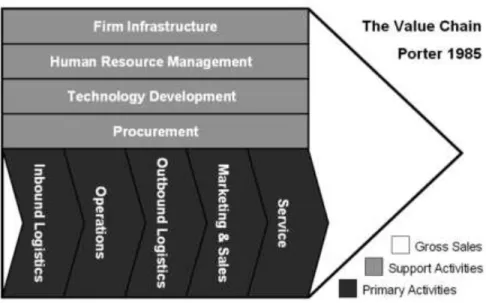
The final protocol employed three distinct foci. First, it assessed the impact of mobile use on the internal process of an enterprise, using Porter’s (1985) value chain model (Fig. 1). The value chain comprises the activity inputs into a product or service: inbound logistics, operations (production), outbound logistics, marketing and sales, and after-sales service. The value chain also includes supporting
7
owned by the enterprise), and procurement. Together these activities can create customer value in
excess of the costs to provide it, yielding profit. Porter (1985, p. 168), argues that information and communication technologies can be used to improve almost any of these primary and supporting activities. Although the value chain framework was developed with larger enterprises in mind, it can be applied to MSEs, since in small firms the same individual can carry out different business-related activities during the day. Both researchers coded individual papers for mentions of the mobile’s role in any of the primary or supporting functions.
Figure 1: The Porter Value Chain
image released to public domain as per http://en.wikipedia.org/wiki/Image:ValueChain.PNG
The second analysis used another Porter (1985) framework, the value system2, to offer a corresponding assessment of how mobile use influences the network of interdependencies and relationships external to the enterprise, including producers, traders, wholesalers, retailers and end-customers.
2 The term ‘value system’ is sometimes used interchangeably with ‘industry value chain’. This review uses the
8
An initial reading of the papers identified four categories of potential impacts. Some research stresses (a) the increased availability of information in the network; other studies stress (b) the entry of new actors, particularly buyers and sellers, into markets. Both factors tend to increase competition, but do so in different ways. One focuses on the actors in the network, the other on the information those actors exchange. Nevertheless, the two changes do not necessarily move in tandem; it is one thing to assert that the same set of actors exchange information at lower cost and higher frequency, another to say that markets have expanded. Two other categories of network impacts can be expressed as
assertions that (c) mobiles help enterprises cut out middlemen and that (d) mobiles help individuals start new businesses.
Unlike the value chain analysis (coded for affirmative mentions only), the value system analysis coded for both affirmations and negations of the four potential impacts. After the initial reading, we elected to track negations since some of the sources made a point of arguing against one or more of the assertions from the popular and practitioner literature.
The third analysis explored mobile use by MSEs is or is not different from landline use (Duncombe
and Heeks, 2002; Souter et al., 2005; Duncombe and Heeks, 1999). Technological properties of mobile
communication make it inherently more prone to adoption by MSEs than landline communication: it is cheaper to build towers than lay cable, prepay accounts have no startup costs, and inexpensive/used handsets are readily available. However, in this case the third analysis focused narrowly on two differences in use rather than cost or access.
First, studies were coded for mentions of mobility. In the developing world many mobiles are purchased as substitutes for landlines, rather than complements to them (Hamilton, 2003). Yet mobility itself is a crucial difference between mobiles and landlines—while landlines connect places to places, mobiles generally connect people to people, wherever they are and regardless of the time and situation. This mobility leads to increased individual addressability, and can change how people structure social and economic activity (Castells et al., 2007). Most relevant to this analysis, mobility may enable the rise of roaming businesses, just-in-time service and what Townsend (2000) has called the “real time city”.
Second, the nature of the mobile as a portable, personal device means it is particularly easy to use for both personal and business functions during the same day. Thus, studies of the role of mobiles in the
lives of MSE operators are often different from studies of the role of the device in the businesses themselves. The analysis coded for studies that explore these social functions.
Once the protocol was established, each researcher re-read the papers, coding them in isolation. We then compared our codes and resolved any discrepancies through discussion. The resulting codes are
9
less prone to reflect the bias of a single reader. Of the 112 cells on the matrix requiring codes, 16 required discussion to align the codes.
Results
The results of the coding exercise are detailed in Table One.
Enterprise value chain
Ten studies mention the core processes of marketing and sales. Analyses ranging from Jensen’s (2007) model of searching for the best price for fish to Kamga’s (2006) description of improvements to the local laundry services in Cote d’Ivoire asserts that mobiles help connect vendors and buyers, often at a distance and usually at lower cost than an in-person journey. Esselaar et al.(2007) report results of a survey of SMEs, including 1/3 microenterprises, conducted across 13 countries. “Mobile phones are used more often for keeping in contact with customers and clients” (p 92). This is the highly visible, intuitive role of mobiles for small enterprises.
The picture is sparser for other core processes within the value chain. Three studies mention inbound or outbound logistics, particularly Abraham (2007), who details how fishermen can now use small supply boats (dispatched via mobile) to stay out fishing longer. Overå (2006) describes how traders in Ghana can time harvests (inbound) and change the terms of delivery financing (outbound) because of the mobile.
Operations receives two mentions, again by (Abraham, 2007), who notes that fishermen use mobiles to coordinate the timing and location of when to drop nets and search for fish. Similarly, Jagun
et al. (2008) describe how weavers call customers mid-process to revise plans for the garments they are creating.
Two studies mention after-sales service. Molony (2006) describes how Tanzanian exporters of carved wood use the mobile to elicit feedback and built trust with buyers after (and ideally between) sales.
In terms of crosscutting functions, five studies reference procurement and address price search by buyers of inputs (or by traders). There is little evidence for the mobile’s role in the proprietary
technology, infrastructure or HR functions of MSEs, perhaps because these enterprises are too small to invest in these assets. Although studies outside the review (Boadi et al., 2007; Donner, 2006a) provide
10
anecdotes of small employers giving mobiles to employees, this infrastructure function is of limited utility for tiny firms and sole-proprietorships.
Industry value system
The second analysis turns the lens outside the enterprise, towards its location in a network of relationships. The most common finding links mobile use to an increase in the flow of information between actors in the value system. The two primary sub-themes are more frequent or wide-ranging exchanges of price information (Abraham, 2007; Aker, 2008; Overå, 2006), and a more generalized
discussion of increased communication with customers (Esselaar et al., 2007; Thomas S.J. Molony, 2006;
Samuel et al., 2005; Frempong, 2009). These findings are reflections of the frequent references to marketing and sales and procurement activities in the previous value chain analysis. Jagun et al. (2008) mention an increase in the completeness of the information, but note that they saw no increase in quality.
While it is one thing to say that mobile use accelerates the flow of information in existing value systems, it is another to say that mobile use brings new customers or suppliers into the market. This is the first element in the systematic review in which there is some disagreement between the primary studies. Numerous studies present evidence that mobile use expands markets by allowing MSEs to reach
new customers. Of the Keralan fishermen, Jensen (2007, p. 891) explains “while almost all sales before mobile phones were conducted via beach actions, fishermen with phones, often carrying lists with the numbers of dozens or even hundreds of potential buyers, would typically call several buyers in different markets before deciding where to sell their catch”. Similarly, Aker finds that “Grain traders in markets with cell phone coverage search over a greater number of markets, have more contacts and sell in more markets. This underscores the fact that the primary mechanism by which cell phones affect market efficiency is a reduction in search costs and hence transaction costs.” (2008, p. 4-5) In the study, mobile use lowered price dispersion by 21%, and increased profits by 29%.
And yet two other studies specifically argue that the phones have done little to introduce new buyers. Donner (2007b) finds that MSEs in urban India are much more likely to recruit customers via face-to-face channels, rather than via a phone call. Molony (2006) argues that mobiles help accelerate and strengthen trusting relationships but only among parties that have already established a face-to-face bond.
Two other general assertions about the impact of mobile use on MSE value systems receive less support from the studies. None of the studies asserts that mobiles help MSEs bypass middlemen. Indeed three of the papers focus specifically on middlemen, wholesalers or traders as enterprises, (Aker, 2008;
11
Jagun et al., 2008; Overå, 2006) describing how mobiles allow them to perform their roles more effectively. Another specifically emphasizes how producers work with existing middlemen in their industries, rather than routing around them. Rather than radically restructuring these marketplaces, Molony argues, “mobile phones can be seen as a facilitating technology for existing, trust-based relationships” (2006, p. 78).
Similarly, there is relatively little evidence for the assertion that mobiles help people start new businesses. Only Samuel et al. (2005) make this case, reporting that among a sample of MSEs in Egypt and South Africa, 26%-29% of businesses attributed their start to the availability of the mobile. Taking the opposite position, Horst and Miller (2006, p. 164) argue that despite some isolated examples to the contrary (taxi drivers and musicians), “there is no new spirit of enterprise based on either the cell phone or the internet” among the Jamaican households in their study. Nevertheless, they argue that despite a dearth of new enterprises, the mobile is essential to the economic survival of those households. By allowing individuals to leverage broad networks of informal social and financial support through a process Jamaican mobile users call “link up,” “the phone is not central to making money, but is vital to getting money.” (Horst and Miller, 2006, p. 166)
In sum, in value systems where mobile telephony is introduced, there is more evidence for changes
in degree (more information, more customers) than for changes in structure (new channels, new businesses).
On attributes of the mobile vs. the landline
Roughly half of the studies described use cases that take advantage of mobility. Clearly, fishermen take advantage of wireless telecommunications (Abraham, 2007; Jensen, 2007) to place and receive calls while on the water. This is not only an advantage for determining which markets to target, but Abraham (2007) points out that it also enables fishermen to feel safer and less isolated while at sea. Traders (Aker, 2008; Overå, 2006) use the mobile to be individually addressable wherever they are. Kamga (2006) illustrates the responsiveness of businesses that can serve the customer, 24 hours a day, while Overå (2006) portrays “availability as comparative advantage”, and argues that this more frequent interaction builds trust between suppliers and customers.
Given that MSE operators often carry their mobiles throughout the day and into the evening, a blending of mediated communication for social and instrumental purposes often occurs. Most papers in the review focus exclusively on the business functions, but some illustrate this blurring. Blurring occurs at the aggregate level —a survey by Donner (2006b) found that roughly 1/3 of calls made by MSE owners in Rwanda were business-related. It also occurs within individual calls—non-business
(“chit-12
chat”) exchanges increase trust between clients and customers (Thomas S.J. Molony, 2006; Overå, 2006). Finally Horst and Miller (2006) describe the “link up” process in Jamaica, in which individuals retain a roster of numbers of friends, family and acquaintances that can be tapped periodically for loans or small cash gift transfers. This process intermingles social and economic functions of mobile use.
Discussion
This paper offers a systematic review of the current research on the impact of mobile use on MSEs, applying both an internal (value chain) and external (value system) perspective. The review finds a pattern of evidence suggesting that mobiles increase the information available to MSEs. Some (Aker, 2008; Jensen, 2007) provide quantitative evidence for how this information translates into reduced price variability and higher profits per actor. The current studies suggest mobiles are most useful for
streamlining marketing and sales (downstream) and procurement (upstream) with existing business contacts. In some cases, studies suggest that mobile use expands the size of markets by bringing a larger number of buyers and sellers into the marketplace. However not all studies found evidence that new customers were acquired. Far fewer studies present evidence that mobiles enable the creation of new businesses, or that mobile use re-organizes value systems to allow producers to bypass middlemen. Indeed, middlemen are positioned to take advantage of mobiles themselves.
To summarize, the review of the evidence offered across the thirteen studies suggests that within the MSE sector, benefits of mobile use accrue mostly (but not exclusively) to existing enterprises, in ways that amplify and accelerate material and informational flows, rather than fundamentally transform them. This summary does not diminish the positive utility of mobiles to MSEs, but it places that utility in context and in doing so echoes assertions by Castells et al. (2007) and Harper (2003); mobile use by MSEs extends the informational society, rather than restructuring it.
A second theme in the analysis involves mobiles as complements or substitutes for landlines. Evidence here remains mixed; while some case studies highlight enterprises that take advantage of “availability as comparative advantage” (Overå, 2006), there is insufficient data to determine whether these are isolated cases or representations of a more universal condition. The majority of MSEs may take greater advantage of place-to-place connectivity, than mobility, but this point merits further study.
Generalization and segmentation
The variety of studies illustrate how mobiles offer distinct benefits to MSEs— everything from more accurate price information and access to new customers to better after-sales service and procurement, from increased responsiveness to the opportunity to build trust at a distance. However, it is currently
13
difficult to determine whether the various impacts and benefits enumerated in this review accrue equally to all MSEs. Looking across a diversity of MSEs, across nations, industries, and different locations in value systems, the current research points toward a multiplicity of intertwined and sometimes contradictory impacts of mobile use (say, from the perspective of a trader vs. a producer), rather than the universal and rather uncomplicated benefits which have characterized the popular rhetoric. Thus while this review has made some progress towards elaborating the kinds of benefits mobiles are more (and less) likely to offer, the tasks of generalization and segmentation remain largely unaddressed, and are of critical importance if further research on mobile use by MSEs is to inform broader questions of interest to development researchers. To guide future policy or institutional interventions, it would be helpful to deploy future research against a set of open questions: Which kinds of MSEs are gaining the most return on mobile use? Which kinds (and what proportion) of MSEs are poised to find new
customers and expand their markets, and not simply be more responsive to the ones they already have? Which kinds (and what proportion) are unlikely to reap any benefit from mobiles, or actually may be threatened by changes in mobile use elsewhere in their value systems?
These questions remain open because most studies to date have been either sector-specific explorations or broad aggregate surveys; few studies specifically identify differences in mobile use or impact among subpopulations of MSEs. By contrast, recent studies of mobile use by farmers are
identifying factors which differentiate between subgroups, for example, between growers of perishable and non-perishable crops or by distance from local markets (Muto and Yamano, 2009), or according to different levels of infrastructural constraint (Gandhi et al., 2009). An important path for further study would apply similar comparative analyses to assess and predict the impact of mobile use by different classes of MSEs.
These are hefty quantitative tasks. Future designs will require increased attention to the factors that distinguish subgroups of MSEs as well as careful measurement of desirable outcomes such as
productivity, market participation, or revenue growth. However, this review helps to identify a range of variables for both the independent and dependant sides of such analyses. Indeed, a quantification of mobile use by subpopulations of MSEs may begin to close the gap between micro-level case studies and
research on the impact of mobiles on macroeconomic growth (Waverman et al., 2005).
Enterprises, livelihoods or lives?
The conclusions of this review naturally depend on the methods and theoretical frameworks employed at the primary and secondary stages of analysis. Ethnographies (Thomas S.J. Molony, 2006; Jagun et al., 2008; Overå, 2006) tended to discuss a broader range of uses and impacts than focused quantitative tests (Jensen, 2007; Aker, 2008; Donner, 2007b). Similarly, the lenses chosen for this
14
systematic review highlight some dimensions of MSE use over others. For example, a livelihoods framework (Duncombe, 2007), instead of enterprise-specific frameworks would have emphasized different patterns.
The dichotomous treatment of new vs. existing businesses has its limitations. Jagun et al (2008) describe the emergence of “coordinator weavers,” suggesting a transformation in the structural location and internal processes of some enterprises, but this was an exception among the studies, most of which looked only to existing enterprises for their sample. Horst and Miller (2006) can assert that mobiles help only a few households start new enterprises only because households rather than MSEs are its primary units of analysis.
These examples reveal that insights about use of mobiles in MSEs can come from studies that focus not exclusively on enterprises, but rather on the individuals who manage them. Focusing on individuals also allows for increased linkage to research on social uses of the mobile.
New applications on the mobile platform
Studies have documented how mobiles can enable information search and improve communication between MSEs, customers and suppliers. However, there has been little research evidence to date that suggests mobiles are being used for information storage or processing. As was the case with landlines (Duncombe and Heeks, 1999), most MSEs currently value voice calls more than any other function on the mobile.
Esselaar et al.’s (2007, p. 99) assertion that mobiles “cannot be used to track inventory, provide cash flow and income statements, or even more basically, produce formal letters, marketing campaigns, or brochures” may need to be reexamined. Recently, various systems to support small enterprises have emerged that go beyond the voice and peer-to-peer texting functions on the handset (for a review of these services in Africa see (Donner, 2009). These make the handset approximate a PC (with processing happening on the handheld), or as the client in a client-server model, with primary processing
happening elsewhere on the network. These latter systems take advantage of everything from basic SMS services (Veeraraghavan et al., 2009) to voice prompts and voicemail, to mobile internet applications and browsing experiences. Promising applications include are distributed marketplaces, such as Cell Bazaar and Esoko, and mobile-banking/mobile-payments initiatives such as Kenya’s popular M-PESA (Morawczynski, 2009). In addition, a variety of promising pilots are underway, such as(Javid and Parikh, 2006; Kumar et al., 2008; Chakraborty et al., 2007; Biswas and Roy, 2007), which promise to yield further functionality, for example, in supply chain management.
15
Full evaluations of the use and impact of these services on MSEs are not yet available, and are urgently needed, and would ideally happen concurrently to the increased availability of data-enabled handsets and mobile internet services in the developing world. In the short term, SMS messages will remain the norm, but baseline analysis would help clarify which impacts more advanced systems may be having. Findings that suggest, for example, that mobile trading platforms help MSEs bypass middlemen, would be even more impressive given this synthesis’ conclusion that there is limited evidence that basic voice calls can have this effect. Similarly, findings that suggest MSEs are using m-banking or m-payments applications to transform credit relationships or otherwise change the procurement and sales functions could be assessed more accurately against the baseline of the voice-based behaviors found so far.
Conclusion
This paper has summarized fourteen primary research studies examining mobile use by MSEs. The research generally concurs with the emerging popular narrative in the development community— mobile use helps many MSEs become more productive, and does so particularly but not exclusively via improvements to sales and marketing and procurement processes. That said, the review goes far beyond the popular narrative, suggesting that not all enterprises will prosper from increased access to telecommunications, and among those that do, their uses of mobiles will vary across industries and positions in value systems. As mentioned above, current evidence suggests that the benefits of mobile use accrue mostly (but not exclusively) to existing enterprises, in ways that amplify and accelerate material and informational flows, rather than fundamentally transform them.
On balance, MSEs are likely to remain unproductive relative to larger enterprises (la Porta and Shleifer, 2008). However, the improvements to productivity associated with mobile use do seem to be improving the livelihoods of many individuals in the MSE sector.
The results of this review are helpful to the development research community in at least three ways. First, by disaggregating and identifying distinct impacts of mobile use, the review provides a more nuanced and more accurate representation of the value of mobile use to MSEs than was previously available. Second, the review identifies a skew (in both sample and implied impacts) towards existing enterprises that should be noted by policymakers who may expect mobiles to create new businesses and new employment. Finally, the review identifies two priorities for future research: (1) generalization , segmentation and further quantification of impacts by subsectors of MSEs, and (2) an assessment of the use of new non-voice advanced mobile services (such as mobile banking and mobile marketplaces) by MSEs.
16
References
Abraham R. 2007. Mobile phones and economic development: Evidence from the fishing industry in India. Information Technologies and International Development4 (1):5-17. 10.1162/itid.2007.4.1.5
Adeoti JO, Adeoti AI. 2008. Easing the burden of fixed telephone lines on small-scale entrepreneurs in Nigeria: GSM lines to the rescue. Telematics and Informatics25 (1):1-18.
Aker JC. 2008. Does digital divide or provide? The impact of cell phones on grain markets in Niger.
BREAD Working Papers (177), http://ipl.econ.duke.edu/bread/papers/working/177.pdf.
Aminuzzaman S, Baldersheim H, Jamil I. 2003. Talking back: Empowerment and mobile phones in
rural Bangladesh: A study of the village pay phone of Grameen Bank. Contemporary South Asia12
(3):327-348.
Bhavnani A, Won-Wai Chiu R, Janakiram S, Silarszky P. 2008. The role of mobile phones in sustainable rural poverty reduction. Washington, DC: World Bank Global Information and Communications
Department.http://siteresources.worldbank.org/EXTINFORMATIONANDCOMMUNICATIONANDTECHNO
LOGIES/Resources/The_Role_of_Mobile_Phones_in_Sustainable_Rural_Poverty_Reduction_June_2008. pdf
Biswas S, Roy S. 2007. A shared ICT infrastructure for Indian SME clusters. Presented at 2nd
IEEE/ACM International Conference on Information and Communication Technologies and Development (ICTD2007), Bangalore, India
Boadi RA, Boateng R, Hinson R, Opoku RA. 2007. Preliminary insights into m-commerce adoption in
Ghana. Information Development23 (4):253-265.
Castells M. 1996. The rise of the network society. Vol. 1, The information age: Economy, society and culture. Malden, MA: Blackwell.
Castells M, Fernández-Ardèvol M, Qiu JL, Sey A. 2007. Mobile communication and society: A global perspective (information revolution and global politics). Cambridge, MA: MIT Press.
17
Chakraborty D, Dasgupta K, Mittal S, Misra A, Gupta A, Newmark E, Oberle CL. 2007. Businessfinder:
Harnessing presence to enable live yellow pages for small, medium and micro mobile businesses. IEEE
Communications Magazine45 (1):144-151.
Chogi BF. 2007. The impact of mobile phone technologies on medium and small enterprises/jua kali (MSEs) - - In CPRsouth2. Chennai.
Donner J. 2004. Microentrepreneurs and mobiles: An exploration of the uses of mobile phones by
small business owners in Rwanda. Information Technologies and International Development2 (1):1-21.
———. 2006a. The social and economic implications of mobile telephony in Rwanda: An
ownership/access typology. Knowledge, Technology, and Policy19 (2):17-28.
———. 2006b. The use of mobile phones by microentrepreneurs in Kigali, Rwanda: Changes to
social and business networks Information Technologies and International Development3 (2):3-19.
———. 2007a. Customer acquisition among small and informal businesses in urban India:
Comparing face to face, interpersonal, and mediated channels. Presented at Conference on Living the Information Society: The Impact of ICT on People, Work, and Communities in Asia, April, Manila
———. 2007b. Customer acquisition among small and informal businesses in urban India:
Comparing face to face, interpersonal, and mediated channels. . The Electronic Journal of Information Systems in Developing Countries32 (3):1-16.
———. 2008. Research approaches to mobile use in the developing world: A review of the literature. The Information Society24 (3):140-159.
Duncombe R. 2007. Using the livelihoods framework to analyze ICT applications for poverty
reduction through microenterprise. Information Technologies and International Development3
(3):81-100. doi:10.1162/itid.2007.3.3.81
Duncombe R, Heeks R. 2006. Information and communication technologies and small enterprise in
Africa: Findings from Botswana. Institute for Development Policy and Management, University of Manchester 1999 [cited June 10 2006]. Available from
18
———. 2006. Enterprise development and information and communications in developing countries:
Supporting "ICT flyers". IDPM, University of Manchester 2001 [cited June 10 2006]. Available from
http://www.unbotswana.org.bw/undp/docs/bhdr2002/Supporting%20ICT%20flyers.pdf.
———. 2002. Enterprise across the digital divide: Information systems and rural microenterprise in Botswana. Journal of International Development14 (1):61-74.
Economist. 2005. Calling an end to poverty. The Economist, 7 July, 51-52.
Esselaar S, Stork C, Ndiwalana A, Deen-Swarra M. 2007. ICT usage and its impact on profitability of
SMEs in 13 African countries Information Technologies and International Development4 (1):87-100.
Frempong G. 2009. Mobile telephone opportunities: The case of micro- and small enterprises in Ghana. Info - The journal of policy, regulation and strategy for telecommunications11 (2):79-94. doi:10.1108/14636690910941902
Gandhi S, Mittal S, Tripathi G. 2009. The impact of mobiles on agricultural productivity. India: The Impact of Mobile Phones, The Vodafone Policy Paper Series #9, 21-33.
Hamilton J. 2003. Are main lines and mobile phones substitutes or complements? Evidence from Africa. Telecommunications Policy27:109-133.
Harper R. 2003. Are mobiles good or bad for society? In Mobile democracy: Essays on society, self and politics, edited by Nyíri K. Budapest, Hungary: Passagen Verlag.
Horst H, Miller D. 2006. The cell phone: An anthropology of communication. Oxford: Berg.
Ilahiane H, Sherry J. 2008. Joutia: Street vendor entrepreneurship and the informal economy of
information and communication technologies in Morocco. The Journal of North African Studies13
(2):243-255.
ITU. 2009. Online statistics, icteye. International Telecommunication Union 2009 [cited 7 June 2009]. Available from http://www.itu.int/ITU-D/icteye/Indicators/Indicators.aspx.
Jagun A, Heeks R, Whalley J. 2008. The impact of mobile telephony on developing country micro-enterprise: A Nigerian case study. Information Technologies and International Development4 (4):47-65.
19
Javid PS, Parikh TS. 2006. Augmenting rural supply chains with a location-enhanced mobile information system. Presented at International conference on information and communication technologies and development, 25-26 May, Berkeley, CA
Jensen R. 2007. The digital provide: Information (technology), market performance, and welfare in the South Indian fisheries sector. Quarterly Journal of Economics122 (3):879-924.
Kamga O. 2006. Mobile phone in Cote d'Ivoire: Uses and self-fulfillment. Presented at International conference on information and communication technologies and development, 25-26 May, Berkeley, CA
Kumar A, Rajput N, Agarwal S, Chakraborty D, Nanavati AA. 2008. Organizing the unorganized - employing it to empower the under-privileged Presented at The 17th international conference on World Wide Web, Beijing
la Porta R, Shleifer A. 2008. The unofficial economy and economic development. Brookings papers
on economic activity. Washington, DC: Brookings
Institute.www.brookings.edu/economics/bpea/bpea.aspx
Light RJ, Pillemer DB. 1984. Summing up: The science of reviewing research. Cambridge, MA: Harvard
University Press.
Littell JH, Corcoran J, Pillai V. 2008. Systematic reviews and meta-analysis. Edited by Tripodi T,
Pocket guides to social work research methods. New York: Oxford University Press.
Lugo J, Sampson T. 2008. E-informality in Venezuela: The 'other path' of technology. Bulletin of Latin American Research27 (1):102-118. doi:10.1111/j.1470-9856.2007.00259.x
Mead DC, Leidholm C. 1998. The dynamics of micro and small enterprises in developing countries.
World Development26 (1):61-74.
Mei W, Yun LH. 2008. Perpetual contact for business: Mobile phones and Fujian entrepreneurs. Presented at ANZCA08: Power and Place, Wellington,
NZhttp://anzca08.massey.ac.nz/massey/fms//Colleges/College%20of%20Business/Communication%20a nd%20Journalism/ANZCA%202008/Refereed%20Papers/Wu_Lin_ANZCA08.pdf
Molony T. 2008. The role of mobile phones in tanzania’s informal construction sector: The case of
20
Molony TSJ. 2006. ‘I don't trust the phone; it always lies’: Trust and information and communication
technologies in tanzanian micro- and small enterprises. Information Technologies and International
Development3 (4):67-83.
Morawczynski O. 2009. Exploring the usage and impact of “transformational” mobile financial services: The case of M-PESA in Kenya. Journal of Eastern African Studies3 (3):509-525.
Moyi ED. 2003. Networks, information and small enterprises: New technologies and the ambiguity
of empowerment. Information Technology for Development10:221-232.
Muto M, Yamano T. 2009. The impact of mobile phone coverage expansion on market participation:
Panel data evidence from Uganda. World Development37 (12):1887-1896.
doi:10.1016/j.worlddev.2009.05.004
Noblit GW, Hare RD. 1988. Meta-ethnography: Synthesizing qualitative studies, Qualitative research methods series. Newbury Park, CA: Sage.
Opiyo RO, K'Akumu OA. 2006. ICT application in the informal sector: The case of the Kariokor Market MSE cluster in Nairobi. Urban Forum17 (3):241-261.
Overå R. 2006. Networks, distance, and trust: Telecommunications development and changing
trading practices in Ghana. World Development34 (7):1301-1315.
Porter ME. 1985. Competitive advantage: Creating and sustaining superior performance. New York: Free Press.
Samuel J, Shah N, Hadingham W. 2007. Mobile communications in South Africa, Tanzania, and
Egypt: Results from community and business surveys. Moving the Debate Forward: The Vodafone Policy Paper Series #3 2005 [cited August 17 2007]. Available from
http://www.vodafone.com/etc/medialib/attachments/cr_downloads.Par.78351.File.tmp/GPP_SIM_pap er_3.pdf.
Saunders RJ, Warford JJ, Wellenieus B. 1994. Telecommunications and economic development. 2 ed.
Baltimore, MD: Johns Hopkins University Press.
Snodgrass D. 2005. Inventory and analysis of donor-sponsored MSE development programs.
Washington, DC: Development Alternatives Inc.
21
Souter D, Scott N, Garforth C, Jain R, Mascararenhas O, McKemey K. 2007. The economic impact of telecommunications on rural livelihoods and poverty reduction: A study or rural communities in India (Gujarat), Mozambique, and Tanzania. Commonwealth Telecommunications Organisation for UK Department for International Development 2005 [cited November 1 2007]. Available from
http://www.telafrica.org/R8347/files/pdfs/FinalReport.pdf.
Townsend AM. 2000. Life in the real-time city: Mobile telephones and urban metabolism. Journal of
Urban Technology7 (2):85-104.
Veeraraghavan R, Yasodhar N, Toyama K. 2009. Warana unwired: Replacing PCs with mobile phones in a rural sugarcane cooperative. Information Technologies and International Development5 (1):81-95.
Waverman L, Meschi M, Fuss M. 2005. The impact of telecoms on economic growth in developing
nations. Africa: The Impact of Mobile Phones: The Vodafone Policy Paper Series #3. London Retrieved 30
November 2009 from
http://www.vodafone.com/etc/medialib/attachments/cr_downloads.Par.78351.File.tmp/GPP_SIM_pap er_3.pdf
22
Table I: Summary of the Review
Studies
Enterprise Value Chain Industry Value System Uses
Core Processes Cross-cutting Functions Add Inform-ation Add Buyers/ Sellers Bypass Middle-men Start
busi-nesses Mobility Social (Abraham, 2007) “Mobile phones and economic
development: evidence from the fishing industry in India”
Inbound & Outbound Logistics,
Operations, Marketing & Sales.
Procurement Yes Yes No -- Yes Yes
(Aker, 2008) “Does digital divide or provide? The impact of cell phones on grain markets in Niger”
Marketing & Sales -- Yes Yes -- -- Yes --
(Donner, 2004) “Microentrepreneurs and mobiles: An exploration of the uses of mobile phones by small business owners in Rwanda”
-- -- -- -- -- -- Yes Yes
(Donner, 2006b) “The use of mobile phones by microentrepreneurs in Kigali, Rwanda: Changes to social and business networks”
Marketing & Sales -- -- Yes -- -- -- Yes
(Donner, 2007a) “Customer acquisition among small and informal businesses in urban India: Comparing face to face, interpersonal, and mediated channels”
-- -- -- No -- -- -- Yes
(Esselaar et al., 2007) “ICT usage and its impact on profitability of SMEs in 13 African Countries”
Marketing & Sales Procurement Yes -- -- -- -- Yes
(Frempong, 2009) “Mobile telephone opportunities: the case of micro- and small enterprises in Ghana,”
Marketing & Sales;
Service Procurement Yes Yes -- -- -- --
(Horst and Miller, 2006) “The Cell Phone: An
Anthropology of Communication” -- -- -- -- -- No -- Yes
(Jagun et al., 2008) “The Impact of Mobile Telephony on Developing Country Micro-Enterprise: A Nigerian Case Study”
Inbound & Outbound Logistics, Operations, Marketing & Sales
Procurement Yes Yes No -- -- --
(Jensen, 2007) “The Digital Provide: Information (Technology), Market Performance, and Welfare in the South Indian Fisheries Sector”
Marketing & Sales -- Yes Yes -- -- Yes --
(Kamga, 2006)“Mobile phone in Cote d'Ivoire:
uses and self-fulfillment” Marketing & Sales -- Yes -- -- -- Yes Yes
(Thomas S.J. Molony, 2006), “„I don't trust the phone; it always lies‟: Trust and information and communication technologies in Tanzanian micro- and small enterprises”
Marketing & Sales;
Service -- Yes No No -- -- Yes
(Overå, 2006) “Networks, distance, and trust: Telecommunications Development and changing trading practices in Ghana”
Inbound Logistics, Outbound Logistics, Marketing & Sales
Procurement Yes Yes -- -- Yes Yes
(Samuel et al., 2005) “Mobile Communications in South Africa, Tanzania, and Egypt: Results from Community and Business Surveys”