Computer Science Publications
Computer Science
5-2019
Boa Meets Python: A Boa Dataset of Data Science
Software in Python Language
Sumon Biswas
Iowa State University, [email protected]
Md Johirul Islam
Iowa State University, [email protected]
Yijia Huang
Iowa State University, [email protected]
Hridesh Rajan
Iowa State University, [email protected]
Follow this and additional works at:
https://lib.dr.iastate.edu/cs_pubs
Part of the
Programming Languages and Compilers Commons
, and the
Software Engineering
Commons
The complete bibliographic information for this item can be found at
https://lib.dr.iastate.edu/
cs_pubs/37
. For information on how to cite this item, please visit
http://lib.dr.iastate.edu/
howtocite.html
.
This Article is brought to you for free and open access by the Computer Science at Iowa State University Digital Repository. It has been accepted for inclusion in Computer Science Publications by an authorized administrator of Iowa State University Digital Repository. For more information, please [email protected].
Boa Meets Python: A Boa Dataset of Data Science Software in Python
Language
Abstract
The popularity of Python programming language has surged in recent years due to its increasing usage in Data
Science. The availability of Python repositories in Github presents an opportunity for mining software
repository research, e.g., suggesting the best practices in developing Data Science applications, identifying
bug-patterns, recommending code enhancements, etc. To enable this research, we have created a new dataset
that includes 1,558 mature Github projects that develop Python software for Data Science tasks. By analyzing
the metadata and code, we have included the projects in our dataset which use a diverse set of machine
learning libraries and managed by a variety of users and organizations. The dataset is made publicly available
through Boa infrastructure both as a collection of raw projects as well as in a processed form that could be
used for performing large scale analysis using Boa language. We also present two initial applications to
demonstrate the potential of the dataset that could be leveraged by the community.
Keywords
MSR, Boa, AST, machine learning, data science, open source repositories, program analysis
Disciplines
Computer Sciences | Programming Languages and Compilers | Software Engineering
Comments
This is a pre-print, available at:
http://design.cs.iastate.edu/papers/MSR-19/
.
Boa Meets Python: A Boa Dataset of Data Science
Software in Python Language
Sumon Biswas, Md Johirul Islam, Yijia Huang, and Hridesh Rajan
Department of Computer Science Iowa State University
226 Atanasoff Hall Ames, IA, USA
{sumon, mislam, hyj, hridesh}@iastate.edu
Abstract—The popularity of Python programming language has surged in recent years due to its increasing usage in Data Science. The availability ofPythonrepositories inGithubpresents an opportunity for mining software repository research, e.g., sug-gesting the best practices in developingData Scienceapplications, identifying bug-patterns, recommending code enhancements, etc. To enable this research, we have created a new dataset that includes 1,558 mature Github projects that develop Python
software forData Science tasks. By analyzing the metadata and code, we have included the projects in our dataset which use a diverse set of machine learning libraries and managed by a variety of users and organizations. The dataset is made publicly available throughBoainfrastructure both as a collection of raw projects as well as in a processed form that could be used for performing large scale analysis using Boa language. We also present two initial applications to demonstrate the potential of the dataset that could be leveraged by the community.
Index Terms—MSR, Boa, AST, machine learning, data science, open source repositories, program analysis
I. INTRODUCTION
Machine learning tools and techniques are becoming preva-lent in data-intensive software projects. Among various lan-guages used for Data Science, Python has become one of the most popular languages because of its large collection of libraries to organize and analyze data. Mining such Python
projects would be helpful to improve language design, library enhancements, bug detection as well as open new research di-rections. For example, by analyzing programs from thousands of Data Science projects, we can suggest the best library for performing specific tasks, find recurrent bugs, improve certain APIs, etc.
Inspired by this need, we have created a dataset fromGithub Data Sciencerepositories that are using thePythonlanguage. We have stored the AST of parsedPythonprograms from each revision along with the metadata into the dataset.
Collecting appropriate projects from Github repositories and analyzing them has been an effective method for mining software repository research [1]. DaCapo benchmark [2], New Zealand Digital Library project [3], Software-artifact Infras-tructure Repository (SIR) [4], are good examples of datasets that contain C, C++, C# and Java projects. These datasets do not include the project’s commit history. Also, there are some datasets that are not open-source for the community. Another category of datasets includes the project’s commit history.
Boa [5], GHTorrent [6] and Java Qualitas Corpus (JQC) [7] are some examples of available curated datasets with history.
Boa and JQC both provide additional information about the projects in the form of metadata. Boa also provides its own domain specific language to write query on all the revisions of
Githubprojects. While most of the datasets have focused on C, C++ and Java, a few datasets also containPythonprojects such as GHTorrent [6], Open Hub [8], work of Orruet. al.[9]. However, to our knowledge, no dataset is publicly available that contains curatedData Scienceprojects written inPython. We created this dataset forBoa, a domain specific language and infrastructure for MSR [5]. Boa provides a platform for writing program analysis queries and abstracts away de-tails of software repository mining. One can use the web interface of Boa to write queries, select the dataset and submit a job to Hadoop cluster. The user does not worry about data collection, storage, and concurrency concerns that are handled automatically by the platform. A Boa job can be shared and others can reproduce the result. Boa has its own types (Project, CodeRepository, and Revision), built-in methods (getast, getsnapshot, etc.) and other quanti-fiers (foreach,forall,exists) to write queries on the dataset. A program is parsed and translated into a custom representation including types such as Namespace, Declara-tion, Method, Variable, Statement, and Expression [10]. A
Boa program is written to run a query on the dataset. The
Boa program is converted into a Hadoop [11] MapReduce [12] program and submitted to the Hadoop cluster to run in parallel.
The main goal for generating this dataset is to enable MSR research on Data Science programs. For dataset generation, using the GitHub REST APIs, first, we have filtered the projects that use Python as the main language. Then, we have filtered the projects that perform Data Science tasks. For this filtering, we have applied two methods: 1) search for Data Science related keywords in the description of the project, 2) filter projects that use machine learning and Data Science related libraries. To include only mature projects in our dataset, we have also filtered projects that have at least 80 stars. By following these filtering criteria, we have ensured that the dataset incorporates high-quality 1,558 Data Science
also extended the data schema used by Boa infrastructure, originally designed for Java-like languages, to supportPython
and written data conversion tools to convert raw data into the Hadoop sequence file format used byBoato facilitate scalable queries.
To our knowledge, this is the first dataset that includes
Data Science projects written in Python. Machine learning packages and APIs are changing very rapidly to introduce new features and enhance existing ones.Pythonis also a very well-maintained language that is evolving quickly. Our dataset will help researchers to study the state-of-software-engineering-practice followed in open sourceData Scienceprojects.
The key contributions of the paper are:
1) A large dataset for analyzing Python Data Science
projects that contains 1,558Githubopen-source projects with 4,977,680 revisions ofPython files.
2) A data schema for efficiently storing this data in Hadoop sequence file in order to make it memory efficient and parallelly accessible.
3) Dataset is publicly available on Boa web-based infras-tructure [5]. One can write MSR queries using theBoa
language and submit the job to Hadoop cluster for further processing.
II. METHODOLOGY
A. Data Source
We have collected our dataset fromGithub. Source code in
Github is organized into repositories, branches and commits, which allows retrieving every revision of a program. Besides source code, Githubalso provides metadata about the project such as developer information, commit date, commit log, etc. that help to answer a larger set of research questions. We have filtered repositories, as discussed below, to create the dataset suitable for further research on MSR forData Science
software.
B. Data Collection and Preprocessing
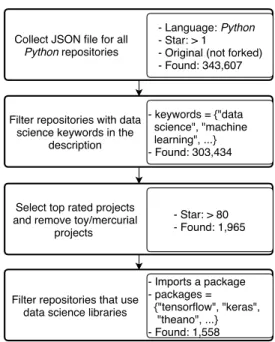
Github provides several REST APIs to search and collect metadata and source code. An overview of the repository selection and filtering procedure is shown in Figure 1. Using the APIs, first we collect all the repositories having Python
as the main language and having more than one star. To bookmark and follow new updates of a project, Githubusers
‘star’a project. Following several prior works in this area, we have also used the number ofstars as the indication of matured and popular project. For each project, we have collected the metadata and other API URLs for the repository in the form of a JSON file. By following this method, we have collected JSON files for 343,607 Github projects. These projects are original (not forked from another project), use Python as the primary language and have more than one star.
The next step is to identify matureData Scienceprojects. To filter the Data Scienceprojects, we have followed two meth-ods. First, we have filtered the projects having Data Science
related keywords such as machine learning, deep learning, neural network, image processing, artificial intelligence, etc. in
Collect JSON file for all Python repositories
- Language: Python - Star: > 1
- Original (not forked) - Found: 343,607
Filter repositories with data science keywords in the
description
- keywords = {"data science", "machine learning", ...}
- Found: 303,434
Filter repositories that use data science libraries
- Imports a package - packages = {"tensorflow", "keras", "theano", ...}
- Found: 1,558 Select top rated projects
and remove toy/mercurial projects
- Star: > 80 - Found: 1,965
Fig. 1. Repository selection process and criteria
the Githubdescription of each repository. However, keyword search with a wide list of keywords in the description has the possibility to be imprecise. Therefore, we undertake a second strategy. We filter the projects that use machine learning libraries such as Tensorflow, Keras, Theano, etc. To include high-quality projects in the dataset, we have removed projects having less than 80 stars. Finally, we have collected JSON files for 1,558 projects. These JSON files are the input to our dataset generation process.
C. Data Generation
For each chosen Github repository, the data generation starts with caching all the metadata and cloning the repository locally. The Python parser, implemented in Java, is used to parse the source code retrieved by JGit from the local repository into AST data. Then, we utilized data writers generated by the Protocol Buffers compiler to convert the AST data intoSequenceFiles. Protocol Buffer is an extensible mechanism developed by Google for serializing structured data fast compared to other formats like XML. The SequenceFile
stores data in a special format similar to map which stores key-value pairs. In this case, key is the project and value is the binary representation of Protocol Buffer message. Finally, the generated SequenceFile is transferred to Hadoop Cluster and is made accessible toBoa queries.
D. Mapping Python AST to Boa AST
We traverse each revision of aPythonfile and parse it with the appropriate parser. While parsing, we identify thePython
version used in the program and attach a version tag with each file. Two different parsers have been used to parse Python 2
andPython 3files. The next step is to convertPythonAST to predefinedBoa AST format.Boa AST format is defined in a flexible way so that it can incorporate most of the AST nodes
from different languages. However,Pythonhas some different language features such as lambda statement, with statement. As a result, we had to add a few new AST nodes and change few existing structure ofBoaschema. For example, inPython, a function can be defined inside a function. To achieve that, we modified theMethodnode inBoaso that it can holdMethods recursively.
E. Data Storage
The storage strategy is the same as other dataset storage mechanism in Boa. The SequenceFile data is populated into a distributed database called HBase tables [11]. HBase is provided by Hadoop which is an open source implementation of Google’s Bigtable [13]. From these tables, another data structure MapFileis generated which generates an index file. These generated files and HBase tables are the input to the dataset mining queries.
III. DATADESCRIPTION
A. Metrics
The dataset contains 1,558 repositories developed by 9,839 developers. The projects are owned by both organizations and individual users. Some of the top rated projects are Tensorflow Models, Keras, Scikit-learn, Pandas, Spacy, Spotify Luigi, NVIDIA FastPhotoStyle, Theano, etc. The dataset also contains projects that use at least 33 Data Science libraries including Pytroch, Caffe, Keras, Tensorflow, XGBoost, NLTK, StatsModels, etc. Table I presents the important metrics of the dataset.
TABLE I METRICS OF THE DATASET
Metric Count
All repositories Owner
Organization 350 Individual user 1,208
Total 1,558
Developers 9,839
Revisions 557,311
Python files (latest snapshot) 86,321 Python files (all revisions) 4,977,680
B. Data Schema
The dataset is created under the predefined data format of
Boa. The fields in the dataset for storing metadata about the repository are shown in Table II.
TABLE II
DOMAIN-SPECIFIC TYPES FOR STORING REPOSITORY,BASED ON[5]
Fields Attributes
Project id, name, created date, code repositories, ... Repository url, kind, revisions
Revision id, log, committer, commit date, files Person username, real name, email File name, kind
For storing the parsed AST from the source code, the dataset captures the fields listed in Table III. The top-level
node which holds a program file is named ASTRoot in Boa. The Namespace node holds the qualitative path to the file,
Declarations and other source code. A classDeclarationholds the Python functions as Methods which in turn holds other
Statements and Expressions. The fields with kind attribute are the union of different record structures wherekind is an enumerated type.
TABLE III
DOMAIN-SPECIFIC TYPES FOR SOURCE CODE,BASED ON[5]
Fields Attributes
ASTRoot imports, namespaces Namespace name, modifiers, declarations
Declaration name, kind, modifiers, parents, fields, methods, ... Type name, kind
Method name, modifiers, return type, statements, ... Variable name, modifiers, initializer, variable type Statement kind, condition, expression, statements, ... Expression kind, literal, method, is postfix, ... Modifier kind, visibility, other, ....
IV. USAGE
A. Boa Web-based Interface
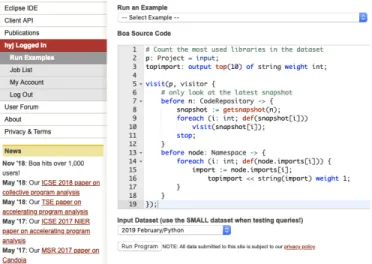
The dataset can be accessed through Boa website [14] to write queries and submit them toBoacluster for execution. A snapshot of this web-based interface is presented in Figure 2. There are three steps to executingBoaqueries on thePython
dataset. First, log on to the Boawebsite as a registered user. Then navigate to user menu and choose Run Examples from the left panel. Second, write a query under the Boa Source Code. If researchers are not familiar with the language, the example Boaprograms can be utilized by clicking the Select Examples. Third, select 2019 February/Python dataset in the drop-down list underInput Dataset and run the query.
A client API is also provided to programmatically access the
Boainfrastructure. This allows researchers to write their own program to submit aBoa query, like SQL queries embedded in other languages, and retrieve results back for analysis.
B. Boa Query and Output
The Boaprogram presented in Figure 2 is for counting the most used Data Science libraries. TheBoa program contains an input project p and an output aggregator topimport
(line 2). A depth-first search (DFS) strategy is implemented in the visit function (line 5) with an input project p and a specified visitor. Before traversing the whole AST under
CodeRepository node, the visitor only looks at the latest snapshot (line 8). For each file in the snapshot, the program uses the same visit strategy (line 10) to aggregate different libraries inNamespacenodes (lines 13-16). The top aggregator selects the 10 highest weighted results as output.
The submitted Boa jobs can be accessed in the left panel under Job List. The corresponding job status such as job ID, created time, source code, compile/execution log is provided for a specific job. If the job is finished without any compila-tion/execution error, the result can be found under View Job Outputand can be downloaded as text file.
C. Using Dataset without the Web Interface
The dataset can be accessed outside of theBoainfrastructure as well. Our dataset is in the format of Hadoop sequence file that can be read or written using protocol buffer reader/writers. If parallel processing over this dataset is desired, then one would need to use threads or write MapReduce [15] tasks from scratch to analyze the data as shown in [5]. Another method to use the dataset outside of Boa infrastructure is to get the publicly available Boa compiler and run queries on the dataset directly after building the compiler in the target environment. The instructions and resources of this submission can be obtained from [16].
V. APPLICATIONS
To show the potential of the dataset, we describe the following applications of the dataset.
A. Individual vs. Organization
Our dataset contains 1,558 repositories developed by 9,839 individuals developers. As a first application, we extracted repository metadata from Githubto get information about the projects. This information is shown in Table I. The owners of the projects are classified into two categories: organization and individual user. Among all the repositories, 350 repositories are managed by organizations such as Google, Microsoft, IBM, DeepMind, OpenAi, etc. and 1,208 repositories are owned by individual developers.
B. API Usage Study
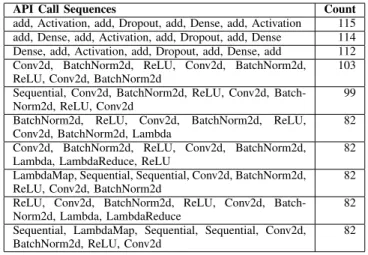
Data Science projects in Python heavily use APIs from common libraries, but previous research [17] has shown that programmers often struggle to use API appropriately. Some APIs are meant to be called in a specific sequence, with prede-fined parameter types, values and guard conditions. Violating these rules will result in a crash, performance degradation or other unwanted output. To identify the misuse of an API, we need to identify the good uses in the first place. Therefore, we
have collected top frequent API call sequence patterns from the dataset. In Table IV, we have listed the top 10 frequent method call sequences related to artificial neural network. We manually created a list of neural network related APIs. For each API method M from the list, we search for frequent temporal sequence of k API calls where M is one of thek
API methods. The result in Table IV is shown for k = 8. These sequence patterns can be leveraged to investigate the violation of the order of these API calls.
TABLE IV
TOP10 APISEQUENCES EXTRACTED FROM THE DATASET.
API Call Sequences Count
add, Activation, add, Dropout, add, Dense, add, Activation 115 add, Dense, add, Activation, add, Dropout, add, Dense 114 Dense, add, Activation, add, Dropout, add, Dense, add 112 Conv2d, BatchNorm2d, ReLU, Conv2d, BatchNorm2d, ReLU, Conv2d, BatchNorm2d
103 Sequential, Conv2d, BatchNorm2d, ReLU, Conv2d, Batch-Norm2d, ReLU, Conv2d
99 BatchNorm2d, ReLU, Conv2d, BatchNorm2d, ReLU, Conv2d, BatchNorm2d, Lambda
82 Conv2d, BatchNorm2d, ReLU, Conv2d, BatchNorm2d, Lambda, LambdaReduce, ReLU
82 LambdaMap, Sequential, Sequential, Conv2d, BatchNorm2d, ReLU, Conv2d, BatchNorm2d
82 ReLU, Conv2d, BatchNorm2d, ReLU, Conv2d, Batch-Norm2d, Lambda, LambdaReduce
82 Sequential, LambdaMap, Sequential, Sequential, Conv2d, BatchNorm2d, ReLU, Conv2d
82
VI. LIMITATIONS
Limitations in our dataset can arise from internal and external threats. One internal threat to our dataset could be that the collected projects are not representative of Data Science
projects. To alleviate this threat, we have used both keyword-based filtering and the use of machine learning libraries as our filtering criteria. A potential external threat could be the lack of maturity of the projects. We usestar count of at least 80 as a filtering criteria to select repositories to mitigate this threat. Another external threat could be the trustworthiness of the Pythongrammar that we used to parse the programs. We have used the official ANTLR grammar [18] to alleviate this threat.
VII. SUMMARY
Analyzing open source code repositories is a widely used method in software engineering and programming language re-search. As of this writing, no open source dataset for studying
Data Sciencesoftware is available. We created a dataset from
Githubprojects that are usingPython, a popular programming language for Data Science. The dataset contains 1,558 high-quality projects with 557,311 revisions. The projects in the dataset are mature, owned by a diverse set of users and organizations, and use a large set of machine learning libraries. The dataset has been developed for theBoainfrastructure and also available outside of the infrastructure. Finally, we have shown possible research directions to utilize the dataset.
REFERENCES
[1] M. Allamanis and C. Sutton, “Mining source code repositories at massive scale using language modeling,” inProceedings of the 10th Working Conference on Mining Software Repositories. IEEE Press, 2013, pp. 207–216.
[2] S. M. Blackburn, R. Garner, C. Hoffmann, A. M. Khang, K. S. McKinley, R. Bentzur, A. Diwan, D. Feinberg, D. Frampton, S. Z. Guyer et al., “The DaCapo benchmarks: Java benchmarking development and analysis,” inACM Sigplan Notices, vol. 41, no. 10. ACM, 2006, pp. 169–190.
[3] I. H. Witten, S. J. Cunningham, and M. D. Apperley, “The new zealand digital library project,”D-Lib magazine, vol. 2, no. 11, 1996. [4] H. Do, S. Elbaum, and G. Rothermel, “Supporting controlled
experi-mentation with testing techniques: An infrastructure and its potential impact,”Empirical Software Engineering, vol. 10, no. 4, pp. 405–435, 2005.
[5] R. Dyer, H. A. Nguyen, H. Rajan, and T. N. Nguyen, “Boa: A language and infrastructure for analyzing ultra-large-scale software repositories,” in Proceedings of the 2013 International Conference on Software Engineering. IEEE Press, 2013, pp. 422–431.
[6] G. Gousios and D. Spinellis, “GHTorrent: GitHub’s data from a fire-hose,” inMining software repositories (MSR), 2012 9th ieee working conference on. IEEE, 2012, pp. 12–21.
[7] E. Tempero, C. Anslow, J. Dietrich, T. Han, J. Li, M. Lumpe, H. Melton, and J. Noble, “The Qualitas corpus: A curated collection of Java code for empirical studies,” inSoftware Engineering Conference (APSEC), 2010 17th Asia Pacific. IEEE, 2010, pp. 336–345.
[8] G. Farah, J. S. Tejada, and D. Correal, “Openhub: a scalable architecture for the analysis of software quality attributes,” inProceedings of the 11th Working Conference on Mining Software Repositories. ACM, 2014, pp. 420–423.
[9] M. Orr´u, E. Tempero, M. Marchesi, R. Tonelli, and G. Destefanis, “A curated benchmark collection of python systems for empirical studies on software engineering,” inProceedings of the 11th International Confer-ence on Predictive Models and Data Analytics in Software Engineering. ACM, 2015, p. 2.
[10] R. Dyer, H. Nguyen, H. Rajan, and T. N. Nguyen, “Boa: Ultra-large-scale software repository and source-code mining,”ACM Trans. Softw. Eng. Methodol., vol. 25, no. 1, pp. 7:1–7:34, 2015.
[11] Apache Software Foundation, “Hadoop.” [Online]. Available: https: //hadoop.apache.org
[12] J. Dean and S. Ghemawat, “Mapreduce: Simplified data processing on large clusters 6th symposium on operating system design and implementation,”San Francisco, 2004.
[13] F. Chang, J. Dean, S. Ghemawat, W. C. Hsieh, D. A. Wallach, M. Bur-rows, T. Chandra, A. Fikes, and R. E. Gruber, “Bigtable: A distributed storage system for structured data,” ACM Transactions on Computer Systems (TOCS), vol. 26, no. 2, p. 4, 2008.
[14] H. Rajan, T. N. Nguyen, R. Dyer, and H. A. Nguyen, “Boa website,” http://boa.cs.iastate.edu/, 2015.
[15] J. Dean and S. Ghemawat, “MapReduce: simplified data processing on large clusters,”Communications of the ACM, vol. 51, no. 1, pp. 107–113, 2008.
[16] S. Biswas, M. J. Islam, Y. Huang, and H. Rajan, “MSR Data-Showcase Submission,” http://design.cs.iastate.edu/papers/MSR-19/, 2019. [17] T. Zhang, G. Upadhyaya, A. Reinhardt, H. Rajan, and M. Kim, “Are
code examples on an online Q&A forum reliable?: a study of API misuse on stack overflow,” inProceedings of the 40th International Conference on Software Engineering. ACM, 2018, pp. 886–896.
[18] T. J. Parr and R. W. Quong, “ANTLR: A predicated-LL (k) parser generator,”Software: Practice and Experience, vol. 25, no. 7, pp. 789– 810, 1995.