
Abstract: Hemorrhoids are a common cause of perianal complaints and affect 1-10 million people in North-America and with similar incidence in Europe. Symptomatic hemorrhoids are associated with nutrition, inherited predisposition, retention of feces with or without chronic abuse of laxatives or diarrhea. Increased pressure and shearing force in the anal canal may lead to severe changes in to-pography with detachment of the hemorrhoids from the internal sphincter and fibromuscular net-work resulting in bleeding, itching, pain and dis-ordered anorectal function, even incontinence. The significance of hemorrhoids for anal conti-nence (corpus cavernosum) is recognized. In most instances, hemorrhoids are treated conservatively; the surgeon is contacted when conservative meas-ures have failed or complications, e.g., thrombo-sis, have occurred. 4° prolapsed internal hemor-rhoids are the main indication for hemorrhoidec-tomy: high (Parks) or low (Milligan-Morgan) liga-tion with excision, closed hemorrhoidectomy (Ferguson) or stapler hemorrhoidectomy. Throm-bosed external hemorrhoids are primary treated by incision and secondary by excision. Complicati-ons after operative treatment of external throm-bosed hemorrhoids are rare. After standard he-morrhoidectomy for internal hemorrhoids ap-proximately 10% may have a complicated follow-up (bleeding, fissure, fistula, abscess, stenosis, uri-nary retention, soiling, incontinence); there may be concomitant disease, e.g., perianal cryptoglan-dular infection, causing complex fistula/abscess, which is associated with an increased risk (30-80%) for complications, e.g., incontinence. Other treat-ment options, e.g., sphincterotomy, anal stretch, have been accused to cause more complications, e.g., incontinence in 30-50% of cases. However, incontinence is a complex phenomenon; it is evi-dent that an isolated single injury is normally not a sufficient cause, e.g., injury of the internal sphincter. The majority of patients may present with prior obstetric injury, perianal infection or Crohn’s disease and other comorbidity. Therefore all systemic and regional disorders, causing incon-tinence, should be excluded before starting mano-metric, neurophysiological and sonographic inves-tigations. Variation and overlap in test results, pa-tient-, instrument- or operator-dependent factors ask for cautious interpretation. There is vast evi-dence that the demonstration of muscle fibers in
hemorrhoidectomy specimens is a normal feature. In conclusion, standard hemorrhoidectomy with proper indication is a safe procedure. If complica-tions occur, it is in the interest of the patient and surgeon to perform a thorough investigation. Key words: hemorrhoids – hemorrhoidectomy – fecal incontinence – external thrombosed hemor-rhoids – anal fistula – complication – anal manom-etry – endoanal sonography – internal anal sphincter – ischiorectal abscess
Hemorrhoids affect many human beings in North-America and Europe. It is estimated that one to ten million Americans suffer from hemor-rhoidal complaints per year. The incidence ranges from 58 % to 86 % (Haas et al. 1983; Dennison et al. 1988; Johanson and Sonnenberg 1990; Bleday et al. 1992).
Hemorrhoids are classified into external and internal hemorrhoids. Internal hemorrhoids are further subclassified into first, second, third and fourth degree internal hemorrhoids (Thomson 1981; Hulme-Moir and Bartolo 2001). Thickened cushions of mucosa and submucosa appear to the right anterior, right posterior, and left posterior position with possible variations and secondary cushions. Hemorrhoids consist of venous plexus and arterial supply embedded in a stroma of con-nective tissue, smooth muscle and nerves (Thomson 1975; Mosley et al. 1980).
The epithelial lining of the anal canal has been divided into three zones: cutaneous, middle, and mucosa. The cutaneous zone consists of true skin and squamous stratified epithelium. The transi-tion zone from cutaneous to middle zones is called mucocutaneous junction and contains the anal crypts. The mucosal zone consists of true co-lumnar epithelium and continues upward as rec-tal mucosa. On palpation a depression is felt between the internal and external sphincter, which should not be confused with a dip formed by the mucocutaneous junction. According to Parks Milligan and others confused the visible de-pression (the line of anal crypts) with the palpa-ble groove lower in the anal canal (Parks 1956). This intersphincteric groove may be misleading in the diagnosis of sphincter defect (Sangwang and Solla 1998).
Eur J Med Res (2004) 9: 18-36
©
I. Holzapfel Publishers 2004Review
H
EMORRHOIDECTOMY
: I
NDICATIONS AND
R
ISKS
R. G. Holzheimer University Halle-Wittenberg, Germany
In relation to the anal canal, there are two ana-tomical spaces that are of clinical importance: the submucous space, lying between the mucous membrane and the internal sphincter, including the internal hemorrhoidal plexus, covered by glandular rectal epithelium, and the perianal space which contains the external hemorrhoid plexus and the subcutaneous external sphincter (Milligan et al. 1937).
The internal sphincter forms a wall of the whole anal canal though the subcutaneous external sphincter may occupy the terminal position. Fibers of the conjoined longitudinal muscle, which acts as supportive structure for the venous plexus and the anal submucosa and mucosa penetrate the internal and external sphincter forming a fibroelas-tic network (Thomson 1975; Haas and Fox 1977; Mosley et al. 1980). The longitudinal muscle is at-tached to the anal skin and anal margin. Through the gap between the two sphincter muscles passes the most medial of the terminating strands of the longitudinal muscle, which gains firm attachment to the skin over the anal verge. The groove between the hemorrhoidal plexuses is caused by the adherence of a fibromuscular band to the mu-cosa, which was called mucosal suspensory liga-ment by Parks (1956). It consists of muscularis mu-cosae, muscle-fibers from the internal sphincter, fi-brous tissue from the fascia surrounding the inter-nal sphincter, gains attachment to the mucosa of the anal crypts and divides the subepithelial space into the superior compartment containing the internal hemorrhoidal plexus and the inferior compartment, marginal or perianal space which contains the external hemorrhoidal plexus (Parks 1956). Thomson (1975) noted that this smooth muscle (corrugator cutis ani, musculus submucosae ani, mucosal suspensory ligament, musculus canal-is ani) was always present in normal cadavers and hemorrhoidectomy specimens. The anatomical de-scription of the conjoined longitudinal muscle layer and the musculus canalis ani with its relation to the sphincter muscles, rectal mucosa suggested a role in normal defecation and internal sphincter contraction (Fine and Lawes 1940; Shropshear 1960; Lawson 1974; Thomson 1975; Hansen 1976; Haas and Fox 1977; Lunniss and Phillips 1992; Loder et al. 1994). Stelzner (1992) emphasized that with regard to the anorectal continence we are fo-cused on the sphincter muscles not recognizing the importance of the corpus cavernosum and the net-work of the longitudinal muscle mesh. Stieve re-ported that the internal sphincter might not com-pletely close the anal canal (Stieve 1928; Stieve 1930). Stelzner has introduced the term corpus cavenosum with his description of the arteriove-nous shunts in the hemorrhoids (Stelzner 1962). The importance of the cushions for the continence has been elucidated in further studies and it is now suggested that the vascular filling is contributing 15 to 20 % to the resting anal pressure (Stelzner et al. 1966; Thomson 1975; Hansen 1977; Gibbons et al. 1986; Lestar et al. 1989). This has been support-ed by the finding that excision of the piles in
he-morrhoidectomy may impair continence to rectal saline infusion (Read et al. 1982).
E
TIOLOGYThe pathogenesis of hemorrhoids is not yet finally elucidated. It has been suggested by several authors that there is a genetic link, which would explain the association between hemorrhoids and hernia and prolapse of the genitourinary system or vari-cose veins (Stelzner 1962; Burkitt 1975; Loder et al. 1994). Environmental factors, e.g., low-fiber diet, constipation, repeated and prolonged strain-ing, hard stool, chronic use of laxatives, have been identified to support the development of hemor-rhoids (Burkitt 1975; Haas et al. 1984). In fact, straining associated with constipation, gynecolog-ical prolapse and prolapse of the anal mucosa with loose stools, diarrhea or ulcerative colitis can be found in the patient history (Stern 1964). Chronic abuse of laxatives has been observed in 22.2% of males and 76.4% of females prior to hemorrhoidec-tomy (Kouba 1980). In recent reports it has been proposed that hemorrhoids are caused by patho-logic slippage of the normal lining of the anal canal together with changes in connective tissue, e.g., loss of organization, muscular hypertrophy, fragmentation of the muscle and elastin compo-nents which may be aggravated by stress during defecation (Gass and Adams 1950; Thomson 1975; Haas and Fox 1980; Haas et al. 1983; Haas et al. 1984; Loder et al. 1994). Venous stasis, ischemia, edema, clot formation may be responsible for com-plications of the hemorrhoidal disease, e.g., super-ficial ulceration, fissure formation, hemorrhagic infarction, external thrombosed hemorrhoids (Dayal and DeLellis 1989; Jongen et al. 2003).
S
YMPTOMSPatients with symptomatic hemorrhoids may have bleeding, prolapse, pain, itching, mucous dis-charge, leakage of anal contents, soiling, rectal dysfunction, incontinence, feeling of a lump and constipation (Stern 1964; Ganchrow et al. 1971; Thomson 1994).
P
ATHOPHYSIOLOGYThe anal cushions resemble erectile tissue contain-ing large blood spaced fed by arterioles (Thomson 1975). In normal subjects they may help to pre-serve continence by forming an expansive seal (Gibbons et al. 1986). Forty % of patients with hemorrhoids, especially non-prolapsing hemor-rhoids, complain of obstructed defecation and vig-orous straining (Hancock 1977; Sun et al. 1990) leading to increased anal pressure, lower rectal compliance and more perineal descent (Arabi et al. 1977; Hiltunen and Matikainen 1985; el-Gendi and Abdel-Baky 1986; Lin 1989; Sun et al. 1990; Ho et al. 1995). It has been assumed that the ab-normal high anal pressures are caused by an in-creased tonic activity of the internal and external
sphincter (Hancock 1977; Teramoto et al. 1981; Lane 1982), which may hinder defecation, and cause expansion of the anal cushions by impairing venous drainage (Sun et al. 1990). Teramoto dem-onstrated by biopsies taken from anal sphincters in patients with hemorrhoids that these were in a state of increased tonic contraction, which causes muscle hypertrophy and may contribute to in-creased resting pressure (Teramoto et al. 1981). More recently, the anal cushions were rediscov-ered as main cause for the high resting and residu-al pressures in the outer canresidu-al by demonstrating abnormally high vascular pressure in anal cush-ions themselves (Sun et al. 1990). Hancock (1976) considered ultraslow waves to represent a syn-chronous contraction of the whole internal sphincter. Roe et al. (1987) observed that ultra-slow waves were associated with high pressures and often a pulse wave was superimposed indicat-ing the vascularity of the hemorrhoidal tissue. Ultraslow waves may represent some form of per-istaltic action in the sphincters by the presence of hemorrhoids (Roe et al. 1987). During defecation, when sphincters are relaxed to facilitate expulsion of stool, dilated anal cushions could cause anal re-sistance, which could only be overcome by in-creased abdominal pressure (straining). This pres-sure may create a shearing force with detrimental effect on venous drainage of the cushions, connec-tive tissue supporting the anal lining finally lead-ing to intermittent or permanent prolapse of hem-orrhoids and influencing the continence (Hancock 1977; Hancock 1981; Shafik 1984; Gibbons et al. 1986; Sun et al. 1990). The external sphincter in patients with hemorrhoids may remain in a state of increased tonic contraction, inducing muscle hypertrophy; the role of the internal sphincter for the pressure in the anal canal when a bolus is present may be overestimated (Teramoto et al. 1981). Especially females with a history of consti-pation and preg-nancy were recognized to be prone to develop spontaneous incontinence (Stelzner 1992). Despite controversy on the occur-rence of increased resting anal pressure in patients with symptomatic hemorrhoids (Fantin et al. 2002) it is well accepted that there is distal dis-placement of anal cushions with loosening and fragmentation of the subepithelial connective tis-sue (conjoined longitudinal muscle, musculus can-alis ani, fibromuscular ligament) with a significant change of the topography of the anal canal which may affect continence (Parks 1956; Stelzner 1962; Thomson 1975; Hansen 1976; Hansen 1977; Haas et al. 1984; Stelzner 1992; Loder et al. 1994).
D
IAGNOSISFor diagnosis of hemorrhoids a detailed history with local and general examination may be neces-sary. Inspection and proctoscopy may reveal acute thrombosed external or internal hemorrhoids; however, perianal abscess, submucous abscess, and even ischio-rectal abscess should be ruled out. Sigmoidoscopy, colonoscopy or further radiologic
examinations (barium enema, MRT) may be nec-essary in individual cases. (Stern 1964). The sphincter ani externus and internus can be palpat-ed well and their functional status checkpalpat-ed. The inferior part of the sphincter ani internus has been described by Stelzner as “hard as cartilage” (Stelzner et al. 1966). Sensitivity of the anal canal, which is also important for continence, is highest in the lower part (Stelzner 1992).
T
REATMENTEvidence-based treatment modalities include injec-tion sclerotherapy, photocoagulainjec-tion, cryothera-py, diathermy, banding, laser, open or closed he-morrhoidectomy and stapled hehe-morrhoidectomy (Holzheimer 2001). The indication for hemor-rhoidectomy should be based on the patient’s symptoms and the condition of rectal outlet (Ferguson and Heaton 1959). Associated anorectal disease may be present at least in 22 % of patients (Bleday et al. 1992). Patients with long-standing hemorrhoids may have impaired anal sphincter pressures associated with perineal descent and pu-dendal nerve injury (Hancock 1976; Read et al. 1982; Bruck et al. 1988; Ho et al. 1995). External sphincters may be hypertrophied probably from hyperactivity in response to an irritating anal mass as well as the constant fear of soiling from discharge associated with piles (Teramoto et al. 1981). Most patients with symptomatic hemor-rhoids may be treated conservatively (45.2%) or by rubber band ligation (44.8%) (Rudd 1970; Bleday et al. 1992). The most common indication for surgery are persistent grade IV hemorrhoids after failure of conservative management with the conventional excision-ligation (Milligan-Morgan) hemorrhoidectomy being the most common tech-nique in Britain and Ireland (Beattie et al. 2002), but the best treatment for hemorrhoids is preven-tion (Brisinda 2000). Patients seek surgical atten-tion often after onset of complicaatten-tion or when medical therapies have failed. Surgical interven-tion is required when clear signs and significant discomfort are present (Tajana 1989).
H
IGH ANDL
OWL
IGATION WITHE
XCISIONVERSUS
C
LOSEDT
ECHNIQUEThe operation should aim at the removal of the dilated veins, ligation of the hemorrhoidal arteries and fixation of the anal mucosa to the underlying muscle (internus) to prevent prolapse and to oblit-erate the submucous space (Parks 1956). Ligation of the hemorrhoidal artery may be done as high li-gation (Parks 1956) or low lili-gation (Milligan et al. 1937). Closed hemorrhoidectomy is supposed to be less painful and may preserve anal sensory function better and lead to faster wound healing (Ferguson and Heaton 1959; Khubchandani et al. 1972) but it has a reputation in Europe for dehis-cence and infection (Turell 1952; Watts et al. 1964). However, Ferguson insisted that complicat-ions such as abscess or para-anal cellulitis
practi-cally never occur after closed hemorrhoidectomy (Ferguson and Heaton 1959). In Europe the Milligan-Morgan procedure is preferred whereas in the United States the closed hemorrhoidectomy as described by Ferguson is more popular (Milligan et al. 1937; Ferguson and Heaton 1959; Wolf et al. 1979; Arbman et al. 2000). However, only few studies have compared closed and open techniques (Gemsenjäger 1989; Ho et al. 1997; Arbman et al. 2000); nevertheless, both operations may have an impact on the maximum resting pres-sure leaving the recto-anal inhibitory reflex un-changed which would infer that the hemorrhoidal tissue itself is responsible for the increased pres-sure (Roe et al. 1987). In most descriptions of the hemorrhoidectomy technique the dissection of the mucosal ligament of the internal sphincter opens up a plane between the superior hemor-rhoidal plexus and the internal sphincter – the plane of the M. canalis ani or M. corrugator ani (Milligan et al. 1937; Parks 1956; Ferguson et al. 1971; Stelzner 1992). Stelzner has emphasized that only hemorrhoids which have been disconnected from the rectum and/or sphincter ani internus or a fibrotic/thrombotic at the anal verge fixated seg-ment of the hemorrhoids (external hemorrhoid) may be securely resected (Stelzner 1992). Parks’ observations support this notion: adherent muco-sa is difficult to rise from the underlying muscle unless continued prolapse has resulted in attenua-tion of the mucosal ligament. In third degree piles the mucosal ligament has disappeared and the mucosa flaps have to be fixed to the muscle be-cause otherwise the slipping down of rectal muco-sa may cause discharge and irritation (Parks 1956).
S
PHINCTEROTOMY ANDS
TAPLERP
ROCEDURESome authors have recommended an additional sphincterotomy for surgical treatment of hemor-rhoids, although this may be associated with a risk for incontinence (Tajana 1989; Arbman et al. 2000). Baradnay (1974) stated that the high recur-rence rate after the Langenbeck (1852) operation, and the frequent incontinence, stricture and mu-cosal prolapse after the Whitehead (1887) opera-tion, has been a stimulus for the surgeons to look for better procedures (Milligan et al. 1937, Parks 1956; Ferguson and Heaton 1959; Baradnay 1974), but neither closed nor open techniques are per-fect. Postoperative pain, a frequent nuisance to the patient, led to the introduction of the stapler procedure as described by Longo for the treat-ment of third and fourth degree hemorrhoids (Longo 1998; Kohlstadt 1999; Rowsell et al. 2000; Fazio 2000).
T
REATMENT OFT
HROMBOSEDE
XTERNALH
EMORRHOIDSThrombosed external hemorrhoid, located in the marginal or perianal space, is probably one of the most frequently diagnosed anorectal emergencies
and as a result excision is a frequently performed anorectal operation (Jongen et al. 2003). Symptomatic isolated thrombosed external hem-orrhoids may ask for a much higher excision rate (84 %) than internal disease, which may be due to the increased occurrence and recurrence of exter-nal thrombosed hemorrhoids (Bleday 1992). Although acute thrombosed external hemorrhoids are usually obvious, according to Stern (1964) they should be differentiated from perianal scess, submucous abscess or even ischiorectal ab-scess. The treatment strategy from that performed in internal non-thrombosed hemorrhoids differs: in acute thrombosed hemorrhoids it is not neces-sary to perform a standard three-position hemor-rhoidectomy but rather just to remove sympto-matic tissue (Hayssen et al. 1999; Hulme-Moir and Bartolo 2001).
C
OMPLICATIONS“Poor results of hemorrhoidectomy have nearly al-ways been reported by surgeons among cases referred to them in which the initial treatment was given elsewhere. Those who have attempted to follow-up their own cases have all reported satisfactory results” Parks (1965) was quite aware that it is difficult to evaluate postoperative complications due to flaws in subjective – there is a group of patients with he-morrhoidal symptoms who have either weak anal sphincters or whose muscle relax easily when they strain is leading to a descent of the perineum and a shallow anal canal – and objective factors – assess-ing the results of operations performed elsewhere may be difficult as one never can be sure what procedure was carried out (Parks 1965). 13-18 % of treated patients had preoperative incontinence, soiling was reported in 82-84 %, bleeding in 95-97 % and prolapse in 79-82 % of patients (Arbman et al. 2000). Even histological examination may not be reliable as the fixed tissue lost its elasticity. The interpretation of the actual topography is finally left to the attentive surgeon (Stelzner 1992). On the other hand, surgical hemorrhoidectomy is known to have an impact on continence – conti-nence to saline infusion and anal canal pressures are reduced – which may be due to anal dilatation (Read et al. 1982; Ho and Tan 1997; Shalaby and Desoky 2001). Hemorrhoidectomy is the most de-finitive way of treating prolapsing piles. Postoperative pain is a major concern, and surgery itself is not without complications, including not-ably bleeding and anal stricture (Golighten et al. 1969; Milsom and Mazier 1986; MacRae and McLeod 1995). Recurrence of hemorrhoids after hemorrhoidectomy has been observed in 0.5 % to 26 % of cases (Bennett et al. 1963; Tajana 1989; Konsten and Baeten 2000).
Complications occurring within the first two postoperative days include urinary retention, bleeding, soft fecal impaction, and itching. Later complications include urinary tract infection, sec-ondary bleeding, wound infection, fissure and in-continence. Up to 50% of patients complain of
soiling in the early postoperative period (Roe et al. 1987; Isler 1999).
C
OMPLICATIONS ANDE
MERGENCYS
URGERYEmergency surgery, usually performed by junior doctors, did not result in a higher incontinence rate when compared to elective operation (4.4 % versus 5.2 %) (Eu et al. 1994).
C
OMPLICATIONS ANDS
PECIFICS
URGICALT
ECHNIQUESome types of techniques seem to be associated with a higher complication rate. Four piles he-morrhoidectomy may have an increased risk of in-continence when compared to modified radical hemorrhoidectomy (Seow-Choen and Low 1995). There is some controversy with regard to addi-tional sphincterotomy. When anal stretch was used in the treatment of hemorrhoids 57.3 % of patients suffered from fecal soiling for ten weeks postoperatively when compared to 6.4 % of pa-tients with additional subcutaneous external sphincterotomy (Asfar et al. 1988; Arbman et al. 2000) whereas Goligher observed impairment of anal control for 6-12 months postoperatively (Goligher et al. 1969). It seems fair to say that in general anal dilatation and lateral sphincterotomy in combination with open hemorrhoidectomy may not offer an advantage and carries the risk of incontinence; however, the interpretation of the studies remains open as different techniques, e.g., open partial sphincterotomy, subcutaneous exter-nal sphincterotomy, partial lateral interexter-nal sphincterotomy (LIS), were used (Goligher et al. 1965; Mortensen et al. 1987; Asfar et al. 1988; Bleday et al. 1992; Mathai et al. 1996; Arbman et al. 2000), and some investigators saw no inconti-nence in patients treated with excision-ligation procedure, anal dilatation and open partial sphinc-terotomy (Arbman et al. 2000). Chung et al. (2002) found no difference in postoperative com-plications after harmonic scalpel, bipolar scissors hemorrhoidectomy or scissors excision (Chung et al. 2002).
G
ENERALC
OMPLICATIONS AFTERH
IGH/
LOW
L
IGATIONH
EMORRHOIDECTOMYIn a survey among the members of the American Society of Colon and Rectal surgeons (ASCRS) comparing open and closed techniques inconti-nence has been observed after both procedures (0.18 % – 14.6 %) (Wolf et al. 1979). A high inci-dence of temporary soiling and leakage was pro-duced by both procedures, with half of the pa-tients in each group (submucosal hemorrhoidecto-my; excision/ligation hemorrhoidectomy) affect-ed (Roe et al. 1987). These figures are supportaffect-ed by Arbman et al. who reported that six weeks after closed and open hemorrhoidectomy 28-52 % had soiling, 9-15 % incontinence. More than one year after hemorrhoidectomy 24-30 % had soiling
and 8-15 % incontinence (Arbman et al. 2000). Urinary retention may occur in 4-12 %, early hemorrhage in 1-3 %, late hemorrhage in 1 %, fis-sure in 2-4 %, inflammatory complications in 3-6 % of patients treated with the excision/ligation technique. Pain may be severe in 4-8 %, mild in 55-65 %. Disturbances of continence can be present even a long time after operation and is usually due to muscular strains, diarrhea, imper-fect closure of the anus or change in sphincter pressure (Baradnay 1974; Tajana 1989; Argov 1999). It became obvious that a definite assessment of the surgical results cannot be done prior to the end of a year (Kouba 1980).
C
OMPLICATIONS AFTERC
LOSEDH
EMORRHOIDECTOMYThe introduction of the closed hemorrhoidecto-my by Ferguson as opposed to the open technique by Milligan-Morgan did not eliminate the risk of delayed bleeding. Obviously, both the classical open and the closed hemorrhoidectomy tech-niques are far from optimal: both operations seem to be followed by protracted convalescence period and significant prevalence of complications al-though the fear of infection caused by primary closure of hemorrhoidectomy incisions is un-founded (Ganchrow et al. 1971; Buls and Goldberg 1978; Sayfan 2001).
P
AIN AFTERH
EMORRHOIDECTOMYIn the period immediately following operation not only retention of urine, hemorrhage, occa-sionally incontinence but also pain may occur (Parks 1956). Pain sometimes increases a few days after hemorrhoidectomy and should be differen-tiated from infection (Carapeti et al. 1998). Watts et al. (1964) have compared five different forms of hemorrhoidectomy (excision with high ligation, excision with low ligation, excision with primary suture, submucosal excision, excision with clamp and cautery). Despite the extensive intra-anal wounds, healing of the mucosal part of the anal canal proceeded rapidly. There was no difference in pain following the different types of operation, with the exception of excision with primary su-ture, which was more painful (Watts et al. 1964). Recognition of postoperative pain has been a pow-erful stimulus to surgeons in introducing various modifications of technique for this operation (Watts et al. 1964). Diathermy excision of hemor-rhoids has not been shown to reduce postopera-tive pain compared with scissors excision (Seow-Choen et al. 1992; Andrews et al. 1993).
C
OMPLICATIONS AFTERS
TAPLERH
EMORRHOIDECTOMYStapler hemorrhoidectomy has been compared in several studies against standard hemorrhoidecto-my techniques. Data from randomized studies showed that continence score, anorectal
mano-metric and endoanal ultrasonographic findings were not different after stapler hemorrhoidecto-my from those after open hemorrhoidectohemorrhoidecto-my (Ho et al. 2000). Complications observed were urinary retention, hemorrhage in up to 50% of cases, anal fissure, anal stenosis and incontinence (Mehigan et al. 2000; Ho et al. 2001). The development of postoperative pain after stapler hemorrhoidecto-my has been a matter of controversy recently. Cheetham et al. reported that patients had severe rectal pain and fecal urgency after stapler hemor-rhoidectomy (2000), whereas Fantin et al. (2002) observed only mild rectal pain in 68% and inter-mittent anal bleeding in 50% of patients. Also oth-ers have reported less pain and less urinary reten-tion after stapler operareten-tion (Longo 1998; Kohlstadt et al. 1999; Mehigan et al. 2000; Rowsell et al. 2000; Cheetham et al. 2001; Ebert and Meyer 2002; Fantin et al. 2002). Ebert and Meyer were concerned about the high rate of incontinence in their patients treated with stapler hemorrhoidec-tomy, although they admitted that these were sub-jective complaints and preoperative incontinence was not recorded (Ebert and Meyer 2002). Rarely, septic complications after stapler hemorrhoidecto-my were observed (Molloy and Kingsmore 2000).
C
OMPLICATIONS AFTERE
XCISION OFE
XTERNALH
EMORRHOIDSExternal hemorrhoids represent distended vascu-lar tissue distal to the dentate line. They may re-sult from straining with stools, childbirth, long car trips or prolonged sitting, constipation or di-arrhea. 50% of patients treated for acute throm-bosed external hemorrhoids had previous bleed-ing/prolapse of hemorrhoids and diarrhea in 54% of cases (Turell 1952; Sakulsky et al. 1970; Oh 1989). A prior history of hemorrhoids was nearly always obtained (Stern 1964). Previous anal symp-toms (wet anus, itching, bleeding at defecation, prolapsing hemorrhoids) were recorded in 74-88% of patients (Nieves et al. 1977; Saleeby et al. 1991). External hemorrhoids are covered by anoderm and perianal skin richly innervated with somatic pain fibers, which explains why thrombosis may cause intensive pain (Zuber 2002). Perianal throm-bosis results from thromthrom-bosis within the rich ex-ternal venous plexus constituting the most distal part of the hemorrhoidal mechanism, mostly caused by stasis and local trauma (Ganchrow et al. 1971; Thomson 1982; Brearly and Brearly 1988; Oh 1989). Pain will often prevent a full assess-ment of other local conditions (Stern 1964). “Traditionally, it has been taught, for safety’s sake, hemorrhoidal crisis should be treated with heat or ice, bed rest, ointments, analgesics, suppositories, antibiotics, and in some countries, with prayers to St. Fiacre, patron saint of proctologists and hemor-rhoid sufferers” (Nieves et al. 1977). However, a re-view of the literature has failed to substantiate the widely held belief that operation at this time car-ries with it a risk of infection and subsequent por-tal pyemia (Smith 1967). Usually a simple
evacua-tion of the blood clot through a small incision is performed (Stern 1964). In up to 70% of cases, however, a secondary hemorrhoidectomy may be necessary (Grace and Creed 1975). Hemor-rhoidectomy is performed through an elliptic or circumferential incision over the site of the thrombosis with removal of the entire diseased he-morrhoidal plexus. Infection after suture closure is rare secondary to the rich vascular network in the anal area (Turell 1952; Sakulsky et al. 1970; Mazier 1973; Hansen and Jorgensen 1975; Grosz 1990; Zuber 2002). Possible complications include bleeding, excessive scarring, stenosis, fissure and fistula – incontinence has not been reported as complication after hemorrhoidectomy of external thrombosed hemorrhoids (Blessing et al. 1992; Zuber 2002). Infectious complications of the exci-sion procedure may relate to unrecognized infec-tious processes, such as perianal abscess (Zuber 2002; Jongen et al. 2003). Ulceration of the overly-ing mucosa and not the presence of thrombosis seemed to be the determinating factor in degree of inflammatory change. By histological examination of a segment of the subcutaneous portion of the external sphincter it has been demonstrated that thrombosis did not increase the occurrence of postoperative infection (Laurence and Murray 1962). In conclusion, thrombosed external hemor-rhoid can be safely performed as outpatient proce-dure with a low complication rate (Jongen et al. 2003). (Table I)
P
REVALENCE OFF
ECALI
NCONTINENCEFecal incontinence is said to affect at least 2 % of the adults in the United States (Nelson et al. 1995). The prevalence may be much higher in spe-cific groups, e.g., multiple sclerosis (51 %), irrita-ble bowel syndrome (20 %) and diabetes (20 %) (Feldman and Schiller 1983; Okamoto et al. 1983; Drossman et al. 1986; Hinds et al. 1990; Harari et al. 1997; Krogh et al. 1997; Menter et al. 1997). However, “reluctance to disclose incontinence is recognized to be an impediment to obtain accurate estimates of the prevalence of fecal incontinence; only one-third of individuals with fecal inconti-nence have discussed this with a physician” (Johanson and Lafferty 1996). The majority of pa-tients seen in specialized units have incontinence resulting from trauma, especially obstetrical inju-ry, from a cryptogenic abscess/fistula, or from a sphincter disruption due to Crohn’s disease (Kodner 1990).
D
EFINITION OFF
ECALI
NCONTINENCEDespite the definition of incontinence – recurrent uncontrolled passage of fecal material for at least one month – the difficulty has been recognized to articulate a definition of fecal incontinence that re-liably separates health from disease (Whitehead et al. 1999; Whitehead et al. 2001). There may be dif-ferent forms of incontinence which may be asso-ciated with specific pathology: passive
inconti-Table I.
Complications after surgical treatment of thrombosed hemorrhoids.
Author Patients Type of Operation Fecal Fistula Stenosis Hemorrhage Infection Ulcer Incontinence hemorrhoid impaction stricture fissure Laurence and 12 Prolapsed Dissection and Yes No Yes No No No No Murray 1962
ligation; White- head
Tinckler and 39 External Excision No No 3 N o N o N o N o Baratham 1964 prolapsed Smith 1967 15 Internal St. Marks No No No No No No No Howard and 25 External Whitehead No No No No No No No
Pingree 1968 Sakulsky et al.
50 Mostly Excision No No No 1 N o 1 No 1970 external Ganchrow A) 100 A) 87 Ferguson No No 1 3 No No No et al. 1971 B) 30 external B) 23 external Hansen and 25 Prolapsed Milligan- Morgan No No 1 2 No No No
Jorgensen 1975 Nieves et al.
85 Prolapsed St. Marks No No No 1 N o 1 No 1977 Saleeby et al. 25 Thrombosed Closed hemor-No No No 1 N o N o N o 1991 or gangrenous rhoidectomy Jongen et al. 340 External Excision No 7 (2.1%) No 1 (0.3%) See fistula No No 2003
nence (unwanted stool without patient awareness), urge incontinence (unwanted stool despite active attempts to inhibit defecation), post-defecation soiling (stool postvoiding with normal conti-nence), nocturnal fecal incontinence or inconti-nence associated with increased bowel frequency; 80% of patients with rectal prolapse report some degree of incontinence (Talley et al. 1992; Engel et al. 1995; Buchanan et al. 2001).
P
ATHOGENESIS OFF
ECALI
NCONTINENCE“Fecal continence is maintained by the integrated ac-tion of anal sphincteric funcac-tion, the puborectalis, the levator plate, and intact sensory pathways. It is de-pendent on rectal reservoir function, colonic motil-ity, the volume and consistency of stool, anorectal sensation, the anorectal angle, normal resting anal tone and resistance to opening. As continence depends on several factors, some mechanisms may be able to compensate and maintain clinical continence when one element is abnormal. Therefore, objective knowl-edge of the continence state and of the function of all components is fundamental to an adequate estimate of the clinical situation”. In view of the heterogene-ous etiology of anal incontinence, a uniform defect in anorectal function should not be expected. (Felt-Bersma et al. 1990; Felt-Bersma et al. 1992; Penninckx et al. 1992; Mavrantonis and Wexner 1998; Francombe et al. 2001; Whitehead et al. 2001). True fecal incontinence must be distin-guished from soiling, which may be caused by def-ormation of the anal canal, fecal mass in the rec-tum, mucosal prolapse, and from urgency – pa-tients are unable to withhold the stool -, which may be related to impaired rectal compliance due to inflammatory disease of the rectum. Incontinence may be due to a sensory loss in the anal canal, which is characterized by the passage of feces without the patient being aware of it, as in rectal prolapse and in patients with neuropathic incontinence or diabetes (Felt-Bersma et al. 1989; Mavrantonnis and Wexner 1998). Incontinence
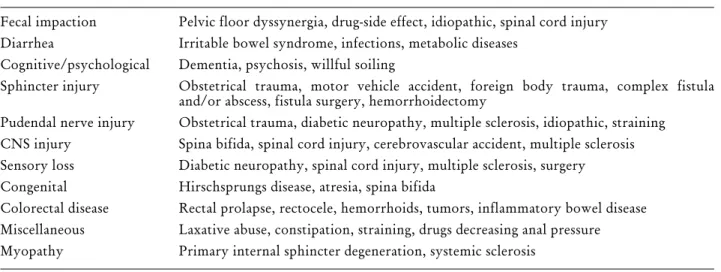
may be associated with perineal descent or de-scending perineum syndrome which occurs more often in women, not only because of obstetric in-jury, but also because of the higher incidence of straining during defecation, constipation, and out-let obstruction (Moore-Gillon 1984; Pinho et al. 1990). A thorough history, which includes the pos-sibility of steatorrhea, neurologic information, ob-stetric and gynecological surgical history in female patients, all previous operations upon the anus, rectum, colon and operations for fistulae and hem-orrhoids is mandatory (Mavrantonis and Wexner 1998). Causes of incontinence could be simple structural defects, weak sphincters, idiopathic in-continence, rectal prolapse, diabetes mellitus, pro-gressive systemic sclerosis, multiple sclerosis, de-scending perineum syndrome, perianal infection (Penninckx et al. 1992; Vaizey et al. 1998). The cause of incontinence may be classified according to functional aspects, sphincter weakness, sensory loss (Whitehead et al. 2001), sphincter complex, neurological disorders, sensory, alterations of compliance, congenital, psychological, and miscel-laneous disorders (Francombe et al. 2001) or trau-ma, congenital, myopathy, neurological, colorectal disease, and miscellaneous disorders (Buchanan et al. 2001). Whitehead et al. (2001) stated that diar-rhea and constipation are the most common cause of incontinence. Several compounds may decrease the anal basal pressure, which may affect conti-nence, e.g., diltiazem, ketanserin, encephalin, glu-cagon, somatostatin (Pennickx et al. 1992; Carapeti et al. 1999; Whitehead et al. 2001). (Table II)
D
IAGNOSIS OFF
ECALI
NCONTINENCEBefore specific investigations are performed, all in-testinal and systemic disorders must be excluded as causative factors (Mavrantonis and Wexner 1998). Due to the multifactorial and complex etiology the investigation should include anorectal manom-etry, electromyography, pudendal nerve terminal
Table II.Common causes for fecal incontinence.
Fecal impaction Pelvic floor dyssynergia, drug-side effect, idiopathic, spinal cord injury
Diarrhea Irritable bowel syndrome, infections, metabolic diseases
Cognitive/psychological Dementia, psychosis, willful soiling
Sphincter injury Obstetrical trauma, motor vehicle accident, foreign body trauma, complex fistula
and/or abscess, fistula surgery, hemorrhoidectomy
Pudendal nerve injury Obstetrical trauma, diabetic neuropathy, multiple sclerosis, idiopathic, straining
CNS injury Spina bifida, spinal cord injury, cerebrovascular accident, multiple sclerosis
Sensory loss Diabetic neuropathy, spinal cord injury, multiple sclerosis, surgery
Congenital Hirschsprungs disease, atresia, spina bifida
Colorectal disease Rectal prolapse, rectocele, hemorrhoids, tumors, inflammatory bowel disease
Miscellaneous Laxative abuse, constipation, straining, drugs decreasing anal pressure
Myopathy Primary internal sphincter degeneration, systemic sclerosis
motor latency, cinedefecography, and anal ultra-sound. While some authors reported that an expe-rienced colorectal surgeon is capable of assessing the resting and squeeze pressures with physical ex-aminations, others disagree. To make things even more difficult, the usefulness and practicality of anorectal neurophysiologic evaluation is a matter of controversy (Hallan et al. 1989; Wexner et al. 1991; Buchanan et al. 2001). The investigation nor-mally starts with perianal inspection, which may reveal scarring from previous surgery, childbirth damage or episiotomy, hemorrhoids, skin tags or rectal prolapse, and digital rectal examination for assessment of anal sphincter tone, impaction, ab-normalities of stool. Proctosigmoidoscopy is man-datory to view mucosal abnormality, hemor-rhoids, fissure, or fistula (Hallan et al. 1989; Buchanan et al. 2001).
A
NALM
ANOMETRY, R
ECTALC
APACITY,
S
ALINE-
INFUSION ANDPNTML
Anorectal manometry is most commonly used to assess anal sphincter function. Maximum basal pressure (MBP) was thought for measurement of the internal sphincter and maximum squeeze pres-sure (MSP) for evaluation of the external sphincter (Felt-Bersma et al. 1990). Early study results falsely gave the impression that the maximum basal pres-sure is generated for 85 % by the internal sphincter and for 15 % by the external sphincter (Frenckner and von Euler 1975). This, however, is no longer accepted as more recent studies came up with dif-ferent figures: the MBP is generated for 30 % by the external sphincter, for 55 % by the internal sphincter and for 15 % by expansion of the hemor-rhoidal plexus (Lestar et al. 1989; Felt-Bersma et al. 1992). Furthermore, the anal manometry may be influenced by sex, age, prolapsing or non-pro-lapsing hemorrhoids, rectocele or rectal tumor presence and repair (Loening-Baucke and Anuras 1985; McHugh and Diamond 1987; Arnold et al. 1990; Felt-Bersma et al. 1990; Sun et al. 1990; Keck et al. 1995; Ho et al. 1998). “There is no accepted standardized method of performing or interpreting this test, thus comparison of data between institutions has been problematic” (Mavrantonis and Wexner 1998). This and the limited value of anal manome-try in patients with soiling were repeatedly dem-onstrated (Felt-Bersma et al. 1989; Diamant et al. 1999). Several studies have analyzed differences between incontinent and continent patients with basic anorectal function investigations including anal manometry, rectal capacity, and the saline-in-fusion test with controversial results (Read et al. 1979; Read et al. 1984; Felt-Bersma et al. 1988). In a more recent study Felt-Bersma et al. found no significant difference in MBP between incontinent patients and normal controls. Differentiation between incontinent and continent patients was not possible with a single test (anal manometry, rectal capacity, saline-infusion), because there was complete overlap. “Therefore, in the individual pa-tient, an abnormal result in one test must be
inter-preted with caution.” (Felt-Bersma et al. 1990). The saline-infusion test has been developed for demon-stration of fluid incontinence (Read et al. 1979), but Felt-Bersma et al. (1990) found no absolute dis-crimination between incontinent and continent patients, even when corrected for stool consisten-cy. Rectal capacity may be influenced by concomi-tant diseases, e.g., proctitis, Crohn’s disease (Buchman et al. 1980). Anal sensation has been rec-ognized as important factor for the continence (Read et al. 1982; Read and Read 1982). If impaired it may indicate neurological or postsurgical nerve impairment (Miller et al. 1989; Kamm and Lennard-Jones 1990). However, both methods, anal manometry and determination of anal sensa-tion, are largely dependent on the patient’s coop-eration (Read et al. 1982; Felt-Bersma et al. 1990) and on the absence of certain compounds which are known to influence anal pressure, e.g., diltia-zem, etc. (Penninckx et al. 1992) or lignocaine. Lignocaine is known to double the electrosensitiv-ity threshold (Roe et al. 1987). The rectoanal in-hibitory reflex has been proposed as a measure of the internal sphincter function, but the interpreta-tion of levels in continent and incontinent patients is difficult (Buchanan et al. 2001; Zbar et al. 2001). Pudendal nerve terminal motor latency (PNTML) is often used to provide additional information on the innervation of the external anal sphincter. While some authors report it may reveal unsus-pected neuropathy in traumatic fecal incontinence or correlate with outcome from sphincteroplasty (Felt-Bersma et al. 1992; Engel et al. 1994; Ternent et al. 1997), the test has been criticized by others for its lack of sensitivity and specificity (Laurberg et al. 1988; Wexner et al. 1991; Vernava et al. 1993; Cheong et al. 1995; Ho and Goh 1995; Gilliland et al. 1998; Buchanan et al. 2001).
E
NDOANALU
LTRASONOGRAPHY, MRT
ANDE
VACUATIOND
EFECOGRAPHYAnal ultrasonography may be used for mapping internal and external sphincter defects (Yang et al. 1993). Different structures of the upper part, mida-nal camida-nal or lower part may be identified (Mavrantonis and Wexner 1998). It is primarily used for identifying morphologic anomalies (Whitehead et al. 2001). Interpretation of the ultra-sonographic investigation may be difficult after hemorrhoidectomy: Ho et al. (2001) demonstrated new internal sphincter defects after hemorrhoidec-tomy, but none of the patients had symptoms of incontinence. “It is conceded that operator dependen-cy and possible false identification of anal sphincter injury at endoanal ultra-sonography is possible” (Ho et al. 2001). Variability in manometric measure-ment (Ho et al. 2001) and the use of a 7 MHz probe instead of a 10 MHz probe (Buchanan et al. 2001) will make the job more difficult. Unfortunately magnetic resonance imaging, which is complimentary to endoanal ultrasonography, has shown lower inter-observer reproducibility for detecting sphincter defects (Buchanan et al. 2001;
Malouf et al. 2001). Evacuation proctography (de-fecography) is not of established value in patients with fecal incontinence (Diamant et al. 1999). In conclusion, “although anorectal investigations are in widespread use, their clinical value has sometimes been doubted” and results of tests should be inter-preted with caution (Buchanan et al. 2001).
O
BSTETRICI
NJURY ANDF
ECALI
NCONTINENCEThe majority of patients referred to a colorectal clinic may have incontinence as a result of obstet-ric injury to the sphincter complex (uncontrolled second stage delivery, epidural anesthesia, instru-mental delivery, episiotomy) or as results of pro-longed labor with damage to the innervation (Nn. Levatorii, Ganglion pelvinum, Nn. Pudendales) (Snooks et al. 1985; Stelzner 1991; Sultan et al. 1993; Sultan et al. 1994; Kamm 1994; Poen et al. 1998; Sultan et al. 1998). Occult injuries to the sphincter are more common than previous thought and may present many years later (Sultan et al. 1998; Francombe et al. 2001). The occult denerva-tion of the pudendal innervadenerva-tion is a gradually pro-gressive phenomenon in that functional effects of the original injury together with other factors, e.g., abnormal straining patterns of defecation with pel-vic floor descent, are leading to stretch-induced damage to the pelvic floor during defecation (Parks et al. 1977; Snooks et al. 1984; Swash et al. 1985; Snooks et al. 1985b; Snooks et al. 1986; Snooks et al. 1990). There may be extensive reinervation, which may explain why in some patients the exter-nal sphincter seems to be intact despite obstetric trauma in the past (Wunderlich and Swash 1983). Childbirth causing damage to the pelvic floor in-nervation is considered to be a precursor of stress incontinence (Snooks et al. 1986). After first vagi-nal delivery endoavagi-nal ultrasonography has demon-strated sphincter defects in 30 % of women (Sultan et al. 1993). In a study by Jacobs et al. (1990) 19 % were incontinent without signs of obstetric injury (Jacobs et al. 1990). This has been supposed to be an early manifestation of idiopathic (neurogenic) incontinence, which has been associated with pro-longed or difficult labor (Neill et al. 1981; Kiff and Swash 1984). There is evidence gained in recent studies that 25% of primiparous women and about 33% of multiparous women with a history of vagi-nal delivery have an avagi-nal sphincter defect. The probability that postpartum fecal incontinence is associated with an anal sphincter defect is 76.8-82.8 % (Oberwalder et al. 2003).
C
ONSTIPATION ANDF
ECALI
NCONTINENCEMany incontinent patients were women with chronic constipation and a descending perineum. Incontinence is believed to be caused by chronic stretch injury of the pudendal nerve and the sacral branches causing a low anal pressure and an ob-tuse puborectalis angle (Neill et al. 1981; Bartolo et al. 1983; Read et al. 1984; Felt-Bersma et al.
1990). Anorectal incontinence due to sphincter denervation has been demonstrated in patients with rectal prolapse and fecal impaction (Parks et al. 1977). Stelzner (1991) has seen an association of the abuse of laxatives causing toxic damage to the innervation of the bowel and the consecutive in-continence.
N
EUROLOGICALD
ISEASE ANDF
ECALI
NCONTINENCEIn patients with neurological disease other factors than childbirth need to be identified, e.g., side ef-fects of drugs or coexistent behavioral disorders (Hinds et al. 1990). Fecal incontinence may be ob-served in patients with multiple sclerosis (50%), spinal injury (61%), spina bifida (90%), or in pa-tients with long-standing neuropathy secondary to diabetes mellitus (Hinds et al. 1990; Malone et al. 1994; Glickman and Kamm 1996). Isolated degen-eration of the smooth muscle of the internal anal sphincter may affect both men and women often in the middle age and is a common cause of soiling (Vaizey et al. 1997). The resting anal pressure is usually low and endosonography shows a thin and fibrotic internal sphincter (Francombe et al. 2001). Degeneration and fibrosis of the internal anal sphincter and sensory receptors, leading to passive fecal incontinence may occur in patients with pro-gressive systemic sclerosis, idiopathic intestinal pseudoobstruction and diarrhea may aggravate the clinical situation (Engel et al. 1994). Incontinence is seen in patients treated for anal atresia or Hirschsprung’s disease (Catto-Smith et al. 1995; Mulder et al. 1995; Hassink et al. 1996). Sphincter function may also be impaired by radiation injury (Varma et al. 1985; Varma et al. 1986).
A
NALS
TRETCH, S
PHINCTEROTOMY ANDF
ECALI
NCONTINENCEManual dilatation (Lord procedure) for treatment of hemorrhoids has not gained widespread accep-tance since it relies on uncontrolled damage to the anal sphincter with high incontinence rates (20% and more) at long-term follow-up (Lord 1969; MacIntyre and Balfour 1977; Buls and Goldberg 1978; Konsten and Baeten 2000). Fecal inconti-nence after sphincterotomy may range from 1% to 5%, but 35% of patients may have a lack of control for flatus and 22% complain of soiling (Buls and Goldberg 1978; Khubchandani and Reed 1989; Lund and Scholefield 1996). However, others have performed sphincterotomy without observing any case of incontinence (Bleday et al. 1992). Arbman et al. (2000) used anal dilatation in the Milligan-Morgan group, but they found no patient with fecal incontinence after six weeks of follow-up.
A
NALF
ISTULA/
ABSCESS ANDF
ECALI
NCONTINENCEAnal abscess and fistula are parts of a spectrum of the same disease process (Eisenhammer 1954). The
incidence for men has been estimated to be 12.3 per 100.000 and for women 5.6 per 100.000 (Sainio 1984). Anorectal suppuration is usually caused by cryptoglandular infection. The anal glands, arising at the level of the crypts, penetrate through the internal sphincter muscle into the transphincteric plane (Johnson 1914; Morgan and Thomson 1956; Shropshear 1960; Schouten and van Vroonhoven 1991). Anal fistula is caused by infected anal glands in the vast majority of cases (Eisenhammer 1956; Eisenhammer 1961; Parks 1963). Anal abscess or fistula may be idiopathic or non-specific. Specific causes of anorectal sepsis include Crohn’s disease, tuberculosis, actinomycosis, various malignancies, gut duplication, foreign bodies, as well as intraab-dominal or pelvic disease (Seow-Choen and Nicholls 1992). The site of the internal opening is relevant for the development of incontinence as is the type of fistula (high or complex fistula) (Milligan and Morgan 1934; Belliveau et al. 1983; Garcia-Aguilar et al. 1996). Most of the ducts have their orifices in the posterior portion of the anal canal, which may explain the predominance of posterior anal fistulae (6 O’clock in lithotomy po-sition) (Morgan 1936; Burke et al. 1951; Kuster 1965; Cirocco and Reilly 1992). Intersphincteric, transsphincteric and extrasphincteric fistula were identified by Stelzner (1959). The most widely used system of classification is that of Parks: inter-sphincteric, transinter-sphincteric, suprasphincteric and extrasphincteric fistula (Parks et al. 1976). The prevalence of supralevator fistulous abscess varies from 2-22 % (Eisenhammer 1966; Bevans et al. 1973; Parks et al. 1976; Hanley 1978; Read and Abcarian 1979; Prasad et al. 1981; Terranova et al. 1989), the prevalence of infralevator or ischiorectal abscess ranges from 9-38% (Hamilton 1975; Hanley et al. 1976; Parks and Stitz 1976; Aluwihare 1983; Ustynoski et al. 1990). Ischiorectal abscess, which is the second most common anatomic site, is prone to cause incontinence (Cox et al. 1997). The esti-mated amount of internal sphincter involved by the fistula has been identified as an independent factor for the development of incontinence by multivariate analysis (Garcia-Aguilar et al. 1996). Soiling (20.6%) and incontinence (21.8 %) was present already in one fifth of patients before sur-gical treat-ment (Schouten and van Vroohoven 1991) and they may have already a poor resting tone and/or voluntary contraction before opera-tion, which indicates an already compromised internal or external anal sphincter function (Pescatori et al. 1989). Affected patients may have quite subtle signs despite the development of mas-sive anorectal suppuration (Seow-Choen and Nicholls 1992). Problematic fistula and/or abscess-es may be missed or misdiagnosed even in special-ized units. Endoanal ultrasonography was not con-sidered to be as useful as digital examination (Seow-Choen and Phillips 1991). Management of anal fistula may be done by classical laying open (fistulotomy), by excision (fistulectomy) or by in-cision and drainage. Several studies have shown continence disturbance in 44 to 67 % of patients
(Parks and Stitz 1976; Hanley 1978; Oh 1983; Ramanujam et al. 1983; Culp 1984; Kuypers 1984; Aguilar et al. 1985; Mann and Clifton 1985; Parkash et al. 1985; Christensen et al. 1986; Wedell et al. 1987; Reznick and Bailey 1988; Shemesh et al. 1988; Thomson and Ross 1989; Kennedy and Zegarra 1990; Ustynoski et al. 1990; Schouten et al. 1991; Williams et al. 1991; Seow-Choen and Nicholls 1992; Kodner et al. 1993; Matos et al. 1993; Pearl et al. 1993; Lunniss et al. 1994; van Tets and Kuijpers 1994; Graf et al. 1995; Garcia-Aguilar et al. 1996; Ozuner et al. 1996; Golup et al. 1997; Hamalainen and Sainio 1997; Ho et al. 1997; Garcia-Aquilar et al. 2000; Gustafsson and Graf 2002). Early studies have demonstrated a higher in-cidence of complications with ischiorectal and intersphincteric abscesses (Chrabot et al. 1983; Ramanujam et al. 1984; Vasilevsky and Gordon 1984). Major incontinence will follow with drain-age of transsphincteric fistula with translevator su-pralevator extension (Parks et al. 1976). Women are particularly prone to sphincter damage during surgery for anal fistula (Goldberg 1976; Seow-Choen and Nicholls 1992). In a more recent study incontinence was associated with female sex, high anal fistula, type of surgery, and previous fistula surgery. “Surgical treatment of fistula-in-ano is asso-ciated with a significant risk of recurrence and a high risk of incontinence“(Garcia-Aguilar et al. 1996). Certain types of fistula may be associated with an even higher rate of incontinence: transphincteric 54%, suprasphincteric 80%, extrasphincteric 83% (Garcia-Aguilar et al. 1996). In certain cases it may be difficult to find the internal openings and the production of false openings or passages may result in complex supralevator or infralevator abscesses (Kratzer 1950; Scoma et al. 1974; Lockart-Mummery 1975; Hanley 1978; Hanley 1979; Fazio 1987) enbloc resection of the scarred tissue may cause incontinence (Stelzner 1992). In conclusion, surgical treatment of fistula-in-ano frequently re-sults in postoperative incontinence (Garcia-Aguilar et al. 2000). Even a simple division of an acceptable portion of the sphincter muscle in low anal fistula may cause varying degrees of impairment of anal control (Sainio and Husa 1985; Shoulder 1986). The risk for incontinence after treatment of ischio-rectal abscess is higher than after perianal abscess (Ho et al. 1997). The higher risk of incontinence after fistula surgery in female patients is probably attributable in part to partial anal disruption and/or traction injury to the pudendal nerve dur-ing vaginal delivery (Garcia-Aguilar et al. 1996).
H
EMORRHOIDECTOMY ANDI
NCONTINENCEHemorrhoidectomy is not generally regarded as cause of incontinence, but may be a predisposing factor when the patient has diarrhea (Read et al. 1979; Read et al. 1982). The evaluation is compli-cated by preexisting comorbidity. Bennett report-ed that 63% of patients with symptomatic hemor-rhoids admitted that they have experienced peri-anal trouble for more than five years before
opera-tion. 86% complained of pain and discomfort prior to the hemorrhoidectomy (Bennett et al. 1963). The details of studies on the incidence of inconti-nence after hemorrhoidectomy are often unclear. Read has reported an incidence of less than 10 % of frank incontinence following hemorrhoidectomy (Read et al. 1982). Bennett is often quoted to re-port an incidence of 26% of incontinence after he-morrhoidectomy. However, he indicates that these were minor defects of anal control and “certainly do not amount to frank incontinence” (Bennett et al. 1963). Minor defects in anal control do also occur in normal people, according to Bennett: 10% expe-rience inadvertent passage of flatus, 3% occasional unexpected leakage of feces and 2% frequent soil-ing. He concluded, that as none of the sphincters are divided in a standard hemorrhoidectomy – though the possibility of slight inadvertent damage to superficial layers of the internal sphincter can-not be entirely excluded – it might be assumed that the functional imperfections are related to removal of sensitive anal skin (Duthie and Gairus 1960; Bennett et al. 1963). “Whether an insensitive anal-canal scar, weakened sphincter action, or yet uneluci-dated factors are responsible, it is apparent that minor imperfections of continence do sometimes occur after hemorrhoidectomy as well as after other anorectal operations” (Bennett et al. 1963). The true incidence of symptomatic soiling after hemorrhoi-dectomy is unknown which may be due to no or short follow-up (Bennett et al. 1963; Zbar et al. 2001). Patients have been reported to present with symptoms of incontinence after hemorrhoidecto-my 11 months (inter-quartile range 8-16 months) after hemorrhoidectomy (Zbar et al. 2001). Mano-metry or sphincter morphology has been studied only rarely in incontinent patients before and/or after hemorrhoidectomy and results are conflict-ing (Read et al. 1992; Abbasakoor et al. 1998; Zbar et al. 2001). It is well recognized that patients with long-standing hemorrhoids can have impaired anal sphincter pressures at rest before surgery (Bruck et al. 1988; Ho et al. 1995; Zbar et al. 2001) and after hemorrhoidectomy (Ho and Tan 1997). Several other factors may influence anal pressure. The function of the internal anal sphincter may be al-tered by endoanal retraction during hemorrhoi-dectomy (Zbar et al. 2001). Increased sphincter tone is maintained by the presence of hemor-rhoids, possibly because of reflex tonic contrac-tion of the internal and external anal sphincter caused by prolonged stimulation of the anal canal (Hancock and Smith 1975; Hancock 1976; Teramoto et al. 1981; Read et al. 1982). The fact that postoperative squeeze pressures were lower in patients who soiled after hemorrhoidectomy com-pared to those who did not suggests that conscious contraction of the external sphincter may be of importance in preventing leakage through a dis-torted anal canal (Read et al. 1982). Hemorrhoi-dectomy is known to result in the abolition of ultra-slow waves together with a reduction in basal and squeeze pressures. An association was found between soiling following surgery and abnormally
low postoperative squeeze pressure (Read et al. 1982), but manometry failed to correlate with clin-ical function after operation (Melange et al. 1992). It also has been stated that morphologic assess-ment of anal sphincters after surgery may not be helpful for assessment. “The causes of incontinence after these types of surgery (lateral sphincterotomy, he-morrhoidectomy) are probably multifactorial and do not seem to rely entirely on the presence either of an occult preexisting sphincter injury or an advertent intraoperative sphincter injury”(Zbar et al. 2001), although it has been conceded that individual patients’ variations in the length and tone of the anal sphincter, preexisting sphincter injuries unde-tected by diagnostic modalities and differences in other anatomic and functional elements may con-tribute to anal incontinence (Garcia-Aguilar 2001). “Continence is a more complex phenomenon than mere preexisting or inadvertent intraoperative sphincter injury. This of course has considerable me-diolegal significance” (Zbar et al. 2001).
I
NTERNALS
PHINCTERD
EFECT ANDF
ECALI
NCONTINENCEInternal sphincter defect does not necessarily lead to a state of incontinence. There may be transient incontinence and/or internal sphincter fragmenta-tion found on endoanal ultrasound 6-8 weeks after operation, which may not be present at later con-trols (Ho et al. 2000). Internal anal sphincter de-fects seen on the endoanal ultrasound are not nec-essarily associated with clinical incontinence (Ho et al. 2000; Brown et al. 2001; Ho et al. 2001). Complete fecal incontinence does not usually occur with internal sphincterotomy (Mavrantonis and Wexner 1998); it is the interaction between the internal anal sphincter and anal cushions, which is essential for perfect anal control (Sanwang and Solla 1998). The anatomic topogra-phy may also be relevant for the interpretation of a possible sphincter injury: while internal hemor-rhoids are in close contact with the internal sphincter, the external thrombosed hemorrhoid is located more distally in the anal canal and sphinc-ter injury does occur less likely, actually there is none reported in the literature “The pathologist can tell by looking at the lining of protruding hemor-rhoids, if they are internal (mucosa lining) or exter-nal (anoderm)” (Haas et al. 1984).
M
USCLEF
IBERS INH
EMORRHOIDECTOMYS
PECIMEN ANDF
ECALI
NCONTINENCESmooth muscle fibers are normally present in nor-mal hemorrhoids (Haas et al. 1984). Their pres-ence does not indicate injury to the sphincter. Hemorrhoids consist of a stroma with blood ves-sels, smooth muscles and supporting connective tissue; and there is the anchoring connective tissue system, which connects hemorrhoids to the inter-nal sphincter and the conjoined longitudiinter-nal coat, all consisting of muscle fibers (Haas et al. 1984). Teramoto et al. reported that biopsies of
sphinc-ters were taken in patients with hemorrhoids but no case of incontinence has been reported (Teramoto et al. 1981). Khalil et al. (2000) found skeletal muscle fibers and smooth muscles fibers in histological specimens after sutured hemorrhoi-dectomy and stapler hemorrhoihemorrhoi-dectomy. They concluded that the histological presence of muscle fibers in excised hemorrhoidal tissue neither means sphincter injury nor incontinence (Khalil et al. 2000).
In summary, in most instances, hemorrhoids are treated conservatively; the surgeon is contact-ed when conservative measures have failcontact-ed or complications, e.g., thrombosis, have occurred. 4° prolapsed internal hemorrhoids are the main indi-cation for hemorrhoidectomy: high (Parks) or low (Milligan-Morgan) ligation with excision, closed hemorrhoidectomy (Ferguson) or stapler hemorrhoidectomy. Thrombosed external hemor-rhoids are primary treated by incision and secon-dary by excision. Complications after operative treatment of external thrombosed hemorrhoids are rare. After standard hemorrhoidectomy for internal hemorrhoids approximately 10% may have a complicated follow-up (bleeding, fissure, fistula, abscess, stenosis, urinary retention, soil-ing, incontinence); there may be concomitant dis-ease, e.g., perianal cryptoglandular infection, caus-ing complex fistula/abscess, which is associated with an increased risk (30-80%) for complica-tions, e.g., incontinence. Other treatment op-tions, e.g., sphincterotomy, anal stretch, have been accused to cause more complications, e.g., in-continence in 30-50% of cases. However, inconti-nence is a complex phenomenon; it is evident that an isolated single injury is normally not a suffi-cient cause, e.g., injury of the internal sphincter. The majority of patients may present with prior obstetric injury, perianal infection or Crohn’s dis-ease and other comorbidity. Therefore all system-ic and regional disorders, causing incontinence, should be excluded before starting manometric, neurophysiological and sonographic investiga-tions. Variations and overlap in test results, pa-tient-, instrument- or operator-dependent factors ask for cautious interpretation. There is vast evi-dence that the demonstration of muscle fibers in hemorrhoidectomy specimens is a normal feature. In conclusion, standard hemorrhoidectomy with proper indication is a safe procedure. If complica-tions occur, it is in the interest of the patient and surgeon to perform a thorough investigation.
R
EFERENCESAbbasakoor F, Nelson M, Beynon J, Patel B, Carr ND. Anal endosonography in patients with anorectal symptoms after haemorrhoidectomy. Br J Surg 1998; 85:1522-4
Aguilar PS, Plasencia G, Hardy TG Jr, Hartmann RF, Stewart WR. Mucosal advancement in the treatment of anal fistula. Dis Colon Rectum 1985 ;28 :496-8 Aluwihare APR. Anterior horseshoe fistulae. Ann R
Coll Surg Engl 1983;63:121-122
Andrews BT, Layer GT, Jackson BT, Nicholls RJ. Ran-domized trial comparing diathermy hemorrhoidecto-my with the scissors dissection Milligan-Morgan op-eration. Dis Colon Rectum 1993;36:580-583
Arabi Y, Alexander-Williams J, Keighley MR. Anal pres-sures and anal fissure. Am J Surg 1977;134(5):608-10
Arbman G, Krook H, Haapaniemi S. Closed vs. open he-morrhoidectomy – is there any difference? Dis Colon Rectum 2000;43:31-34
Argov S. Ambulatory radical hemorrhoidectomy : per-sonal experience with 1,530 Milligan-Morgan opera-tions with follow-up of 2-15 years. Dig Surg 1999; 16:375-378
Arnold MW, Stewart WR, Aguilar PS. Rectocele repair. Four years’ experience. Dis Colon Rectum 1990;33: 684-687
Asfar SK, Juma TH, Ala-Edeen T. Hemorrhoidectomy and sphincterotomy. A prospective study comparing the effectiveness of anal stretch and sphincterotomy in reducing pain after hemorrhoidectomy. Dis Colon Rectum 1988 ;31(3) :181-5
Baradnay G. Late results of hemorrhoidectomy accord-ing to Milligan and Morgan – A follow-up study of 210 patients. Am J Proctol 1974;25(5):59-62
Bartolo DC, Jarrat JA, Read MG, Donnelly TC, Read NW. The role of partial denervation of the puborec-talis in idiopathic faecal incontinence. Br J Surg 1983; 70:664-667
Beattie GC, Wilson RG, Loudon MA. The contempo-rary management of haemorrhoids. Colorectal Dis 2002;4:450-454
Belliveau P, Thomson JPS, Parks AG. Fistula-in-ano. A manometric study. Dis Colon Rectum 1983;26:152-154
Bennett RC, Friedman MH, Goligher JC. Late results of haemorrhoidectomy by ligature and excision. BMJ 1963;2:216-9
Bevans DW, Westbrok KC, Thompson BW, Caldwell FT. Perirectal abscess: a potentially fatal illness. Am J Surg 1973;126:765-768
Bleday R, Pena JP, Rothenberger DA, Goldberg SM, Buls JG. Symptomatic hemorrhoids: current inci-dence and complications of operative therapy. Dis Colon Rectum 1992;35(5):477-81
Blessing H, Schläpfer HU, Ammann JF. Notfallmässige Hämorrhoidektomie bei akuter Hämorrhoidalthrom-bose. Helv chir Acta 1982;49:861-865
Brearley S, Brearley R. Perianal thrombosis. Dis Colon Rectum 1988;31:403-404
Brisinda G, Maria G. Oral nifedipine reduces resting anal pressure and heals chronic anal fissure. Br J Surg 2000;87:251
Brisinda G. How to treat haemorrhoids. BMJ 2000; 321:582-583
Brown SR, Ballan K, Ho E, Ho Fams YH, Seow-Choen F. Stapled mucosectomy for acute thrombosed cir-cumferentially prolapsed piles: a prospective ran-domized comparison with conventional haemorrhoi-dectomy. Colorectal Dis 2001;3(3):175-8
Bruck CE, Lubowski DZ, King DW. Do patients with haemorrhoids have pelvic floor denervation? Int Colorectal Dis 1988 ;3 :210-4
Buchanan GN, Nicholls T, Solanki D, Kamm MA. Investigation of faecal incontinence. Hosp Med 2001;62(9):533-537
Buchman P, Mogg GA, Alexander-Williams J, Allan RN, Keighley MR. Relationship of proctitis and rec-tal capacity in Crohn’s disease. Gut 1980;21:137-140 Buls JG, Goldberg SM. Modern management of
Burke RM, Zavela D, Kaump DH. Significance of the anal gland. Am J Surg 1951;82:659-662
Burkitt DP. Hemorrhoids, varicose veins and deep vein thrombosis: epidemiologic features and suggestive causative factors. Can J Surg 1975;18:483-8
Carapeti EA, Kamm MA, McDonald PJ, Phillips RK. Double-blind randomised controlled trial of effect of metronidazole on pain after day-case haemorrhoidec-tomy. Lancet 1998;351(9097):169-72
Carapeti EA, Kamm MA, Evans BK, Phillips RKS. Topical diltiazem and bethanechol decrease anal sphincter pressure without side effects. Gut 1999;45:719-722
Catto-Smith AG, Coffey CM, Nolan TM, Hutson JM. Fecal incontinence after the surgical treatment of Hirschsprung’s disease. J Pediatr 1995;127:954-7 Cheetham MJ, Mortensen NJ, Nystrom PO, Kamm
MA, Phillips RK. Persistent pain and faecal urgency after stapled haemorrhoidectomy. Lancet 2000; 356:730-733
Cheong DM, Vaccaro CA, Salanga VD, Wexner SD, Phillips RC, Hanson MR. Electrodiagnostic evalua-tion of fecal incontinence. Muscle Nerve 1995;18:612-9
Chrabot CM, Prasad ML, Abcarian H. Recurrent ano-rectal abscesses. Dis Colon Rectum 1983;26:105-108 Christensen A, Nilas L, Christiansen J. Treatment of
transsphincteric anal fistulas by the seton technique. Dis Colon Rectum 1986;29:454-5
Chung CC, Ha JPY, Tai YP, Tsang WWC, Li MKW. Double-blind, randomized trial comparing harmonic scalpel TM hemorrhoidectomy, bipolar scissors he-morrhoidectomy, and scissors excision. Dis Colon Rectum 2002;45:789-794
Cirocco WC, Reilly JC. Challenging the predictive accu-racy of Goodsall’s rule for anal fistulas. Dis Colon Rectum 1992;35 :537-42
Cox SW, Senagore AJ, Luchtefeld MA, Mazier WP. Outcome after incision and drainage with fistuloto-my for ischiorectal abscess. Am Surg 1997;63:686-689 Culp CE. Use of penrose drains to treat certain anal fis-tulas: a primary operative seton. Mayo Clin Proc 1984;59:613-7
Dayal Y, DeLellis RA. The gastrointestinal tract. In: Cotran RS, Kumar V, Robbins SL (eds.). Robbins pa-thologic basis of disease. WB Saunders Company Philadelphia 1989: 827-910
Dennison AR, Wherry DC, Morris DL. Hemorrhoids: Nonoperative management. Surg Clin North Am 1988;68:1401-1409
Diamant NE, Kamm MA, Wald A, Whitehead WE. AGA technical review on anorectal testing tech-niques. Gastroenterology 1999;116:735-60
Drossman DA, Sandler RS, Broom CM, McKee DC. Urgency and fecal soiling in people with bowel dys-function. Dig Dis Sci 1986;31:1221-5
Duthie HL, Gairus FW. Sensory nerveendings and sensa-tion in the anal region of man. Br J Surg 1960;47:585-595
Ebert KH, Meyer HJ. Die Klammernahtresektion bei Hämorrhoiden – eine Bestandsaufnahme nach zweijähriger Anwendung. Vergleich der Ergebnisse mit der Technik nach Milligan-Morgan. Zentralbl Chir 2002;127:9-14
Eisenhammer S. Advances of anorectal surgery with spe-cial reference to ambulatory treatment. S Afr Med J 1954;28:264-266
Eisenhammer S. The internal anal sphincter and the ano-rectal abscess. Surg Gynecol Obstet 1956;103:501-6 Eisenhammer S. The anorectal and anovulval fistulous
abscess. Surg Gynecol Obstet 1961;113:519-20
Eisenhammer S. The anorectal fistulous abscess and fis-tula. Dis Colon Rectum 1966;9:91-106
El-Gendi MA, Abdel-Baky N. Anorectal pressure in pa-tients with symptomatic hemorrhoids. Dis Colon Rectum 1986;29:388-391
Engel A, Kamm MA, Talbot IC. Progressive systemic sclerosis of the internal anal sphincter leading to pas-sive faecal incontinence. Gut 1994;35:857-9
Engel AF, Kamm MA, Sultan AH, Bartram CL, Nicholls RJ: Anterior anal sphincter repair in pa-tients with obstetric trauma. Br J Surg 1994;81:1231-4 Engel AF, Kamm MA, Bartram CI, Nicholls RJ. Relationship of symptoms in faecal incontinence to specific sphincter abnormalities. Int J Colorectal Dis 1995;10(3):152-5
Eu KW, Seow-Choen F, Goh HS. Comparison of emer-gency and elective haemorrhoidectomy. Br J Surg 1994;81(2):308-10
Fantin AC, Hetzer FH, Christ AD, Friedt M, Schwizer W. Influence of stapler haemorrhoidectomy on ano-rectal function and on patients’s acceptance. Swiss Med Wkly 2002;132:38-42
Fazio VW. Complex anal fistulae. Gastroenterol Clin North Am 1987;16:93-114
Fazio VW. Early promise of stapling technique for hae-morrhoidectomy (comment). Lancet 2000;355:768-768
Feldman M, Schiller LR. Disorders of gastrointestinal motility associated with diabetes mellitus. Ann Int Med 1983;98:378-84
Felt-Bersma RJ, Klinkenberg-Knol EC, Meuwissen SG. Investigation of anorectal function. Br J Surg 1988;75:747-56
Felt-Bersma RJF, Janssen JJWM, Klinkenberg-Knol EC, Hoitsma HFW, Meuwissen SGM. Soiling: anorectal function and results of treatment. Int J Colorectal Dis 1989 ;4 :37-40
Felt-Bersma RJ, Klinkenberg-Knol EC, Meuwissen SG. Anorectal function investigations in incontinent and continent patients: differences and discriminatory value. Dis Colon Rectum 1990;33:479-86
Felt-Bersma RJF, Cuesta MA, Koorevaar M, Strijers RLM, Meuwissen SGM, Dercksen EJ, Wesdorp RIC. Anal endosonography : relationship with anal ma-nometry and neurophysiologic tests. Dis Colon Rectum 1992;35:944-949
Ferguson JA, Heaton JR. Closed hemorrhoidectomy. Dis Colon Rectum 1959;176:176-179
Ferguson JA, Mazier WP, Ganchrow MI, Friend WG. The closed technique of hemorrhoidectomy. Surgery 1971;70(3):480-484
Fine J, Lawes CHW. On the muscle-fibres of the anal submucosa, with special reference to the pecten band. Br J Surg 1940;27:723-727
Francombe J, Carter PS, Hershman MJ. The aetiology and epidemiology of faecal incontinence. Hosp Med 2001;62(9):529-532
Frenckner B, von Euler C. Influence of pudendal block on the function of the anal sphincters. Gut 1975;16:482-9
Ganchrow MI, Bowman HE, Clark JF. Thrombosed hemorrhoids: a clinicopathologic study. Dis Colon Rectum 1971;14(5):331-340
Ganchrow MI, Mazier WP, Friend WG, Ferguson JA. Hemorrhoidectomy revisited – a computer analysis of 2,038 cases. Dis Colon Rectum 1971;14(2):128-133
Garcia-Aguilar J, Belmonte C, Wong WD, Goldberg SM, Madoff RD. Anal fistula surgery: factors associated with recurrence and incontinence. Dis Colon Rectum 1996;39 :723-9

![The crystal structure of ((cyclohexylamino){(Z) 2 [(E) 5 methoxy 3 nitro 2 oxidobenzylidene κO]hydrazin 1 ylidene κN2}methanethiolato κS)(dimethyl sulfoxide κS)platinum(II): a supramolecular two dimensional network](data:image/gif;base64,R0lGODlhAQABAIAAAP///wAAACH5BAEAAAAALAAAAAABAAEAAAICRAEAOw==)