Design for All Research Group
Middlesex University Research Office
Middlesex University
LONDON
NW4 4BT
Declaring conformance on web
accessibility
Project Reference: ANEC-R&T-2009-ICT-001final
This study was commissioned by:
ANEC, The European consumer voice in standardisation,
AISBL,
Avenue de Tervueren 32,
Box 27,
B-1040 Brussels,
Belgium
Document status: Final print version 21st May 2011 Editor: Suzette Keith,
Researcher, Middlesex University, UK Email: [email protected]
Project Advisor: Nikolaos Floratos e-Accessibility expert
ANEC Print version 21 May 2011 Page 1 Declaration of conformance Acknowledgements
Project advisor Nikolaos Floratos
Email: [email protected]
Research design, analysis and report editor Suzette Keith
Email: [email protected]
Middlesex University, School of Engineering and Information Sciences, London NW4 4BT, UK
Accessibility assessment
Andrea Kennedy and Mehmet Evsen,
Email: [email protected]
Shaw Trust, Disability Action Centre, Llandarcy, Neath SA10 6EJ Email Shaw Trust: [email protected]
Automatic testing tool SortSite™
http://www.powermapper.com/products/sortsite/index.htm
I would like to express my thanks for additional support and advice from:
Robin Medlock, Shaw Trust
Gabriella Mancero (Spanish), Middlesex University Simone Rozzi (Italian), Middlesex University
Cam Nicholl and Gavin Evans, Digital Accessibility Centre http://digitalaccessibilitycentre.org
ANEC Print version 21 May 2011 Page 2 Declaration of conformance
Contents
Management summary and recommendations ... 3
1. Introduction ... 6
2. Web content accessibility guidelines... 8
3. National certification schemes ... 9
4. Methodology... 15
5. Results of the selection activity ... 18
6. Results of automatic testing ... 21
7. Results of manual testing... 24
8. Discussion... 28
9. Conclusions... 31
10. References ... 32
ANEC Print version 21 May 2011 Page 3 Declaration of conformance
Management summary and recommendations
“We design websites that not only look fantastic but also work. We take pride in making websites accessible for everyone - from the mobile phone user to the disabled.”
http://www.gawds.org/showmember.php?memberid=904
Some web developers clearly take great pride in making websites that are both accessible and of high overall quality. Fully accessible websites are an important goal in achieving equal access to the information society by people with disabilities and older people. Accessibility guidelines are well established and set out a measurable standard, however various studies have found that too few websites meet these requirements.
Recognised national certification organisations have an important role in determining the quality of accessible websites. Some websites display certification marks from a national certification body or make non-certified declarations of accessibility. Where websites provide a declaration it is essential that these claims are reliable, and measurable against relevant standards. This study investigated the use of declaration of accessibility and differences in effect between third party independent certification by a recognised certification body and self declaration.
The W3C Web Accessibility Initiative (WAI) web pages provide a considerable body of material to support the design including the Web Accessibility Content Guidelines 1.0 (1999) and 2.0 (2008). They give additional advice and information on evaluation of website accessibility and use of conformance logos including the recommendation to aim for conformance priority level AA. WCAG 2.0 is supported by documented techniques in support of the success criteria.
Each national certification schemes is subject to different legal and regulatory frameworks with a greater emphasis placed on accessibility of government websites. Websites for this study were selected from five countries with established certification schemes: Germany, Italy, Netherlands, Spain and UK. Each scheme has different procedures and methodologies for evaluating websites. As at the time of the assessments in 2010, these requirements and procedures are largely based on WCAG 1.0, while plans are variously in place to upgrade to or harmonise with WCAG 2.0 and for government websites to meet accessibility guidelines by the end of 2010.
The study identified 100 websites from government and public bodies and commercial
organisations, half of these were selected because they displayed web accessibility logos from a recognised national organisation and were listed in the organisation directory. Half the selected websites were ‘self declared’ - carrying the WCAG 1.0 or WCAG 2.0 conformance logos and link to W3C website, or were leading national websites having a strong statement of accessibility.
For consistency, the evaluation tools and test programmes chosen for this study used WCAG 2.0. The tests included both automatic and manual testing. The automatic test tool automatically
selected 25 pages from the web address given. Those which passed or had 10 or less failure points at WCAG 2.0 level A were subject to manual testing. Twenty-three out of 76 Government and public body websites were manually tested. Results for the commercial sites were much worse overall, and only two out 24 were found to have 10 or less failure points.
All of the manually tested website pages showed some evidence of accessibility awareness and best practice. Three certified government and public body websites passed all or all but one of the level A success criteria, and a further three had four or less failed checkpoints. None of the self declared government and public body websites passed all criteria and only three had four or less failed checkpoints. The remaining third (3 certified and 5 self declared) showed some evidence of meeting accessibility guidelines but failed between six and eight different checkpoints included basic
ANEC Print version 21 May 2011 Page 4 Declaration of conformance issues affecting perception, such as text equivalence and operability, keyboard only input, skip navigation and control of forms.
There were few overall differences that indicate any significant differences between the
effectiveness of certification and self declared during automatic testing and manual inspection. The manual inspection results were marginally in favour of the certified websites which included the two websites which passed all manual tests, and which had a lower average number of criteria failed. In the automatic tests, three self declared websites passed all criteria at level A, however this early lead was not maintained and failures were found during manual testing. The main differences between certification and self declaration identified in this study are:
1. Finding certified websites was much easier where the certification body offered a directory, however some of the certification bodies have relatively low numbers of listed sites. Finding websites which self declare is more problematic since there is no directory. Few popular and prestigious websites such as those tested during the MeAC study and reviewed for this study make any declaration of accessibility policy.
2. Government and public bodies appear to be making better progress than Commercial
organisations and appear to be more likely to use certification bodies or make a strong statement of accessibility policy. In Italy, the certification body lists over 800 websites many of which are related to local government.
3. During the search for websites that self declare some instances were found of misuse of the WCAG logos and links and misunderstanding of the terms of use including where this was
embedded within the page footer as part of the content management system and therefore on every page, or only used within a statement about accessibility policy and not elsewhere. The WCAG logos and links should only be applied to the pages which meet the guidelines, leaving scope for the website owner to declare that some pages may not be accessible.
4. The results of the automatic and manual testing revealed basic failures among the certified sites. This may be due to differences in methods between certification schemes or the result of drift over time – where the website has changed since certification.
5. Some of the government websites making strong statements of accessibility did remarkably well in the automatic testing with three passing automatic testing to level A. These were all self declared. This suggests that there may be good internal policies and a commitment to continue to monitor conformance.
6. At the detailed level, inspection results in relation to individual success criteria, there is slight indication that the websites that had self declared did not, as a group, perform as well as the certified sites. It was disappointing to find more than half the websites failed Criteria 1.1.1 on the provision of non-text alternatives. It was noted that the introduction of multimedia elements is creating a new hazard to passing manual tests at WCAG 2.0 level A. Five criteria were identified that account for half of all failures (see Section 7.1).
It is recommended that:
• Both certification and self declaration of accessibility are important strategies for promoting best practice, and improving access opportunities by people with disabilities. More positive action is needed to increase the number of leading commercial organisations to
demonstrate a commitment to accessibility.
• The certification bodies should make a move towards WCAG 2.0, to encourage the use of this guidance at national level, and reduce the confusion resulting from the continued reliance on the outdated WCAG 1.0.
ANEC Print version 21 May 2011 Page 5 Declaration of conformance
• Certification bodies should ensure that the integrity of the approved website is maintained following certification and that the organisation has plans in place for maintenance. It should act to remove websites from the register if they fail to maintain the standard. • Action is needed to further plans to harmonise accessibility evaluation procedures and
systems of conformance delaration to WCAG 2.0. It is noted that a previous attempt through the Unified Web Evaluation Methodology (UWEM) project offered an opportunity for harmonising accessibility evaluation throughout Europe but failed to achieve
international acceptance.
• Website developers and owners should make use of appropriate declaration for their business type and promote their achievements by providing a clear statement of accessibility policy.
• Website developers and owners should put in place a maintenance plan and retest to ensure that the website pages remains accessible. When adding new multimedia elements and other ‘non-text’ elements they should ensure that these, and their control elements are identifiable in accordance with WCAG 2.0.
• Automatic evaluation tools alone are insufficient to identify all criteria at WCAG 2.0 level A but can be used to highlight specific issues. Human intervention is currently still needed for judgement calls and interpretation of the many techniques and results. It is recommended that training on awareness and best practice should be focussed on the five criteria which are most commonly failed.
• W3C should have in place some element of quality control to assess whether the WCAG logo and links are mis-used since in the long term this will devalue its usefulness in identifying accessible websites.
ANEC Print version 21 May 2011 Page 6 Declaration of conformance
1. Introduction
The power of the Web is in its universality. Access by everyone regardless of disability is an essential aspect. Tim Berners-Lee, W3C Director and inventor of the World Wide Web http://www.w3.org/WAI/
1.1 Background
Previous surveys of European websites to determine progress towards eInclusion and levels of conformance to published Web Content Accessibility Guidelines (WCAG) have revealed
disappointing low levels of compliance within government and the commercial sectors [3, 4, 5, 6]. This lack of progress towards accessibility of websites leaves barriers to full participation in the information society by people with disabilities, whether using assistive technology, needing to make use of alternative input or output devices such as keyboard only operation, or simply needing an acceptable level of colour contrast.
This study specifically addresses the issues of declaration of accessibility made about a website and published on the website. Declarations of accessibility are important and highlight to potential users that this website meets agreed standards of accessibility, as well as acting as a beacon of good practice and claiming credit for the commitment and effort taken to make a website accessible. Two models of claiming conformance exist – that the website is certified by a recognised
certification body as meeting published guidelines, and the other by self declaration that the website meets accessibility guidelines. As a result of either model, the declaration can be publicised on the website using the logos for the certification body or level of conformance to WCAG and a statement of accessibility policy.
The purpose of this study was to determine whether there are differences in effect of these two models by testing the accessibility of websites which are certified, or which make a declaration of conformance to agreed standards.
The objectives of this study were set out in the briefing documents as follows:
• To examine how many websites that claim that they are accessible according to relevant standards, in reality are complying with these standards
• To specify on the websites that are complying in reality with the referenced web accessibility standards, how many self-declare their conformity and how many declare their conformity through an assessment by an independent third party.
• To specify on the websites that are not complying in reality with the referenced web accessibility standards, how many self-declare their conformity and how many declare their conformity through an assessment by an independent third party.
• To propose recommendations on which of the two web accessibility declaration models is the most appropriate one in order to ensure web accessibility.
The briefing documents called for the selection and testing of 100 websites drawn from five
European countries. A combination of automatic testing could be used followed by manual testing of those identified as passing the automatic tests.
1.2 Conformance assessment
A conformity assessment is a ‘demonstration the specified requirements are fulfilled’ (CEN/BT/WG 185 2008) [2]. This requires that there is:
• a set of specified requirements
• a procedure for assessing conformity to the requirements • a statement that fulfilment is demonstrated.
ANEC Print version 21 May 2011 Page 7 Declaration of conformance
As part of an examination of the issues of improving eAccessibility to goods and services in Europe consideration was given to the current state of certification on web accessibility in different countries and differences in national regulations affecting the requirements, especially of government and public bodies [2].
The results of CEN/BT/WG 185 2008 were used within this study in order to identify certification bodies and countries having strong policies on delivering accessibility especially in the government and public sector.
1.3 Measuring progress towards conformance
With each certification body applying different evaluation methodologies it was decided that all websites tested should be tested to the same scheme. The initial automatic testing and manual testing used to evaluate the selected websites took account of Web Content Accessibility Guidelines 2.0 (WCAG 2.0 2008) in order to support like for like comparison.
Within the briefing document it was proposed that the results of the assessments should be used to categorise the levels of accessibility awareness and achievement using the following grading scheme:
a) The website does not show any evidence of accessibility awareness.
b) The website shows limited accessibility features (eg: text resize widget and a "skip navigation" link on the page and add alt attributes to images).
c) The website shows a real effort towards accessibility but not implemented correctly (eg: the heading structure may not correctly reflect the logical structure)
d) Fully accessible.
As a result of the testing of the websites described in this report, this framework was revised: • A: Fully accessible – for the purposes of this study this category was reserved for small
number of websites that passed all WCAG 2.0 success criteria at level A or with only a single minor failure instance
• B: The website shows a real effort towards accessibility but not always implemented correctly. Including minor issues associated with Criteria 1.1.1
• C: As B, the website shows real effort towards accessibility but with significant failures including criteria 1.1.1 and no more than 5 failure points at WCAG 2 level A.
• D: The website shows limited accessibility features (eg: text resize widget and a "skip navigation" link on the page and add alt attributes to images), but fails to successfully implement multiple criteria at level WCAG 2 level A.
2. Web content accessibility guidelines
Web Content Accessibility Guidelines (WCAG) were produced as part of the World Wide Web Consortium (W3C) Web Accessibility Initiative (WAI). The goal of the Guidelines is to provide a single shared standard for web content accessibility that meets the needs of individuals,
organizations, and governments internationally. W3C is considered to be a ‘de facto’ standards body working by consultation and consensus between experts, industry and government and user organisations.
Briefly, WCAG 1.0 (1999) set out guidelines to delivering improved accessibility during website design, development and to support evaluation [8]. There were 14 guidelines each with a number of individual checkpoints. Conformance to the three priority levels 1, 2 and 3 is expressed as WCAG 1.0 A, AA or AAA. These guidelines have been integrated into national requirements and
regulations, certification schemes, and in-house guidelines for large organisations such as the Europa site of the European Union.1.
The much revised WCAG 2.0 (2008) is framed around four key principles of perception, operation, understandability and robustness [1]. The guidelines are intended to be technology independent. The extensive accompanying information published by the Web Accessibility Initiative (WAI)2 includes techniques to meet the guidelines and resolve common failings. WCAG 2.0 guidelines have been translated as authorised versions in 4 European languages with others having unofficial translations or candidates for becoming authorised versions in 13 further European languages. As previously, the Guidelines are organised into 3 levels of priority with the expectation that organisations will move towards the second level AA. These guidelines are framed as testable success criteria. In WCAG 2.0, a single issue can be covered by more than one success criteria at different levels of compliance, for example the required standard of contrast between text and background is lower at level A than at level AA.
WAI additionally provides information on how to evaluate websites, including automated and expert testing and more recently on involving disabled and older people in user testing. WCAG
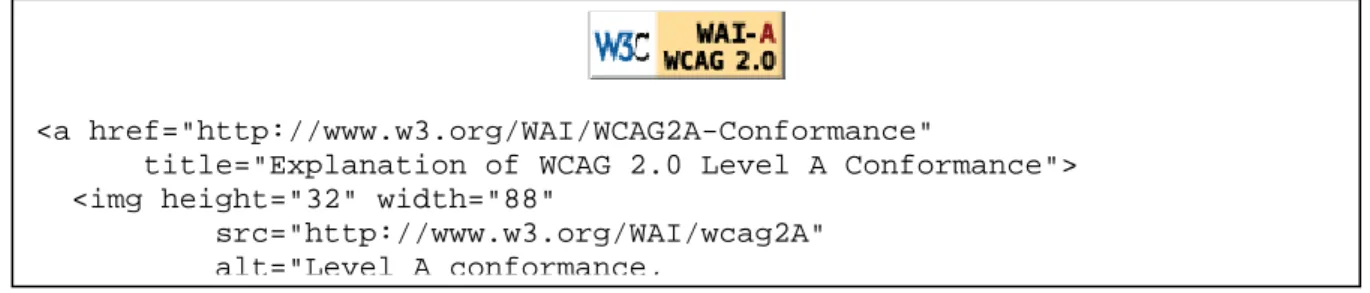
conformance logos and links are available from the WAI website, together with conditions of use3. The logo applies only to the page on which it is displayed and the whole page must meet all the Guidelines. The WCAG logo is used to indicate which set of Guidelines (1 or 2.0) and which priority level (A, AA, AAA). Additionally, the logo must be used with a link code which directs back to the WAI conformance page.
<a href="http://www.w3.org/WAI/WCAG2A-Conformance"
title="Explanation of WCAG 2.0 Level A Conformance"> <img height="32" width="88"
src="http://www.w3.org/WAI/wcag2A" alt="Level A conformance,
Figure 1 WCAG 2.0 conformance logo and link code
ANEC Print version 21 May 2011 Page 8 Declaration of conformance
1 http://europa.eu/geninfo/accessibility_policy_en.htm 2 http://www.w3.org/WAI/
ANEC Print version 21 May 2011 Page 9 Declaration of conformance
3. National certification schemes
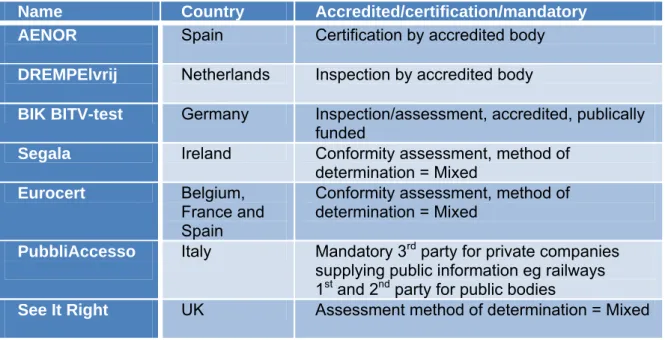
National certification schemes on web accessibility have been developed in a number of European Countries and documented in CEN/BT/WG 185 (2008) and in a further study on compliance with WCAG 2.0 (European Commission 2009). Schemes were identified in Belgium, France,
Netherlands, Italy, Germany, Spain, Ireland and UK. Some recent additional information presented here is taken from the website of the certification body.
Table 1 Summary of national certification schemes
Name Country Accredited/certification/mandatory AENOR Spain Certification by accredited body DREMPElvrij Netherlands Inspection by accredited body
BIK BITV-test Germany Inspection/assessment, accredited, publically funded
Segala Ireland Conformity assessment, method of determination = Mixed
Eurocert Belgium,
France and Spain
Conformity assessment, method of determination = Mixed
PubbliAccesso Italy Mandatory 3rd party for private companies supplying public information eg railways 1st and 2nd party for public bodies
See It Right UK Assessment method of determination = Mixed
3.1 Legal and regulatory framework
Each of these countries took part in the Riga Ministerial Conference - "ICT for an Inclusive Society" June 2006 and supported the Declaration on e-Inclusion which includes:
“Promoting and ensuring accessibility of all public web sites by 2010, through compliance with the relevant W3C common web accessibility standards and guidelines. Calling upon the private sector to do likewise, to consider accessibility principles from the outset of the web development process, and to develop the appropriate authoring tools and software.” http://ec.europa.eu/information_society/events/ict_riga_2006/doc/declaration_riga.pdf
For the purpose of this study, certification schemes were selected from Germany, Italy, Netherlands, Spain and UK. As set out in a previous study (European Commission 2009, Appendix 2) each have different national legal and regulatory frameworks which underpin efforts towards equality of access to ICT and web accessibility. These are summarised and updated in Table 2.
Table 2 Legal and regulatory framework
Country Legal position
Italy The ‘Stanca’ Law No. 4 of 9th January 2004.
Two subsequent decrees implemented the Law: the Decree of the President of the Republic (March 1, 2005, No.75) containing the Implementation
ANEC Print version 21 May 2011 Page 10 Declaration of conformance Regulations, and the Ministerial Decree (July 8, 2005) containing the Technical Rules.
The public agency CNIPA (Centro Nazionale per l’Informatica nella Pubblica Amministrazione - National Centre for IT in Government) designed the implementation rules for the Stanca law, including the general operational and organisational practices for achieving accessibility, the procedures for conformity assessment, and the market surveillance methods.
Public administrations may carry out a self-assessment or use a third-party from a list of officially recognised evaluators.
The law covers public services and private organisations in so far as they deliver public services.
Netherlands In June 2006 the Council of Ministers decided that all websites of the central government should comply with the Web Guidelines by the end of 2010. Each minister is responsible for the websites that are built by or
commissioned by his or her ministry.
Since April 2007, the Web Guidelines were declared as a national standard for government websites by the national standardisation body.
In December 2008 the National Implementation Programme on Better Services was officially agreed between the central government and local and regional governments. This document states that all governmental websites should be accessible according to the Web Guidelines also by the end of 2010.
There are no obligations on private websites to be accessible, though they may apply for the Drempelvrij certification.
Spain
Legislation in relation to website accessibility was first established in Law
34/2002. This was later affirmed and expanded in the anti-discrimination Law 51/2003 and then affirmed again in relation to public websites in the Royal Decree 1494/2007 on accessibility to the information society, and in the public procurement Law 30/2007.
Article 5 of the Royal Decree 1494/2007 provides regulation related to Law 51/2003 by specifying a mandatory minimum level of accessibility for government websites of “priorities 1 and 2″ of the UNE Standard 139803:2004 (referring to WCAG Levels A and AA).
Germany Federal Disabled Equalization Law (BGG) and the Federal Decree on Barrier-free Information Technology (the so-called BITV regulation) are the main legal/regulatory provisions for web accessibility. BITV came into effect for German federal websites eg Federal Ministries and agencies, supra-regional insurances companies or charitable trusts.
At the time it did not apply to regional government. BITV was based on WCAG1, updating to WCAG 2.0 is ongoing.
UK The Disability Discrimination Act (1995, updated 2005) is the main legislative basis for website accessibility. The original Act contains provisions to prevent discrimination against disabled people by service providers and requires service providers to make [reasonable adjustments in order to make] services accessible to disabled people. The Code of Practice to part III of the Act gives the example of a website as a service that is covered by the Act.
The recently published standard BS 8878 (2010) Web Accessibility Code of Practice sets out the process of developing an accessible website and refers to latest W3C accessibility guidelines including authoring tools: WCAG2.0, ARIA, and ATAG.
ANEC Print version 21 May 2011 Page 11 Declaration of conformance 3.2 Certification Methodology
The certification schemes have a number of important differences in approach to accessibility evaluation and the methods applied. These include whether the checkpoints are derived wholly from WCAG or make use of other references, and the overall approach and methodology. This includes how many pages are tested; what checkpoints are used; whether tests are automatic or manual, or involve users with impairments using assistive technology; and whether results allow for a ranking scale or pass mark.
Some of these elements are captured in Table 3, however not all certification bodies publish full details of their approach of methods. This combines to make like for like comparisons difficult as the processes and results are consequently different. In a European Framework 6 project a number of partners set out to provide a mechanism for harmonisation through the Unified Web Evaluation Methodology (UWEM).
Technosite in Spain and Foundation Quality Mark, Drempelvrij in the Netherlands make use the UWEM in the design of their certification schemes. UWEM was developed under the WAB Cluster, which was a cluster of three European projects: Support EAM, EIAO, BenToWeb. They developed a conformity assessment scheme intended to promote better harmonization between European organisations working in the field of conformity assessment of websites. UWEM supported automatic and manual testing for single page and large website use, and monitoring activities. In parallel, Support EAM proposed a certification mechanism within a CEN Workshop Agreement (CWA 15554 June 2006).
Although some objections were registered in relation to methodology and training issues, this body of work remains highly relevant to a consideration of third party and self-certification mechanisms, such as maintenance of a public register and time limit on use of the logo following certification.
3.3 Migration of certification towards WCAG 2.0
UWEM provided a plan to migrate towards WCAG 2.0 before the project funding was completed and prior to the final publication of WCAG 2.0 (2008).
Technosite and Foundation Quality Mark Drempelvrij currently indicate that they have plans to migrate their existing practices towards conformance with WCAG 2.0. The BIK project also reports on activity to align the BITV-test with WCAG 2.0. In the UK, the RNIB offers two certification schemes with the original See it Right certificate linked to WCAG 1 and Surf it Right conforming to WCAG 2.0
3.4 Certification directories
It is an important element of the certification process that certification bodies should provide information on the test procedures used and provide a directory of approved websites.
The information provided by the certification bodies and the number of websites certified varied. For example, in addition to providing a company name and website URL some directories such as BIK BITV-test, Germany indicated the date of certification, as well as providing details of the web
developers. In the Netherlands, Drempelvrij provided a link to the certificate which also included the date of certification.
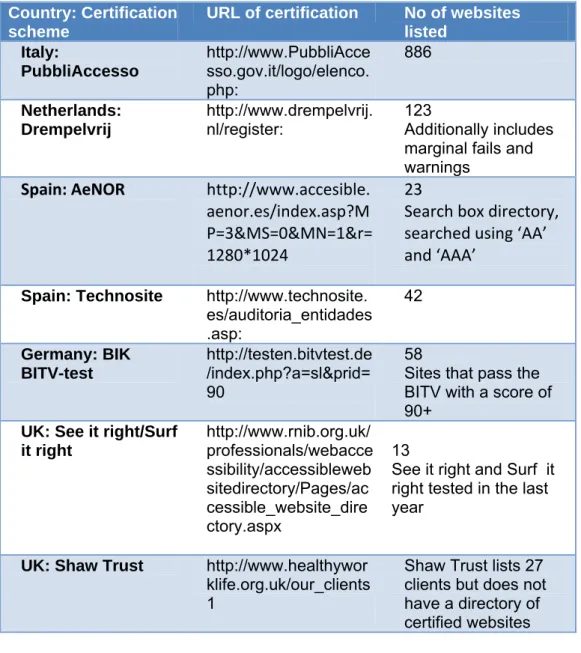
Apart from the Italian PubbliAccesso, the number of websites held on the various registers is very low, with four of seven the registers having less that 50 certified websites each.
ANEC Print version 21 May 2011 Page 12 Declaration of conformance
Table 3 National certification schemes and number of websites listed (August 2010) Country: Certification
scheme
URL of certification No of websites listed Italy: PubbliAccesso http://www.PubbliAcce sso.gov.it/logo/elenco. php: 886 Netherlands: Drempelvrij http://www.drempelvrij. nl/register: 123 Additionally includes marginal fails and warnings
Spain:
AeNOR
http://www.accesible.
aenor.es/index.asp?M
P=3&MS=0&MN=1&r=
1280*1024
23
Search
box
directory,
searched
using
‘AA’
and
‘AAA’
Spain: Technosite http://www.technosite. es/auditoria_entidades .asp: 42 Germany: BIK BITV-test http://testen.bitvtest.de /index.php?a=sl&prid= 90 58
Sites that pass the BITV with a score of 90+
UK: See it right/Surf it right http://www.rnib.org.uk/ professionals/webacce ssibility/accessibleweb sitedirectory/Pages/ac cessible_website_dire ctory.aspx 13
See it right and Surf it right tested in the last year
UK: Shaw Trust http://www.healthywor klife.org.uk/our_clients 1
Shaw Trust lists 27 clients but does not have a directory of certified websites
ANEC Print version 21 May 2011 Page 13 Declaration of conformance Table 4 National certification schemes: evaluation source and methods
Country Certification scheme
Basis of evaluation No of checkpoints Method Progress to WCAG 2.0
Italy PubbliAccesso
http://www.Pubb liAccesso.gov.it/
WCAG 1.0, 508 and technical experience
22 derived from and a further 12 points relating to usability
Mixed
Automated, and expert
Authorised translation into Italian December 2009 http://www.w3.org/Translations/ WCAG20-it/ Netherlands Foundation Quality Mark drempelvrij.nl Test houses include: http://www.acce ssibility.nl/ http://www.qualit yhouse.nl/ Based on WCAG 1, level A also AA and some AAA 16 priority 1 checkpoints. Score out of 16. Pass 46 checkpoints including priority2 Inspection, UWEM
WCAG 2.0 is due to become part of the official mark from mid-2011
Authorised translation into Dutch December 2010
http://www.w3.org/Translations/ WCAG20-nl
Spain AeNOR This standard is
based on and compatible with WCAG 1.0.
Inspection and audit
Spain Technosite WCAG 1.0, A and
AA
Euracert (AnySurfer, Accessiweb,
Technosite)
UWEM
Candidate authorised translation reviewed as at January 2010. Technosite reports developing methodology to test to WCAG 2.0
Germany BITV-Test, BIK (Barrierefrei Informieren und Kommunizieren
Based on WCAG 1 to level AA. BITV-test was published in 2004 and has been continually updated. Developed by the BIK project 52 checkpoints based on WCAG 1.0 level A and AA are weighted according to their impact on accessibility. Maximum score of 100, over 90 is
Tests are carried out by trained personnel, with results from 2 testers compared. Tests are primarily manual and do not include use of assistive
Action is ongoing to harmonise existing tests to WCAG 2.0 success criteria and techniques. Authorised translation into German October 2009:
http://www.w3.org/Translations/ WCAG20-de/
ANEC Print version 21 May 2011 Page 14 Declaration of conformance accessible and over 95 is very
accessible
technology
UK See it Right/Surf
it Right (RNIB)
See it Right is aligned with WCAG 1.0 A,AA and some AAA
Not published Mixed Surf it Right is aligned with
WCAG 2.0 Shaw Trust
Accessible
WCAG 1.0 and WCAG 2.0.
Not published Mixed,
experienced AT users
ANEC Print version 21 May 2011 Page 15 Declaration of conformance
4. Methodology
Given the considerable variation in the way that conformance testing takes place we chose to apply one consistent and systematic process for selecting the websites and a consistent and systematic process for applying both automatic and manual tests of conformance. We describe here first the selection process and then the test process.
4.1 Website selection
The overall aim of the selection process was to identify 100 websites from government, public bodies and relevant commercial interest which claimed that they met accessibility guidelines either as a results of a third party certification process or as self declaration. The following selection criteria were applied in order to balance key factors affecting conformance including national requirements and certification processes available.
4.1.1 By country
Different European countries are at different stages of legislature, standardisation and availability of national certification schemes on web accessibility. This study investigated websites from five European countries where there were existing certification schemes UK, Germany, Netherlands, Spain and Italy identified in a previous study [2]. Consideration was also given to identifying international sites including those using the identification
codes .org, .com and .eu 4.1.2 Certified websites
Most of the certification bodies in these countries provided directories of websites that they have tested and have passed the defined standards for that certification body:
• Directories of accessible websites provided by third party certification bodies were reviewed from the following: AENOR and Technosite in Spain, BIK-BITV in Germany, PubbliAccesso in Italy, Drempelvrij in Netherlands and See it Right (RNIB) and Shaw Trust in UK.
• Websites which have been certified usually choose to display the certification logo of the awarding body. Lists of government and commercial websites reviewed in a previous web accessibility studies (MeAC 2007) were inspected to verify which, if any, displayed certification logos.
4.1.3 Self declaring websites
The W3C does not maintain a directory of websites using WCAG logos and link, however they do set out the rules by which website owners may apply the logos together with the links to the relevant statement. For example, the visible logo image together with underlying link should only be applied to the page which has met the appropriate criteria and does not apply to the whole site. Applied strictly, a single page level failure causes the whole page to fail. It is acceptable to indicate in the web accessibility policy statement which pages do not meet the guidelines and action being taken to improve them.
Backlinking tools were identified which can be used to search for links from within the
backlinking directories. These tools are primarily intended to support developers with search engine optimisation by establishing who links to your website. The tool selected was able to backlink to the specific reference page within the W3C site and offered the opportunity to download up to 1000 website addresses4. The search was run separately for WCAG 1 level A,
4 The search link used the reference link: “a href=http://www.w3.org/WAI/WCAG1A-Conformance” where WCAG1A was amended to cover different levels and WCAG 2.0
ANEC Print version 21 May 2011 Page 16 Declaration of conformance
AA, AAA and WCAG 2.0 level A, AA and AA. The results were filtered for country codes and a sample were selected for inspection of the type of business. Those weeded out included websites for web development companies, business to business sites, and social and personal websites.
In addition to backlinking, other lists and directories were investigated: • Listings of web accessibility competitions eg BENE, Germany
• Directories promoting web designers demonstrating web standards compliance, specifically http://w3csites.com/
• Lists of popular web sites per country eg Alexa, http://www.alexa.com/ 4.1.4 MeAC listings
The MeAC study (2007) [5] reported on website accessibility studies conducted in 25 European countries, inspecting 6 government sites and 6 leading private/sectoral
organisations in each country. The URL’s given for these sites were selected from 5 countries: UK, Germany, Italy, Netherlands and Spain, giving a pool of 60 websites that were examined to determine the presence of certification logos or statements relating to accessibility policy. Where a website had been moved or combined with another site since 2007, this new link was examined for possible inclusion in this study.
Searches within these websites used the search terms ‘W3C’, ‘WAI’, ‘accessibility’ or national equivalents eg Barrierefrei (Germany), Accesibilidad (Spain), toegankelijkheid (Netherlands) to discover statements of accessibility policy or declaration.
4.1.5 By category
A distinction was made between Government and Commercial websites. Government and public bodies have been under more regulatory pressure to meet accessibility guidelines and previous studies have revealed greater progress when compared with the disappointing results from the commercial sector. The websites listed in the certification body registers were inspected to identify government and local government sites as well as commercial websites within the sub-categories of travel, entertainment and banking or similar.
The initial search results for self certified websites and some of the registers gave very little information about the website apart from the URL. Careful inspection was needed to identify those within the required categories of government and commerce and to create meaningful sub-categories. The search results returned many non-relevant sites notably vanity sites from web development companies, large corporate business to business sites and personal
websites.
4.1.6 Final selection
The initial pool of websites identified was reviewed and the final selection of 100 websites took account of the need for like for like comparisons of certified and self declared conformance to accessibility guidelines. The final selection included an equal number of certified and self certified websites. Additional balancing criteria included the number of selections per country, and declared level of WCAG conformance. The final selection contains a higher proportion of government, local authority and public bodies (76) and lower proportion of commercial organisations. (24)
ANEC Print version 21 May 2011 Page 17 Declaration of conformance
4.2 Automatic testing
Automatic testing of web accessibility is a useful strategy for processing a large number of websites quickly and to ensure consistency and objectivity. Various tools are available for testing to WCAG 1.0 and are now adding WCAG 2.0, some of these such as TAW5, WAVE6 and SortSite™7 are available online and will support a developer running a test of a single page online as well as larger assessments. We selected SortSite™ to run automatic tests at WCAG 2.0 across 25 pages of each of the selected websites. This automatic tool uses over 100 checkpoints and was used to identify which sites passed all testable success criteria. The results from automatic checking were reviewed to remove false negatives and duplicated results.
Although WCAG 2.0 was published nearly two years ago many of the certification bodies and self-certified sites have tested and continue to test to WCAG 1, and use different or additional
checkpoints. WCAG 2.0 was chosen to act as a diagnostic tool to identify successful websites and in order to achieve consistency for comparison.
4.3. Manual testing
Websites that passed automatic testing were tested manually by an expert using the testpoints identified with the SortSite™ tool as requiring manual inspection. An initial inspection of the results revealed that very few of the websites passed all automatically testable criteria even at level A, and thus the criteria for manual inspection was adjusted from pass to those with 10 or less fails at WCAG 2.0 level A.
Some important criteria and checkpoints within WCAG 1 and 2.0 cannot be verified automatically and require manual assessment. Manual testing is a detailed inspection using a schedule of checkpoints derived from the WCAG 2.0. Some of the success criteria can be met by a number of different techniques. Furthermore manual testing also helped to resolve different causes of failure within the same success criteria, and multiple instances of the same criteria within the same or different pages. The manual testing was applied to 5 pages typically home page, information pages, task specific pages such as purchasing transactions, site maps and search tools.
Further details about the automatic and manual tests run by Shaw Trust and using SortSite™ are provided in Appendix 6.
5 http://www.tawdis.net/ingles.html?lang=en 6 http://wave.webaim.org/
5. Results of the selection activity
The selection process highlighted some of the differences between the certification process and self declaration and these are reported here, followed by an analysis of the results of the automatic and manual testing.
5.1 Certification schemes
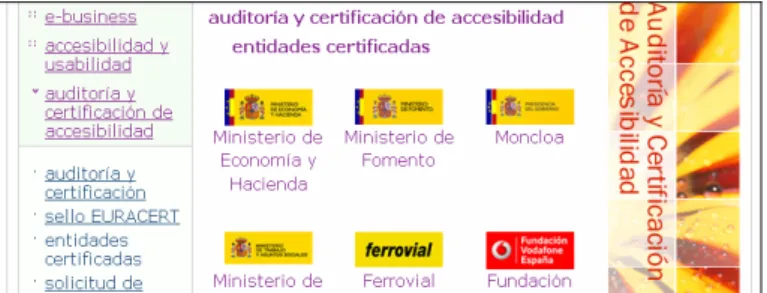
All the third party certification bodies with the exception of Shaw Trust have public registers of websites that have successfully passed the certification process. Technosite for example, display the company name and logo, while BIK offers a detailed listing with name date, web developer and the BITV-test score.(see Fig. 2 and 3)
Figure 2 Certification register: Technosite
Figure 3 Certification register: BIK
5.2 Self-declaration
Tracing websites making an independent declaration of accessibility was much harder than finding certified sites. Of the various strategies applied most did not produce useful results for selecting websites for this study. Directories of popular websites such as Alexa were dominated by websites that were not in the defined categories – for instance national search engines rated very high, or there was no identifiable evidence of an accessibility statement or logos and links. Simple searches for WCAG links or logos produced unanalysable results. Searching through W3sites which is a trade directory for web designers was disappointing because accessibility was not offered as a
searchable category. The best resource for identifying self-declaration of conformance to WCAG was a backlinking search tool which had some in built biases towards websites with an English language version. In addition, 10 websites were selected from the MeAC listings because they provided a very positive statement of their accessibility policy.
ANEC Print version 21 May 2011 Page 19 Declaration of conformance 5.3 Category differences
There was some indication that government and public sector opted for different approaches to declaring accessibility. In particular the national government sites appeared to be more likely to have either full third party certification or provide a strong statement of accessibility policy. They appeared less likely to use WCAG logos or links on their own – although there were some instances of displaying multiple logos of standards compliance and other certificates.
By contrast, within the non-governmental public sector the pool of websites using WCAG logos was much greater but the pool of websites that were certified was much smaller. Differences in numbers of selected sites by category reflects those differences found within the certification registers.
Table 5 Websites selected per category of government and public body
Category National
government
Local government
Health and other public bodies Certified 15 20 3 Self declaration 8 13 17 Total 23 33 20 5.4 National differences
As far as possible, selected sites were chosen to represent different national practices and requirements. In addition, ten sites were selected which represented European bodies using the address code .EU and a further European body using .ORG.
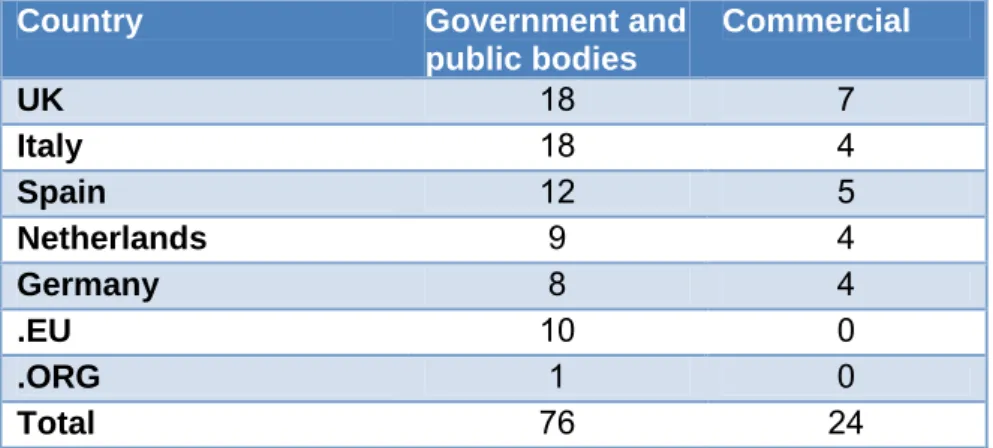
While every effort was made to balance the number of websites selected per country the variations in numbers reflect the differences in the numbers of relevant sites found within the certification directories and the results returned in the online searches. (See Table 6.)
Table 6 Websites selected per country
Country Government and
public bodies Commercial UK 18 7 Italy 18 4 Spain 12 5 Netherlands 9 4 Germany 8 4 .EU 10 0 .ORG 1 0 Total 76 24
5.5 Final selection of certified and self declared websites
The number of websites selected from each certification body and self declared websites is summarised in Table 7, showing numbers per certification scheme, and per WCAG conformance declaration.
• How many certified websites were selected? There are 50 certified websites from 7
certification schemes. Government and public bodies were reasonably well represented within the national certification scheme registers and the selection includes eight each from Germany, Italy and Netherlands, and a total of eight from Spain from two certification schemes.
ANEC Print version 21 May 2011 Page 20 Declaration of conformance
• How many self declared websites were selected? There are 50 self declared websites, 40 displayed WCAG logos and 10 made a statement of accessibility. The Government and public bodies appeared to be more likely to choose WCAG 1.0 level AA and this is reflected in the numbers chosen for automatic testing. A total of 26 websites were included which declared conformance to WCAG 1 and 14 to WCAG 2.0.
• Was there any evidence of misuse of self declared conformance logos? The results of the backlinking tool revealed large numbers of results, however it was noted that those claiming AAA conformance were particularly unsatisfactory. Close inspection revealed that there were some instances of mis-use of the logo, for instance, as part of a limited general statement about accessibility policy, mis-matching between logo and the link destination, and default inclusion within the page template in a popular Content Management System (CMS) tool.
Table 7 Final selection of certified and self declared websites Certification scheme Government and public bodies Commercial Self-declaration Government sites and public bodies Commercial BIK BITV-test, Germany 8 2 WCAG 1 A 5 1 PubbliAccesso, Italy 8 3 WCAG 1 AA 15 5 Drempelvrij, Netherlands 8 3 WCAG 2 A 4 1
AENOR, Spain 4 1 WCAG 2 AA 7 2
Technosite, Spain 4 2 Total WCAG 31 9 See it Right, RNIB, UK 3 1 Statement of accessibility 7 3 Shaw Trust Accessible, UK 3 0 Total WCAG & Statement 38 12 Total certified 38 12
ANEC Print version 21 May 2011 Page 21 Declaration of conformance
6. Results of automatic testing
The results of automatic testing were inspected for inconsistencies and duplication of test results. The resulting failed ‘testpoints’ discussed below relate to the number of tests carried out by the automatic tool and do not directly relate to the number of WCAG 2.0 success criteria. The automatic tool uses multiple tests to cover different aspects of some criteria. The resulting total number of failed testpoints should be regarded as indicative of the level of effort and success in meeting WCAG 2.0 criteria at level A. The results of the automatic tests give a general indication of differences between certification and self declaration and were used to select the more successful websites for detailed manual inspection. No results were returned for two websites due to
unresolved technical issues.
Average number of failed testpoints
An initial examination of the results of the automatic tests reveals that the average number of testpoints failed overall was 16.9 with a range from none to 37. The overall difference between certified and self-declared websites is marginally in favour of the certified sites:
Certified: 16.5 Declaration: 17.3
The results for the government and public bodies were notably better on average than the commercial sector:
Government and public bodies: 15.8 Commercial sector: 20.0
Within the websites selected from the government and public bodies there is a considerable difference between those making a declaration in the form of a strong statement and those displaying WCAG conformance logos:
Certified, government and public bodies: 15.4 Declared, government and public bodies: 16.3 Declared WCAG only: 18.4 Declared by statement only: 7.1
The thirteen websites selected from the previous MeAC studies provided particularly good results, and particularly for those carrying a strong statement of accessibility but no conformance logos:
MeAC source, all 10.2 MeAC source, certified 13.8 MeAC source, declared by statement 7.1
As a group, the .EU project websites were the worst performing group. All the .EU websites self declared to WCAG 1 or 2 however, the average number of testpoints failed was 23.7.
Within the commercial sector there is little difference between certification and declaration among the websites and the results as a whole are worse than for those selected from government and public bodies. Only two of the commercial websites met the criteria for selection for manual testing:
Certified commercial: 19.8 Declared commercial: 20.3 Declared WCAG: 19.0 Declared by statement: 20.8
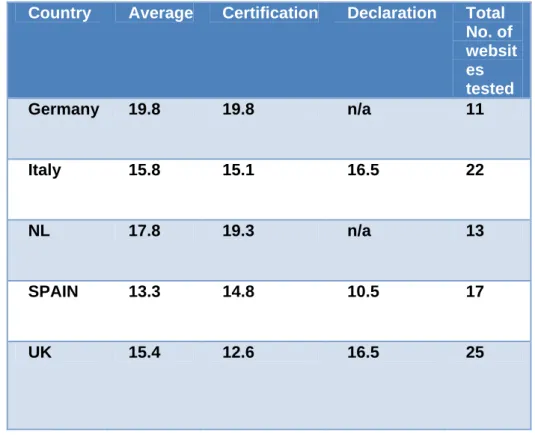
The results show some national variation, with the best results from the group of self declared government and public body websites in Spain with an average of 10.5 failed testpoints. Six of the
ANEC Print version 21 May 2011 Page 22 Declaration of conformance
Spanish websites met the criteria for selection for manual testing. The worst performing group were the certified websites in Germany (19.8) and Netherlands (19.4). Just one website from Germany and three from the Netherlands met the criteria to be selected for manual testing.
Table 8 Average number of testpoints failed per country (n/a indicates insufficient data to calculate average)
Country Average Certification Declaration Total No. of websit es tested Germany 19.8 19.8 n/a 11 Italy 15.8 15.1 16.5 22 NL 17.8 19.3 n/a 13 SPAIN 13.3 14.8 10.5 17 UK 15.4 12.6 16.5 25
Meeting success criteria
The selection criteria for manual testing was set as those passing all automatic tests, or having ten or less failed testpoints. More detailed analysis of the automatic testing to WCAG 2.0 revealed that three websites passed all success criteria at level A, and of these two also succeeded at level AA (Table 9). All three had self declared conformance, one used WCAG1 AA logo and link and the other two provided a strong statement of accessibility policy.
The two statemented websites were both national government and were both identified through the MeAC results, of which one was a recent replacement.
Table 9 Pass automatic tests at WCAG 2.0 level A
URL Country Type Conformance
claim Automatic pass WCAG 2.0 http://www.rijks overheid.nl/ NL National Statement AA http://www.la-moncloa.es/def ault.htm
Spain National Statement AA
http://www.hant s.gov.uk/local government UK Local government WCAG 1 AA A
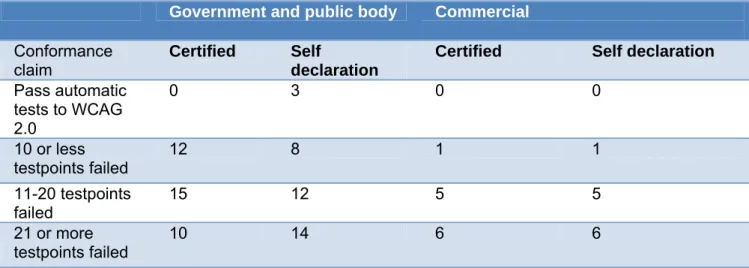
ANEC Print version 21 May 2011 Page 23 Declaration of conformance In total, 23 of the government and public body websites had ten or less failure points and were selected for manual inspection. None of the certified websites passed all elements of the automatic testing but 12 had ten or less failure points. There were 11 self declared websites having ten or less failure points and including three passes. (Table 10)
The results of automatic testing for the Commercial organisations found none that passed automatic testing to WCAG 2.0 level A and just one in each category of claim had 10 or less failures. This included one of the three commercial websites claiming WCAG 2.0 AA. (See Table 10).
Of the worst performing sites, one-third had 21 or more failure points. The worst ten results for the government and public bodies websites were found to have between 27 and 37 failure points, with four of these being certified sites and six being self declared. These self declared websites
consisted four of the .EU websites, one of .ORG website and one health body. The worst performing website had a .EU web address and displayed WCAG 1 level A logos.
Of the worst performing commercial websites, half the sample had 21 or more failure points. The worst ten results were found to have between 22 and 37 failure points. Six of these were certified, three had WCAG logos and links and one provided a statement. The worst performing Commercial site was from the UK and declared conformance to WCAG 2.0 level A.
Table 10 Summary results of number of websites passing WCAG 2.0 testpoints
Government and public body Commercial
Conformance claim
Certified Self
declaration
Certified Self declaration Pass automatic tests to WCAG 2.0 0 3 0 0 10 or less testpoints failed 12 8 1 1 11-20 testpoints failed 15 12 5 5 21 or more testpoints failed 10 14 6 6
ANEC Print version 21 May 2011 Page 24 Declaration of conformance
7. Results of manual testing
Five pages were selected for detailed manual inspection at WCAG 2.0, level A from each website which had met the selection criteria from the automatic tests. As shown in Table 11, just two
websites passed all manual check points and these were both certified government and public body websites. One of these was certified by PubbliAccesso, Italy and the other by Drempelvrij,
Netherlands. The overall average for all 23 manually tested government and public body websites was 4.3 failures per website.
None of the eleven self declared sites passed all checkpoints. The best website had just two failures, and was a national government site from Spain carrying a declaration to WCAG 1 AA. The worst results were for a website that had eight failures and carried a declaration to WCAG 1 AA. Only two websites declared to WCAG 2 A or AA and these were found to have 5 and 4 failures respectively. The declared government and public body websites had an average of 5.0 criteria failed per website. Of the two Commercial websites tested manually, the certified website was found to have 3 failures, and the self declared website had 7 failures.
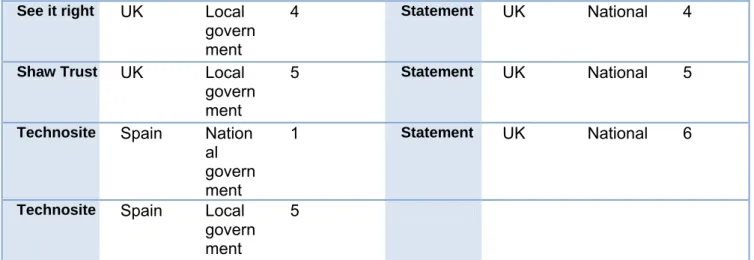
Table 11 Summary results of manual tests for Government and public bodies
Certification Declaration
Certification Country Type WCAG 2
Fails at level A
Declaration Country Type WCAG 2
Fails at level A
Aenor Spain Local
govern ment 4 WCAG 2 AA Italy Public body - health 4
Aenor Spain Local
govern ment 7 WCAG 2 A Spain Public body - health 5
BITV BIK Germa
ny Nation al govern ment 4 WCAG 1 AA Spain National 2 Drempelvri j Netherl ands National govern ment 0 WCAG 1 AA .EU Public body 6 Drempelvri j Netherl ands Public body 6 WCAG 1 AA UK Local governm ent 7 PubbliAcc esso Italy Nation al govern ment 0 WCAG 1 AA Italy Local governm ent 8 PubbliAcc esso Italy Local govern ment 2 Statement Netherl ands National 4 PubbliAcc esso Italy Local govern ment
ANEC Print version 21 May 2011 Page 25 Declaration of conformance
See it right UK Local
govern ment
4 Statement UK National 4
Shaw Trust UK Local
govern ment
5 Statement UK National 5
Technosite Spain Nation
al govern ment
1 Statement UK National 6
Technosite Spain Local
govern ment
5
7.1 Analysis by success criteria
The detailed results of the manual test were further analysed to try and identify differences between certified and self declared websites. Altogether, there were 99 failures identified in relation to 23 checkpoints inspected. Of these, 44 failures were from certified websites and 55 were from self declared websites. The certified websites had failures in relation to 15 criteria and the self declared websites had failures in relation to 18 criteria.
Just five criteria from WCAG 2.0, level A account for around half of all failures. As shown in Table 12, more than half the websites failed Criteria 1.1.1 relating to the provision of text alternatives for non-text content (see Appendix 1 for list of WCAG 2.0 level A criteria.)
Table 12 Top 5 failures of WCAG 2.0 level A criteria
WCAG 2.0 criteria 1.1.1 1.3.1 2.4.4 3.3.2 4.1.2 Total No. of sites Certified 6 4 3 4 3 12 Self declared 7 5 6 5 5 11 Total 13 9 9 9 8 23
As well the requirement to add text labels to pictures, Criteria 1.1.1 applies to the labelling of buttons and other navigational elements where the designer has chosen to use an image rather than text, as well as search boxes and multimedia elements. In addition purely decorative items should be labelled in a way that allows them to be ignored. A further examination of Criteria 1.1.1 revealed qualitative differences in problems identified.
An analysis of the results in relation to Criteria 1.1.1. found that the top four certified websites had no failures of 1.1.1. However, six websites had potentially serious failures that could cause
difficulties affecting navigation or identification of multimedia elements. The remaining seven failures had potentially minor difficulties and may be due to a difference of opinion as to the relevance of a pictorial element or over-enthusiastic labelling of a decorative item, or the result of a single instance of a missing relevant picture label.
ANEC Print version 21 May 2011 Page 26 Declaration of conformance
The other three most common failures (Criteria 1.3.1 Information and relationship, 2.4.4 link purpose and 3.3.2 lables) all make demands for appropriate text labels where the required information, control function or link cannot be programmatically determined. The fifth criteria (4.1.2 name, role value), on user interface elements was found to particularly relate to form design issues. The expert evaluator noted some inter-relationships apparent between the failures of these elements and the design of search boxes and forms. The certified sites appeared to be less likely to have problems with these elements.
7.2 National variations
Of the top three best performing certified government and public body websites, one was from the Netherlands and one from Italy and one from Spain. The results of the manual tests revealed no clear pattern of national variation. For example, three websites were certified by PubbliAccesso Italy, of which one had no failures, one had two failures detected and the other had six. Two websites were certified by Drempelvrij Netherlands, of which one had no failures and the other six failures detected.
Overall, there is some suggestion that the websites selected from Italian PubbliAccesso certification register performed better in the combined automatic and manual tests. However there is no clear pattern of websites from one country or one certification scheme having a better or worse result at the manual testing level. The websites selected from Spain were more successful at passing the automatic tests, with two from AENOR and two from Technosite meeting the selection criteria. It is noted, that as a result of the automatic tests, only one of the ten government and commercial websites certified by BIK BITV, Germany met the criteria for selection for manual testing.
Table 13 Individual certified website manual test results per country Country Certification scheme WCAG 2
Manual Fails at A
Germany BIK BITV 4
Italy PubbliAccesso 0 Italy PubbliAccesso 2 Italy PubbliAccesso 6 Netherlands Drempelvrij 0 Netherlands Drempelvrij 6 Spain Aenor 4 Spain Aenor 7 Spain Technosite 1 Spain Technosite 5 UK See it right 4 UK Shaw trust 5
ANEC Print version 21 May 2011 Page 27 Declaration of conformance
three Spanish sites were slightly better and more consistent than those from the four UK sites. Table 14 Individual self declared website manual test results per country
Country WCAG claim WCAG2 Automatic test Fails at A WCAG 2 Manual test Fails at A .EU WCAG 1 AA 3 6 Italy WCAG 1 AA 8 8 Italy WCAG 2 AA 8 4 Netherlands Statement AA Pass 4
Spain Statement AA Pass 4
Spain WCAG 1 AA 6 2 Spain WCAG 2 A 9 5 UK Statement 4 4 UK Statement 6 5 UK Statement 4 6 UK WCAG 1 AA A Pass 7
8. Discussion
Some websites showed excellent progress towards accessibility, for example, a German
government site (BMAS) which was certified by BIK BITV (See Figure 4). The site performed well in automatic testing with only one failure point, and was in the top five following manual testing. As well as meeting most accessibility criteria successfully, it additionally provided some information in multimedia using national sign language.
Figure 4 Screenshot http://www.bmas.de/portal/16702/startseite.html
The 23 manually tested websites from government and public bodies and two commercial websites all showed that some effort had been made to meet accessibility guidelines, however over half failed Criteria 1.1.1. Other studies have shown that failures of non-text equivalence are very common at WCAG 1 and WCAG 2.0.
An in-depth analysis of WCAG 2.0 criteria was conducted in order to better distinguish between those sites making significant effort towards accessibility but having failures at the most basic levels affecting perception, specifically text equivalence and operation, specifically keyboard operation.
It is recommended practice that websites should meet WCAG 2.0 level AA and WCAG
Conformance guidance further demands that there should be no failed criteria on any page showing the conformance logo. Very few of the manually inspected websites managed to meet all success criteria for level A. For the purposes of this study and to support further comparison of multiple certified and self declared websites we have given special attention to four of the success criteria from level A and drawn from the 10 most commonly failed criteria in order to represent different activities and the types of barrier faced by users with a range of different impairments. These include the most common failed Criteria 1.1.1 and three others that are operationally important to accessing core tasks of navigation, content and form filling:
ANEC Print version 21 May 2011 Page 29 Declaration of conformance • Criteria 1.1.1 (text equivalence)
• Criteria 2.1.1 (keyboard operation)
• Criteria 2.4.1 (bypass blocks) which includes the provision of skip navigation and enables the screen reader software to jump to the main content
• Criteria 3.3.2 (labels) which includes labelling the input area of forms correctly.
The proposed ranking scheme for measuring progress towards conformance (see Introduction 1.3) was revised to take account of the results which showed that most of the manually tested websites had taken real effort to make it accessible and to conform to accessibility guidelines but
nevertheless had not always implemented everything correctly. We have combined overall results for each website with their success at meeting the four selected criteria above, and used this to modify the proposed ranking scheme:
• A: Fully accessible – for the purposes of this study this category was reserved for small number of websites that passed all WCAG 2.0 success criteria at level A or with only a single minor failure instance.
• B: The website shows a real effort towards accessibility but not always implemented correctly. Minor issues relating to criteria 1.1.1, or no more than one of the task critical criteria 2.1.1, 2.4.1, or 3.3.2 and no more than four fails in total.
• C: As B, the website shows real effort towards accessibility but with significant failures including criteria 1.1.1 and no more than 5 failure points at level A.
• D: The website shows limited accessibility features (eg: text resize widget and a "skip navigation" link on the page and add alt attributes to images), but fails to successfully implement selected and other criteria at level WCAG 2 level A.
• E: The website does not show any evidence of accessibility awareness.
The full details are shown in Table 15. Using these categories reveals some differences between the certified and declared websites by providing a more detailed inspection of selected criteria. Of the government and public body websites, six are in the higher level categories A and B, whereas only 3 of the self declared sites achieve category B only.
In the lower categories, one quarter (3 out of 12) of the certified websites are in category D whereas nearly half (5 out of 11) of the declared websites are in category D. The self declared commercial website is also in category D.
All the manually tested websites showed some evidence of accessibility awareness. The results of the automatic tests showed that the ten websites performing worst in the automatic tests had between 29 and 37 failure points. However, one of the worst performing sites tested automatically included skip links and some images were appropriately labelled indicating there was some understanding of accessibility issues but also some serious misunderstandings.
ANEC Print version 21 May 2011 Page 30 Declaration of conformance Table 15 Detailed analysis of individual websites and success category rating
Access Category Rating A = Fully accessible at WCAG 2.0 A, B = Real effort towards accessibility, C = Some accessibility features implemented, D = Some evidence of accessibility awareness, E= No evidence of accessibility awareness
Reference number: cg = certificated government and public body, wg = WCAG logos of conformance, sg = statement of accessibility, COM = commercial. Ref Success criteria 1.1.1 Succes s criteria 2.1.1 Success criteria 2.4.1 Succes s criteria 3.3.2 No. of criteri a failed at level A Category ranking Ref Succe ss criteria 1.1.1 Succes s criteria 2.1.1 Succes s criteria 2.4.1 Succes s criteria 3.3.2 No. of criteri a failed at level A Category ranking
Certified Government and public body Self declared Government and public body
cg46 0 A wg55 f 2 B cg50 0 A sg58 f 4 B cg53 1 A wg06 f 4 B cg17 f 2 B wg04 f 5 C cg41 4 B sg57 f f 4 C cg22 f 4 B sg59 f f 4 C cg07 f f f 4 C wg71 f 6 D cg25 f f 5 C sg60 f f f 5 D cg26 f f 5 C sg62 f 6 D cg18 f f 6 D wg31 f f f 7 D cg64 f f 6 D wg29 f f 8 D cg09 f f f 7 D
Certified commercial Self declaration commercial
Com 9
2 B co