A&A 586, A108 (2016)
DOI:10.1051/0004-6361/201527441
c
ESO 2016
Astronomy
&
Astrophysics
New and updated convex shape models of asteroids based
on optical data from a large collaboration network
J. Hanuš
1,2, J. ˇ
Durech
3, D. A. Oszkiewicz
4, R. Behrend
5, B. Carry
2, M. Delbo
2, O. Adam
6, V. Afonina
7,
R. Anquetin
8,45, P. Antonini
9, L. Arnold
6, M. Audejean
10, P. Aurard
6, M. Bachschmidt
6, B. Baduel
6, E. Barbotin
11,
P. Barroy
8,45, P. Baudouin
12, L. Berard
6, N. Berger
13, L. Bernasconi
14, J-G. Bosch
15, S. Bouley
8,45, I. Bozhinova
16,
J. Brinsfield
17, L. Brunetto
18, G. Canaud
8,45, J. Caron
19,20, F. Carrier
21, G. Casalnuovo
22, S. Casulli
23, M. Cerda
24,
L. Chalamet
86, S. Charbonnel
25, B. Chinaglia
22, A. Cikota
26, F. Colas
8,45, J.-F. Coliac
27, A. Collet
6, J. Coloma
28,29,
M. Conjat
2, E. Conseil
30, R. Costa
28,31, R. Crippa
32, M. Cristofanelli
33, Y. Damerdji
87, A. Debackère
86, A. Decock
34,
Q. Déhais
36, T. Déléage
35, S. Delmelle
34, C. Demeautis
37, M. Dró˙zd˙z
38, G. Dubos
8,45, T. Dulcamara
6, M. Dumont
34,
R. Durkee
39, R. Dymock
40, A. Escalante del Valle
85, N. Esseiva
41, R. Esseiva
41, M. Esteban
24,42, T. Fauchez
34,
M. Fauerbach
43, M. Fauvaud
44,45, S. Fauvaud
8,44,45, E. Forné
28,46,†, C. Fournel
86, D. Fradet
8,45, J. Garlitz
47,
O. Gerteis
6, C. Gillier
48, M. Gillon
34, R. Giraud
34, J.-P. Godard
8,45, R. Goncalves
49, Hiroko Hamanowa
50,
Hiromi Hamanowa
50, K. Hay
16, S. Hellmich
51, S. Heterier
52,53, D. Higgins
54, R. Hirsch
4, G. Hodosan
16, M. Hren
26,
A. Hygate
16, N. Innocent
6, H. Jacquinot
55, S. Jawahar
56, E. Jehin
34, L. Jerosimic
26, A. Klotz
6,57,58, W. Ko
ff
59,
P. Korlevic
26, E. Kosturkiewicz
4,38,88, P. Kra
ff
t
6, Y. Krugly
60, F. Kugel
19, O. Labrevoir
6, J. Lecacheux
8,45, M. Lehký
61,
A. Leroy
8,45,62,63, B. Lesquerbault
6, M. J. Lopez-Gonzales
64, M. Lutz
6, B. Mallecot
8,45, J. Manfroid
34, F. Manzini
32,
A. Marciniak
4, A. Martin
65,66, B. Modave
6, R. Montaigut
8,45,48,63, J. Montier
52,53, E. Morelle
27, B. Morton
16,
S. Mottola
51, R. Naves
67, J. Nomen
26, J. Oey
68, W. Ogłoza
38, M. Paiella
33, H. Pallares
28,69, A. Peyrot
58, F. Pilcher
70,
J.-F. Pirenne
6, P. Piron
6, M. Poli´nska
4, M. Polotto
6, R. Poncy
71, J. P. Previt
53, F. Reignier
72, D. Renauld
6, D. Ricci
34,
F. Richard
8,45, C. Rinner
73, V. Risoldi
33, D. Robilliard
53, D. Romeuf
74, G. Rousseau
75, R. Roy
76, J. Ruthro
ff
77,
P. A. Salom
24,42, L. Salvador
6, S. Sanchez
26, T. Santana-Ros
4, A. Scholz
16, G. Séné
6, B. Ski
ff
78, K. Sobkowiak
4,
P. Sogorb
79, F. Soldán
80, A. Spiridakis
35, E. Splanska
6, S. Sposetti
81, D. Starkey
82, R. Stephens
83, A. Stiepen
34,
R. Stoss
26, J. Strajnic
6, J.-P. Teng
58, G. Tumolo
84, A. Vagnozzi
33, B. Vanoutryve
6, J. M. Vugnon
8,45, B. D. Warner
83,
M. Waucomont
6, O. Wertz
34, M. Winiarski
38,†, and M. Wolf
3(Affiliations can be found after the references)
Received 24 September 2015/Accepted 22 October 2015
ABSTRACT
Context.Asteroid modeling efforts in the last decade resulted in a comprehensive dataset of almost 400 convex shape models and their rotation
states. These efforts already provided deep insight into physical properties of main-belt asteroids or large collisional families. Going into finer detail (e.g., smaller collisional families, asteroids with sizes20 km) requires knowledge of physical parameters of more objects.
Aims.We aim to increase the number of asteroid shape models and rotation states. Such results provide important input for further studies, such
as analysis of asteroid physical properties in different populations, including smaller collisional families, thermophysical modeling, and scaling shape models by disk-resolved images, or stellar occultation data. This provides bulk density estimates in combination with known masses, but also constrains theoretical collisional and evolutional models of the solar system.
Methods.We use all available disk-integrated optical data (i.e., classical dense-in-time photometry obtained from public databases and through a
large collaboration network as well as sparse-in-time individual measurements from a few sky surveys) as input for the convex inversion method, and derive 3D shape models of asteroids together with their rotation periods and orientations of rotation axes. The key ingredient is the support of more that 100 observers who submit their optical data to publicly available databases.
Results.We present updated shape models for 36 asteroids, for which mass estimates are currently available in the literature, or for which
masses will most likely be determined from their gravitational influence on smaller bodies whose orbital deflections will be observed by the ESA
Gaiaastrometric mission. Moreover, we also present new shape model determinations for 250 asteroids, including 13 Hungarias and three near-Earth asteroids. The shape model revisions and determinations were enabled by using additional optical data from recent apparitions for shape optimization.
Key words.minor planets, asteroids: general – techniques: photometric – methods: observational – methods: numerical
1. Introduction
Asteroid modeling efforts in the last decade resulted in an ex-tensive dataset of almost 400 convex shape models and rotation states (see the review by Durech et al. 2015aˇ ). The major-ity of these models was determined by the lightcurve inver-sion method (LI) developed byKaasalainen & Torppa(2001) andKaasalainen et al.(2001). About 100 models are based on disk-integrated, dense-in-time optical data (e.g., Torppa et al. 2003;Slivan et al. 2003; Michałowski et al. 2005;Marciniak et al. 2009,2011). Combining dense-in-time data with in-time measurements from large sky surveys, or using only sparse-in-time data, increased the number of available shape models by a factor of 4 (Durech et al. 2009ˇ ;Hanuš et al. 2011,2013a,c). Future data fromGaia, Panoramic Survey Telescope and Rapid Response System (PanSTARRS), and Large Synoptic Survey Telescope (LSST) should result in an increase of shape mod-els by an order of at least one magnitude (Durech et al. 2005ˇ ). The methods that will be used for analysis of these future data of unprecedented amount and quality, by the means of complex shape modeling, are similar to those applied here and developed within the scope of our recent studies.
Most asteroid shape models derived by the LI method and their optical data are available in the Database of Asteroid Models from Inversion Techniques (DAMIT1; Durech et al.ˇ
2010).
We would like to emphasize and acknowledge that the shape modeling stands on the shoulders of hundreds of observers, often amateurs, who regularly obtain photometric data with their small and mid-sized telescopes. These observations have significantly contributed to the great progress of the shape modeling field in the last decade. Although there is much more sparse than dense data available, the latter will always remain important because their much higher photometric accuracy and rotation coverage leads to higher quality shape models. This is a typical example of the great interaction between the professional and amateur community (Mousis et al. 2014).
Knowing the rotational parameters and shapes of asteroids is very important for numerous applications. The large amount of currently known asteroid models already provided a deep insight into physical properties of main-belt asteroids (MBAs) and large collisional families: (i) an excess of prograde rotators within (MBAs) larger than∼50 km in diameter, predicted by nu-merical simulations (Johansen & Lacerda 2010), was confirmed byKryszczy´nska et al.(2007),Hanuš et al.(2011); (ii) an ex-cess of retrograde rotators within near-Earth asteroids (NEAs) is consistent with the fact that most of the NEAs come from the ν6 resonance (La Spina et al. 2004). To enter theν6
res-onance via Yarkovsky effect2, the object must be a retrograde rotator; (iii) an anisotropy of spin-axis directions of MBAs as-teroids with diameters 30 km and NEAs was revealed and explained by the YORP effect3, collisions, and mass shedding (Hanuš et al. 2011;Pravec et al. 2012); (iv) a bimodality of pro-grade and retropro-grade rotators symmetric with respect to the cen-ter of the family is caused by the combined Yarkovsky, YORP, 1 http://astro.troja.mff.cuni.cz/projects/asteroids3D
2 A thermal recoil force affecting rotating asteroids (Bottke et al. 2001).
3 Yarkovsky–O’Keefe–Radzievskii–Paddack effect, a torque caused by the recoil force from anisotropic thermal emission, can alter the rota-tional periods and orientation of spin axes; see, e.g.,Rubincam(2000), Vokrouhlický et al.(2003).
and collisional dynamical evolution (Kryszczy´nska 2013;Hanuš et al. 2013a); (v) the larger dispersion of spin-axis directions of smaller (D50 km) prograde than retrograde asteroids suggests that spin states of prograde rotators are affected by resonances (Hanuš et al. 2013c); or (vi) the disruption of asteroid pairs4was most likely the outcome of the YORP effect that spun up the original asteroid (Polishook 2014).
With the use of convex shape models in combination with as-teroidal stellar occultations and disk-resolved images obtained by space telescopes or ground-based telescopes equipped with adaptive optics (AO) systems, the size of the model can be con-strained, making it possible to determine the asteroid volume. Even when the object is considerably nonconvex, the scaled con-vex model from occultations and AO data tends to compensate by average fitting to the disk-resolved data. As a result, the over-estimation of the volume is smaller than would correspond to the convex hull. The volume can then provide, in combination with mass estimates, realistic values of bulk densities (Durech et al.ˇ 2011;Hanuš et al. 2013b).
The mass is one of the most challenging parameters to mea-sure for an asteroid. Mass estimates are now available for 280 as-teroids, but only 113 of these are more precise than 20% (Carry 2012;Scheeres et al. 2015). However, the situation is expected to improve significantly in the near future. The observations of the ESAGaiaastrometric satellite will provide masses accurate to better than 50% for≈150 asteroids (and for≈50 with an ac-curacy better than 10%;Mouret et al. 2007,2008) by the orbit deflection method. The advantage of the masses determined by
Gaiais in the uniqueness of the mission: we should obtain a comprehensive sample with well-described biases (e.g., the cur-rent mass estimates are curcur-rently strongly biased toward the in-ner main belt).
To maximize the possible outcome by means of density de-terminations, we focus on determination of shape models for as-teroids for which accurate mass estimates are available or will most likely be determined byGaia. Moreover, it is also impor-tant to update shape models for such asteroids using recently obtained optical data. By doing this, we can provide better con-straints on the rotational phase (i.e., on the asteroid orientation, which is important for scaling the size) of these asteroids due to the improvement of the rotation period, and more accurate rota-tion state and shape parameters.
Convex models, together with thermal infrared observations, have also been used as inputs for thermophysical modeling, enabling the determination of geometric visible albedo, size, and surface properties (e.g., Müller et al. 2011; Hanuš et al. 2015). This application is particularly important because it can make use of the large sample of infrared data for more than 100 000 asteroids acquired by the NASA’s Wide-field Infrared Survey Explorer (WISE). The missing input here is shape mod-els of sufficient quality (Delbo et al. 2015).
Moreover, convex models or at least rotational states are usu-ally necessary inputs for more complex shape modeling, which can be performed if additional data, such as stellar occultations, AO images or interferometry containing information about the nonconvexities, (Kaasalainen & Viikinkoski 2012;Carry et al. 2010a,b,2012;Viikinkoski et al. 2015;Tanga et al. 2015) are available.
Finally, large flat areas/facets on convex shape models, rep-resented by polyhedra, usually indicate possible concavities 4 An asteroid pair consists of two unbound objects with almost
(Devogèle et al. 2015). Candidates for highly irregular bodies can be identified for further studies.
In Sect.2, we introduce the dense- and sparse-in-time op-tical disk-integrated data, which we used for the shape model determinations. We describe the lightcurve (convex) inversion method in Sect.3, present updated and new shape model deter-minations in Sects.4.1and4.2, comment on several individual solutions in Sect.4.3, and conclude our work in Sect.5.
2. Optical disk-integrated photometry
Similar to Hanuš et al. (2011, 2013a,c), we use two diff er-ent types of optical disk-integrated data: (i) dense-in-time pho-tometry, i.e., classical continuous multihour observations; and (ii) sparse-in-time photometry consisting of a few hundred indi-vidual calibrated measurements from several astrometric obser-vatories, typically covering∼15 years.
Dense photometry was acquired from publicly available databases, from those of our collaborators, or directly from sev-eral individual observers. The historical data from the second half of the twentieth Century are mainly stored in the Asteroid Photometric Catalogue (APC5; Piironen et al. 2001). Currently, the common practice, which is used mostly by observers from the United States, is a regular data submission to the Minor Planet Center in the Asteroid Lightcurve Data Exchange Format (ALCDEF6;Warner et al. 2011). These data are publicly avail-able and often also published in the Minor Planet Bulletin7, where the synodic rotation period is reported. Many European observers send their data to the Courbes de rotation d’astéroïdes et de comètes database (CdR8), maintained by Raoul Behrend at Observatoire de Genève. Composite lightcurves with best-fitting synodic rotation periods are then published on the web page.
We obtained the first type of sparse-in-time photometric data for this study from the AstDyS site (Asteroids – Dynamic Site9) and processed the data according toHanuš et al.(2011). We solely employ sparse data from the USNO-Flagstaff sta-tion (IAU code 689) and the Catalina Sky Survey Observatory (IAU code 703,Larson et al. 2003), weighting them with re-spect to dense data (unity weight) by 0.3 and 0.15, rere-spectively. As an alternative to this type of sparse-in-time data, we use the Lowell Photometric Database (Oszkiewicz et al. 2011;Bowell et al. 2014). The photometry from several astrometric surveys, including both USNO-Flagstaff and Catalina Sky Survey, re-ported to the Minor Planet Center (MPC), was reprocessed; e.g., systematic effects in the magnitude calibration were removed. This enormous dataset typically consists of several hundreds of individual measurements for each of the∼320 000 asteroids that were processed so far. Although the accuracy of the re-calibrated photometry is improved, the dataset for each aster-oid is still a mixture of measurements from several observato-ries with different photometric quality. Compared to the data of USNO-Flagstaffand Catalina observatories downloaded from AstDyS, Lowell data provide an increased quantity of measure-ments from more observing geometries. These data, however, are, on average, of poor photometric quality, as they also con-tain measurements from observatories that were originally re-jected inHanuš et al. (2011) owing to low accuracy. We as-signed to Lowell data the weight of 0.1. A subset of Lowell 5 http://asteroid.astro.helsinki.fi/
6 http://www.minorplanet.info/alcdef.html
7 http://www.minorplanet.info/minorplanetbulletin.html
8 http://obswww.unige.ch/~behrend/page_cou.html
9 http://hamilton.dm.unipi.it/
data was already analyzed byDurech et al.ˇ (2013) and a com-plex analysis of the reliability of shape models, based solely on these data, is underway (Durech et al. 2016ˇ ). On top of that, the volunteer project Asteroids at home10, which makes use of dis-tributed computing and runs in the framework of Berkeley Open Infrastructure for Network Computing (BOINC), currently em-ploys shape model computations based on Lowell data (Durechˇ et al. 2015b). Thousands of individual home computational sta-tions of volunteers are currently participating in the project.
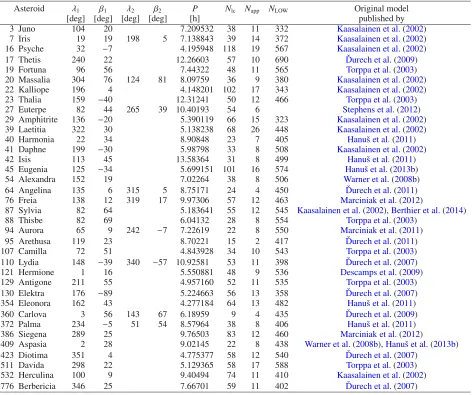
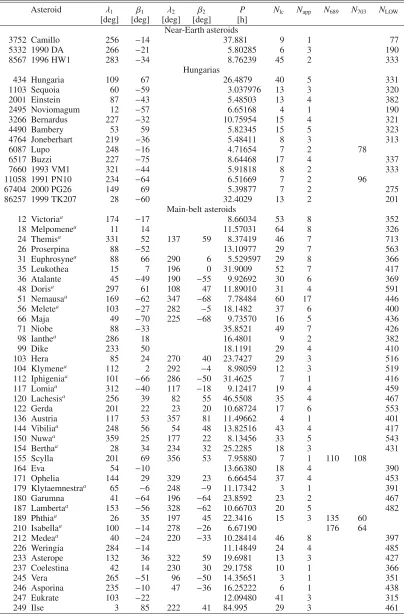
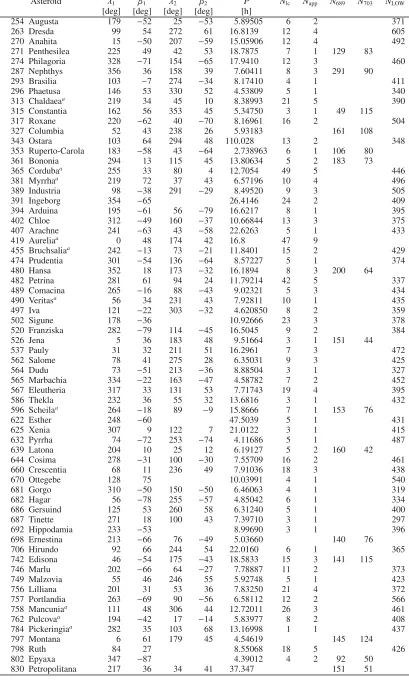
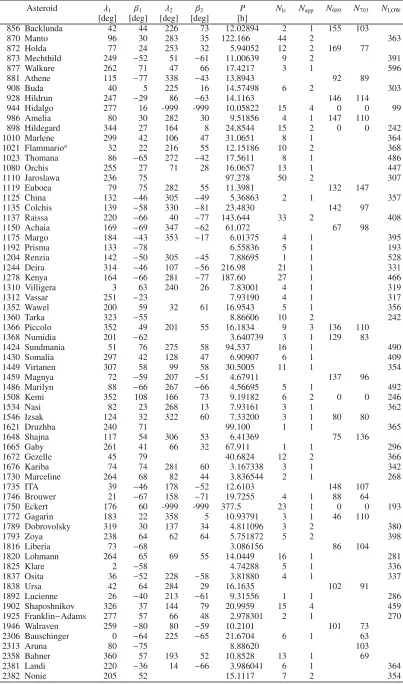
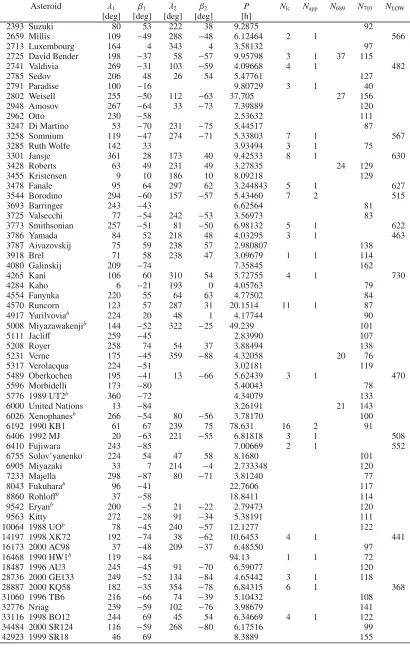
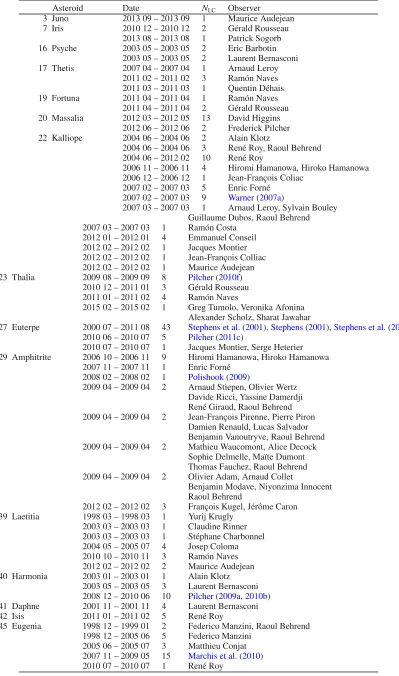
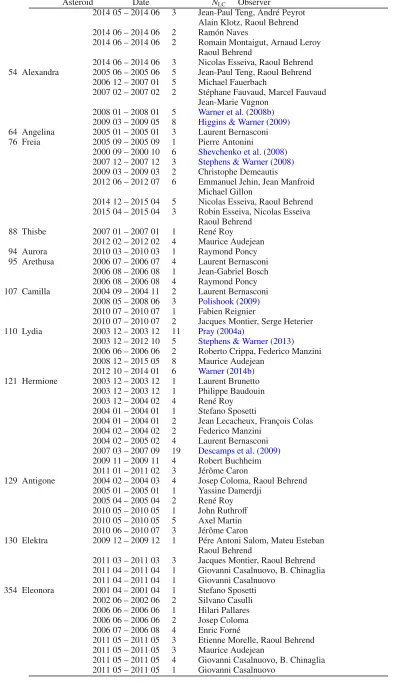
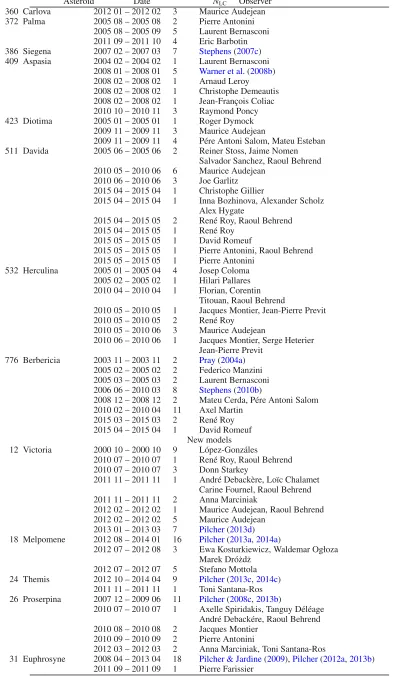
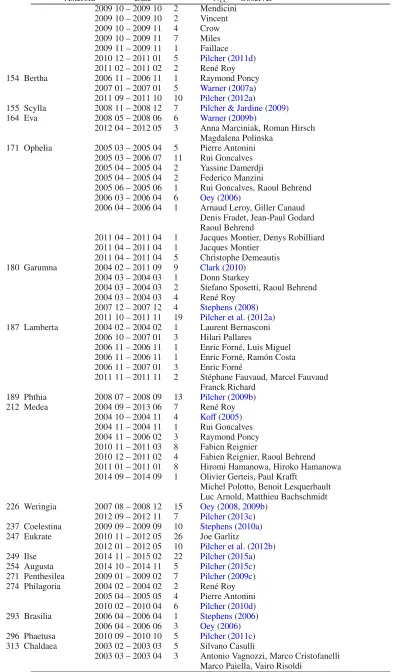
Tables 1 and A.1 include the information about the op-tical data used for the shape model determination, such as the number of dense-in-time lightcurves and apparitions cov-ered by dense-in-time observations and the number of sparse-in-time measurements from corresponding astrometric surveys. Table A.2 provides references to the dense data used for the shape model determinations and TableA.3links the observers to their observatories.
3. Convex inversion and reproducibility
In this work, we use the lightcurve inversion method of Kaasalainen & Torppa (2001) and Kaasalainen et al. (2001), which is already a well-documented, investigated, and employed technique for asteroid shape modeling (for more details, see the review byDurech et al. 2015aˇ ).
The main advantage of using convex inversion is that convex models are usually the only stable or unambiguous inversion re-sult (Durech & Kaasalainen 2003ˇ ); they best portray the resolu-tion level or informaresolu-tion content of disk-integrated photometry. To demonstrate this more intuitively, consider an asteroid with a large planar region (or many regions) on the surface (e.g., an el-lipsoid with a sizable chunk or chunks chopped off), and a large crater (say, half the size of the plane) at one end of the plane. Then it is impossible to tell from lightcurve data (no matter how large solar phase angles, i.e., shadows) where the crater is in the plane, or whether it is two craters half the size, or even myriads of small craters on the surface that have the same combined area as the big one (even if the crater filled most of the plane). In other words, one simply cannot say whether the lightcurves are caused just by small-scale surface roughness on a convex shape, or by huge nonconvexities that would be obvious in any disk-resolved data. Hence, any nonconvex model from disk-integrated photo-metric data is inevitably ambiguous, while the convex model is unambiguous. This also explains why the assumption of the non-convexity represented by a large plane in the convex model (e.g., Devogèle et al. 2015), while often a good guess because of phys-ical constraints, cannot usually be more than an assumption.
Convex inversion was successfully used for shape model de-terminations of almost 400 asteroids. On top of that, several con-vex models were validated by disk-resolved and delay-Doppler images or by direct comparison with images obtained by space probes (e.g., Kaasalainen et al. 2001;Carry et al. 2012). The parameter space of shape, rotation period, spin vector orienta-tion, and scattering properties (simple three-parameter empirical model) is systematically investigated in the means of aχ2-metric
χ2=
i
L(i) OBS−L
(i) MOD
σ2
i
, (1)
Table 1.Rotational states and summary of used photometry for asteroids for which we updated their shape models based on new disk-integrated optical data.
Asteroid λ1 β1 λ2 β2 P Nlc Napp NLOW Original model
[deg] [deg] [deg] [deg] [h] published by
3 Juno 104 20 7.209532 38 11 332 Kaasalainen et al.(2002)
7 Iris 19 19 198 5 7.138843 39 14 372 Kaasalainen et al.(2002)
16 Psyche 32 −7 4.195948 118 19 567 Kaasalainen et al.(2002)
17 Thetis 240 22 12.26603 57 10 690 Durech et al.ˇ (2009)
19 Fortuna 96 56 7.44322 48 11 565 Torppa et al.(2003)
20 Massalia 304 76 124 81 8.09759 36 9 380 Kaasalainen et al.(2002)
22 Kalliope 196 4 4.148201 102 17 343 Kaasalainen et al.(2002)
23 Thalia 159 −40 12.31241 50 12 466 Torppa et al.(2003)
27 Euterpe 82 44 265 39 10.40193 54 6 Stephens et al.(2012)
29 Amphitrite 136 −20 5.390119 66 15 323 Kaasalainen et al.(2002)
39 Laetitia 322 30 5.138238 68 26 448 Kaasalainen et al.(2002)
40 Harmonia 22 34 8.90848 23 7 405 Hanuš et al.(2011)
41 Daphne 199 −30 5.98798 33 8 508 Kaasalainen et al.(2002)
42 Isis 113 45 13.58364 31 8 499 Hanuš et al.(2011)
45 Eugenia 125 −34 5.699151 101 16 574 Hanuš et al.(2013b)
54 Alexandra 152 19 7.02264 38 8 506 Warner et al.(2008b)
64 Angelina 135 6 315 5 8.75171 24 4 450 Durech et al.ˇ (2011)
76 Freia 138 12 319 17 9.97306 57 12 463 Marciniak et al.(2012)
87 Sylvia 82 64 5.183641 55 12 545 Kaasalainen et al.(2002),Berthier et al.(2014)
88 Thisbe 82 69 6.04132 28 8 554 Torppa et al.(2003)
94 Aurora 65 9 242 −7 7.22619 22 8 550 Marciniak et al.(2011)
95 Arethusa 119 23 8.70221 15 2 417 Durech et al.ˇ (2011)
107 Camilla 72 51 4.843928 34 10 543 Torppa et al.(2003)
110 Lydia 148 −39 340 −57 10.92581 53 11 398 Durech et al.ˇ (2007)
121 Hermione 1 16 5.550881 48 9 536 Descamps et al.(2009)
129 Antigone 211 55 4.957160 52 11 535 Torppa et al.(2003)
130 Elektra 176 −89 5.224663 56 13 358 Durech et al.ˇ (2007)
354 Eleonora 162 43 4.277184 64 13 482 Hanuš et al.(2011)
360 Carlova 3 56 143 67 6.18959 9 4 435 Durech et al.ˇ (2009)
372 Palma 234 −5 51 54 8.57964 38 8 406 Hanuš et al.(2011)
386 Siegena 289 25 9.76503 83 12 460 Marciniak et al.(2012)
409 Aspasia 2 28 9.02145 22 8 438 Warner et al.(2008b),Hanuš et al.(2013b)
423 Diotima 351 4 4.775377 58 12 540 Durech et al.ˇ (2007)
511 Davida 298 22 5.129365 58 17 588 Torppa et al.(2003)
532 Herculina 100 9 9.40494 74 11 410 Kaasalainen et al.(2002)
776 Berbericia 346 25 7.66701 59 11 402 Durech et al.ˇ (2007)
Notes.We also provide the reference to the original model and in two cases to the plausible non-convex model as well. The table gives ecliptic coordinatesλ1 and β1 of the best-fitting pole solution, ecliptic coordinatesλ2 and β2 for the possible second (mirror) pole solution, sidereal rotational periodP, the number of dense lightcurvesNlcspanning Nappapparitions, the number of sparse-in-time measurements from Lowell
NLOW, and the reference to the original model.
where the ith brightness measurement L(OBSi) (with an uncer-tainty ofσi) is compared to the corresponding modeled bright-nessL(MODi) . The best-fitting parameter set is searched for.
A significant minimum in the parameter space indicates a unique solution. Visual examination of the fit in the period subspace is performed as well as the comparison between ob-served and modeled lightcurves. Additionally, the pole-ecliptic latitudes should be similar within the two pole solutions, which are typically determined as a result of the ambiguity (symme-try) presented in most lightcurve inversion models (Kaasalainen & Lamberg 2006). On the other hand, the pole-ecliptic lon-gitudes of these so-called mirror solutions should differ by ∼180 degrees. The pole ambiguity is present in the majority of our shape models.
Moreover, we also compute the principal moments of inertia of each shape model, assuming a homogeneous mass distribu-tion, and compare these moments with the moment of inertia along the rotation axis. A reliable solution should rotate within ∼10–20 degrees of the axis with the largest moment of inertia.
If available, we use a priori information about the rota-tion period of the asteroid from the Minor Planet Lightcurve Database11(Warner et al. 2009) to significantly reduce, usually by at least two orders of magnitude, computation requirements. Hence, we investigate the parameter space only in the proximity of the expected rotation period.
It should be kept in mind that none of the shape models should be taken as granted, i.e., each asteroid model contains an uncertainty (both in shape and rotation state), which increases with decreasing amount, variety, and quality of the optical data. It was already shown inHanuš et al. (2015) that by varying a shape model within its uncertainty, one can obtain significantly different fits to the thermal infrared data by the thermophysical modeling. Thus, the shape uncertainty plays an important role for the interpretation of the thermal infrared data. This demon-strates the need of accounting for the shape model uncertainties 11 http://cfa-www.harvard.edu/iau/lists/
in all further shape model applications. Also, the overall shape model based mostly on sparse data usually contains many flat facets (areas) with rather sharp edges, thus most of the low-detail topography is hidden (i.e., we have a large uncertainty in the shape). As we use more dense data, the shape becomes smoother and has more details. This limits the application of the lower-resolution shape models based mostly on sparse data.
In the ecliptic coordinate frame, the typical pole direction uncertainties are: (i)5◦ in latitude βand5◦/cosβ in longi-tudeλfor asteroid models based on large multiapparition dense lightcurve datasets; (ii) ∼5−10◦ in β and ∼5−10◦/cosβ in λ for models based on combined multiapparition dense data and sparse-in-time measurements; and finally; (iii) ∼10−30◦ in β and∼10−30◦/cosβ inλ for models based on combined few-apparition dense data with sparse-in-time measurements or only sparse-in-time data.
To sum up, we follow the same procedure for the shape model determinations as inHanuš et al.(2011,2013a,c). Finally, we would like to emphasize that our work can be easily re-produced by anyone who is interested. The LI code and the lightcurve data are available in DAMIT, as well as the user manual.
4. Results and discussions
4.1. Updated shape models
We updated shape models of 36 asteroids with known mass es-timates or for which masses will be most likely determined by the orbit deflection method from theGaiaastrometric observa-tions (Mouret et al. 2007,2008, and personal communication with François Mignard). For each one of these asteroids, there were new available optical dense data (see TableA.2). We com-bined these new data with Lowell data and the already available dense photometry from DAMIT. If applicable, we replaced the original sparse data from AstDyS with the Lowell data.
In most cases, rotational states of updated shape models are similar to those of the original models in the DAMIT database. The only exceptions, which we individually commented on in Sect.4.3, are asteroids (27) Euterpe, and (532) Herculina. We performed the LI independently from any previous shape model-ing results (e.g., we did not use information about the spin axis). Updated models provide better constraints on the rotational phase, thus these models allow us, for example, to better link re-cently obtained AO and occultation profiles with the orientation of the shape model at the time of the observation. This is essen-tial for a potenessen-tial scaling of the sizes of shape models to com-pute the volume, and consequently bulk densities. Obviously, the uncertainties in rotation period, spin axis direction, and shape model should be improved as there are more data used for the modeling.
Optimized rotation state parameters and information about optical data are listed in Table1. References to the optical dense-in-time data can be found in TableA.2.
4.2. New shape models
The majority of our new shape model determinations is obtained by combining dense-in-time data with sparse-in-time measure-ments from the Lowell database. However, the fact that Lowell data contain for each asteroid a mixture of measurements from several observatories makes it difficult to find a representative weight with respect to the dense data. Indeed, a specific single
value of the weight can result in an overestimation for some as-teroids, while it can underestimate others. Despite these issues, we decided to use a weight of 0.1 for the Lowell data as a whole and to present corresponding shape models. As a consequence, we sometimes obtained a unique shape solution if we combined dense data and the sparse data from AstDyS (i.e., from USNO and Catalina), but not if we used the Lowell data instead. We present these shape models as well.
Moreover, 57 out of 250 shape models are based only on sparse data from USNO-Flagstaffand Catalina Sky Survey ob-servatories. That these models can nevertheless be reliable was already shown in Hanuš & ˇDurech (2012) and Hanuš et al. (2013c). As suggested there, we ran the LI search for shape and rotation state parameters with two different shape resolutions: (i) standard one; and (ii) lower one, which serves as a test of the solution stability. For this case, the asteroid’s synodic rotation period is also available in the Minor Planet Lightcurve Database (LCDB,Warner et al. 2009), an additional test for the reliability can be performed. A rotation period derived by the LI (a period interval of 2–1000 h is typically scanned), which matches that al-ready reported, points to a secure solution. In practice, all shape solutions based solely on sparse data that fulfilled our stability tests had rotation periods in an agreement with synodic periods from LCDB. This also demonstrates that our other unique solu-tions, for which a previous period estimate is not available, are reliable. We present nine of these shape and rotation state solu-tions; these are labeled in TableA.1.
We present shape models of three NEAs, which all have neg-ative values of their pole latitudesβ, and obliquities larger than 90◦. The fact that they all show retrograde rotation supports the consensus that about half of the NEAs migrated through the ν6 secular resonance, which causes an observed excess of
ret-rograde rotators (La Spina et al. 2004).
We further present shape models of 13 asteroids that are clas-sified as Hungarias. The majority of them (10 out of 13) exhibit retrograde rotation, which is in an agreement with the findings of Warner et al.(2014), who reported, in a sample of 53 Hungarias, a 75% representation of retrograde rotators.
Thirty-one of the derived shape models are those asteroids whose density will be measured in future or was already ob-tained. While for some of them, estimations on their masses are already available, the masses of the others will be determined fromGaia astrometric measurements. Constraining the model sizes of these asteroids using disk-resolved images, stellar oc-cultation data, or thermophysical modeling will directly facili-tate estimation of bulk densities.
Rotation state parameters and information about used opti-cal data for all new shape model determinations are listed in TableA.1. References to the optical dense-in-time data can be found in TableA.2.
4.3. Individual asteroids
(532) Herculina.Our (single) pole solution only differs by ∼180◦ in longitudeλfrom that reported by Kaasalainen et al.
(2002), thus it corresponds to their mirror solution. In contrast to their solution, our model is based on additional data from 2005 and 2010 apparitions.
(537) Pauly.The rotation period of 14.15 h from the LCDB is in contradiction with our shape modeling result: our period of 16.2961 h fits the data significantly better and thus is preferred.
(596) Scheila. The observations taken on December 11th, 2010 with the Catalina Schmidt telescope exhibited a comet-like appearance (Larson 2010). This behavior was later confirmed byJewitt et al.(2011) from the HST observations on December 27th, 2010 and on January 4th, 2011 and interpreted as caused most likely by a collision with a 35m asteroid. All photometric data used for the shape modeling date prior to this event, so the shape model does not reflect any potential changes in the shape, period, or spin orientation induced by the collision (Bodewits et al. 2014).
(8567) 1996 HW1.The shape model of this NEAs was
al-ready determined byMagri et al.(2011) from a combination of dense lightcurves and radar Doppler images. We derived a con-sistent shape model and rotational state solution from combined dense and sparse data. The main difference between these two models is the fact that the Doppler images contain nonconvex signatures that were translated into their shape model. Even if our shape model is purely convex, it reliably represents the over-all shape of the real asteroid. This case once again demonstrates the reliability of the convex inversion method.
(9563) Kitty. We derived the shape model of this asteroid without knowledge of a previous period estimate. However, Chang et al. (2015) recently reported period P = 5.35 ± 0.03 h based on the optical data from the Intermediate Palomar Transient Factory that is in perfect agreement with our indepen-dent determination ofP=5.38191±0.00005 h.
5. Conclusions
In this work, we updated shape models of 36 asteroids with mass estimates by including new optical dense-in-time data in the shape modeling. For 250 asteroids, including 13 Hungarias and three NEAs, we derived their convex shape models and ro-tation states from combined disk-integrated dense- and sparse-in-time photometric data or from only sparse-sparse-in-time data. This effort was achieved with the help of the community of∼100 in-dividual observers who shared their lightcurves. All new models are now included in the DAMIT database and are available to anyone for additional studies. For nine asteroids, we provide, together with shape models and pole orientations, their first ro-tation period estimates.
Our work is a typical example in which a contribution of hundreds of observers, who are regularly obtaining photometric data with their small and mid-sized telescopes, was necessary to achieve presented results. The initial motivation of the observers is to derive the synodic rotation period (sometimes this is an ob-ject of a publication in the Minor Planet Bulletin), however, the shape modeling provides a welcome additional opportunity for the usage of their optical data. We acknowledge all the observers who submit their observations to the public databases and in-vite others to do so as well. This practice allows us an easy and straightforward access to the data and largely avoids an overlook of the precious data.
The shape models can be used as inputs for various stud-ies, such as spin-vector analysis, detection of concavitstud-ies,
thermophysical modeling with the varied-shape approach by Hanuš et al. (2015), nonconvex modeling, size optimiza-tion by disk-resolved images or occultaoptimiza-tion data, or density determinations.
Shape models based only on sparse data (or combined with a few dense lightcurves) are convenient candidates for follow-up observations, both to confirm the rotation periods and to improve the shape models, which is necessary, e.g., for thermophysical modeling. Finally, we maintain a web page with a list of aster-oids, for which mass estimates are available and the shape model determination still requires additional photometric data (Hanuš 2015). These objects are candidates for accurate density deter-mination and any lightcurve support is welcome.
Acknowledgements. J.H. greatly appreciates the CNES post-doctoral fellowship program. J.H. and M.D. were supported by the project under the contract 11-BS56-008 (SHOCKS) of the French Agence National de la Recherche (ANR), JD by grant GACR 15-04816S of the Czech Science Foundation, DO by the grant NCN 2012/S/ST9/00022 of Polish National Science Center, and A. Marciniak by grant 2014/13/D/ST9/01818 of Polish National Science Center. We thank the ref-eree, Mikko Kaasalainen, for his thorough review of our manuscript and his con-structive comments and suggestions that led to a significant improvement of the text. The computations have been carried out on the “Mesocentre” computers, hosted by the Observatoire de la Côte d’Azur, and on the computational cluster Tiger at the Astronomical Institute of Charles University in Prague (http:// sirrah.troja.mff.cuni.cz/tiger). Data from Pic du Midi Observatory were partly obtained with the 0.6 m telescope, a facility operated by observa-toire Midi-Pyrénées and Association T60, an amateur association. The Joan Oró Telescope (TJO) of the Montsec Astronomical Observatory (OAdM) is owned by the Catalan Government and operated by the Institute for Space Studies of Catalonia (IEEC). We thank Franck Pino (INO-AZ) and Lech Mankiewicz (EU-HOU/Comenius) for the remote access to Ironwood North.
References
Alkema, M. S. 2013a,Minor Planet Bulletin, 40, 133 Alkema, M. S. 2013b,Minor Planet Bulletin, 40, 68 Alton, K. B. 2011,Minor Planet Bulletin, 38, 8 Benishek, V. 2014,Minor Planet Bulletin, 41, 126
Berthier, J., Vachier, F., Marchis, F., ˇDurech, J., & Carry, B. 2014,Icarus, 239, 118
Bodewits, D., Vincent, J.-B., & Kelley, M. S. P. 2014,Icarus, 229, 190 Bottke, W. F., Vokrouhlický, D., Brož, M., Nesvorný, D., & Morbidelli, A. 2001,
Science, 294, 1693
Bowell, E., Oszkiewicz, D. A., Wasserman, L. H., et al. 2014,Meteor. Planet. Sci., 49, 95
Brinsfield, J. W. 2007a,Minor Planet Bulletin, 34, 58 Brinsfield, J. W. 2007b,Minor Planet Bulletin, 34, 108 Brinsfield, J. W. 2008a,Minor Planet Bulletin, 35, 179 Brinsfield, J. W. 2008b,Minor Planet Bulletin, 35, 86 Brinsfield, J. W. 2009,Minor Planet Bulletin, 36, 64 Brinsfield, J. W. 2010a,Minor Planet Bulletin, 37, 19 Brinsfield, J. W. 2010b,Minor Planet Bulletin, 37, 50 Brinsfield, J. W. 2011,Minor Planet Bulletin, 38, 73 Brinsfield, J. W. 2012,Minor Planet Bulletin, 39, 55 Buchheim, R. K. 2005,Minor Planet Bulletin, 32, 79 Buchheim, R. K. 2007,Minor Planet Bulletin, 34, 13 Buchheim, R. K. 2014,Minor Planet Bulletin, 41, 241
Cantu, S., Adolphson, M., Montgomery, K., & Renshaw, T. 2015,Minor Planet Bulletin, 42, 28
Carry, B. 2012,Planet. Space Sci., 73, 98
Carry, B., Dumas, C., Kaasalainen, M., et al. 2010a,Icarus, 205, 460 Carry, B., Kaasalainen, M., Leyrat, C., et al. 2010b,A&A, 523, A94
Carry, B., Kaasalainen, M., Merline, W. J., et al. 2012,Planet. Space Sci., 66, 200
Chang, C.-K., Ip, W.-H., Lin, H.-W., et al. 2015,ApJS, 219, 27 Clark, M. 2010,Minor Planet Bulletin, 37, 89
Delbo, M., Mueller, M., Emery, J., Rozitis, B., & Capria, M. T. 2015, Asteroids IV, in press
Descamps, P., Marchis, F., Durech, J., et al. 2009,Icarus, 203, 88 Devogèle, M., Rivet, J. P., Tanga, P., et al. 2015,MNRAS, 453, 2232 ˇ
Durech, J., & Kaasalainen, M. 2003,A&A, 404, 709 ˇ
Durech, J., Grav, T., Jedicke, R., Denneau, L., & Kaasalainen, M. 2005,Earth Moon Planets, 97, 179
ˇ
ˇ
Durech, J., Kaasalainen, M., Warner, B. D., et al. 2009,A&A, 493, 291 ˇ
Durech, J., Sidorin, V., & Kaasalainen, M. 2010,A&A, 513, A46 ˇ
Durech, J., Kaasalainen, M., Herald, D., et al. 2011,Icarus, 214, 652 ˇ
Durech, J., Hanuš, J., Vanˇco, R., Oszkiewicz, D., & Bowell, E. 2013, in AAS/Division for Planetary Sciences Meeting Abstracts, 45, 304.05 ˇ
Durech, J., Carry, B., Delbo, M., Kaasalainen, M., & Viikinkoski, M. 2015a, Asteroids IV, in press
ˇ
Durech, J., Hanuš, J., & Vanˇco, R. 2015b, Astronomy and Computing, 13, 80 ˇ
Durech, J., Hanuš, J., Oszkiewicz, D., & Vanˇco, R. 2016, A&A, in press, DOI: 10.1051/0004-6361/201527573
Ferrero, A., Klinglesmith, III, D. K., & Pilcher, F. 2014,Minor Planet Bulletin, 41, 33
Hanuš, J. 2015,Minor Planet Bulletin, 42, 208 Hanuš, J., & ˇDurech, J. 2012,Planet. Space Sci., 73, 75 Hanuš, J., ˇDurech, J., Brož, M., et al. 2011,A&A, 530, A134 Hanuš, J., Brož, M., ˇDurech, J., et al. 2013a,A&A, 559, A134 Hanuš, J., Marchis, F., & ˇDurech, J. 2013b,Icarus, 226, 1045 Hanuš, J., ˇDurech, J., Brož, M., et al. 2013c,A&A, 551, A67
Hanuš, J., Delbo, M., ˇDurech, J., & Alí-Lagoa, V. 2015,Icarus, 256, 101 Higgins, D. 2008,Minor Planet Bulletin, 35, 30
Higgins, D., & Goncalves, R. M. D. 2007,Minor Planet Bulletin, 34, 16 Higgins, D., & Pilcher, F. 2009,Minor Planet Bulletin, 36, 143 Higgins, D., & Warner, B. D. 2009,Minor Planet Bulletin, 36, 159
Higgins, D., Pravec, P., Kusnirak, P., et al. 2006a,Minor Planet Bulletin, 33, 89 Higgins, D., Pravec, P., Kusnirak, P., et al. 2006b,Minor Planet Bulletin, 33, 8 Higgins, D., Pravec, P., Kusnirak, P., Reddy, V., & Dyvig, R. 2006c,Minor Planet
Bulletin, 33, 64
Jehin, E., Gillon, M., Queloz, D., et al. 2011,The Messenger, 145, 2
Jewitt, D., Weaver, H., Mutchler, M., Larson, S., & Agarwal, J. 2011,ApJ, 733, L4
Johansen, A., & Lacerda, P. 2010,MNRAS, 404, 475
Kaasalainen, M., & Lamberg, L. 2006,Inverse Problems, 22, 749 Kaasalainen, M., & Torppa, J. 2001,Icarus, 153, 24
Kaasalainen, M., & Viikinkoski, M. 2012,A&A, 543, A97 Kaasalainen, M., Torppa, J., & Muinonen, K. 2001,Icarus, 153, 37 Kaasalainen, M., Torppa, J., & Piironen, J. 2002,Icarus, 159, 369
Klinglesmith, III, D. A., Hanowell, J., Risley, E., et al. 2014,Minor Planet Bulletin, 41, 139
Klinglesmith, D. A., DeHart, A., Hanowell, J., & Hendrickx, S. 2015,Minor Planet Bulletin, 42, 101
Koff, R. A. 2001,Minor Planet Bulletin, 28, 77 Koff, R. A. 2002,Minor Planet Bulletin, 29, 25 Koff, R. A. 2004,Minor Planet Bulletin, 31, 58 Koff, R. A. 2005,Minor Planet Bulletin, 32, 32 Koff, R. A. 2006,Minor Planet Bulletin, 33, 31
Koff, R. A., & Brincat, S. M. 2000,Minor Planet Bulletin, 27, 49 Koff, R. A., & Brincat, S. M. 2001,Minor Planet Bulletin, 28, 67
Koff, R. A., Brincat, S. M., Stephens, R. D., & Pravec, P. 2001,Minor Planet Bulletin, 28, 46
Kryszczy´nska, A. 2013,A&A, 551, A102
Kryszczy´nska, A., La Spina, A., Paolicchi, P., et al. 2007,Icarus, 192, 223 La Spina, A., Paolicchi, P., Kryszczy´nska, A., & Pravec, P. 2004,Nature, 428,
400
Larson, S. M. 2010,IAU Circ., 9188, 1
Larson, S., Beshore, E., Hill, R., et al. 2003, in BAAS, 35, AAS/Division for Planetary Sciences Meeting Abstracts 35,982
Magri, C., Howell, E. S., Nolan, M. C., et al. 2011,Icarus, 214, 210 Marchis, F., Lainey, V., Descamps, P., et al. 2010,Icarus, 210, 635 Marciniak, A., Michałowski, T., Hirsch, R., et al. 2009,A&A, 498, 313 Marciniak, A., Michałowski, T., Poli´nska, M., et al. 2011,A&A, 529, A107 Marciniak, A., Bartczak, P., Santana-Ros, T., et al. 2012,A&A, 545, A131 Martinez, L. E. 2012,Minor Planet Bulletin, 39, 25
Michałowski, T., Kaasalainen, M., Marciniak, A., et al. 2005,A&A, 443, 329 Miles, R., & Warner, B. D. 2009,Minor Planet Bulletin, 36, 66
Mouret, S., Hestroffer, D., & Mignard, F. 2007,A&A, 472, 1017
Mouret, S., Hestroffer, D., & Mignard, F. 2008,Planet. Space Sci., 56, 1819 Mousis, O., Hueso, R., Beaulieu, J.-P., et al. 2014,Exp. Astron., 38, 91 Müller, T. G., ˇDurech, J., Hasegawa, S., et al. 2011,A&A, 525, A145 Oey, J. 2006,Minor Planet Bulletin, 33, 96
Oey, J. 2008,Minor Planet Bulletin, 35, 132 Oey, J. 2009a,Minor Planet Bulletin, 36, 4 Oey, J. 2009b,Minor Planet Bulletin, 36, 162
Oey, J., Vilagi, J., Gajdos, S., Kornos, L., & Galad, A. 2007,Minor Planet Bulletin, 34, 81
Oey, J., Pilcher, F., Benishek, V., Higgins, D., & Pravec, P. 2012,Minor Planet Bulletin, 39, 86
Oszkiewicz, D. A., Muinonen, K., Bowell, E., et al. 2011,J. Quant. Spectr. Rad. Transf., 112, 1919
Owings, L. E. 2009,Minor Planet Bulletin, 36, 51 Owings, L. E. 2013a,Minor Planet Bulletin, 40, 104 Owings, L. E. 2013b,Minor Planet Bulletin, 40, 8
Piironen, J., Lagerkvist, C., Torppa, J., Kaasalainen, M., & Warner, B. 2001,in BAAS, 33, 1562
Pilcher, F. 2008a,Minor Planet Bulletin, 35, 51 Pilcher, F. 2008b,Minor Planet Bulletin, 35, 71 Pilcher, F. 2008c,Minor Planet Bulletin, 35, 135 Pilcher, F. 2009a,Minor Planet Bulletin, 36, 133 Pilcher, F. 2009b,Minor Planet Bulletin, 36, 25 Pilcher, F. 2009c,Minor Planet Bulletin, 36, 100 Pilcher, F. 2010a,Minor Planet Bulletin, 37, 98 Pilcher, F. 2010b,Minor Planet Bulletin, 37, 167 Pilcher, F. 2010c,Minor Planet Bulletin, 37, 119 Pilcher, F. 2010d,Minor Planet Bulletin, 37, 148 Pilcher, F. 2010e,Minor Planet Bulletin, 37, 45 Pilcher, F. 2010f,Minor Planet Bulletin, 37, 21 Pilcher, F. 2011a,Minor Planet Bulletin, 38, 183 Pilcher, F. 2011b,Minor Planet Bulletin, 38, 76 Pilcher, F. 2011c,Minor Planet Bulletin, 38, 50 Pilcher, F. 2011d,Minor Planet Bulletin, 38, 156 Pilcher, F. 2012a,Minor Planet Bulletin, 39, 57 Pilcher, F. 2012b,Minor Planet Bulletin, 39, 220 Pilcher, F. 2013a,Minor Planet Bulletin, 40, 33 Pilcher, F. 2013b,Minor Planet Bulletin, 40, 189 Pilcher, F. 2013c,Minor Planet Bulletin, 40, 85 Pilcher, F. 2013d,Minor Planet Bulletin, 40, 161 Pilcher, F. 2014a,Minor Planet Bulletin, 41, 155 Pilcher, F. 2014b,Minor Planet Bulletin, 41, 47 Pilcher, F. 2014c,Minor Planet Bulletin, 41, 250 Pilcher, F. 2015a,Minor Planet Bulletin, 42, 190 Pilcher, F. 2015b,Minor Planet Bulletin, 42, 280 Pilcher, F. 2015c,Minor Planet Bulletin, 42, 91
Pilcher, F., & Franco, L. 2014,Minor Planet Bulletin, 41, 35 Pilcher, F., & Higgins, D. 2011,Minor Planet Bulletin, 38, 32 Pilcher, F., & Jardine, D. 2009,Minor Planet Bulletin, 36, 52
Pilcher, F., Benishek, V., Delos, S., et al. 2012a,Minor Planet Bulletin, 39, 46 Pilcher, F., Delos, S., Ahrendts, G., & Barker, T. 2012b,Minor Planet Bulletin,
39, 204
Pilcher, F., Ferrero, A., & Oey, J. 2012c,Minor Planet Bulletin, 39, 228 Pilcher, F., Alvarez, E. M., Ferrero, A., et al. 2014,Minor Planet Bulletin, 41, 70 Pilcher, F., Ferrero, A., Klinglesmith, III, D. A., & Hanowell, J. 2015,Minor
Planet Bulletin, 42, 90
Polishook, D. 2009,Minor Planet Bulletin, 36, 119 Polishook, D. 2014,Icarus, 241, 79
Polishook, D., Ofek, E. O., Waszczak, A., et al. 2012,MNRAS, 421, 2094 Pravec, P., Wolf, M., & Šarounová, L. 1998,Icarus, 136, 124
Pravec, P., Scheirich, P., Vokrouhlický, D., et al. 2012,Icarus, 218, 125 Pray, D. P. 2004a,Minor Planet Bulletin, 31, 34
Pray, D. P. 2004b,Minor Planet Bulletin, 31, 6 Rubincam, D. P. 2000,Icarus, 148, 2
Ruthroff, J. C. 2010,Minor Planet Bulletin, 37, 158 Ruthroff, J. C. 2011,Minor Planet Bulletin, 38, 86
Scheeres, D. J., Britt, D., Carry, B., & Holsapple, K. A. 2015, Asteroids IV. In press
Shevchenko, V. G., Chiorny, V. G., Gaftonyuk, N. M., et al. 2008,Icarus, 196, 601
Skiff, B. A., Bowell, E., Koehn, B. W., et al. 2012,Minor Planet Bulletin, 39, 111
Slivan, S. M., Binzel, R. P., Crespo da Silva, L. D., et al. 2003,Icarus, 162, 285 Stephens, R. D. 2001,Minor Planet Bulletin, 28, 5
Stephens, R. D., & Warner, B. D. 2008,Minor Planet Bulletin, 35, 84 Stephens, R. D., & Warner, B. D. 2013,Minor Planet Bulletin, 40, 93 Stephens, R. D., Malcolm, G., Koff, R. A., Brincat, S. M., & Warner, B. 2001,
Minor Planet Bulletin, 28, 1
Stephens, R. D., Warner, B. D., Megna, R., & Coley, D. 2012,Minor Planet Bulletin, 39, 2
Stephens, R. D., Coley, D., & Warner, B. D. 2014,Minor Planet Bulletin, 41, 8 Strabla, L., Quadri, U., & Girelli, R. 2011,Minor Planet Bulletin, 38, 169 Strabla, L., Quadri, U., & Girelli, R. 2012,Minor Planet Bulletin, 39, 177 Strabla, L., Quadri, U., & Girelli, R. 2013,Minor Planet Bulletin, 40, 232 Tanga, P., Carry, B., Colas, F., et al. 2015,MNRAS, 448, 3382
Torppa, J., Kaasalainen, M., Michałowski, T., et al. 2003,Icarus, 164, 346 Viikinkoski, M., Kaasalainen, M., & Durech, J. 2015,A&A, 576, A8 Vokrouhlický, D., Nesvorný, D., & Bottke, W. F. 2003,Nature, 425, 147 Warner, B. D. 1999,Minor Planet Bulletin, 26, 31
Warner, B. 2000,Minor Planet Bulletin, 27, 4 Warner, B. 2001,Minor Planet Bulletin, 28, 4 Warner, B. D. 2005a,Minor Planet Bulletin, 32, 29 Warner, B. D. 2005b,Minor Planet Bulletin, 32, 54 Warner, B. D. 2005c,Minor Planet Bulletin, 32, 4 Warner, B. D. 2006a,Minor Planet Bulletin, 33, 82 Warner, B. D. 2006b,Minor Planet Bulletin, 33, 58 Warner, B. D. 2006c,Minor Planet Bulletin, 33, 85 Warner, B. D. 2006d,Minor Planet Bulletin, 33, 35 Warner, B. D. 2007a,Minor Planet Bulletin, 34, 72 Warner, B. D. 2007b,Minor Planet Bulletin, 34, 104 Warner, B. D. 2008a,Minor Planet Bulletin, 35, 56 Warner, B. D. 2008b,Minor Planet Bulletin, 35, 163 Warner, B. D. 2009a,Minor Planet Bulletin, 36, 109 Warner, B. D. 2009b,Minor Planet Bulletin, 36, 7 Warner, B. D. 2009c,Minor Planet Bulletin, 36, 172 Warner, B. D. 2010a,Minor Planet Bulletin, 37, 112 Warner, B. D. 2010b,Minor Planet Bulletin, 37, 24 Warner, B. D. 2010c,Minor Planet Bulletin, 37, 57 Warner, B. D. 2010d,Minor Planet Bulletin, 37, 127 Warner, B. D. 2011a,Minor Planet Bulletin, 38, 142 Warner, B. D. 2011b,Minor Planet Bulletin, 38, 25 Warner, B. D. 2011c,Minor Planet Bulletin, 38, 63 Warner, B. D. 2012a,Minor Planet Bulletin, 39, 158 Warner, B. D. 2012b,Minor Planet Bulletin, 39, 16 Warner, B. D. 2012c,Minor Planet Bulletin, 39, 69 Warner, B. D. 2012d,Minor Planet Bulletin, 39, 245 Warner, B. D. 2013a,Minor Planet Bulletin, 40, 71 Warner, B. D. 2013b,Minor Planet Bulletin, 40, 137 Warner, B. D. 2014a,Minor Planet Bulletin, 41, 27 Warner, B. D. 2014b,Minor Planet Bulletin, 41, 144 Warner, B. D. 2015a,Minor Planet Bulletin, 42, 54 Warner, B. D. 2015b,Minor Planet Bulletin, 42, 115 Warner, B. D. 2015c,Minor Planet Bulletin, 42, 132
Warner, B. D., Shepard, M. K., Harris, A. W., et al. 2006,Minor Planet Bulletin, 33, 102
Warner, B. D., Behrend, R., Poncy, R., & Coliac, J.-F. 2008a,Minor Planet Bulletin, 35, 25
Warner, B. D., Durech, J., Fauerbach, M., & Marks, S. 2008b,Minor Planet Bulletin, 35, 167
Warner, B. D., Harris, A. W., & Pravec, P. 2009,Icarus, 202, 134
Warner, B. D., Stephens, R. D., & Harris, A. W. 2011,Minor Planet Bulletin, 38, 172
Warner, B. D., Harris, A. W., Stephens, R. D., & Coley, D. 2014, in AAS/Division for Planetary Sciences Meeting Abstracts, 46, 509.12
1 Centre National d’Études Spatiales, 2 place Maurice Quentin 75039
Paris Cedex 01, France
e-mail:[email protected]
2 Laboratoire Lagrange, UMR7293, Université de la Côte d’Azur,
CNRS, Observatoire de la Côte d’Azur, Blvd de l’Observatoire, CS 34229, 06304 Nice Cedex 4, France
3 Astronomical Institute, Faculty of Mathematics and Physics,
Charles University in Prague, V Holešoviˇckách 2, 18000 Prague, Czech Republic
4 Astronomical Observatory Institute, Faculty of Physics, A.
Mickiewicz University, Słoneczna 36, 60-286 Pozna´n, Poland 5 Geneva Observatory, 1290 Sauverny, Switzerland
6 Aix Marseille Université, CNRS, OHP (Observatoire de Haute
Provence), Institut Pythéas (UMS 3470), 04870 Saint-Michel-l’Observatoire, France
7 Centre for Science at Extreme Conditions, The University of
Edinburgh, Erskine Williamson Building, Peter Guthrie Tait Road, Edinburgh, EH9 3FD, UK
8 Association T60, Observatoire du Pic du Midi, 65200
Bagnères-de-Bigorre, France
9 Observatoire des Hauts Patys, 84410 Bédoin, France
10 Observatoire de Chinon, Mairie de Chinon, 37500 Chinon, France 11 Villefagnan Observatory, France
12 Harfleur Observatory, France
13 490 chemin du gonnet, 38440 Saint Jean de Bournay, France 14 Observatoire des Engarouines, 1606 chemin de Rigoy, 84570
Malemort-du-Comtat, France
15 Collonges Observatory, 90 allée des résidences, 74160 Collonges,
France
16 SUPA, School of Physics & Astronomy, North Haugh, St Andrews,
KY16 9SS, UK
17 Via Capote Observatory, Thousand Oaks, CA 91320, USA 18 Le Florian, Villa 4, 880 chemin de Ribac-Estagnol, 06600 Antibes,
France
19 Observatoire de Dauban, 04150 Banon, France
20 Levendaal Observatory, Uiterstegracht 48, 2312 TE Leiden, The
Netherlands
21 European Southern Observatory, La Silla, Coquimbo, Chile 22 Eurac Observatory, Bolzano/Bozen, Italy
23 Vallemare di Bordona, Rieti, Italy
24 Observatorio Astronómico Caimari, 07144 Costitx, Spain 25 Observatoire de Durtal, 49430 Durtal, France
26 OAM - Mallorca, 07144 Costitx, Spain
27 20 parc des Pervenches, 13012 Marseille, France
28 Agrupación Astronómica de Sabadell, Apartado de Correos 50,
PO Box 50, 08200 Sabadell, Barcelona, Spain 29 Observatorio El Vendrell, 1193 Trragona, Spain
30 AFOEV (Association Française des Observateurs d’Etoiles
Variables), Observatoire de Strasbourg 11, rue de l’Université, 67000 Strasbourg, France
31 Observatori d’Ager, 08014 Barcelona, Spain
32 Stazione Astronomica di Sozzago, 28060 Sozzago, Italy 33 Santa Lucia Stroncone, 05039 Stroncone, Italy
34 Institut d’Astrophysique de l’Université Liège, Allèe du 6 Aout 17,
4000 Liège, Belgium
35 Haleakala-Faulkes Telescope North, Hawaii, USA
36 Seine-Maritime, Le Havre, 76600 Haute-Normandie, France 37 Village-Neuf Observatory, 9bis rue du Sauvage, 68300 Saint-Louis,
France
38 Mt. Suhora Observatory, Pedagogical University. Podchor ˛a˙zych 2,
30-084, Cracow, Poland
39 Shed of Science Observatory, 5213 Washburn Ave. S, Minneapolis,
MN 55410, USA 40 Waterlooville, UK
41 Observatoire St-Martin, 31 grande rue, 25330 Amathay Vésigneux,
France
42 Observatorio CEAM, Caimari, Canary Islands, Spain
43 Florida Gulf Coast University, 10501 FGCU Boulevard South, Fort
Myers, FL 33965, USA
44 Observatoire du Bois de Bardon, 16110 Taponnat, France
45 Association T60, 14 avenue Edouard Belin, 31400 Toulouse, France 46 Osservatorio l’Ampolla, Tarragona, Spain
47 International Occultation Timing Association, Montgomery, AL,
USA
48 Club d’Astronomie de Lyon Ampere (CALA), Place de la Nation,
69120 Vaulx-en-Velin, France 49 Linhaceira Observatory, Portugal
50 Hong Kong Space Museum, Tsimshatsui, Hong Kong, PR China 51 Institute of Planetary Research, German Aerospace Center,
Rutherfordstrasse 2, 12489 Berlin, Germany 52 Astroqueyras, Mairie, 05350 Saint-Véran, France
53 51 Centre astronomique de la Couyère, La Ville d’ABas, 35320
La Couyère, France
54 Hunters Hill Observatory, 7 Mawalan Street, Ngunnawal ACT 2913,
55 Observatoire des Terres Blanches, 04110 Reillanne, France 56 Department of Physics, University of Strathclyde, 16 Richmond
Street, Glasgow G1 1XQ, UK
57 Guitalens Observatory, 5 chemin d’En Combes, 81220 Guitalens,
France
58 Observatoire Les Makes, G. Bizet 18, 97421 La Rivière, France 59 980 Antelope Drive West, Bennett, CO 80102, USA
60 Institute of Astronomy of Kharkiv Karazin National University,
Kharkiv 61022, Sumska Str. 35, Ukraine
61 Severní 765, 50003 Hradec Králové, Czech republic
62 Uranoscope, Avenue Carnot 7, 77220 Gretz-Armainvilliers, France 63 Observatoire OPERA, France
64 Instituto de Astrofísica de Andalucía, CSIC, Apdo. 9481, 08080
Barcelona, Spain 65 Mulheim-Ruhr, Germany
66 Tzec Maun Foundation Observatory, Mayhill, New Mexico, US 67 Observatorio Montcabrer, C/Jaume Balmes nb 24, Cabrils 08348
Barcelona, Spain
68 Kingsgrove, NSW, Australia
69 Sant Gervasi Observatory, 08022 Barcelona, Spain 70 4438 Organ Mesa Loop, Las Cruces, NM 88011, USA 71 Rue des Ecoles 2, 34920 Le Crès, France
72 11 rue François-Nouteau, 49650 Brain-sur-Allonnes, France 73 Ottmarsheim Observatory, 5 rue du Lièvre, 68490 Ottmarsheim,
France
74 Université Claude BERNARD Lyon 1. Observatoire de Pommier,
POMMIER, 63230 Chapdes-Beaufort, France
75 4 rue de la Bruyère, 37500 La Roche Clermault, France
76 Observatoire de Blauvac, 293 chemin de St Guillaume, 84570
Blauvac, France
77 Shadowbox Observatory, 12745 Crescent Drive, Carmel, IN 46032,
USA
78 Lowell Observatory, Flagstaff, AZ 86001, USA 79 Savigny-le-Temple, France
80 Observatorio Amanecer de Arrakis, MPC274 Alcalá de Guadaíra,
Sevilla, Spain
81 Gnosca Observatory, 6525 Gnosca, Switzerland
82 DeKalb Observatory, 2507 CR 60, Auburn, IN 46706, USA 83 Center for Solar System Studies, 9302 Pittsburgh Ave, Suite 105,
Rancho Cucamonga, CA 91730, USA
84 School of Physics and Astronomy, University of Edinburgh, James
Clerk Maxwell Building, Peter Guthrie Tait Road, Edinburgh, EH9 3FD, UK
85 European Space Astronomy Centre, ESA, PO Box 78, 28691
Villanueva de la Cañada, Madrid, Spain 86 Ironwood North, Hawaii, USA
87 Centre de Recherche en Astronomie, Astrophysique et
Géophysique, BP 63 Bouzereah, Algiers
88 Astronomical Observatory of Jagiellonian University, ul. Orla 171,
Appendix A: Additional tables
Table A.1.New asteroid shape model determinations from disk-integrated optical data.
Asteroid λ1 β1 λ2 β2 P Nlc Napp N689 N703 NLOW
[deg] [deg] [deg] [deg] [h]
Near-Earth asteroids
3752 Camillo 256 −14 37.881 9 1 77
5332 1990 DA 266 −21 5.80285 6 3 190
8567 1996 HW1 283 −34 8.76239 45 2 333
Hungarias
434 Hungaria 109 67 26.4879 40 5 331
1103 Sequoia 60 −59 3.037976 13 3 320
2001 Einstein 87 −43 5.48503 13 4 382
2495 Noviomagum 12 −57 6.65168 4 1 190
3266 Bernardus 227 −32 10.75954 15 4 321
4490 Bambery 53 59 5.82345 15 5 323
4764 Joneberhart 219 −36 5.48411 8 3 313
6087 Lupo 248 −16 4.71654 7 2 78
6517 Buzzi 227 −75 8.64468 17 4 337
7660 1993 VM1 321 −44 5.91818 8 2 333
11058 1991 PN10 234 −64 6.51669 7 2 96
67404 2000 PG26 149 69 5.39877 7 2 275
86257 1999 TK207 28 −60 32.4029 13 2 201
Main-belt asteroids
12 Victoriaa 174 −17 8.66034 53 8 352
18 Melpomenea 11 14 11.57031 64 8 326
24 Themisa 331 52 137 59 8.37419 46 7 713
26 Proserpina 88 −52 13.10977 29 7 563
31 Euphrosynea 88 66 290 6 5.529597 29 8 366
35 Leukothea 15 7 196 0 31.9009 52 7 417
36 Atalante 45 −49 190 −55 9.92692 30 6 369
48 Dorisa 297 61 108 47 11.89010 31 4 591
51 Nemausaa 169 −62 347 −68 7.78484 60 17 446
56 Meletea 103 −27 282 −5 18.1482 37 6 400
66 Maja 49 −70 225 −68 9.73570 16 5 436
71 Niobe 88 −33 35.8521 49 7 426
98 Ianthea 286 18 16.4801 9 2 382
99 Dike 233 50 18.1191 29 4 410
103 Hera 85 24 270 40 23.7427 29 3 516
104 Klymenea 112 2 292 −4 8.98059 12 3 519
112 Iphigeniaa 101 −66 286 −50 31.4625 7 1 416
117 Lomiaa 312 −40 117 −18 9.12417 19 4 459
120 Lachesisa 256 39 82 55 46.5508 35 4 467
122 Gerda 201 22 23 20 10.68724 17 6 553
136 Austria 117 53 357 81 11.49662 4 1 401
144 Vibiliaa 248 56 54 48 13.82516 43 4 417
150 Nuwaa 359 25 177 22 8.13456 33 5 543
154 Berthaa 28 34 234 32 25.2285 18 3 431
155 Scylla 201 69 356 53 7.95880 7 1 110 108
164 Eva 54 −10 13.66380 18 4 390
171 Ophelia 144 29 329 23 6.66454 37 4 453
179 Klytaemnestraa 65 −6 248 −9 11.17342 3 1 391
180 Garumna 41 −64 196 −64 23.8592 23 2 467
187 Lambertaa 153 −56 328 −62 10.66703 20 5 482
189 Phthiaa 26 35 197 45 22.3416 15 3 135 60
210 Isabellaa 100 −14 278 −26 6.67190 176 64
212 Medeaa 40 −24 220 −33 10.28414 46 8 397
226 Weringia 284 −14 11.14849 24 4 485
233 Asterope 132 36 322 59 19.6981 13 3 427
237 Coelestina 42 14 230 30 29.1758 10 1 366
245 Vera 265 −51 96 −50 14.35651 3 1 351
246 Asporina 235 −10 47 −36 16.25222 6 1 438
247 Eukrate 103 −22 12.09480 41 3 315
249 Ilse 3 85 222 41 84.995 29 3 461
Table A.1.continued.
Asteroid λ1 β1 λ2 β2 P Nlc Napp N689 N703 NLOW
[deg] [deg] [deg] [deg] [h]
254 Augusta 179 −52 25 −53 5.89505 6 2 371
263 Dresda 99 54 272 61 16.8139 12 4 605
270 Anahita 15 −50 207 −59 15.05906 12 4 492
271 Penthesilea 225 49 42 53 18.7875 7 1 129 83
274 Philagoria 328 −71 154 −65 17.9410 12 3 460
287 Nephthys 356 36 158 39 7.60411 8 3 291 90
293 Brasilia 103 −7 274 −34 8.17410 4 1 411
296 Phaetusa 146 53 330 52 4.53809 5 1 340
313 Chaldaeaa 219 34 45 10 8.38993 21 5 390
315 Constantia 162 56 353 45 5.34750 3 1 49 115
317 Roxane 220 −62 40 −70 8.16961 16 2 504
327 Columbia 52 43 238 26 5.93183 161 108
343 Ostara 103 64 294 48 110.028 13 2 348
353 Ruperto-Carola 183 −58 43 −64 2.738963 6 1 106 80
361 Bononia 294 13 115 45 13.80634 5 2 183 73
365 Cordubaa 255 33 80 4 12.7054 49 5 446
381 Myrrhaa 219 72 37 43 6.57196 10 4 496
389 Industria 98 −38 291 −29 8.49520 9 3 505
391 Ingeborg 354 −65 26.4146 24 2 409
394 Arduina 195 −61 56 −79 16.6217 8 1 395
402 Chloe 312 −49 160 −37 10.66844 13 3 375
407 Arachne 241 −63 43 −58 22.6263 5 1 433
419 Aureliaa 0 48 174 42 16.8 47 9
455 Bruchsaliaa 242 −13 73 −21 11.8401 15 2 429
474 Prudentia 301 −54 136 −64 8.57227 5 1 374
480 Hansa 352 18 173 −32 16.1894 8 3 200 64
482 Petrina 281 61 94 24 11.79214 42 5 337
489 Comacina 265 −16 88 −43 9.02321 5 3 434
490 Veritasa 56 34 231 43 7.92811 10 1 435
497 Iva 121 −22 303 −32 4.620850 8 2 359
502 Sigune 178 −36 10.92666 23 3 378
520 Franziska 282 −79 114 −45 16.5045 9 2 384
526 Jena 5 36 183 48 9.51664 3 1 151 44
537 Pauly 31 32 211 51 16.2961 7 3 472
562 Salome 78 41 275 28 6.35031 9 3 425
564 Dudu 73 −51 213 −36 8.88504 3 1 327
565 Marbachia 334 −22 163 −47 4.58782 7 2 452
567 Eleutheria 317 33 131 53 7.71743 19 4 395
586 Thekla 232 36 55 32 13.6816 3 1 432
596 Scheilaa 264 −18 89 −9 15.8666 7 1 153 76
622 Esther 248 −60 47.5039 5 1 431
625 Xenia 307 9 122 7 21.0122 3 1 415
632 Pyrrha 74 −72 253 −74 4.11686 5 1 487
639 Latona 204 10 25 12 6.19127 5 2 160 42
644 Cosima 278 −31 100 −30 7.55709 16 2 461
660 Crescentia 68 11 236 49 7.91036 18 3 438
670 Ottegebe 128 75 10.03991 4 1 540
681 Gorgo 310 −50 150 −50 6.46063 4 1 319
682 Hagar 56 −78 255 −57 4.85042 6 1 334
686 Gersuind 125 53 260 58 6.31240 5 1 400
687 Tinette 271 18 100 43 7.39710 3 1 297
692 Hippodamia 233 −53 8.99690 3 1 396
698 Ernestina 213 −66 76 −49 5.03660 140 76
706 Hirundo 92 66 244 54 22.0160 6 1 365
742 Edisona 46 −54 175 −43 18.5833 15 3 141 115
746 Marlu 202 −66 64 −27 7.78887 11 2 373
749 Malzovia 55 46 246 55 5.92748 5 1 423
756 Lilliana 201 31 53 36 7.83250 21 4 372
757 Portlandia 263 −69 90 −56 6.58112 12 2 566
758 Mancuniaa 111 48 306 44 12.72011 26 3 461
762 Pulcovaa 194 −42 17 −14 5.83977 8 2 408
784 Pickeringiaa 282 35 103 68 13.16998 1 1 437
797 Montana 6 61 179 45 4.54619 145 124
798 Ruth 84 27 8.55068 18 5 426
802 Epyaxa 347 −87 4.39012 4 2 92 50
Table A.1.continued.
Asteroid λ1 β1 λ2 β2 P Nlc Napp N689 N703 NLOW
[deg] [deg] [deg] [deg] [h]
856 Backlunda 42 44 226 73 12.02894 2 1 155 103
870 Manto 96 30 283 35 122.166 44 2 363
872 Holda 77 24 253 32 5.94052 12 2 169 77
873 Mechthild 249 −52 51 −61 11.00639 9 2 391
877 Walkure 262 71 47 66 17.4217 3 1 596
881 Athene 115 −77 338 −43 13.8943 92 89
908 Buda 40 5 225 16 14.57498 6 2 303
928 Hildrun 247 −29 86 −63 14.1163 146 114
944 Hidalgo 277 16 -999 -999 10.05822 15 4 0 0 99
986 Amelia 80 30 282 30 9.51856 4 1 147 110
898 Hildegard 344 27 164 8 24.8544 15 2 0 0 242
1010 Marlene 299 42 106 47 31.0651 8 1 364
1021 Flammarioa 32 22 216 55 12.15186 10 2 368
1023 Thomana 86 −65 272 −42 17.5611 8 1 486
1080 Orchis 255 27 71 28 16.0657 13 1 447
1110 Jaroslawa 236 75 97.278 50 2 307
1119 Euboea 79 75 282 55 11.3981 132 147
1125 China 132 −46 305 −49 5.36863 2 1 357
1135 Colchis 139 −58 330 −81 23.4830 142 97
1137 Raissa 220 −66 40 −77 143.644 33 2 408
1150 Achaia 169 −69 347 −62 61.072 67 98
1175 Margo 184 −43 353 −17 6.01375 4 1 395
1192 Prisma 133 −78 6.55836 5 1 193
1204 Renzia 142 −50 305 −45 7.88695 1 1 528
1244 Deira 314 −46 107 −56 216.98 21 1 331
1278 Kenya 164 −66 281 −77 187.60 27 1 466
1310 Villigera 3 63 240 26 7.83001 4 1 319
1312 Vassar 251 −23 7.93190 4 1 317
1352 Wawel 200 59 32 61 16.9543 5 1 356
1360 Tarka 323 −55 8.86606 10 2 242
1366 Piccolo 352 49 201 55 16.1834 9 3 136 110
1368 Numidia 201 −62 3.640739 3 1 129 83
1424 Sundmania 51 76 275 58 94.537 16 1 490
1430 Somalia 297 42 128 47 6.90907 6 1 409
1449 Virtanen 307 58 99 58 30.5005 11 1 354
1459 Magnya 72 −59 207 −51 4.67911 137 96
1486 Marilyn 88 −66 267 −66 4.56695 5 1 492
1508 Kemi 352 108 166 73 9.19182 6 2 0 0 246
1534 Nasi 82 23 268 13 7.93161 3 1 362
1546 Izsak 124 32 322 60 7.33200 3 1 80 80
1621 Druzhba 240 71 99.100 1 1 365
1648 Shajna 117 54 306 53 6.41369 75 136
1665 Gaby 261 41 66 32 67.911 1 1 296
1672 Gezelle 45 79 40.6824 12 2 366
1676 Kariba 74 74 281 60 3.167338 3 1 342
1730 Marceline 264 68 82 44 3.836544 2 1 268
1735 ITA 39 −46 178 −52 12.6103 148 107
1746 Brouwer 21 −67 158 −71 19.7255 4 1 88 64
1750 Eckert 176 60 -999 -999 377.5 23 1 0 0 193
1772 Gagarin 183 22 358 5 10.93791 3 1 46 110
1789 Dobrovolsky 319 30 137 34 4.811096 3 2 380
1793 Zoya 238 64 62 64 5.751872 5 2 398
1816 Liberia 73 −68 3.086156 86 104
1820 Lohmann 264 65 69 55 14.0449 16 1 281
1825 Klare 2 −58 4.74288 5 1 336
1837 Osita 36 −52 228 −58 3.81880 4 1 337
1838 Ursa 42 64 284 29 16.1635 102 91
1892 Lucienne 26 −40 213 −61 9.31556 1 1 286
1902 Shaposhnikov 326 37 144 79 20.9959 15 4 459
1925 Franklin−Adams 277 57 66 48 2.978301 2 1 270
1946 Walraven 259 −80 80 −59 10.2101 101 73
2306 Bauschinger 0 −64 225 −65 21.6704 6 1 63
2313 Aruna 80 −75 8.88620 103
2358 Bahner 360 57 193 52 10.8528 13 1 69
2381 Landi 220 −36 14 −66 3.986041 6 1 364