Dr. Eugene Tu
Director, NASA Ames Research Center
An Overview of Agency Highlights, Research
Accomplishments at NASAS Ames with Emphasis on
High End Computing Research and Quantum Computing
Your Planet is Changing
Air Pollution Reduction Seeing Thru the Clouds
Measuring Ice Thickness Measuring Water Use
Simulating Worldwide Weather (GEOS-5) Understanding Global Warming
Off the Earth, for the Earth
Atlas V (Boeing) Falcon 9 (SpaceX) Antares (Orbital) Cygnus (Orbital) Dragon Cargo (SpaceX)Crew Dragon (SpaceX)
Technology Drives Exploration
Space Travel
Manufacturing,
Materials,
3-D Printing
Robotics
High-Tech Computing
Science
Instruments
Living in Space
NASA Is With You When You Fly
Safe, Efficient Growth
in Global Operations
Innovation in Commercial
Supersonic Aircraft
Ultra-Efficient
Commercial Vehicles
Real-Time System-Wide
Safety Assurance
Assured Autonomy for
Aviation Transformation
Transition to Alternative
Propulsion and Energy
James Web
Space Telescope
TESS
Hubble Space Telescope
K2: Kepler’s
Second Light
SOFIA
NASA: We’re Out There
Icy Worlds: Habitability and
Life Detection
Mars: Habitability of Early Mars Origin and Nature of
Life, Co-evolution with Planet Earth
Join Us on the Journey
Mars 2020 MAVEN (2013)
Curiosity (2011)
SLS
Orion (aboard EM-1) Commercial Crew
9
Illustration by: Bryan Christie Design Updated: 2015
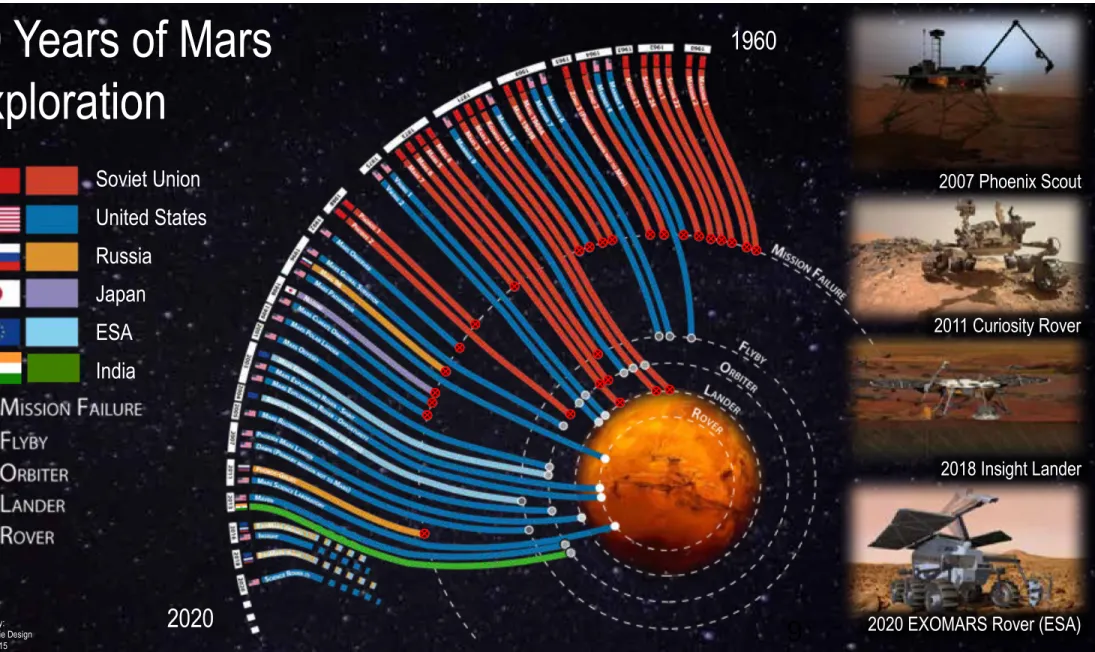
1960
2020
Soviet Union
United States
Russia
Japan
ESA
India
60 Years of Mars
Exploration
2020 EXOMARS Rover (ESA) 2018 Insight Lander 2011 Curiosity Rover 2007 Phoenix Scout
Di
st
an
ce
62 mi
180-300 mi
240,000 mi
Millions mi
36 million mi
Mission Duration
6 Months
12 Months
3 Years
Mars
Near Earth Objects
Unknown
Known
ISS Studies & free flyers in LEO
Ground Studies
Ames is One of the Early NACA Laboratories
NASA
1958
Dryden
1946
Lewis
1940
NACA
Langley
1915
Ames
1939
Joseph S. Ames
NASA Centers and Installations
Armstrong Flight Research Center Jet Propulsion Laboratory Johnson Space Center Stennis Space Center Kennedy Space Center Marshall Space Flight Center Glenn Research Center Langley Research Center Goddard Space Flight Center HeadquartersAmes
Research
Center
78 Years of Innovation
1940
Conical Camber Apollo Guidance System1960
Viking1970
1980
1990
2015
ER-2 Pioneer 10/11 Pioneer Venus Tiltrotor Kuiper Observatory X-36 Air Transportation SystemMars Science Lab SSERVI Lunar Prospector Tektites Lifting Body Swept-Back/Wing Transonic Flow Flight Simulator Apollo Heat Shield Tests Life Sciences Research
1950
Flight Research Blunt Body Concept Apollo Re-Entry Shape Hypervelocity Free Flight Arcjet Research 80x120 Wind Tunnel CFD Astrobiology Institute NASA Research Park Pleiades SOFIA Kepler LCROSS Galileo Nanotechnology LADEE IRIS Aero Institute Space Biology Sustainability Base Quantum Computing ISS Human Centered Computing2000
Ames Research Center
•
Occupants:
• ~1130 civil servants; ~2,100 contractors;1,650 tenants
• 855 summer students in 2016
•
FY2016 Budget: ~$915M (including reimbursable/EUL)
•
~1,900 acres (400 acres security perimeter); 5M building ft
2Core Competencies at Ames Today
Entry Systems
Space and Earth Sciences
Astrobiology and Life Science
Aerosciences
Advanced Computing
& IT Systems
Air Traffic Management
Cost-Effective Space Missions
Air Traffic Management
CMS
Controller-Managed Spacing in Terminal AirspaceTMA-TM
Traffic Management Advisor with Terminal MeteringFIM
Flight Deck Interval Management for Arrival OperationsAir Traffic Demonstration – ATD-1
Entry Systems
MSL Thermal Protection System
Interaction Heating Facility PICA
ADEPT
Intelligent Adaptive Systems
Synchronized Position Hold, Engage Reorient, Experimental SatellitesAstrobee
Free-Flyer
Autonomous nav, docking and recharge, and mobile sensor IVA work on the ISS.
Planetary Lake
Lander
Adaptive science for dynamic phenomena in deep-space missions. Field testing in Chile.
Self
Driving Car
Adapt space robotics technlology to “fleet management” use. Astronauts Self-scheduling And Planning Activity Mission Planning For Crew On ISS Activity Mission
Planning For Mars Scheduling For Planning And Human Robotic
Teams / Future
Distributed Ops Testing
OVEN Reactor Heater Partnering Lander Concept Payload & Drill
Cost-Effective Space Missions @ Ames
Biosentinel
LCROSS (2009)
LADEE (2013)
PhoneSat (2013), EDSN (2013)
TechEdSat-4
Astrobiology and Life Sciences
Advanced Life Support Technologies
Air Revitalization
Water Recovery Waste Recovery
Dry Electrode ECG System
Cell$ Cell$
Cell$ Porous$
Support$Self$repairing$Lipid$Membrane$
Cell$ Feed$Side$ Wastewater$ Cell$ Sacrificial$Fa<y$ $Acid$Biofilm$ OsmoAc$agent$soluAon$ containing$engineered$cells$ that$hyper$express$lipids$and$ fa<y$acids.$ Wastewater$flows$across$ the$membrane$ Na+ ClH$ Na+ ClH$ Na+ClH$ Na+ ClH$ Na+ClH$ Na+ClH$ Na+ ClH$ Na+ ClH$ Na+ ClH$ Na+ ClH$ Na+ ClH$ Na+ClH$ Na+ ClH$ Na + ClH$ Na+ ClH$ Na+ClH$
Synthetic Biology
Regenerable water processing membraneSolar System and Beyond:
Our Journey of Discovery
Exoplanet Biosignatures
NASA Astrobiology Institute
LIFE IN THE UNIVERSE
Icy Worlds: Habitability and
Life Detection
Mars: Habitability of Early Mars Origin and Nature of
Life, Co-evolution with Planet Earth
Technology
:
Technology Drives Exploration
Global Partnerships Employing Collaborative Technologies Rodent Research-1 (SpaceX-4) Experimental cassette for Seedling Growth-2
Space and Earth Sciences
Kepler
SOFIA
2007: CheMin installed in MSL ChemCam SAM In Support of Curiosity REMSColumn Visible Dust Opacity at Ls: 281
-90 -60 -30 0 30 60 90 Latitude -180 -150 -120 -90 -60-30 0 30 60 90120 150 180 E Longitude -90 -60 -30 0 30 60 90 Latitude With Clouds Without Clouds
Understanding
Mars Climate
Global Circulation Model Field Studies in Antartica
Advanced IT and Computing Systems
Large Scale
Visualization
Enterprise Managed
Cloud Computing
Big Data
Analytics
NEXDisruptive Technologies
Quantum ComputingSupercomputing
Systems
Modeling and Simulation
Advanced IT and Computing Systems
KEPLER
Time Critical Computing
Capacity
Computing
Capability
Computing
Biswas, SMC-IT, 28 Sept 2017
Need for Advanced Computing
2 5
Enables modeling, simulation, analysis, and decision-making
• Digital experiments and physical experiments are tradable• Physical systems and live tests generally expensive & dangerous (e.g., extreme environments), require long wait times, and offer limited sensor data
• NASA collects and curates vast amounts of observational science data that require extensive analysis and innovative analytics to advance our understanding
• Decades of exponentially advancing computing technology has enabled dramatic improvements in cost, speed, and accuracy – in addition to providing a predictive capability
• Many problems pose extremely difficult combinatorial optimization challenges that can only be solved accurately using advanced technologies such as quantum computing
• NASA’s goals in aeronautics, Earth & space sciences, and human & robotic exploration require orders-of-magnitude increase in computing capability to enhance accuracy, reduce cost, mitigate risk, accelerate R&D, and heighten societal impact
Advanced Computing Environment
Biswas, SMC-IT, 28 Sept 2017
NASA’s Diverse HPC Requirements
2 7
Aerodynamic database generation
Rotary wing unsteady aerodynamics Real-time hurricane prediction
• Engineering requires HPC resources that can process large ensembles of moderate-scale computations to efficiently explore design space (high throughput / capacity)
• Research requires HPC resources that can handle high-fidelity long-running large-scale computations to advance theoretical understanding (leadership / capability)
• Time-sensitive mission-critical applications require HPC resources on demand (high availability / maintain readiness)
Biswas, SMC-IT, 28 Sept 2017
Balanced HPC Environment
Computing Systems
• Pleiades: 246K-core SGI Altix ICE (now HPE) with 4 generations of Intel Xeon (64 nodes GPU-enhanced: Nvidia M2090, K40; 32 nodes have Phi 5110P); 938 TB RAM; 7.25 PF peak (#15 on TOP500, #10 on HPCG) • Electra: 32K-core Altix ICE with Intel Broadwell; modular container;
147 TB RAM; 1.24 PF peak
• Merope: 22K-core Altix ICE with Intel Westmere; 86 TB RAM; 252 TF peak • Endeavour: Two SGI UV2000 nodes with 2 and 4 TB shared memory SSI
via NUMALink-6; 32 TF peak
• hyperwall: 2560-core Intel Ivy Bridge, 128-node Nvidia GeForce GTX78 cluster for large-scale rendering & concurrent visualization (240M pixels)
Data Storage
• 49 PB of RAID over 7 Lustre filesystems • 490 PB of tape archive
Networks
• InfiniBand interconnect for Pleiades in partial hypercube topology; connects all other HPC components as well
• 10 Gb/s external peering
2 8
Biswas, SMC-IT, 28 Sept 2017
Modular Supercomputing Facility (MSF)
Current HEC Facility
• Limited to 6 MW electrical power of which 25% used for cooling • Open-air cooling tower with four 450 T chillers
Prototype MSF (FY17)
• Modular container currently holds Electra (16 Broadwell-based racks)
• External air fan cooling; switch to adiabatic evaporative cooling when needed • PUE of 1.03 resulting in 93% power savings and 99.4% water use reduction
over our traditional computer floor
• Pad has 2.5 MW of electrical power and can accommodate 2 modules • In production use since Jan ‘17
• Second module being added with 4 E-Cells, bringing Electra to 4.78 PF peak
Full MSF (FY18 – FY22)
• Larger second pad with 30 MW electrical power and associated switchgear • Ability to hold up to 16 modular units (and 1 M cores)
• Flexibility to rapidly modify and react to changes in NASA requirements, computing technology, and facility innovations
2 9
Artist’s rendering of future MSF
Prototype MSF hosting Electra
Integrated Spiral Support Services
3 0
Scientists and engineers plan computational analyses, selecting the best-suited codes to address NASA’s complex mission
challenges
Performance Optimization
NASA Mission Challenges
Computational Modeling, Simulation, and Analysis
Data Analysis and Visualization
NAS software experts utilize tools to parallelize
and optimize codes, dramatically increasing simulation performance while decreasing turn-around time
NAS support staff help users productively utilize HPC resources (hardware, software, networks, and storage) to meet NASA’s needs
NAS visualization experts apply advanced data analysis and rendering techniques to help users explore and understand large, complex computational results
Outcome: Dramatically enhanced
understanding and insight, accelerated science and engineering, and increased mission safety and performance
Biswas, SMC-IT, 28 Sept 2017
Helicopter Rotor Aerodynamics & Aeroacoustics
3 1
Biswas, SMC-IT, 28 Sept 2017
Time-Evolving Global State of Ocean
3 2
Biswas, SMC-IT, 28 Sept 2017
Launch Environment
3 3
Biswas, SMC-IT, 28 Sept 2017
SRB separation from SLS
3 4
Biswas, SMC-IT, 28 Sept 2017
Low Density Supersonic Decelerator
3 5
Biswas, SMC-IT, 28 Sept 2017
NASA Earth Exchange (NEX)
3 6
A virtual collaborative environment that brings scientists and researchers together in a
knowledge-based social network along with observational data, necessary tools, and
computing power to provide transparency and accelerate innovation:
Science-as-a-Service
VIRTUAL
COLLABORATION
Over 650
members
CENTRALIZED
DATA
REPOSITORY
Over 3.5 PB
of
observational
data
SCALABLE
COMPUTING
Heterogene
ous and
remote,
secure
KNOWLEDGE
Workflows,
virtual
machine
images,
model codes,
Biswas, SMC-IT, 28 Sept 2017
Science via NEX
3 7
High-resolution projections for climate
impact studies
Global vegetation biomass at 100m resolution by blending data from 4 different
satellites
High-resolution monthly global data for monitoring crops, forests, and water resources
Machine learning and data mining – moving toward data-driven approaches
Sample publication using NEX environment:
Nature 532.7599 (2016): 357
Biswas, SMC-IT, 28 Sept 2017
Quantum Computing 101
3 8
• Quantum mechanics deals with physical phenomena at very small scales (~100nm) and at very low temperatures (few K) where actions are quantized • The outcome of a quantum experiment is probabilistically associated both with
what was done before the measurement and how the measurement was conducted
• Qubits (quantum bits) can exist in a superposition of states, allowing nqubits to represent 2n states simultaneously
• At the end of a computation, on measurement, the system collapses to a classical state and returns only one bit string as a possible solution
Numerous Implementations
Ion trap with microwave control NIST
NIST
Penning trap in optical lattice
Trapped Ions and Neutral Atoms
Photonic Quantum Chips
University of Bristol
Photonic with optical waveguides
Nanoelectronics, NMR, Diamond Chips, etc.
RWTH
Quantum dots
Molecule spin states in liquid Nitrogen vacancies
in diamond USC
Biswas, SMC-IT, 28 Sept 2017
Quantum Computing for NASA Applications
3 9 Data Analysis and Data Fusion Air Traffic Managemen t
Mission Planning, Scheduling, and Coordination
V&V and Optimal Sensor Placemen t Topologically-aware Parallel Computing Anomaly Detection and Decision Making
Common Feature:
Intractable (NP-hard / NP-complete)
problems!
Objective:
Find “better” solution
• Faster
• More precise
Biswas, SMC-IT, 28 Sept 2017
Quantum Annealing
A physical technique to solve combinatorial optimization problems
• N-bit string of unknown variables {z} • H0: Hamiltonian with known ground state
• HP: Hamiltonian whose ground state represents solution to the problem • Large A(t) responsible for quantum fluctuations slowly (adiabatically) lowered
to zero while maintaining minimum energy of the system at all times • In conjunction, cost function of interest B(t) gradually turned on
• Transitions between states occur via tunneling through barriers due to quantum fluctuations
• Solution is configuration {z} that produces minimum Ewith non-zero probability
• Method similar to simulated annealing where transitions between states occur via jumping over barriers due to thermal fluctuations
4 0 A(t) B(t) Initialize in an easy-to-prepare full quantum superposition E({z},
t
=0) {z} 1Final state a bit-string encoding solution with probability E({z},
t
=1) {z} 3 Quantum states explored by quantum tunneling E({z},t
<1) {z} tunneling 2 Time, t 1 2 3Biswas, SMC-IT, 28 Sept 2017
D-Wave System Hardware
4 1
• Collaboration with Google and USRA via Space Act Agreement led to installation of system at NASA Ames in early 2013
• Started with 512-qubit Vesuvius processor – currently 2031-bit Whistler • 10 kg of metal in vacuum at ~15 mK
• Magnetic shielding to 1 nanoTesla • Protected from transient vibrations • Single annealing typically 20
µ
s• Typical run of 10K anneals (incl. reset & readout takes ~4 sec) • Uses 15 kW of electrical power
Focus on solving discrete optimization problems using quantum
annealing
Magnetic Flux 1 0 Superconducting LoopBiswas, SMC-IT, 28 Sept 2017
Programming the D-Wave System
4 2
2
Embed the QUBO coupling matrix in the hardware graphof interacting qubitsD-Wave qubit hardware connectivity
is a Chimera graph, so embedding methods mostly based on heuristics
Q
ij
=
1
Map the target combinatorialoptimization problem into QUBO
No general algorithms but smart mathematical tricks (penalty functions, locality reduction, etc.)
αijk yijzk+ βijk(3yij−2ziyij−2zjyij+zizj) P ijQijzizj! P ihisi+ P i,jJijsisj
3
Run the problem several times and collect statisticsUse symmetries, permutations, and error correction to eliminate the systemic hardware errors and check the solutions
Probability
Solution’s energy/cost
Mapping not needed for random spin-glass models
Embedding not needed for native Chimera problems
Performance can be improved dramatically with smart pre-/post-processing
Biswas, SMC-IT, 28 Sept 2017
Current NASA Research in Quantum
4 3
Complex Planning and Scheduling
Graph-based Fault Detection 1 2 3 4 5 6 7 8 9 10 11 12 13 14 15 16 17 18 19 20 21 22 23 24 25 26 27 28 29 30 31 32 33 34 35 36 37 38 39 40 41 42 43 44 45 46 0 1 00 1 0 0 01 0 0 01 1 11 Circuit Breakers Sensors Observations Graph Isomorphis m Nu m be r of qubi ts Nu m be r of qubi ts
hbiases (before) correction hbiases after correction
hprog=hspec+hbias
0 Calibration of Quantum Annealers Effect of Noise on Quantum Annealing Optimal Embedding and Parameter Setting
Biswas, SMC-IT, 28 Sept 2017
Advanced Computing Mission
4 4
Enable the science & engineering required to meet NASA’s missions and goals
Advanced technologies
to meet future goals
KEPLER HURRICANES COSMOLOGY SPACE LAUNCH SYSTEM GLOBAL CIRCULATION LAUNCH COMPLEX ROTORCRAFT