2017 2nd International Conference on Computer, Mechatronics and Electronic Engineering (CMEE 2017) ISBN: 978-1-60595-532-2
The Construction of Heterogeneous Platform of Unified Service System
Based on Cloud Computing
Allam MAALLA, Cheng ZHOU and Guang-Yu WU
Research Institute of Open Data Commercial Application, School of Information Technology and Engineering, Guangzhou College of Commerce, Guangzhou, China
Keywords: Intelligent grid information platform, Cloud computing, Distributed storage system.
Abstract. The primary function of intelligent grid information platform is to realize the integration and the optimization of large-scale heterogeneous information and resources, and to provide the data center of resource intensive configuration for smart grid. The platform can set all the business systems together, assign tasks reasonably, and have high concurrent access, fault transfer, fault-tolerant mechanism, buffering mechanism and other functions with distributed lock Manager. It is a unified information platform to meet the modern smart grid.
Introduction
The information system of the power grid is mostly based on the needs of this business or the department. There are different platforms, application systems and data formats, which result in the dispersion of information and resources, the heterogeneity, the horizontal cannot be shared, and the vertical and horizontal difficulties between the upper and lower levels. For example, there are monitoring, control, maintenance, energy management, distribution management, market operation [1], ERP and other information systems in the power system, and most of them are separated from each other and cannot be effectively combined with each other while data information cannot be integrated. The infrastructure of the smart grid information platform for large-scale [2] .large number and in different locations, while running multiple applications. To effectively manage these infrastructures and to reduce the operational costs of data centers are huge challenges Platform Function Description.
Integration Optimization and Virtualization of Heterogeneous Resources
Specific Methods: Distributed Storage System (Open Source HDFS)
Cloud computing can fully integrate the existing business data information and computing resources, the establishment of business collaboration and interoperability of information platform to meet the smart grid of information and resources, a high degree of integration and sharing needs. Unlike the way in which grid computing uses middleware to mask heterogeneous systems, the cloud computing uses a variety of virtualization technologies such as server virtualization [3]. Network virtualization, storage virtualization, application virtualization, and desktop virtualization with different types of Resources abstract into the form of service for different services with different methods to block the infrastructure, operating system and system software differences.
The infrastructure layer of cloud computing uses the virtualized server resources, storage resources and network resources, and can be used and managed by users in the way of infrastructure as a service (IaaS), so that it can be more effective in shielding products difference.
Automated Management of Business Systems
Specific Methods: Massive Data Management System (HBase)
a wide range of enterprise computing is more universal [4]. The expansion of cloud computing technology is very simple, you can directly use the idle x86-based server structures, and don’t need the same server type, significantly reduce construction costs, and virtualization technology with scalability and flexibility to improve resource utilization. Traditional data centers are usually built on a cluster of computers, besides, the hardware accidental damage is inevitable. Cloud computing technology by copying the file in the existence of servers, to solve the hardware accident damage this potential problem. Further, almost all the software and data in the data center for centralized maintenance of cloud computing client devices require a minimum. The maintenance task is almost inexistent.
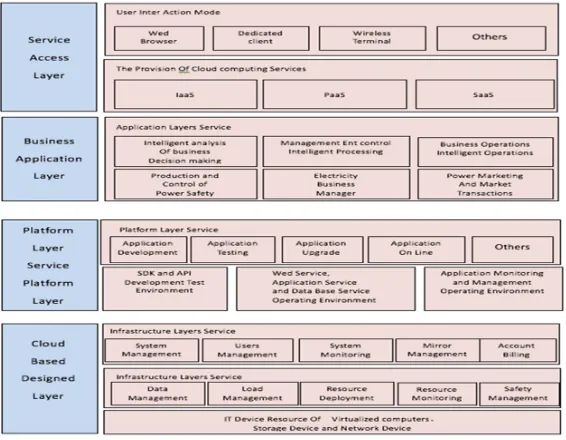
Cloud computing application framework can be divided into service layer, application layer and infrastructure layer. The service layer is the top of cloud computing application framework, the role of the layer is for the cloud service providers and users to provide interactive interface, so that users can get timely access to cloud services related results. The middle layer of the application framework is called the application layer, which provides many common services components, application service interfaces, middle components provided by third parties and so on. The core level of cloud computing application service is the application layer, which provides the necessary support for the user's various service requirements. The infrastructure layer is at the bottom of the application framework, which aggregates the software resources and hardware resources that support cloud computing, providing users with a variety of information processing services such as computing, communication and storage.
Reasonable Allocation of Loads
At present, the server’s utilization is not very high, the load of each server is seriously unbalanced, how to properly allocate the server load task is related to the normal operation of the system, especially in the increasingly large number of data tasks in the field of modern smart grid, Load distribution is even more critical and important.
Specific Methods: Open Source Xen Virtual Machine
Load balancing is one of the key support technologies which can improve system resource utilization. Cloud computing is according to the strategy or algorithm to make the virtual machine reasonable allocation to the corresponding resources, so that the system will run normally. When the load of the system is imbalanced, the dynamic management mechanism of the virtual machine will dynamically move the load of the node, so as to realize the load balancing. Load balancing is consistent with the goal of unified management and scheduling of cloud computing resources. Therefore, the efficient implementation of load balancing will be able to improve the system's resource utilization. Server consolidation technology can also further improve the utilization of resources. It is usually the use of energy-based virtual machine migration technology will be scattered on multiple servers on the virtual machine integrated into the same server, so that other idle servers can be directly closed or set to energy-saving state, thereby improving the system's resource utilization. Xen's virtual machine dynamic migration process migrates all the information contained in the virtual machine. And important information on it includes memory, network and storage and other information. The entire virtual machine live migration among the most difficult is the migration of memory, because the memory of them is not only informative, but also to change the time.
Distributed Lock Manager
Specific Method: Lust Locks Manager
Luster file system is a high performance, high reliability and scalability, for next-generation object-based distributed file system is stored. It provides synchronous access and consistent views for shared resources across the system through the Luster Distributed Lock Manager (LDLM) technology. The Luster DLM model uses Lock Namespace to organize and manage shared resources and locks on resources. When you get a resource lock, you first name the resource in the lock namespace. Any resource belongs to a lock resource namespace, and has a corresponding parent resource (except for root resources, whose parent resources are typically set to 0). Each lock resource has a resource name which is unique to its parent node. All lock resources make up a lock resource tree structure. When you want to get a resource lock, the system must first get a lock from all ancestors of the resource. In the Luster lock manager, each resource in the lock namespace maintains three lock queues:
(1) Authorization lock queue: This queue contains all locks that have been authorized by the lock manager, but are being converted to locks that are not compatible with the authorized lock mode, and the lock holder of the queue can access the resource.
(2) Conversion lock queue: The lock of the queue has been authorized, but the lock mode attempted to be converted is not compatible with the lock mode in the current authorization queue and is waiting for other locks to release or lower access. The lock manager processes the locks in the conversion queue in the order of the FIFO.
(3) Wait for a lock queue: The queue contains all new lock requests that are waiting for authorization. The lock mode in the queue is not compatible with the authorized lock mode. The lock manager processes the locks in the waiting queue in the order of the FIFO.
Platform Structure Block Diagram
Cloud Computing Architecture
As shown in the following figure, the system of smart grid information platform based on cloud computing is mainly composed of the following four parts:
[image:3.612.165.448.495.715.2]1) Cloud computing infrastructure layer 2) cloud computing platform layer 3) Business application layer 4) Service access layer
Figure 1. The architecture of smart grid information platform based on cloud computing.
platform for data communication, to protocol implementation and resource management and other functions, thus building a flexible, high availability and energy saving features such as cloud computing platform architecture.
Figure 2. Cloud platform basic structure Log management.
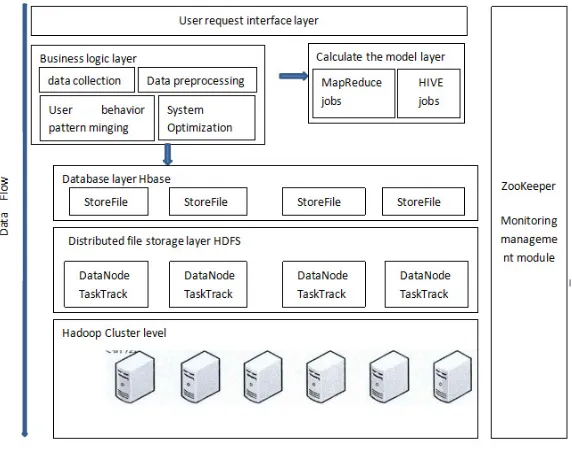
According to the log processing process, it can be divided into log collection, log preprocessing, and log analysis and so on. The massive log analysis system is shown below.
Figure 3. Mass log analysis system.
Massive log analysis platform frame design shown above, the cluster is divided into hardtop resource layer, the distributed file storage layer, a database layer, a calculation model, business logic, user request interface layer, a distributed management system monitoring.
For the user to use the search engine can obtain two kinds of log information: The first category is to retrieve the relevant log, that is, the user's network retrieval behavior related to the log, including the search site source, user retrieval time, source IP address, query inches, search keywords, and so on; Includes the system and browser that the user uses, the IP address of the user, the search portal, the order of results returned by clicking, etc. The specific flowchart is as follows:
[image:4.612.166.452.360.587.2]Summary
The primary function of intelligent grid information platform is to realize the integration and optimization of large-scale heterogeneous information and resources, and to provide the data center of resource intensive configuration for smart grid. The platform can set all the business systems together, assign tasks reasonably, and have high concurrent access, fault transfer, fault-tolerant mechanism, buffering mechanism and other functions with distributed lock Manager. It is a unified information platform to meet the modern smart grid.
Acknowledgement
This research was financially supported by Characteristic Key Subject of E-commerce Construction Project of Guangzhou College of Commerce Foundation, project No. TSZDXK201601.
Reference
[1] Maalla A (2016) Construction of Information Ecosystem on Enterprise Information Portal (EIP). J Electr Electron Syst 5: 205. doi:10.4172/2332- 0796.1000205 .
[2] Swaroop D, Hedrick JK, Chien C, Ioannou P (2005) A comparison of spacing and headway control laws for automatically controlled vehicles. Vehicle System Dynamics Journal 23: 597-625.
[3] Tambe M (2007) Towards flexible teamwork. Journal of Acritical Intelligence Research 7: 83-124.
[4] Tambe M, Zhang W (2013) Towards flexible teamwork in persistent teams: extended report. Journal of Autonomous Agents and Multi-agent Systems, special issue on Best of ICMAS 98(3): 159-183.