6
I
January 2018
Qualitative and Quantitative Analysis of the Stem
of Pergularia daemia
R. Nithyatharani1, U.S. Kavitha2
1
Assistant Professor, Cauvery College for Women, Trichy, Tamil Nadu, India-620 018 2
Cauvery College for Women, Trichy, Tamil Nadu, India-620 018
Abstract: Medicinal plants are a pride of our nature. It is estimated that there are more than 45,000 species of medicinal plant
present in India. One such traditionally used ethanomedicinal plant is Pergularia daemia. It is a hispid perennial twinning herb distributed in the roadsides of tropical and sub tropical regions. The whole plant possess more medicinal values and traditionally used in the treatment of various ailments. The present study involves to determine the qualitative and quantitative analysis of stem of Pergularia daemia in different solvents like methanol, ethanol, chloroform, petroleum ether and aqueous. The results of which showed the presence of alkaloids, steroids, terpenoids, flavanoids, saponins, phenols, tannins, aminoacids, cardiac glycosides, carbohydrates and proteins. The quantification of the compounds like alkaloids, flavanoids and phenols were estimated. The result confirms that the stem of Pergularia daemia possess significant phytocomponents as mentioned in traditional claims and highlights it as the source of many pharmacological studies and a curative for various ailments.
Keywords: Pergularia daemia, Stem, Phytochemical screening, Medicinal plant, Solvents
I. INTRODUCTION
Medicinal plants are the gift to human beings to lead a disease free healthy life [1]. They play a significant role in maintaining our human health. According to World Health Organization, approximately 80% of the population currently uses herbal medicine [2]. The prime reason is that the other systems of medicine have number of side effects. Plant based system of medicine does not possess serious problems. One such traditionally used plant is Pergularia daemia.
Pergularia daemia is a slender, hispid, fetid smelling lactiferous herb [3] found in tropical and sub tropical regions. It belongs to Asclepiadaceae family which include more than 2000 species [2]. It is popularly known as “Veliparuthi” in Tamil and “Hariknot” in English. This plant has been used in the traditional medicine for wide range of ailments. The whole plant is used as anti-helminthic, anti-pyretic, as a laxative, expectorant and to treat infantile diarrhoea. Each part of the plant possesses various therapeutic properties. Shoots of the plant are used commonly to treat whooping cough [4]. The latex from the stem is used to treat veneral diseases, arthritis, muscular pain, asthma and rheumatism [5]. The bark of the stem is used in the treatment of cold [6] and diarrhoea in infants [7]. It also possesses antipyretic properties [8] and analgesic activity [9]. The aim of this study is to identify the phyto compounds of the stem of Pergularia daemia in different solvents like Ethanol, Methanol, Petroleum Ether, Chloroform and Aqueous both qualitatively and quantitatively.
II. MATERIALS AND METHODS
A. Collection of plant sample
The fresh leaves were collected from Tirukoilur, Villupuram district, Tamilnadu, India.
B. Preparation of the extract
The leaves of Pergularia daemia were washed thoroughly in tap water to remove dust particles. The leaves were then dried in shade at room temperature and coarsely powdered by a mechanical grinder. The dried powdered sample was soaked in different solvents like methanol, ethanol, chloroform and petroleum ether for 3 to 5 days. Aqueous extract of the leaves were also prepared by soaking the dried powder in distilled water. After 5 days, the extracts were filtered using No.1 Whatman filter paper and stored in air tight container for further analysis.
C. Qualitative analysis of phytochemicals
1) Test for alkaloids (Mayer’s test): To 1ml of extract, 1 ml of Mayer’s reagent (Potassium iodide solution) was added. Formation of whitish yellow or cream coloured precipitate indicates the presence of alkaloids.
2) Test for steroids (Libermann Burchard test): To 1ml of extract, 2ml of acetic anhydride and 2ml of concentrated sulphuric acid were added. Formation of violet to blue or green colour indicates the presence of steroids.
3) Test for terpenoids (Salkowski test): To 1 ml of extract, 2ml of chloroform and few drops of sulphuric acid were added. Formation of reddish brown ring indicates the presence of terpenoids.
4) Test for flavanoids (Alkaline reagent test): To 1 ml of extract, few drops of dilute ammonium solution and few drops of concentrated hydrochloric acid were added. A yellow colouration indicates the presence of flavanoids.
5) Test for saponins (Froth test): To 1 ml of extract, 5 ml of distilled water was added and shaked vigorously. Formation of froth indicates the presence of saponins.
6) Test for phenols (Lead Acetate test): To 1ml of extract, 1 ml of lead acetate solution was added. Formation of precipitate indicates the presence of phenols.
7) Test for tannins (Lead acetate test): To 1ml of extract, 1ml of lead acetate was added. A formation of white precipitate indicates the presence of tannin
8) Test for tannins (Ferric chloride test): To 1ml of extract, 1ml of ferric chloride solution was added. Formation of blue, black or brownish green colour indicates the presence of tannins.
9) Test for cardiac glycosides (Keller killiani test): To 1ml of extrct, 5ml of distilled water was added and evaporated to dryness. Then to the Sample 2ml of glacial acetic acid containing trace amount of ferric chloride solution was added. Then 1ml of concentrated sulphuric acid was added along the sides of the tube. Formation of brown ring underlayed with blue colour indicates presence of cardiac glycosides.
10) Test for aminoacids (Ninhydrin test): To the 1ml of sample, 3 to 4 drops of Ninhydrin solution was added and boiled in water bath for 10 minutes. Formation of purple or blue colour indicates the presence of amino acids.
11) Test for proteins (Biuret test): To the 1ml of extract, 1ml of 40% sodium hydroxide solution and 2 drops of 1% copper sulphate solution were added. Formation of violet colour indicates the presence of proteins.
12) Test for carbohydrates (Barfoed test): To the 2ml of extract, 1ml of Barfoed’s reagent was added and boiled in water bath for few minutes. Formation of reddish brown precipitate indicates the presence of carbohydrates.
13) Test for reducing sugars (Fehling’s test): To the 1ml of extract, equal quantities of Fehling solution A and B were added and heated. Formation of brick red precipitate indicates the presence of reducing sugars.
D. Quantitative estimation of phytochemicals
1) Alkaloid determination: 5 gm of sample was added to 200 ml of 10% acetic acid in ethanol in a beaker. The beaker was tightly covered and allowed to stand for 4 hours. This was filtered and the extract was concentrated on a water bath to one quater of the original volume. The entire solution was precipitated by the drop wise addition of concentrated ammonium hydroxide solution. The precipitate was collected and washed with dilute ammonium hydroxide and filtered. The residue is alkaloid, which was dried and weighed [10]
2) Flavanoid determination: 10 gm of sample was added to 100 ml of 80% aqueous methanol in a beaker. The whole solution was filtered through Whatman filter paper No.42 (125mm). The filtrate was then evaporated to dryness and weighed [10].
3) Determination of total phenols: Few grams of sample were boiled with 50 ml of ether for 15 minutes for the extraction of phenols. To the 5ml of extract, 10 ml of distilled water, 2ml of ammonium hydroxide solution and 5ml of concentrated amyl alcohol were added. The samples were left for 30 minutes. This was measured at 505 nm [10].
III. RESULTS AND DISCUSSION
TABLE 1
QUALITATIVE ANALYSIS OF STEM OF PERGULARIA DAEMIA
Tests Methanol Ethanol Petroleum ether Chloroform Aqueous
Alkaloid + + - + +
Steroids + + + + +
Flavanoids + + - + +
Terpenoids - - + - -
Saponins - - + - -
Phenols + - - - -
Tannins + + - - -
Cardiac glycosides
+ - - - +
Aminoacids + + + + +
Proteins + + + + +
Carbohydrates - - - - -
[image:4.612.77.541.410.623.2]Reducing sugars + + + + +
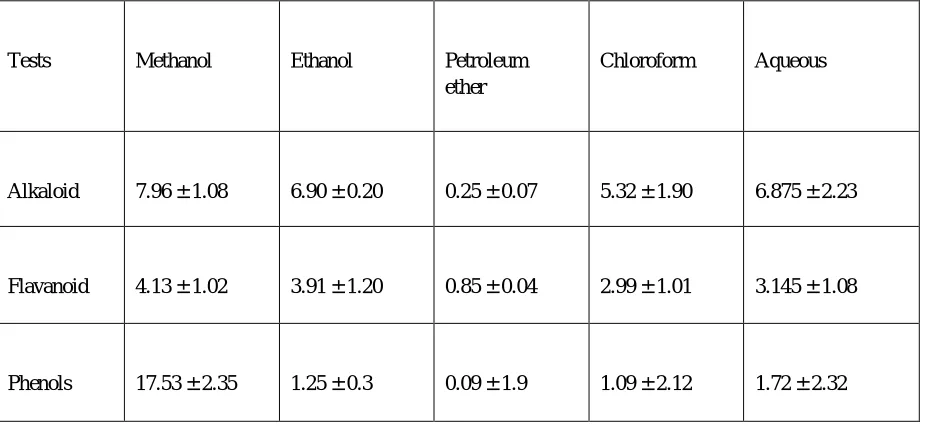
Table 2 shows the quantitative analysis of stem of Pergularia daemia
Tests Methanol Ethanol Petroleum
ether
Chloroform Aqueous
Alkaloid 7.96 ± 1.08 6.90 ± 0.20 0.25 ± 0.07 5.32 ± 1.90 6.875 ± 2.23
Flavanoid 4.13 ± 1.02 3.91 ± 1.20 0.85 ± 0.04 2.99 ± 1.01 3.145 ± 1.08
Phenols 17.53 ± 2.35 1.25 ± 0.3 0.09 ± 1.9 1.09 ± 2.12 1.72 ± 2.32
IV. CONCLUSION
REFERENCES
[1] Archana Sharma, R. A. Sharma, and Hemalatha singh, “Phytochemical and Pharmacological Profile of Abutilon indicum L. Sweet: A Review”, International Journal of Pharmaceutical Sciences Review and Research, Vol. 20, pp. 120-127, Jun 2013.
[2] K. Karthishwaran and S. Mirunalini, “Therapeutic Potential of Pergularia daemia (Forsk.): The Ayurvedic Wonder”, International Journal of Pharmacology, Vol. 6, pp. 836-843, 2010.
[3] A. Doss and S. P. Anand, “Antihyperglycemic activity of methanol and aqueous extracts of Pergularia daemia Linn”, African Journal of Biotechnology, Vol. 13(1), pp.170-174, Jan.2013.
[4] J. O. Kokwaro, “A review of research on plants for fertility regulation in Africa. Proc who symposium on plant-derived products for fertility regulation”, Seoul, Korea February, pp.8, 1981.
[5] P. Van Damme, V. V. Den Eynden and P. Vernemmen, “Plant uses by the topnaar of the kuiseb valley, Namib desert”, Afrika focus, Vol. 8, pp. 223-252, 1922. [6] O. B. Dokosi, Herbs of Ghana, Ghana universities Press, Accra, Ghana, pp. 746, 1998.
[7] T. T. Nguyen, E. Tran, C. K. Ong, S. K. Lee and P. T. Do et al, “Kaempferol-induced growth inhibition and apoptosis in A549 lung cancer cells is mediated by activation of MEK-MAPK”, Journal of cell physiology, Vol.197, pp. 110-121, 2003.
[8] N. G. Sutar and S. C. Pal, “Finger printing analysis of the flavanoid from leaves Pergularia daemia using HPTLC analysis”, Journal of Pharmacognosy and Phytochemistry, Vol. 3(5), pp. 157-161, Jan 2015.
[9] V. Kishor Kumar, P. Satheesh Kumar, and T. Venkatachalam, “Investigation of antihelminthic activity of Pergularia daemia leaves”, Pharmacophore, Vol. 5(1), pp. 44-48, 2014.
[10] C. K. Kokate, Practical pharmacognosy, Vallabh Prakashan, New Delhi, 1st ed., pp.15-30. 1986.
[11] J. B. Harborne , Phytochemical methods, Chapman and Hall limited, London. Pp 49 – 189, 1980.
[12] Karthiswaran K, Mirunalini S, Dhamodharan G, Krishnaveni M, Arulmozhi V, Journal of biological sciences, Vol. 10 pp. 242-246, 2010.
[13] S. Cherian, K. T. Augusti, “Insulin sparing action of leucopelargonidin derivative isolated from Ficus bengalesis linn”, Indian journal of experimental biology, Vol. 33, pp.608-611, 1995.