Technology (IJRASET)
QOS Aware Routing Protocol For
Wireless Sensor Networks
Priya Devi1, Dr. Sanjay Kumar Malik2 1
M.tech (CSE), 2CSE , Deptt Hindu College of Engineering, Sonepat, India
Abstract— Wireless Sensors Network is used to monitor Health Monitoring, Military application, Pollution control, agriculture field etc. with limited energy resources. Various energy efficient Quality of Service (QoS) aware routing protocols are available to send sensed information to Base Station (BS).The sensor nodes have limited transmission range, their storage capabilities and as well as their processing capabilities are also limited. So, QoS routing become an important issue. Also, one is to know how to gather sensed information in energy efficient way in Wireless Sensor Networks (WSNs). In this paper, we proposed a QoS aware routing protocol for WSNs as Clear Headed Multi Hop Protocol (CHMHP) for Wireless Sensor Networks. It provides large stability period and minimum energy consumption of nodes; contribute to high throughput by applying residual energy cost function to select a relay node which has high residual energy and minimum distance to sink. It uses multi-hop topology to achieve minimum energy consumption and longer network lifetime. Hence, our proposed protocol maximizes the network stability period as the nodes stay alive for longer period.
Keywords---- QoS, Residual Energy cost function, Relay Node, CHMHP, WSNs.
I. INTRODUCTION
A wireless sensor network is a group of sensors that are geographically distributed and interconnected by wireless networks. Sensors get information about physical world. In the traditional, wire-based networks, applications often concern about data transport between two specific nodes. While in typical applications of WSNs, the data sensed about event or target is reported by a group of sensors which is quite different from the traditional end-to end model [1]. The use of wireless sensor networks is increasing day by day and at the same time it faces the problem of energy constraints in terms of limited battery lifetime. As each node depends on energy for its activities, this has become a major issue in WSNs [2]. The failure of one node can interrupt the entire system or application. Every sensing node can be in active {for receiving and transmission activities}, idle and sleep modes. In active mode, nodes consume energy when receiving or transmitting data. In idle mode, the nodes consume almost the same amount of energy as in active mode, while in sleep mode, the nodes shutdown the radio to save the energy. So, the main objective for WSNs is to prolong the lifetime of the networks as it senses information and delivers it to the sink. As the main power source in WSNs, batteries cannot be replaced due to cost or remote environment. Therefore, the design, implementation and operation of WSNs require the integration of many disciplines. Unlike other networks, WSNs connect end-users directly to the physical world in order to provide information that is precisely determined in time and space according to the needs and demands of users. However, the specific consideration of the unique properties of sensor networks such as limited battery power, bandwidth, and large scale deployment etc. are challenges in the design of sensor networks.
So, QoS of any particular network can be considered as its ability to deliver an assured level of service to its users and/or applications. Due to resource constraints as memory, processing power, power source and bandwidth in sensor networks, QoS support in WSNs is a challenging task [3]. QoS in WSNs can be characterized by energy efficiency, reliability, availability, robustness, and security, among others. However, QoS requirements in WSNs such as aggregation delay, coverage, fault tolerance data accuracy, and network lifetime etc. are application specific and they are different from the traditional end-to-end QoS requirements due to the difference in application domains and network properties [4].
Therefore, we propose a protocol that supports QoS requirements for WSNs which is named as Clear Headed Multi Hop Protocol (CHMHP). CHMHP uses a relay node concept which is selected by applying the residual energy cost function. Here, a relay node is a node within a field which have maximum energy and minimum distance from the sink node by using multi hop topology. Relay node is always in the range of sink node that collects data from all other sensor nodes and forward it to sink node. Our purposed protocol improves the QoS requirements for WSNs as compared to other protocols. The comparison of our proposed protocol with other protocols is shown in simulation results.
II. RELEATED WORK
Technology (IJRASET)
WSNs is challenging due to decentralized and dynamic nature of WSNs. Moreover, limited energy of nodes and low bandwidth wireless links are the limitations in designing efficient routing protocols. Routing in WSNs has been the focus of research in the networking community due to their immense potential for various real world civil and military applications. Therefore, a number of routing protocols based on different design have been proposed for WSNs.
Sequential Assignment Routing (SAR) is the first routing protocol to provide QoS support in WSNs. This is a multi path, table driven routing protocolwhich tries to achieve both faulttolerance and recovery [3]. Assumingmultiple paths to the sink node, each sensor uses a SARalgorithm for path selection. It takes into account the energyand QoS factors on each path, and the priority level of a packet [5]. This protocol creates a tree of sensor nodeshaving root at one hop neighbour of the sink node. Using the createdtree,
multiple paths are selected based on the energy resourceand QoS on each path. The shortcomings of the protocol are the overhead
of maintaining routing tables andstates at each sensor node particularly when the numberof sensor nodes deployed is large.
SPEED is based on geographic information and provides a soft real-time end to-end routing. It provides three types of real-time services, these are real-time nicest, real-time area-multicast and real-time area-anycast [6]. Each node in this protocol maintains information about its neighbours and it utilizes geographic forwarding technique to find a path. It also tries to maintain a certain delivery speed for each packet in the network. SPEED maintains this speed by diverting the traffic at the network layer and regulating the traffic sent to the MAC layer locally. To some extent, it achieved the end-to-end transmission rate guarantee, network congestion control and load balancing [3].
Multi-path and Multi-SPEED (MMSPEED) is across-layer routing protocol, it achieved routing based on reliability and the minimum packet time of arrival, and proposed a routing metric called On-Time Reachability [6]. This protocol is an extension of SPEED providing multi path multi speed of packets across the network. MMSPEED routing protocol supports probabilistic QoS guarantee by provisioning QoS in two domains, timeliness and reliability. The protocol involves data being allocated to the correct speed layer to be positioned in the best queue in accordance to own speed classification. Then data are employed in the FCFS policy, to enable high priority packets are executed first before low priority packets takes their turn [7]. MMSPEED might use its redundant path selection scheme for load balancing, which is not only for reliability enhancement, but also to improve the overall network lifetime.
LEACH is the most popular hierarchical model which works by forming the clusters. It is based on the idea of an iterative randomized selection of CH in order to distribute the load of CH among nodes. Thus, it maximize the lifetime of the network. In which nodes transmit information to their cluster heads, and the cluster heads aggregate and compress the data and forward it to the base station (sink). Each node uses a stochastic algorithm at each round to determine whether it will become a cluster head in this round [13]. LEACH also uses CDMA so that each cluster uses a different set of CDMA codes, to minimize interference between clusters.
III. PROPOSED ALGORITHM
In our algorithms, we consider event-driven wireless sensor network, assuming that every sensor node in the network has a unique ID. The sensors may have different quality with different signal-to-noise ratio and different memory capability, and all of them have limited processing power and can only make a basic decision on an event. All the nodes have very limited energy and thus how to prolong the life of sensors is an important issue. We also assume that all the sensor nodes can work as senders and receivers, having bidirectional communication. Our approach is based on the following observations.
A. Assumptions
Consider the following problem:
From a set of N network nodes, each node is independently randomly placed on a two-dimensional simulation area A. A uniform
random distribution is used, such that with Poisson process for large N and large A, one can define a constant node density. To model the wireless transmission between the nodes, a radio link model is assumed in which each node has a certain transmission range r. Two nodes are able to communicate directly via a wireless link if they are within the range of each other. In the transmission space, the homogenous transmission range guarantees that all links are bidirectional. All nodes are free to move in the system area according to a certain mobility model e.g. random waypoint, random direction, street model, etc.
B. Algorithm Description
Technology (IJRASET)
graph form source to sink node by multi-hop we find the shortest path using distributed Bellman Ford shortest path algorithm. After finding shortest path, we find minimum exposure path according to its minimum weight. Before sending the packet from source to destination, we choose the relay node which has maximum residual energy within the region. When shortest path is created, we start the transmission by implementing binary search according to minimal edge weight.
Large stability period and minimum energy consumption of nodes, contribute to high throughput. It uses multi-hop topology to achieve minimum energy consumption and longer network lifetime. This scheme proposes a cost function to select parent node or forwarder. Proposed cost function selects a relay node which has high residual energy and minimum distance to sink. Residual energy parameter balances the energy consumption among the sensor nodes while distance parameter ensures successful packet delivery to sink. Simulation results show that our proposed protocol maximizes the network stability period and nodes stay alive for longer period. Longer stability period contributes high packet delivery rate to sink which is major interest for continuous monitoring.
C. Data Collection And Distribution
(Transmission from Si to Sj is successful iff the following are true :) j is in range, that is d (i, j) ≤ r, where d (i, j) is the distance between Si and Sj j is not, itself, transmitting in this time slot
There is no interference from other transmissions in the direction of j. Formally, every Sk, k ≠ i, that is transmitting in this time slot in the direction of Sj is out of range. Here, out of range means d (k, j) ≥ (1 + δ) r, where δ > 0 is an interference constant.
D. Cost Function Formula
On the basis of this cost function, each node decides whether to become forwarder node or not. If i is number of nodes than cost function of i nodes is computed as follows:
C.F (i) = d (i)/RE (i) ……… (1)
Where d(i )is the distance between the node i and sink, RE(i) is the residual energy of node i and is calculated by subtracting the current energy of node from initial total energy. A node with minimum cost function is preferred as a forwarder. All the neighbour nodes stick together with forwarder node and transmit their data to forwarder. Forwarder node aggregates data and forward to sink. Forwarder node has maximum residual energy and minimum distance to sink; therefore, it consumes minimum energy to forward data to sink
E. Path Loss
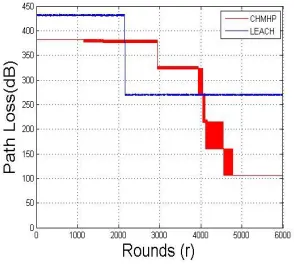
Path loss is a function of frequency and distance. Path loss shown in Figure 6 below is function of distance. It is calculated from its distance to sink with constant frequency 2.4 GHz. We use path loss coefficient 3.38 and 4.1 for standard deviation σ. The proposed
multi-hop topology reduces the path loss as shown in figure. It is due to the fact that multi-hop transmission reduces the distance, which leads to minimum path loss. Figure 6 represents the results of both topologies. Initially CHMHP protocol performs well. However, after 2000 rounds, path loss of LEACH dramatically decreased because some nodes of LEACH topology die. Minimum number of alive nodes has minimum cumulative path loss. As our proposed protocol has longer stability period and more alive nodes has more cumulative path loss.
F. Path Loss Model
Path loss represents the signal attenuation and is measured in decibels (dB). Signal power is also degraded by Additive White Gaussian Noise (AWGN). Path loss is the difference between the transmitted power and received power whereas antenna gain may or may not be considered. Path loss occurs due to the increasing surface area of propagating wave front. Transmitting antenna radiates power outward and any object between transmitter and receiver causes destruction of radiated signal. In CHMHP, different area postures, movement of nodes, obstacle and interference, affects the transmitted signal. Path loss is related to the distance and frequency and expressed as:
PL(f,d)=PL(f)× PL(d) ….. (2)
Technology (IJRASET)
(PL(f))/fk … (3)Where k is frequency dependent factor and it is related to the geometry of the field. The relation of distance with path loss is given as:
PL(f,d)=PLo+10nlog10d/do+ Xσ …. (4)
Where PL is received power, d is the distance between transmitter and receiver, do is the reference distance, n is the path loss coefficient and its value depends on the propagation environment. In free space its value is 2, for WSNs, n varies from 3-4 for line of sight (LOS) communication and 5-7.4 for non line of sight (NLOS) communication. X is Gaussian random variable and σ is
standard deviation. PLo is received power at reference distance do and it is expressed as:
PLo = 10log10 (4π × d × f)2/c ………….. (5)
Where f is frequency, c is speed of light and d is distance between transmitter and receiver. The value of reference distance do is 10cm. In reality it is difficult to predict strength of signal between transmitter and receiver boundary. To solve this issue, we use a
deviation variable Xσ.
IV. PERFORMANCE EVALUATION
We present and discuss in this section our simulation results for the performance study of our CHMHP protocol.
Table1 1: Simulation parameters
Nodes 200
Area 1000mX1000m
Packet Size 32bytes
Energy Transmission(ETx)
167*10^-6 kj
Energy Received(ERx)
0.361*10^-7 kj
Emp 1.97*0.000000001
EDA 5*0.000000001
Topology Dynamic
Rounds 0, 1000, 2000,
3000,4000 5000, 6000
Technology (IJRASET)
[image:6.612.229.376.499.631.2]Figure 1: No. of dead nodes vs. Rounds(r).
Figure 2: Packets send to sink vs. Rounds(r).
Figure 3: Residual energy(J) vs. Rounds(r).
Figure 4: Path Loss (dB) vs. Rounds(r)
Technology (IJRASET)
Simulation results show that around 4050 rounds, both techniques are relatively equal in amount of energy consumption, after that CHMHP loses energy quickly till 5875 rounds and after that it shows more stability till the complete energy is utilized at 7345 round as compared to 7200 rounds in LEACH. So, CHMHP maximizes the network stability period as the nodes stay alive for longer period.
V. CONCLUSION
The goal of this research is to provide energy efficient QoS aware routing protocols for Wireless Sensor Networks (WSNs). The comparative analysis of recent QoS aware routing protocols for WSNs has been done for the first time, to the best of our knowledge. The proposed scheme uses a cost function to select appropriate route to sink. Cost function is calculated based on the residual energy of nodes and their distance from sink. Relay node for monitoring forward their data direct to sink as they are placed near sink. Our simulation results shows that proposed routing scheme enhance the network stability time and packet delivered to sink. Path loss is also investigated in this protocol. So, large stability period and minimum energy consumption of nodes, contribute to high throughput and increases network lifetime.
REFERENCES
[1] LIN Xiao-zhu, ZHOU Jue-jia, IEEE, MU Chun-di, , “Collective Real-Time QoS in Wireless Sensor Networks”, IEEE, pp. 1-4, 2006.
[2] V. Raghunathan, C. Schurgers, S. Park, and M. B. Srivastava, “Energy-Aware wireless Microsensor Networks”, IEEE Signal Processing Magazine, 19 (2002), pp 40-50.
[3] Bhaskar Bhuyan, Hiren Kumar Deva Sarma, Nityananda Sarma, Avijit Kar, Rajib Mall, “Quality of Service (QoS) Provisions in Wireless Sensor Networks and Related Challenges”, vol. 2, no. 11 , pp. 861-868, 2010.
[4] V Naveen Kumar, K Siva Sankar, L.Srinivasa Rao & Dr. I.Santhi Prabha, “Comparative Analysis of QoS-Aware Routing Protocols for Wireless Sensor Networks”, IISTE, Vol. 3, no. 4, pp.6, 2012.
[5] R.Sumathi and M.G.Srinivas, “A Survey of QoS Based Routing Protocols for Wireless Sensor Networks”, J Inf Process Syst, Vol.8, No.4, December 2012 [6] Cao Shasha, Ke Zongwu & Chen Niansheng, “Research of QoS Routing Technology for Wireless Multimedia Sensor Network” ISECS International, no. 4, pp.
334-337, 2009
[7] 1adulaleem Ali Almazroi, Ma Ngadi, “A Review on WSNs Routing Protocol: Challenges in Multipath Techniques” Journal of Theoretical and Applied Information Technology,Vol. 59 No.2, pp. 469-509,2014
[8] C.E. Perkins and E. M. Royer, “Ad hoc On-Demand Distance Vector Routing”, IEEE Workshop on Mobile Computing Systems and Applications, New Orleans, LA, pp. 90-100, 1999.
[9] Y. Zhang, M. Fromherz and L. Kuhn, “RMASE: Routing Modeling Application Simulation Environment”, http://www.parc.com/era/nest/Rmase, 2009. [10] O. Chipara, Z. He, G. Xing, Q. Chen, X. Wang, C. Lu, J. Stankovic and T. Abdelzaher, “Real-time Power-Aware Routing in Sensor Networks”, IEEE
International Workshop on Quality of Service(IWQoS’06), New Haven, CT, USA, pp. 83-92, 2006.
[11] T. He, J. A. Stankovic, C. Lu and T. Abdelzaher, “SPEED: A Stateless 168 Protocol for Real-Time Communication in Sensor Networks”, Proceedings of the 23rd International Conference on Distributed Computing Systems, Providence, RI, USA, pp. 46-55, 2003.
[12] M. Hamid, M. Alam and C. S. Hong, “Design of a QoS-Aware Routing Mechanism for Wireless Multimedia Sensor Networks”, Proceedings of IEEE International Conference Global Telecommunications (GLOBECOM’08), New Orleans, LA, USA, pp. 800-805, 2008
[13] Shio Kumar Singh, M P Singh, and D K Singh, “Routing Protocols in Wireless Sensor Networks –A Survey”, International Journal of Computer Science & Engineering Survey (IJCSES) Vol.1, No.2, pp.63-83, 2010
[14] Neha Rathi, Jyoti Saraswat and Partha Pratim Bhattacharya, “A Review on Routing Protocols for Application in WSNs”, International Journal of Distributed and Parallel Systems (IJDPS), Vol.3, No.5, pp.39-58, September 2012