Technology (IJRASET)
Mobility-Based Auspicious Network Management
K.VasanthaMary1, R.Uma Mageswari2 M.Tech
1
II year M.E (CSE Dept), 2Assistant Professor Department of CSE, National college of Engg, Maruthakulam.
Abstract- Amidst of the growing impact of wireless sensor networks (WSNs) on real world applications, numerous schemes have been proposed for collecting data on multipath routing, tree, clustering, and cluster tree. Effectiveness of WSNs only depends on the data collection schemes. Existing methods cannot provide a guaranteed reliable network about mobility, traffic, and end-to-end connection, respectively. To mitigate such kind of problems, a simple and effective scheme is proposed, which is named as Start-State and Steady-State Cluster tree(SSSSCT) scheme for data collection in WSNs is proposed which would effectively mitigate the problems of coverage distance, mobility, delay, traffic, tree intensity and end-to-end connection. It simply collects the data packet from the cluster head and delivers it to the sink Start-State and Steady-State Cluster tree constructs the Data Collection Tree based on the cluster head location. This is algorithm is to construct a simple tree structure, thereby reducing the energy consumption of the cluster head and avoids frequent cluster formation. It also maintains the cluster for a considerable amount of time. Simulation results have demonstrated that Start-State and Steady-State Cluster Tree(SSSSCT) provides better QoS in terms of energy consumption, throughput, end-to-end delay, and network lifetime for mobility-based WSNs.
Keywords— Start-State and Steady-State Cluster Tree
I. INTRODUCTION
WSNs have recently come into prominence because they hold potential to revolutionize many segments of our economical life, environmental monitoring, health care applications, infrastructure protection, context-aware computing, and battlefield awareness. The strength of WSNs lies in their flexibility, energy consumption, mobility, and scalability. The number of sensors capability and their organized fashion made wireless sensor communication first option to utilize them in remote or hazardous environments. The ultimate goal of such WSNs is often to deliver the sensing data from sensor nodes to sink node and then conduct further analysis at the sink node.To perform such tasks effectively, several network routing protocols have been proposed mainly for data collection. Topology management plays a vital role in minimizing various constraints such as limited energy, computational resource crisis, latency, and quality of communication. Now, the transmission distance between the sensor nodes is responsible for energy consumption.
Hardware includes mobile devices or device components.Start-State and Steady-State Cluster Tree(SSSSCT) is a proficient method is proposed to construct a mobility-based auspicious network management architecture for WSNs, to exploit the network lifetime, connection time, residual energy,Received signal strength indicator, throughput, stable link for mobile sensor nodes, where as each cluster member chooses the cluster head with better connection time and forwards the data packets to the corresponding cluster head in an allocated time slot.
Data collection node elects the one-hop neighbor Data collection node or cluster head with maximum threshold value, connection time, Received signal strength indicator and with less network traffic. From the simulation results, it is revealed that SSSSCT provides more stable links, better throughput, energy utilization and PDR with reduced network traffic than existing protocols such as EEDCP-TB, CREEC, CTDGA, MBC and CIDT.
Topology management plays a vital role in reducing various constraints such as limited energy, node failure, computational resource crisis, long-range communication within a network, communication failure, delay, traffic, etc. Likewise, the topology inherently defines the types of routing path, as unicast or broadcast and it determines the size, type of packets and other over heads. Choosing a right topology helps to enhance the performance, coverage, lifetime of the network and QoS of the network. An efficient topology ensures that neighbors are at a minimal distance and reduces the probability of a packet being lost between sensor nodes. One very important parameter that plays a major role in the performance of WSNs is energy consumption. Energy consumption is directly related to the transmission distance between the sensor nodes. In WSNs, power loss is directly attributed to distance, given by Ploss
= dρ, where d is the distance between sensor nodes, ρ is the environmental fading factor, ρ = 2 for free space fading and ρ = 4 for multipath fading.
II. RELATED WORK
Technology (IJRASET)
gathering and dissemination applications, various types of logical topologies are classified as Unstructured Topology, Chain Based Topology, Cluster Based Topology ,Tree Based Topology, Cluster Tree Topology, etc.
Unstructured topology is a very easy method to gather the data from the remote location to sink , since it uses flooding, direct communication, gossiping, etc. Here, each sensor node plays an equal role and forwards the data packet to the one-hop distance neighbor nodes or selected neighbor nodes. Chaia Topology sensor node is selected in the chain to act as a leader, and then the remaining sensor nodes can communicate with each other along the chain path. Excessive delay from distant nodes on the chain is the main demerit of this topology. Based on the applications, numerous sensor nodes have been elected to act as a chain leader to avoid the excessive delay, and cover the chain to the entire WSN.
Chain based topology has been widely used in WSNs for data gathering, data dissemination, target tracking, etc. Clustering is a proficient method, widely used in dense WSNs scalability to hundreds or thousands of nodes. Scalability in this context implies the need for proficient resource management, data fusion/aggregation, load balancing, robustness, etc. It contains start phase and steady state phase. In set-up phase, cluster head election is an important task, which is achieved by a variety of methods like centralized (i.e., assigned by base station) or distributed (i.e., random method, probabilistic, residual energy and election phase) election in intra cluster communication. Thereafter, the entire cluster head connected to the sink with either direct-hop (i.e., cluster head directly connected with sink) or multi-hop (i.e., communication with cluster head to cluster head and then sink) communication techniques in an inter cluster communication.
Tree Based Topology works with Depth First Search or Breadth First Search method. Here, the entire data packet passes from leaf node to the parent nodes. Likewise, data flow from all sensor nodes to the sink is carried out. Constructing a logical tree avoids packet flooding. It uses unicast instead of broadcast, since the flooding is not necessary for data communication. Therefore, tree topology consumes less power than flat topology. When compared to a few basic clustering protocols, tree topology proves to be much more effective on energy utilization .Tree formation for the whole network is a time consuming and costly operation. It cannot tolerate node failures and power consumption is uneven across the network. For avoiding the interference problem, different access methods are chosen. Otherwise, it causes delay in sending the data packet from leaf nodes to the root node.
III. EXISTING SYSTEM
Numerous data collection schemes such as multipath, chain, tree, cluster and hybrid topologies are available in literature for collecting data in WSNs. However, the existing data collection schemes fail to provide a guaranteed reliable network in terms of mobility, traffic, and end-to-end connection. The FT designed to static WSNs, and there is no predefined topology to transfer the data from the sensor nodes to sink. Here, all the sensor nodes directly communicate with the sink or simply forwards the data packets to the one-hop neighbor nodes and finally reach to the sink. The existing methods have limitation such as delay, node failure, data redundancy and large amount of energy utilization, since, it is using flooding, gossiping, direct communication, etc., to communicate between the nodes. It is the main drawback of this topology and not recommended to mobile WSNs.
The chain topology provides better performance than flat topology. However, it increases the data collection time. Since, it must follow the chain route to reach sink, the intermediate node or leader along the chain path aggregates data with the received data from previous node, the entire network dies slowly due to the even energy utilization on WSN. Even the chain topology offers better performance than the flat topology, but it also has the following demerits viz. delay, node failure and energy exploitation. Because of such limitations in chain topology, that is not mended to adapt mobility-based WSNs. The cluster based data collection offers better performance with cluster heads. However, the data dissemination from cluster head to cluster head or sink (i.e., direct-hop or multi- hop) requires reliable stable links, which causes more energy consumption. In the case of data aggregation, it provides better performance than flat, tree and chain topologies. For mobility-based environments, frequent cluster changes lead to link failure which results in diminished the network lifetime. Tree based topology can save more energy than cluster and chain based topology. It includes several time stamps in order to collect data from leaf to root node. In mobility environment, it leads to link failure, packet drop and delayed transmissions. It is observed that the hybrid topology can offer better performance than the existing single topologies.
Technology (IJRASET)
mitigates the existing issues in CIDT such as coverage, mobility, traffic, tree intensity and delay of the tree structure.
IV. PROPOSED SYSTEM
The above topolo- gies become probably infeasible and cannot be adapted to mobile sensor ambiance. To overcome the existing protocols limitations of the topologies such as energy consumption, coverage, RSS, connection time, throughput, end-to-end delay and network lifetime, we propose a novel logical topology for data collection, named, Start-State and Steady-State Cluster Tree(SSSSCT).It is an enhanced version of CIDT, which mitigates the existing issues in CIDT such as coverage, mobility, traffic, tree intensity and delay of the tree structure. The impact of WSNs on real time civil and military applications, more number of sensor nodes are required to monitor the large-scale areas. Start-State and Steady-State Cluster Tree(SSSSCT) is a proficient method is proposed to construct a mobility-based auspicious network management architecture for WSNs, to exploit the network lifetime, connection time, residual energy, RSSI, throughput, PDR and stable link for mobile sensor nodes, where as each cluster member chooses the cluster head with better connection time and forwards the data packets to the corresponding cluster head in an allocated time slot. Similarly, the sink or DCN elects the one-hop neighbor DCN or cluster head with maximum threshold value, connection time, RSSI and with less network traffic. From the simulation results, it is revealed that SSSSCT provides more stable links, better throughput, energy utilization and PDR with reduced network traffic than existing protocols such as EEDCP-TB, CREEC, CTDGA, MBC and CIDT.
V. SYSTEM ARCHITECTURE
The SSSCT scheme consists of set-up phase and a steady- state phase. In the set-up phase, cluster formation and data collection tree construction is initiated to identify the optimal path between cluster member and sink. It is denoted in intra cluster and DCT communication. Then, the steady-state phase is initiated to transfer the data from the cluster members to the sink.
Set-up phase carry out with the intra cluster communication and DCT communication operations. In an intra cluster communication all the sensor node elects the cluster head with threshold value, and forms a cluster with better connection time, RSS, coverage time and robustness for connection. After the intra cluster communication, DCT communication is initiated to collect the data from its cluster head and then forwards the aggregated data packet to the sink. Let all the cluster head to be connected with DCN, and all the DCN connected with sink which constructs the DCT.
Technology (IJRASET)
The strength of the proper data collection algorithm is to construct a simple tree structure, thereby reducing the energy consumption of the cluster head and avoids frequent cluster formation. It also maintains the cluster for a considerable amount of time. Simulation results have demonstrated that SSSSCT provides better QoS in terms of energy consumption, throughput, end-to-end delay, and network lifetime for mobility-based WSNs.
New DCN selection also is carried out by the sink, which is based on the mobility of the new cluster head.The DCN collects the data from cluster head, aggregates the data (i.e., drops duplicated information) and then forwards it to the next DCN. The DCT construction algorithm is executed by sink in order to select the DCN to form an independent tree structure. the DCT construction algorithm. Initially the sink starts to find a first DCN from one-hop distance neighbor nodes to add that particular node in DCT. The parameters include HC = 1 (i.e., HC is the Hop Count or Hop distance) is used to select the CNI that is one-hop distance Neighbor Node (NN) from sink or DCN. NHC (Next Hop Count) is an additive value, which denotes that one-hop distance SN from the NN (i.e., NHC=++HC), and it is used to identify the cluster head from NN. NN is the one-hop distance SN from the sink, and NH (Next Hop) is the next one-hop distance SN from the NN.
The start-up phase completed, steady-state phase is initiated. In steady-state phase, all the cluster members send the collected data to the cluster head in allocated time slots. Then, the cluster head starts to collect and aggregate the data from its cluster members. Meanwhile, the DCT communication is initiated, which uses Direct Sequence Spread Spectrum (DSSS) to transfer the data from the cluster head to DCN and then the sink. The DCN collects and aggregates the data from the corresponding cluster head or DCN. Meanwhile, the DCT communication is initiated, which uses Direct Sequence Spread Spectrum (DSSS) to transfer the data from the cluster head to DCN and then the sink. Here, the DCN collects and aggregates the data from the corresponding cluster head or DCN.
VI. PROPOSED ALGORITHM
Technology (IJRASET)
VII.RESULT ANALYSIS
The SSSSCT algorithm is able to achieve better throughput than the existing schemes. This may be attributed to two salient features of the SSSSCT algorithm. First, VELCT offers minimum load on intra cluster and inter cluster communications. Second, the SSSSCT avoids the unwanted control packet flooding on node mobility because DCT selects an optimal link between the cluster head and sink.
The performance of SSSSCT algorithm with CIDT, MBC, CTDGA, CREEC and EEDCP-TB in terms of PDR (Packet Delivery Ratio).The SSSSCT reduces the packet overhead of the cluster head in each round, and selects the stable links with maximum connection time and RSS. Again, the DCT offers less traffic (i.e., minimum load over the network) between the cluster head and the sink.
Fig.1 single node generation
Fig.2 cluster formation
Technology (IJRASET)
Fig.4 select the cluster head
Fig.5 send the data cluster head to base station
Technology (IJRASET)
Graph:Packet Delivery Ratio Vs Number of nodes.
[image:8.612.197.419.97.254.2]Number of nodes
Fig. 7. Packet Delivery Ratio versus Number of nodes.
The performance of SSSSCT algorithm with CIDT, MBC, CTDGA, CREEC and EEDCP-TB in terms of PDR (Packet Delivery Ratio). SSSSCT is able to achieve 2 percent better performance than CIDT in terms of PDR. Percent better performance than MBC, CREEC, CTDGA and EEDCP-TB in terms of PDR.
[image:8.612.199.418.327.472.2]Number of nodes
Fig.8. Throughput versus Number of nodes.
Observations from Fig. 8 clearly indicate that the SSSSCT algorithm is able to achieve better throughput than the existing schemes. This may be attributed to two salient features of the VELCT algorithm. First, VELCT offers minimum load on intra cluster and inter cluster communications. Second, the VELCT avoids the unwanted control packet flooding on node mobility because DCT selects an optimal link between the cluster head and sink. The total number of nodes in each cluster is also maintained in every round.
Total Energy versus Number of nodes
Number of nodes
[image:8.612.206.407.558.707.2]Technology (IJRASET)
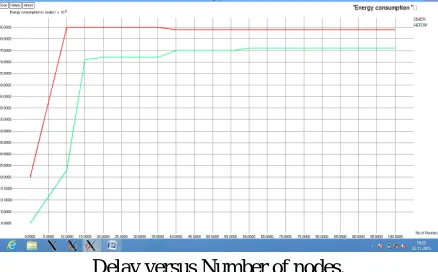
The performance of total number of nodes and energy consumption. The SSSSCT selects the cluster head with better threshold value, connection time, RSSI and minimum control packets overhead. Here, each cluster head selected with the maximum residual energy, coverage distance and less mobility with cluster members.
Delay versus Number of nodes. Fig. 10. Delay versus Number of nodes.
The simulation shows that SSSSCT has minimum delay when compared to the other existing protocols such as CIDT, MBC, CTDGA, CREEC and EEDCP-TB. This is because the SSSSCT offers the shortest path. It can also able to provide a stable link with maximum connection time between cluster members to the sink on each round, which reduces the packet drop ratio and packet retransmissions over the network.
Packet Delivery Ratio versus Speed.
Speed in m/s
Figs. 11. Packet Delivery Ratio versus Speed.
Figs. 11 show that SSSSCT has achieved superior performance when compared to CIDT, MBC, CTDGA, CREEC and EEDCP-TB. From the simulation results, it can be enunciated that the SSSSCT protocol provides a stable link and adopted itself to high mobility. It is observed that the proposed SSSSCT protocol can conserve the sensor node residual energy, prolong the network lifetime and network reliability. In addition, it is adaptable to high mobility environment and provides a better quality communication.
Delay Vs Speed.
[image:9.612.197.416.119.255.2]Technology (IJRASET)
Figs. 12 show that SSSSCT has achieved superior performance when compared to CIDT, MBC, CTDGA, CREEC and EEDCP-TB. From the simulation results, it can be enunciated that the SSSSCT protocol provides a stable link and adopted itself to high mobility. It is observed that the proposed SSSSCT protocol can conserve the sensor node residual energy, prolong the network lifetime and network reliability. In addition, it is adaptable to high mobility environment and provides a better quality communication.
VIII. CONCLUSION
With the growing impact of WSNs on real time civil and military applications, numerous sensor nodes are required to monitor the large-scale areas. Cluster tree is a proficient method to construct suspicious network management architecture. The ultimate goal is to exploit the network lifetime, residual energy, throughput, PDR, and stable link for mobile sensor nodes. In this paper Start-State and Steady-State Cluster Tree(SSSSCT) proposed for mobility-based WSNs, each cluster member chooses the cluster head with better connection time, and RSS. Then, forward the data packets to the corresponding cluster head in an allocated time slot. Consequently, the sink or DCN select the one-hop neighbor DCN or cluster head with the maximum of threshold value, RSS, connection time, and less network traffic. From the simulation results, it is evident that CIDT provides more stable links, throughput, PDR with a reduction of network traffic and a condensed sum of energy utilization than LEACH, HEED, and MBC.
REFERENCES
[1] O. Demigha, W.-K. Hidouci, and T. Ahmed, “On energy efficiency incollaborative target tracking in wireless sensor network: A review,” IEEECommun. Surv. Tuts., vol. 15, no. 3, pp. 1210–1222, Jul. 2013.
[2] J. Yang, B. Bai, and H. Li, “A cluster-tree based data gathering algorithm for wireless sensor networks,” in Proc. Int. Conf. Autom. Control Artif. Intell. (ACAI), Xiamen, China, Mar. 2012, pp. 22–25.
[3] M. R. Saadat and G. Mirjalily, “Efficient convergecast tree for datacollection in wireless sens or networks,” in Proc. 20th Iranian Conf. Elect. Eng. (ICEE), Tehran, Iran, 2012, pp. 1534–1539.
[4] S. Deng, J. Li, and L. Shen, “Mobility-based clustering protocol for wireless sensor networks with mobile nodes,” IET Wireless Sensor Syst.,vol. 1, no. 1, pp. 39–47, 2011.
[5] S. Deng, J. Li, and L. Shen, “Mobility-based clustering protocol for wireless sensor networks with mobile nodes,” IET Wireless Sensor Syst., vol. 1, no. 1, pp. 39–47, 2011.
[6] D. Koutsonikolas, S. M. Das, Y. Charlie Hu, and I. Stojmenovic, “Hierarchical geographic multicast routing for wireless sensor networks,” Wireless Netw., vol. 16, no. 2, pp. 449–466, 2010.
[7] M. Liu, J. Cao, G. Chen, and X. Wang, “An energy-aware routing protocol in wireless sensor networks,” Sensors, vol. 9, no. 1,pp. 445–462, 2009.
[8] K.-W. Fan, S. Liu, and P. Sinha, “Structure-free data aggregation in sensor networks,” IEEE Trans. Mobile Comput., vol. 6, no. 8,pp. 929–942, Aug. 2007
[9] H. Li, H. Yu, and A. Liu, “A tree based data collection scheme for wireless sensor network,” in Proc. Int. Conf. Netw., Int. Conf.Syst.,Int. Conf. Mobile Commun. Learn. Technol. (ICNICONSMCL), Morne, Mauritius, Apr. 2006.
[10] S. S. Satapathy and N. Sarma, “TREEPSI: Tree based energy efficient protocol for sensor information,” in Proc. Int. Conf. Wireless Opt.Commun. Netw. (IFIP), Bangalore, India, 2006.
[11] K. Akkaya and M. Younis, “A survey on routing protocols for wireless sensor networks,” Ad Hoc Netw., vol. 3, no. 3, pp. 325–349, 2005.
[12] M. Ye, C. Li, G. Chen, and J. Wu, “EECS: An energy efficient clustering scheme in wireless sensor networks,” in Proc. 24th IEEE Int. Perform.,Comput., Commun. Conf. (IPCCC), Phoenix, AZ, USA, Apr. 2005.
[13] O. Younis and S. Fahmy, “HEED: A hybrid, energy-efficient, distributed clustering approach for ad hoc sensor networks,” IEEE Trans. Mobile Comput., vol. 3, no. 4, pp. 366–379, Oct./Dec. 2004.
[14] W. B. Heinzelman, A. P. Chandrasekasan, and H. Balakrishnan, “An application-specific protocol architecture for wireless microsensor networks,” IEEE Trans. Wireless Commun., vol. 1, no. 4, pp. 660–670, Oct. 2002.